If you're running a machine shop or industrial manufacturing business, you already know the trap. The plant needs attention today. Quotes need to go out. Lead times need watching. A key customer wants faster turnaround. At the same time, you know your current mix, your current process, and your current marketing system won't carry the business forever.
That tension is exactly where the 3 Horizons Framework becomes useful. Not as theory. As a practical way to separate what you must protect, what you should build next, and what future options deserve real attention before urgency crowds them out.
Table of Contents
- Beyond the Next Quarter Planning for Long-Term Growth
- Diagnosing Your Business with the 3 Horizons Framework
- Putting the 3 Horizons to Work in Your Shop
- How to Implement the 3 Horizons Framework Today
- Measuring Success Across All Three Horizons
- Common Mistakes When Using the 3 Horizons Framework
- Your 3 Horizons Growth Checklist
Beyond the Next Quarter Planning for Long-Term Growth
Most manufacturers don't fail because they stop working. They fail because all their effort gets absorbed by the current system.
That shows up in familiar ways. Engineering spends all its time on customer revisions. Sales pushes the same accounts harder instead of opening adjacent markets. Marketing updates the website but never builds a system that supports future product lines. Leadership talks about innovation, but every planning meeting collapses back into this month's backlog.
The problem isn't laziness or lack of ideas. It's a planning system problem.
Why short-term pressure keeps winning
In manufacturing, today's throughput, quality, quoting, and customer retention are real operational demands. You can't ignore them. But if every decision gets filtered through immediate production pressure, future growth gets treated like an optional project instead of part of the operating system.
That creates a zero-sum mindset:
- Protect the line or fund development
- Serve current customers or pursue new segments
- Fix current marketing gaps or build future demand channels
Those aren't bad questions. They're incomplete questions.
Practical rule: If future work only gets attention when the shop is quiet, it isn't part of strategy. It's leftover capacity.
The value of the 3 horizons framework is that it gives you a structure for handling present and future work at the same time. Instead of asking whether you should focus on current operations or long-term growth, you start asking which activities belong in which horizon, who owns them, and how they connect.
What this changes in practice
For B2B manufacturers, this framework is useful because it translates strategy into a portfolio of operating choices. It helps you defend the current business, test adjacent opportunities, and shape future options without confusing those jobs.
If your leadership team has been wrestling with how to modernize your go-to-market model while protecting existing revenue, this is the same strategic tension behind business model innovation in established firms.
A good planning system doesn't remove trade-offs. It makes them visible. That's why this framework works.
Diagnosing Your Business with the 3 Horizons Framework
The 3 horizons framework works best when you use it as a diagnostic lens, not a slide for a board meeting.
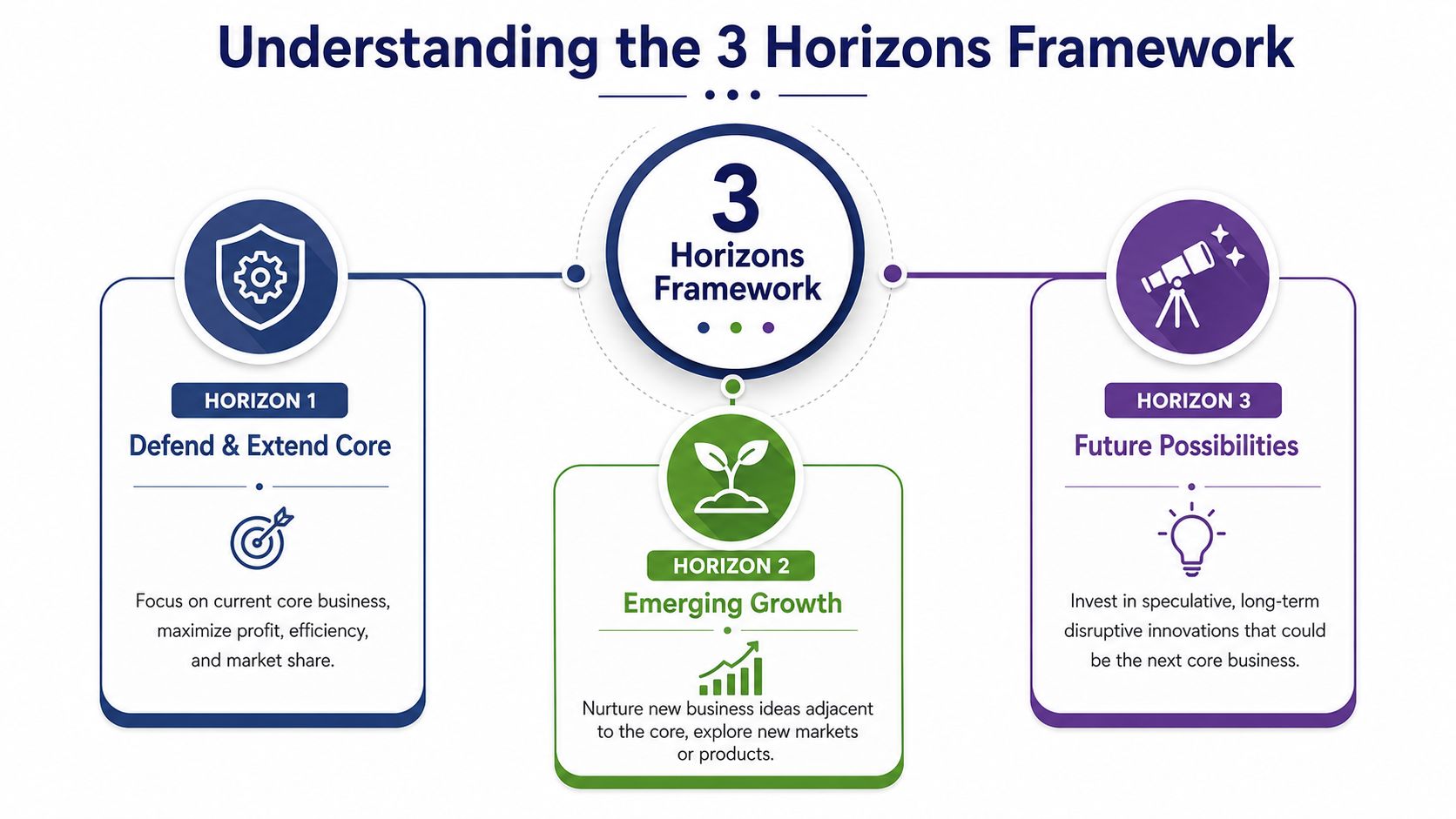
According to Insight and Foresight's overview of Bill Sharpe's Three Horizons, the framework maps Horizon 1 as sustaining the status quo, Horizon 2 as transitional activities, and Horizon 3 as emerging future patterns. The important part is that it isn't sequential. You can and should engage all three at once.
What the model is actually showing you
The framework is typically drawn on axes. Time runs across the horizontal axis. The vertical axis represents value or prevalence, depending on which version of the model you're using.
That matters because the chart isn't saying, "Finish Horizon 1, then move to Horizon 2." It's showing overlapping waves. The current business dominates now. Transitional initiatives gain relevance as the core ages or shifts. Future patterns start small, then become more important if you actively support them.
For a manufacturer, this is useful because your business rarely changes all at once. Your quoting process, production model, customer mix, sales process, and product development pipeline all evolve at different speeds.
A manufacturing analogy that makes it practical
Think about the horizons like this:
| Horizon | Manufacturing example | Strategic intent |
|---|---|---|
| H1 | Optimizing current CNC cells, reducing setup time, improving quoting accuracy | Defend and extend the current business |
| H2 | Retrofitting equipment with sensors, packaging engineering support as a premium service, entering an adjacent vertical | Build transitional growth |
| H3 | Exploring additive manufacturing capability, lights-out production models, or a future service model built around digital monitoring | Create viable future options |
This is why we like using the framework with industrial firms. It fits the way engineers think. Systems have current operating conditions, transitional states, and future design targets.
The biggest mistake is treating all initiatives as if they deserve the same timeline, the same owner, and the same success criteria.
A manufacturer that only funds H1 gets efficient at a model that may be peaking. A company that jumps straight to H3 without a bridge usually creates excitement, then stalls. H2 is where reality meets ambition.
If you're trying to understand where your company sits today, it helps to compare your current strategy against broader business growth stages for established companies. Most firms don't have a growth problem first. They have a horizon-mix problem.
Putting the 3 Horizons to Work in Your Shop
A framework is only valuable if it changes what your team does on Monday morning. For manufacturers, that means mapping real product and marketing work to each horizon.

The failure point is usually mindset. As noted in the Complex Systems Frameworks explanation of Bill Sharpe's model, effective transformation requires managerial, entrepreneurial, and visionary mindsets across the three horizons, and lacking the entrepreneurial mindset in H2 is a primary cause of failed transformations. In plain terms, many shops know how to operate and how to dream, but they don't know how to bridge.
Horizon 1 work that protects the core
H1 is your current engine, housing your existing revenue, reputation, and operational discipline.
For marketing, H1 work often includes:
- Core service SEO: Tighten pages around services you already sell, such as CNC machining, custom fabrication, precision grinding, or contract manufacturing.
- Quote conversion fixes: Improve RFQ forms, response workflows, and sales follow-up so existing demand doesn't leak out of the system.
- Customer proof assets: Build case-page structure, process pages, certifications pages, and capability summaries that help buyers say yes faster.
- CRM hygiene: Clean pipeline stages, enforce follow-up ownership, and standardize handoff from inquiry to estimate.
For product and operations, H1 usually means:
- Throughput improvement: Reduce rework, shorten setup times, and remove recurring bottlenecks.
- Margin protection: Review which jobs are profitable, which customers create operational drag, and which quoting assumptions are out of date.
- Quality system reinforcement: Tighten SOPs, inspection discipline, and revision control.
- Capacity visibility: Improve production scheduling and backlog transparency.
This isn't glamorous work. It's essential work.
Horizon 2 work that builds the bridge
H2 is where most manufacturers are weak. These initiatives are close enough to the current business to be real, but different enough to require experimentation.
Examples on the marketing side:
- Adjacent market campaigns: If you already serve aerospace, test messaging for medical, defense, or electronics enclosures where your capabilities transfer.
- Premium offer packaging: Turn engineering support, prototyping speed, or documentation rigor into a differentiated offer instead of an unpriced extra.
- Account-based outreach: Build focused outbound campaigns for a shortlist of target OEMs or buyer types instead of relying only on inbound.
- Thoughtful automation: Use CRM workflows to segment leads by industry, urgency, or fit, then route them differently.
On the product and commercial side:
- Variant development: Create a premium or specialized version of an existing product for an adjacent buyer.
- Service extensions: Add assembly, kitting, light design-for-manufacturing support, or inventory support where customer demand already exists.
- Technology retrofits: Use sensors, monitoring, or digital reporting to improve service value around existing equipment.
- Channel testing: Explore whether reps, distributors, or direct outreach perform better in a new niche.
H2 requires tighter feedback loops than H1. You are not scaling chaos. You are testing what could become part of the next core.
Field note: If your H2 list is empty, your future is being left to chance.
Horizon 3 work that creates future options
H3 is where you explore what could matter later, even if it doesn't fit current budgeting habits.
For marketing, H3 might include:
- Thought leadership around future manufacturing models: Publish serious content on reshoring, automation, digital traceability, or Industry 5.0 if those topics align with where you intend to go.
- Audience development in emerging categories: Start building visibility with buyers you don't serve yet but may serve later.
- Format experimentation: Test webinars, technical video, or engineering-focused newsletters designed for future positioning, not immediate quoting volume.
For product strategy, H3 can include:
- Advanced process exploration: Investigate additive manufacturing, robotics integration, or more autonomous production models.
- New business model options: Consider whether recurring service, monitoring, digital support, or platform-style offers could fit your future.
- Capability research: Build early technical understanding before the market demands it.
H3 isn't about pretending you know the future. It's about creating informed options so you're not forced into reactive decisions later.
How to Implement the 3 Horizons Framework Today
Most companies don't need another strategy document. They need a process that turns a concept into ownership, capacity, and review.
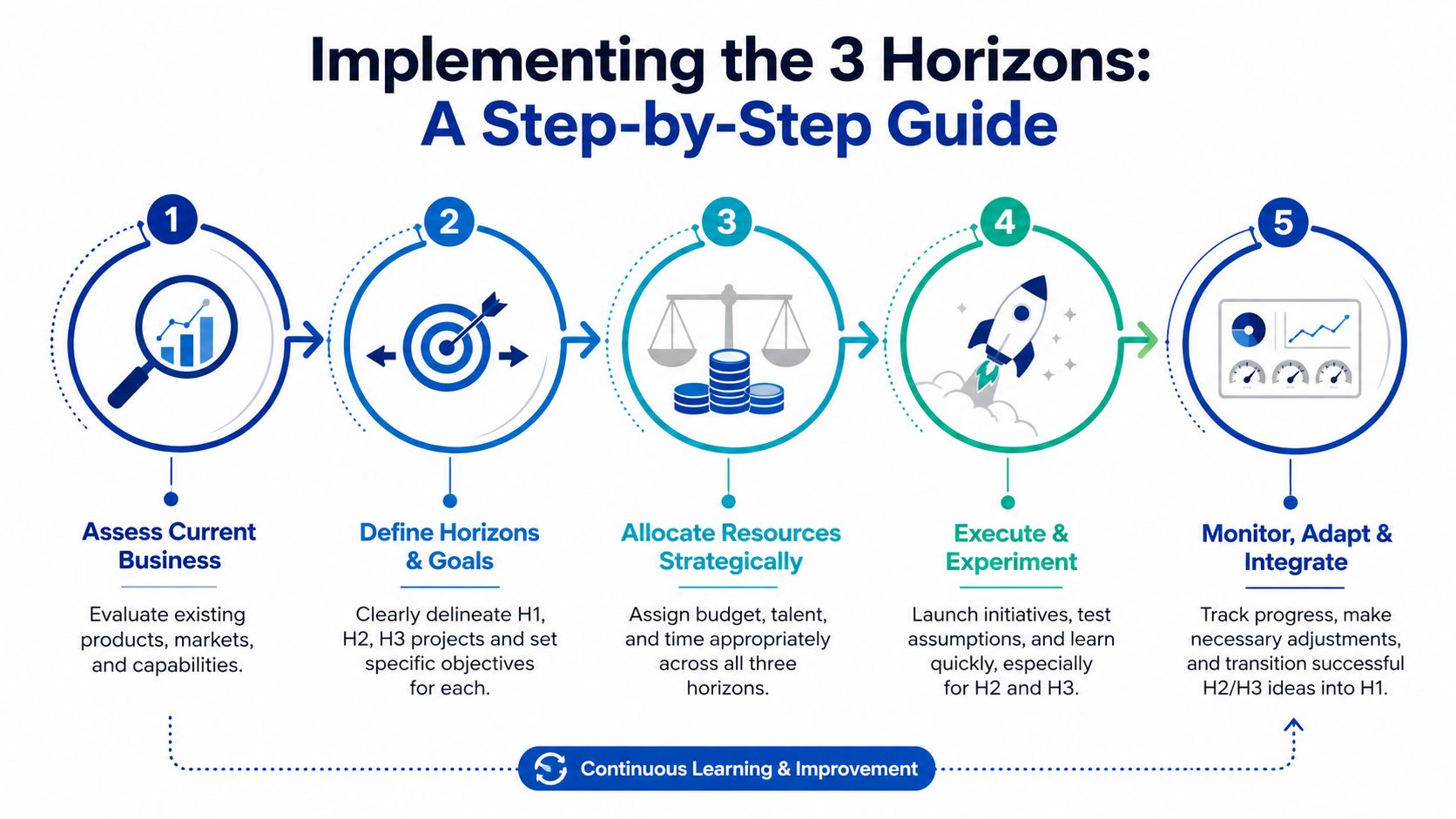
A five-step rollout for manufacturers
Start small, but make it real.
Assemble the right team
Pull in leadership, sales, engineering, operations, and whoever owns marketing execution. If one of those groups is missing, your map will be incomplete. Sales knows where demand is shifting. Engineering knows what's possible. Operations knows what the system can absorb.Audit Horizon 1
Identify what the current business depends on. List the customers, services, channels, products, and operational capabilities that keep the business healthy. Then mark where H1 is strong, brittle, overcomplicated, or overdue for improvement.Define a credible Horizon 3 view
Don't turn this into science fiction. Ask what future state would make strategic sense for your firm. Better automation? Different customer segments? A stronger aftermarket position? A more specialized niche? The point is to describe a future that would be valuable and plausible.
A short video can help your team align on the concept before the workshop:
Build the H2 bridge
This is the hard part. Name the initiatives that move you from current operations toward that future. These should be practical experiments, pilot offers, market tests, technology trials, or commercial shifts. Every H2 initiative should answer one question: how does this help us move from today's model toward tomorrow's model?Assign resources and ownership
Put names, time, and review dates against the work. According to McKinsey's Three Horizons of Growth, successful growth organizations often allocate 60 to 70% of resources to Horizon 1 with a 1 to 3 year ROI horizon, and 10 to 15% to Horizon 3 with a 5 to 10 year ROI horizon, and this balanced approach can lead to 2.5x higher revenue growth. The exact split in your business may differ, but the principle shouldn't. If H3 has no protected resources, it isn't real.
Where resource allocation usually breaks down
Leadership teams often approve future-facing ideas, then reassign the people behind them when H1 pressure rises. That's predictable. It also kills momentum.
A better implementation rule is simple:
- Protect H1 from neglect
- Protect H2 from drift
- Protect H3 from starvation
Use a visible horizon map. Tag every initiative. Review the portfolio as a system, not as a collection of unrelated projects.
Measuring Success Across All Three Horizons
A common mistake is using one scoreboard for everything. That doesn't work.
If you judge exploratory work by the same standards you use for current production efficiency, you will shut it down too early. If you judge your core business with soft innovation language, you'll miss operational problems that need discipline.
Use different scoreboards for different horizons
Here is a practical starter set for manufacturers.
Horizon 1 metrics
H1 should be measured with operational and commercial performance indicators tied to the current business.
- Operational reliability: OEE, scrap trends, on-time delivery, setup reduction, backlog stability
- Commercial efficiency: quote win patterns, cost per lead, speed to first response, close rate by service line
- Customer stability: repeat order behavior, account retention patterns, complaint frequency
Horizon 2 metrics
H2 needs market traction and transition metrics. You are looking for evidence that a bridge is forming.
- Offer adoption: uptake of a new premium service, pilot engagement, repeat interest from the adjacent segment
- Channel proof: quality of meetings from a new outbound motion, response from target accounts, progress by niche
- Operational fit: whether the new offer can be delivered without disrupting the core
Horizon 3 metrics
H3 is about learning, options, and signal quality.
- Learning velocity: what assumptions were tested, what was invalidated, what new capability was gained
- Option creation: number of plausible future bets with a clear next step
- Strategic relevance: whether the exploration aligns with where the business may need to move
Measure H3 by what the team is learning and validating, not by whether it behaves like a mature revenue stream.
If your marketing team is trying to clean this up, it helps to define attribution, pipeline stages, and reporting rules early. A more structured approach to measuring marketing ROI in industrial companies keeps H1 and H2 reporting from getting mixed together.
A practical governance rhythm
Different horizons need different review cadences.
| Horizon | Review style | Primary reviewers |
|---|---|---|
| H1 | Frequent operating reviews | Operations, sales leadership, finance |
| H2 | Structured strategic reviews with pilot decisions | Cross-functional leadership team |
| H3 | Periodic learning reviews focused on options and assumptions | Owner, executive team, strategy group |
The key is consistency. If H2 and H3 only come up when someone has spare time, they will never mature.
Common Mistakes When Using the 3 Horizons Framework
Most failures with the 3 horizons framework aren't conceptual. They're managerial.
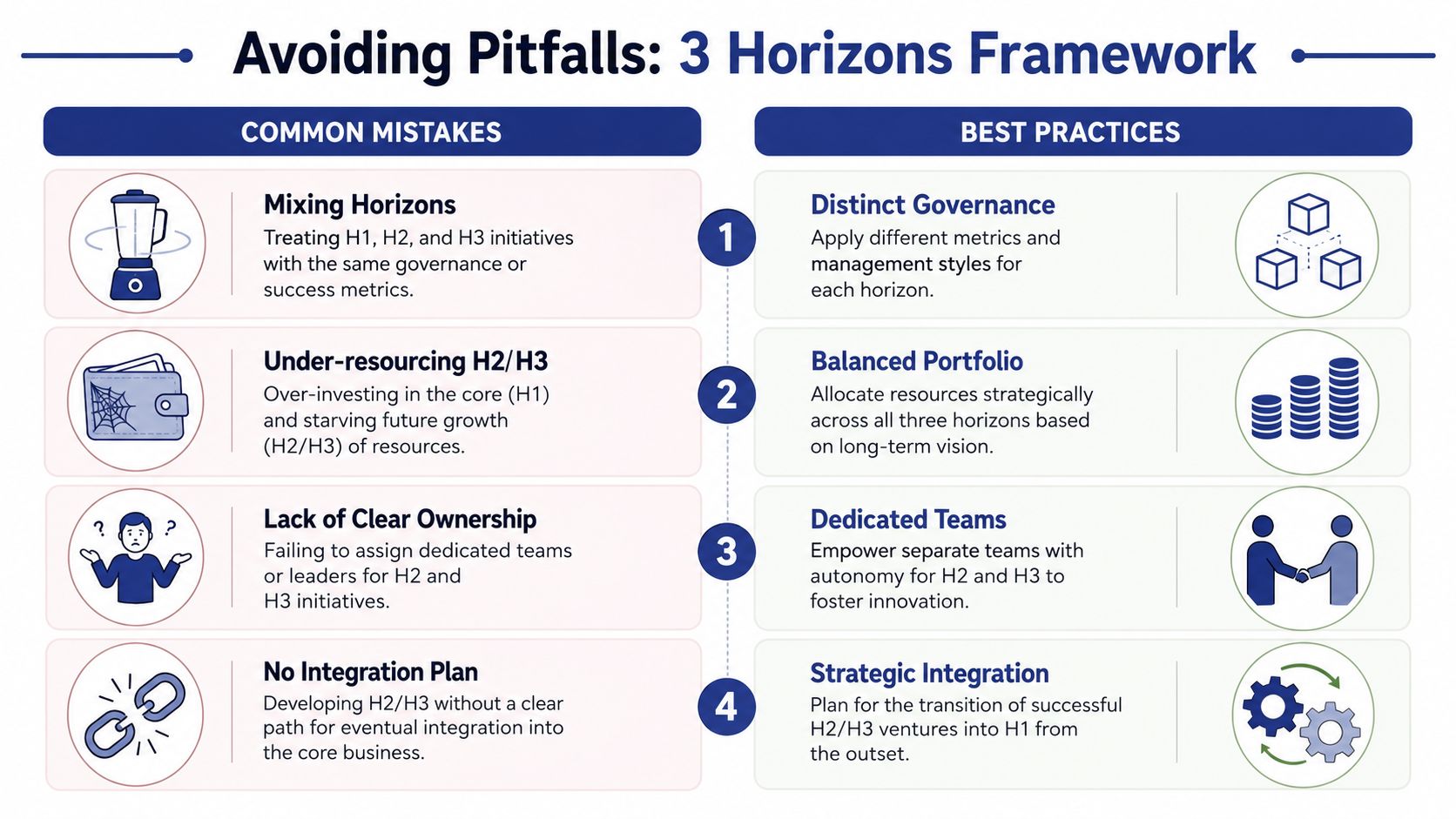
The pattern is usually the same. Leadership likes the model. The workshop goes well. Then the current business pulls everyone back into familiar behavior.
Mistake one Horizon 1 consumes everything
This is the most common failure mode. A big customer issue lands. Capacity gets tight. A hiring gap appears. Future work gets paused "for now" and never recovers.
According to Board of Innovation's explanation of the McKinsey Horizons Model, H2 initiatives often take 2 to 5 years to show results, while H3 ventures can take 5 to 12 years, which naturally creates conflict with quarterly and yearly review cycles. That's exactly why Horizon 1 pressure wins so often.
Ask:
- What keeps getting deferred every quarter
- Which future initiatives lose staff first
- Do we only fund work with immediate visibility
Corrective action: pre-commit capacity and ownership for H2 and H3 before the next operational fire starts.
Mistake two there is no real Horizon 2
Some firms are good at H1 and enthusiastic about H3. They still fail because nothing connects the two.
Signs of an H2 gap:
- Your future vision has no pilot projects
- New ideas skip directly from brainstorm to budget rejection
- No one owns adjacent market experiments
The fix is to create bridge projects with clear commercial or technical purpose. H2 should feel uncomfortable but credible.
Your H2 pipeline should answer one practical question. What are we doing now that could become part of the next business model?
Mistake three innovation theater replaces execution
Innovation theater looks polished. Teams hold workshops, use future-facing language, and mention transformation often. But there is no protected budget, no accountable owner, and no review process.
Diagnostic questions:
- Who owns each H2 and H3 initiative
- What work has scheduled review dates
- Which projects have actual time assigned, not verbal support
Corrective action: turn horizon labels into operating commitments. If an initiative doesn't have an owner, a scope, and a review date, it isn't part of strategy.
Your 3 Horizons Growth Checklist
The strength of the 3 horizons framework is simple. It helps you run today's business without letting today's demands erase tomorrow's options.
For manufacturers, that's not an abstract benefit. It gives you a way to organize marketing, product development, commercial strategy, and operational improvement into one visible system. You stop treating growth as a pile of disconnected ideas. You start treating it as a managed portfolio.
A one-afternoon checklist
Use this checklist with your leadership team, sales lead, and operational lead.
- List your Horizon 1 engine: Write down the services, products, customer segments, and capabilities that currently drive the business.
- Mark current strain points: Identify where the core is healthy and where it is fragile, such as margin pressure, concentration risk, quoting delays, or weak inbound quality.
- Describe one believable Horizon 3 future: Keep it short. Pick a future position that fits your capabilities and market direction.
- Name three Horizon 2 bridges: Choose practical initiatives that could move you toward that future without disrupting the company.
- Assign one owner to each horizon: Shared ownership usually becomes no ownership.
- Set review rhythm: Put H1, H2, and H3 on the calendar with different expectations for each.
- Remove one dead initiative: If a project doesn't fit any horizon, challenge why it exists.
Questions to ask before you finish
- Are we protecting the core or hiding inside it
- Do we have real bridge projects or only wishful thinking
- Are our future bets funded with time and people, or just words
- Do our metrics match the kind of work each horizon represents
A strong strategy doesn't eliminate uncertainty. It gives you a better operating system for dealing with it.
If you complete the checklist and the gaps become obvious, that's progress. Clarity comes before transformation.
If you want help turning the 3 horizons framework into a working growth system for your manufacturing business, Machine Marketing helps industrial companies diagnose the gaps between today's marketing, tomorrow's demand, and the systems needed to connect them.