If your sales team is burning daylight on unqualified leads or watching valuable prospects go cold, the problem isn’t a lack of effort—it’s a system gap. Business to business marketing automation is the engineering solution to that very problem. It's a smart system designed to identify, nurture, and qualify leads around the clock, freeing up your team to do what they do best: close deals.
In this guide, we’ll diagnose the common gaps in B2B marketing systems and share a practical, step-by-step roadmap for building an automation engine that delivers predictable results.
Diagnosing Your B2B Marketing System
Are you struggling to create a predictable flow of sales-ready leads? You’re not alone. We see this all the time—and the root cause is often hidden in plain sight. The real issue is almost always a gap in the handoff between your marketing and sales processes.
Many businesses run on disconnected, manual efforts that let opportunities slip through the cracks. The result is always the same: wasted time, frustrated reps, and inconsistent revenue.
Think of your current process like a pipeline with invisible leaks. You pour time and money into the top, but much of that value never makes it out the other end. The solution is to stop patching individual holes and start engineering a stronger, seamless system.
Identifying the Symptoms of a Leaky System
Does any of this sound familiar? You're likely dealing with a systemic problem if your team is battling these issues:
- Inconsistent Lead Follow-up: Great conversations from a trade show go cold because there's no standard process to keep them warm.
- Sales Team Chasing Cold Leads: Your best closers waste hours on prospects who aren't ready to buy because there’s no qualification filter.
- No Visibility into What Works: You’re spending money on marketing but can’t tell which activities are bringing in qualified opportunities.
- Disjointed Customer Experience: A prospect gets confusing messages because your marketing emails and sales calls aren't aligned.
These aren’t one-off mistakes; they're clear symptoms of a broken workflow. The global marketing automation industry is projected to skyrocket from $6.65 billion in 2024 to $15.62 billion by 2030. This growth is fueled by B2B companies fixing these exact operational leaks. You can dig into these marketing automation statistics to see the trend for yourself.

To make it clearer, let's connect the everyday frustrations you see with the underlying system gaps—and show exactly how automation provides the fix.
Diagnosing Common B2B Marketing System Failures
| Symptom (The Problem You See) | Root Cause (The System Gap) | Automation Solution (The Fix) |
|---|---|---|
| Promising leads "go dark" after initial contact. | Manual Follow-up Failure: No consistent process exists to nurture leads over time. | Automated Nurture Sequences: Send a timed series of targeted emails to keep leads engaged until they're ready to talk. |
| Sales reps complain about wasting time on "tire kickers." | No Lead Qualification: Marketing sends every inquiry directly to sales, regardless of their intent. | Lead Scoring & Grading: Automatically score leads based on their behavior (e.g., website visits) and profile to prioritize the hottest prospects. |
| You can't tell which marketing campaigns are driving revenue. | Disconnected Data: Marketing and sales data live in separate silos, making it impossible to connect the dots. | Closed-Loop Reporting: Integrate your CRM to track a lead from their first click to a closed deal, proving marketing ROI. |
| Prospects get repetitive or conflicting information. | Lack of Centralized Communication: Marketing and sales don't have a shared view of a contact's history. | Unified Contact Record: A single source of truth shows every interaction, ensuring a seamless and personalized experience. |
Seeing your challenges laid out like this makes one thing obvious: these are system problems. The most effective way to solve a system problem is with a system-level solution. That's where marketing automation comes in.
The Core Components of Your B2B Automation Engine
Think about your business to business marketing automation platform as an automated assembly line. Raw materials (new leads) go in one end. They move through a series of precise, automated steps and come out the other side as a finished product: a sales-qualified opportunity, ready for your team to close.
This digital engine is built from several core components that must work together. If you understand how these pieces fit, you can engineer a system that builds predictable revenue.
Capturing and Centralizing Your Leads
First, your automation engine can't process what it can't see. The initial component is a system for capturing every lead and funneling them into one central place.
This means connecting all your lead entry points:
- Website Forms: Contact forms, quote requests, and downloads.
- Landing Pages: Dedicated pages built for specific campaigns.
- Offline Events: A simple way to upload lists from trade shows or networking events.
Without a central hub, leads get lost in spreadsheets and inboxes. By bringing them all together, you create a single source of truth for every potential customer.
Integrating Your CRM for a Unified View
Once a lead is in the system, your automation platform needs to talk seamlessly with your Customer Relationship Management (CRM) system. This integration is the critical bridge connecting marketing activity to sales outcomes.
The automation platform qualifies and nurtures, while the CRM is the sales team's command center. When a lead becomes "sales-ready," their entire history is instantly available to the sales rep. This context helps your team have smarter, more effective conversations. Getting this right is foundational, and professional help with CRM setup and management can make all the difference.
Question to ask yourself: "Do my marketing and sales teams have a single, shared view of a prospect's entire journey, or are they operating from separate records?"
Setting Up Triggers and Workflows
This is where the "automation" really happens. Triggers are the "if-then" rules that power your engine. A trigger is a specific action a lead takes that kicks off a predefined sequence of events, called a workflow.
Here are a few common B2B triggers:
- A prospect fills out a "Request a Demo" form. This could trigger an instant notification to a sales rep and add the prospect to a follow-up email sequence.
- A contact downloads a technical whitepaper. This might trigger a workflow that sends them more educational emails on that topic over the next two weeks.
- A lead hasn't opened an email in 90 days. This could trigger a re-engagement workflow to either win them back or clean them from your list.
Using Segmentation to Deliver Relevance
Finally, segmentation ensures you're sending the right message to the right person at the right time. It’s about dividing your audience into smaller groups based on shared characteristics. Without it, your automation feels robotic.
You can segment B2B contacts using data points like:
- Job Title: A CEO needs a different message than a project engineer.
- Industry: Tailor content for manufacturing clients versus professional services firms.
- Behavior: Group leads who have visited your pricing page separately from those who have only read your blog.
- Lead Score: Automatically group leads once they hit a certain "sales-ready" score.
By building these four components—capture, integration, triggers, and segmentation—you create a powerful business to business marketing automation engine that transforms random interest into structured opportunity.
Building Your B2B Automation Implementation Roadmap
A solid automation system isn’t something you just buy and turn on; it's engineered with a clear plan. Jumping in without a roadmap leads to buying the wrong tools and building clunky workflows. We'll walk through a practical, phased blueprint to help you avoid those mistakes.
This approach moves from big-picture strategy to execution. Each step builds on the last, ensuring your business to business marketing automation engine solves your specific challenges.
Phase 1: Define Your Goals and Diagnose the Problem
Before looking at software, define what a "win" looks like. What specific business problem are you trying to fix? Don't settle for vague goals like "get more leads." Think like an engineer finding a failure point.
Get your team together and ask these direct questions:
- Where's the biggest leak in our sales pipeline? Are we failing to attract prospects, struggling to nurture them, or fumbling the handoff to sales?
- What's the single most time-consuming task our sales and marketing teams do?
- If we could fix one communication breakdown with prospects, what would it be?
Your answers will point you to a clear objective. For example, a manufacturer might realize their biggest headache is following up with leads from trade shows. Their goal isn't "follow up better." It's: "Automate the first 90 days of communication with trade show leads to increase booked sales meetings by 25%." That’s a target you can measure and is especially critical for refining industrial marketing strategies.
Phase 2: Select the Right Tools for the Job
With a clear goal, you can start looking at tools. Your goal cuts through the hype. It’s easy to get distracted by platforms with features you’ll never use. Find the tool that solves your specific problem efficiently.
For most small and midsize B2B companies, a platform that combines CRM and automation, like GoHighLevel (GHL), is a smart move. It eliminates the integration headaches that often derail these projects. A unified system keeps your data clean and gives your team a single, accurate view of the customer.
What to look for: The best tool isn't the one with the most features. It's the one your team will actually use every day. Simplicity and problem-solving focus are key.
Phase 3: Design and Build Your First Workflow
Now it's time to build. Start small. Pick one workflow that directly tackles the goal from Phase 1. Think of this as your pilot program to prove the concept and score an early win.
Let's use our manufacturer example. Their "Trade Show Lead Nurture" workflow might look like this:
- Trigger: A new contact is added to the "Trade Show Leads" list.
- Action 1 (Immediate): Send a personalized "Nice to meet you" email from the sales rep.
- Action 2 (Wait 3 Days): Send a follow-up email with a relevant case study.
- Action 3 (Wait 7 Days): Send a short email asking if they have any initial questions.
- Action 4 (If no reply): Create a task in the CRM for the sales rep to make a personal call.
This isn't complex, but it’s powerful. It’s a logical sequence that ensures no lead falls through the cracks and provides real value without being intrusive.
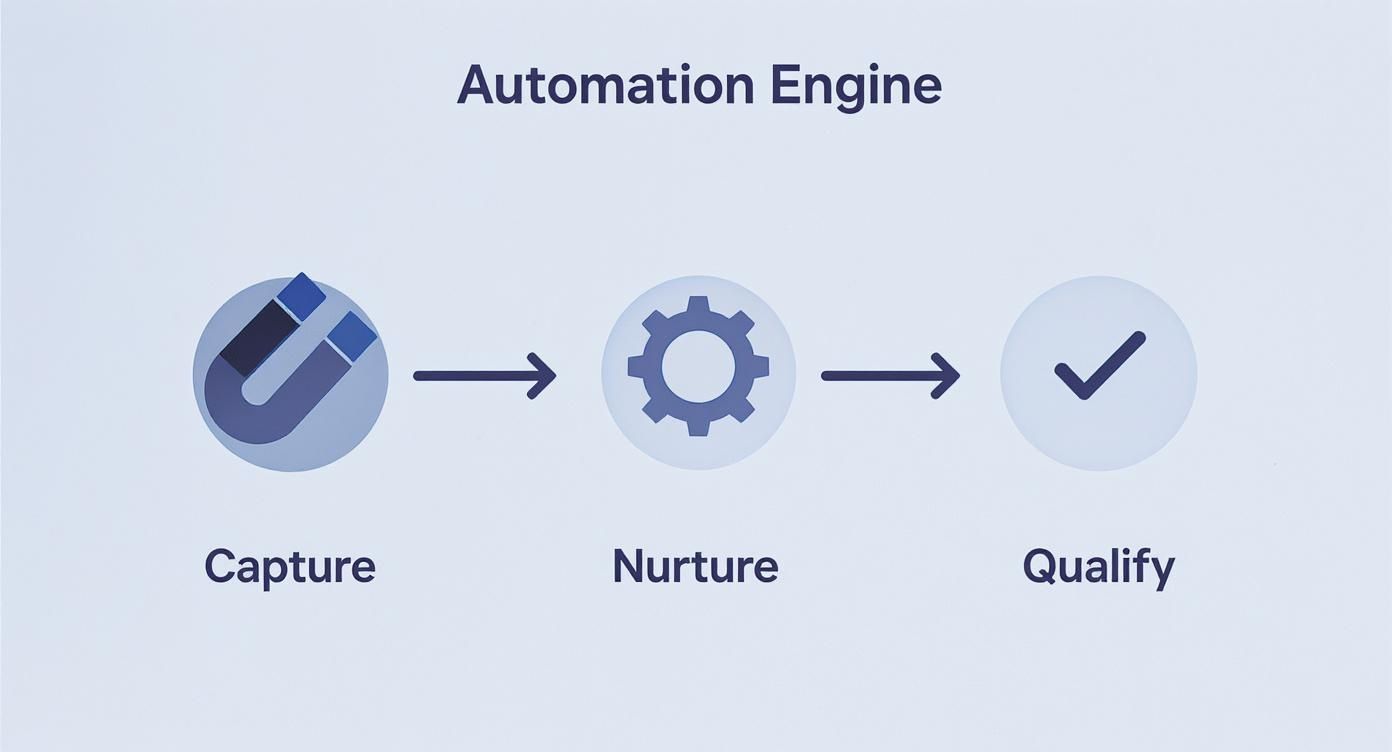
The journey is clear: from a raw lead ("Capture"), to an engaged prospect ("Nurture"), and finally to a sales-ready opportunity ("Qualify").
Phase 4: Establish Your KPIs and Measure Everything
The final piece is measurement. How will you know if your workflow is a success? Define your Key Performance Indicators (KPIs) before you launch.
For our trade show workflow, the essential KPIs would be:
- Email Engagement Rate: Are people opening and clicking the emails?
- MQL to SQL Conversion Rate: How many nurtured leads become "sales-qualified"?
- Meetings Booked: What percentage of leads from this workflow book a sales call?
Tracking these numbers tells you what’s working and what needs tweaking. A recent survey showed that 54% of B2B marketers plan to moderately increase their marketing automation budgets, with another 19% planning a significant increase. Their top priorities? Improving data quality and personalization—two things impossible to achieve without clear KPIs.
By following this four-phase roadmap, you move from a vague idea to a functioning, measurable system. This methodical approach is the key to building a business to business marketing automation engine that creates predictable, sustainable growth.
Practical Automation Workflows You Can Build Today
Theory is great, but let's get practical. To show you what business to business marketing automation looks like in action, we’ve mapped out three high-impact workflows you can adapt for your business.

Think of these as templates. For each, you’ll see the trigger, the automated steps, and the goal. This is how you stop collecting contacts and start building a sales pipeline.
Workflow 1: The Trade Show Lead Nurture
This is a must for any business that relies on in-person events. It solves the classic problem of a stack of business cards going cold. The goal is to systematically turn a handshake into a qualified sales meeting.
- Trigger: You add a new contact to your CRM with the tag "Trade Show 2024."
- Step 1 (Day 1): An email automatically sends from the sales rep who met them, saying it was great to connect.
- Step 2 (Day 4): A second email follows up with a relevant case study or product spec sheet.
- Step 3 (Day 10): A third email asks a simple question: "Did you have any questions after reviewing the material?"
- Step 4 (Day 15): If there's no response, the system creates a task in your CRM for the sales rep to make a personal phone call.
- Goal: Book a discovery call or product demo. This sequence guarantees every lead gets timely, relevant follow-up.
Workflow 2: The Content Download Follow-Up
This workflow is perfect for converting someone who was passively consuming content into an active sales conversation.
- Trigger: A prospect fills out a form on your website to download a guide, like "The Manufacturer's Guide to Reducing Downtime."
- Step 1 (Immediate): The system emails them the guide and gives a heads-up that you'll send more related tips.
- Step 2 (Wait 5 Days): Send a follow-up email with a link to a blog post or video that expands on an idea from the guide.
- Step 3 (Wait 5 Days): Send another email sharing a client success story tied to the guide’s topic to provide social proof.
- Step 4 (Final Email): The last email makes a clear ask: "If reducing downtime is a priority, let's schedule a 15-minute diagnostic call."
- Goal: Turn an anonymous download into a scheduled consultation by providing value first.
Workflow 3: The Cold Prospect Re-Engagement
What about leads in your CRM who went silent months ago? This workflow warms them back up. The goal is to find out if there's any interest left—and either reactivate the lead or clean up your list.
Transparency Note: Getting a "no" or an unsubscribe from a cold lead is also a win. It means your sales team can stop wasting time on dead ends and you can keep your data clean, improving your email deliverability.
- Trigger: A contact hasn’t opened or clicked an email in the last 120 days.
- Step 1: The system automatically adds them to a "Re-Engagement" campaign. The first email asks: "Are you still interested in [Topic]?" and offers fresh content.
- Step 2: If they click the link, they’re removed from the re-engagement sequence and can be added to a different nurture workflow. Their lead score increases.
- Step 3: If they don't engage after a few tries, the system can automatically tag them as "inactive" and archive the contact.
- Goal: Efficiently sift through your database to find hidden opportunities, ensuring your team only spends time on leads showing interest.
Measuring Success and Avoiding Common Pitfalls
How do you know if your automation engine is working? You can't rely on feelings. Launching a business to business marketing automation system without clear metrics is like flying a plane with no instruments—you’re moving, but you don’t know if you’re heading in the right direction.
It's tempting to focus on vanity metrics like email open rates. Those numbers feel good, but they don't pay the bills. To understand your system's performance, track the key performance indicators (KPIs) that connect directly to revenue.
Key Metrics That Actually Matter
Let’s get direct. Your dashboard should focus on a handful of numbers that measure the health of your sales pipeline.
Here’s a checklist of essential KPIs to track:
Essential B2B Marketing Automation KPIs
| KPI | What It Measures | Why It Matters | Calculation/Formula |
|---|---|---|---|
| Lead Velocity Rate (LVR) | The month-over-month growth rate of your qualified leads. | This is a real-time indicator of future revenue. A positive LVR shows your pipeline is growing. | ((# of Qualified Leads This Month – # of Qualified Leads Last Month) / # of Qualified Leads Last Month) x 100 |
| MQL to SQL Conversion Rate | The percentage of Marketing Qualified Leads (MQLs) that sales accepts as Sales Qualified Leads (SQLs). | This is the ultimate test of marketing and sales alignment. A low rate means marketing’s definition of a "good lead" doesn't match sales' reality. | (# of SQLs / # of MQLs) x 100 |
| Customer Acquisition Cost (CAC) | The total cost of sales and marketing to acquire one new customer. | Automation should drive your CAC down over time by improving efficiency. If this number isn't shrinking, your system isn't optimized. | (Total Sales & Marketing Spend) / # of New Customers Acquired |
Keeping an eye on these metrics gives you an honest view of what’s happening. For a deeper dive, check out our guide on [how automation can triple an engineering firm’s ROI](https://machine-marketing.com/boost-your-bottom-line-how-automation-can-triple-your-engineering-firms-roi/).
Diagnosing and Fixing Common Pitfalls
Even with the right KPIs, it's easy to stumble. We see the same mistakes trip up businesses repeatedly. Here’s how to spot and fix them.
1. The Pitfall of Poor Data Hygiene
- Diagnosis: Your automation is only as good as its data. If your contact lists are a mess of duplicates and outdated info, your workflows will fail. Personalization looks sloppy, emails bounce, and your sales team loses trust in the system.
- Solution: Make data hygiene a non-negotiable from day one. Set up strict data entry rules and use automation to clean and standardize information. Schedule regular audits to purge inactive contacts.
2. The Pitfall of Over-Automating Personalization
- Diagnosis: It’s easy to get carried away and automate everything. But relying too heavily on generic merge fields like
[First Name]feels robotic. B2B prospects can spot a mass-produced email from a mile away. - Solution: Use automation for scale but save true personalization for impact. Automate initial follow-ups and data tracking, but create triggers that prompt your sales team to write genuinely personal notes at key moments.
Our advice: The goal of automation isn't to remove the human element. It's to handle repetitive tasks so that your team has more time for meaningful human interactions.
3. The Pitfall of Misaligned Marketing and Sales Teams
- Diagnosis: This is the most common point of failure. If marketing and sales haven't agreed on the definition of a "qualified lead," marketing celebrates MQLs that sales sees as junk. The result is finger-pointing and a broken process.
- Solution: Before building a single workflow, get marketing and sales in a room to create a "Service Level Agreement" (SLA). This document must clearly define the criteria for MQLs and SQLs and the exact handoff process. This alignment is the foundation for success.
Your Next Step: Build Your Marketing Machine
You have the blueprint. You see how to transform your B2B marketing from manual tasks into a predictable growth engine. The secret to making business to business marketing automation work is to start small and be deliberate. Resist the urge to automate everything at once.
Your first move is diagnosis.
Find the single biggest leak in your current system. Where is the real pain? Is it capturing new leads? Qualifying them without wasting sales time? Or just inconsistent follow-up?
Once you’ve identified that one core problem, pick a workflow from this guide and build it as a pilot project. For example, if trade show leads are collecting dust, build that specific nurture sequence first. This focused approach lets you learn the system, prove the concept, and score a tangible win that builds momentum.
That first victory validates the investment and makes it easier to get buy-in for future automation efforts. You’re not just buying software; you’re building a smarter, more scalable way to grow your business.
This is how you stop patching leaks and start building a true marketing machine.
If you’re ready to diagnose the specific gaps in your marketing system, we can help pinpoint the highest-impact place to start. A structured diagnosis is the only way to build the right solution.
Still Have Questions? Let's Clear a Few Things Up.
Even with a plan, business to business marketing automation can bring up questions. We hear the same ones from business owners all the time, so let's tackle them head-on.
What's the Real Difference Between B2B and B2C Automation?
The short answer? The sales cycle.
B2C automation is about the now. It’s built for impulse buys and quick decisions, like abandoned cart reminders. It’s a sprint, designed for high volume and immediate action from a single buyer.
B2B automation, on the other hand, is a marathon. It’s engineered for a long, complex journey with multiple decision-makers and a lot of trust-building. That’s why B2B systems focus on sophisticated lead scoring, deep CRM integration, and strategies that nurture an entire buying committee over months.
How Much Is This Actually Going to Cost?
The price can vary widely. You can start with entry-level tools for around $50–$100 per month, which is perfect for a small business automating its first few campaigns.
As you grow, more powerful platforms like HubSpot or Salesforce's Pardot can run from several hundred to thousands of dollars a month, depending on your number of contacts and feature needs.
The right question isn't "What's the price?" It's "What's the ROI?" A system that costs $500 a month but frees up 20 hours of your sales team's time and boosts lead quality by 25% pays for itself.
So, Does Marketing Automation Replace My Sales Team?
Not at all. This is a common misconception. Automation makes your sales team more human, not obsolete.
Think of it this way: your automation platform is the assistant handling all the repetitive work. It sifts through new leads, sends initial follow-ups, and educates prospects.
By the time a lead gets to your sales team, they're warmed up, informed, and genuinely interested. This frees your people to do what they do best: build relationships, have strategic conversations, and close deals. Automation handles the machine work so your team can focus on the human work.
Ready to stop plugging holes and start building a predictable growth engine? The first step is a clear-eyed diagnosis of where you are now. At Machine Marketing, we build automation systems that drive measurable results.
Let's find out what's possible. Book a discovery call today and we'll start mapping out your plan at https://machine-marketing.com.