Is your marketing system leaking leads? You’re not just imagining it. We see this all the time—companies generate interest, but potential revenue bleeds out from dozens of tiny gaps in their process. The root cause is almost always the same: they lack an engineered system for growth.
In this guide, we'll show you how to diagnose those gaps and share practical steps you can take today to build a marketing machine that captures, nurtures, and converts leads automatically. This isn't just about efficiency; it's about building a predictable engine for your business.
Why Your Marketing System Is Leaking Leads

Does your sales pipeline feel like a rollercoaster? Leads get lost because follow-up is too slow. Messaging is inconsistent. The sales team is drowning in manual tasks. Without a deliberate structure, your marketing and sales efforts are just a collection of disconnected activities.
A killer ad campaign might bring in traffic, but if those new contacts aren't engaged immediately, that initial spark dies out. This is where an engineering mindset changes everything. Instead of just adding more work, you need to diagnose the system's failures and build a machine that works for you.
Diagnosing the Leaks in Your Funnel
Before you can fix the problem, you have to pinpoint where the leaks are. Most business owners can feel the pain of a leaky funnel, but they struggle to name the specific symptoms. Asking the right questions is the first step.
This isn't a new challenge. The global marketing automation market was valued at about USD 6.65 billion in 2024 and is on track to more than double to USD 15.58 billion by 2030. While huge corporations have used these tools for years, small and mid-sized businesses are now the fastest-growing segment. That proves you don't need a massive budget to build a powerful system. You can discover more insights about this growing market trend to see how accessible it has become.
To help you get started, we’ve put together a quick diagnostic checklist based on the most common issues we see.
Your Marketing Automation Diagnostic Checklist
Use this table to quickly identify common pain points in your current process. These are the tell-tale signs that automation can—and will—solve.
| Symptom (The Problem) | Common Cause | How Automation Fixes It |
|---|---|---|
| Inconsistent Lead Quality | No lead nurturing process exists to educate and qualify prospects before they talk to sales. | Automated email and SMS sequences warm up leads with valuable content, filtering out those who aren't a good fit. |
| High Drop-Off Rates | Prospects fill out a form or download a resource, but the follow-up is too slow or non-existent. | Instant, personalized welcome emails and follow-up campaigns engage leads the moment their interest is highest. |
| Overwhelmed Sales Team | Sales reps are bogged down with administrative tasks like logging calls, sending follow-up emails, and scheduling. | Automation handles the repetitive work, freeing up your team to focus on high-value conversations and closing deals. |
| Lost Deals in the Funnel | Long-term prospects who aren't ready to buy today are forgotten and never contacted again. | A "long-term nurture" workflow keeps your brand top-of-mind with periodic, helpful content until the prospect is ready. |
If any of those symptoms sound familiar, you're in the right place. An automated system is the solution.
The core issue is rarely a lack of leads; it's a lack of a system to manage them. Effective marketing automation isn't about sending more emails—it's about creating a reliable, predictable engine for business growth.
By taking this diagnostic approach, you shift from simply "doing marketing" to engineering a specific result. You stop plugging individual leaks and start building a watertight pipeline. The rest of this guide will walk you through exactly how to construct that system, piece by piece.
Map the Customer Journey Before You Automate
Jumping straight into automation software without a clear plan is like trying to build a complex machine without a schematic. The most powerful marketing automation isn't about the software; it’s built on a deep understanding of your customer's path from a curious stranger to a loyal partner.
Before you write a single automated email, you must map this journey. Why? Because this map tells you exactly what content to deliver, when to send it, and what your customer needs to hear at that specific moment. When you get it right, your automation feels like a genuinely helpful, personal conversation.
Defining the Key Stages of the Journey
Every customer's path is different, but they almost always follow a predictable pattern. From an engineering standpoint, we can break it down into distinct stages. Your job is to figure out what each stage looks like for your business.
Let's walk through two real-world scenarios to make this concrete.
Example 1: A B2B Manufacturer of Custom Parts
- Awareness: A production manager is fed up with an unreliable parts supplier causing costly delays. They search Google for "custom metal fabrication services" or "reliable CNC machining partners."
- Consideration: They find your website and download a case study showing how you solved a similar supply chain problem. Now they're comparing your capabilities, lead times, and quality certifications against competitors.
- Decision: They've requested a quote. The decision now boils down to price, your team's responsiveness, and your ability to meet their technical specifications.
- Loyalty: The first order is a success. They are now set up in your client portal with proactive project updates. Later, an automated email asks for feedback on the process.
Example 2: A Local HVAC Service Business
- Awareness: It’s the hottest day of the year, and a homeowner's AC just died. They frantically search for "emergency AC repair near me."
- Consideration: Your business appears with over 200 positive Google reviews. They click to your site and see a bold "Same-Day Service" guarantee.
- Decision: They either call your number or submit your emergency service request form. They chose you because you promised speed and reliability.
- Loyalty: A week after the repair, they get a simple text asking for a review. Six months later, an automated email reminds them to book a furnace tune-up before winter.
See how different those journeys are? The manufacturer needs technical details and case studies. The homeowner needs immediate reassurance and a fast response. Your automation must speak to these completely different needs.
Pinpointing Critical Touchpoints and Questions
Once your stages are defined, identify the critical touchpoints where your business interacts with a potential customer. Then, for each one, ask a simple but powerful question: "What is my customer trying to figure out right now?"
This question forces you to see the world from their perspective.
- At the Awareness stage, they might be thinking, "Do I really understand my problem?" or "Who can help me solve this?"
- During Consideration, the questions get more specific: "Which of these options is the best fit for my situation and budget?"
- At the Decision point, it’s all about confidence: "Am I sure this is the right choice? Will I regret this?"
This approach is the foundation of creating segmented campaigns. In fact, marketers who use segmented campaigns see as much as a 760% increase in revenue. It works because you're answering the exact question on their mind at the right time. You can dig into the full research on how segmentation drives these incredible results.
Your customer journey map is the blueprint for your entire automation system. It's not a 'nice-to-have' exercise; it is the single most important document you will create before you build a single workflow.
By taking the time to complete this mapping process, you stop guessing and start operating from a structured plan. You'll know exactly where a lead is in their journey and what they need from you next. This clarity separates failed marketing automation projects from those that produce predictable, scalable growth.
Practical Automation Recipes You Can Build Today
Now that you have your customer journey map, it's time to bring that strategy to life. This is where we stop planning and start building the actual automated workflows, or "recipes," that will work for you 24/7. Think of each one as a pre-programmed sequence designed to hit a specific business goal.
Below are three high-impact automation recipes we've built for clients again and again. Use them as a framework, but tweak the timing and messaging to perfectly match the journey you mapped out.
This diagram shows the core stages—Awareness, Consideration, and Decision—that your automations will guide people through.
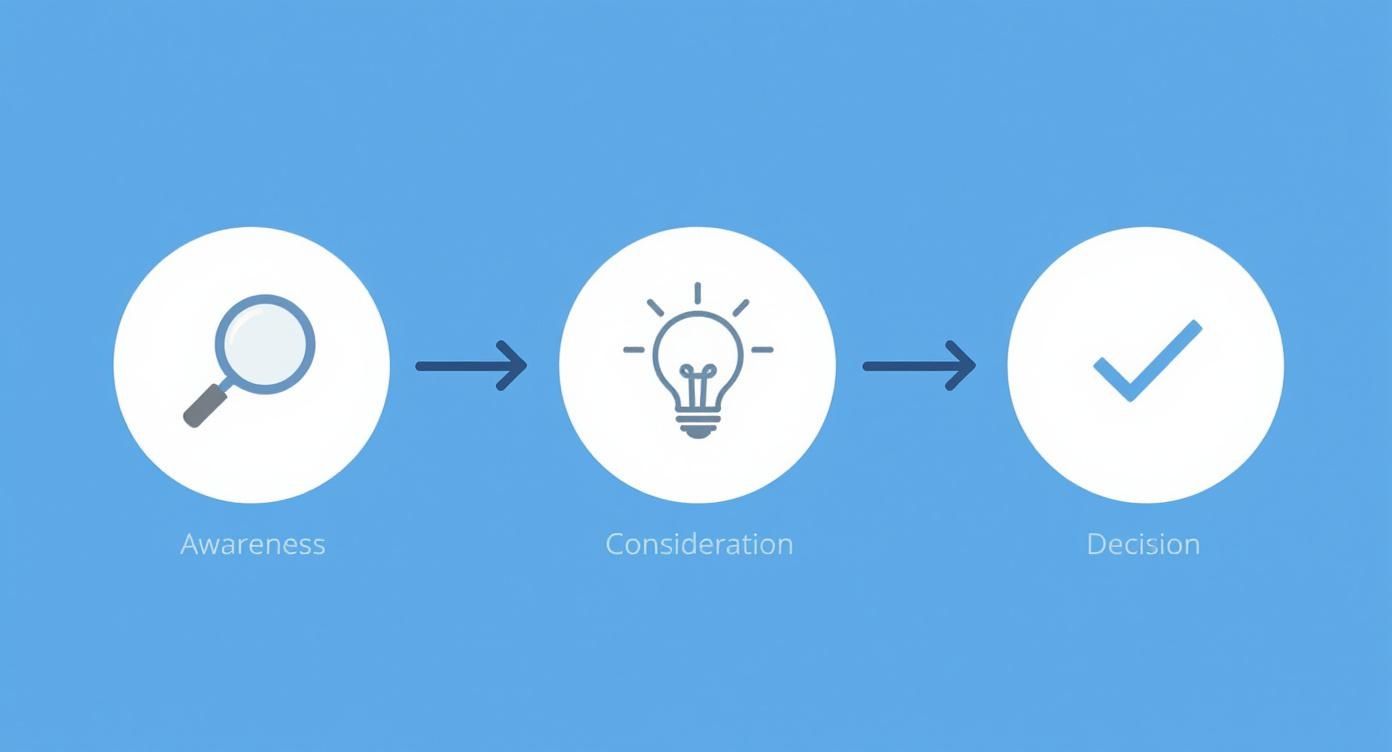
Every recipe you build should be designed to move a contact from one stage to the next, giving them exactly what they need at just the right moment.
Recipe 1: The Welcome and Nurture Series
If you only build one automation, make it this one. It plugs the biggest leak in most marketing funnels by kicking in the second a new lead shows interest—whether they fill out a form, download a guide, or request a quote.
Goal: Immediately engage a new lead, deliver what you promised, and start building a relationship by providing real value.
- Trigger: A contact submits a form on your website (e.g., "Download Our Ebook").
- Action 1 (Immediate): Instantly send an email delivering the resource. This builds immediate trust.
- Action 2 (Wait 2 Days): Follow up with a related resource or a helpful tip, like a relevant case study or a "5 Things to Check" list.
- Action 3 (Wait 3 Days): Send another email that addresses a common pain point and subtly positions your service as the solution.
- Action 4 (Wait 4 Days): Send a final, direct email with a clear call to action, like "Book a 15-Minute Consultation" or "Request a Custom Quote."
Recipe 2: The Long-Term Nurture for Cold Leads
What about leads who go through your welcome series but don't convert? Most companies forget about them. This automation keeps your brand top-of-mind, ensuring you're the first one they think of when they're finally ready to buy.
Goal: Re-engage cold leads over several months with low-pressure, high-value content, making you the obvious choice when their needs change.
- Trigger: A contact is added to a "Cold Lead" list (e.g., 30 days after the Welcome Series ends with no conversion).
- Action 1 (Day 30): Send an email sharing a new blog post or an interesting industry insight. The tone is purely helpful, with no sales pitch.
- Action 2 (Wait 45 Days): Send a different piece of content—perhaps an invitation to a webinar or a link to a useful tool.
- Action 3 (Wait 60 Days): Send a simple "checking in" email. Ask if their priorities have shifted. This can often restart a stalled conversation.
This slow-drip approach is incredibly powerful. The data shows that nurtured leads make 47% larger purchases than non-nurtured leads.
Recipe 3: The Post-Purchase Onboarding and Review Request
Your job isn’t done once the deal is closed. This automation turns new customers into loyal fans by creating a smooth onboarding experience and then strategically asking for reviews.
Goal: Reduce buyer's remorse, boost customer satisfaction, and generate powerful social proof like testimonials and online reviews.
- Trigger: A contact's deal is marked as "Won" or they are tagged as a new customer in your CRM.
- Action 1 (Immediate): Send a "Welcome Aboard!" email. Set expectations for what comes next and thank them for their business.
- Action 2 (Wait 7 Days): Send a quick check-in email to see if they have any initial questions. This shows you care.
- Action 3 (Wait 21 Days): Send an automated email or SMS asking for feedback with a direct link to your Google Business Profile or preferred review site.
These recipes aren't just about sending messages; they're about engineering a customer experience. Each step is designed to build momentum and move the relationship forward, all without you having to lift a finger.
For a deeper dive into workflows specific to industrial and manufacturing companies, check out our guide on business-to-business marketing automation. These templates provide a solid foundation for building a system that generates predictable results.
Choosing Your Tech Stack Without the Headache

The market for marketing automation tools is a jungle. It's crowded, noisy, and easy to get paralyzed by feature comparisons. We’re going to cut through that and give you a practical framework for picking a tool that actually fits your business.
The truth is, powerful marketing automation strategies don’t come from the most expensive software. They come from using the right software for your specific goals. You don't need a spaceship; you need a reliable engine.
Diagnosing Your Core Needs First
Before you look at a pricing page, get clear on your operational reality. The best tool for a local service business is often completely wrong for a B2B manufacturer with a nine-month sales cycle.
Start by asking yourself these clarifying questions:
- Who is my customer? Are you selling to other businesses (B2B) or directly to consumers (B2C)?
- How long is my sales cycle? Does a customer decide in a day, a week, or a year?
- What is my team’s technical comfort level? Be honest. Do you need a simple, drag-and-drop interface?
- What other software must this integrate with? Think about your existing CRM, project management, or accounting tools.
Answering these questions acts as a filter, helping you focus only on solutions that solve your actual problems. For a deeper dive, our complete guide to marketing automation for small business offers a more detailed diagnostic checklist.
All-in-One Platforms vs. Best-in-Class Tools
Your next decision is choosing a path: an all-in-one platform or a custom stack of integrated tools. Neither is inherently better, but they serve different needs and there are trade-offs to consider.
All-in-One Platforms (e.g., HubSpot, GoHighLevel):
These systems aim to be the central nervous system for your marketing and sales.
- Pros: Everything just works together. You get a single source of truth for customer data, one bill, and a consistent user experience.
- Cons: You might have to compromise. The email builder might not be as slick as a dedicated tool, or the landing page editor might feel a bit rigid.
Best-in-Class Integrated Stack (e.g., Mailchimp + Salesforce + Leadpages):
This is the à la carte approach where you pick the absolute best tool for each specific job.
- Pros: You get top-tier functionality in every category, allowing you to build an incredibly powerful, customized system.
- Cons: Integrations can be a headache. They can be fragile, complex to manage, and often cost more in both time and money.
For most small to mid-sized businesses, an all-in-one platform provides 80% of the value for 20% of the headache. The simplicity and reliability of a unified system almost always outweigh the benefits of a slightly better feature in a standalone tool.
Making the Final Call
Once you've diagnosed your needs and picked an approach, your shortlist of potential platforms should be much smaller. Now it's time to demo your top two or three contenders.
When you're in the demo, pay less attention to the sales pitch and more to how intuitive the platform feels. Can you see yourself and your team actually using this day in and day out?
Remember: the tool is not the strategy. Over 75% of marketers are already using at least one automation tool. The advantage no longer comes from just having the tech; it comes from having a clear plan for how you use it.
Measuring What Matters to Prove Automation ROI
So, you've built your automated system. That’s a huge step, but it’s only half the job. If you can't prove it's delivering a real return, it’s just an expensive hobby.
We see too many business owners fixated on "vanity metrics"—things like email open rates or social media likes. Those numbers feel good, but they don't pay the bills. From an engineering perspective, every system needs a dashboard with meaningful gauges. Your marketing automation engine is no different.
Moving Beyond Vanity Metrics
The first step is to shift your focus from activity metrics to outcome metrics. An open rate tells you someone saw your email, not if it generated a qualified sales call.
To prove the value of your automation, you have to measure the metrics that track the entire journey, from a curious prospect to a paying customer.
These are the numbers that actually tell a story:
- Lead-to-Customer Conversion Rate: This is the ultimate test. Of all the leads your system nurtures, how many actually become customers? This single number reveals the health of your entire sales funnel.
- Marketing-Attributed Revenue: How much revenue can you directly trace back to a specific automated campaign? A well-configured CRM connects a closed deal to the marketing touchpoints that got it there.
- Sales Cycle Length: Is your automation shortening the time it takes to close a deal? Shrinking your sales cycle from 90 to 60 days is a massive win for your cash flow.
- Cost Per Acquisition (CPA): As your system gets more efficient, your cost to acquire a new customer should drop. This is pure efficiency in action.
Zeroing in on these KPIs is what separates guessing from knowing. It's how you can confidently say, "Our automation system generated $50,000 in new business last quarter." For a deeper dive, our article on how automation can triple your engineering firm's ROI breaks down the financial impact.
Using A/B Testing to Engineer Better Results
Once you're tracking the right metrics, you can start fine-tuning the machine. A/B testing is your best tool here. It’s a simple concept: create two versions of a single element—like an email subject line—and see which one performs better.
Don't overcomplicate it. Start with simple, high-impact tests:
- Subject Lines: Test a straightforward subject line (e.g., "Your Guide to X") against a question (e.g., "Struggling with X?").
- Call to Action (CTA): Does "Request a Quote" outperform "Book a Consultation"? You won't know until you test.
- Timing: Is a two-day follow-up better than a three-day one? Let the data decide.
- Message Format: Try a simple, plain-text email against a version with more images and branding.
The point of testing is continuous improvement. A small 5% lift in conversion from one A/B test can compound into serious revenue growth over a year.
The data backs this up. Companies that dial in their automated nurturing see a staggering 451% increase in qualified leads. That kind of jump doesn't happen by accident. It comes from systematically filtering and preparing prospects—a process you refine through constant measurement. You can discover more insights about these powerful findings and see how this relentless optimization pays off.
Your Top Marketing Automation Questions, Answered
We’ve dug into the strategy, the tech, and the numbers. Now, let’s get straight to the questions we hear all the time from business owners who are considering automation. Our goal is to cut through the noise and give you the real-world answers you need.
Is This Going to Be Too Expensive for My Business?
This is always the first question, and thankfully, the answer has changed. It used to be that only enterprise-level companies could afford this kind of technology. Not anymore.
But the real way to think about it isn't the monthly fee. It's the cost of not doing it.
If an automation tool saves your team 20 hours of manual work a month and helps you land just one more client this year, has it paid for itself? Absolutely. The hidden costs of lost leads and wasted time almost always dwarf the price of the software. A good automation system isn't a cost; it's an investment.
Will This Make Our Marketing Feel Robotic and Impersonal?
It's a fair question. We've all received bad, generic automation, and it feels awful. But that's not what we're talking about here.
Bad automation is impersonal. Great automation is the opposite—it's hyper-personal.
The whole point of a solid marketing automation strategy is to use what you know about a person—like the specific page they visited or their industry—to send them something that's actually relevant. Instead of a generic blast, you can send an email that references the exact case study they just downloaded.
When you do it right, automation is the only way to deliver personal, one-to-one communication at scale. It’s how you can have thousands of relevant "conversations" at once, something no human team could ever manage manually.
How Long Does It Take to Actually See Results?
You'll feel the impact in two different waves, and it's important to track both.
Wave One: The Immediate Efficiency Boost (Weeks 1-4)
- This happens almost right away. Within the first month of getting your core automations running, you'll free up time. No more manually sending welcome emails or logging follow-ups. Your team will feel that relief instantly.
Wave Two: The Revenue and Growth Impact (Months 1-6+)
- This timeline depends on your sales cycle. If you're a local service business with a one-week sales cycle, you could see a lift in conversions within the first quarter. If you’re a B2B manufacturer with a nine-month cycle, you'll first see leading indicators improve—more qualified leads, more meetings booked—before the revenue number ticks up.
The key is to track both your efficiency gains and your revenue metrics from day one.
If We Can Only Build One Thing to Start, What Should It Be?
Great question. If you're wondering where to get the biggest bang for your buck right out of the gate, the answer is almost always a "New Lead Welcome & Nurture" sequence.
Think of this as your digital first impression. It kicks in the second someone fills out a form on your site.
It must do a few crucial things:
- Instantly deliver what they asked for (the guide, the quote, etc.).
- Introduce your brand and set expectations for what's coming next.
- Follow up with 3-5 genuinely helpful emails over the next two weeks to build trust and demonstrate expertise.
This one automation plugs the biggest leak in most marketing funnels: failing to engage with interested people the moment they show interest. It’s the bedrock of the whole system.
Ready to stop leaking leads and start building a predictable growth engine? At Machine Marketing, we specialize in diagnosing your unique challenges and engineering a marketing automation system that delivers real results.
If you’re ready for a clear roadmap and an expert partner to help you execute it, book a discovery call today.