If you’re sinking time and money into email marketing only to see your open rates flatline, you’re missing real opportunities to connect with customers and drive business. We see this all the time—and the root cause is often hidden in plain sight.
The problem usually isn't just one bad subject line. It’s often buried in technical details or overlooked strategies that stop your emails from ever getting a fair shot in a crowded inbox.
To fix this, we need to diagnose the system, not just treat the symptoms. Before you can think about clever copy or irresistible offers, you have to ensure your emails are technically sound and seen as trustworthy by gatekeepers like Gmail and Outlook. In this article, we’ll show you how to diagnose gaps in your email system and share practical steps you can take today to start seeing results.
The Three Pillars of a Healthy Open Rate
Think of your email's journey as passing through three critical gates. If it fails at any one, your open rate tanks. Simple as that.
-
Pillar 1: Getting Delivered. This is the technical foundation. Your sender reputation and email authentication protocols (SPF, DKIM, and DMARC) are non-negotiable. Get these wrong, and email providers will flag you as spam before your subscribers even see your message.
-
Pillar 2: Getting Noticed. This is your first impression. Once your email lands in the inbox, it's competing with dozens, sometimes hundreds, of others. Your sender name, subject line, and preheader text are the only tools you have to grab their attention and earn the open.
-
Pillar 3: Staying Relevant. This is where knowing your audience pays off. Blasting a generic message to your entire list is a surefire way to get ignored. Personalization and segmentation ensure you're sending the right message to the right person at the right time, giving them a reason to keep opening your emails.
Questions to ask yourself: Is a sudden drop in open rates pointing to a deliverability issue? Or is a slow, steady decline a symptom of tired subject lines or a lack of relevance to your audience? Diagnosing the pattern is the first step.
The fight for inbox attention is more intense than ever. Recent data shows the average email open rate across all industries has climbed to 42.35%, which tells us that marketers who get their strategy right are winning.
Just personalizing a subject line with a recipient's name can lift open rates by up to 26%. This drives home a critical point: the one-size-fits-all approach is dead. You can dig into more of these email benchmarks on HubSpot’s blog.
Email Open Rate Diagnosis Checklist
When open rates dip, it's easy to jump to conclusions. Is it the subject line? The time of day? This quick checklist will help you diagnose the most likely culprit based on the symptoms you're seeing, so you can focus your efforts where they'll make the biggest impact.
| Symptom You Are Seeing | Potential Root Cause | Where to Look First |
|---|---|---|
| A sharp, sudden drop in open rates across all campaigns (e.g., from 30% to 5%). | Deliverability Issue | Check your SPF/DKIM/DMARC records. Review your domain's reputation with tools like Google Postmaster Tools. |
| Consistently low open rates (under 15%) for a long period. | List Health & Reputation | Run a list hygiene process to remove inactive or invalid emails. Check for any recent spam complaints. |
| Open rates are okay, but click-through rates are very low. | Relevance & Offer | Your subject line got them in, but the content didn't deliver. Review your email copy, call-to-action (CTA), and offer. |
| Certain segments have great open rates, while others are terrible. | Segmentation Mismatch | The message isn't resonating with the low-performing segment. Re-evaluate your segmentation criteria and content for that group. |
| Open rates slowly decline over several months. | Audience Fatigue / Content | You might be sending too frequently or your content has become stale. A/B test new subject line styles and content formats. |
By starting with a clear diagnosis, you avoid wasting time on fixes that don't address the core problem. This systematic approach is the fastest way to get your open rates back on track.
Building a Bulletproof Deliverability Foundation
Before you even think about writing a killer subject line, your email has to pass a much more basic test: actually landing in the inbox. Many business owners jump straight into creative copy, completely unaware that their emails are being flagged as suspicious and routed directly to the spam folder.
Getting this technical foundation right isn't just a "nice-to-have." It's everything.
Think of it like building a house. You wouldn't frame the walls on a cracked, unstable foundation. In email marketing, that solid ground is your sender reputation, and the tools you use to build it are called authentication protocols.
This funnel breaks down the journey every single email takes. It all starts with getting delivered.
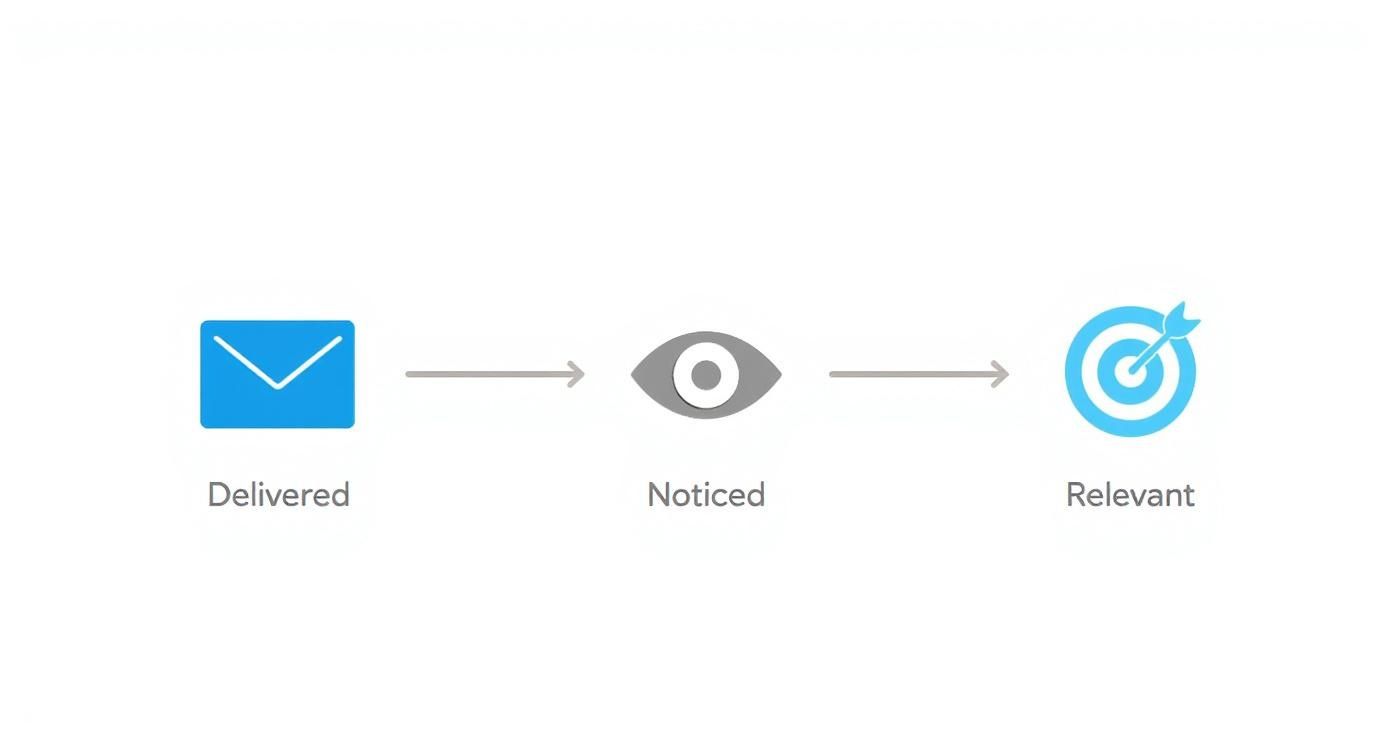
If you fail at the 'Delivered' stage, nothing else matters. The most brilliant email in the world is useless if no one ever sees it. That’s why we always start our diagnosis here.
Understanding Email Authentication Protocols
Are your emails coming from a legitimate, verified source? Mailbox providers like Gmail and Outlook are constantly asking this question. Authentication protocols are simply your way of proving the answer is "yes, this is really from me."
You’ve probably seen the acronyms floating around: SPF, DKIM, and DMARC. Let's cut through the jargon.
- SPF (Sender Policy Framework): This is like a public guest list for your domain. It tells the internet, "Only emails coming from these specific servers are authorized to send on my behalf." Anything else should be viewed with suspicion.
- DKIM (DomainKeys Identified Mail): Think of this as a digital, tamper-proof seal on your email. It adds a unique signature that the receiving server can check to make sure the message wasn't altered after it left your server.
- DMARC (Domain-based Message Authentication, Reporting & Conformance): This is the policy that ties the other two together. It tells mailbox providers what to do if an email fails the SPF or DKIM check—you can tell them to let it through anyway, quarantine it, or reject it outright.
You don't need to be a coding genius to get this done. Most modern email platforms, like GoHighLevel, have simple guides to help you set up these records correctly in your domain settings.
What to look for: Use a free tool like MXToolbox to check your domain's SPF, DKIM, and DMARC records. If you see errors or warnings, that’s a major red flag and the very first thing you need to fix. It's likely torpedoing your deliverability.
The Crucial Practice of List Hygiene
Your sender reputation isn't just about technical setups. It’s also judged by the quality of your email list. If you're constantly sending to a list bloated with inactive, invalid, or fake addresses, you look like a spammer to the algorithms. It’s a huge negative signal.
Keeping your list healthy isn't a one-and-done task; it's an ongoing discipline. A clean list means you're only emailing people who actually want to hear from you, which is the surest path to higher open rates.
Here’s the SOP we stick to for maintaining a clean and engaged list:
- Validate New Subscribers: Use a verification service right at the point of sign-up. This catches typos (like
gnail.cominstead ofgmail.com) and burner addresses before they ever poison your list. - Monitor Bounces and Complaints: Look at your campaign reports. A high bounce rate (emails that failed to deliver) or a spike in spam complaints are direct hits to your reputation. Don't ignore them.
- Implement a Sunset Policy: This is just a system for pruning unengaged subscribers. If someone hasn't opened an email from you in 90 days, it’s time to move them out. You can try a last-ditch re-engagement campaign, but if that fails, remove them. Be ruthless.
A smaller, highly engaged list will always outperform a massive, unengaged one. The goal is to build a community that looks forward to your emails, not just a database you blast messages at. This mental shift separates pros from amateurs and is key to improving your open rates for good.
Crafting Subject Lines That Demand a Click
If your deliverability is the foundation, your subject line is the front door. It’s the single most important piece of copy you'll write for any email campaign. If the subject line doesn't earn the click, all the time you spent on the email's content is wasted.
Too many business owners treat subject lines as a last-minute task—a huge mistake. Your customer's inbox is a battlefield, packed with meeting reminders, internal updates, and dozens of other businesses vying for attention. Your subject line gets just a few seconds to argue why your email is the one worth opening right now.

The Art of the Subject Line
Writing a great subject line is part science, part psychology. You're not just describing what's inside the email; you’re tapping into human triggers like curiosity, urgency, and the desire for a solution. While there's no single magic formula, a few proven approaches give you a massive head start.
Here are a few frameworks we use all the time:
- Benefit-Driven: Stop talking about your product and start talking about their problem. Instead of "Our New CNC Machine," try "Cut Production Time by 15% with the New X-Series."
- Curiosity Gap: Pique their interest without giving away the whole story. "The one tool our top clients can't live without" is way more compelling than "Check out our latest software."
- Urgency/Scarcity: Give them a reason to act now. "Your 20% discount expires Friday" creates a real deadline and a clear consequence for waiting.
- Social Proof: People trust what other people are doing. "Join 500+ manufacturers who upgraded their systems" builds instant credibility.
The golden rule is to always write from your reader’s perspective. Constantly ask yourself: "What’s in it for them?" If the answer isn't obvious from the subject line, go back to the drawing board.
Don’t Neglect the Preheader
Right next to or underneath your subject line is a snippet of text called the preheader. Most marketers ignore it, which means the email client just pulls in the first line of text from the email—usually something boring like, "View this email in your browser."
This is a massive missed opportunity.
Think of the preheader as your second subject line. It’s extra real estate to provide context, add a compelling detail, or continue the story you started in the subject line.
A strong subject line and preheader work as a team. For example:
-
Subject Line: A question for our local partners
-
Preheader: We're hosting a free workshop to help you…
-
Subject Line: Your Q3 production report is ready
-
Preheader: See how your output compares to last year's benchmarks.
This one-two punch gives your reader a much stronger reason to engage, which is absolutely critical for improving email open rates.
Optimize for the Mobile Experience
These days, your subject line has to work on a tiny screen. With over 41.9% of all emails being opened on mobile devices, you can’t afford to ignore it. A long, rambling subject line will get cut off, and your message will be lost. For a deeper dive into these trends, check out the latest email engagement statistics from The Frank Agency.
A good rule of thumb is to keep your subject lines under 50 characters. This keeps the core message visible on almost any device. Before you hit send, always use your email platform’s preview tool to see exactly how it will look on a phone.
Common Subject Line Mistakes to Avoid
Knowing what not to do is just as important as knowing what to do. Certain habits will get your emails ignored or, even worse, flagged as spam.
Here are a few landmines to watch out for:
- AVOIDING ALL CAPS AND EXCESSIVE PUNCTUATION!!! It looks unprofessional, feels spammy, and is a classic filter trigger.
- Using misleading prefixes like "Re:" or "Fwd:" Tricking someone into opening your email is a surefire way to destroy trust and rack up spam complaints.
- Making vague or generic statements. "July Newsletter" tells me nothing. Give me a reason to care about what's inside.
- Overusing buzzwords or jargon. Speak like a human. Your goal is clarity, not trying to sound clever.
Writing great subject lines is a skill that gets better with practice. The next step is to start testing these different angles to find out what really connects with your specific audience.
Using Personalization to Boost Engagement

Sending the same generic email blast to your entire list is a surefire way to land in the trash folder. If you've ever felt like your open rates are stuck in a rut, a lack of relevance is almost always the culprit. Your subscribers are busy, and a one-size-fits-all message doesn't cut through the noise.
This is where personalization and segmentation become your secret weapons. We're talking about more than just dropping a [First Name] tag into the subject line. True personalization means using what you know about your audience to send them content that feels like it was written specifically for them. It’s the difference between shouting into a crowd and having a genuine one-on-one conversation.
The results speak for themselves. A well-executed personalization strategy can bump up open rates by as much as 26% compared to generic campaigns. In fact, marketers who get serious about segmenting their lists consistently see their open rates climb, as detailed in these email open rate statistics from SuperOffice.
Going Beyond the First Name
Real personalization is fueled by data. Your CRM is likely sitting on a goldmine of information you can use to create powerful audience segments. The entire goal is to group subscribers based on shared traits or behaviors so you can speak directly to their needs.
Forget having one giant "newsletter" list. Think smaller and smarter.
- Purchase History: Group customers by what they've bought. Someone who just ordered a specific machine part has different needs than a client who bought a comprehensive maintenance package.
- Website Behavior: See what pages they visit on your site. A prospect who keeps returning to your "Custom Fabrication" page is a hot lead for that exact service.
- Engagement Level: Split your most active readers from the folks who haven't opened an email in 90 days. Each group needs a totally different approach.
You wouldn't use the same opening line on a brand-new acquaintance that you would on a long-time client. Your email strategy needs that same social awareness.
Practical Segmentation for Your Business
Let’s make this real. How can a local service business or a B2B supplier actually put this into practice? You don't need a complex system to get started.
Example for a Local HVAC Company:
- Segment 1 – "Installation Leads": Anyone who downloaded your "Buyer's Guide to New AC Units."
- Email Content: Send them case studies of recent local installations, info on financing options, and a clear CTA to book a free estimate.
- Segment 2 – "Service Reminder": Customers whose last tune-up was about 11 months ago.
- Email Content: A simple, friendly reminder that it's time for their annual service, with a direct link to your online booking calendar.
Example for a B2B Parts Supplier:
- Segment 1 – "High-Volume Buyers": Customers who purchase over a certain dollar amount each quarter.
- Email Content: Offer them exclusive access to new product previews, special loyalty discounts, and the direct contact info for their dedicated account manager.
- Segment 2 – "Inactive Customers": Clients who haven't ordered in over six months.
- Email Content: Send a "We miss you" offer, a quick survey asking for feedback, or an update on new inventory that’s relevant to their past purchases.
Setting Up Simple Automations
The best part? You can put this on autopilot. Using a CRM like GoHighLevel, you can build simple "if-then" rules that trigger these personalized emails automatically.
For example, you can create an automation that adds a user to your "Installation Leads" segment the second they download your buyer's guide. This kicks off a pre-written email sequence designed to nurture that specific lead, delivering hyper-relevant content at the perfect time. It's a hands-off system that builds trust and seriously improves your email open rates.
By treating your email list like a collection of individuals instead of a faceless monolith, you’ll build a more profitable and engaging communication channel. For a deeper dive into leveraging your contact list, check out our guide on database email marketing.
Testing and Optimizing Your Send Strategy
Boosting your email open rates isn't about finding a single silver bullet. It's a game of inches, won through a constant process of tweaking and refining. If you're just guessing or blindly following generic "best practices," you're leaving money on the table. The only way to figure out what truly clicks with your audience is to test, measure, and adjust.
This is where a solid A/B testing framework makes all the difference. Sometimes called split testing, it’s a simple concept: you send two slightly different versions of an email to small, separate groups from your list to see which one performs better. The winner gets sent to everyone else.
The golden rule? Only change one variable at a time. If you test a new subject line and a new sender name in the same email, you'll have no idea which change actually caused the bump in opens.
Building Your A/B Testing System
You don't need a complex or expensive setup to get started. Most modern email platforms have A/B testing tools built right in, making it incredibly simple to run experiments. Your goal is to create a feedback loop where every campaign gives you data to make the next one even smarter.
Here’s a straightforward SOP for testing:
- Start with a Hypothesis: Frame it as a simple question. "I believe a subject line that asks a direct question will get more opens than a statement."
- Isolate One Variable: Pick the single element you're going to test. For open rates, the biggest levers are the subject line, preheader text, sender name, and send time.
- Run the Test: Send Version A to a small slice of your list (say, 10%) and Version B to another equal-sized slice.
- Analyze the Winner: Give it 4-24 hours and see which version got a statistically significant higher open rate. Your email software will usually declare a winner for you.
- Deploy and Document: Send the winning version to the remaining 80% of your list. And this is crucial: write down what you learned. Over time, these notes will paint a very clear picture of what your audience responds to.
A common trap is calling a test too early or using a sample size that’s too small to be meaningful. You need enough data to make a confident call. Let the test run for at least a few hours to give people a chance to see it.
What Should You Actually Be Testing?
When you’re trying to move the needle on open rates, not all tests are created equal. You need to focus your energy on the elements that make that critical first impression in a crowded inbox.
Here are a few practical ideas to get your gears turning.
Effective A/B Testing Ideas for Open Rates
| Variable to Test | Example A | Example B | Why It Matters |
|---|---|---|---|
| Subject Line Angle | "Your Q3 Production Report is Here" | "A question about your Q3 production" | This helps you learn if your audience is more motivated by direct information or by curiosity. |
| Sender Name | "Karl at Machine Marketing" | "The Machine Marketing Team" | Does your list respond better to a personal, human touch or a more official company name? This test will tell you. |
| Personalization | "A new tip for your business" | "John, a quick tip for [Company Name]" | This measures the real-world impact of using dynamic personalization tags beyond just the classic {{first_name}}. |
| Send Time | Tuesday at 10:00 AM | Thursday at 2:00 PM | This is how you stop relying on generic industry advice and find the exact day and time your specific list is most active and likely to open. |
Finding Your Perfect Send Cadence
Testing isn't just about what you say; it's also about when and how often you say it. While you might read reports claiming Tuesday mornings are the "best" time to send, the manufacturing reps on your list might have completely different inbox habits.
Start by digging into your past campaign data. Look for patterns. Are there certain days or times that consistently get higher engagement? Use that as your baseline for A/B testing send times.
The same logic applies to your sending frequency. For some subscribers, a weekly email feels just right. For others, a monthly digest is more than enough. Sending too often leads to email fatigue and unsubscribes, but sending too rarely means they might forget who you are. The right business-to-business marketing automation system can help you schedule these tests and analyze the results without manual busywork.
By adopting this engineering mindset—hypothesize, test, analyze, and repeat—you can turn your email marketing from a guessing game into a predictable engine for growth.
Your First Action Step
We've diagnosed the causes of low open rates and outlined the solutions. Now, it’s time to build a system that works. The biggest killer of progress is feeling overwhelmed, so we’re going to focus on one deliberate step that builds real momentum.
First, ask yourself some honest questions. Don't just assume everything is fine. Is your list hygiene automated? When was the last time you checked your SPF and DKIM records? The answers will point you straight to your biggest opportunities for a quick win.
Your Essential Checklist
Don't try to boil the ocean. Pick just one of these to tackle this week.
- Audit Your Foundation: Pop your domain into a free online SPF and DKIM checker. This is step zero.
- Segment Just One Audience: Create one simple segment. A great starting point is grouping customers who haven't bought anything in the last six months.
- Run Your First A/B Test: Test one simple thing, like using a question versus a statement in your subject line.
- Clean Your List: Find every subscriber who hasn't opened an email in 90 days. Send them one single re-engagement campaign. If they still don't open it, it's time to let them go.
Quick Win Template: The "Are You Still There?" Email
Subject: A quick question for you, [First Name]
Body: Hey, it's been a while since we've seen you. We're working to make our emails more valuable and wanted to ask—what would you actually like to see from us?
If you're no longer interested, no hard feelings at all. You can unsubscribe with one click below.
Focusing on one small improvement at a time is how you build a stronger, more effective email machine. It's about consistent, smart moves that compound over time, not one giant leap. For more ideas on list building, see our guide on growing your list of contacts with proven tactics for manufacturers.
Try this step next: Pick one item from that checklist. Just one. Commit to getting it done this week. That’s how you start seeing real transformation.
Common Questions Answered
Even with the best playbook, you're bound to run into questions once you start digging in. Here are some of the most common things we hear from business owners who are getting serious about their email marketing.
What Is a Good Email Open Rate?
Everyone wants a magic number, but a “good” open rate is simply one that’s getting better over time. While the global average hovers around 35% to 40%, that number can be misleading. It changes dramatically based on your industry and how engaged your audience is.
A niche B2B manufacturer sending targeted updates will almost always see higher open rates than a broad retail store blasting out a generic sale. The only metric that truly matters is your own. Your goal should be to beat your last campaign's performance, not some universal benchmark.
How Can I Improve My Subject Lines?
To get someone to open your email, your subject line has to accomplish one of three things: create a sense of urgency, spark genuine curiosity, or promise a clear benefit. Personalization is your best friend here—and not just using [First Name]. Reference their past behavior, like, "Still thinking about that drill press?"
You absolutely have to A/B test your ideas. You might be shocked to discover that a straightforward, no-fluff subject line like "Your Q3 Production Report" crushes a clever, more creative one. Let the data tell you what your audience actually wants.
The best subject line feels like it was written for one person, not a massive list. Clarity and relevance will always win against cleverness.
Why Are My Emails Going to Spam?
If your emails are consistently landing in the spam folder, it's rarely just one thing. The most common culprits we see are a damaged sender reputation, missing email authentication (SPF and DKIM are non-negotiable), or using classic spam trigger words like "free" or "act now."
But one of the biggest factors is simply low engagement. When a huge chunk of your list never opens your emails, inbox providers like Gmail and Outlook take that as a massive red flag. Regularly cleaning your list to get rid of inactive subscribers is one of the most powerful things you can do to protect your reputation and stay out of the spam folder.
If you're ready to stop guessing and start building a reliable email system that actually drives business, the team at Machine Marketing is here to help. We build and manage the marketing systems that get you unstuck and ready to scale. Book a discovery call with Karl today to get a clear diagnosis and a practical roadmap for growth.