Are you using social media but not getting any real leads? You’re not alone. Many businesses post consistently but see no measurable return. The problem isn't the platform; it's the lack of a system.
In this guide, we'll diagnose the common failure points in using social media for lead generation. We'll give you a step-by-step framework to turn your social channels from a content chore into a predictable engine for business growth.
Building Your Lead Generation Foundation
If your social media isn't bringing in leads, the problem is almost always foundational. Too many businesses jump straight to posting, hoping for the best. It’s like trying to build a house without a blueprint. The result? Wasted time, sporadic results, and the feeling you’re shouting into the void.
Before creating a single post, let's engineer the groundwork. We need to diagnose what success actually looks like for your business.
Define Your Goals and Ideal Customer
First, we need to replace vague hopes with specific, measurable outcomes. "More leads" isn't a goal; it's a wish. An engineered goal sounds like this: "Generate 20 qualified sales calls per month from LinkedIn." See the difference? Now you have a clear target to aim for and measure against.
Just as critical is dialing in your Ideal Customer Profile (ICP). This goes beyond basic demographics. You need to understand their world.
To build a social strategy that works, you have to know your audience’s challenges, motivations, and where they spend their time online. Without that clarity, your content will never connect.
Questions to Ask Yourself
To diagnose your current strategy and sharpen your focus, answer these questions about your ideal customer:
- What are their biggest professional pain points? What problems keep them up at night that you can solve?
- Which social media platforms do they actually use for business? Are they seeking professional insights on LinkedIn or discovering tools in Facebook Groups?
- What kind of content do they find valuable? Are they looking for quick video tips, in-depth guides, or detailed case studies?
- What language do they use to describe their problems? Ditch industry jargon and use their words in your posts and ads.
Answering these questions gives you the blueprint for your system. This foundation ensures every piece of content you create and every dollar you spend is strategically aimed at generating real business. According to Social Media Examiner, 66% of marketers generate leads from social media by dedicating just six hours per week to it. That efficiency only comes from a solid plan. For more on this, check out our deep dive into social media marketing.
Crafting Content and Offers That Convert
Your social media feed is a strategic asset, but only if every post serves a purpose. Too many business owners just "post to post." It's like revving an engine without a transmission—you make noise, but you don't go anywhere.
The single most important goal of your social content system is to turn passive scrollers into active leads.
This process starts with a simple yet powerful idea: provide value before you ask for anything. Your audience is bombarded with sales pitches. To cut through the noise, you must solve a small, specific problem for them first. This simple act builds trust and positions you as a helpful expert, not just another vendor.
For example, a manufacturing consultant could post a quick video detailing "Three Common Calibration Errors and How to Fix Them in Under 5 Minutes." That's immediately useful, establishing credibility from the start.
Develop Lead Magnets People Actually Want
A lead magnet is the specific, valuable offer you provide in exchange for contact information. It's the bridge connecting your free social content to your sales process. The secret is creating something so useful your ideal customer would have considered paying for it.
Avoid generic, low-effort offers. Instead, diagnose a specific pain point your audience has and build a targeted solution.
- Checklists: A "Pre-Audit Safety Checklist" for a compliance consultant.
- Templates: A "Monthly Content Calendar Template" for a marketing agency.
- Mini-Guides: A "5-Step Guide to Reducing Material Waste" for a process engineer.
- ROI Calculators: An interactive tool to help a prospect estimate their potential savings.
These work because they are practical, actionable, and tied directly to a business outcome your ideal customer cares about.
Engineering High-Converting Posts
What does a post that converts look like? It blends a value-first approach with a clear, compelling call to action (CTA). It doesn’t just share information; it guides the reader toward a specific next step. This becomes even more powerful when you use authentic video.
Research shows that 86% of consumers bought something based on an influencer's recommendation last year. This highlights how much authentic, human voices drive action. You can see more on the latest lead generation trends on socalnewsgroup.com.
Let's walk through a real-world example for a B2B software company:
- The Hook: Start with a probing question: "Are you still manually reconciling invoices at month-end? Here's why that's costing you more than you think."
- The Value: Offer three quick, actionable tips right in the post—like using batch processing or specific software filters—to provide immediate help.
- The Bridge (CTA): Smoothly transition to the lead magnet: "We built a free spreadsheet template that automates this entire reconciliation process. Grab your copy at the link in our bio."
This structure works because it solves a small problem upfront, then offers a tool to solve the bigger one. Once you’ve captured that lead, you can continue the conversation with targeted follow-ups. To learn what to do with those new leads, see our guide on email campaign best practices.
Designing and Launching Paid Social Funnels
Organic reach has a ceiling. If you're serious about creating a predictable stream of leads, you can't leave it to the algorithm. It’s time to build a paid social media funnel—a system engineered to guide a complete stranger from casual scroller to qualified lead.
Many business owners we talk to are hesitant about paid ads. The fear is always the same: "What if I waste my budget?" The solution isn't spending more; it's spending smarter by building a simple, effective funnel that does the heavy lifting for you.
The core process is straightforward: solve a specific problem, capture interest with a compelling offer, and convert that interest into a real lead.
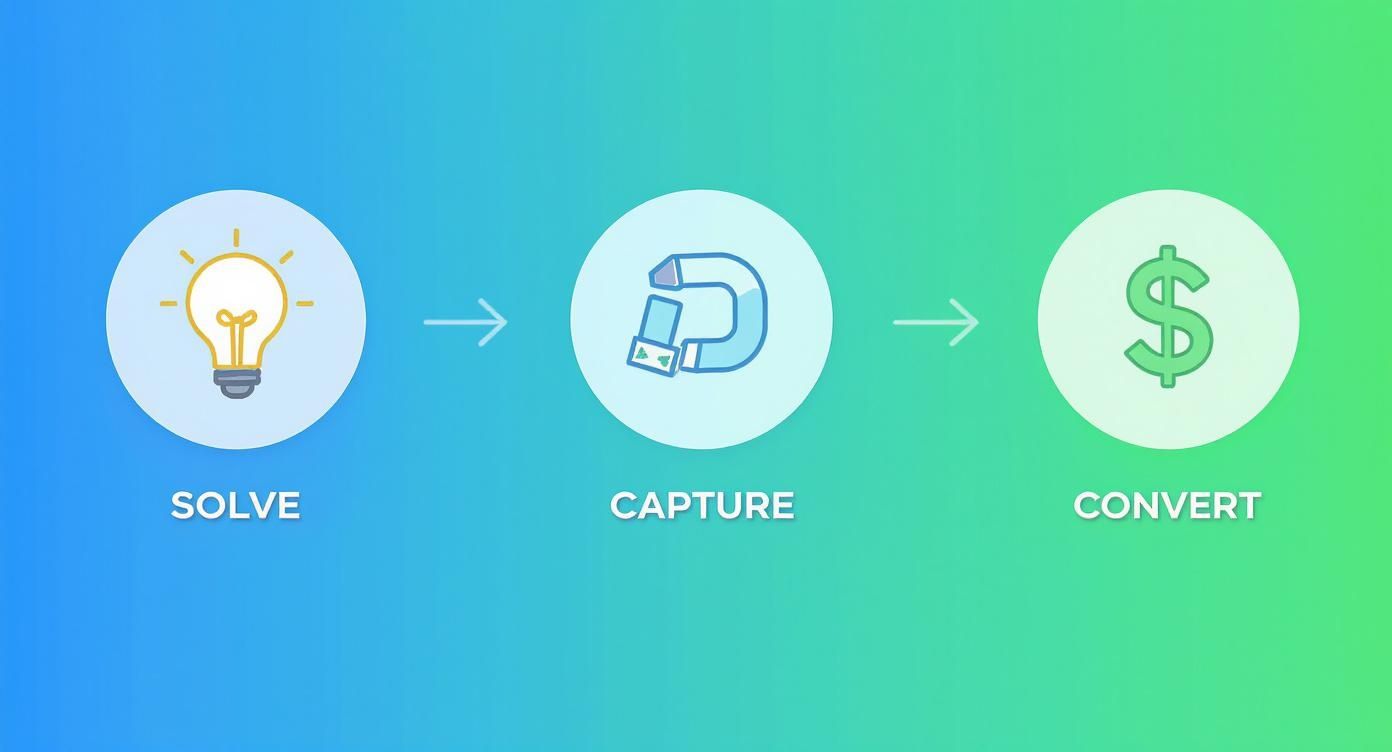
This three-step flow is the backbone of any paid campaign that works, ensuring every dollar you spend is tied directly to a business goal.
Structuring Your First Paid Campaign
Let's break down the components of a basic but powerful funnel. You don't need a complex multi-step sequence to get started. All you need is a clear path for your ideal customer to follow.
Your first campaign needs just three core pieces:
- The Ad: This is your hook. Its one job is to grab the attention of your ICP by speaking directly to a pain point. Use clear, direct copy and an eye-catching image or a short, punchy video.
- The Offer (Lead Magnet): This is the value exchange. Your ad should promote the high-value checklist, template, or guide you already created. It’s the reason they'll click.
- The Landing Page: This is where the conversion happens. Keep it simple: a headline matching the ad, a few bullet points reinforcing the benefits, and a simple form to collect their contact info. That's it.
One of the most common mistakes we see is sending paid traffic to a website's homepage. A dedicated landing page with a single goal—capturing the lead—will almost always outperform a general website page because it eliminates distractions.
Targeting Your Ideal Customer
This is where paid social truly excels. The targeting capabilities on platforms like Facebook and LinkedIn are incredibly powerful, allowing you to ensure your ad budget reaches the right people.
When building your audience, start by layering these options:
- Demographics: This is especially powerful on LinkedIn for B2B. You can target by job titles, company size, or specific industries.
- Interests: On Facebook, you can zero in on users who follow industry leaders, belong to relevant groups, or have shown interest in your competitors.
- Behaviors: You can even target based on online behaviors, such as identifying users who are small business owners or early adopters of new technology.
Don't target everyone. A smaller, highly relevant audience will always deliver a better Cost Per Lead (CPL) than a broad, unfocused one. Pick a specific segment of your ICP and start testing with a budget around $25–$50 per day. The initial goal isn't profit; it's to gather data. Once you find a winner, you can confidently scale what’s proven to work.
Integrating and Automating Your Lead Flow
Getting a lead from social media is the starting line, not the finish. The real work begins the moment they hit "submit."
One of the first issues we diagnose with new clients is the "leaky bucket"—that costly gap between a lead showing interest and your team following up. Any delay kills the momentum you just paid to create, and your ad spend goes down the drain.
What happens in the first five minutes after a prospect fills out your form determines whether you have a real opportunity or just another contact gathering dust. This is where a seamless, automated system becomes essential for growth.
Connecting Social to Your CRM
Your social media efforts can't live on an island. They must plug directly into your CRM (Customer Relationship Management) tool. Platforms like HubSpot or GoHighLevel act as the central nervous system for your marketing operation, making sure no lead ever slips through the cracks.
The goal is a clean, instant handoff.
When someone downloads your guide from a Facebook Ad, their info should appear in your CRM immediately, with zero manual data entry. This simple connection creates a single source of truth for every lead.
Here's a look inside the GoHighLevel dashboard. You can see how conversations, opportunities, and automated workflows are all managed from one central hub.
When all your lead data is centralized, you can see the entire customer journey and trigger the perfect follow-up at the right time.
Setting Up Instant Follow-Up Sequences
Speed is your greatest advantage. A lead's interest is at its peak the moment they engage. An automated follow-up sequence—sent via email or SMS—is how you capitalize on that interest before it fades.
The core principle is simple: Engage every lead instantly and consistently. Automation isn’t about being robotic; it's about delivering a perfect, prompt response every time, even when you're busy.
Here’s a basic but effective follow-up workflow you can build:
- Immediate Delivery: The instant a lead submits their info, an automated email or text fires off. This message delivers what you promised (e.g., "Here's the checklist you requested!") and sets expectations.
- Value-Add Follow-Up (Day 2): Send a second email offering another helpful tip related to the original topic. This reinforces your expertise without being pushy.
- Soft Call-to-Action (Day 4): The third message can gently introduce your core service. Invite them to a no-pressure consultation if they feel ready for the next step.
Building out systems like this is what separates stalled businesses from scalable ones. We dive deeper into these concepts in our complete guide to marketing automation strategies. This approach turns your social media lead generation from a manual chore into a reliable, self-sustaining machine.
Measuring Performance and Optimizing Your System
What you don't measure, you can't improve. Launching a social media campaign without tracking results is like driving blindfolded. You feel like you're moving forward, but you don't know if you're headed in the right direction. This is where we stop guessing and start engineering a predictable, profit-generating machine.
It’s easy to get distracted by vanity metrics—likes, shares, and follower counts. They feel good, but they don’t pay the bills. We must cut through the noise and zero in on the Key Performance Indicators (KPIs) that directly impact your bottom line.
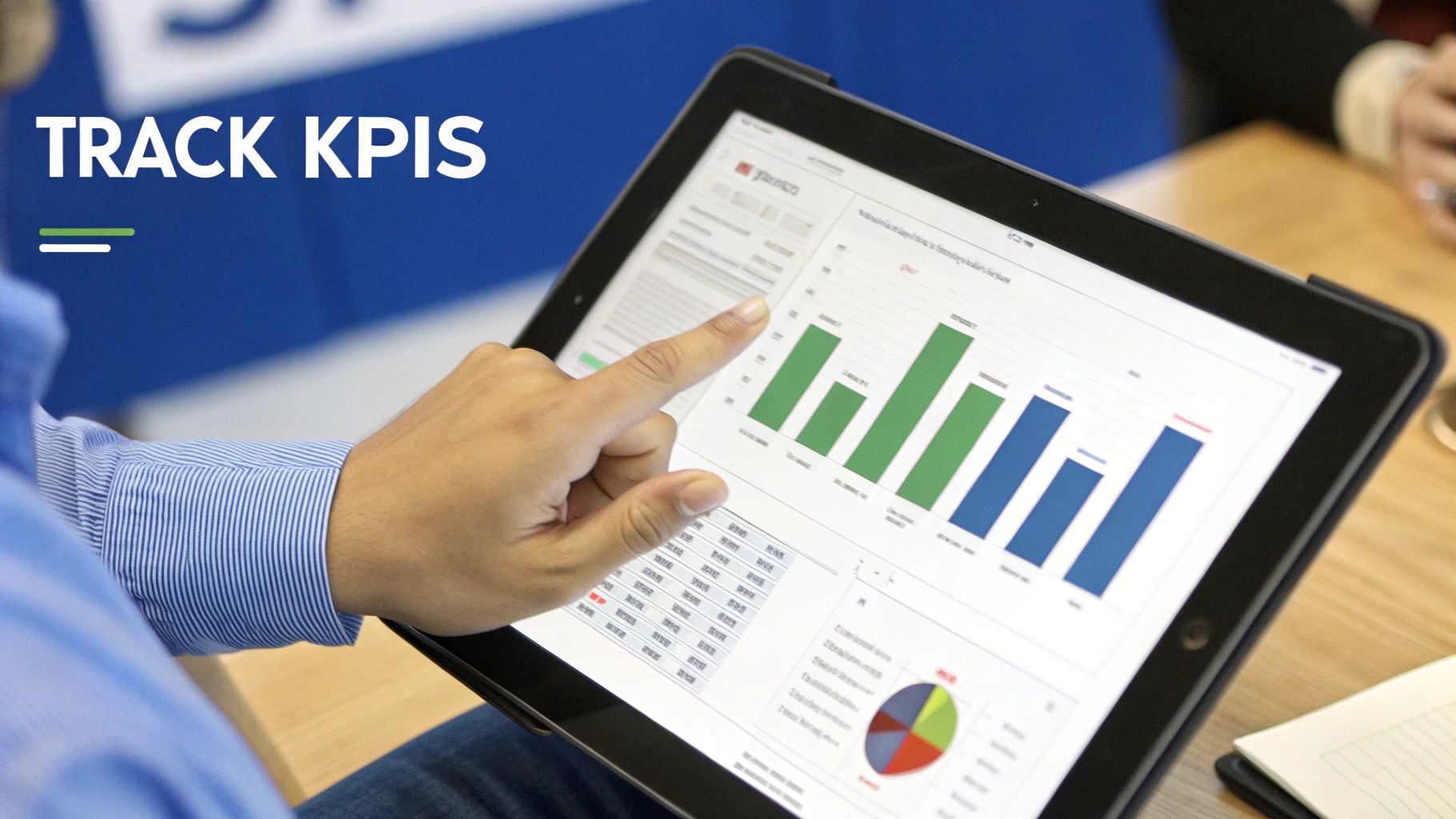
Identifying the KPIs That Actually Matter
Your goal isn't to track every data point. That's a recipe for overwhelm. Instead, focus on a handful of metrics that tell the real story of your campaign’s health.
Here's what you should be watching:
- Cost Per Lead (CPL): This is your north star. It tells you exactly how much you're paying for one new lead. If your CPL is rising, it could mean your ad targeting is off or your offer is no longer compelling.
- Lead-to-Customer Conversion Rate: This measures how many leads become paying customers. If this number is low, it’s a red flag that there's a problem in your sales or follow-up process, not necessarily your ads.
- Return on Ad Spend (ROAS): This is the ultimate measure of profitability. For every dollar you put into ads, how many dollars in revenue are you getting back? A ROAS below 1.0 is a clear sign you're losing money.
The most successful campaigns aren't built on luck. They are systematically improved by watching the data, forming a hypothesis, and testing that hypothesis relentlessly.
To get a clearer picture, here’s a breakdown of the essential metrics and what they mean for your business.
Essential Lead Generation KPIs and Benchmarks
| Metric (KPI) | What It Measures | Why It's Important | Good Benchmark |
|---|---|---|---|
| Cost Per Lead (CPL) | The average cost to acquire a single new lead. | Your primary efficiency metric. A low CPL means your front-end is working. | Varies by industry, but aim for < $50 for B2B. |
| Conversion Rate | The percentage of visitors who take a desired action (e.g., fill out a form). | Shows how compelling your offer and landing page are. | Landing Pages: 10-15%+ |
| Click-Through Rate (CTR) | The percentage of people who see your ad and click on it. | Indicates if your ad creative and copy are grabbing attention. | Social Ads: 1-2% |
| Return on Ad Spend (ROAS) | Total revenue generated for every dollar spent on advertising. | The ultimate profitability metric. Tells you if your ads are making money. | 3:1 is solid; 5:1 is excellent. |
| Lead-to-Customer Rate | The percentage of leads that become paying customers. | Measures the effectiveness of your sales and follow-up process. | Aim for 10%+ (B2B). |
These benchmarks are starting points. Your own numbers are your best guide, but this provides a solid baseline to work from.
A/B Testing Your Way to Better Results
Once you have your core KPIs, it’s time to optimize. A/B testing is simply running two slightly different versions of an ad or landing page to see which performs better. It’s a disciplined way to make small improvements that lead to massive wins over time.
The key is to test only one variable at a time—the headline, the image, the button color—so you know exactly what caused the change in performance.
What to Test for Maximum Impact
- Ad Creative: Pit a video ad against a static image. A raw, authentic video of you explaining the offer might outperform a slick, polished graphic.
- Ad Copy: Try a question-based headline against a statement. For instance, "Struggling with cash flow?" versus "The Ultimate Guide to Managing Cash Flow."
- Landing Page Headline: Test a benefit-driven headline like, "Cut Your Invoicing Time in Half," against a feature-driven one like, "Our New Automated Invoicing Software."
- Call to Action (CTA): Even a few words can make a huge difference. See what gets more clicks: "Get Your Free Guide" or "Download Now."
Start by building a simple performance dashboard. Track your key metrics weekly. When you see a number you don't like—like a rising CPL—don't see it as a failure. See it as a signal. The data is telling you exactly where to look to diagnose the problem and test a solution. This loop of measuring, diagnosing, and optimizing is how you turn social media into a reliable system for growth.
Your Top Questions, Answered
Over the years, we've heard the same questions from business owners trying to crack the code on social media lead gen. Let's tackle the most common ones.
How long does it take to see results?
With a well-targeted paid funnel, you can start seeing leads within the first week. But be clear: the initial goal isn't profit. It's buying data to learn what makes your audience click.
Organic is a marathon, not a sprint. Plan on three to six months of consistent, high-value content before leads flow reliably. You're building trust and momentum, which takes time. Forget chasing a viral post; focus on building a system that lasts.
What's a realistic starting budget for ads?
For a small business just getting started, $25–$50 per day is a great starting point. That’s enough to get meaningful feedback on your ads without betting the farm.
Think of those first few weeks as an investment in intelligence. You're paying to test your audience, offer, and creative. Once you find that winning combination, you can scale up with confidence.
Which platform is best for B2B?
Without question, LinkedIn is the heavyweight champion for B2B. Its targeting is unmatched—you can dial in on specific job titles, industries, and company sizes with incredible precision.
But don't ignore other platforms. We've seen fantastic B2B results on Facebook and Instagram when the offer is right and the targeting is smart. You just have to adapt your approach to fit the platform's more personal, interest-driven nature.
The best platform is always where your Ideal Customer Profile (ICP) spends their time. Don't guess. Use your initial diagnosis to make a smart decision.
Do I need a complicated CRM right away?
No. While a powerful CRM like HubSpot or GoHighLevel is non-negotiable for scaling, you can start with a simple spreadsheet and an email tool.
What's crucial is having a process. You need a documented, repeatable way to follow up with every lead quickly and consistently. Don't let the "perfect" CRM setup stop you from getting started. Build a reliable system first, then upgrade your tools.
Ready to stop guessing and start building a predictable lead generation engine? At Machine Marketing, we specialize in diagnosing marketing gaps and engineering systems that drive real growth.
Book a discovery call with Karl today to get a clear, actionable roadmap for your business.