If your marketing feels disconnected—ads that don't convert, a sales team sending mixed signals, and leads who don't understand what you do—the problem isn't a lack of effort. It's the lack of a system. A marketing messaging framework is that system. It's the blueprint that defines what you say, who you say it to, and how you say it, ensuring every piece of communication drives results.
In this guide, we'll diagnose why inconsistent messaging hurts your bottom line and give you a step-by-step process to build a framework that aligns your team, attracts the right customers, and fuels real growth.
Why Your Current Marketing Feels Disconnected
Does this sound familiar? You're spending money on ads with murky ROI, your pipeline is full of low-quality leads, and your team seems to be speaking different languages. We see this all the time—it's a classic symptom of a marketing engine without a central blueprint.

Without a marketing messaging framework, every communication is an improv act. Your sales team creates talking points on the fly. Your social media manager develops a unique voice for their channels. Your website copy strikes a completely different tone from your email campaigns. The result? A disjointed customer experience that breeds confusion and kills trust.
The Real Cost of Inconsistent Messaging
This isn't just a branding headache; it directly hits your bottom line. From an engineering perspective, any system without a shared blueprint is guaranteed to fail. In marketing, those failures look like this:
- Wasted Ad Spend: You're paying to send conflicting messages, confusing potential customers and driving them to competitors who make sense.
- Confused Customers: If a prospect can't figure out what you do and why it matters in seconds, they're gone. Trust evaporates, and so does the sale.
- Inefficient Sales Cycles: Your sales team wastes precious time re-explaining the basics instead of digging into the customer’s real problems and closing deals.
- Team Burnout: Marketing and sales get stuck reinventing the wheel for every campaign. This means slower content creation, duplicated work, and a lot of frustration.
A solid framework is what separates a chaotic, ad-hoc approach from a streamlined communication engine. It’s the tool that turns your messaging from a liability into your most powerful asset for driving business results.
Our Diagnosis: A marketing messaging framework isn't a 'nice-to-have' for the branding folks. It's the core system that makes your entire go-to-market strategy function efficiently and profitably. It plugs leaks in your marketing budget and gets your whole team rowing in the same direction.
The Power of a Unified Voice
When every channel speaks with one clear, compelling voice, the impact is immediate. Consistency builds trust and makes your brand memorable. Why? Because a unified message makes your company feel predictable and reliable to your customers.
A framework also makes life easier internally. It becomes the single source of truth that guides everything from writing website copy to building effective marketing automation strategies. Your team can finally move faster and with more confidence because the core "what" and "why" are already defined. This is the first, crucial step in building a marketing machine that works for you.
The 5 Core Components of a Winning Framework
Think of your marketing messaging framework less like a theoretical document and more like a practical blueprint for your company's communication engine. It’s a system designed to ensure every message you send is powerful, consistent, and effective.
To build one that lasts, you need five essential pillars. Let’s diagnose what each one solves and the questions you need to answer to get it right.
1. The Value Proposition
This is the most important message you have. Your value proposition is a crystal-clear statement explaining the unique benefit you provide and why a customer should choose you over anyone else. This isn't just a slick tagline; it's the core promise your business is built on.
If you can't state this clearly, how can you expect your customers to understand it? A fuzzy value proposition leads to confused prospects and a sales team fighting an uphill battle.
- Question to Ask Yourself: What is the number one problem we solve for our ideal customer, and how do we solve it better than any alternative?
2. Audience Segments
You don't talk to a CEO the same way you talk to a frontline technician. A one-size-fits-all message usually ends up being a one-size-fits-none message. That's why defining your audience segments is the next critical step.
Go deeper than job titles. You need to get into their heads. What are their specific pain points, professional goals, and the actual language they use every day? What keeps them up at night? What results are they measured on?
Answering these questions lets you tailor your messaging so each segment feels like you’re speaking directly to them.
3. Key Messages and Talking Points
Once you know what you promise (value prop) and who you're talking to (segments), it's time to build the actual messages. These are the core talking points your team will use in day-to-day conversations—on sales calls, in emails, and across all your marketing materials.
For each audience segment, develop a set of primary and secondary messages that tie your value prop directly to their world.
- Primary Messages: These are the big-picture ideas. For a business owner, a primary message might focus on increasing profitability or slashing operational risk.
- Secondary Messages: These are the supporting details that make the primary message real. For that same owner, a secondary message could detail how your software saves 20 hours of manual work each week.
This structure gives your team a consistent story to tell while allowing them to adapt the specifics to the conversation.
4. Proof Points
Claims are cheap. Trust is earned. Proof points are the hard evidence that backs up every promise you make. In a B2B world full of noise and skepticism, this component is non-negotiable.
Without proof, your key messages are just empty words. You need to give prospects concrete evidence to turn their doubt into confidence.
Start building a library of proof your team can use:
- Case Studies: Real stories showing how a customer transformed their business.
- Testimonials: Direct quotes from happy clients that speak to the value you delivered.
- Data and Statistics: Hard numbers that quantify your impact (e.g., "Our clients see an average 35% reduction in production downtime").
- Awards and Certifications: Third-party validation that signals expertise.
5. Tone of Voice
Finally, your tone of voice is your brand's personality. Are you authoritative and formal, or helpful and conversational? Deciding on this ensures how you say something is just as consistent as what you say.
This isn’t about writing rigid scripts. It’s about setting clear guidelines so your brand sounds like itself, no matter who is writing the email or social media post. Building that consistency is a core principle we cover in our guide to content marketing best practices, because it's directly linked to building brand recognition and trust.
A well-defined tone pulls all the other components together into one cohesive system.
Marketing Messaging Framework Components
| Component | Purpose | Key Question to Answer |
|---|---|---|
| Value Proposition | Defines the core promise of your brand. | What's the #1 problem we solve better than anyone else? |
| Audience Segments | Identifies who you are talking to. | What are their specific pains, goals, and motivations? |
| Key Messages | Crafts the specific talking points. | How does our value prop solve their specific problem? |
| Proof Points | Provides evidence to build trust. | How can we prove our claims are true? |
| Tone of Voice | Establishes your brand's personality. | What personality do we want to project in our communication? |
By thoughtfully addressing each of these pillars, you move from just "doing marketing" to building a communication engine that drives real, measurable results.
How to Build Your Framework from Scratch
Let's move this from a big idea into a real-world asset. A marketing messaging framework isn't an academic paper you write once and forget. It's a living system you build to get results. The best place to start is by tapping into the brainpower you already have—your team knows your customers better than anyone.
This is the diagnosis phase. Your first move is to run an internal workshop, pulling in key players from sales, marketing, and customer service. Their insights are pure gold.
This diagram shows how all the pieces connect. It's not a checklist; it's a system where each part strengthens the others.
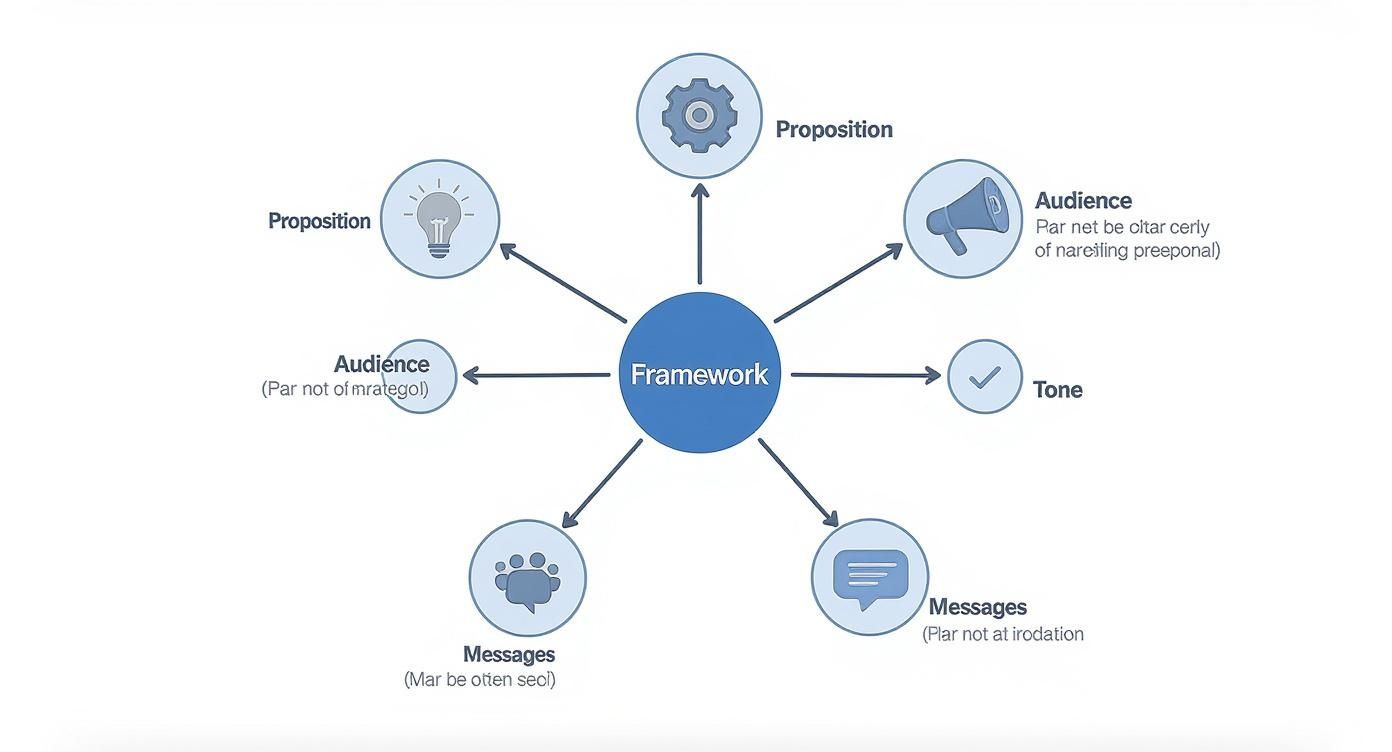
The framework’s power comes from how the five pillars—Proposition, Audience, Messages, Proof, and Tone—all work together. They're not isolated concepts.
Step 1: Start with an Internal Workshop
Before you write a single line of copy, get your customer-facing teams in a room. The goal is to extract the raw, unfiltered truth about your customers and your market position. Forget polished marketing jargon; you want the real story.
Use these questions to guide the conversation:
- Customer Pains: What are the top three frustrations your ideal customers bring up on calls? What problem are they really trying to fix when they find us?
- Customer Language: What specific words or phrases do your happiest customers use to describe what we do? How do they talk about their "before" and "after"?
- Competitor Perceptions: Who do prospects constantly compare us to? What do they say our competitors do better—or worse?
- "Aha!" Moments: What’s the one thing that makes a prospect lean forward and say, "Okay, I get it now"?
Document everything. This workshop is about gathering the raw materials you'll need to build your framework.
Step 2: Conduct a Competitive Analysis
Once you have that internal knowledge, look outside your own walls. You need to understand where you fit in the competitive landscape. This step is about finding the gaps in the market that only you can fill.
Analyze 3-5 of your main competitors in a simple spreadsheet. For each one, break down their messaging:
- Stated Value Proposition: What's the main promise on their homepage?
- Target Audience: Who are they talking to? Look at their copy and case studies—who is the hero of their story?
- Key Messages: What are the 2-3 recurring themes they hammer home?
- Proof Points: What are they using for proof? Testimonials? Hard data? Big-name logos?
- Tone of Voice: What’s their personality? Formal and corporate, playful and casual, or super technical?
The Goal: This isn't about copying competitors. It's about finding your unique angle. Look for the message they aren't using or the customer pain they’re ignoring. That’s your opening.
Step 3: Synthesize and Build Your Document
Now, put it all together. Combine insights from your internal workshop and competitive analysis to build your official marketing messaging framework. This needs to be a clean, clear document that anyone in the company can understand instantly.
As you build it, focus on being practical and direct. Ditch the buzzwords. This document should become the source of truth for your team, guiding everything from website copy to sales scripts.
Remember, this isn't a "set it and forget it" project. Your framework is a living document. Plan to revisit it quarterly as you get new market feedback. Think of it as a powerful tool for your business, just like a well-tended list for effective database email marketing.
Putting Your Messaging Framework into Action
A brilliant messaging framework is useless if it just sits in a shared drive. Its real power is unleashed when you put it to work—when it stops being a document and starts being the everyday language of your business. This is where the blueprint becomes a system that fuels growth.
The goal is to weave your new messaging so deeply into your company’s DNA that consistency becomes second nature. It's about equipping your teams with the core building blocks they need to communicate with confidence and clarity.
Powering Your Marketing Engine
Your marketing team is the natural starting point. This is where your core messages are transformed into the assets that find, attract, and convert ideal customers.
Instead of staring at a blank page, your team now has a playbook.
- Website & Landing Page Copy: Your value proposition and key messages should be front and center on your homepage and landing pages. Every headline and call-to-action can be pulled straight from the framework.
- Ad Campaigns: Whether it’s Google Ads or LinkedIn, your framework provides the raw material for ad copy. Test different key messages against specific audience segments to see what resonates.
- Content Creation: Blog posts, white papers, and case studies should all start with the framework. Map each piece of content to a specific audience segment's pain points and let your defined tone of voice guide the writing process.
What to Look For: Could a stranger look at your website, a recent social post, and a sales one-pager and immediately understand who you help, what you solve, and why you’re the best choice? If yes, your framework is working.
Equipping Your Sales Team for Success
The sales team is where messaging meets money. When marketing and sales speak the same language, the customer's journey from prospect to client feels seamless. Your framework becomes their single source of truth.
This system shifts your reps from improvising on calls to leading strategic, value-driven conversations.
Here's how to integrate it:
- Sales Scripts & Call Outlines: Build your framework’s key messages and proof points directly into discovery call outlines to help your team qualify leads faster.
- Email Outreach Sequences: Standardize outreach templates using messaging tailored for each audience segment. An email to a CEO should sound different from one to an operations manager—your framework defines how.
- Objection Handling: Use the framework to proactively prepare answers for common objections. When a prospect questions your price, your team can respond with a powerful, value-based argument.
Systemizing Consistency in Your CRM
Finally, embed your framework directly into your technology stack, especially your CRM (like HubSpot or GoHighLevel). This is how you scale consistent messaging and make it stick.
When you systemize your messages, you ensure every automated communication reinforces your brand. For example, build automated email nurture sequences where each message is perfectly tailored to a specific audience segment defined in your framework.
This consistency has a massive impact. Research shows a clear messaging framework can lead to 3.5 times higher brand visibility. And with 90% of customers expecting a unified brand voice, systemizing your message is no longer optional. You can review more insights on developing a brand framework to see the data for yourself.
By activating your framework across marketing, sales, and your core systems, you create a powerful feedback loop that drives sustainable growth.
Common Mistakes When Building Your Framework
Building a marketing messaging framework is a huge step forward, but the path has potential traps. We've seen companies invest significant effort into a framework that ends up collecting dust. Acknowledging where things can go wrong is just as important as knowing the right steps to take.
Let's diagnose the most common failure points. By getting ahead of these, you can create a framework your team actually uses to get results.

Many well-intentioned frameworks break down before they even launch. Diagnose these issues now to avoid costly rework later.
Using Internal Jargon
This is the single biggest mistake. You create messages that make perfect sense in your internal meetings but are complete gibberish to your customers. Your team might live and breathe your acronyms and technical specs, but your prospects don't.
When you use jargon, you force customers to do the mental work of translating what you mean. Most won't bother—they'll just click away to a competitor who speaks their language.
- The Problem: Your message feels exclusive and confusing, putting up a wall between you and potential buyers.
- The Solution: Run every word through a simple filter: "Would my ideal customer say this out loud?" If the answer is no, cut it.
Building It in a Silo
A framework created solely by the marketing team or a single executive is doomed from the start. Your customer-facing teams—sales and customer service—are on the front lines every day. They hear what resonates, what causes confusion, and what objections come up in real conversations.
Ignoring their input is like trying to design a car without talking to the people who will actually drive it. You'll miss the critical, real-world insights that make a framework practical and powerful.
Our Take: Your framework has to be a team sport. The best ideas often come from outside the marketing department. Be transparent and get everyone in the room when you're building it.
Making It Too Complex
Another common pitfall is over-engineering the framework until it becomes a 50-page behemoth that nobody reads. If your team needs a manual to understand the messaging manual, you’ve already lost. Complexity is the enemy of adoption.
Your messaging framework should be a simple, accessible tool that makes your team's job easier, not harder. A new hire should be able to get the gist in under an hour.
- Signs of Over-Complication: Confusing messaging tiers, overly academic persona documents, or vague guidelines instead of clear talking points.
- The Fix: Prioritize clarity. A punchy one-page summary is almost always more powerful than a comprehensive guide that no one uses.
Treating It as a One-and-Done Project
Finally, many businesses treat their framework like a static document. They perfect it, launch it, and then let it sit untouched for years. But your market isn't static. Your customers evolve, your competitors adapt, and your business changes.
Your messaging framework must be a living document. It needs regular check-ups and updates based on what’s happening in the real world.
Think of it as the operating system for your company's voice—it needs periodic updates to stay effective. Plan to review and tweak it quarterly based on feedback from your sales and marketing teams.
Frequently Asked Questions
Putting a new marketing messaging framework into action will bring up practical questions. As problem-solvers, we believe in tackling those concerns head-on. Here are direct answers to the questions we hear most often from business owners.
How often should we update our marketing messaging framework?
Your framework should be a living document, not a static file. We recommend a full, comprehensive review at least once a year.
However, you should also plan for more frequent check-ins. A great system involves getting feedback from your sales and customer service teams quarterly. If they report that certain messages aren't landing or a competitor’s new angle is getting traction, it’s time for a targeted update.
Do we really need a formal framework if we are a small company?
Yes, absolutely. A formal framework is arguably more critical for a small business where everyone wears multiple hats. When you have a small crew, you can't afford the wasted time and energy that comes from inconsistent messaging.
A framework ensures everyone—from the founder on a sales call to the marketing assistant posting on social media—is communicating the same powerful message.
Our Diagnosis: Small teams often suffer from "message drift" because key people are pulled in too many directions. A formal framework is the system that keeps a small, agile team perfectly aligned, allowing you to punch well above your weight.
What is the difference between a brand guide and a messaging framework?
This is a great question, and the distinction is crucial. They are two different tools that work together, but they solve different problems.
Think of it like building a house:
- A Brand Guide is the architectural style and interior design. It defines your visual identity—logo, color palette, and fonts—and your brand's personality, or the voice you use. It's about how you look and sound.
- A Marketing Messaging Framework is the blueprint and structural engineering. It defines what you actually say. It outlines your core value proposition, key talking points for different audiences, and the proof you use to back up your claims.
One ensures your message looks and feels like you, while the other ensures the message itself is strategic, persuasive, and moves the needle on business goals. You need both.
How do we measure the success of our new messaging framework?
Measuring your framework’s impact is about looking at your entire go-to-market motion. A successful framework improves efficiency and effectiveness across the board, so you’ll want to track a mix of hard numbers and real-world feedback.
Quantitative Metrics to Watch:
- Conversion Rates: Are more visitors on key landing pages taking action?
- Lead Quality: Is your sales team reporting that incoming leads are a better fit?
- Sales Cycle Length: Are deals closing faster because prospects "get it" much sooner?
- Content Velocity: Is your marketing team able to produce on-brand content more quickly?
Qualitative Feedback to Gather:
- Ask your sales team: "Is it easier to get past common objections with these talking points?"
- Ask your marketing team: "Do you feel more confident and clear when writing new copy?"
- Listen to call recordings: Are your customers starting to use your language to describe their problems?
A successful marketing messaging framework doesn’t just change your copy; it streamlines your entire revenue engine.
Ready to build a messaging framework that aligns your team and drives real growth? Machine Marketing specializes in diagnosing communication gaps and implementing systems that generate consistent, high-quality leads.
Book a discovery call with us to start building your marketing machine.