If your website isn't bringing in a steady stream of qualified leads, the problem probably isn't a lack of content—it's a lack of diagnosis. We see this all the time. The fastest way to increase organic traffic is to first get a clear, honest picture of where you stand right now. This means looking past vanity metrics and focusing on the numbers that actually signal business growth.
In this guide, we’ll show you how to diagnose the gaps in your website's performance and share the practical steps you can take today to build a system that generates results.

Find the Real Problem with Your Traffic
Before you can build a growth strategy that works, you have to think like an engineer and diagnose what’s holding your website back. You can’t fix a problem you don’t understand. This isn't about getting lost in spreadsheets; it’s about asking the right questions to find the technical issues or content gaps that are costing you leads.
The good news? You don't need a suite of expensive tools to start this diagnosis. Google provides two powerful, free platforms with everything you need for an initial audit: Google Analytics 4 (GA4) and Google Search Console.
Think of them this way: GA4 shows you what’s happening on your site (who’s visiting, what they're doing). Search Console shows you how Google sees your site (which keywords you show up for, how often people click).
Start with the Right KPIs
Most business owners get hung up on total website visits, but that number tells you almost nothing about the health of your business. Instead, we zero in on a handful of key performance indicators (KPIs) that connect directly to your bottom line.
- Organic Conversion Rate: What percentage of visitors from a Google search actually do something valuable, like fill out a contact form or request a quote? A low number is a red flag that your content isn't matching what your ideal customer is looking for.
- High-Intent Keyword Rankings: Are you visible for the search terms people use when they're ready to buy? For a manufacturer, that's something like "custom CNC machining services," not "what is CNC machining." You need to know where you stand on these money-making keywords. We dig deeper into this for industrial businesses in our guide to SEO for manufacturing companies.
- Organic-Sourced Leads & Revenue: This is the ultimate metric. How many actual leads and how much real revenue can you trace back to people who found you through a search engine?
Focusing here is critical because organic search is a powerhouse for business growth. It drives 53% of all website traffic globally. For B2B companies, these leads are gold—they close at a 14.6% rate, making them over eight times more effective than outbound marketing.
Your Initial Diagnostic Report
To get a quick read on your situation, head straight to your GA4 acquisition report. It gives you a clean breakdown of where your traffic is coming from.
This simple report tells you which channels are your heavy hitters. From here, you can dig in and see not just how many people came from each source, but how they behaved on your site and whether they converted. It’s the first step to figuring out which channels are actually bringing you valuable customers and which ones are just noise.
To really get to the bottom of your site's performance, focus on the metrics in the table below. This isn't just data; it's the story of how customers find you and what they do when they get there.
Key Metrics for Your Organic Traffic Diagnosis
Focus on these metrics to understand what's really happening with your website's performance. This table breaks down what each metric means and why it's critical for a business owner.
| Metric | What It Measures | Why It Matters for Your Business |
|---|---|---|
| Organic Sessions | The total number of visits to your site originating from a search engine like Google. | This is your top-level indicator of search visibility. A decline here is an early warning that something is wrong. |
| Organic Conversion Rate | The percentage of organic visitors who complete a goal (e.g., form submission, call). | This tells you if you're attracting the right traffic. High traffic with zero conversions is a waste of resources. |
| Keyword Rankings (Top 10) | The number of commercially valuable keywords for which your site ranks on the first page of Google. | First-page rankings get over 90% of clicks. If you're not here for your core service terms, you're invisible. |
| Click-Through Rate (CTR) | The percentage of people who see your site in search results and actually click on it. | A low CTR can mean your page titles and meta descriptions aren't compelling enough to attract clicks, even if you rank well. |
| Bounce Rate / Engagement Rate | How many visitors leave your site after viewing only one page (Bounce Rate) or how many actively engage (Engagement Rate in GA4). | High bounce or low engagement rates suggest your landing page content doesn't meet the searcher's expectations. |
By analyzing these numbers together, you move from guessing to knowing. You’ll have a clear, data-backed starting point that tells you exactly where to focus your efforts for the biggest impact on your bottom line.
Building a Rock-Solid Technical SEO Foundation
Let's talk about the engine under the hood of your website. You can have the best-looking car with the most amazing features (your content), but if the engine is sputtering, you're not going anywhere. That's technical SEO. We see this all the time: businesses get frustrated with stagnant traffic, assuming their content is the problem, when the real issue is that Google's crawlers can't even properly find, understand, or index their pages.
A clean technical setup is non-negotiable. It ensures search engines can efficiently access and interpret everything you publish. Without it, you’re basically invisible to the only audience that matters for organic traffic. So, let’s cut the jargon and focus on the high-impact fixes that will give your content a fighting chance.
Prioritize Site Speed And Mobile Experience
How fast your site loads isn't a "nice-to-have"; it's a make-or-break ranking factor. The numbers don't lie: pages loading within two seconds have an average bounce rate of just 9%. Push that load time to five seconds, and the bounce rate shoots up to a staggering 38%. For a busy decision-maker looking for a spec sheet, a three-second delay is an eternity.
Just as critical is your site's performance on a phone. Google now operates on mobile-first indexing, meaning it primarily looks at your site's mobile version to decide how to rank you. If your site is a clunky, hard-to-read mess on a mobile device, your rankings will suffer everywhere.
Questions to ask yourself:
- Does my website feel almost instant on both desktop and mobile?
- Can someone easily tap through the menus and click on buttons without zooming in?
- Is all the content formatted correctly for a smaller screen?
A fantastic (and free) place to start your diagnosis is Google's PageSpeed Insights. It gives you a clear performance score and, more importantly, a specific checklist of what to fix.
Use Schema Markup to Speak Google's Language
One of the most powerful, yet underused, tools for business websites is schema markup. Think of it as a secret language you add to your website's code to tell search engines exactly what your content is about. It’s like adding clear, bold labels to a filing cabinet instead of just stuffing papers inside.
For instance, you can use schema to tell Google things like:
- "This is our local business, and here is our exact address, phone number, and hours."
- "This page features a specific product, and here's its price, stock status, and average review rating."
- "This is an FAQ section, and these are the distinct questions and answers."
Why does this matter? Because Google uses this information to create rich snippets in the search results. These are the eye-catching listings you see with star ratings, product prices, or event dates baked right in. They take up more real estate on the page and can dramatically improve your click-through rate.
By adding structured data, you stop hoping Google will figure things out. You're giving it a direct, unambiguous blueprint of your content. This clarity gives you an immediate leg up on competitors who are ignoring it.
While it sounds technical, tools like the Schema Markup Generator make the process much more straightforward. This one proactive step helps you stand out in a sea of plain blue links. If you want to go deeper on how this connects with your content strategy, we break it all down in our technical content SEO guide.
Developing Content That Attracts and Converts
Once your technical foundation is solid, the next question is always the same: “What should we actually write about?” This is where many businesses get it wrong. They start a blog, publish a few posts about company news, and wonder why the phone isn’t ringing. That approach is a surefire way to waste time and money.
To actually drive organic traffic—the kind that turns into leads and sales—you need a content system. The goal isn't just to write; it's to solve real customer problems and prove to Google (and your prospects) that you're the authority in your space.
The best way to do this is with the Topic Cluster model. Forget one-off articles. We're talking about building an organized library of content that covers one of your core services from every conceivable angle.
From Cornerstone Guides to Cluster Articles
The Topic Cluster model has two parts that work hand-in-hand to build your authority and boost your rankings. Think of it as a hub-and-spoke system for your company's knowledge.
- Cornerstone Content (The "Pillar"): This is a massive, in-depth guide covering a broad topic tied directly to a core service. If you're a custom metal fabricator, a perfect cornerstone piece would be, "The Ultimate Guide to Choosing a Metal Fabrication Partner." This is meant to be the absolute best, most comprehensive resource on that subject.
- Cluster Content (The "Spokes"): These are shorter, laser-focused articles that answer one specific question related to your cornerstone topic. For that same fabricator, cluster posts might be "What's the Difference Between TIG and MIG Welding?" or "How to Read Fabrication Blueprints for Beginners."
Every one of those cluster articles links back up to the cornerstone guide. In turn, the cornerstone guide links out to each of the cluster articles. This tight internal linking structure tells Google you have deep expertise on the entire subject and keeps visitors on your site, guiding them from one helpful resource to the next.
For a deeper look at this strategy, check out our guide on content marketing best practices.
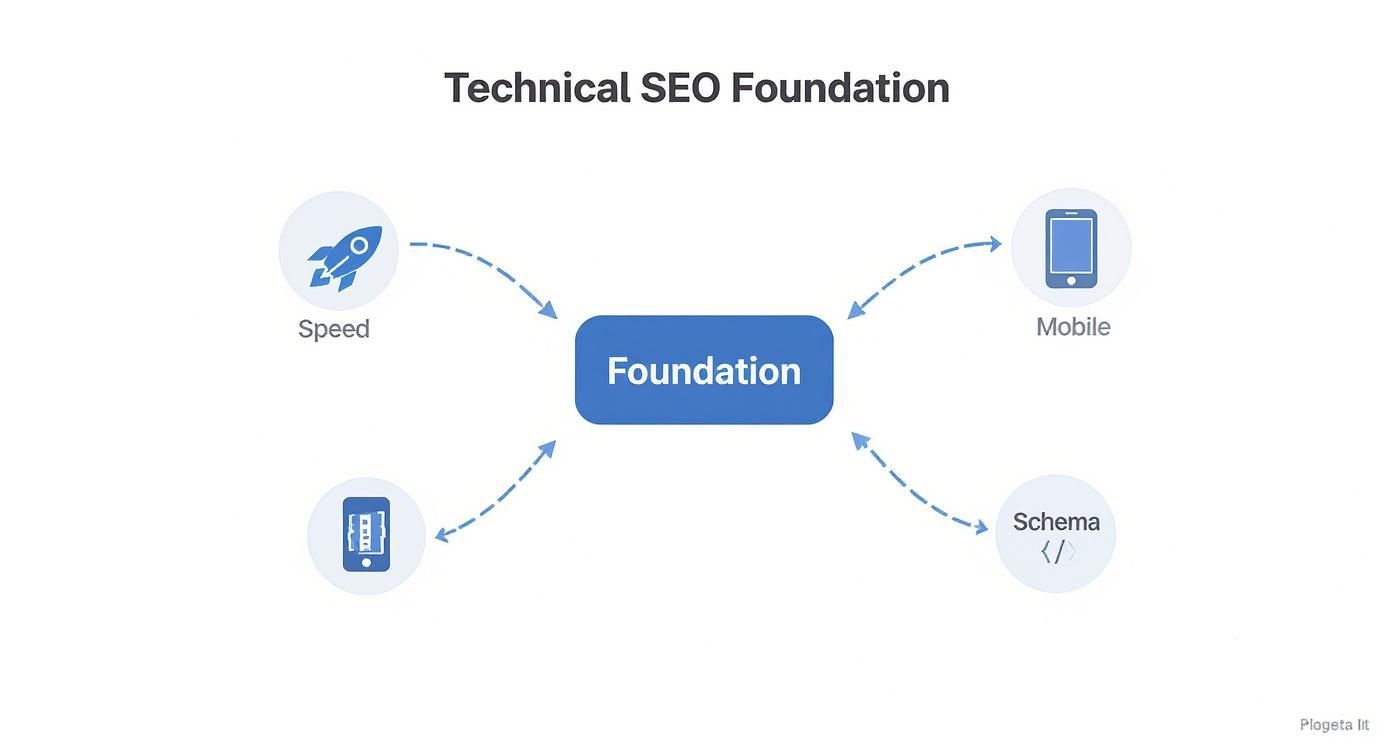
As you can see, all of this great content has to sit on a solid technical foundation. Without it, even the best articles will struggle to get seen.
To truly understand how these pieces fit together, let's break down their distinct roles.
Cornerstone Content vs Cluster Content
Understand the difference between these two critical content types and how they work together to boost your authority and rankings.
| Attribute | Cornerstone Content (The Pillar) | Cluster Content (The Spokes) |
|---|---|---|
| Purpose | To be the definitive, go-to resource on a broad topic. | To answer a single, specific question in detail. |
| Length | Very long-form (2,500+ words). In-depth and comprehensive. | Shorter and focused (750-1,500 words). |
| Keywords | Targets a broad, high-volume "head" term. | Targets a specific, long-tail "question" keyword. |
| Example | "The Complete Guide to Commercial HVAC Systems" | "How Often Should You Change Commercial HVAC Filters?" |
| Link Structure | Links out to all relevant cluster articles. | Links up to the main cornerstone content piece. |
This hub-and-spoke system creates a powerful feedback loop. The pillar provides the authority, while the spokes attract highly targeted traffic from people asking very specific questions—exactly the kind of people who are looking for a solution.
Finding Your Best Content Ideas
So, where do you find the topics for these articles? Your best ideas are already inside your business.
They’re hiding in the questions your sales and customer service teams hear every single day. These folks are on the front lines, and they have a direct line to the pain points and questions of your ideal customers.
Ask your team:
- What are the top 5 questions you get on every single sales call?
- What are the most common objections or hesitations you have to overcome?
- What's the biggest misunderstanding prospects have about what we do?
- What's one thing you wish every potential customer knew before they called you?
Each answer is a perfect topic for a cluster article. This isn't guesswork; it’s building content that's guaranteed to be relevant because it comes directly from your target audience.
Once you have this list, you can use a tool like Ahrefs to validate the ideas, see how people are searching for them, and find related questions you might have missed.
The goal isn't just to rank for keywords. The goal is to become the most trusted resource for your specific audience by systematically answering their questions better than anyone else.
By building out these topic clusters, you stop chasing algorithm updates and start building a permanent asset. You create a library of content that demonstrates your expertise, solves real problems for your customers, and drives sustainable, long-term growth for your business.
Winning the Local Search Game with Google Business Profile

If you're a local service business or a manufacturer serving a specific region, your Google Business Profile (GBP) is your single most powerful free marketing tool. Full stop. It's not just a map pin anymore; it's a dynamic digital storefront that’s often the very first impression a potential customer gets of your company.
The problem? Many businesses treat it as a “set it and forget it” task. They fill out the basics one time and never look at it again. This is a massive missed opportunity to pull in organic traffic from the people who matter most—the ones right in your backyard.
Let's walk through how to turn that passive listing into an active lead-generation machine.
Your GBP Optimization Checklist
Think of your profile less like a static page and more like a living document that needs regular attention. When you consistently feed it accurate and detailed information, you're signaling to Google that you’re an active, trustworthy business worth showing to searchers.
Here’s our diagnostic checklist for whipping your GBP into a high-performer:
- Complete Every Single Field: Don't skip a thing. Fill out your service areas, hours, phone number, and a detailed business description. The more complete the profile, the more Google trusts it.
- Choose Hyper-Specific Categories: Don't just list "Manufacturer." Get granular. Are you a "Metal Fabricator," a "CNC Machine Shop," or a "Plastic Injection Molding Service"? Pick a primary category that nails your core business, then layer in secondary categories for everything else you do.
- Upload High-Quality, Real Photos: Stock photos are a dead giveaway. Customers want to see your actual facility, your team at work, and your finished products. We recommend a minimum of 10 high-resolution photos to start, then add new ones each month to build trust and prove you’re a real, active operation.
Engage Actively to Build Trust
A complete profile is just the foundation. The real magic happens when you start using the engagement tools Google gives you. These features are designed to answer customer questions and showcase your expertise before they even click to your website.
Ignoring these tools tells potential customers you might not be responsive. On the flip side, using them proactively helps you leapfrog lazy competitors.
Your Google Business Profile isn't just for visibility; it's for validation. Every review you respond to, every question you answer, and every Post you publish tells potential customers that you are engaged, professional, and ready to help.
Make a habit of using these three features consistently:
- Google Posts: Share updates, special offers, or photos of new projects every week. These act like mini-blog posts right on your profile and are a huge signal to Google that you're an active business.
- Q&A Section: Don't wait for customers to ask questions—populate this section yourself. Brainstorm the top 5-10 questions you always get and answer them clearly. This lets you control the narrative and address their concerns upfront.
- Reviews: Respond to every single review—good or bad—within 24 hours. A thoughtful response to a negative review can often be more powerful than a dozen positive ones. It shows you care and are committed to making things right.
Turning Clicks into Customers
Ultimately, optimizing your GBP is all about driving profitable action. You want a potential customer to call you, visit your website, or request directions. Your job is to make that as easy as possible.
Double-check that your "Book," "Call," or "Visit Website" buttons are set up correctly and point to the most relevant pages on your site. For instance, if you're promoting a specific service in a Google Post, link directly to that service page, not just your homepage.
This direct, helpful approach is what turns local searchers into leads. It transforms your profile from a simple map pin into your hardest-working salesperson, engaging prospects and building the trust you need to win their business.
Earning Authority with Real Backlinks
Once your technical foundation is solid and you have a system for creating valuable content, it's time to tackle the final piece of the SEO puzzle: authority.
In a crowded market, Google needs signals to decide who to trust. High-quality backlinks—links from other websites pointing to yours—are the currency of that trust.
Think of it like a real-world referral. A recommendation from a respected industry leader carries far more weight than a hundred flyers left on car windshields. The same is true online. A single, relevant link from an authoritative site in your niche is exponentially more valuable than hundreds of spammy, low-quality ones. This is a core part of how search engines work.
Stop Chasing Links, Start Earning Them
The old way of thinking about this was "link building"—a numbers game focused on getting as many links as possible, often through shady tactics. That game is over.
We approach this from a different angle. We don't build links; we earn them by creating assets so valuable that other people in your industry want to reference them. The goal isn't to trick Google. It's to build genuine relationships and become a go-to resource in your field.
So, what does a "link-worthy" asset actually look like for a business like yours?
- Original Data or Research: A report summarizing trends you're seeing with your clients.
- In-Depth Case Studies: A detailed breakdown of how you solved a complex problem for a customer, complete with real numbers and results.
- Unique Tools or Calculators: A simple, free calculator that helps an engineer estimate material costs.
- Expert Interviews: A Q&A with a respected leader in your local business community.
These are the kinds of things that journalists, bloggers, and industry associations are actively looking for to support their own content. You're making their job easier.
A Practical Outreach System
Once you have a valuable asset, you need to let the right people know it exists. This isn't about spamming thousands of generic emails. It's about targeted, respectful outreach to build real connections.
Your outreach list should be small and focused. Quality over quantity, always.
- Industry Publications & Blogs: Identify the top 5-10 trade magazines or blogs that your ideal customers actually read.
- Local News Outlets: If you serve a specific region, find the local business journals or news sites that cover your industry.
- Professional Associations: Look for industry groups you're a part of. They often have newsletters or resource pages where they share valuable content with members.
When you reach out, keep it short, personal, and focused on providing value to their audience. Don't just ask for a link; show them how your resource can make their next article better.
Pro Tip: Your outreach email should never be about you. Frame it entirely around them. A good subject line could be "Data for your next article" or "A resource your readers might find useful." It immediately signals that you're there to help, not just to take.
Why Quality Backlinks Are Non-Negotiable
Ignoring this part of the process is one of the biggest mistakes we see businesses make. Building authority is what separates sites that get a trickle of traffic from those that dominate the search results for their most important keywords.
The correlation is undeniable. The number one organic result on Google has, on average, 3.8 times more backlinks than the results in positions two through ten. Recent data leaks from Google itself have only confirmed that site-wide authority metrics are a critical component of its ranking system. You can explore more data on these search statistics to see just how crucial authority has become.
By creating valuable assets and building real relationships, you're not just earning links. You're building a defensible competitive advantage that drives meaningful, long-term organic traffic to your website.
Your 90-Day Organic Traffic Growth Roadmap
Knowing what to do is just one piece of the puzzle. The real challenge for a busy business owner is knowing where to start. A scattered, "throw everything at the wall" approach just leads to burnout and wasted money. That's why we've organized these strategies into a prioritized 90-day plan.
This isn't a random checklist. It's a strategic system designed to build momentum and deliver real results. We hit the highest-impact activities first, because you can't build great content on a broken website, and you won't earn backlinks without something valuable to share. Each phase builds on the last.
Phase 1: Days 1-30 — Diagnosis and Quick Wins
The first month is all about getting your house in order. We need a clear baseline and have to fix the critical issues that are actively holding you back. Don't skip this part—it ensures every single thing you do from here on out is based on data, not a hunch.
- Action 1: Conduct Your Traffic Audit. Dive into Google Analytics and Search Console. Figure out which pages are already working for you and where your biggest content gaps are. You’re looking for those high-intent keywords where you’re already ranking, even if it's just on page two or three.
- Action 2: Fix Core Technical Issues. Run your site through Google's PageSpeed Insights. Don't get overwhelmed by the report; just focus on the biggest speed bottlenecks. Make sure the site is completely mobile-friendly, then submit a fresh sitemap in Search Console so Google knows you've made improvements.
Phase 2: Days 31-60 — Local Presence and Cornerstone Content
With a solid technical foundation, it's time to build your visibility and authority. This phase is about owning your local turf and publishing your first big piece of content that establishes you as an expert.
Don't aim for perfection with your first cornerstone guide. The goal is to get a truly comprehensive, valuable resource published. You can—and should—come back later to update and improve it. Done is better than perfect here.
- Action 3: Optimize Your Google Business Profile. Go through your Google Business Profile and fill out every single section. We mean everything. Upload at least 10 high-quality photos of your team, your facility, and your work. Then, pre-populate the Q&A section with your top five most common customer questions and answer them yourself.
- Action 4: Publish Your First Cornerstone Guide. Look at the audit you did in month one. Pick a broad, important topic that your business needs to be known for. Now, create and publish a detailed, 2,500+ word guide that will act as the central hub for all your future content on that subject.
Phase 3: Days 61-90 — Build Authority and Outreach
In the final month of this sprint, you'll expand on that cornerstone guide and begin earning signals that tell Google you're an authority. This is where your expertise starts becoming a tangible asset that brings in both customers and high-quality backlinks.
- Action 5: Write Supporting Cluster Content. Create two or three shorter blog posts that dive deep into very specific questions related to your cornerstone guide. Make sure you link these new posts up to the main guide to start building out your first topic cluster.
- Action 6: Start Your First Outreach Campaign. Identify five relevant industry blogs, local publications, or even non-competing businesses in your area. Reach out with a personalized, helpful email that shares your new cornerstone guide as a potential resource for their audience. No hard sells, just genuine value.
Straight Answers to Tough SEO Questions
Business owners always have questions about what it really takes to get more organic traffic. Let's cut through the noise and get straight to the answers for the questions we hear most often.
How Long Does It Take to See Results from SEO?
This is the big one, and the honest answer is: it depends. You can often see a positive bump from quick technical fixes and on-page tweaks within 60 to 90 days. That's the low-hanging fruit.
But building real authority and ranking for the keywords that actually drive sales? That’s a long-term investment. Most businesses should plan on seeing a meaningful, undeniable increase in organic traffic and leads within six to twelve months of consistent, focused effort. Think of it less like a sprint and more like building a valuable business asset that pays dividends for years to come.
What’s More Important: Content or Backlinks?
This is a classic chicken-and-egg question. The truth is, you can't have one without the other. They're two sides of the same coin.
Exceptional content is the foundation. Without it, you have nothing valuable for other sites to link to. It's how you prove your expertise and solve your customer's problems. But great content sitting alone on an island will struggle to rank for anything competitive. That's where backlinks come in—they're the "votes of confidence" that signal your authority to Google.
Our Approach: We always start by creating a truly valuable cornerstone content asset. Then, we use that incredible piece of content as the reason to build relationships and earn high-quality backlinks. They have to work together.
Do I Really Need a Blog to Increase Organic Traffic?
Yes, but let's reframe the question. Stop thinking of it as a "blog" and start thinking of it as your company's "learning center" or "resource hub."
A static, five-page website gives Google almost no information about your expertise. It's a digital brochure. Each high-quality article you publish is a new net you cast in the water—a new opportunity to rank for a specific customer question and prove you know your stuff. It's how you build the topic clusters that drive significant, long-term organic growth and attract qualified buyers at every stage of their journey.
Ready to stop guessing and start building a predictable system for organic growth? At Machine Marketing, we specialize in diagnosing traffic issues and implementing proven SEO frameworks for manufacturers and B2B businesses. We’ll build you a roadmap to turn your website into a lead-generation engine. Book your discovery call with us today.