Getting generic, overpriced proposals from web agencies? The problem probably isn't them—it's your Request for Proposal (RFP). A vague RFP for website development is like sending a mechanic a blurry photo of your engine and asking, "How much to fix it?" You're guaranteed to get mismatched solutions and waste time because you haven't diagnosed the real business problem you need to solve.
In this guide, we'll show you how to diagnose the gaps in your current RFP process and build a document that attracts the right strategic partners—not just order-takers.
Why Most Website RFPs Fail to Attract the Right Partner
We see this all the time. A business owner spends hours writing a document that boils down to one question: "How much for a new website?"
That simple question is the root of the problem. It frames the project as a commodity purchase, like buying printer paper, not a strategic partnership.
When you do that, you attract agencies that check boxes, not solve complex business challenges. You force them to guess your goals, your audience, and what "success" looks like. You end up with a stack of proposals that are impossible to compare because every agency has filled in the blanks with their own assumptions.
The Mismatch Between Features and Outcomes
The biggest mistake we see is an RFP that’s just a laundry list of features instead of a clear statement of business outcomes. A company might say they need "an e-commerce shopping cart" or "a blog section." Sure, those are features, but they say nothing about the why.
Here’s how to reframe your thinking:
-
Instead of: "We need an e-commerce shopping cart."
-
Ask: "How can we increase online sales of our core products by 30% within the first year?"
-
Instead of: "We need a blog."
-
Ask: "How can we generate 50 qualified leads per month through educational content that establishes us as an industry authority?"
This one small shift from features to outcomes is a game-changer. It invites agencies to get creative and propose solutions that will actually work. You're no longer looking for an order-taker; you're looking for a strategic partner who can recommend the right tools to hit your goals.
A great RFP doesn’t just list requirements; it tells a story. It should paint a picture of where your business is today, where you want it to be, and what’s standing in your way. That context allows a great partner to build a truly effective solution for you.
The Real Cost of Being Vague
An unclear RFP costs you more than just time. It’s a direct line to scope creep, blown budgets, and a final website that doesn't move the needle for your business.
When agencies have to guess, they hedge their bets. They build in financial padding to cover all the unknowns, which inflates their price. By providing clarity upfront, you’ll get more accurate pricing and attract partners who value a well-defined plan.
Ultimately, a successful RFP for a website is a strategic document. It's the foundation for a partnership, not just a transactional request for a quote.
The Anatomy of a High-Impact Website RFP
Let’s move from diagnosing the problem to building a better system. A powerful RFP for a website isn’t just a document; it’s a strategic communication tool. Its purpose is to get clear, comparable, and insightful proposals from potential partners.
Think of it as the blueprint for your project. A good one leaves no room for guessing.
We’ll walk you through each critical piece, sharing real-world examples to show you exactly how to spell out your needs. This isn't about filling in a template; it's about building a document that attracts the right kind of thinking from the start.
Start with Your Story and Business Context
Before you dive into technical details, set the stage. Why does this project matter? What's your company’s story? Agencies get dozens of RFPs; the ones that stick are the ones that tell a clear, compelling story.
This section should briefly cover:
- Who You Are: A quick overview of your company, what you do, and who you serve. Keep it concise.
- Your Current Situation: Describe your existing website. What’s working? More importantly, what’s broken? Maybe it looks dated, fails to bring in leads, or is a nightmare to update. Be transparent.
- The Opportunity: Explain the business challenge driving this project. Are you launching a new product line? Entering a new market? Getting crushed by competitors online?
This context helps an agency step into your world and start thinking like a partner, not just a vendor. It's the difference between asking someone to "build a house" and explaining you need a home for a growing family that loves to entertain outdoors. The details change everything.
Define Your Business Goals Clearly
This is the most critical part of your entire RFP. If you get this wrong, nothing else matters. Your goals must be specific, measurable, and tied directly to real business outcomes—not just a checklist of website features.
Good goals give an agency a target to aim for. Vague goals will only get you generic, cookie-cutter solutions.
Question to ask yourself: Does this RFP focus on business outcomes that empower agencies to propose creative solutions, or does it just list features that invite order-takers?
Example Scenario: A Manufacturer's Goals
Let's imagine a mid-sized manufacturer that makes industrial parts. Here’s how they could turn fuzzy needs into rock-solid goals:
- Weak Goal: "We need a new website to look more modern."
- Strong Goal: "Increase qualified lead submissions from engineering firms by 40% within 12 months of the new site launch."
See the difference? Let's do another one.
- Weak Goal: "We want to add a resource library."
- Strong Goal: "Reduce inbound customer support calls regarding product specifications by 25% by creating a searchable, user-friendly technical document library."
These strong goals paint a crystal-clear picture of success. A potential partner can now propose specific strategies—like advanced filtering for that resource library or targeted landing pages for engineers—that directly solve the business problem.
This strategic approach is becoming the norm. Organizations now submit an average of 153 RFPs annually, with 61% planning to submit even more, showing growing confidence in using well-crafted RFPs to find the right partners. You can read more about these trends in RFP submissions to see just how much the landscape is changing.
Detail the Project Scope and Key Functionality
Once you’ve established the "why," you can get into the "what." This section is where you outline the specific deliverables and functionality you need. The goal here is clarity, which is your best defense against scope creep down the road.
Your scope should be thorough but focused on requirements, not the technical implementation. You're defining the problems to be solved, not telling the agency how to solve them.
Key areas to cover include:
- Sitemap or Page List: Provide a rough outline of the pages you anticipate needing (e.g., Home, About Us, Products, Case Studies, Contact). This gives agencies a sense of the site's scale.
- Core Functionality: List any special features the site must have. Do you need e-commerce, a customer portal, a dealer locator, or a complex product configurator?
- Third-Party Integrations: This is a huge one that often gets missed. List every single piece of software your website needs to connect with. This includes your CRM (like HubSpot or Salesforce), ERP system, email platform, or payment gateways.
Forgetting a key integration can cause massive headaches and budget blowouts later. Be meticulous and list everything.
The flowchart below shows the common failure loop that starts with a vague RFP and ends with wasted time and money.
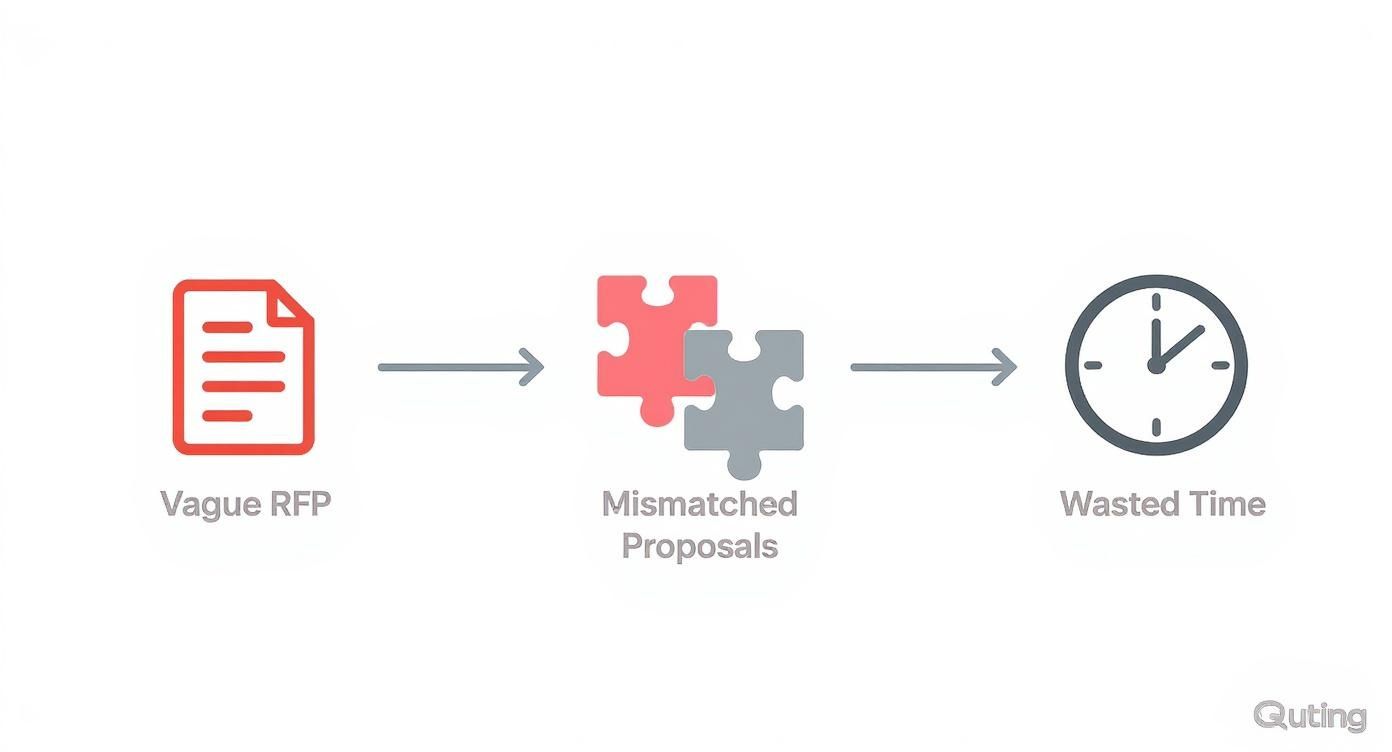
This process shows how a lack of clarity at the start leads directly to mismatched proposals and lost time—a costly mistake for any business.
To help you stay organized, here's a quick-reference table summarizing the core components we've discussed. Use it as a checklist to ensure your RFP has all the essential elements.
Core Components of a Winning Website RFP
| RFP Section | Primary Goal | Key Information to Include |
|---|---|---|
| Business Context | To ground the project in your business reality and help agencies understand your world. | Company overview, current website issues, and the business opportunity driving the project. |
| Business Goals | To define what success looks like in measurable, business-focused terms. | Specific, measurable, and outcome-based goals (e.g., "Increase leads by 40%"). |
| Project Scope | To clearly define the "what" of the project and prevent scope creep. | Sitemap outline, core functionality requirements, and a complete list of third-party integrations. |
| Timeline & Budget | To set realistic expectations and receive comparable, practical proposals. | A realistic budget range and a desired launch date with key project phases outlined. |
Following this structure will put you miles ahead of most RFPs and attract partners who are ready to deliver real results.
Frame Your Timeline and Budget Expectations
Being transparent about your timeline and budget is essential if you want realistic proposals. We know many companies hesitate to share a budget, fearing they’ll get overcharged. In our experience, withholding this information does more harm than good.
Without a budget range, you force agencies to guess. You’ll get proposals that are too low to be serious or so high they’re instantly disqualified. This makes it impossible to compare your options on a level playing field.
How to Present Your Budget
Provide a realistic range you're comfortable with, like "$40,000 – $60,000". This allows agencies to scope a solution that delivers the most value within your financial reality. It encourages them to be creative and prioritize the work that will have the biggest impact.
Similarly, provide a desired launch date or timeline. Make sure you work backward and account for all the project phases:
- Discovery & Strategy: The initial planning and deep-dive research.
- Design & UX: Wireframing, user experience, and visual design.
- Development & Integration: The actual coding and connecting all the systems.
- Content Migration & QA: Moving your content over and testing everything.
- Launch & Training: Going live and getting your team up to speed.
A realistic timeline sets clear expectations and signals to high-quality agencies that you understand the project's complexity, making you a good partner to work with.
How to Define Scope and Technical Needs in Plain English
For most business leaders, this is the part of the RFP that feels like a minefield. You know what you want your new website to do, but you may not have the developer-speak to describe how it should be built.
This is a common sticking point, but it's easier to overcome than you think.
The trick is to stop worrying about technical jargon and start describing business outcomes. Instead of trying to guess which programming language or server setup is best, describe what you need your customers to accomplish. This shift gives agencies clarity and frees them up to propose the best technical solution for the job.
Translate Your Business Needs into Simple "User Stories"
Your goal here isn't to play web developer—it's to communicate your needs clearly. A simple framework called a user story is the best tool for this. It's a short, plain-English description of a feature from the perspective of the person who'll use it.
The format is simple:
"As a [type of user], I want to [perform some task] so that I can [achieve some goal]."
This formula is powerful. It forces you to tie every feature back to a real user benefit, which helps you avoid asking for things that sound cool but don't add value. For agencies, it’s a crystal-clear roadmap of what needs to be built.
Let's see it in action for a B2B manufacturer:
- Instead of writing: "We need a product filtering system."
- Use the User Story: "As a purchasing manager, I want to filter products by technical specification and industry application so that I can quickly find the exact part I need."
See the difference? Here's another example:
- Instead of writing: "The website needs a login area."
- Use the User Story: "As a returning customer, I want to log into my account to view past orders and track current shipments so that I can manage my procurement process efficiently."
Building your requirements with this method creates a rock-solid scope of work without needing technical expertise.
Key Technical Areas to Cover in Your RFP
While user stories nail down the "what," there are a few foundational pieces you need to address. You don't have to be an expert, but asking the right questions will prompt agencies to give you a complete picture of their solution.
Here are the must-haves:
1. Content Management System (CMS)
This is the engine of your website—it lets your team update content without calling a developer. Don't just say, "we need a CMS." Ask questions that get to the heart of your needs:
- How easy does it need to be for our non-technical staff to add a blog post or change a product photo?
- What kind of user permissions do we need? For example, can a marketing intern draft a blog post but not publish it?
- Will the site need to support multiple languages or regional content in the future?
2. Third-Party Integrations
This is a big one and a common source of scope creep. Be meticulous and list every single piece of software your new website needs to connect with.
- CRM: Salesforce, HubSpot, Zoho
- ERP: NetSuite, SAP, Epicor
- Email Marketing: Mailchimp, Klaviyo, Constant Contact
- Payment Gateways: Stripe, PayPal, Authorize.net
- Analytics: Google Analytics, Adobe Analytics
What to look for: Be ruthless with this list. A forgotten integration can turn into an expensive change order later. Get your team together and map everything out.
3. SEO and Content Strategy
A beautiful website is worthless if your customers can't find it. Your RFP must make it clear that you expect SEO to be baked in from the beginning, not bolted on at the end. You need a partner who knows how to structure a site for both people and search engines. For a deeper look, our guide on content writing for SEO breaks down how to create content that gets found.
4. The Non-Negotiables: Security, Accessibility, and Performance
These three things are table stakes for any modern website. Mentioning them in your RFP signals to agencies that you're a serious client.
- Security: State that you expect a secure website that protects company and customer data, uses an SSL certificate, and follows modern security best practices.
- Accessibility: Specify that the site must be accessible and compliant with the Americans with Disabilities Act (ADA), following WCAG 2.1 AA guidelines. This is often a legal requirement and good business.
- Performance: Nobody waits for a slow website. Define your expectations: "The website should load quickly for users on both desktop and mobile devices, aiming for a Google PageSpeed Insights score of 80+."
When you frame your technical needs this way—with user stories, targeted questions, and clear standards—you empower potential partners to bring their A-game and show you exactly how they'll get it done.
Setting a Realistic Budget and Project Timeline
Let's talk about the two sections that cause the most heartburn for both clients and agencies: the budget and the timeline. When these are off, you get proposals that are either too expensive or promise the moon in two weeks. It's a frustrating dance for everyone.
Being upfront about your numbers isn't showing your hand; it's a strategic move. Keeping your budget a secret doesn't give you a negotiation superpower. It just forces agencies to take a shot in the dark, meaning you'll get a stack of proposals that are impossible to compare. It’s a massive waste of your time and theirs.
Communicating Your Website Budget Effectively
We get it. You might worry that if you name a price, every proposal will magically come in at the top of that number. It’s a fair concern, but the alternative is far worse. With no budget guidance, you'll get quotes based on completely different assumptions about scope, quality, and tech.
A much better approach is to provide a realistic budget range.
This simple act of transparency accomplishes several powerful things:
- It weeds out bad fits. Agencies that can't deliver what you need within your range will bow out early.
- It sparks creative solutions. A great agency can now focus on packing the most value into your budget, prioritizing features that will move the needle for your business.
- It builds immediate trust. It signals that you've done your homework and are ready for a serious business conversation.
For example, saying your budget is "$45,000 to $65,000" is infinitely more helpful than saying nothing at all. An agency can now craft a real solution, perhaps by suggesting a phased launch or focusing on the highest-impact features first.
Building a Practical Project Timeline
A great website doesn't materialize overnight. A rushed timeline is the number one cause of cut corners and missed requirements. Any high-quality agency will respect a well-thought-out timeline.
The best way to map this out is to work backward from your ideal launch date. Leave enough room for the distinct phases of a professional website build—each one requires dedicated time for the agency's work and your team's feedback.
Here’s a typical project flow:
- Discovery and Strategy: Deep-dive workshops and research. (2-4 weeks)
- UX/UI Design: Wireframing, user journeys, and visual design. (4-6 weeks)
- Development and Integrations: Coding and connecting systems like your CRM or ERP. (6-10 weeks)
- Content Migration and Quality Assurance (QA): Moving content and trying to find and fix bugs. (2-4 weeks)
- Launch and Training: Pushing the site live and teaching your team how to use it. (1 week)
Remember: You are asking agencies to invest significant time and resources just to respond to your RFP. Being clear about your budget and timeline shows you respect their effort and signals that you are an organized, serious partner.
That respect is more important than you might think. The cost of responding to RFPs is a major factor for agencies. Some teams spend an average of 16 days on a single proposal. It’s a huge commitment, which is why the best agencies are getting picky, only pursuing RFPs that look like a genuine, well-defined opportunity. You can discover more insights on the RFP response process and see it from their side.
Once you’ve sent out your RFP, the proposals will start rolling in. Getting a stack of documents isn't the finish line—it’s where the real diagnostic work begins. The goal isn’t just to pick a vendor; it’s to find a true strategic partner who understands your business, not just the one with the flashiest deck or the lowest bid.
This part of the process demands a structured system. Without one, it’s easy to get swayed by a slick sales pitch and lose sight of your business objectives. A systematic approach takes the guesswork out and helps you make a confident decision.
Creating Your Evaluation Scorecard
Before you open the first proposal, build a simple scoring rubric. This is your single most important tool for comparing apples to apples. It forces you to define what really matters and weigh each criterion accordingly.
First, list your key evaluation categories. Then, assign a weight to each one based on how critical it is to your project's success.
Here’s a practical example of what that scorecard could look like:
| Evaluation Criteria | Weight (out of 100) | Why It Matters |
|---|---|---|
| Relevant Experience & Portfolio | 30 | Have they successfully solved similar problems for businesses like yours? |
| Technical Approach & Solution | 25 | Does their proposed solution actually solve your stated business problems? |
| Project Management & Process | 20 | Do they have a clear, transparent process for communication and getting things done? |
| Team & Cultural Fit | 15 | Do you get a sense of partnership and trust from the people you’ll be working with daily? |
| Price & Value | 10 | Does the price align with the business impact you expect to see? |
Take a close look at that table. Price is weighted the lowest. Why? Because a cheap website that fails to generate leads or solve your operational headaches is easily the most expensive mistake you can make. The real value is in the business transformation, not the upfront cost.
Looking Beyond the Document
A proposal document can only tell you so much. The best insights often come from what a potential partner does—and doesn’t—do. You’re looking for signs that an agency has truly engaged with your RFP for a website and is thinking critically about your business.
Here are a few key signals of a strong potential partner:
- They Ask Smart Questions: A great partner will come back with clarifying questions about your goals, your audience, or your technical integrations. It shows they’re digging deeper.
- They Focus on Outcomes, Not Just Features: Their proposal should constantly tie everything back to the business goals you outlined. Instead of just listing features, they should explain how those features will help you increase leads or reduce support calls.
- Their Portfolio Shows Results: Don’t just scroll through pretty pictures. A strong portfolio should include case studies that prove they delivered tangible business results for past clients.
A proposal is a diagnostic tool. A great one proves the agency has accurately diagnosed your business problem and prescribed a credible solution. A weak one just parrots your feature list back at you.
Red Flags to Watch For
Just as important as spotting the good signs is knowing how to identify the red flags. These are warnings that a partnership might be headed for trouble.
Be wary of any proposal or agency that:
- Offers a Vague or Cookie-Cutter Solution: If the proposal feels generic enough that it could have been written for any company, it’s a sign they haven't put real thought into your specific challenges.
- Lacks Transparency on Process: If they can’t clearly explain their project management methodology, how they’ll communicate, or who will be on your team, it’s a major warning sign of disorganization.
- Is Reluctant to Discuss Challenges: Every complex project has potential hurdles. An honest, experienced partner will be upfront about potential risks and how they plan to mitigate them. Avoiding these conversations suggests inexperience or a lack of candor.
Choosing a partner is the final, most crucial step in the RFP process. By using a scoring system and looking for these qualitative signals, you can move beyond a simple price comparison and select an agency that is genuinely invested in your success.
Common Questions About the Website RFP Process
Even with a detailed guide, jumping into the RFP process can feel daunting. We've found that most business owners hit the same roadblocks and ask the same questions. Let’s tackle the most common ones we hear.
How Much Time Should I Really Invest in Writing an RFP?
There isn't a single magic number, but you should plan for a team effort that takes two to four weeks. Think of the time you invest upfront in a thoughtful, detailed RFP for a website as an insurance policy against a failed project.
Rushing this first step is the biggest reason projects go off the rails. A hurried RFP gets you vague proposals, which leads to miscommunication, scope creep, and picking the wrong partner. A few weeks of focused work now will save you months of headaches later.
Should I Put My Budget in the RFP?
Yes, you absolutely should. We know the old thinking is that withholding your budget gives you a stronger negotiating position, but in our experience, it just creates confusion and wastes everyone's time.
When you provide a realistic budget range, it allows agencies to get creative and propose the best possible solution within your means. Without it, you’ll get proposals that are either too basic to solve your problems or so high they're not worth considering. This makes a true apples-to-apples comparison impossible.
Transparency leads to better solutions. When an agency knows your budget, they can focus their energy on maximizing the value you get for your investment.
How Many Agencies Should I Send My RFP To?
Quality over quantity is the name of the game. Blasting your RFP out to dozens of agencies is a waste of time—for them and for you. It signals you haven't done your research and makes it impossible to give each proposal the attention it deserves.
Instead, do your homework first. Shortlist three to five agencies that feel like a strong fit based on their portfolio, client results, and industry experience. This focused approach means you can have a much more meaningful and thorough review process.
What’s the Single Biggest Mistake to Avoid in an RFP?
The biggest mistake we see, hands down, is focusing on a laundry list of features instead of defining business outcomes. Don't just list what you think you need, like "add a blog section."
Frame it around the business goal: "We need to increase inbound leads by 20% through our content." This simple shift is critical. It empowers agencies to propose innovative solutions you might not have thought of and ties the entire project directly to measurable business results.
A well-crafted RFP isn't just a document; it's the first step toward building a website that drives growth. At Machine Marketing, we specialize in diagnosing business challenges and building the digital systems to solve them.
If you’re ready to move from guessing to a clear, actionable plan, let's talk. Book a discovery call with us to build a marketing system that delivers real results.