If your B2B sales pipeline feels unpredictable, you’re not just imagining it. We see this all the time: companies pour huge budgets into marketing that casts a wide net but drags in mostly unqualified leads. The problem is a fundamental disconnect between those broad campaigns and what your most valuable clients actually need. Account based marketing for B2B flips that traditional model on its head. Instead of hoping a few good leads stick, you treat your highest-value accounts like individual markets. In this guide, we’ll diagnose the common gaps in B2B marketing systems and show you practical steps to implement an ABM strategy that delivers bigger deals and a stronger ROI.
Diagnosing Your B2B Marketing: Is Account Based Marketing for B2B the Right Solution?
Does this sound familiar? Your sales team complains about the low-quality leads marketing sends over, marketing can’t prove how its efforts connect to closed deals, and your pipeline is clogged with small opportunities that go nowhere.
This is a classic symptom of a volume-based marketing system. It treats every lead the same, which is wildly inefficient in a complex B2B sales cycle where decisions involve multiple stakeholders over several months.
Ask yourself:
- Are we wasting time and resources chasing leads who will never buy?
- Is there constant friction between our sales and marketing teams?
- Are we struggling to land the large, transformative clients we know we can help?
If you answered yes, your system is likely broken. The diagnosis isn’t a lack of effort; it’s a flawed strategy.

Flipping the Funnel: The ABM Solution
Account Based Marketing (ABM) is the antidote. Instead of a wide-to-narrow funnel, ABM flips it. You start by identifying a specific list of high-value companies that are a perfect fit. Then, you build a coordinated sales and marketing plan to engage the key decision-makers within those accounts.
Think of it as the difference between fishing with a giant net and spear fishing. The net catches everything, and you waste time sorting through the junk. The spear lets you target only the fish you want. That precision is the core of account based marketing for B2B.
By treating “accounts as markets of one,” you stop wasting resources on prospects who will never buy. Instead, you invest your budget and creative energy into winning the clients who can truly transform your business.
This focused approach works. Businesses using ABM have seen a 208% increase in marketing-generated revenue over three years. In fact, 97% of marketers report that ABM delivers a higher ROI than any other strategy. To see the data for yourself, check out these account-based marketing stats.
Transformation: From Volume to Value
The shift from traditional marketing to ABM is a fundamental change in your go-to-market strategy. Here’s a clear breakdown of the transformation.
| Metric | Traditional Marketing (Wide Net) | Account Based Marketing (Spear) | The Business Transformation |
|---|---|---|---|
| Primary Goal | Generate as many leads as possible (quantity). | Generate opportunities within specific target accounts (quality). | You stop chasing dead-ends and focus on accounts that can actually move your revenue needle. |
| Targeting | Broad; based on general personas or industries. | Hyper-specific; a named list of pre-qualified companies. | Resources aren’t wasted on poor-fit companies, leading to a much higher and more predictable ROI. |
| Sales/Marketing | Operate in silos with a lead handoff. | Tightly integrated; work as one team on the same accounts. | A unified message builds trust faster and eliminates the classic sales vs. marketing friction. |
| Communication | Generic, one-to-many messaging. | Highly personalized, one-to-one or one-to-few messaging. | You speak directly to the buyer’s unique pain points, making your solution feel essential, not optional. |
| Key Metric | Cost per lead, lead volume. | Account engagement, pipeline velocity, deal size. | Success is measured by revenue impact, not vanity metrics like lead count. |
So, why does this shift work so well? B2B buying decisions are made by a committee. A generic message can’t speak to the CFO, the VP of Operations, and the end-user simultaneously. ABM lets you create personalized campaigns that address the specific challenges of each person in that buying group.
This creates a powerful ripple effect:
- Shorter Sales Cycles: Engaging the whole buying committee with relevant information builds consensus faster.
- Higher Deal Values: A deep understanding of an account’s needs helps you position your solution as a strategic investment.
- Stronger ROI: Your budget is concentrated on fewer, more valuable targets, so every dollar is spent with purpose.
- Improved Sales and Marketing Alignment: Both teams finally operate from the same playbook, targeting the same accounts with a unified message.
Building Your Account Based Marketing for B2B Foundation: Selecting the Right Target Accounts
An ABM campaign lives or dies by the accounts you target. Get this wrong, and all the messaging and outreach that follows is a waste of time and money. The goal isn’t just to build a big list; it’s to build the right one. We’re looking for businesses with the exact problems you are uniquely equipped to solve.
Defining Your Ideal Customer Profile (ICP)
Before picking companies, you need a crystal-clear Ideal Customer Profile (ICP). This is a living document describing the perfect-fit company for your solution. If you haven’t reviewed yours recently, now is the time.
Start by analyzing your best customers—the ones with the highest lifetime value and smoothest sales cycles. Your CRM is a goldmine for this data.
Questions to Ask About Your Best Customers:
- Firmographics: What’s their industry, annual revenue, and employee count?
- Technographics: What other software or tech are they using? (e.g., Do your best clients all use a specific ERP system?)
- Behavioral Triggers: What happened right before they became a customer? (e.g., Did they hire a new VP of Operations or announce an expansion?)
- Pain Points: What specific, repeatable business challenges did your solution fix for them?
The answers move you from “we sell to mid-sized manufacturers” to “we sell to mid-sized manufacturers with outdated inventory systems who recently hired a new supply chain director.” This level of specificity is what makes account based marketing for B2B so effective.
From ICP to a Target Account List
With a sharp ICP, you can build your target account list. This is where data meets strategy.
Practical steps to get started:
- Mine Your CRM: Look for closed-lost deals that fit your new, refined ICP. A “no” from two years ago might be a “yes” today.
- Use Data Tools: Platforms like LinkedIn Sales Navigator are essential for filtering companies by size, industry, and even keywords.
- Monitor Buying Signals: Watch for trigger events. Is the target company posting jobs for roles your solution supports? Did their top competitor just get acquired?
Don’t just build a list; build a dossier. For each target account, you should clearly state why they are on the list and what specific business challenge you believe you can solve for them.
Tiering Your Accounts for Maximum Focus in Account Based Marketing for B2B
To make your outreach manageable, you must tier your accounts. This ensures your most intensive resources are aimed at the accounts with the highest potential.
| Account Tier | Description | Common Tactics |
|---|---|---|
| Tier 1 | Your “white whale” accounts. A perfect ICP fit with massive revenue potential. (5-15 accounts). | Highly personalized 1:1 outreach, custom content, executive-level engagement, high-touch direct mail. |
| Tier 2 | A strong ICP fit with significant revenue potential. (20-50 accounts). | Personalized 1-to-few campaigns, industry-specific content, targeted digital ads, small-group virtual events. |
| Tier 3 | A good ICP fit, but may be smaller or have a less urgent need. (50-200+ accounts). | Broader 1-to-many programs with light personalization, automated email nurtures, targeted content. |
This tiered structure is the backbone of a scalable ABM program. It lets you go deep with your top targets while efficiently engaging a broader set of potential customers.
Executing the Plan: Designing Your ABM Plays
You’ve built your target list. Now, how do you get their attention? The answer is designing coordinated, multi-channel campaigns we call “plays.” A play is an orchestrated series of touchpoints delivering a personalized message that speaks directly to a company’s problems.
Moving Beyond Generic Messaging
The goal is to make every outreach feel like a one-to-one conversation. Your message must be mapped to the unique challenges of both the industry and the specific roles you’re targeting. An ABM play for a manufacturing firm will look completely different from one for a professional services company.
Example Scenario A: Targeting a Manufacturing Firm
- The Problem: They struggle with supply chain delays caused by outdated inventory systems.
- Your Play: Run a LinkedIn ad campaign targeting their VP of Operations with a case study showing how a similar manufacturer cut downtime by 25%. Simultaneously, send their CFO a direct mail package with a report on the financial drain of supply chain inefficiency.
Example Scenario B: Targeting a Professional Services Company
- The Problem: They can’t accurately track billable hours across remote teams, which costs them money.
- Your Play: An email sequence for their Director of Finance could highlight your software’s advanced time-tracking features. Meanwhile, invite their Managing Partner to an exclusive webinar on boosting operational efficiency in a hybrid work model.
See the difference? Each touchpoint reinforces the same core solution but is framed to resonate with each stakeholder’s priorities.
Orchestrating a Multi-Channel Experience
The most effective ABM plays surround the entire buying committee with a consistent message across multiple platforms. This builds familiarity and trust much faster than a single channel ever could.
Effective tactics to include in your plays:
- Hyper-Personalized Email: Go beyond
[First Name]. Reference a recent company press release or an article a key contact shared on LinkedIn. - Targeted Social Ads: Use LinkedIn Matched Audiences to serve ads directly to employees at your target accounts.
- High-Touch Direct Mail: In a digital world, a thoughtful physical package makes a massive impact, especially for Tier 1 accounts.
- Executive-Level Content: Create white papers, ROI calculators, or industry benchmark reports that address the strategic challenges of the C-suite.
These tactics must be orchestrated as a cohesive sequence, often powered by business to business marketing automation to get the timing right.
The goal is to create a seamless experience where every interaction reinforces that you truly understand their business.
Building Your Account Based Marketing System: Technology and Team Alignment
A brilliant strategy means nothing if your sales and marketing teams aren’t perfectly in sync. I’ve seen the best ABM plans fail without a solid operational system to back them up. Success in account based marketing for b2b requires two pillars: ironclad team alignment and the right technology. This is about building a unified revenue engine where everyone operates as one team with shared goals.

Forging an Unbreakable Sales and Marketing Pact
To fix the classic friction between sales and marketing, you need a Service Level Agreement (SLA). Think of it as the official rulebook for your ABM program. This clear document defines exactly who is responsible for what, eliminating guesswork and blame.
A strong ABM SLA must define:
- Roles and Responsibilities: Who builds the account list? Who creates personalized content? Who initiates outreach?
- Handoff Triggers: What is the exact moment a marketing-engaged account becomes a sales-ready opportunity? This could be an engagement score or a specific action, like a C-level executive attending a webinar.
- Follow-Up Cadence: What is the agreed-upon timeframe for sales to act on a hot account?
- Feedback Loop: How will sales report back on conversation quality? This feedback is gold for marketing to refine plays on the fly.
This simple agreement transforms your teams into a single, accountable revenue team.
Architecting Your Essential Account Based Marketing Tech Stack
With your teams aligned, you can build the tech system to make your strategy scalable. This isn’t about buying every new tool; it’s about choosing tech that solves specific problems in your ABM workflow. Your CRM must be configured to track accounts as the central entity, not just leads. If you need guidance, read our article on how to choose a CRM system.
Here are the core components of an effective ABM system:
- Account & Contact Data: Tools like LinkedIn Sales Navigator or ZoomInfo are necessary for building target lists and finding the right contacts.
- Engagement & Orchestration: A platform like GoHighLevel, HubSpot, or Marketo is essential for running your multi-channel plays.
- Advertising Platforms: LinkedIn Matched Audiences is non-negotiable for serving ads directly to your target accounts.
The goal isn’t to have the most tools; it’s to have the right tools integrated into a seamless system that gives you clear visibility into what’s working.
This focus on alignment and systems is why 56% of organizations with ABM report better collaboration between marketing and sales, and 58% experience larger deal sizes.
Measuring What Matters: Account Based Marketing Metrics That Drive Revenue
In traditional marketing, it’s easy to get hooked on vanity metrics like clicks and impressions. But do they tell you if you’re closer to landing a six-figure account? In ABM, the answer is no. Success isn’t about the volume of activity; it’s about the quality of engagement and its direct line to revenue.
From Leads to Account-Level Insights
The real story of your ABM program is told through account-level KPIs. These are the metrics that diagnose what’s working. They answer the questions that matter: Are our messages resonating? Are we getting in front of the right people? Is the sales cycle getting shorter?
Core metrics you must track:
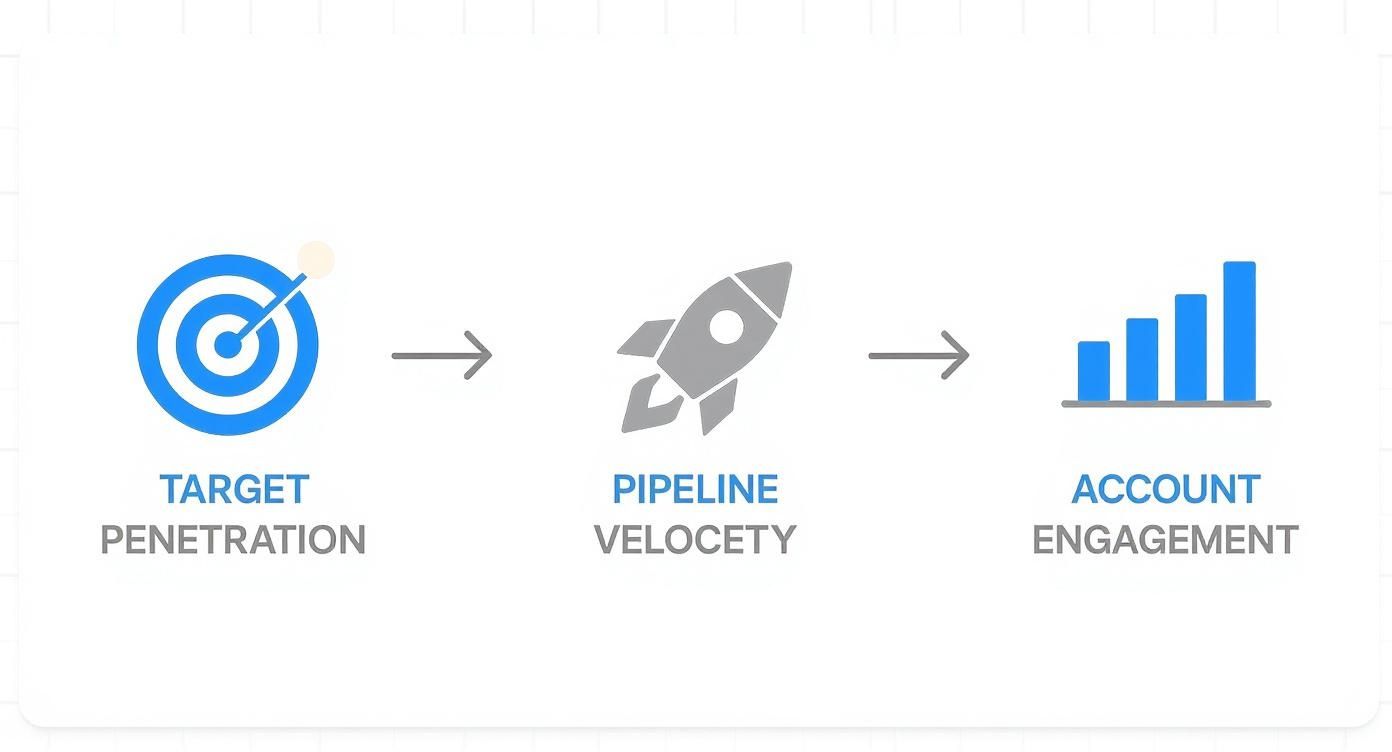
- Target Account Penetration: This measures how many key contacts you’ve meaningfully engaged within your target accounts. It answers, “Are we reaching the right people?”
- Account Engagement Score: A single score that combines every interaction from an account—website visits, content downloads, webinar attendance. It’s your best signal for which accounts are ready for a sales conversation.
- Pipeline Velocity: This tracks how quickly accounts move through your sales pipeline, from first touch to closed-won. A decreasing time-to-close is a powerful sign your ABM strategy is working.
When you measure account engagement instead of counting leads, your perspective shifts. You’re no longer a lead-gen machine; you’re building relationships within the companies that can truly move your business forward.
Building Your ABM Dashboard
To get a real-time pulse on your program, you need a simple dashboard focused on these new KPIs. This shifts the conversation from old-school metrics to account-centric ones. If you need a refresher on the basics, our guide on what is marketing analytics can provide a solid foundation.
Here’s a look at what an essential ABM dashboard should track.
| Metric | What It Measures | How to Track It (Example) | Why It’s a Better KPI than Clicks/Leads |
|---|---|---|---|
| Target Account Coverage | The percentage of your target accounts where you have engaged at least one key contact. | (Engaged Accounts / Total Target Accounts) x 100 | This shows reach within your defined market, not just random website traffic. |
| Account Engagement Score | The level of interest is from an entire account, not just one person. | Sum of weighted activities (e.g., webinar attendance = 10 pts, email click = 2 pts) per account. | It prioritizes accounts showing genuine buying intent across their entire team, signaling sales-readiness. |
| Sales Cycle Length | The average time for a target account to move from first touch to a closed deal. | Track the average days between “Created Date” and “Closed-Won Date” for ABM accounts. | This directly measures the impact of your efforts on accelerating revenue generation. |
| Average Deal Size | The average contract value of deals closed within your target account list. | Compare the average deal size for ABM-targeted accounts versus non-ABM accounts. | It proves that focusing on high-value accounts leads to more substantial, business-changing wins. |
A dashboard built around these KPIs doesn’t just track progress—it changes how your organization thinks about marketing’s contribution to the bottom line.
Your First 90-Day Account Based Marketing Action Plan
Strategy is great, but a plan turns ideas into revenue. This 90-day action plan is your roadmap to get a pilot ABM program off the ground, build momentum, and secure early wins. The goal is to get from planning to doing as fast as possible, learning as you go.
Days 1-30: Foundation and Focus
The first month is about getting the foundation right. Rushing this part leads to misaligned campaigns. The focus is clarity and alignment.
Your checklist:
- Finalize ICP and Target List: Lock down your Ideal Customer Profile and build a prioritized list of 10-20 high-value accounts for this pilot.
- Secure Sales & Marketing Alignment: Hold a kickoff meeting. Review the target list, define roles, and agree on handoff criteria in your Service Level Agreement (SLA).
- Configure Your Tech: Ensure your CRM is set up to track accounts, not just leads. Build the necessary dashboards to track pilot KPIs from day one.
Days 31-60: Campaign Development and Launch
With your targets locked and your team aligned, it’s time to build and launch your first campaign “play.” The focus this month is on creative execution and engagement.
What to do:
- Deep-Dive Account Research: For your top-tier accounts, build a dossier on their challenges, strategic goals, and key players.
- Develop Personalized Messaging: Ditch generic templates. Craft unique value propositions for each account or account tier.
- Launch Your First Coordinated Play: Execute your multi-channel campaign—roll out personalized emails, launch targeted LinkedIn ads, and send any planned direct mail.
This is where you shift from targeting accounts to actively engaging them.
Days 61-90: Monitoring and Optimization
Your campaign is live and data is coming in. This final phase is about analysis and iteration. You will watch what’s happening, get feedback from sales, and make smart adjustments.
Your priorities:
- Monitor Account Engagement: Keep a close eye on your ABM dashboard. Which accounts are lighting up? Which messages are resonating?
- Conduct Weekly Sales Check-ins: Talk to sales every week. What are they hearing on calls? What objections are coming up? This qualitative feedback is gold.
- Run Your First Optimization Cycle: Use data and feedback to tweak your messaging, adjust ad targeting, or refine your follow-up sequence.
Your Top Account Based Marketing for B2B Questions, Answered
Jumping into account-based marketing always sparks questions. As a business owner, you need straight answers before committing your time and budget. Here are the most common ones we hear.
How Much Should We Budget for an ABM Pilot?
The honest answer is: it depends. A smart starting point is to redirect 10-20% of your current marketing budget. This isn’t about finding new money—it’s about using what you have more effectively on accounts that matter.
Instead of another broad ad campaign, that budget could fund:
- A high-impact direct mail piece for 10 key executives.
- A hyper-targeted LinkedIn ad campaign reaching just 50 people.
- A subscription to a sales intelligence tool for better data.
Start small, prove the ROI on a focused pilot, and then you’ll have the justification to scale up.
How Many Accounts Should We Target?
Trying to target too many accounts is a classic mistake that dilutes focus. For your first pilot, keep the list tight:
- Tier 1: 5-10 “white whale” accounts for full 1-to-1 personalization.
- Tier 2: 15-25 accounts for 1-to-few plays, grouped by industry or challenge.
This keeps the workload manageable so your teams can give each account the attention it deserves. You can always add more accounts once you have a proven system.
Key Takeaway: Account-based marketing for B2B is a marathon, not a sprint. The objective is to build a scalable, repeatable system that delivers results. Starting with a focused list gives you room to learn, optimize, and build the confidence to go bigger.
Ready to stop guessing and start winning the high-value clients that will transform your business? With account based marketing for B2B, Machine Marketing builds systems that directly connect your marketing spend to real, measurable revenue. Book a discovery call with us to get a clear diagnosis of your current strategy and a practical roadmap for real growth.