If you’re struggling to generate B2B leads consistently, the problem isn't a lack of effort—it's the lack of a system. Random tactics produce random results. To get a predictable flow of qualified buyers, you need an engineered process built on a precise customer profile, clear messaging, and a structured outreach plan.
This isn't about hoping for leads. It's about building a machine that finds and qualifies the right prospects, every single time. This guide is your blueprint for building that machine.
Diagnosing Your Lead Generation System
When leads are a trickle, not a flow, the root cause is almost always the system, not the people. We see this all the time—business owners throw more money at ads or hire another salesperson, hoping to patch a foundational problem.
The good news? A system can be diagnosed and fixed.

Before you spend another dollar, you must pinpoint where things are really breaking down. Let's start with an honest look under the hood. A high-performing lead generation engine isn’t a mystery; it’s the result of getting a few critical parts working together.
Start with Foundational Questions
Answering these questions honestly is the first step toward a predictable flow of leads. Get your team in a room and put these on the whiteboard:
- Who are we really selling to? Do you have a documented Ideal Customer Profile (ICP)? Is it based on data from your best clients, or is it a guess?
- Does our messaging connect? When a prospect reads your website or email, does it speak directly to their biggest problems? Or are you just listing features?
- Is our outreach repeatable? Can a new hire follow a clear process to find and contact leads? Or is every attempt a manual scramble?
- What happens when a lead raises their hand? When a prospect shows interest, is there an immediate, automated next step? Or do they sit in an inbox waiting for someone to notice?
These questions often reveal uncomfortable truths. Many businesses discover their "system" is just a collection of disconnected activities. That lack of a cohesive structure is precisely why so many marketing efforts fail to deliver a reliable return.
Identifying the Gaps in Your System
To make this diagnosis more concrete, think of your lead generation like an assembly line. Each station must do its job correctly for a qualified lead to emerge. If one part is broken, the whole line grinds to a halt.
Use this simple checklist to find the weak spots in your current process and start a conversation about what needs to be fixed first.
| Lead Generation System Diagnostic Checklist |
| :— | :— | :— |
| System Component | Status (Clear/Unclear/Non-Existent) | Question to Ask Your Team |
| Ideal Customer Profile (ICP) | | Could a new hire read our ICP and know exactly who to target tomorrow? |
| Core Messaging & Value Prop | | Does our homepage headline make a prospect say, "That's exactly my problem"? |
| Outreach Channels (Email, LinkedIn, etc.) | | Do we have defined, repeatable sequences for each channel we use? |
| Lead Capture & CRM Integration | | Is every new lead automatically entered and tagged in our CRM? |
| Follow-Up & Nurture Process | | What happens to a lead who says "not right now"? Is there an automated plan? |
| Key Performance Indicators (KPIs) | | Can we pull a report in 5 minutes showing our cost per lead and meeting rate? |
Completing this checklist gives you a clear, visual map of where the breakdowns are happening. It moves the problem from a vague "we need more leads" to a specific "our follow-up process is non-existent."
Your goal isn't just to find more leads; it's to build a system that produces the right leads, predictably and scalably. This shift in mindset from "hunting" to "engineering" is critical for long-term growth.
As you diagnose your current setup, it’s also worth exploring how technology can fill these gaps. For instance, a modern AI workflow for lead generation can automate prospect discovery and qualification, removing much of the manual work from the equation.
By methodically checking each component—from who you target to how you follow up—you build a foundation that can support real growth. This diagnostic phase isn't glamorous, but it’s the most important step you'll take.
Building Your Foundation with a Laser-Focused ICP
High-quality B2B leads don't just happen; they're engineered. The process starts long before you send an email or launch an ad. It begins with getting undeniably clear on who you're talking to. Trying to generate leads without a precise Ideal Customer Profile (ICP) is like building a house without a blueprint—expensive, chaotic, and guaranteed to fail.
Many businesses think they have an ICP, but what they really have is a vague description that's too broad to be useful. "Manufacturing companies with 50-200 employees" isn't a profile; it's a starting point. An actionable ICP is a detailed portrait of the companies that get the most value from what you do and are the most profitable for you to serve.

From Vague Ideas to Data-Driven Profiles
To build an ICP that actually works, you have to stop guessing and start diagnosing. The answers you need are already inside your business, with your best existing customers. They are the proof of your value. Your first move is to interview your top 5-10 clients—the ones you wish you could clone.
Get on the phone with them and ask these direct questions:
- Trigger Events: What was happening in your business that forced you to look for a solution like ours?
- Pain Points: What specific problems were you trying to solve? Listen for their exact words.
- Desired Outcomes: Before you talked to us, what did a "win" look like for you?
- Alternatives: What other options did you consider? (Don't forget to ask about the most common alternative: doing nothing).
This isn't an academic exercise. It's how you move from abstract demographics to the real human motivations that drive every purchasing decision. A sharp profile acts as your filter, ensuring you only spend time, energy, and money on prospects who are a perfect fit.
Translating Your ICP into Resonant Messaging
Once you know who you're talking to, the next step is figuring out what to say. Your messaging needs to be a magnet for your ICP and a mild repellent for everyone else. Generic marketing copy that tries to be everything to everyone ends up being nothing to anyone.
The goal isn’t to be clever; it’s to be clear. Your prospects don’t care about your company’s history or a list of features. They care about their problems. Your messaging should be a mirror reflecting their reality.
The best way to do this is to map the pain points and desired outcomes from your ICP research directly to your services. Create a simple framework that anyone on your team can use.
- Problem: "Many machine shops struggle with…" (State the exact pain point you heard in your interviews.)
- Solution: "We help you solve this by…" (Connect it directly to your service.)
- Transformation: "So you can finally…" (Describe their desired outcome in their terms.)
This structure forces you to speak your customer's language. It immediately shifts the conversation from what you do to what you deliver. This customer-first approach is also the bedrock of more advanced strategies. If you're interested in going deeper, our guide on account-based marketing for B2B shows how to apply this precise messaging to your highest-value accounts.
Aligning Your Team with a Simple Framework
Your ICP and messaging framework can't live in a forgotten Google Doc. They are operational tools that must guide every marketing and sales action. The key is to make them practical by distilling everything into a simple one-page summary.
This single document becomes the source of truth for your entire operation:
- Sales teams use it to build hyper-targeted prospect lists.
- Marketing teams use it to write ad copy and landing pages that convert.
- Content creators use it as a guide for developing blog posts that resonate.
When your entire team is aligned around a single, data-backed definition of your best customer, your lead generation efforts become exponentially more effective. This isn't just prep work; it's the engine that will drive everything else we're about to build.
Engineering a Multichannel Outreach System
Now that you have your blueprint, it's time to build the machine that delivers qualified leads. A random approach—an email blast here, a LinkedIn message there—doesn't work. You need an integrated system where every channel works together, turning guesswork into a predictable process.
A scattered strategy breeds chaos. A true system gives you clarity and control over how you find your next customer.

Making LinkedIn Your Primary Engine
When it comes to B2B, one platform is the undisputed heavyweight champion. For most business owners, LinkedIn isn't just an option; it's the most direct, data-rich channel for connecting with decision-makers.
The numbers don't lie. A staggering 80% of all B2B leads come from LinkedIn. It’s where business happens online and the natural starting point for your outreach system. You can dig into more stats and learn how LinkedIn outperforms other channels.
But just being on LinkedIn isn't enough. You have to engineer your presence for outreach.
- Optimize Your Personal Profile: Your profile is not a resume; it's a landing page. Your headline and "About" section should speak directly to your ICP’s pain points. Ditch "CEO at [Your Company]" for "Helping Machine Shops Slash Downtime with [Your Solution]."
- Leverage Sales Navigator: This is non-negotiable for serious B2B outreach. Sales Navigator is how you build hyper-targeted lists based on the exact ICP criteria you’ve already defined—company size, industry, specific job titles.
- Craft Connection Requests that Work: The generic "I'd like to connect" message is a dead end. Reference a shared connection, a recent post, or relevant company news. The goal isn't to sell; it's to start a real conversation.
Building a Targeted Email Outreach Sequence
While LinkedIn opens doors, email is the workhorse for structured follow-up. A well-designed email campaign delivers your message directly and builds familiarity over time. This isn’t about spamming a purchased list; it's about thoughtful communication with a hand-picked group of prospects.
First, you need accurate contact info. Tools like Apollo.io or Hunter.io are excellent for finding verified email addresses for contacts you’ve identified on Sales Navigator. This step is critical—it ensures your messages get delivered.
Your email sequence isn't meant to get an immediate "yes." The goal is to stay top-of-mind by consistently offering value and showing you understand their world. When the time is right, you'll be the first person they think of.
With your list ready, build your sequence. A solid outreach cadence might look like this:
- Email 1 (The Icebreaker): A short, personalized message referencing a trigger event or pain point specific to their industry.
- Email 2 (The Value Add): Send something genuinely useful—a short case study, a relevant article, or a link to a helpful tool. No sales pitch.
- Email 3 (The Gentle Nudge): A quick follow-up. Ask if they had a chance to see the resource and if it sparked any ideas.
- Email 4 (The Breakup): A polite final message letting them know you won't follow up again unless you hear back. This often prompts a response.
Keep every email short, make it easy to read on a phone, and stick to a single call to action.
Capturing High-Intent Leads with Targeted Ads
Direct outreach is your proactive engine, but targeted ads act like a net, catching prospects who are already searching for a solution. You don't need a huge budget to make this work—you just need to be precise.
For most B2B companies, the two most effective channels are LinkedIn Ads and Google Search Ads.
- LinkedIn Ads: This platform lets you place your message directly in the feed of your ICP with surgical precision. Target by job title, company, and industry. A great starting point is to promote a high-value asset, like a webinar or an industry guide.
- Google Search Ads: This is all about capturing active intent. You bid on the specific keywords your ideal customer would type into Google when they have a problem you can solve, like "CNC machine maintenance services" or "custom metal fabrication near me."
The real magic happens when you integrate everything. A prospect might see your LinkedIn ad, get a connection request, and later receive a follow-up email. This multichannel approach builds credibility and keeps you visible, dramatically increasing your odds of success.
Using Content and SEO as a Lead Magnet
Outreach is how you get a foot in the door. Inbound content marketing is how you get qualified B2B leads to come knocking on your door.
This approach flips the script. You stop chasing prospects and start attracting buyers by turning your expertise into a magnet for your Ideal Customer Profile (ICP). It’s about answering the questions they’re already asking Google, long before they’re thinking about a sales call. When you create genuinely helpful content, you're building an asset that can generate leads for years.
First, Diagnose Your Audience’s Pain Points
The best content starts with a diagnosis of your audience's problems. What’s keeping them up at night? What’s standing between them and their goals? Your ICP research from earlier is the perfect place to start.
Your job is to identify the exact phrases a potential customer would use when looking for a solution. Don't just think about your service name.
- Are they searching for "how to reduce scrap in CNC machining"?
- Do they need to know the "best practices for industrial equipment maintenance"?
- Or are they looking for a "checklist for factory safety compliance"?
Every question is a content opportunity. By creating content that solves these specific problems, you instantly position yourself as a knowledgeable guide, not just another vendor. That’s how you build trust from the very first click.
Turn Your Expertise Into High-Value Content
Once you know what your ICP is asking, create the best answers on the internet. Your deep industry knowledge is your most powerful marketing tool. You don't need a huge content team; you just need to document what you already know.
This content must be practical and immediately useful. Create resources like:
- How-To Guides: In-depth, step-by-step articles that walk readers through solving a specific problem.
- Checklists and Templates: Downloadable resources that make a complex process easier for your audience.
- Case Studies: Real-world examples showing exactly how you helped a customer tackle a challenge and get a specific result.
This is a long-term play, but the data is clear. SEO-driven leads have a 14.6% close rate, which blows outbound's 1.7% out of the water. Nurtured leads from content also result in 50% more sales at a 33% lower cost. You can discover key insights about lead generation statistics to learn more.
SEO Is The Engine That Drives Traffic
Creating great content is only half the job. Search Engine Optimization (SEO) ensures your ideal customers actually find it. SEO isn’t a dark art; it’s the process of making your content easy for search engines like Google to find, understand, and rank.
Your content's job is to solve a prospect's problem. SEO's job is to make sure your solution shows up when they're searching for it. The two must work together.
Think of every piece of content as a digital salesperson working for you 24/7. When you optimize it correctly, you get in front of people actively looking for your expertise. Our guide to content marketing best practices breaks down how to bake SEO principles into your content from the start.
Build a Simple Content Calendar
To make this work, you must be consistent. A simple content calendar keeps you on track. A basic spreadsheet is all you need to get started.
Here’s a simple framework to get you going:
| Month | Theme/Topic Cluster | Target ICP Pain Point | Content Piece 1 (Blog Post) | Content Piece 2 (Checklist) |
|---|---|---|---|---|
| Month 1 | Equipment Maintenance | Reducing Unplanned Downtime | "5 Early Warning Signs of Machine Failure" | "Daily Maintenance Checklist for CNC Machines" |
| Month 2 | Production Efficiency | Improving Output Without Adding Staff | "How to Conduct a Bottleneck Analysis on Your Shop Floor" | "Production Efficiency Calculator Template" |
| Month 3 | Team Training & Safety | Ensuring Operator Safety and Compliance | "A Guide to OSHA's Top 10 Manufacturing Violations" | "New Employee Safety Orientation Checklist" |
This approach ensures every piece of content is tied directly to a business goal and a customer need. It transforms your blog from a collection of random articles into a strategic asset that consistently brings in high-intent, sales-ready B2B leads.
Building Your Tech Stack for Automation
A brilliant strategy is just an idea until you have the tools to execute it. Your outreach systems and ICP are the engine of your lead generation machine. Your technology stack is the chassis and transmission—the backbone that makes sure all that power gets to the road.
This isn't about buying expensive enterprise software. It's about piecing together affordable, powerful tools that guarantee no lead gets left behind. The goal is to automate repetitive work so your team can focus on what they do best: talking to people and closing deals.
Your CRM Is Your Single Source of Truth
The heart of any modern lead generation system is a Customer Relationship Management (CRM) platform. This is the central nervous system for your entire sales and marketing operation. Every lead, every email, every call, and every deal lives here, giving you a clear, real-time picture of your pipeline.
For most business owners we work with, a tool like HubSpot or GoHighLevel is a perfect fit. They’re built to handle the entire customer journey, from the first touch to a long-term partnership.
A good CRM instantly solves common operational headaches:
- It kills the "lost lead" problem. No more prospects buried in a forgotten spreadsheet or a salesperson's inbox. Every lead is captured and accounted for.
- It gives you total visibility. You know where a lead came from, what pages they viewed, and where they are in your sales process.
- It forces sales and marketing to work together. When both teams look at the same data, the classic disconnect finally stops.
Designing Simple Automation Workflows
This is where you get a huge return on your technology investment. By setting up simple "if this, then that" rules, you can put critical tasks on autopilot. We're talking about automating the simple, predictable steps that are easy to forget but costly to miss.
The real magic of automation isn't just about saving time; it's about being relentlessly consistent. It ensures every lead gets the right follow-up at the right time. For a small team, that kind of systematic approach is a game-changer.
Start with these foundational workflows:
- Instant Lead Routing: A new lead fills out a demo request form. An automation instantly assigns it to the right salesperson and sends them a notification. They can now follow up in minutes, not hours.
- Follow-Up Reminders: A salesperson gets a new lead but hasn't logged a call or email within 24 hours. The system automatically sends a reminder. This simple workflow can save countless high-intent leads from going cold.
- Basic Nurture Sequences: Someone downloads your "CNC Maintenance Checklist." The system automatically adds them to a 3-email sequence that sends more helpful content on that topic over the next week. It's a value-add, not a hard sell.
Our guide on marketing automation for small businesses breaks down exactly how to set up these systems to save time and close more deals.
Tagging and Segmentation for Smarter Outreach
Finally, your tech stack allows you to get smart with your communication. Using tags and segments inside your CRM lets you group leads based on who they are and what they've done. This is how you stop sending generic email blasts and start sending relevant outreach that gets a response.
You can create segments based on almost anything:
- Lead Source: "LinkedIn Outreach," "Website Demo Request," "Trade Show."
- Industry: "CNC Machining," "Metal Fabrication," "Plastics Injection Molding."
- Behavior: "Downloaded Maintenance Checklist," "Visited Pricing Page," "Attended Webinar."
Organizing your contacts this way is incredibly powerful. Now you can send a targeted email about a new maintenance service specifically to the people who downloaded your checklist. Your marketing suddenly feels less like an interruption and more like helpful advice.
Your 90-Day Lead Generation Action Plan
Theory is useless without action. Real wins come from execution. That's why we're mapping out a clear, 90-day action plan to prove this system can work for your business.
Don't think of this as a massive overhaul. Treat it like a focused experiment designed to get tangible results, fast. We'll break it down into three 30-day sprints, moving you from guesswork to a predictable lead generation engine without the overwhelm.
Sprint 1 (Days 1-30): Build Your Foundation
Your first month is all about preparation. You cannot skip this step. Trying to jump straight into outreach without this groundwork is the number one reason B2B lead generation campaigns fail.
Your singular focus this month is achieving absolute clarity.
- Finalize Your ICP & Messaging: Use the frameworks we covered. Talk to your best customers, dig in, and define your Ideal Customer Profile. Then, craft messaging that speaks directly to their biggest problems.
- Set Up Your Tech Stack: Get your CRM configured. Whether it's GoHighLevel or HubSpot, import your contacts and set up basic pipelines for tracking and tagging new leads.
- Build Your Initial Prospect List: Armed with your new ICP, build a target list. Use tools like LinkedIn Sales Navigator or Apollo.io to build a laser-focused list of at least 200 high-fit prospects.
The tech you put in place is the engine for everything that follows. It allows you to scale your efforts without losing the personal touch.
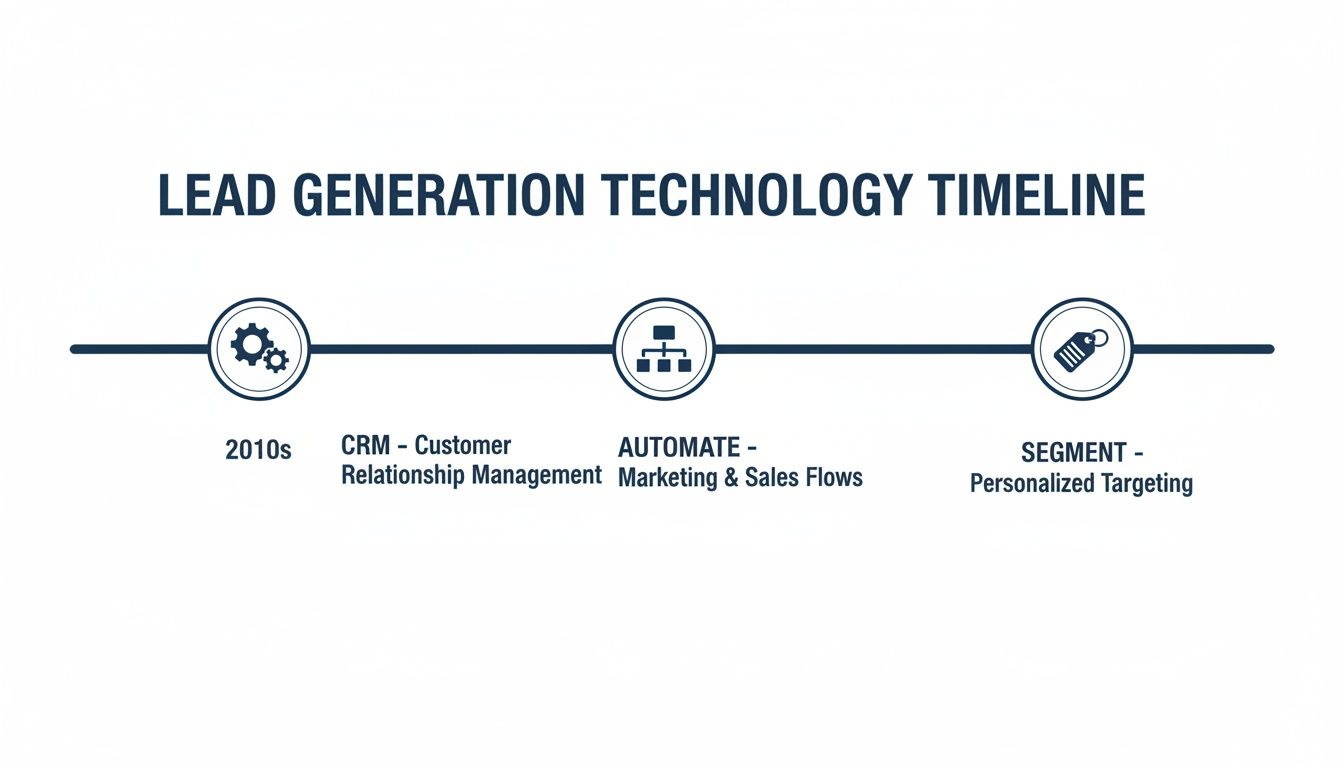
As you can see, it's a progression. You master your CRM, layer in smart automation, and then start targeting with precision. Each step builds on the last.
Sprint 2 (Days 31-60): Launch and Gather Data
With your foundation solid, it's time to launch. The goal here isn't perfection; it's activity. It's about getting your message in front of real people to see what works.
This is the month you deploy your first multichannel outreach campaigns to the prospect list you built. Start sending personalized LinkedIn connection requests. Launch your multi-touch email sequences.
The key: Do not obsess over the results yet. The mission is to execute the plan consistently and start collecting data.
Sprint 3 (Days 61-90): Review and Optimize
You now have a full 30 days of real-world data. It’s time to look under the hood, diagnose what's happening, and make intelligent tweaks. This is where you shift from just doing the work to engineering a better result.
Get familiar with your core Key Performance Indicators (KPIs):
- LinkedIn Connection Rate: Are people accepting your request? Aim for 20% or higher.
- Email Open & Reply Rates: A good benchmark is a 30% open rate and a 2-5% reply rate.
- Meetings Booked: This is the bottom line. How many qualified sales conversations did your work generate?
If your numbers are low, don't panic. It's expected on the first run. This is feedback, not failure. Go back to your messaging. Tweak your email subject lines. Rework your LinkedIn connection note. Then run the test again.
This 90-day cycle of building, launching, and optimizing isn't a one-time project. It's the framework you will use to create a B2B lead generation system that lasts.
Common B2B Lead Generation Questions
Even with a blueprint, questions will come up. Here are the most common ones we hear from business owners who are ready to build a reliable lead generation system.
How long until I see real results?
The honest answer: while you can get quick wins, a truly sustainable system takes time. Expect to see consistent, predictable results in about 60-90 days.
Here’s a realistic breakdown:
- First 30 Days: Foundation work. Your focus is on nailing your ICP, sharpening your messaging, and configuring your tech stack.
- Next 30-60 Days: Launch time. Get your first campaigns out the door, test your assumptions, and gather crucial data.
- After 90 Days: By now, you've started optimizing based on what the market is telling you. This is where a reliable flow of quality leads begins to take shape.
What is a realistic budget for a small business?
You can start with a "sweat equity" approach, focusing on manual LinkedIn outreach and creating your own content. It works, but it's not scalable.
When you're ready to automate, plan for a few key tools. A good starting point is a CRM like GoHighLevel ($100-300/mo), a data provider like Apollo.io ($100/mo), and a modest ad spend of $500-$1,500/mo. That's enough to accelerate your testing on platforms like LinkedIn or Google Ads.
Should I focus on inbound or outbound first?
Start with outbound.
If you want the fastest path to feedback and your first sales conversations, nothing beats direct outreach on LinkedIn and email. It forces you to test your messaging against the real world and validate your ICP right away.
Then, use the insights from those initial conversations—the language prospects use, the problems they actually care about—to fuel your inbound content strategy. A healthy mix of both is the long-term goal, but outbound gets you in the game today. For a deeper look at different tactics, this guide on 10 Proven B2B Lead Generation Strategies is a great resource.
Building a predictable lead generation system is the single most powerful move you can make for sustainable growth. At Machine Marketing, we specialize in diagnosing and engineering these exact systems for business owners.
If you’re ready to stop guessing and start building a system that delivers results, book a free discovery call with us today. https://machine-marketing.com