If your content marketing feels like you're just throwing spaghetti at the wall, you're not dealing with an idea problem—you have a system problem. Without a clear process, even great ideas result in "random acts of content" that don't build momentum or drive results.
In this article, we'll diagnose why a simple to-do list for posts isn't enough. We'll give you a step-by-step framework to build a true content system—one that turns your marketing from a cost center into a predictable growth engine.
Moving Beyond a Schedule to a Content System

We see this diagnosis all the time: a business owner knows they should be posting, so they scramble to create something whenever they find a spare moment. The outcome? An inconsistent presence that fails to tell a cohesive story or guide potential customers toward a solution.
The Shift from Scheduling to System Building
What's the difference between a schedule and a system? A schedule just answers, "What are we posting today?"
A true content system answers the much more important questions: "Why are we posting this? Who is it for? And how does it help us hit our business goals?" This shift in perspective is what transforms your marketing efforts.
Here’s the fundamental difference:
- A Schedule: Focuses on filling slots. It's tactical, short-sighted, and a fast track to burnout and muddled messaging.
- A System: Is a repeatable process built for efficiency and impact. It ties every single piece of content back to a larger business objective, ensuring your efforts compound over time.
A content system is your operational blueprint. It defines your goals, audience, themes, and workflow, creating a reliable machine that produces valuable content, consistently. This is how you build a marketing operation that gets results.
Adopting this mindset is crucial. You’re building an asset for your business, not just checking off a daily task. To get this right, you have to master the social media content calendar by planning, posting, and measuring performance effectively.
A well-built system brings clarity and direction, ensuring your content is perfectly aligned with your business strategy. For a deeper dive into this foundational thinking, read our guide on how to build a marketing plan that connects all the dots.
Defining Your Content's Purpose and Pillars

Before you think about a single topic, you must define the "why" behind your content. A good content calendar isn’t a to-do list; it’s a strategic tool designed to hit specific business goals. If you skip this part, you're just making noise.
So, ask yourself: What’s the primary job of our content right now? The answer must be tied to a real, measurable business objective.
Start with Your Business Goals
You wouldn't build a machine without knowing its function, and the same goes for your content. Every article, video, and social post needs a purpose that pushes your business forward. Is your main goal to generate more qualified leads? Or are you trying to become the go-to authority in a crowded market?
Most content goals fall into one of these buckets:
- Generate Qualified Leads: Attracting potential customers already looking for your solutions.
- Increase Website Traffic: Driving the right kind of people to your site.
- Establish Industry Authority: Becoming the trusted source for expertise and answers.
- Nurture Existing Leads: Guiding prospects through the sales funnel by addressing their questions.
Pick one primary goal to start. This focus is crucial. Trying to do everything at once is a surefire way to accomplish nothing.
Diagnose Your Audience’s Real Problems
Once your goal is set, get inside the head of your ideal customer. A huge mistake we see is companies relying on vague demographic data. To create content that actually connects, you have to understand your customer's mindset.
What are the real-world questions they're asking? What frustrations are keeping them up at night? The best way to find out is to listen.
Talk to your sales and customer service teams. They are on the front lines hearing the raw, unfiltered challenges and pain points directly from your customers. Their insights are pure gold for content ideas.
This diagnostic work helps you move past generic topics and start addressing specific, urgent needs. This is how you build trust and become a valuable resource, not just another company trying to sell something.
Build Your Core Content Pillars
With your goal defined and audience pain points diagnosed, it’s time to build your content pillars. Think of these as the 3-5 core themes your brand will own. They are the strategic subjects that bridge the gap between what you sell and what your audience needs to know.
These pillars are the foundation of your entire content calendar. They ensure every piece you create is strategically aligned and working towards your goal.
For example, a B2B manufacturer focused on lead generation might land on these pillars:
- Process Optimization: Content showing how to boost efficiency and cut waste.
- Material Science Innovations: Educational content on new materials and their practical uses.
- Preventative Maintenance: Practical guides and checklists for keeping machinery running smoothly.
- Supply Chain Resilience: Insights on building a tougher, more reliable supply chain.
This approach stops you from creating random content. Instead, you're systematically building a library of expertise around the topics that matter most to your ideal customers. A deep understanding of pillars is one of the most important content marketing best practices you can implement.
Use this framework to map this out clearly.
Content Pillar Development Framework
This table helps you connect your business goals and audience pain points to specific content pillars, ensuring every topic is strategically aligned.
| Business Goal | Audience Question/Pain Point | Resulting Content Pillar | Sample Content Topic Ideas |
|---|---|---|---|
| Increase Qualified Leads | "How can I reduce downtime on my CNC machines?" | Preventative Maintenance | – "The Ultimate CNC Machine Maintenance Checklist" – "5 Warning Signs Your Equipment Needs Service" |
| Establish Industry Authority | "What's the next big thing in lightweight alloys?" | Material Science | – "A Guide to Graphene in Industrial Applications" – "Comparing Steel vs. Carbon Fiber in 2024" |
| Drive Relevant Website Traffic | "How do I make my supply chain more resilient to disruption?" | Supply Chain Resilience | – "How to Audit Your Supply Chain for Weaknesses" – "Building a Diversified Supplier Network" |
| Nurture Existing Leads | "Is automating our packaging line worth the investment?" | Process Optimization | – "Calculating the ROI of Robotic Automation" – "Case Study: How We Cut Packaging Costs by 30%" |
This foundational work ensures your entire marketing system is built on solid ground. In fact, 80% of top performers personalize their content calendars around specific audience needs, which can lift conversions by 15-20%. Getting this right from the start makes everything that follows more effective.
Choosing Your Tools and Calendar Structure
You’ve defined your goals and your content pillars are locked in. Now it’s time to build the machine that makes it all happen: the actual content calendar.
Many business owners get stuck here, thinking they need expensive, complicated software. That's a myth. Your first content calendar can be as simple as a well-organized spreadsheet.
The goal isn't to find the "perfect" tool. It’s to create a single source of truth for your entire content operation. This document, whether a spreadsheet or an app, is what brings transparency and efficiency to your process. It's the central hub where your strategy meets execution.
The Foundational Spreadsheet: A Powerful Starting Point
For most businesses starting out, a simple spreadsheet in Google Sheets or Excel is more than enough. It's free, completely customizable, and makes collaboration easy. Its power is in its simplicity.
We’ve seen seven-figure businesses run their entire content operation from a single, well-structured spreadsheet. The key is setting it up correctly from the start.
To make it work, your calendar needs to track each piece of content from idea to publication. Make sure you include these fields:
- Publish Date: The exact date the content goes live.
- Topic/Title: The working headline.
- Content Pillar: Which of your 3-5 core themes does this support? This keeps you on strategy.
- Author/Owner: Who is responsible for getting this done?
- Status: A simple dropdown (e.g., Idea, In Progress, In Review, Scheduled) shows progress at a glance.
- Target Keyword: The primary SEO keyword you're aiming for.
- Format: Is it a blog post, case study, LinkedIn video, or email newsletter?
- Channel(s): Where will this be published and promoted?
- CTA (Call to Action): What do you want the reader to do next?
Pro Tip: Your CTA is non-negotiable. Every piece of content must have a clear next step. Whether it’s "Download the Checklist" or "Book a Diagnosis Call," this is how your content drives business results.
When to Upgrade to a Project Management Tool
Spreadsheets are fantastic, but they do have their limits. As your team or content volume grows, you’ll start to see bottlenecks. Communication gets lost in email chains, and tracking multiple approval stages becomes a mess.
This is when a dedicated project management tool like Asana, Trello, or ClickUp becomes a smart investment.
Here’s a quick rundown of when it’s time to think about upgrading:
| Spreadsheet (Google Sheets/Excel) | Project Management Tool (Asana/Trello) |
|---|---|
| Best For: Solo operators, small teams, and businesses just starting out. | Best For: Growing teams, high-volume production, and complex workflows. |
| Pros: Free, highly flexible, easy to share, and no new software to learn. | Pros: Centralized communication, automated notifications, and clear task dependencies. |
| Cons: Lacks automated reminders, can get cluttered, and has no built-in communication. | Cons: Has a learning curve, involves a monthly cost, and might have features you don't need. |
The decision to upgrade isn't just about features; it’s about efficiency. The global market for marketing calendar software is projected to hit USD 1,157.9 million by 2035—because businesses are realizing how much time and money they save with automation and real-time collaboration.
When your manual spreadsheet process starts costing you more in lost time and missed deadlines than a subscription would, it’s time to make the switch. For a deep dive into planning and organizing your content, check out this comprehensive guide to a content calendar for social media.
Systemizing Your Content Production Workflow
Having a calendar filled with topics is a solid first step, but a real content system is what brings it to life—consistently and efficiently.
This is where you make the critical shift from just planning content to building a repeatable production machine.
Without a system, you’re constantly reinventing the wheel. Every blog post or social update becomes a chaotic project. A documented workflow, however, ensures quality and keeps things moving, no matter who is doing the work. It's about creating a predictable process for turning an idea into a finished asset that drives results.
From Idea to Published: A Simple Workflow
The goal is to map out every stage of content creation so there’s zero guesswork. This process should feel logical and transparent, killing the dreaded "what's the status of that blog post?" emails for good.
A dependable production workflow usually moves through these key phases:
- Idea & Research: This is where you fill the pipeline. Ideas should flow from your content pillars, common customer questions, and keyword research. Find topics your audience is actively searching for—ones you have a realistic shot at ranking for.
- The Content Brief: A detailed brief is the blueprint for your content. This is a non-negotiable step that saves countless hours of revisions. The brief must clearly define the goal, audience, primary keyword, key talking points, and the call-to-action.
- Drafting & Design: This is where the writer and designer execute on the brief. This stage is about creating the raw materials—the copy, visuals, or video footage.
- Review & Approval: Here's where things often get stuck. Establish a clear, simple approval process. Who needs to see it? Keep this circle as small as possible to maintain momentum.
- Scheduling & Promotion: Once approved, the content gets plugged into your chosen tool (like GoHighLevel or a social media scheduler) and a promotion plan is locked in. This means scheduling social posts, prepping an email newsletter mention, and flagging other distribution channels.
This simple process flow chart shows how different tools—from a basic spreadsheet to a Kanban board or a full platform—can support your workflow.
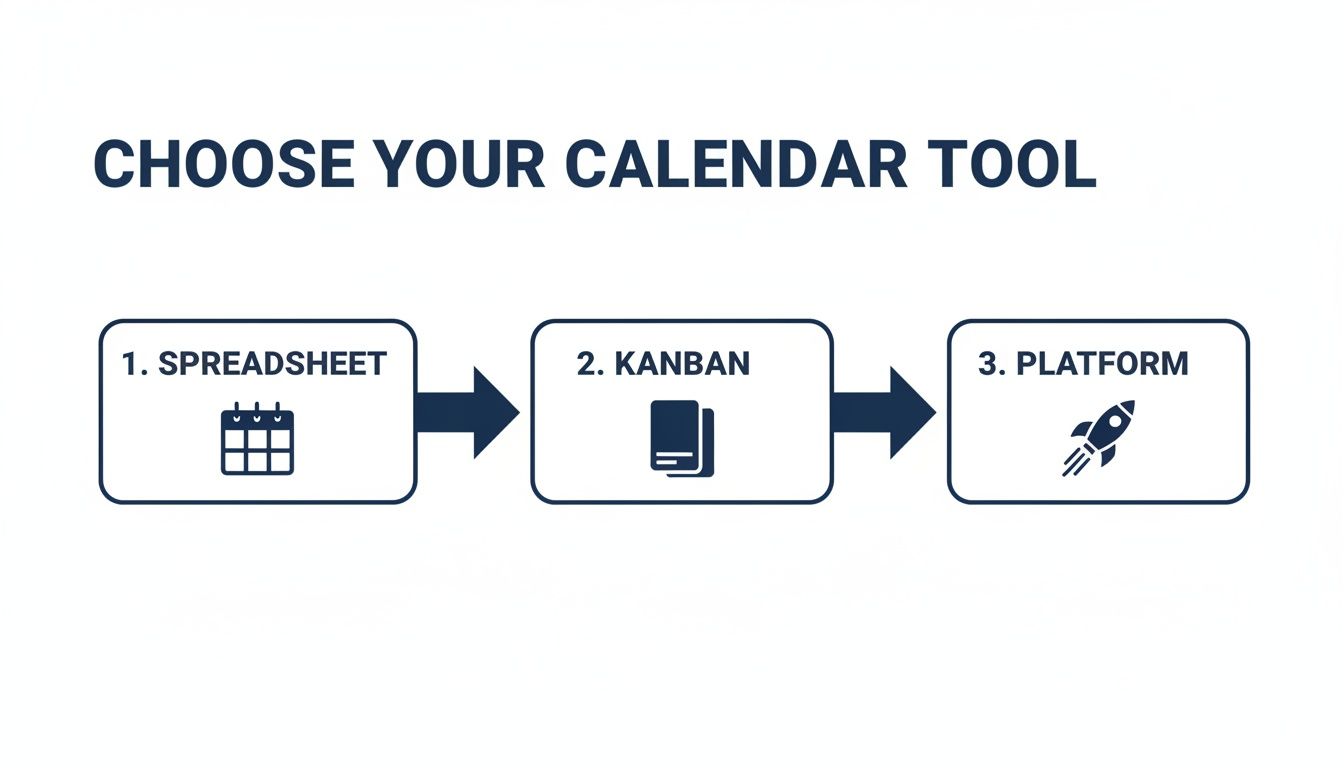
As you can see, the tool just provides the structure; the underlying workflow of planning, creating, and publishing stays the same.
Building Repeatable SOPs
To make your workflow truly systematic, you need to document it with Standard Operating Procedures (SOPs). An SOP is just a simple checklist or document that outlines how to complete a specific task, step-by-step.
You don't need to write a novel. A simple checklist in a Google Doc is often all it takes.
An SOP is about ensuring consistency and quality, not stifling creativity. It empowers your team by giving them a clear roadmap, which frees up their mental energy to focus on producing great work.
For example, your SOP for "Creating a Content Brief" might be a simple checklist like this:
- [ ] Copy the content brief template.
- [ ] Fill in the target audience persona and primary business goal.
- [ ] Add the primary keyword and 3-5 secondary keywords from research.
- [ ] Outline the key sections and talking points for the writer.
- [ ] Specify the final Call to Action (CTA) and the destination link.
- [ ] Assign the brief to the writer and set a clear due date.
Create simple SOPs like this for each major step in your workflow. That’s how you build a content engine that can scale.
Integrating Your Calendar with Your CRM
Your content calendar shouldn't live on an island. To understand its business impact, you must connect it to the tools that track your leads and customers, like your CRM.
This is where a platform like GoHighLevel becomes a game-changer. When you publish a new blog post, for instance, you can create automation workflows inside GoHighLevel that trigger when someone engages with that content.
Here’s a practical example for a manufacturing company:
- A blog post titled "The Ultimate CNC Machine Maintenance Checklist" goes live.
- The CTA is to download the checklist, which takes the user to a GoHighLevel form.
- When a prospect fills out the form, they are automatically tagged in the CRM as a "Hot Lead – CNC Maintenance."
- This tag instantly triggers an email nurture sequence that sends them more helpful content about equipment maintenance and gently introduces your service offerings.
This integration transforms your content from "information" into an active lead generation tool. You can directly see which pieces of content are filling your sales pipeline because the data is all connected in one system. This is how you stop guessing at your ROI and start proving it with hard numbers.
A Real-World 30-Day Content Calendar Example
Theory is great, but seeing a system in action is where things really click. Let's move from the abstract and build out a practical, 30-day content calendar for a B2B manufacturing company.
This isn't just a generic template. Think of it as a real-world model showing how to blend different content formats across your core pillars to hit specific business goals. You can easily adapt this blueprint for your own business.
Our hypothetical company is "Precision Parts Inc.," and their goal this month is to generate qualified leads for their new CNC machining service. Their content pillars are Process Optimization, Material Science, and Preventative Maintenance.
A Sample 30-Day Content Calendar for a B2B Manufacturer
Here’s a week-by-week look at how Precision Parts Inc. can mix content pillars, formats, and channels to build momentum and drive leads.
| Day | Topic/Title | Pillar | Format | Channel | Call to Action (CTA) |
|---|---|---|---|---|---|
| Week 1 | The Ultimate CNC Machine Maintenance Checklist | Preventative Maintenance | Blog Post & PDF | Website/Blog | Download the Checklist |
| Week 1 | Share blog post hook: "Downtime costs money…" | Preventative Maintenance | Text Post | Read the blog | |
| Week 1 | Newsletter Feature: "Your Free CNC Checklist" | Preventative Maintenance | Email List | Download the Checklist Now | |
| Week 1 | "5 Key Maintenance Tips" from the blog post | Preventative Maintenance | Carousel | Get the full checklist (link in bio) | |
| Week 2 | "How ABC Mfg. Cut Production Errors by 15% with Us" | Process Optimization | Case Study | Website/Blog | Book a Free Consultation |
| Week 2 | Share powerful client quote from case study | Process Optimization | Text & Image | Read the Case Study | |
| Week 2 | Poll: "What's your biggest CNC machining challenge?" | Audience Research | Poll | Vote in the Poll | |
| Week 3 | Comparing Titanium vs. Stainless Steel for High-Stress Parts | Material Science | Blog Post | Website/Blog | View Our Material Spec Sheets |
| Week 3 | Lead engineer shares a technical tip on material choice | Material Science | Text-Only Post | What's your experience? (engage) | |
| Week 4 | 60-second video tour of the new CNC machine in action | Process Optimization | Video | Book a Consultation Today | |
| Week 4 | Follow-up: "Free Maintenance Process Audit" offer | Preventative Maintenance | Checklist Downloaders | Schedule Your Free Audit | |
| Week 4 | Announce a new material option or capability | Innovation | Company Update | Reach out with questions |
This calendar shows a natural progression. It starts with high-value, educational content to build an audience (Week 1), then introduces proof with a case study (Week 2). From there, it dives deeper into technical expertise (Week 3) before making a direct push for consultations and nurturing new leads (Week 4).
A Closer Look at the Strategy
Let's break down the "why" behind this calendar.
The first week is all about establishing expertise and capturing initial interest. We're leading with a high-value blog post—"The Ultimate CNC Machine Maintenance Checklist"—that solves a major pain point. It's a lead magnet, optimized for SEO and promoted across LinkedIn and email to drive traffic and capture contacts.
Week two shifts to building trust. With our foundational content out there, we pivot to social proof.
Many companies fall into the trap of only posting self-promotional content. A strong calendar must balance educational content (like the checklist) with proof-based content (like a case study) to guide prospects through their decision-making journey.
We do this by publishing a case study showing how Precision Parts Inc. helped a real company cut production errors by 15%. This isn't just telling; it's showing. We round out the week with a LinkedIn poll to gather audience insights that will fuel future content ideas.
In week three, we dive deep into the Material Science pillar to cement Precision Parts Inc. as a true authority. A technical article comparing materials demonstrates expertise, while a text-only post from the lead engineer adds a welcome human touch.
Finally, the fourth week is all about conversion. After providing value and building trust, it's time to make a direct offer. A short video tour of the new CNC machine ends with a clear CTA to book a consultation.
We also circle back to the leads generated in Week 1, sending a targeted email to everyone who downloaded the checklist with an exclusive offer for a free "Maintenance Process Audit." It's a perfect example of using social media for lead generation and then nurturing those contacts into qualified opportunities.
Questions to Ask Before You Start
Even the best-laid plans run into questions once you start putting them into practice. We hear the same ones all the time from business owners building out their content systems for the first time. Here are the straight answers to the most common sticking points.
How far in advance should I plan my content?
This is a classic question. The best approach is a hybrid one that balances long-term strategy with short-term agility.
Plan your big-picture themes and major campaigns quarterly. This gives you a strategic roadmap, so you know you're aligning content with your actual business goals.
But when it comes to the details—the individual topics and headlines—fill those in just one month at a time. This gives you a high-level vision but keeps you nimble enough to jump on new industry trends or pivot based on what your performance data is telling you.
What are the most important metrics to track?
Forget vanity metrics. Likes and shares are nice, but they don't keep the lights on. The only metrics that truly matter are the ones tied directly to the business goals you set in the first place.
Here’s how to think about it:
- For Brand Awareness: Are more of the right people seeing your brand? Track reach, impressions, and the growth in website traffic from specific channels.
- For Lead Generation: This is where the rubber meets the road. You need to be laser-focused on conversion rates, form fills from your CTAs, and, most importantly, the number of sales-qualified leads (SQLs) that each piece of content generates.
If your goal is to generate leads but you're only celebrating your follower count, you're tracking noise, not results. Always tie your metrics back to revenue.
How do I keep coming up with fresh content ideas?
Running out of ideas shouldn't be a problem if you have a system for capturing them. That way, you’re never starting from a blank page.
First, talk to your sales and customer service teams. They hear the exact questions, objections, and pain points your customers have every single day. Their insights are content gold.
Next, use SEO tools (or even free ones like AnswerThePublic) to see what your audience is actively searching for. This gives you data-backed topics you already know people want to learn about.
Finally, repurpose your greatest hits. That one blog post that performed well? Turn it into a video script. That webinar you hosted? Slice it into a dozen social media tips. Don't reinvent the wheel when you already have proven winners.
What is the difference between a content and an editorial calendar?
People often use these terms interchangeably, but there's a useful distinction.
An editorial calendar typically refers to a publication-style workflow, like for a blog or online magazine. It’s focused on the specific steps of writing, editing, and publishing articles.
A content calendar is a much broader tool. It covers all of your marketing content across all of your channels—social media, email newsletters, videos, and case studies. For most businesses, creating a single, unified content calendar is the way to go, as it provides a complete view of your entire marketing operation.
At Machine Marketing, we build these kinds of systems to help businesses generate leads and grow predictably. If you're ready to move beyond random acts of content and implement a marketing engine that delivers real results, let's talk.
Book a discovery call with Karl today to get a clear roadmap for your business.