If your sales pipeline feels more like a rollercoaster than a predictable machine, you're not alone. We see this all the time—the root cause is often a lead generation system that just isn't engineered for consistent results.
Marketing efforts feel scattered, money gets poured into low-quality inquiries that go nowhere, and the sales team is stuck cold prospecting instead of closing deals. In this guide, we'll show you how to diagnose the gaps in your marketing system and share practical, step-by-step instructions to build an engine that drives predictable growth.
Why Your Current Lead Generation System Is Broken
The real issue is usually a lack of an engineered approach to marketing. You'd never build a complex piece of machinery without a detailed schematic, yet marketing is often a jumble of disconnected activities. A trade show here, a random social media post there—none of it is tied together by a cohesive strategy.

This approach can't produce consistent, repeatable results. Before you can build a better engine, you have to diagnose why the old one keeps stalling out.
Starting with a Clear Diagnosis
To fix this, you have to ask the right questions. Think of it like a machine diagnostic—you wouldn’t just start swapping out parts hoping for the best. You'd analyze the data, pinpoint the real bottleneck, and then make a targeted fix. The same logic applies here. For a great deep dive into this framework, check out this guide on building an automated lead generation system.
Here are the first places to look for trouble:
- Ideal Customer Profile (ICP) Clarity: Do you truly know who your best customers are? This is more than company size or industry. It's knowing their specific operational headaches, non-negotiable technical requirements, and what finally triggers them to look for a new supplier.
- Messaging Resonance: Does your marketing copy sound like it was written by an engineer for an engineer? Vague promises about "quality" and "innovation" are just noise. Your message needs to hit on their specific pain points with credible, technical solutions.
- Channel Alignment: Are you actually showing up where your buyers are? Engineers, plant managers, and procurement specialists spend their time in very specific online and offline spaces. If you're not there, you’re invisible.
The point of this diagnosis isn't to assign blame. It's to find leverage. By identifying the weakest link in your process, you can focus your resources where they’ll have the biggest impact and start building a system that drives predictable growth.
This initial analysis is the bedrock of a stronger strategy. Our guide on digital marketing for manufacturers gives you more context for building this kind of cohesive plan.
Now, let's move from diagnosis to action. In the next sections, we'll lay out the step-by-step playbook to build a high-performance lead generation machine.
Building Your Foundation with a Strong ICP and Messaging
Generic marketing is a one-way ticket to wasted ad spend in the manufacturing world. Your buyers—engineers, procurement managers, and C-suite execs—don't have time for vague promises. They operate on precision and data, and they need to know exactly how your solution solves their very specific operational problems.
This is why a rock-solid Ideal Customer Profile (ICP) isn't just a "nice-to-have"; it's the absolute bedrock of any lead generation system that actually works.

If you can't describe your best-fit customer in excruciating detail, every single marketing dollar you spend will be less effective. An ICP is a deep-dive diagnostic into the companies that are most profitable, easiest to work with, and most likely to stick around for the long haul.
Moving Beyond Basic Firmographics
A weak ICP sounds like this: "We target automotive manufacturers with over $50 million in revenue." An engineered ICP gets into the weeds. It uncovers the real-world context and technical pain points that actually drive a purchasing decision.
To get there, you have to dig into your best existing customers. Ask yourself:
- Operational Pains: What specific production bottleneck were they hitting before they called you? Were they dealing with excessive material waste, fighting constant downtime, or failing to meet tight tolerances?
- Technical Triggers: What was the final straw that forced them to look for a new supplier? Did they fail a compliance audit? Land a new client with impossible specs? Or did a critical failure with their old vendor finally shut down a production line?
- Buying Committee Dynamics: Who really holds the power? Is it the lead engineer who obsesses over performance, the procurement manager who only sees cost and lead times, or the plant manager who just needs it to be reliable?
Answering these questions gives you a true, multi-dimensional picture of your target. This clarity stops you from chasing companies that look great on paper but are a nightmare to work with in reality.
The goal is to create a profile so clear that your sales and marketing teams can instantly recognize a high-potential prospect. It’s the difference between using a shotgun and a sniper rifle for your outreach.
This precision is crucial because manufacturing sales cycles are long, often stretching from 6 to 18 months. The payoff is huge. Data shows that well-nurtured leads can result in 47% larger purchases and generate around 50% more sales-ready leads, all while dropping your cost-per-lead by about 33%. A solid ICP gives you the ammo to stay relevant over that long haul.
To help you get started, we've put together a quick checklist to diagnose your own ICP. Think of it as a blueprint for identifying your most valuable future customers.
ICP Diagnostic Checklist for Manufacturers
| Attribute Category | Questions to Ask Yourself | Example for a Custom CNC Machining Shop |
|---|---|---|
| Firmographics | What industry, revenue range, and employee count? Where are they located? Are they a single-plant operation or multi-national? | Medical device manufacturers with $75M-$250M revenue, located in the Midwest US, with in-house engineering teams. |
| Technographics | What ERP/MES systems do they use? What CAD software is standard? Do they rely on outdated machinery or invest in new tech? | They use SolidWorks for design and run on an older, legacy ERP system that makes supply chain visibility difficult. |
| Psychographics | Are they risk-averse or early adopters? Do they prioritize upfront cost or Total Cost of Ownership (TCO)? What trade publications do they read? | They are quality-obsessed and value long-term reliability over the lowest bid. Their engineers read Medical Design & Outsourcing. |
| Pain Points | Are they struggling with supply chain disruptions? Inconsistent quality from current vendors? Long lead times for complex parts? | Their current supplier is struggling to meet new ISO 13485 compliance standards, putting a major product launch at risk. |
| Buying Triggers | What event initiates a search for a new supplier? A failed audit? A new high-spec product line? A critical vendor failure? | A recent FDA audit flagged inconsistencies in component traceability from their primary machining partner. |
Use this table as a starting point. The more specific you get, the more powerful your targeting will become. It's a living document that you should constantly refine as you learn more about your market.
Translating Your ICP into Resonant Messaging
Once you know exactly who you're talking to, you can craft messaging that lands. Generic marketing fluff like "industry-leading quality" or "innovative solutions" is an instant turn-off for technical buyers. They've heard it all before and need to see that you understand their problems.
Your messaging has to directly hit on the pains and triggers you just uncovered. Instead of rattling off features, translate them into tangible benefits for every person on that buying committee.
- For the Engineer: Don’t just say "high-precision machining." Say, "Achieve tolerances of ±0.001 inches, eliminating rework and ensuring component integrity for your critical aerospace applications."
- For the Procurement Manager: Instead of "competitive pricing," say, "Our streamlined process reduces material waste by 12%, delivering a 15% lower total cost of ownership over the component's lifecycle."
- For the Plant Manager: Don’t say "reliable equipment." Say, "Our system boasts 99.8% uptime, backed by verifiable data, to maximize your production output and crush unplanned downtime."
This approach shifts your value proposition from a generic claim to a specific, compelling solution. By creating messaging that speaks directly to each stakeholder's biggest concerns, you make sure your marketing connects no matter who sees it first. For a deep dive on this, you can learn more about building a powerful marketing messaging framework.
Choosing Your High-Impact Lead Generation Channels
Once you know exactly who you’re talking to and what you need to say, the next question is obvious: where do you say it?
The temptation for many manufacturers is to cast a wide net, putting a little bit of budget everywhere just in case something sticks. Honestly, that’s a perfect recipe for mediocre results and wasted cash.
Instead, get disciplined. Your goal is to master the one or two channels that deliver the absolute best leads for your specific niche. It’s about depth, not breadth. Focus your time and money, and you can build a dominant presence right where your best-fit customers are already looking for answers.
Not all lead sources are created equal. Industry analysis shows that leads from organic search can hit a 14.6% close rate, which is leagues ahead of most outbound tactics. On the social front, LinkedIn is credited with generating up to 80% of all B2B leads. This data tells us that a focused investment in SEO, specialized content, and a smart LinkedIn strategy is a high-ROI move.
Building Your Authority with SEO and Specialized Content
When an engineer or procurement manager has a technical problem, their first move is to open up Google and start searching for a solution. Being the company that provides that solution is one of the most powerful positions you can hold.
Your buyers aren’t searching for vague, top-level terms. They use specific, technical language that shows they're already deep into the buying process.
- They aren't just searching for "metal fabrication." They're searching for "5-axis CNC machining for titanium medical implants."
- They don't look for "conveyor belts." They look for "sanitary conveyor systems for food processing FDA compliance."
Building an SEO strategy around these long-tail keywords is how you attract high-intent traffic. These are prospects who have already diagnosed their own problems and are actively looking for a capable partner. Your job is to create the content that proves you are that partner.
The most effective content for manufacturers often isn't a blog post. It's a valuable, functional asset that helps your prospect do their job better. Think of your content as a tool, not just an advertisement.
Create lead magnets that are genuinely useful to a technical audience, such as:
- Detailed Spec Sheets: Go beyond the basics. Include material properties, performance data, and all relevant compliance info.
- CAD File Downloads: Allowing an engineer to drop your component directly into their design is a massive value-add and a powerful way to capture a highly qualified lead.
- In-Depth Case Studies: Detail the problem, your engineered solution, and the quantifiable results. Show your work and prove your impact.
A Disciplined LinkedIn Strategy
LinkedIn is the digital factory floor. It's where your buyers, competitors, and industry peers all congregate. But just having a company page and posting an occasional update isn't a strategy—it's noise.
An effective LinkedIn plan for lead generation for manufacturing companies requires two things: targeted outreach and consistent authority-building.
First, your team’s personal profiles are your greatest asset. An engineer connecting with another engineer to share a technical insight is infinitely more effective than a generic corporate message. Get your subject matter experts to share project insights, comment on industry news, and engage in relevant groups. This builds personal credibility that reflects back on your brand.
Second, use LinkedIn for precision outreach. With your ICP defined, you can use Sales Navigator to pinpoint the exact decision-makers at your target accounts. The key is to lead with value, not a sales pitch. Your initial message should offer a helpful resource—like one of the content assets we just discussed—rather than just asking for a meeting.
When selecting and implementing any high-impact lead generation channels, adhering to Google Ads lead generation best practices is fundamental for maximizing efficiency, even when you're planning outreach on other platforms like LinkedIn. The principles of targeting and value are universal.
By focusing your energy on these powerhouse channels, you stop chasing low-quality inquiries and start attracting prospects who are actively seeking the expertise you provide. It’s a shift from hunting for leads to engineering a system that brings them directly to you.
Engineering a High-Conversion Manufacturing Website
Your website is your digital factory floor. It needs to be clean, efficient, and built for one specific purpose—turning interested visitors into qualified leads. Too many manufacturing websites are little more than online brochures, packed with technical jargon but lacking a clear path to action.
Frankly, that's a massive missed opportunity.
A confusing or slow website is a lead-killer. We know that over 70% of B2B buyers fully define their needs before ever speaking to a salesperson. If your site doesn't give them the confidence and answers they need in seconds, they will click away to a competitor.
Let's fix that.
Moving from Brochure to Lead Machine
Think of your website as a critical piece of your sales machinery. Every single page, from your homepage down to your most detailed product spec sheet, should guide visitors toward taking the next logical step.
This means shifting your mindset. Stop just presenting information and start engineering an experience that actively encourages conversion. It all begins with building trust and making it incredibly easy for a busy engineer or procurement manager to get what they came for.
Building Unshakeable Trust and Credibility
Technical buyers are skeptical by nature. They need proof, not promises. Your website has to immediately signal that you are a credible, professional, and reliable partner. Here’s how you build that trust on every page:
- Display Your Certifications Prominently: Don't bury your ISO, AS9100, or ITAR compliance badges in the footer. These are powerful signals of quality and expertise. Put them on your homepage and relevant service pages where they can’t be missed.
- Showcase Real-World Success: Use high-quality photos and videos of your actual facility, your team, and your products in action. Generic stock photos communicate a lack of seriousness.
- Leverage Social Proof: Weave in concise testimonials and the logos of companies you’ve worked with. A quick quote from a respected engineer at a known company is worth more than a whole page of your own marketing copy.
A website that looks and feels professional is a subconscious signal that your operations are professional, too. Every design choice, from font selection to page load speed, contributes to a perception of quality and reliability.
Designing Frictionless Forms and Clear CTAs
The single biggest conversion killer on a manufacturing website is friction. If a prospect has to hunt for your contact form or fill out ten fields just to ask a simple question, they won't bother. Your calls-to-action (CTAs) and forms have to be impossible to miss and effortless to use.
Start by auditing every form on your site. Ask yourself: is every single field absolutely necessary right now? For that initial inquiry, you probably only need a name, company, email, and a message box. You can always gather more details later.
Next, make your CTAs direct and valuable. Ditch the generic "Contact Us" and use action-oriented language that matches what your buyer wants to do:
- Request a Quote
- Download CAD Files
- Schedule a Technical Consultation
- View Spec Sheet
Place these CTAs strategically on every relevant page, making it simple for the visitor to know what to do next. This clarity is fundamental. By removing guesswork and simplifying the process, you ensure every interested click has the best possible chance of becoming a real sales opportunity.
Automating Your Sales Engine with a CRM and Nurturing
Getting a lead is a huge win, but for manufacturers with long, complex sales cycles, it’s just the starting line. The real work—and where most marketing systems fall apart—happens in the weeks and months after that first handshake or form submission.
This is where promising opportunities get lost in messy spreadsheets. Follow-ups become sporadic, and your sales team ends up wasting precious time on prospects who aren't ready to talk specifics.
The answer isn’t to chase harder; it’s to build a smarter, more automated system. A well-configured Customer Relationship Management (CRM) platform, powered by automated nurturing workflows, can turn that leaky bucket of leads into a predictable revenue machine.
Choosing the Right CRM System
Think of a CRM as the central nervous system for your entire sales and marketing operation. It’s the single source of truth where every lead, every conversation, and every piece of customer data lives.
But not all CRMs are built for the job. You need a system that can handle the specific, technical demands of a manufacturing sales process.
What to look for in a CRM for your manufacturing business:
- Customization: Can you track unique data points like project specs, material requirements, part numbers, and compliance needs? A rigid, out-of-the-box CRM won’t cut it.
- Built-in Automation: Is the power to create automated email sequences, score leads based on their behavior, and assign tasks to reps a core feature? It should be.
- Integrations: Can the CRM talk to your website forms, your email marketing tools, and maybe even your ERP? A seamless connection is key.
For a much deeper look at this, our complete guide on choosing a CRM for manufacturing companies walks through every feature you should be looking for.
Building Automated Nurturing Workflows
Once your CRM is set up, you can start building the automated sequences that will do the heavy lifting for you. The point is to deliver the right information to the right person at exactly the right time, guiding them through your sales cycle without you manually sending every email.
Your buyers are busy. An automated nurturing system ensures you stay top-of-mind by consistently delivering value, positioning you as the go-to expert when they are finally ready to make a decision.
This isn’t about spamming people with sales pitches. It’s about being a genuinely helpful resource. The investment in this technology is exploding because the ROI is clear. The global market for marketing automation is expected to hit between $15–$21 billion by the early 2030s. More importantly, it just works—around 80% of users report an increase in lead volume after implementing it. (Find more stats on lead gen tech at UpLead).
Here are a few essential workflows every manufacturer should build right away:
- The "Spec Sheet Download" Follow-Up: A prospect downloads a technical document. This should immediately trigger a sequence that offers a related case study, a video of the component in action, and, a week later, an invitation for a no-pressure technical consultation.
- The "Trade Show Lead" Nurture: You scanned a badge at a trade show. That lead should get a personalized "nice to meet you" email within hours, followed by content that reinforces the conversations you had at your booth. This keeps the momentum going.
- The "Quote Request" Confirmation: When someone submits an RFQ, they should instantly get an email confirming you received it and letting them know the exact next steps and timeline. It provides immediate reassurance and sets a professional tone.
To help you visualize this, here are some of the most effective workflows we build for our manufacturing clients.
Essential Lead Nurturing Workflows for Manufacturers
| Trigger Action | Workflow Goal | Sample Content Sequence |
|---|---|---|
| Downloads a CAD file or spec sheet | Provide technical validation and build trust | Email 1: Link to a relevant case study. Email 2: Video demo of the part in action. Email 3: Invite to a 15-min tech call. |
| Becomes a trade show lead | Re-engage and continue the conversation | Email 1: "Great meeting you at FABTECH!" Email 2: Share resources discussed at the booth. Email 3: Connect on LinkedIn. |
| Visits a high-intent page (e.g., pricing) | Identify sales-ready behavior and prompt action | Email 1: Offer a detailed capabilities overview. Email 2: Share a customer testimonial. Email 3: Nudge for a quote request. |
| Submits a general "Contact Us" form | Qualify intent and route to the right team | Email 1: Confirm receipt and set expectations. Email 2: Share "About Us" video/company story. Email 3: Ask a qualifying question. |
These automated sequences ensure that no matter how a lead enters your world, they get a consistent, valuable experience that gently moves them forward.
The Marketing to Sales Handoff
Finally, your system needs a bulletproof process for handing qualified leads from marketing over to the sales team. This is where automation, specifically lead scoring, becomes your most valuable player.
Lead scoring is a method where your CRM automatically assigns points to leads based on who they are (their job title, industry, company size) and what they do (visit your pricing page, download a CAD file, open every email).
Once a lead's score hits a certain number, the system works its magic. The CRM can automatically create a task for a sales rep to follow up immediately, complete with the lead's entire history of interactions.
This data-driven handoff accomplishes two critical things:
- Your sales reps only spend time on high-potential leads. No more wasting hours chasing down prospects who are just kicking tires.
- No qualified lead ever falls through the cracks. The system guarantees that every single sales-ready opportunity gets the attention it deserves, right away.
By engineering this automated engine, you’re not just generating leads; you’re building a scalable system that drives consistent, predictable growth.
Your First 90 Days: A Practical Implementation Plan
A great strategy is useless without disciplined execution. We've seen countless lead generation plans fail—not because the idea was bad, but because the implementation fell apart.
To prevent that, we've put together a practical 90-day blueprint. This isn't a theoretical exercise. It's an actionable roadmap designed to get your system running and delivering results, moving from foundational work to full activation.
This timeline breaks down the 90-day plan into three distinct, manageable stages.
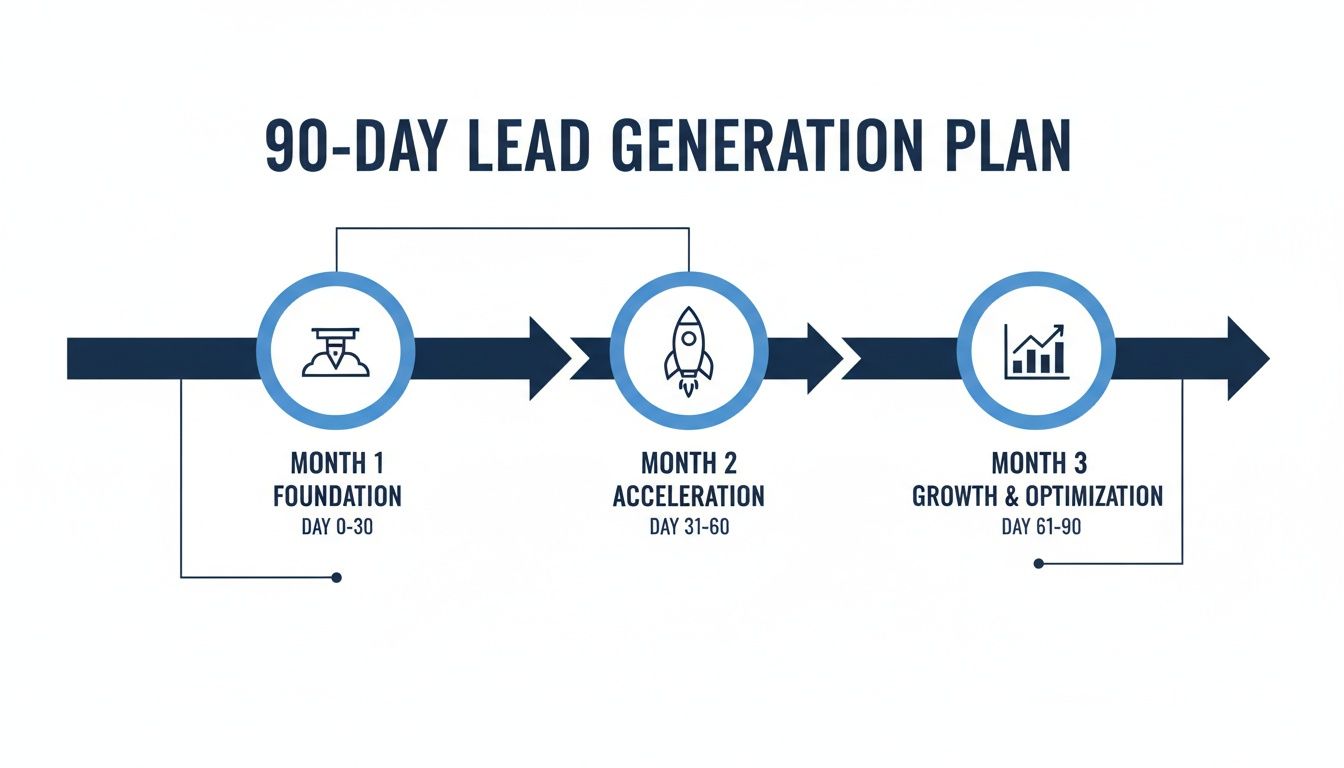
The key insight here is that you can't just jump straight to scaling. You have to build the foundation first to support any kind of sustainable growth.
Month 1: Laying the Foundation (Weeks 1-4)
Your first 30 days are all about getting the core infrastructure right. Don't rush this part. Every step here makes the next two months more effective. The focus is on clarity and setup, making sure your team, tools, and messaging are perfectly aligned before you launch a single thing.
- Weeks 1-2: ICP & Messaging Workshop. Get your sales and marketing teams in a room together. Finalize your Ideal Customer Profile (ICP) based on real sales data and customer interviews. Use this insight to sharpen your core messaging.
- Weeks 3-4: Technical Setup. Configure your GoHighLevel CRM to track leads from your website. Set up basic lead scoring rules and create your first automated email workflow for new inquiries. This ensures no lead gets lost from day one.
Month 2: Activating Your Channels (Weeks 5-8)
With your foundation solidly in place, it’s time to flip the switch on your chosen channels. The goal here isn’t perfection; it’s momentum. You’ll launch your first campaigns, publish your first content assets, and start gathering real-world data on what resonates with your audience.
- Weeks 5-6: Content Launch. Publish your first high-value content piece, like a detailed case study or a downloadable spec sheet. Create a dedicated landing page for it with a clean, frictionless form.
- Weeks 7-8: Campaign Kickoff. Launch a small, tightly targeted LinkedIn ad campaign driving traffic to that new content asset. At the same time, have your sales team begin disciplined outreach using the new messaging from month one.
Month 3: Optimizing and Scaling (Weeks 9-12)
The final month is all about learning and improving. You now have initial data flowing into your system from real prospects. It's time to use it to make informed decisions, double down on what’s working, and refine your approach for long-term, predictable growth.
The objective in Month 3 is to shift from guessing to knowing. Use your KPIs to diagnose performance and make precise adjustments, treating your lead generation system like any other critical piece of machinery on your factory floor.
Still Have Questions? Here Are a Few We Hear Often
Even with a detailed playbook, you're going to run into questions. That's a good thing—it means you're in the trenches, working to build a better system. Here are some of the most common questions we get from manufacturing leaders when they start to modernize their lead generation.
How do we measure marketing ROI?
This is the question, and the answer is refreshingly simple. You measure it by connecting your marketing activity directly to revenue. Forget vanity metrics like website traffic or social media followers. They don't pay the bills.
Instead, zero in on the numbers that matter:
- Cost Per Qualified Lead (CPQL): How much are you spending to get a lead that your sales team actually wants to talk to? This is far more important than the cost of a raw inquiry.
- Lead-to-Customer Conversion Rate: Of those qualified leads, what percentage actually sign a PO and become a paying customer?
- Customer Lifetime Value (CLV): What's the total revenue a new customer is likely to bring in over the entire course of your relationship?
Once you know these three numbers, calculating your ROI is straightforward math. You can see exactly what it costs to acquire a customer versus how much that customer is worth to your bottom line.
The goal isn't just to generate leads; it's to generate profitable customers. If you can't tie your marketing spend to closed-won deals, your system is missing a critical piece.
How much should we budget for lead generation?
There's no magic number, but a solid starting point for most B2B companies is between 2% and 5% of your total revenue.
However, it all depends on your growth ambitions. If you're making an aggressive push into a new market or launching a new product line, you might need to invest closer to 7-10% to gain traction.
The most important shift is to start treating your marketing budget as an investment, not an expense. Begin with a manageable, proof-of-concept budget for your first 90 days. Track your CPQL and ROI like a hawk. Once you've built a predictable, profitable channel, you can scale your investment with confidence.
When should we bring in outside help?
Many companies can and should handle parts of their lead generation in-house. It might be time to look for a partner when you hit one of these familiar roadblocks:
- You lack specialized expertise. You have a great sales team, but no one on staff truly understands the technical side of SEO, marketing automation, or running effective paid ad campaigns.
- Your team is stretched thin. Everyone is already wearing multiple hats. They simply don't have the bandwidth to execute a consistent, optimized marketing plan.
- You've hit a wall. You've tried a few things, but your lead flow is flat. You're not sure what levers to pull next to break through the plateau.
The right partner can bring the focused expertise and execution power needed to build and run your system, freeing up your team to do what they do best: closing deals and taking care of your customers.
Ready to stop guessing and start building a predictable lead generation engine? Machine Marketing specializes in creating and executing marketing systems for manufacturers. Book a discovery call with us to get a clear diagnosis and a practical roadmap for growth.