If you're constantly chasing leads but have little to show for it, the problem isn't your effort—it's your marketing system. The common symptom we see is a sales pipeline that feels unpredictable and inefficient, forcing your team to work too hard for too few qualified conversations.
Making the switch to inbound marketing lead generation is about building a predictable engine. One that attracts, engages, and converts qualified prospects on their terms, instead of just interrupting their day. In this guide, we'll diagnose the common failure points in lead generation and give you the step-by-step framework to build a system that works.
Outbound vs Inbound Lead Generation: A Quick Diagnosis
To get started, let's diagnose your current approach. Does your lead generation feel like a constant uphill battle? If you’re leaning heavily on traditional outbound methods—think cold calls, generic email blasts, or trade show booths—you're probably working way too hard for diminishing returns. These tactics treat marketing as an interruption, forcing your message on people who never asked to hear from you.
Use this table to diagnose where your current efforts fall. It’s a transparent way to contrast the old way of doing things with a modern inbound approach.
| Metric | Traditional Outbound Marketing | Inbound Marketing Lead Generation |
|---|---|---|
| Methodology | Interruption-based. Pushing messages out to a broad audience, hoping something sticks. Think cold calls, direct mail, trade shows. | Permission-based. Attracting interested prospects with valuable content. Think SEO, blogging, helpful guides, and webinars. |
| Cost | High cost-per-lead. You pay for every impression, every call, every email sent, regardless of interest. It's a volume game. | Lower cost-per-lead. Content is an asset that works for you 24/7. The initial investment pays dividends over time, reducing costs. |
| Lead Quality | Generally low. Leads are often unqualified, uninterested, or not ready to buy, leading to wasted sales time. | High quality. Leads are actively searching for a solution and have already engaged with your expertise, making them warmer and more qualified. |
| Scalability | Difficult to scale. More leads require more people, more calls, and more budget. It's a linear, brute-force approach. | Highly scalable. A single piece of content can attract thousands of leads over its lifetime without proportional increases in effort or cost. |
| Customer Relationship | Often adversarial. Starts the relationship from a place of annoyance or skepticism. You're an uninvited guest. | Trust-based. Builds authority and trust from the first interaction. You're positioned as a helpful expert, not a pushy salesperson. |
Seeing the contrast laid out like this usually brings the problem into sharp focus. An outbound-heavy strategy simply doesn't align with how modern B2B buyers operate anymore.
Moving from Reactive to Proactive
The result of a broken, outbound-heavy system is a collection of symptoms we see all the time:
- A sky-high cost-per-lead: You're pouring money and manpower into outreach that generates very few qualified conversations.
- Low-quality inquiries: The leads you do get are often a poor fit, wasting your sales team’s valuable time.
- Inconsistent lead flow: Your pipeline is a rollercoaster, making it impossible to forecast revenue or plan for growth with any confidence.
The core issue is a fundamental mismatch between how you sell and how today's B2B buyers actually make decisions. They don't want to be sold to; they want to be educated. They do their own research, often long before they're willing to talk to a salesperson. An inbound marketing lead generation strategy meets them right where they are with genuinely helpful content that solves their problems.
This isn't just a feel-good philosophy—it directly impacts your bottom line. An inbound system is built for efficiency, attracting customers who are already looking for you.
The numbers don't lie. Inbound marketing costs about 61% less per lead than outbound tactics. Better yet, inbound strategies generate 54% more leads than traditional outbound marketing. And when it comes to closing, leads sourced from SEO have an impressive 14.6% close rate, compared to just 1.7% from outbound sources. You can dig into more of these marketing findings on sociallyin.com.
Shifting to an inbound model transforms your business from a reactive, interruptive organization into a proactive, value-driven partner. You stop chasing prospects and start building a tangible asset—a system that attracts qualified leads automatically. You build trust and authority from the very first click.
To diagnose your current system, ask yourself these three questions:
- Where do our best leads come from right now? Are they from referrals, or from a scalable system we control?
- How much time does our sales team spend filtering out unqualified prospects?
- If we stopped all our outbound efforts tomorrow, would we still have a consistent flow of new leads?
Your answers will shine a light on the gaps. This guide is designed to help you fill them by building a reliable inbound engine from the ground up.
Building Your Foundation With An Ideal Customer Profile
Before you write a single blog post, you have to answer the most important question: who are you really trying to reach? Many businesses get bogged down with vague "personas" that are more creative writing than actual strategy.
For inbound marketing lead generation that actually works, you need a data-driven Ideal Customer Profile (ICP).
Think of your ICP less as a persona and more as the engineering blueprint for your entire marketing machine. It’s a precise definition of the exact type of company that gets the most value from your solution—and in turn, provides the most value back to you. When you get this right, every piece of content you create will feel like a direct conversation with your next best customer.
It's how you shift your strategy from shouting into a crowd to having a meaningful discussion with a future partner. This is the core of a powerful inbound system.
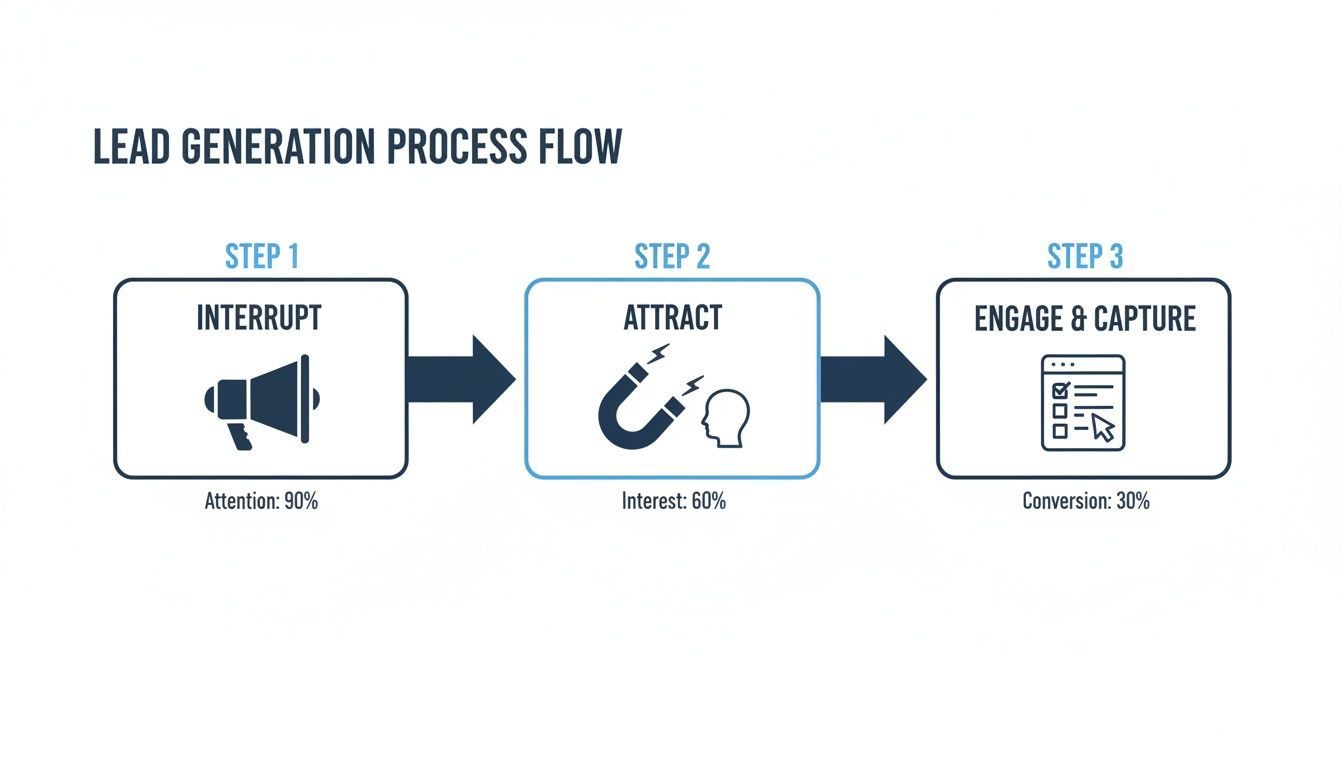
As you can see, the simple act of attracting interested buyers instead of interrupting strangers completely changes the game for engagement and conversion.
Where to Find the Real Data
Forget the marketing textbooks. The best data for your ICP is already inside your business. You just need to know where to look.
Start with your sales team. They’re on the front lines every day and know exactly which leads close easily, which ones push back on price, and which ones turn into nightmare clients.
Next, analyze your best current customers—the top 10-20% by revenue, profit, or lifetime value. These aren't theories; they are your real-world proof. Your job is to find the common threads that connect them.
What to look for: Your ideal customer isn't an imaginary figure. It's a composite sketch of the best clients you already have. The goal is simple: find more companies just like them.
Actionable Questions For Your ICP Diagnosis
To get this out of your head and onto paper, ask the right questions. Use these as a guide when you talk to your team and analyze your customer data.
Firmographic Data (The "Who"):
- Industry/Niche: Be specific. Not just "manufacturing," but "aerospace component manufacturers" or "custom CNC shops for medical devices."
- Company Size: What's their typical annual revenue? How many employees do they have?
- Geography: Are they clustered in one region? Or are they global but primarily English-speaking?
Psychographic & Behavioral Data (The "Why"):
- Primary Pain Points: What specific, costly problem were they facing right before they signed with you?
- Buying Triggers: What event lit a fire under them? A failed audit? A new compliance standard? Losing a contract to a competitor?
- Watering Holes: Where do these people get their information? Think specific trade publications, industry associations, niche LinkedIn groups, or annual conferences.
- Tech Stack: What other tools are they already using? Knowing they all use a particular ERP or project management software can be a huge clue for targeting.
Nailing down these details is the first step toward building a messaging framework that connects with your target audience. This clarity informs every single thing you'll do next. To take this a step further, see our guide on how to develop a powerful marketing messaging framework.
Creating Content That Attracts And Converts

You have your Ideal Customer Profile—that’s the blueprint. Now, it's time to build the engine: your content. For an inbound marketing lead generation system to work, your content must do more than just exist. It has to pull the right people in and give them a compelling reason to take the next step.
Let's get past the fluffy advice like "create valuable content." We're going to build a real-world content and SEO strategy, mapping your content directly to your ICP’s journey. This is how you turn your expertise into a genuine lead-generating machine.
Mapping Content To The Buyer's Journey
Prospects don’t just show up ready to buy. They go through a process, a journey, and your content has to meet them at every single stage.
-
Awareness Stage (Top of Funnel – TOFU): Your future customer has a problem, but they might not know what to call it. They're searching for answers to "why" and "how" questions. Your job here is to educate, not sell.
- Helpful Content Examples: Blog posts like "5 Signs Your QC Process is Inefficient," helpful checklists, or quick, informative videos.
-
Consideration Stage (Middle of Funnel – MOFU): They've named their problem and are now actively researching solutions. They’re comparing different methods, approaches, and products.
- Helpful Content Examples: In-depth webinars, detailed case studies showing off your wins, or comparison guides like "In-House vs. Outsourced CNC Machining: A Cost Analysis."
-
Decision Stage (Bottom of Funnel – BOFU): They’re ready to choose a provider. They need proof that you are the right choice.
- Helpful Content Examples: Free consultations, product demos, transparent pricing pages, and customer testimonials.
When you align your content this way, you’re not just selling—you’re guiding. It’s a system, not a shot in the dark. To go deeper, check out our guide on the fundamentals of content marketing best practices.
Finding The Keywords That Actually Matter
This is where many businesses stumble. They either go after huge, competitive keywords they'll never rank for or use internal jargon no customer would ever type into Google.
The trick is to listen to your ICP. Go back to your research. What questions did you uncover? What are the exact pain points your sales team hears about every day? Start there.
Pop those ideas into a tool like Ahrefs' Free Keyword Generator or Ubersuggest. You're looking for longer, more specific phrases—what we call long-tail keywords. A search for "cnc machining" is browsing. A search for "quick-turn prototype cnc machining services" is a hot lead.
Our Approach: We hunt for "problem-aware" and "solution-aware" keywords. These are the queries that signal a prospect is past window-shopping and is actively looking to make a decision. That's how you get traffic that converts.
Designing Lead Magnets That Convert
A lead magnet is the handshake at the center of inbound marketing. You offer a piece of high-value content, and in return, they give you their contact info. For this to work, the offer can't just be good—it has to be irresistible.
Forget the generic "subscribe to our newsletter" calls to action. They don't work anymore. Your lead magnet must solve a specific, nagging problem for your ideal customer.
Here are a few B2B examples that consistently get results:
- Checklists: "Pre-Production Quality Control Checklist for Aerospace Parts"
- Templates: "A Customizable Machine Maintenance Log Template"
- Calculators: "ROI Calculator for Automating Your Assembly Line"
- Guides: "The SMB's Guide to ISO 9001 Certification"
Your content becomes a tool, not just an article. The data backs this up—content marketing is responsible for over 51.5% of all lead acquisition. The bottom line? Content marketing generates 3 times more leads per dollar than old-school methods.
The Final Piece: Landing Pages With No Friction
Your landing page has one job: get the visitor to download your lead magnet.
Everything on that page must serve that one goal. That means no navigation menu, no footer, no distracting links to other pages. It’s a one-way street.
Look at this simple, powerful landing page from CoSchedule.
See that? A killer headline, punchy bullet points spelling out the benefits, and one big, obvious call-to-action button. This design removes friction and makes it incredibly easy for your visitor to say "yes."
Building Your Automated Lead Nurturing Machine
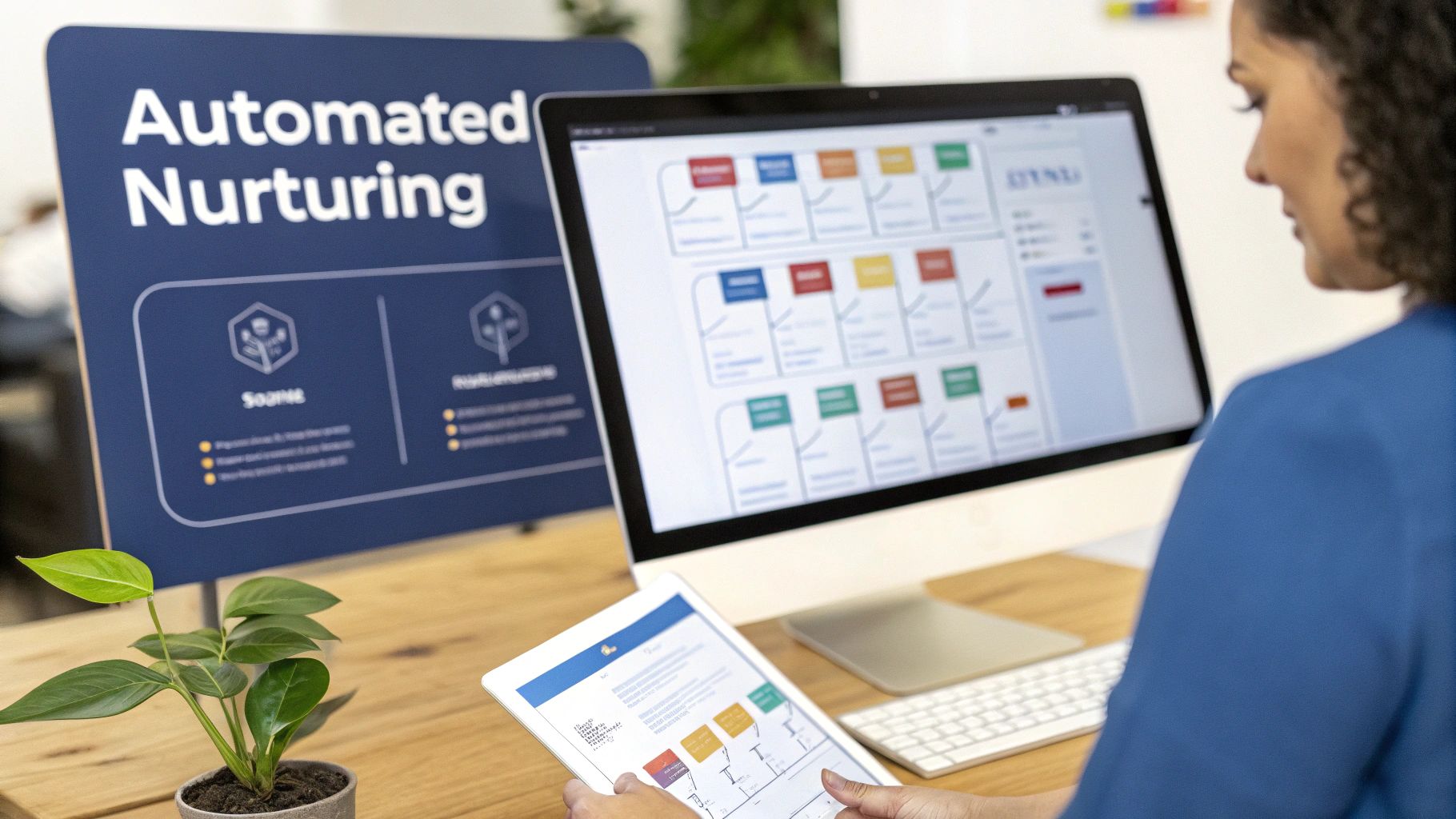
Getting a lead is a great first step, but it’s just that—a first step. The real magic in your inbound marketing lead generation system happens in the follow-up. Without a smart, automated process, even the most promising leads will go cold.
This is where you build the machine that works for you 24/7. It’s all about setting up the tech to capture, segment, and nurture every lead without you lifting a finger. This system ensures no one falls through the cracks and methodically turns initial interest into genuine sales-readiness.
Setting Up Your Lead Management System
Before you can start nurturing, you need a central hub where all your leads live. For most businesses, this will be a CRM or an all-in-one platform like HubSpot or GoHighLevel. Think of this tool as the engine room of your entire inbound operation, connecting all your marketing activities directly to your sales pipeline.
Your first task is to make sure every lead magnet, contact form, and landing page feeds automatically into this system. Manual data entry is a non-starter; it’s a breeding ground for mistakes and lost opportunities. When someone downloads a guide, they need to appear in your CRM instantly, tagged with the specific content they engaged with.
That initial tag is your first, crucial layer of automation. It lets you segment your audience from the get-go. A prospect who downloaded a guide on "ISO 9001 Certification" has a completely different set of problems than someone who wanted your "CNC Machining Cost Calculator." Your system needs to know the difference.
Crafting Nurture Sequences That Actually Work
Once a lead is in your system and tagged, the nurturing can begin. This usually takes the form of automated email or SMS sequences designed to build trust and educate your prospect over time. The goal is to deliver the right message at the right moment.
A good nurture sequence doesn't just hammer them with sales pitches. It continues the conversation you started with your lead magnet, offering even more value and gently guiding them toward seeing you as the solution. The data on this is clear: companies that get lead nurturing right generate 50% more sales-ready leads while slashing acquisition costs by 33%.
Automation is what makes inbound marketing work at scale. It’s no surprise that 76% of companies now use it. Just automating lead management can boost revenue by 10% in as little as 6-9 months.
Practical Nurture Sequence Examples
Let’s get practical. Here are a couple of simple but powerful nurture sequences you can build right now.
Example 1: The "Welcome & Educate" Sequence
This is for a new lead who just downloaded your "Guide to Improving Manufacturing Efficiency."
- Email 1 (Immediate): Delivers the guide. Subject: "Here's the efficiency guide you requested." The body is short. Confirm the download and let them know you’ll share a few more tips over the next week.
- Email 2 (2 Days Later): Shares a related case study. Subject: "How [Client Name] cut production waste by 15%." This email provides social proof and shows your expertise in action.
- Email 3 (4 Days Later): Tackles a common objection. Subject: "The biggest mistake most shops make with efficiency…" This shows you’re a proactive problem-solver.
- Email 4 (7 Days Later): A soft call-to-action. Subject: "A few ideas for your production line." Here, you can offer a brief, no-pressure call to discuss their specific challenges.
Example 2: The "Re-engagement" Sequence
This is for leads who went quiet about 90 days ago.
- Email 1 (Day 1): A simple check-in. Subject: "Still thinking about [their original interest]?" The goal is just to see if their priorities have shifted.
- Email 2 (Day 5): Offer something new and valuable. Subject: "Our latest industry report is here." This gives them a fresh reason to engage with your brand.
- Email 3 (Day 10): A final, direct offer. Subject: "Can we help?" It's a last-ditch effort to spark a conversation. If there's no response, they get moved to a low-frequency newsletter list.
These automated follow-ups are often called drip campaigns. We’ve put together a full guide explaining in detail what a drip email campaign is and how to build one that converts. By getting these systems in place, you ensure every lead gets a consistent, valuable experience.
Amplifying Your Reach And Measuring What Matters
You’ve built great content and a nurture system. But if nobody sees it, it’s like building a high-performance engine and leaving it in the garage. For an inbound marketing lead generation system to work, hope isn't a strategy. You need a deliberate plan to get your content in front of the right people and prove it’s working.
This is where we connect your content engine to a targeted audience. We’ll also cut through the noise of vanity metrics—likes, impressions, and fluff—to focus on the numbers that actually move the needle for your business.
Using Paid Channels With Surgical Precision
Let's be transparent: organic growth from SEO is a long game. It's powerful, but it takes time. If you want to get immediate traction and start feeding qualified traffic into your system now, you need to put some budget behind paid amplification.
Think of paid channels not as a replacement for your organic work, but as a booster rocket.
Your Ideal Customer Profile (ICP) is the blueprint. Platforms like LinkedIn Ads and Google Ads let you use that blueprint with incredible precision.
-
LinkedIn Ads: This is the champion for B2B. You can get hyper-specific, targeting users by job title, company size, industry, or even the exact company they work for. Imagine showing your "Guide to ISO 9001 Certification" directly to Quality Managers in aerospace manufacturing companies with 50-200 employees. That's the level of focus we’re talking about.
-
Google Ads: This is about capturing intent. When an engineer searches for a "solution-aware" keyword like "custom CNC machining services," you can put your most relevant landing page at the top of their search results. You’re meeting them at the exact moment they’re looking for your solution.
The goal isn't to blow a huge budget. It's to run small, efficient, and targeted campaigns that drive your ideal prospects straight to your best lead magnets. This way, you’re not wasting a dime on clicks from people who will never become customers.
Focusing On The KPIs That Matter To A Business Owner
As a business owner, you don’t have time for confusing reports filled with fuzzy metrics. You need to know one thing: is this marketing investment paying off? Forget the vanity metrics and zero in on the three core KPIs that tell the real story of your inbound engine’s performance.
Key Takeaway: Your marketing dashboard should be simple enough to understand in 30 seconds. If it’s cluttered with dozens of metrics, you’re measuring activity, not impact. The goal is clarity, not complexity.
Here are the only three metrics you need to build your performance dashboard around:
-
Lead Conversion Rate: The percentage of visitors who take the action you want them to (e.g., download a guide). It’s a direct measure of how well your content and landing pages are working. A low rate is a signal that your offer isn’t compelling enough or the page has too much friction.
-
Cost Per Lead (CPL): Total marketing spend divided by the number of leads generated. It tells you exactly how much it costs to get a new prospect into your pipeline. The goal is to constantly push this number down as your system gets more efficient.
-
Customer Acquisition Cost (CAC): The ultimate bottom-line metric. It’s your total sales and marketing cost divided by the number of new customers you signed in a period. CAC shows you the true, all-in cost of winning a new piece of business, which is the final proof that your inbound lead generation system is a success.
By tracking these three numbers relentlessly, you can spot problems early, test new ideas, and clearly show the return on investment (ROI). This is how you move from random acts of marketing to a predictable system for growth.
A Few Common Questions We Hear
Even with a clear playbook, switching your approach naturally brings up questions. We get it. Business owners and marketing managers often ask us about the real-world nuts and bolts of moving to an inbound marketing lead generation strategy. We believe in being transparent, so let's tackle the big ones.
Getting honest answers is the only way to set the right expectations and build a system that actually works for your business—not just in theory.
How Long Does It Take For Inbound Marketing To Generate Leads?
This is always the first question, and the honest answer is this: it's not a magic button. While you can get a quick win from a targeted paid ad, a true inbound engine is a long-term asset you're building for your business.
Generally, you can expect to see real traction and a steady stream of leads within 4-6 months. Those first few months are about laying the groundwork—building your SEO authority, creating foundational content, and giving search engines time to recognize the value you're providing.
Think of it like planting a tree, not flipping a switch. The upfront effort establishes deep roots. Once that tree is mature, it provides value for years. A paid ad stops working the second you turn off the spend.
This initial phase is what creates sustainable growth that isn't chained to a never-ending ad budget.
Can Inbound Marketing Work For A Small Business With A Limited Budget?
Yes, absolutely. In fact, inbound marketing is often more cost-effective than outbound tactics, which makes it a perfect match for smaller businesses. The key is to be focused.
Don't launch ten things at once. Instead, be surgical. Here’s a practical, lean approach:
- Create one killer lead magnet. Pinpoint a single, painful problem your ideal customer has and build the absolute best guide or tool to solve it.
- Build one simple, clean landing page. No fluff. Just a direct page focused on that one offer.
- Write three or four solid blog posts that support the theme of your lead magnet and link back to it.
- Pick one or two channels to promote it. That might be a small, targeted LinkedIn ad campaign or just consistently sharing it in a relevant online community.
When you're starting out, focus and quality will crush quantity every time. This approach lets you prove the model works and then reinvest in what's already delivering results.
What Is The Single Most Important Part Of An Inbound Strategy?
If you made us boil it all down to one thing, it would be this: a razor-sharp, data-backed understanding of your Ideal Customer Profile (ICP). Every other part of your strategy is built on this foundation.
Without a well-defined ICP, you're just guessing. A weak ICP leads directly to:
- Targeting the wrong keywords, which brings in traffic that was never going to buy.
- Writing content that falls flat, because it doesn't solve a real problem for a specific person.
- Wasting money on the wrong channels, because you're shouting into rooms where your potential customers aren't hanging out.
Every decision—from the tone of an email to the topic of a blog post—flows from knowing exactly who you're talking to and what keeps them up at night. Get the ICP right, and the rest of the system has a chance to work. Get it wrong, and nothing else matters.
Ready to stop chasing leads and start building a predictable system for growth? At Machine Marketing, we specialize in diagnosing broken marketing systems and building inbound engines that deliver results.
Book a discovery call with us today to get a clear roadmap for your inbound marketing lead generation strategy. Visit us at https://machine-marketing.com to get started.