If your manufacturing business is getting inconsistent or low-quality leads, the problem probably isn’t your product—it’s a disconnected marketing system. We see this all the time. A great sales team is starving for qualified opportunities because the company’s online presence is invisible to the engineers and procurement managers actively searching for solutions.
This isn’t a “nice-to-have” anymore. Digital marketing in manufacturing is a core operational function, just like production or quality control. In this article, we’ll diagnose the common failure points in a manufacturer’s lead generation system and give you a step-by-step playbook to build an engine that delivers predictable results.
Diagnosing Your Broken Lead Generation System
Let’s approach this like an engineer. Before you try to fix anything, you need to diagnose the system. A broken lead generation process is just a symptom, not the root cause. The real problem is usually a set of disconnected activities that feel like marketing but don’t work together as a cohesive engine.

This section is an audit of your current efforts. We’ll ask the questions you should be asking to pinpoint exactly where breakdowns are happening and, more importantly, where they’re costing you revenue.
Where Are Your Buyers Really Looking?
The first part of any diagnosis is understanding the environment. Your ideal buyers—whether they’re design engineers, plant managers, or purchasing agents—have problems they need to solve right now. They aren’t waiting for the next trade show or your sales rep’s cold call.
They are on Google searching for answers.
They use specific, technical phrases to find suppliers, compare specs, and validate their choices. If you aren’t visible at that exact moment of need, you effectively don’t exist. This is the most common failure point in the system.
Questions to ask yourself:
- Do we know the exact technical keywords and questions our ideal buyers are typing into Google?
- When we search for those terms, do we show up on the first page? Or do our competitors?
- Is our website built to answer those specific questions clearly and immediately?
If the answer to any of these is “no” or “I’m not sure,” you’ve found a massive gap. Your competitors are intercepting your potential customers before they even find you.
What Happens When a Lead Actually Arrives?
Let’s say a potential lead does manage to find your website. The next diagnostic test checks the system’s ability to capture and process that interest. A website that’s just a digital brochure is a major point of failure.
Too many manufacturing websites make it difficult for a prospect to take the next step. We’re talking about confusing navigation, buried contact forms, and no clear calls-to-action. That friction causes valuable leads to give up and leave.
Your website’s primary job is not just to inform; it is to convert a visitor’s interest into a tangible lead. Every page and every form should guide them toward that single outcome.
And what happens after someone fills out a form? Does it land in a generic inbox, waiting for someone to get to it? Or does it trigger an automated, systematic process that confirms receipt, qualifies the inquiry, and alerts the right person on your team instantly? Without a system, leads go cold in hours, not days. This is a common and costly breakdown we help clients fix with a structured approach to lead generation for manufacturers.
The Solution: An Integrated Marketing Engine
The solution to these disconnected efforts is what we call an integrated marketing engine. This isn’t about doing more marketing “things.” It’s about building a single, cohesive system where every component works together to attract, engage, and convert your ideal buyers.
A properly integrated engine connects your:
- Visibility (SEO & Ads): Making sure you show up when and where buyers are looking.
- Conversion (Website & Content): Giving them clear answers and easy next steps.
- Systemization (CRM & Automation): Capturing, tracking, and nurturing every single lead efficiently.
When these parts work in harmony, you stop chasing random leads and start building a predictable pipeline of qualified opportunities. This playbook will walk you through building that exact engine.
Laying the Foundation for Digital Marketing Success
Before you spend a dollar on ads or launch a campaign, you have to get the foundation right. Skipping this is like building a factory on a shaky plot of land—it’s not a matter of if things will go wrong, but when. This is the essential first phase to ensure your marketing investment pays off.

This foundational work boils down to two things: defining your Ideal Customer Profile (ICP) with absolute clarity and creating a core message that speaks directly to their biggest problems.
Get Laser-Focused on Your Ideal Customer Profile
Most manufacturers think they know their customers. But when we ask them to describe their best customer, the answer is often too broad—something like “anyone who needs CNC machining.” That’s not specific enough to build a predictable marketing system.
Your ICP isn’t just a list of industries. It’s a detailed picture of the exact type of company and the specific people inside that company who get the most value from what you do and are the most profitable for you.
Here’s what to look for:
- Company Vitals: What’s their annual revenue? How many employees do they have? Are they in a niche sub-sector? Where are they located?
- Technical Specs: What specific materials, processes, or certifications are non-negotiable for them? What are their typical order sizes and complexities?
- Business Pains: Are they getting burned by unreliable suppliers? Struggling with quality control? Are their current vendors causing lead times that throw their production schedules into chaos?
Once you’ve defined the ideal company, pinpoint the key players in the buying process. This is usually a combination of an Engineer, a Procurement Manager, and maybe a C-level executive. Each one cares about different things.
An engineer cares about specs, tolerances, and material properties. A procurement manager focuses on price, lead times, and vendor reliability. Your messaging has to address both of their priorities, or it will fall flat.
This ICP becomes the blueprint for everything that follows. It dictates your keywords, your content, your ad targeting—everything. Without it, you’re just guessing.
Turn Customer Insights Into a Message That Hits Home
Once you know exactly who you’re talking to and what keeps them up at night, you can craft a core message that resonates. This isn’t a catchy slogan. It’s a clear, compelling answer to your ideal customer’s core question: “Why should I pick you over every other option?”
Your messaging must directly address the technical and business pains you uncovered when building your ICP.
For example, instead of a generic line like, “We offer high-quality metal fabrication,” a much stronger message would be: “We deliver certified AS9100 fabricated components with 99.8% on-time delivery, eliminating the supply chain delays that ground aerospace projects.”
See the difference? It speaks to a specific pain point (delays), mentions a critical certification (AS9100), and provides a hard number (99.8% on-time). That’s a message built for your ideal customer.
Your Website and SEO: The Digital Bedrock
Your website is the hub of your entire digital presence. It needs to be more than an online brochure; it must be a machine for converting visitors who fit your ICP into qualified leads. This means focusing on user experience and technical performance.
This is also where Search Engine Optimization (SEO) comes in. SEO isn’t a techy add-on; it’s the work that ensures your ideal customers find you when they’re actively searching for the solutions you provide. This approach isn’t optional for growth.
A solid technical foundation for your website includes:
- Fast Page Speed: Engineers and procurement managers are busy. They won’t wait for a slow-loading site, especially on mobile.
- Clear Calls-to-Action (CTAs): Make it simple for them to take the next step, whether that’s “Request a Quote,” “Download a Spec Sheet,” or “Talk to an Engineer.”
- Content That Answers Real Questions: Your service pages need to be loaded with the technical details, specs, and application info that your engineering-minded buyers are looking for.
Getting this foundation in place is the most important part of building a successful marketing system. For a deeper dive into the technical side, check out our complete guide to SEO for manufacturing companies.
Engineering Your Marketing and Sales Engine
With the groundwork laid, it’s time to build the engine that will consistently attract, nurture, and convert leads. This isn’t about random acts of marketing; it’s about engineering a predictable system for growth. Think of this engine as your central command center, making sure no opportunity slips through the cracks.

The heart of this operation is a Customer Relationship Management (CRM) system. It’s the central nervous system for every customer interaction. We often set up and customize GoHighLevel for our clients because it pulls marketing, sales, and communication tools into one platform, eliminating the need to juggle a dozen disconnected apps.
Setting Up Your Central Command Center
First, your CRM needs to be configured as more than a digital address book. Its real power comes from its ability to manage contacts, track every touchpoint, and automate the follow-up that your team is too busy to handle manually.
Getting this right involves a few key steps:
- Contact Management: Import all existing contacts and—this is crucial—segment them. Are they a hot prospect, a current customer, or a past client? This segmentation allows for targeted communication later on.
- Pipeline Stages: Map out the exact journey a lead takes, from initial inquiry to closed deal. This gives you a clear visual of your sales process and where every opportunity stands.
- Interaction Tracking: Connect your email, phone system, and website forms directly to the CRM. Every call, email, and quote request gets logged automatically under the contact’s record, giving your sales team the full backstory.
A properly configured CRM is the difference between organized, efficient follow-up and pure chaos. It becomes the single source of truth for every lead, eliminating manual data entry and giving your team the context they need to have productive conversations.
Fueling the Engine with High-Impact Campaigns
With your CRM ready to catch and manage leads, you have to fuel the engine. For manufacturers, this means running targeted campaigns designed for a technical audience. While many tactics exist, we’ve found that a focused blend of organic, paid, and direct outreach delivers the most consistent results.
Many manufacturers are still underinvesting here. Industry data shows digital marketing budgets in manufacturing average just 8% of the total spend on advertising. The companies that are actually growing are reallocating their budgets to the channels that work. You can dig into the numbers in this in-depth analysis of manufacturing marketing spend.
Let’s break down the campaigns that move the needle.
Organic Content and SEO
Think of this as your long-term asset. By creating valuable, technical content that answers the exact questions your Ideal Customer Profile is typing into Google, you attract highly qualified prospects who are actively looking for solutions. We’re talking about creating deep, useful resources, not generic blog posts.
Here’s a real-world example: A custom metal fabricator publishes a detailed guide, “Choosing the Right Steel Grade for High-Wear Industrial Applications.” An engineer researching a new project finds it. A simple “Download the PDF Spec Sheet” CTA captures their contact info, and that lead is now directly in your CRM.
Targeted Pay-Per-Click (PPC) Advertising
While organic content builds over time, PPC campaigns on platforms like Google Ads and Microsoft Ads give you immediate visibility. You can get your message in front of buyers at the precise moment they’re searching for a supplier.
For a PPC campaign to be effective, it must be precise:
- High-Intent Keywords: Focus on terms that signal purchase intent, like “AS9100 certified machine shop” or “request a quote for injection molding.”
- Specific Landing Pages: Never send ad traffic to your homepage. Create dedicated pages that match the search query and have one clear, simple form.
- Audience Targeting: Use location and industry targeting to ensure your ads are only shown to relevant prospects.
Email and SMS Nurturing Campaigns
Not every lead is ready to sign a purchase order today. That’s where automated email and SMS campaigns are invaluable. Once a prospect is in your CRM, you can use automated sequences to build trust and stay on their radar without manual effort.
These campaigns drip valuable content over time, nurturing the relationship.
A simple nurturing sequence might look like this:
- Day 1: An automated email instantly delivers the requested spec sheet.
- Day 4: A follow-up email shares a case study about how you solved a tough problem for a similar company.
- Day 10: A quick SMS asks if they have any technical questions and provides a link to book a 15-minute call with an engineer.
These campaigns work together, feeding qualified and engaged leads right into your CRM. It creates a seamless flow from the first touchpoint all the way to a real sales opportunity.
Automating Lead Qualification and Nurturing
Getting a steady stream of inquiries is a great start, but it doesn’t automatically generate revenue. The real bottleneck for most manufacturers is the manual process of sifting through leads to find the few that are ready for a sales conversation. This is where your marketing engine proves its worth—by taking on the heavy lifting of qualification and nurturing.
The goal isn’t just to save your sales team time, although that’s a huge benefit. It’s about building a repeatable system that hands over genuinely hot leads at the perfect moment, complete with the full context of their journey.
Implementing Automated Lead Scoring
How do you know who to call first? The person who downloaded a whitepaper three weeks ago, or the one who just spent ten minutes on your CNC machining specs page? Without a system, it’s a guess. This is the problem lead scoring solves.
Lead scoring is a process in your CRM that automatically assigns points to prospects based on who they are (demographics) and what they do (behaviors). It’s how you separate the tire-kickers from the serious buyers without manual effort.
Here’s a practical way to set it up:
- Behavioral Scoring: Assign points for high-intent actions. A visit to your “Request a Quote” page is a big deal (+15 points). Opening an email is good, but less critical (+2 points).
- Demographic Scoring: Add points if a lead fits your ICP. Are they in a target industry? (+10 points). Do they have a title like “Lead Engineer”? (+20 points).
- Negative Scoring: Subtract points for actions that signal a poor fit. Someone visiting your careers page probably isn’t a buyer (-10 points). Using a personal Gmail address? (-5 points).
A lead score isn’t just a number; it’s a dynamic indicator of sales-readiness. It tells your team exactly where to focus their energy for the highest probability of a win.
Building Trust with Nurturing Sequences
Only a fraction of leads are ready to buy the moment they find you. The rest need time, information, and trust. Automated nurturing sequences—sent via email and SMS—are your best tool for building that trust systematically.
These aren’t sales pitches. They are helpful, educational touchpoints that keep your company top-of-mind and establish you as the expert. The modern B2B buyer now expects B2C-like convenience, a trend pushing manufacturers to invest in automation. You can read more on these manufacturing industry trends on BluestonePIM.com.
A simple but effective nurturing workflow might look like this:
- Immediate Follow-Up: A prospect downloads a CAD file. An automated email instantly delivers it.
- Value-Add Content: Three days later, another email shares a case study showing how a similar part was used in a real-world application.
- Soft Call-to-Action: A week later, a final email offers a 15-minute “engineering review” to discuss their project’s technical specs.
This hands-off process builds credibility and ensures that when they are ready to buy, you’re the first call they make. For a blueprint, see our in-depth guide to building a marketing automation strategy.
Creating Smart Sales Alerts
The final piece of the puzzle is closing the gap between marketing and sales. You can use automation to create internal notifications that alert your sales team the moment a lead gets hot.
Instead of your reps living in the CRM, you set up triggers. For instance, once a lead’s score crosses a specific threshold (e.g., 100 points), the system can automatically:
- Assign the lead to a specific salesperson.
- Create a task for them to follow up within 24 hours.
- Send an email and SMS alert to that salesperson with the lead’s name, contact info, and a link to their full activity history.
This is how you close the loop. Marketing generates and qualifies the lead, and sales gets a timely, actionable alert with all the context they need to start a meaningful conversation. It’s a clean handoff that ensures no high-value opportunity is missed.
Your 90-Day Digital Marketing Roadmap
Strategy and systems are meaningless without execution. To get tangible results and prove the value of digital marketing in manufacturing, you need a clear, actionable plan. We use a 90-day proof-of-concept roadmap designed to build momentum and get wins on the board—fast.
This isn’t about trying to do everything at once. It’s about focusing on the highest-impact activities across three distinct, 30-day sprints. This approach allows you to implement, gather real data, and make smart adjustments without getting bogged down.
Month 1: The Foundation and Setup Sprint
The first 30 days are all about getting your core infrastructure right. You can’t launch campaigns if your website isn’t set up to convert visitors or if your CRM can’t track leads. This month is dedicated to building the engine before you add fuel.
Your Month 1 Action Items:
- Complete the Marketing Audit: Finish the diagnostic phase. Pinpoint every gap in your current lead generation system.
- Finalize Your ICP and Messaging: Get total clarity on your Ideal Customer Profile and the core messaging that speaks to their pain points.
- Website and SEO Fixes: Implement critical on-page SEO updates. Ensure your key service pages are optimized with clear calls-to-action (“Request a Quote”).
- CRM Configuration: Get your CRM (like GoHighLevel) set up and configured. Import contacts, define your sales pipeline stages, and set up basic tracking.
Success Metric for Month 1: The goal is setup, not leads. Success is a fully configured CRM, a technically sound website, and a finalized messaging guide. You’re building the factory floor; production starts next month.
Month 2: The Campaign Launch and Data Collection Sprint
With your foundation secure, it’s time to flip the switch. Month two is about launching your first targeted campaigns to generate traffic and—more importantly—collect real-world data. This is your first test of the assumptions you made about your audience and messaging.
The objective is to get a controlled flow of traffic so you can see what’s resonating.
Your Month 2 Action Items:
- Launch a Targeted PPC Campaign: Kick off a small-scale Google Ads or Microsoft Ads campaign focused on a handful of high-intent keywords.
- Publish Foundational Content: Get your first two or three high-value content pieces live on your website, each targeting a specific question from your ICP.
- Deploy a Simple Nurture Sequence: Create a basic 3-step automated email follow-up for anyone who fills out a form.
- Monitor Early Data: Keep a close eye on your campaign’s Click-Through Rate (CTR), website engagement, and form submission rates.
This is the month you build the simple, automated journey a lead takes after making contact.
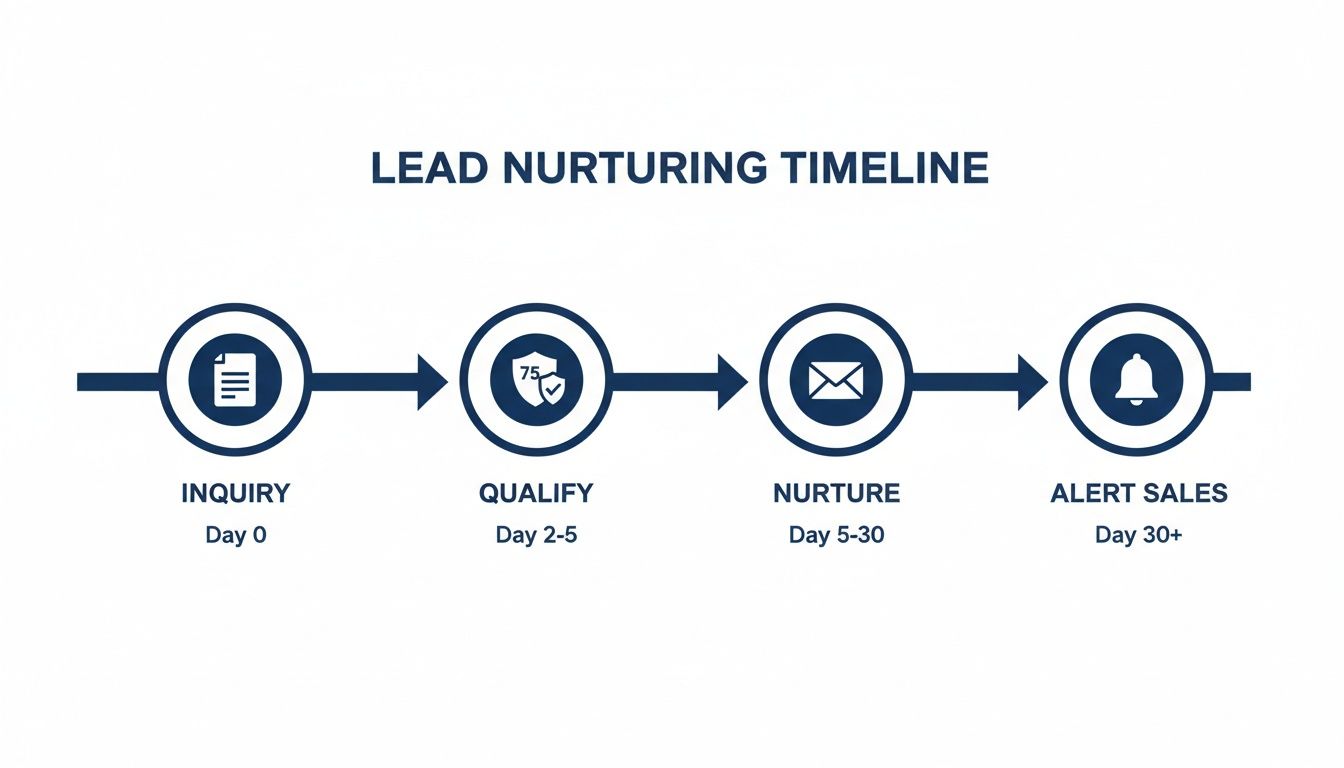
This automated flow takes a raw inquiry and systematically turns it into a sales-ready opportunity.
Month 3: The Optimization and Reporting Sprint
In the final 30 days, the focus shifts from launching to learning. You now have a month’s worth of campaign data—your first real feedback from the market. This month is about using that data to fine-tune your campaigns and report on the initial return on investment.
You’ll make small, informed tweaks to boost performance. This is how you systematically improve lead quality and drive down acquisition costs over time.
Your Month 3 Action Items:
- Analyze Campaign Performance: Dive deep into the data from Month 2. Which keywords are driving qualified leads? Which ad copy is getting the most clicks?
- Optimize and Adjust: Based on your findings, pause underperforming ads and double down on what’s working by reallocating your budget.
- Track Key KPIs: Calculate your initial Cost Per Lead (CPL) and, if possible, your Cost Per Qualified Lead. These are the numbers that matter.
- Report on Progress: Put together your first 90-day report showing the work completed, leads generated, and initial KPIs to build the case for continued investment.
90-Day Digital Marketing Launch Plan
Here’s a high-level look at how these three months fit together. Think of it as a blueprint for turning your digital marketing from a concept into a lead-generating asset.
| Month | Primary Focus | Key Activities | Success Metric |
|---|---|---|---|
| Month 1 | Foundation | Audit, ICP finalization, website/SEO fixes, CRM setup | A fully configured tech stack and a clear strategic direction. |
| Month 2 | Activation | Launch PPC campaign, publish core content, build nurture sequence | First leads generated; initial data on clicks, conversions, and engagement. |
| Month 3 | Optimization | Analyze campaign data, adjust bids/budgets, calculate initial KPIs | Improved lead quality and a clear understanding of Cost Per Lead (CPL). |
By the end of this 90-day sprint, you won’t just have a plan; you’ll have a functioning marketing engine backed by real data, ready to scale.
Common Questions We Get About Manufacturing Marketing
Making the jump to a digital-first marketing approach is a big shift, and it always brings up smart questions. After walking dozens of manufacturing leaders through this exact process, we’ve heard them all.
Here are straight answers to the questions that are probably on your mind.
How Much Should We Budget for Digital Marketing?
This is always the first question, but thinking about it as a percentage of revenue is the wrong approach. A better, engineering-minded method is to work backward from your growth targets.
Instead of asking, “What’s our budget?” you should be asking, “What can we afford to pay to get one new ideal customer?”
First, figure out the lifetime value (LTV) of a customer. Once you know that, you can set a realistic Customer Acquisition Cost (CAC). This reframes marketing from a random expense into a measurable investment in growth. A tight, 90-day proof-of-concept campaign is the perfect way to gather the initial data you need to calculate your starting CAC.
Your budget shouldn’t be based on what other companies are doing. It must be a direct function of your revenue goals and the calculated cost to acquire the customers you need to hit them.
How Do We Know This Is Actually Working?
This is the best part. Unlike old-school tactics like trade shows and print ads, digital marketing is transparent. You can track every dollar and connect it directly to a result. We can finally move past vague ideas like “brand awareness” and focus on the numbers that drive the business.
These are the key performance indicators (KPIs) you should be focused on:
- Cost Per Qualified Lead (CPQL): How much are we spending to get a lead that fits our ICP and shows buying intent?
- Lead-to-Customer Conversion Rate: What percentage of those qualified leads sign a purchase order?
- Pipeline Velocity: How fast are we turning a new lead into a closed deal?
- Marketing-Attributed Revenue: How much new revenue can we trace directly back to our marketing campaigns?
These are the numbers that prove ROI and make it easy to justify further investment.
How Do We Get Our Sales Team on Board?
Let’s be transparent: your sales team is likely skeptical of marketing, and they probably have good reason to be. They’ve been handed lists of bad leads before. The only way to win them over is to show them this system is built to make their lives easier.
You have to frame it correctly. This isn’t about generating more leads; it’s about filtering out the noise so that only genuinely qualified, sales-ready opportunities land on their desk.
Show them how the automated scoring and nurturing process means they’ll spend less time chasing dead ends and more time talking to prospects who are already educated and interested. The first time they get an alert that a prospect just visited the pricing page for the third time, they’ll become your biggest fans. The results will speak for themselves.
Ready to build a predictable lead generation system for your manufacturing business? Machine Marketing specializes in implementing the strategies and systems discussed in this playbook. Book a discovery call to get your tailored 90-day roadmap.