A manufacturing marketing strategy should create predictable, high-quality leads—not random inquiries. If your manufacturing company is struggling to generate consistent opportunities, you’re not alone. The root cause is rarely tactics. It is usually a broken or missing system for attracting, educating, and nurturing the right industrial buyers.
In this guide, we’ll show you how to diagnose the gaps in your marketing system with an engineering mindset. You’ll get practical, step-by-step instructions to build a marketing machine that drives measurable growth.
Diagnosing Your Current Marketing System
Does your lead pipeline feel unpredictable? Does your sales team complain about the quality of the leads they’re getting? These are classic symptoms of a disconnect between your marketing efforts and what your ideal buyers actually need. Instead of cranking up the ad spend on another generic campaign, the first move is to run a full diagnostic.

This process is about moving from assumptions to certainty. It’s about asking the hard questions before you start building the solution so that every dollar you invest is aimed at solving a specific problem and generating a measurable return.
Start With The Data You Already Have
Your first stop isn’t a competitor’s website; it’s your own CRM and sales records. Your business is sitting on a goldmine of information about what a great customer looks like and what actually drives revenue. You need to know your numbers cold to set a baseline for improvement.
Here are the questions to ask yourself to get started:
- Who are our best customers? Pull a list of your top 20% of customers by revenue or profitability. What do they have in common? Look for patterns in their industry, company size, and the specific problems you solve for them.
- How long is our sales cycle? How long does it take to close a deal with an ideal client versus a less-than-ideal one? A shorter sales cycle is often a dead giveaway of a perfect fit.
- Where do our best leads really come from? Don’t just guess. Dig into your records to see if it’s referrals from happy clients, connections from trade shows, or qualified buyers finding you through organic search.
You can’t measure the impact of new strategies if you don’t know your starting point. Knowing how to calculate marketing ROI is critical to prove which channels are actually valuable and which are just noise.
Marketing Diagnosis Checklist For Manufacturers
Use this checklist to diagnose key areas of your current marketing system before building a new strategy from the ground up.
| Diagnostic Area | Key Question To Ask | Why It Matters |
|---|---|---|
| Ideal Customer Profile | Do we have a crystal-clear, data-backed definition of our best customer? | Without this, all your marketing is based on guesswork, leading to wasted spend and low-quality leads. |
| Value Proposition | Can we articulate exactly why our best customers choose us over competitors? | If you can’t state your unique value clearly, your prospects won’t understand it either. |
| Lead Sources | Where have our most profitable deals originated from in the past 12-24 months? | This tells you where to double down your efforts and what channels might be a distraction. |
| Sales Cycle | What’s the average time from first contact to a closed deal for our best customers? | A long sales cycle can indicate friction, poor-fit leads, or a weak message that doesn’t resonate. |
| Website Performance | Does our website actively generate qualified leads, or is it just a digital brochure? | Your site should be your hardest-working salesperson, educating buyers and capturing intent 24/7. |
| Content & SEO | Are we visible on search engines for the problems our ideal customers are trying to solve? | If buyers can’t find you when they’re actively looking for a solution, you’re invisible. |
Running through these questions will give you an honest, unfiltered look at your marketing foundation and expose the cracks that need fixing.
Understanding The Market And Your Place In It
This diagnosis isn’t happening in a vacuum. Recent economic pressures have forced manufacturers to be much smarter with their marketing budgets. In fact, marketing spend in the manufacturing sector has dropped from an average of 8.5% of revenue in 2023 to just 6.7% in 2024.
At the same time, satisfaction with marketing performance is alarmingly low—with 42% of industrial firms feeling neutral about their results and another 30% being outright unhappy. This isn’t bad news; it’s a massive opportunity. Companies that switch to an intentional, data-driven approach have a clear path to pull ahead of the competition.
Your goal is simple: Create a marketing system so perfectly aligned with your ideal customer’s needs that your sales process becomes smoother, faster, and far more predictable.
This diagnostic phase is the foundation for that entire system. By answering these questions honestly, you’re not just auditing—you’re building the blueprint for a marketing machine that actually performs.
Building Your Digital Sales Engine
Think of your website as your hardest-working salesperson—one that never sleeps. Too many manufacturers treat their site like a static, digital brochure. It’s time to re-engineer that thinking. Your website should be the engine for establishing credibility and capturing leads from engineers, specifiers, and procurement managers doing their homework long before they ever pick up the phone.
Let’s turn your passive pamphlet into an active lead-generation machine.

This isn’t about flashy design; it’s about function. Your technical buyers aren’t impressed by flair. They’re hunting for answers and solid proof you can solve their specific problem.
The Non-Negotiable Elements Of A Manufacturer’s Website
Your website has one primary job: educate technical buyers so thoroughly that taking the next step with you feels like the only logical choice. A strong manufacturing website isn’t a mystery; it’s a system built from essential, hard-working components.
Here’s what your site absolutely must have:
- Clear Technical Specification Pages: Don’t make engineers dig for information. Give them detailed spec sheets, downloadable CAD drawings, and performance data right upfront.
- High-Quality Product Photography and Videos: Show, don’t just tell. A video of your machine in action is infinitely more persuasive than a stock photo. In fact, 98% of manufacturers use content to generate qualified leads, and strong visuals are the backbone of that effort.
- Compelling Case Studies and Testimonials: Prospects want proof, not promises. Showcase real-world applications of your products. Detail the client’s problem, your solution, and the measurable results you delivered.
- Easy-to-Find Contact Info and Calls-to-Action: Make it incredibly simple to request a quote, schedule a consultation, or ask a technical question. Every page should guide the user toward that next step.
Your website’s primary goal is to answer a prospect’s questions so thoroughly that they see you as the obvious expert. When you achieve this, lead generation becomes a natural byproduct of providing value.
If any one of these parts is missing or weak, your entire digital sales engine will underperform.
Demystifying Industrial SEO
Having a great website is pointless if no one can find it. This is where Search Engine Optimization (SEO) comes in. For manufacturers, SEO isn’t about chasing trendy keywords. It’s about being highly visible for the specific, technical terms your ideal customers are typing into Google.
This is a critical part of a modern marketing strategy for the manufacturing industry. When a project manager searches for “CNC machining for aerospace components,” you need to be there. If your competitor shows up first, they just won the business.
To get started, focus on these core areas:
- Identify Your “Money” Keywords: These are the specific phrases that signal real buying intent. Think like your customer: “custom metal stamping for medical devices” or “ISO 9001 certified plastic injection molding.”
- Structure Your Site Logically: Organize your website around your core services and capabilities. Every service needs its own dedicated page optimized for relevant keywords.
- Create Content That Answers Questions: Build out a library of blog posts, guides, and FAQs that address the common problems your sales team hears every day. This pulls in targeted traffic and positions you as a helpful authority.
A targeted SEO approach is non-negotiable. For a deeper dive, our guide on SEO for manufacturing companies provides a more detailed blueprint for getting found by the right buyers.
Automating Your Sales Pipeline With A CRM
Leads are worthless if they fall through the cracks. A great lead from your website can go cold in hours if there’s no system to handle it immediately. This is one of the most common—and costly—problems we diagnose in manufacturing businesses.
This is where a robust system becomes a game-changer. It’s not just about storing contacts; it’s about engineering a workflow that ensures no opportunity is ever missed.

Implementing a Customer Relationship Management (CRM) system pulls your marketing and sales together, transforming scattered efforts into a cohesive, automated machine.
Why A CRM Is Non-Negotiable For Manufacturers
For most manufacturers, the sales process is complex, involving multiple decision-makers over a long period. Juggling quote requests and follow-ups on spreadsheets or sticky notes is a recipe for failure. A dedicated CRM acts as the central nervous system for your entire sales pipeline.
Here’s what a well-implemented CRM allows you to do:
- Centralize All Communications: Every email, phone call, and text message with a prospect is logged in one place, giving your team a complete history of the relationship at a glance.
- Track Leads In Real Time: Know exactly where every lead is in your sales process, from initial inquiry to closed deal. This visibility is crucial for forecasting and spotting bottlenecks.
- Automate Tedious Tasks: Free up your sales team from repetitive follow-ups so they can focus on what they do best: building relationships and closing high-value deals.
A CRM isn’t just software; it’s a system designed to install discipline and predictability into your sales process. It’s the difference between reactive scrambling and proactive, systematic growth.
Setting Up Your Automated Follow-Up System
The real power of a modern CRM like GoHighLevel is in its automation. You can build simple “if-then” workflows that handle critical first touches and long-term nurturing without anyone lifting a finger. This guarantees every lead gets a consistent, professional, and timely response.
Let’s walk through a practical example—an automation you can build for new quote requests from your website.
Example Workflow: New Quote Request
- Immediate Confirmation (0-5 minutes): As soon as a prospect fills out your “Request a Quote” form, the system automatically sends an email and an SMS text. The email confirms receipt (“Our team is reviewing your specs and will be in touch within 24 hours“). The text is a simple nudge (“Thanks for your quote request! We just sent an email with next steps. – [Your Company Name]”).
- Internal Notification (Instant): The CRM simultaneously notifies the assigned sales rep via email and a mobile app push notification, giving them all the lead’s details. This eliminates response delays.
- Day 2 Follow-Up (24 hours later): If the sales rep hasn’t updated the lead’s status, an automated email goes out from their address offering a valuable resource, like a relevant case study.
- Long-Term Nurturing: If the lead doesn’t convert right away, they’re automatically added to a monthly newsletter list. This keeps your company top-of-mind with project updates and industry insights until they’re ready to buy.
This entire sequence runs on autopilot, dramatically increasing your chances of closing the deal. Our guide on choosing a CRM for manufacturing companies explores these features and platform options in greater detail.
Designing Lead Generation Campaigns That Actually Work
You’ve built the digital sales engine and your CRM is primed to catch every lead. Now, it’s time to open the floodgates. Effective lead generation for manufacturers is about building a predictable system that brings ideal customers to you by offering genuine value long before you ever ask for the sale.
This isn’t about flashy ads or slick taglines. It’s a strategic approach built on trust, especially when your audience is highly technical. The core principle is simple: be the most helpful resource in your industry.
Adopt The 80/20 Rule Of Content
Let’s be honest: engineers and procurement managers have a finely tuned radar for sales pitches. They’re looking for answers, data, and proof that you understand their world. That’s why the most effective marketing strategies follow a powerful guideline: 80% of your content should be educational, while only 20% is promotional.
Put yourself in your buyer’s shoes. Are you more likely to engage with a company that’s constantly shouting “Buy Now!” or one that offers a detailed whitepaper on improving production line efficiency?
Focusing on education accomplishes two critical things:
- It attracts prospects who are actively trying to solve a problem.
- It establishes your company as a credible expert, building trust before the first sales call.
This “value-first” approach is the bedrock of any successful campaign. For a deeper dive, check out our guide on lead generation for manufacturing companies.
Creating High-Value Content That Attracts Engineers
Your content is the fuel for your lead generation machine. The goal is to create assets your Ideal Customer Profile finds so valuable they’ll happily trade their contact information for it.
Here are a few proven content types for manufacturers:
- Technical Whitepapers: Go deep on a specific problem. A CNC machine shop could publish a guide on “Material Selection for High-Stress Aerospace Components.”
- Video Tutorials & Demos: Show, don’t just tell. A video demonstrating the setup and calibration of a complex piece of equipment is infinitely more powerful than a brochure.
- Case Studies: Nothing builds trust faster than proof. Detail a customer’s challenge, the solution you provided, and the measurable results (e.g., “Reduced cycle time by 15% and cut material waste by 9%”).
Industry data backs this up. A 2023 survey found 71% of manufacturing marketers called content marketing more important than the previous year. Videos are leading the pack, and LinkedIn has become an “extremely helpful” distribution platform for 67% of those same marketers.
Running Targeted Paid Campaigns On LinkedIn
Once you have a great piece of content, it’s time to put it in front of the right people. For speed and precision, nothing beats paid advertising—especially on LinkedIn. Using B2B LinkedIn ads for lead generation is one of the most effective ways to deliver truly qualified leads.
The real power of LinkedIn is its ability to bypass gatekeepers. You can put your message directly in front of the exact decision-makers you need to reach, targeting by job title, industry, company size, and even specific skills.
Example Campaign: Promoting a Whitepaper
Imagine you’ve created a whitepaper on “Automation Solutions for Food & Beverage Packaging.” Here’s how a simple but effective campaign would look:
- Define Your Audience: Target a LinkedIn ad campaign to “Plant Managers,” “Operations Directors,” and “Controls Engineers” at companies in the “Food & Beverage” industry with over 100 employees.
- Craft Your Ad: The copy should be direct and problem-focused. Something like: “Struggling with packaging line bottlenecks? Our new guide details three automation strategies to increase throughput by up to 20%. Download the free guide.”
- Capture the Lead: The ad clicks through to a simple landing page. They enter their email, get the whitepaper, and that contact info is automatically sent to your CRM, kicking off your automated follow-up sequence.
This is a complete, measurable system. You’re not just hoping for leads; you are systematically creating them.
Your 90-Day Marketing Implementation Plan
A great strategy is just a document until you put it into action. To build real momentum without getting overwhelmed, we recommend breaking the launch into a clear, phased 90-day roadmap. This approach turns one massive project into three manageable sprints.
This system will take you from initial setup to analyzing real customer data in just three months, creating a repeatable process for growth.
Days 1-30: The Foundation Phase
The first 30 days are all about building the essential infrastructure. The goal here isn’t to launch a huge campaign—it’s to ensure the core pieces of your marketing engine are in place and working perfectly.
Your key tasks for this phase:
- CRM Setup and Configuration: Install your CRM (like GoHighLevel) and customize it to mirror your sales process. This means creating custom fields, defining your sales pipeline stages, and connecting it to your website forms.
- Refine Your Core Messaging: Go back to the insights from your diagnosis and sharpen your value proposition. Your website’s homepage and key service pages must instantly answer one question for your ideal customer: “Why should I choose you?”
- Initial Website Optimizations: Fix any critical technical SEO issues. Then, optimize your most important product and service pages for the “money” keywords you identified. Finally, ensure your calls to action are clear and compelling.
By the end of this phase, you should have a rock-solid digital foundation. Your site will be ready to convert visitors, and your CRM will be set to capture and manage every single lead.
Days 31-60: The Launch Phase
With the foundation in place, it’s time to flip the switch on lead generation. This month is about launching your first targeted campaigns to start filling the sales pipeline. The key is to start small and test one or two channels.
Your action items for this month:
- Develop and Launch Your First Lead Magnet: Create one piece of high-value content, like a technical whitepaper or a detailed case study. Build a simple landing page and thank-you page for it on your website.
- Activate One Paid Traffic Channel: Run a small, targeted LinkedIn ad campaign to promote your new lead magnet directly to your Ideal Customer Profile. The goal is to prove you can attract the right kind of people at a reasonable cost.
- Implement an Email Reactivation Sequence: Build a short, automated email campaign in your CRM to re-engage your old list of past customers or dormant leads. Offering your new lead magnet is a great way to bring them back into the fold.
This simple workflow—Create, Distribute, Measure—is incredibly powerful.
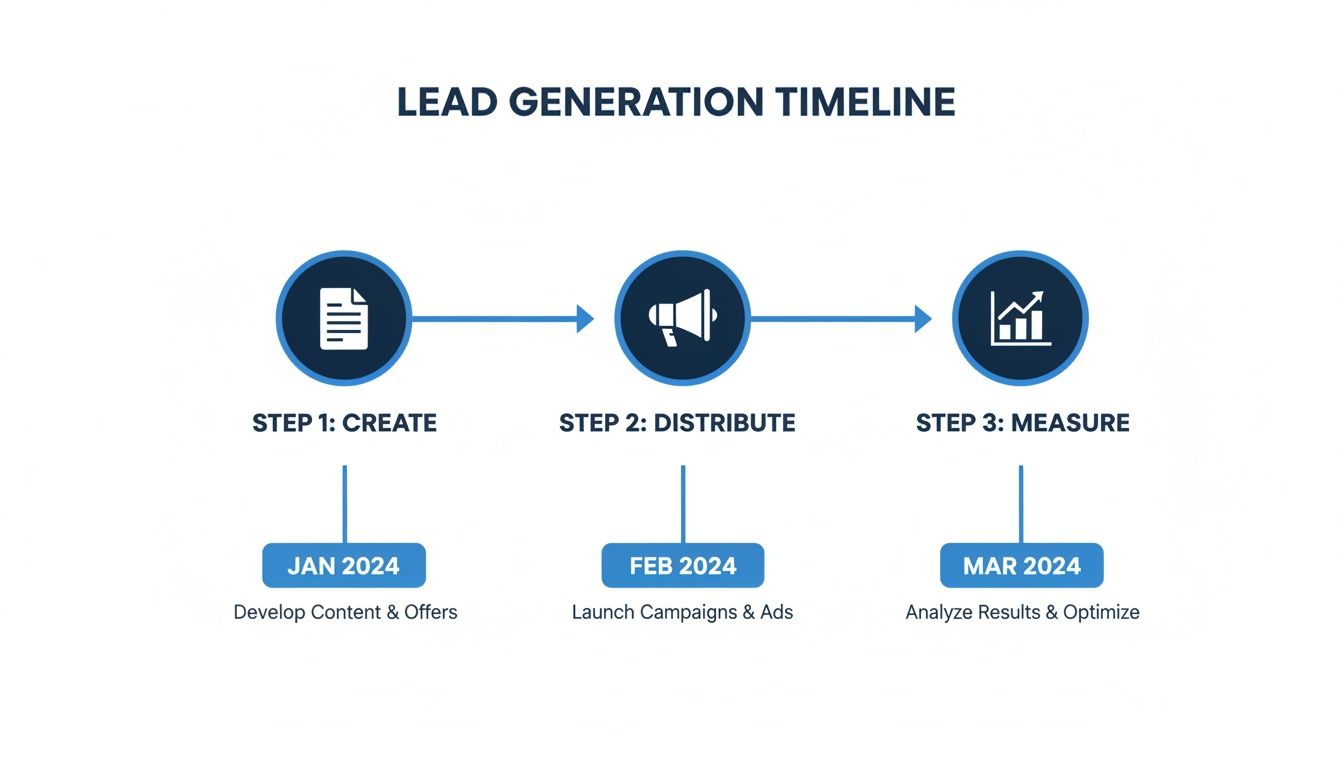
It ensures every asset you create is systematically promoted and its impact is tracked. This turns marketing from a cost center into a measurable investment.
Days 61-90: The Analysis and Iteration Phase
The final 30 days are about looking at the initial data and making smart adjustments. Great marketing is a process of continuous improvement. You’re no longer working on assumptions; you have real-world data.
Here’s your focus for the final stretch:
- Review Campaign Performance: Dive into the data from your LinkedIn campaign and email sequence. What was your cost per lead? Click-through rate? Conversion rate on the landing page?
- Gather Sales Team Feedback: This is critical. Sit down with your sales team. Are the leads qualified? What questions or objections are they hearing on the phone?
- Optimize and Plan the Next Sprint: Based on the data and team feedback, start making changes. Maybe your ad targeting was too broad, or the email copy needs a stronger hook. Use these insights to map out your next 90-day plan.
To help you organize this process, here’s a sample launch plan you can adapt.
90-Day Marketing Launch Plan
This table outlines a sample phased plan to systematically implement your new manufacturing marketing strategy and track progress.
| Phase (Days) | Key Focus | Actionable Tasks | Success Metric |
|---|---|---|---|
| Days 1-30 | Foundation Building | – Configure CRM pipeline & forms – Sharpen website value proposition – Fix critical SEO issues & optimize core pages |
Website conversion rate lift of 5%; All forms integrated with CRM. |
| Days 31-60 | Lead Generation Activation | – Launch one high-value lead magnet – Start a targeted LinkedIn ad campaign – Deploy email reactivation sequence |
Generate first 25 marketing-qualified leads (MQLs); Cost Per Lead < $150. |
| Days 61-90 | Analysis & Optimization | – Analyze campaign data (CPL, CTR) – Collect sales team feedback on lead quality – Plan next 90-day content & campaigns |
5 sales-qualified leads (SQLs) from new campaigns; Clear plan for Q2. |
This 90-day cycle of building, launching, and learning is the engine of sustainable growth.
Answering Your Questions About Manufacturing Marketing
We get it. Pulling the trigger on a new marketing system brings up some serious questions. You need to be sure your investment of time and money is actually going to move the needle. Here are straight answers to the most common questions we hear from manufacturing leaders.
How Much Should A Manufacturing Company Spend On Marketing?
Instead of thinking in terms of a fixed percentage of revenue, we advise a “proof of concept” approach. The real question isn’t “how much to spend,” but rather: What’s the smallest budget we can use to prove a marketing channel actually works?
Start with a focused 90-day plan. This lets you carve out a specific, manageable budget to test one key strategy—like a hyper-targeted LinkedIn ad campaign. The goal isn’t to boil the ocean; it’s to measure the return on that single, focused effort.
Once you have hard data showing a channel can generate qualified leads profitably, then you can scale your investment with confidence. This transforms marketing from a mysterious expense into an investment that produces a predictable return.
What Are The Most Effective Digital Marketing Channels For Manufacturers?
The best channels are always where your technical buyers are actively looking for solutions. For most manufacturers, the high-impact channels are consistently the same few players.
- Search Engine Optimization (SEO): When an engineer searches Google for a specific capability or a solution to a production problem, you have to be there. If you’re not on that first page, you’re invisible.
- LinkedIn: This platform is unmatched for its ability to target specific job titles like engineers, plant managers, and procurement specialists. Think of it as the most valuable industry trade show, running 24/7.
- Content Marketing: Technical buyers need information to make confident decisions. Detailed blog posts, downloadable whitepapers, and real-world case studies are what build the trust needed to get the call.
- Email Marketing: Sales cycles in manufacturing are long. Email is critical for nurturing leads over weeks or months, keeping your shop top-of-mind so you’re the first one they think of when they’re ready to issue a PO.
A real marketing system integrates these channels so they work together, making the whole system stronger.
How Do We Get Our Sales Team On Board With Digital Marketing?
This is a critical hurdle. The key is to position this entire effort as a system designed to support the sales team, not replace them. Salespeople only care about one thing: getting high-quality leads that are easier to close. So, you get their buy-in by delivering exactly that.
Don’t talk to your sales team about clicks or impressions. Talk about how the system will hand them educated, qualified leads with a full history of what they’re interested in. When marketing makes their job easier and their commission checks bigger, they will become your biggest advocates.
Start by getting sales involved in defining the Ideal Customer Profile. Then, put a CRM in place that automatically captures, qualifies, and seamlessly passes leads to them. When they start seeing real opportunities land in their inbox, the resistance will vanish.
How Can We Implement This Without A Dedicated Marketing Team?
You don’t need a massive team to get this done. The 90-day plan we outlined is specifically designed for companies that need to build momentum without a large internal team. The principle is simple: system over scale.
Focus on building one solid system and getting it to work perfectly before you add another. For example, your first move could be setting up a CRM and an automated follow-up for your quote request form. That single system immediately stops leads from falling through the cracks.
Many companies also find it’s more efficient to partner with an agency that lives and breathes manufacturing. This approach gives you access to specialized expertise to get the system built right, delivering results without the overhead of hiring full-time staff.
Ready to stop guessing and start building a marketing system that delivers predictable growth? The team at Machine Marketing specializes in implementing these proven strategies for manufacturers. We can help you diagnose your current system, build a solid foundation, and execute a plan that generates the qualified leads your sales team has been asking for.
Book a no-obligation discovery call with us today to see how we can build a marketing engine for your business.