If you’re running a manufacturing company, you know the challenge: keeping a steady flow of high-quality leads moving through a long sales cycle is a constant effort. Marketing automation for manufacturing is the system built to solve exactly that. It’s not just another piece of software; it’s an engineered process that captures prospects, educates them, and turns them into quote-ready buyers. How do you transform sporadic marketing efforts into a predictable lead machine? Let’s diagnose the problem.
Diagnosing Manufacturing Marketing Automation Gaps

Manufacturing marketing automation replaces scattered manual follow-ups with an engineered, measurable lead process.
In addition, for most manufacturers we work with, inconsistent leads aren’t a symptom of a lack of trying—it’s a broken system. Manual follow-ups, siloed data, and a leaky sales funnel are the root causes. However, your sales team is likely burning valuable time chasing cold inquiries or re-explaining the basics because there’s no process in place to warm up and educate prospects first.
Therefore, this is where an engineering mindset is your biggest asset. We don’t just see a marketing issue; we see a systems problem that can be fixed with the right blueprint. The mission is to shift from manual, reactive chores to an automated, proactive engine that runs 24/7.
Questions to Ask Yourself (The Diagnosis)
- Are your sales reps sending follow-up emails one by one?
- Can you confidently say which prospects are ready for a call and which ones aren’t?
- Do high-value leads ever fall through the cracks due to inconsistent follow-up?
If you answered “yes” to any of these, those small inefficiencies are costing you sales.
From Manual Effort to Automated Systems: The Transformation
Furthermore, the table below breaks down the shift from common manual marketing tasks to their automated, more efficient counterparts.
| Manual Task (The Problem) | Automated Solution (The Transformation) | Business Impact |
|---|---|---|
| Generic “Contact Us” form captures all leads equally. | Targeted landing pages with lead magnets (spec sheets, CAD files) automatically tag and segment new leads. | Higher quality leads; immediate insight into prospect interests. |
| Sales team manually follows up with every new lead, regardless of intent. | Automated email and SMS sequences nurture leads with relevant content (case studies, guides) over time. | Warmer, more educated leads; frees up sales for high-value conversations. |
| No clear way to know which leads are “hot” or “cold.” | Lead scoring tracks engagement (opens, clicks, downloads) and alerts sales when a prospect hits a “sales-ready” threshold. | Sales team focuses only on the most engaged prospects, increasing efficiency. |
| Inconsistent follow-up and dropped leads. | Automated follow-up tasks and reminders are assigned to sales reps, ensuring no opportunity falls through the cracks. | Shorter sales cycles and higher close rates. |
Consequently, this isn’t about doing the same things faster; it’s about building a smarter, more effective process from the ground up.
The Transformation You Should Expect
Moreover, the move to automation is about more than just efficiency. It’s about gaining clarity and control over your sales pipeline. As a result, when the system is dialed in, you get predictable data on exactly how many leads you need at the top of the funnel to hit your revenue targets.
If you want to dive deeper, you can find more strategies for building a reliable pipeline in our complete guide to lead generation for manufacturers.
Specifically, the real game-changer is when your sales team stops spending time prospecting and starts spending it closing. They get a steady stream of educated, interested leads who have already been warmed up by the system, which shortens the sales cycle and boosts win rates.
Manufacturing Marketing Automation CRM Foundation
In practice, before you automate a single email, you need a solid foundation. For any manufacturer, that foundation is a rock-solid Customer Relationship Management (CRM) system. It’s the central hub for your entire marketing and sales operation—the steel frame for the automation engine you’re about to build.
Meanwhile, without a well-structured CRM, any automation you attempt will be chaotic. You’ll send the wrong message to the right person or let high-value leads fall through the cracks because their data is stuck in a spreadsheet. Apply an engineering mindset here: structure and data integrity are everything.
Defining Your Customer and Their Journey
First, you have to be honest about who you’re selling to and how they buy from you. It’s impossible to organize data if you don’t understand the people behind it.
Start by asking these questions:
- Who is our Ideal Customer Profile (ICP)? Don’t just say “engineers” or “procurement managers.” Get specific. What is the company size, industry, and exact job title? What are the real technical problems they’re trying to solve?
- What does their buying journey really look like? Map it out from the first touchpoint (like finding your site via search) to downloading a spec sheet and requesting a quote. This map becomes the blueprint for your sales pipeline stages.
For example, this clarity prevents you from building a generic, useless system. A manufacturer selling custom CNC parts has a completely different customer journey than one selling off-the-shelf industrial pumps. Your CRM must reflect your reality.
Structuring Your CRM for Manufacturing Realities
As such, now for the practical part. While we often use GoHighLevel for its flexibility, these principles apply to any modern CRM. The goal is to capture the data that actually matters in a manufacturing sale. This means setting up custom fields that give your team immediate, valuable context.
Essential Custom Fields for Manufacturers:
- Machine Type or Model: If a prospect shows interest in specific equipment.
- Project Timeline: Are they looking for a solution this quarter or next year?
- Application/Use Case: What specific problem are they solving with your product?
- Key Technical Spec: Is there a critical tolerance, material, or output they need?
- Lead Source: Did they find you at a trade show, through a web search, or a referral?
When a new lead fills out a form, this information should be captured automatically. Suddenly, your sales team isn’t looking at just a name and email—they’re seeing a detailed profile of a potential customer with a specific need.
By structuring your CRM with these manufacturing-specific data points from day one, you’re not just storing contacts—you’re building an intelligent database that powers smart marketing automation. This is the difference between sending a generic “thanks for your interest” email and an automated follow-up with a case study matching their application.
Establishing Clear Pipeline Stages
In addition, once your data is structured, you need to define your sales pipeline stages within the CRM. This is where your customer journey map comes to life. Forget vague statuses like “lead” or “in progress.” Create clear, actionable stages that mirror your actual sales process.
A typical manufacturing pipeline might look like this:
- New Inquiry: A raw lead from a form submission.
- Contacted: An initial email or call has been logged.
- Qualification in Progress: The sales team is confirming budget, authority, and timeline.
- Technical Fit Confirmed: Your engineers have verified your solution meets their specs.
- Quote Sent: A formal proposal is in their hands.
- Negotiation: Final discussions on terms and pricing are happening.
Defining these stages does two critical things. First, it gives leadership a clear, real-time view of the sales forecast. Second, it creates the triggers you need for powerful marketing automation for manufacturing. For example, moving a lead to the “Quote Sent” stage can automatically trigger a follow-up sequence with client testimonials and financing options.
For a deeper dive into choosing and setting up the right platform, our guide on selecting a CRM for manufacturing companies provides a detailed roadmap.
How to Capture High-Quality Manufacturing Leads
With your CRM foundation ready, it’s time to fill it with prospects. Your website needs to be your hardest-working sales tool, not just a digital brochure. Here, we build the machinery—the funnels and landing pages that actively pull in high-quality leads from the people you want to talk to.
Forget the generic “Contact Us” form that treats every visitor the same. The goal is to create specific, high-value offers that your audience of engineers and technical buyers actually wants. Think less “get in touch” and more “get the specs.”
Moving Beyond the Basic Contact Form
In manufacturing, a lead isn’t just a name and email. It’s a person with a technical problem searching for a precise solution. Your lead capture strategy must reflect that. The key is to offer something of immediate, tangible value in exchange for their contact information.
Here are a few high-value offers that work exceptionally well for industrial companies:
- Technical Spec Sheet Downloads: The gold standard. Engineers and buyers live on data. Offering detailed spec sheets is the most direct way to attract serious, qualified prospects.
- CAD File or 3D Model Access: If a buyer needs to integrate your components into their designs, giving them downloadable files is an incredibly powerful lead magnet.
- Webinar Registrations: Host a webinar on a niche technical topic, like “Best Practices for Metal Fabrication in Aerospace,” to attract a highly relevant audience.
- Detailed Quote Request Forms: Go beyond the basics. Design an intelligent quote form that captures key project details upfront, pre-qualifying inquiries before they hit your sales team.
Each of these offers acts as a specific entry point into your marketing automation system. A prospect who downloads a spec sheet for Machine A is telling you exactly what they’re interested in. This allows your automations to follow up with relevant, helpful content instead of generic sales pitches.
Designing Landing Pages That Convert
On the other hand, a landing page has one job: get a visitor to take a specific action. It’s not your homepage, which is often cluttered with distractions. It’s a clean, direct path from your offer to a conversion.
To build a landing page that works, you need these core components:
- A Clear, Compelling Headline: State the value directly. Instead of “Our New Machine,” try “Download the Full Spec Sheet for the XYZ Laser Cutter.”
- Compelling Imagery or Video: Show the machine in action. High-quality visuals or a short video demonstrating its capabilities can make a massive difference.
- A Simple, Smart Form: This is critical. Only ask for the information you absolutely need right now. Name, company, and email are often enough. Long forms are the #1 killer of conversions.
You can see an example below from the GoHighLevel platform, which shows how you can visually build and manage these funnels step-by-step.
This kind of interface lets you map out the entire lead capture process, ensuring a smooth journey from an ad or search result right through to a completed form. The ROI from marketing automation in manufacturing is undeniable: businesses can see a $5.44 return for every $1 spent, and 80% of users report an increase in lead generation.
Your landing page has one job: make it incredibly easy for a qualified prospect to get the valuable resource you’re offering. Every single element—from the headline to the form fields—should serve that one purpose.
By improving your website’s ability to attract and convert visitors, you also strengthen your overall online visibility. This is a core component of any strong digital strategy, and you can learn more in our guide to SEO for manufacturing companies.
Manufacturing Marketing Automation for Lead Nurturing
Getting a new lead is just the opening move. In manufacturing, where sales cycles are long and decisions hinge on technical specs, consistent, intelligent follow-up is what separates a closed deal from a forgotten inquiry.
Here, you build an automated system to educate, build trust, and stay top-of-mind. A prospect might download a spec sheet today but not be ready to buy for nine months. Your automation’s job is to bridge that gap with valuable communication—so when they are ready, your company is the first one they call.
Building Your Automated Nurture Playbook
You don’t need to overcomplicate things. We find that manufacturers get the biggest impact by focusing on three core nurture sequences. Each one has a specific job to do.
- The Welcome Sequence: For brand-new leads. The goal is immediate engagement and delivering more value right away.
- The Long-Term Nurture: For prospects who aren’t ready to buy yet. You’ll educate them over weeks or months with case studies and technical guides.
- The Re-Engagement Campaign: For old, cold contacts sitting in your CRM. The mission is to revive dormant leads with a compelling new offer.
This flow chart gives a simple visual of how a lead moves from an initial offer to a qualified stage—the perfect trigger point for these nurture sequences.
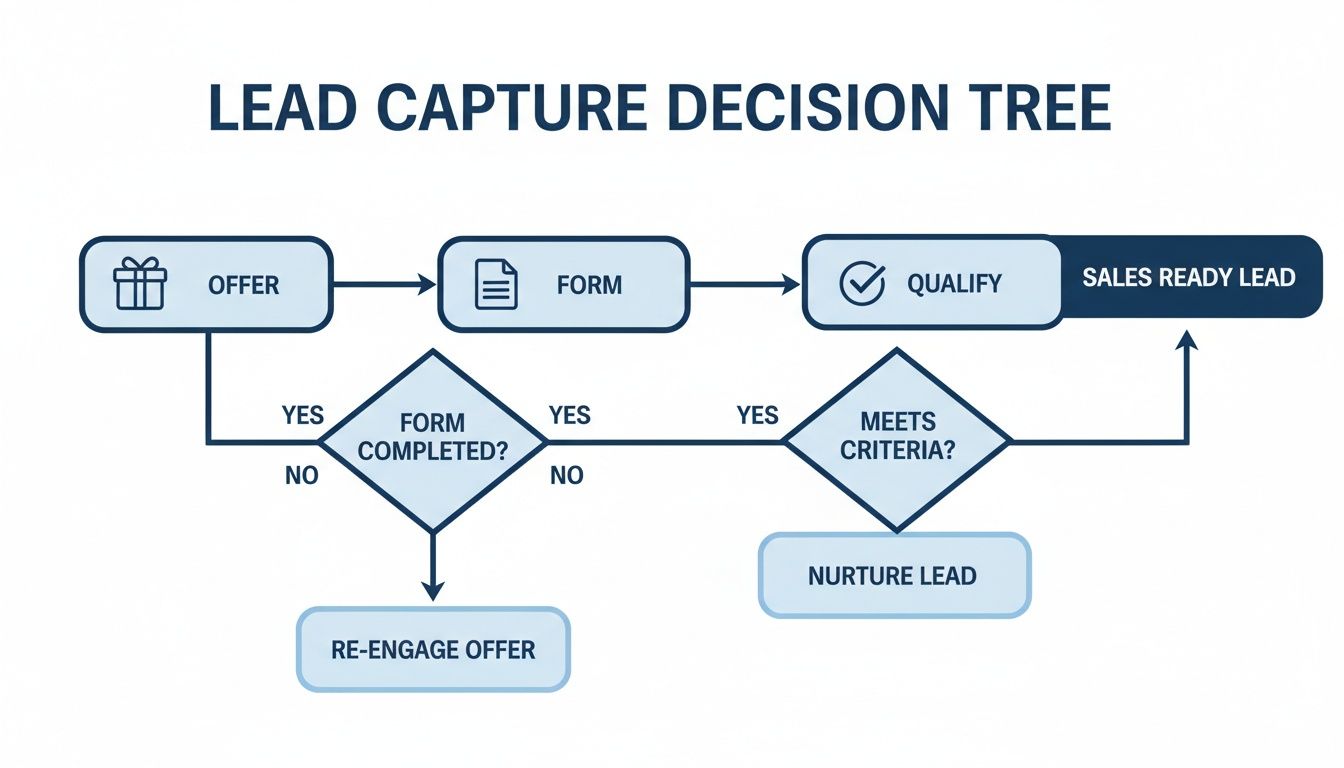
This is the process in action: a high-value offer gets a form submission, which kicks off a qualification process that feeds directly into your automated campaigns.
Using Conditional Logic to Get Smart
This is where your marketing automation for manufacturing really starts to shine. Basic automation sends the same emails to everyone. Smart automation uses conditional logic—simple “if/then” rules—to personalize the experience based on a prospect’s actions.
It turns your system from an email blaster into an intelligent response engine. You’re no longer just sending messages; you’re having a dynamic conversation shaped by their behavior.
Here’s how that looks in the real world:
- IF a prospect downloads the spec sheet for your Model X-500 Laser Cutter…
- THEN the system automatically waits two days and sends them a case study titled, “How ABC Manufacturing Increased Throughput by 35% with the X-500.”
This is infinitely more powerful than a generic “Thanks for your interest” follow-up. You’re delivering proof that directly relates to their stated interest, which dramatically increases the chance of a sales conversation.
Manufacturing Marketing Automation Welcome Sequence Blueprint
Let’s walk through a simple but effective welcome sequence for a lead who just downloaded a technical guide.
- Email 1 (Immediate): Deliver the Asset. Subject: “Here’s the technical guide you requested.” The email delivers the link and reinforces the value of the content.
- Email 2 (2 Days Later): Offer a Related Resource. Share a short video demonstrating a key process from the guide to provide more value.
- Email 3 (4 Days Later): Introduce a Problem-Solution Story. Send a brief case study or testimonial. Frame it around a common problem: “Struggling with [common pain point]? See how we helped [client name].”
- Email 4 (7 Days Later): The Soft Call to Action. Shift from education to conversation. A simple, plain-text email asking if they have any questions or would like to schedule a brief technical consultation works wonders.
This targeted outreach is why the marketing automation market is projected to grow from $2.9 billion in 2020 to $6.6 billion by 2026. This surge reflects the urgent need for manufacturers to streamline complex sales cycles with data-driven nurturing.
By building these simple, smart sequences, you create a system that consistently turns inquiries into warm, educated sales conversations. To dive deeper, explore this actionable guide to B2B marketing automation.
Engineering the Handoff from Marketing to Sales
This is the moment of truth.
You can have the most brilliant marketing automation system in the world, but if the handoff to your sales team is clunky or slow, all that effort is wasted. This isn’t a people problem; it’s a systems problem. Fixing it requires an automated, engineered bridge between your marketing efforts and your sales results.
The entire point is to get a hot, qualified lead to a sales rep instantly, with all the context they need for a meaningful conversation. A seamless handoff turns marketing activity into revenue.
Triggering the Sales Handoff Instantly
First, you must define what “sales-qualified” means for your business. This can’t be a gut feeling; it needs to be a data-driven threshold based on a prospect’s engagement. Maybe a lead is qualified after they visit a key product page, download a spec sheet, and open five nurture emails. The second they cross that line, the automation must fire immediately.
A robust handoff is a symphony of simultaneous actions:
- Instant Notifications: The assigned sales rep gets an immediate email and an SMS notification. Direct and actionable: “New Sales-Qualified Lead: John Doe from ABC Manufacturing. Click to view CRM record.”
- Automated CRM Tasks: The system should automatically create a task in the rep’s CRM queue, like “Call new lead John Doe,” with a clear due date. This builds in accountability.
- Changing Lead Status: The lead’s status in your CRM should instantly flip from “Marketing-Qualified” to “Sales-Qualified,” moving them into the active sales pipeline.
This isn’t futuristic; it’s the standard operating procedure for effective marketing automation for manufacturing. And the trend is picking up speed. Around 50% of companies are already using automation, and 70% of leaders plan to increase their investment. With 83% of leaders anticipating smart factories will change how they operate, synced-up marketing tech isn’t a luxury—it’s a necessity. You can see more on these marketing automation trends on inbeat.agency.
Measuring What Actually Matters
Once you’ve automated the handoff, you need to measure if it’s working. Forget vanity metrics like email open rates. You need to zero in on the KPIs that prove a real return on investment (ROI). These are the numbers your leadership team actually cares about.
Your marketing dashboard should be a diagnostic tool that tells you how healthy your sales pipeline is. If a number is on that dashboard, you should be able to take a specific action based on what it’s telling you.
Here are the only KPIs that matter for this part of the process:
- Lead-to-Customer Conversion Rate: What percentage of marketing-generated leads become paying customers? This is the ultimate test of lead quality.
- Sales Cycle Length: How long does it take to get from inquiry to a closed deal? Good automation should shorten this by delivering more educated prospects to sales.
- Marketing-Influenced Revenue: How much total revenue can you trace back to leads touched by your automation campaigns? This proves the financial impact of your system.
Build a simple dashboard in your CRM or a tool like GoHighLevel to track these three numbers. This will give you a clear, honest picture of your performance, allowing you to spot problems and optimize your system for real business growth.
Your Questions on Manufacturing Automation Answered
Even with a clear roadmap, adopting a new system will bring up practical questions. We hear the same concerns from manufacturing owners every time they start diagnosing their processes. Here are straight answers to help you move forward with clarity.
How long until we see real results?
The honest answer is: it happens in stages.
You’ll feel some benefits almost immediately. Just getting all your contacts into a single, organized CRM provides instant clarity. The chaos of scattered spreadsheets and lost sticky notes disappears overnight.
As for measurable impact, you can expect to see a real jump in lead quality and engagement within the first 90 days. This is when your initial lead capture funnels and welcome sequences start filtering out tire-kickers and warming up genuine prospects.
The full return on investment—where you see a noticeably shorter sales cycle and higher close rates—typically becomes clear within 6 to 9 months. That’s how long it takes for the system to fully nurture longer-term, high-value leads through your entire pipeline.
Is this too complex for a small manufacturing company?
Not at all. The idea that marketing automation is only for massive corporations is a myth. The key is to avoid trying to boil the ocean on day one. A phased implementation is the smart approach.
- Start with one core problem. Is your biggest bottleneck capturing new leads or ensuring consistent follow-up? Solve that one thing first.
- Master the fundamentals. Get your basic lead capture, CRM organization, and a simple welcome sequence running like clockwork.
- Expand from there. Once that initial system is delivering value, you can add more layers, like long-term nurture campaigns.
A system that grows with your business is always better than a complex one that overwhelms your team. Platforms like GoHighLevel, which we configure for clients, are built to be user-friendly and scalable.
Will marketing automation replace my sales reps?
Let me be direct: absolutely not. The purpose of marketing automation for manufacturing is to empower your sales reps, not replace them. Think of it as giving your best players a world-class support crew.
The system takes over the repetitive, time-consuming tasks that bog down a sales team. It qualifies, educates, and warms up prospects before they speak to a human. This frees up your sales experts to focus on high-value activities:
- Building relationships with qualified prospects.
- Conducting detailed technical demos.
- Negotiating and closing deals with well-informed, quote-ready buyers.
Ultimately, it makes your sales team more efficient and far more effective.
What is the biggest mistake to avoid?
The most common—and most expensive—mistake we see is focusing on the tool before the strategy. Too many companies buy sophisticated software expecting it to magically fix their lead generation problems, only to watch it collect dust.
The technology is just an enabler; your strategy is the engine.
Before you watch a single software demo, you need a clear, documented plan for your customer’s journey. You need a precise definition of a “sales-qualified lead” and a rock-solid process for how you intend to capture, nurture, and hand off prospects. Without that strategic blueprint, the best software in the world is useless.
Ready to build a predictable lead generation system without the guesswork? Machine Marketing specializes in implementing practical, results-driven marketing automation for manufacturers. We handle the strategy, setup, and optimization so you can focus on what you do best.
When implemented correctly, manufacturing marketing automation creates a reliable, scalable pipeline that supports long sales cycles and high-value industrial deals. Book a discovery call with Karl today and let’s engineer a solution for your growth.