Identifying your target audience is the difference between marketing that converts and marketing that disappears. If your campaigns feel like shouting into the void, a fuzzy audience definition is usually the cause. The fix isn’t guesswork — it’s a data-driven process: analyze your best customers, validate patterns with research, and turn a vague audience into a clear, actionable profile.
In this guide, we’ll show you how to diagnose the gaps in your audience knowledge and build a system to turn a vague idea into a crystal-clear, actionable profile of the exact person you should be talking to.
Why Failing to Identify Your Target Audience Is Costing You Money
When you identify your target audience with data, your message becomes specific, relevant, and easier to convert.
Does your marketing budget seem to evaporate on ads that don’t convert? Is your sales team spinning its wheels chasing junk leads? This is a problem we see constantly with sharp business owners, especially in B2B services or manufacturing.
The root cause is almost always the same: their message falls flat because it’s trying to impress everyone.
Let’s be direct: thinking ‘everyone’ is your customer is one of the most expensive mistakes you can make. When your target is a blurry concept like “small business owners,” you can’t create content or an offer that solves a specific, urgent problem. Your efforts just don’t have the precision needed to cut through the noise.

The Engineering Mindset for Audience Definition
This is why identifying your target audience is a performance lever — it lowers CPA and improves lead quality. We don’t treat audience identification as a fluffy creative exercise. We treat it like an engineering problem—a system that needs to be diagnosed and optimized. Think like an engineer spotting a flaw in a machine; you need to find the gaps in your audience knowledge with that same precision.
The symptoms of a poorly defined audience are obvious once you know what to look for:
- Wasted Ad Spend: Your cost per acquisition (CPA) is through the roof because you’re paying to show ads to people who will never buy.
- Low-Quality Leads: The leads that do come in aren’t a good fit, bogging down your sales team and killing morale.
- Stalled Campaigns: Your emails have abysmal open rates and your social posts get zero traction because the content just doesn’t connect.
- Weak Messaging: Your website uses generic corporate-speak that fails to build trust or show you actually understand your customer’s world.
Pinpointing your audience with data isn’t just a “nice-to-have” — it’s how you win. Research shows that personalization, a strategy impossible without a clear audience, is a top priority for marketers. You can explore more data on identifying your target market to see how critical this has become.
The goal is to stop marketing to a crowd and start having a conversation with a specific person who has a specific problem you can solve. Precision targeting unlocks immense opportunity, turning your marketing from an expense into a predictable revenue-generating system.
Your Audience Clarity Self-Diagnosis
So, how clear is your current audience definition? Let’s run a quick diagnostic. Ask yourself these questions. If you find yourself answering ‘No’ more than once, the strategies in this guide are critical for your growth.
Questions to Ask Yourself:
- Can I name the top 3 job titles of my ideal buyers? Knowing their roles helps you understand their daily responsibilities, pressures, and priorities.
- Do I know the specific business problem they hire us to solve? This is the core of effective messaging. Without it, you’re just selling features, not solutions.
- Can I describe a “day in the life” of my best customer? Understanding their context helps you create relevant content that fits seamlessly into their world.
- Do I know where they get their information online? This tells you exactly where to place your marketing efforts for maximum impact and efficiency.
If those questions brought more uncertainty than confidence, you’re in the right place. The rest of this guide is designed to help you turn those ‘No’ answers into a resounding ‘Yes’.
How to Identify Your Target Audience with Research That Actually Works
Defining your audience is a diagnostic process, not a guessing game. To get from a vague idea to an actionable profile, you need two types of data: quantitative (the what) and qualitative (the why).
Think of it like this: quantitative data tells you what your best customers look like on paper. Qualitative data tells you why they chose you in the first place. Guessing is like trying to fix a machine without knowing which part is broken—it’s slow and expensive. Instead, we’re going to build a repeatable system for gathering the intel you need.
The best part? This doesn’t require a massive budget. It starts with the valuable data you already own.
Start with the Data You Already Own
Before you spend a single dollar on external research, look inward. Your current customer base is a goldmine of information about who finds the most value in what you do. You’re looking for patterns—commonalities that point directly toward your ideal customer.
Here’s where to start digging:
- CRM or Sales Records: Your CRM is the fastest way to identify your target audience based on real revenue, not opinions. Pull your top 10-20% of customers. Who are they? Look for common firmographics like industry, company size, revenue, and geographical location. What was the original problem they came to you to solve?
- Billing Information: Note their average purchase value and buying frequency. Do your best clients buy one specific service or a bundle? This tells you what your most profitable offerings are and who they appeal to.
- Website Analytics: Tools like Google Analytics can reveal demographic data about your visitors, including their age, gender, and interests. You can also see which pages get the most traffic, signaling what topics hit home. Understanding what marketing analytics can tell you is a crucial first step.
The goal here is to create a data-backed sketch of your current successful customer. This quantitative analysis forms the foundation for the next, even more crucial step.
Your best customers aren’t just the ones who spend the most; they’re the ones who get the most value, are easiest to work with, and become advocates for your brand. Reverse-engineer their success to find more people just like them.
Uncover the ‘Why’ with Qualitative Research
Quantitative data shows you what’s happening, but qualitative research explains why it’s happening. This is where you uncover the real motivations, pain points, and the specific language your customers use. This is how you learn to speak their language.
The most effective way to gather this intel? Just talk to them.
Customer Interviews
A simple 15-minute phone call with a handful of your best clients can yield more actionable insights than a month of staring at spreadsheets. The key is to ask open-ended questions that get them talking beyond surface-level answers. These interviews help you identify your target audience using the exact words they use to describe the problem.
Avoid leading questions. Instead of, “Was our onboarding process easy?” ask, “Can you walk me through your experience of getting started with us?”
Here are a few questions we use that consistently deliver valuable insights:
- “Before you started working with us, what was the biggest challenge you were facing related to [your service area]?”
- “What was the tipping point that made you decide to actively look for a solution?”
- “What’s been the most significant improvement in your business since we started working together?”
- “If you were explaining what we do to a colleague, what words would you use?”
Listen closely to the exact phrases they use. Those are the keywords, headlines, and messaging points you should be using in all of your marketing.
Surveys
Surveys are excellent for scaling your research beyond one-on-one interviews. They let you validate the patterns you’re seeing from the interviews and gather a much broader data set.
Conducting market research via surveys is a gold standard for a reason. For instance, one study highlighted how general population surveys uncovered key purchasing behaviors, like 3 in 4 Gen Z buyers preferring online or mobile shopping. You can read the full research about these survey findings to see how differently various demographics behave.
When building a survey, keep it short and focused. A mix of multiple-choice and a few open-ended questions works best. Focus on understanding their biggest challenges and priorities—this will directly inform your messaging and content strategy.
By combining these methods, you create a 360-degree view of exactly who you should be targeting.
How to Build Your Ideal Customer Profile and Buyer Personas
You’ve done the diagnostic work—gathering quantitative and qualitative data. Now, it’s time to turn that raw research into practical tools your team can use to find and close deals. We’re moving from abstract numbers to living profiles that will guide every marketing and sales decision you make.
The goal isn’t to create a document that collects digital dust. It’s about building a shared, crystal-clear understanding of who you’re serving. This breaks down into two key assets: the Ideal Customer Profile (ICP) and Buyer Personas.
This simple two-step flow—marrying quantitative analysis with qualitative insights—is the foundation for this whole process.
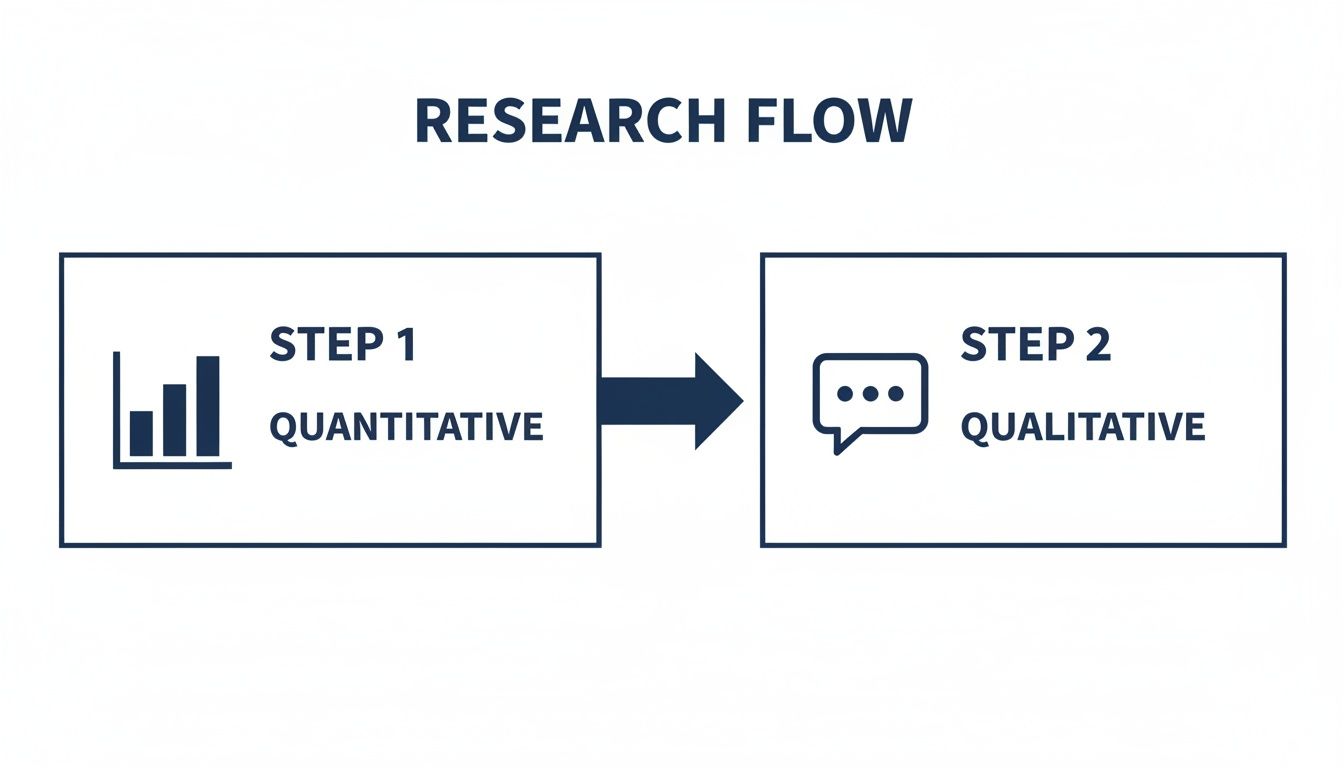
This visual is a powerful reminder: defining your audience starts with hard numbers, but it’s the human stories and motivations that truly bring it to life.
Identify Your Target Audience by Defining Your Ideal Customer Profile (ICP)
Before you can zero in on the people, you need to understand the companies they work for. For any B2B business, this begins with your Ideal Customer Profile. Think of the ICP as a sharp, specific description of the perfect-fit company for your product or service.
Selling to the wrong type of company—even if you connect with the right person inside—is a recipe for churn, frustration, and wasted resources.
An ICP is the ultimate filter for your entire go-to-market strategy. It tells your sales team which doors to knock on and makes sure your marketing dollars are spent reaching organizations that can actually afford—and see value in—what you’re offering.
To build out your ICP, dig back into the quantitative research you already did. You’re looking for the common threads that tie your best, most successful clients together.
Start by asking these questions about your top customers:
- Industry/Vertical: Are they clustered in a specific niche, like medical device manufacturing or commercial construction?
- Company Size: Do you see the most success with businesses of a certain employee count (e.g., 50-200 employees) or annual revenue?
- Geography: Are there regional hot spots? Do you primarily serve clients in a particular state or region?
- Technology Stack: Do your best clients use specific software, like a certain ERP or CRM, that your solution integrates with?
- Company-Wide Pain Points: What are the big challenges they all seem to face? Think “struggling with production bottlenecks” or “facing supply chain disruptions.”
Once you have a clear picture of this ideal company, you can use modern B2B prospecting techniques to find more of them. This profile sharpens your focus, helping you spot high-potential accounts with greater accuracy.
Creating Actionable Buyer Personas
With your ICP locked in, it’s time to zoom in on the specific people inside those ideal companies. These are your Buyer Personas. A buyer persona is a semi-fictional sketch of a decision-maker or influencer you’ll encounter during the sales process.
For example, a manufacturer doesn’t just sell to “the company.” They sell to individuals:
- The Engineer: Obsessed with technical specs, reliability, and integration.
- The Plant Manager: Focused on efficiency, uptime, and safety.
- The CFO: Worried about ROI, total cost of ownership, and payment terms.
Each of these people has different goals and needs to hear a completely different story from you. This is why generic marketing falls flat.
Let’s build out a persona using the qualitative interviews we talked about earlier. We’ll call him “Plant Manager Pete.”
| Persona Element | Example Data for “Plant Manager Pete” |
|---|---|
| Job Title & Role | Plant Manager at a mid-sized custom fabrication shop. |
| Demographics | Male, age 45-55. Likely has an engineering or operations background. |
| Daily Challenges | Unscheduled machine downtime, meeting production deadlines, training new operators. |
| Goals & Motivations | Hitting production targets without running up overtime. Needs predictable maintenance schedules. |
| Pain Points | “I can’t afford another line stoppage. My biggest fear is a critical failure during a big production run.” |
| Where He Gets Info | Industry trade publications, LinkedIn groups for manufacturing pros, recommendations from peers. |
See how specific that feels? Now your team knows exactly how to frame an email or start a conversation that will grab Pete’s attention. These aren’t just documents—they’re your living blueprints for effective communication.
How to Use Target Audience Insights After You Identify Your Target Audience
All that research and persona-building means nothing if it collects dust in a folder. This is where your diagnostic work starts generating real revenue. Your customer profile is a blueprint for creating marketing that doesn’t just get seen, it gets felt.
The entire point is to map your core message directly to the specific headaches and goals of each persona you’ve built.
This is how you graduate from generic statements to compelling website copy, targeted emails, and social media content that actually stops the scroll. You stop shouting at the market and start having a genuine conversation with the right person.

From Persona Pains to Powerful Messaging
Let’s make this practical. Imagine you’re a custom machinery manufacturer. Through your research, you’ve defined two key buyer personas: “Elena the Engineer” and “Charles the CFO.” They work at the same company, but they live on different planets.
Your old marketing probably used a one-size-fits-all message about your “high-quality, innovative machinery.” That’s not good enough.
To get Elena the Engineer’s attention, your content has to speak her language. She worries about reliability, integration, and technical specs. Her performance is measured by uptime and efficiency.
Your messaging for Elena needs to hit on:
- Website Content: Detailed spec sheets, downloadable CAD drawings, and case studies that highlight machine reliability and low maintenance.
- Email Campaigns: Technical whitepapers explaining how your tech solves common production bottlenecks.
- Social Media: Video clips showing the machine in action, emphasizing its precision and ease of use.
Now, Charles the CFO? He barely glances at spec sheets. He operates in a world of budgets, ROI, and total cost of ownership (TCO). A machine failure isn’t a technical glitch; it’s a number that craters the quarterly profit and loss statement.
Your messaging for Charles needs a completely different angle:
- Website Content: An interactive ROI calculator, testimonials from other CFOs talking about cost savings, and clear financing options.
- Email Campaigns: A report showing how your machine’s efficiency cuts labor costs and material waste by 15% over three years.
- Social Media: Sharp infographics on LinkedIn that showcase the long-term financial wins from investing in your equipment.
The machine is the same, but the message is entirely different. This is the power of persona-driven marketing. You’re not just selling a product; you’re selling the specific solution each person in the buying committee is looking for.
Systematizing Your Approach in a CRM
Trying to manage this level of targeted communication manually is a recipe for disaster. This is where your CRM becomes the central nervous system for your marketing operation. We lean on systems like GoHighLevel to turn abstract personas into concrete, actionable segments.
The process is straightforward: you create tags in your CRM that line up with your buyer personas. When a new lead comes in, you tag them.
- Did they download the technical whitepaper? Tag them as an “Engineer” persona.
- Did they use the ROI calculator? Tag them as a “CFO” or financial decision-maker.
Once tagged, automation kicks in. Each persona is dropped into a unique follow-up sequence filled with content tailored to their pains and goals. Elena gets the technical specs; Charles receives the financial case study. This is a cornerstone of any solid strategy for inbound marketing and lead generation.
For B2B companies, a well-defined LinkedIn marketing strategy for B2B is non-negotiable. By targeting job titles that match your personas, you guarantee your content reaches the right people from the start.
How to Validate and Refine Your Audience Over Time
Defining your target audience isn’t a one-and-done project. Markets change, customer needs evolve, and your business grows. The picture of your ideal customer from last year could be dangerously out of focus today.
That’s why you must treat your buyer personas as living documents. You need a system for constant validation and refinement to keep your marketing sharp and efficient, quarter after quarter.
The good news? You don’t need complicated tools. The data you need to test your assumptions is already flowing into your business every day. You just have to know where to look.
Using Real-World Data to Test Your Assumptions
Think of your personas as well-researched hypotheses about who your customers are. Now, it’s time to put those hypotheses to the test. Every blog post, email campaign, and social media update is a chance to gather data.
Here’s how to turn your marketing channels into a powerful validation engine:
- Website Analytics: Dive into Google Analytics and look at your most popular blog posts. Are the articles aimed at your “Plant Manager” persona getting the most traffic? If not, there may be a gap between what you think they care about and what they actually need.
- Social Media Engagement: Pay close attention to which posts get the most engagement on platforms like LinkedIn. If a detailed technical breakdown gets a spike in interaction from engineers, that’s a huge signal your persona insights are hitting the mark.
- Email Campaign Metrics: Your email data is pure gold. Are open and click-through rates higher for emails segmented for your “CFO” persona? If leads from a specific industry segment are converting 20% higher than others, that’s a clear sign telling you where to double down.
Consider your marketing a series of small experiments. Each piece of content is a chance to ask, “Did this resonate with the person I intended it for?” The data will always give you an honest answer.
The Quarterly Audience Review Framework
To make this a repeatable process, we recommend a simple quarterly audience review. This is a focused meeting with key players from sales, marketing, and customer service to check in on your personas and ensure they still match reality.
The goal is to spot gaps between your personas and what’s actually happening on the ground.
Key Questions to Ask Your Team:
- “Based on recent calls, does our ‘Plant Manager Pete’ persona still accurately reflect our customers’ daily headaches?”
- “Are we seeing a new type of buyer show up in the sales process that we haven’t accounted for?”
- “Is our messaging for the ‘CFO’ persona working, or are we hearing new objections our profile didn’t prepare us for?”
This data-driven feedback loop is what separates businesses that grow consistently from those that stall out. It ensures your understanding of how to identify your target audience is never static. It becomes a dynamic system that adapts to the real world, keeping you connected to the people who matter most.
Got Questions About Finding Your Target Audience?
Even with a solid plan, a few tricky questions always seem to pop up. Business owners often get stuck on the same handful of points. Let’s clear those hurdles right now.
Target Market vs. Target Audience: What’s the Difference?
Getting this right sharpens your entire marketing approach. It’s simple when you think about it this way:
Your target market is the big picture—the entire group of businesses you could sell to. For a custom parts manufacturer, their market might be “mid-sized aerospace companies in North America.”
Your target audience is the specific group of people you’re trying to reach with your marketing right now. For that same manufacturer, an audience could be “Lead Design Engineers, aged 40-55, at those aerospace companies who follow Aviation Week on LinkedIn.”
The market is the pond; the audience is the specific fish you’re casting for today. This distinction helps you stop shouting generic messages and start having real conversations.
How Many Buyer Personas Should We Create?
There’s no magic number. Our advice? Start with one to three personas that are incredibly well-defined. It is far better to have one deeply researched persona your team actually uses than ten shallow ones collecting dust.
For most B2B companies, a great place to begin is by focusing on these three roles:
- The Decision-Maker: The person who gives the final “yes.”
- A Key Influencer: The end-user or technical expert whose recommendation carries huge weight.
- A Potential Blocker: The skeptical CFO worried about costs or an IT manager concerned about integration.
Mapping these out helps you anticipate the conversations you need to have, addressing both needs and potential roadblocks from the start.
“But Our Product Can Help Everyone!”
This is one of the most common—and dangerous—mindsets a business can have. Trying to market to “everyone” almost always leads to connecting with no one. Your message gets so watered down that it fails to solve anyone’s specific, urgent problem.
Choosing a narrow, specific audience isn’t about excluding people. It’s about creating a powerful, undeniable connection with the right people first.
When you focus, you can tailor your language, content, and offers to their biggest pain points. That focus builds a stronger bond, drives higher conversion rates, and creates loyal customers who become advocates. Win one specific territory first, then expand.
What Are the Best Free Tools for Audience Research?
You don’t need a massive budget to get started. The best insights come from listening, and you can start with tools that are already at your fingertips.
- Your Own Customer Data: Your CRM or sales spreadsheets are a goldmine. Look for patterns among your best customers. Where did they come from? What’s their role?
- Google Analytics: This free tool tells you a ton about your website visitors—demographics, interests, and which content they spend the most time on.
- A Simple Google Search: Type your main keywords into Google and scroll to the “People Also Ask” box. This is a list of the exact questions your audience is trying to answer. Google Trends is another great one for seeing what topics are picking up steam.
- Online Communities: Go hang out where your audience lives online. For B2B, that’s often specific LinkedIn Groups, industry forums, or subreddits. Pay attention to the language they use and the problems they complain about.
Ready to stop guessing and start building a marketing system that consistently attracts your ideal customers? At Machine Marketing, we specialize in diagnosing the gaps in your current marketing and implementing a clear, data-driven strategy for growth.
Book a no-obligation discovery call with us today and let’s diagnose how we can help you define your audience and turn those insights into predictable revenue.