If your lead flow feels more like a rollercoaster than a predictable system, you're not alone. The common impulse is to push harder—more cold calls, more ads—but that's treating a symptom, not the disease. The real problem is often a disconnected marketing approach that interrupts potential buyers instead of attracting them.
In this guide, we'll diagnose the common gaps in a B2B marketing system and give you a step-by-step framework to build an inbound engine that pulls in qualified leads, builds trust, and creates sustainable growth.
Diagnosing Your B2B Lead Generation Gaps

For manufacturers and industrial business owners, a feast-or-famine lead flow is exhausting and unpredictable. The problem is rarely a lack of effort; it's a lack of a cohesive system. Chasing individual sales is a short-term tactic. Building a system that consistently attracts your ideal buyers is how you create long-term, sustainable growth.
To fix this, you need to approach it with an engineering mindset. Instead of patching surface-level symptoms like "we need more website traffic," we need to diagnose the root cause of your lead generation problems.
Asking the Right Diagnostic Questions
A solid inbound B2B marketing plan begins with an honest audit. Your current process is likely leaving opportunities on the table, but you can't fix what you can't see. Kick things off by asking some direct questions about each part of your system.
Questions to ask about your audience and messaging:
- Are we attracting website traffic, or are we attracting the right traffic? A hundred visits from your ideal buyer profile are infinitely more valuable than a thousand from the wrong crowd.
- Does our website's messaging speak directly to our ideal customer's biggest problems, or is it just a list of our services?
- When a qualified prospect lands on our site, do they instantly understand what problem we solve and who we solve it for?
These questions shift your focus from vanity metrics to business impact. This isn't about getting more clicks; it's about getting the right clicks from prospects who are a perfect fit for what you offer.
The core issue we uncover time and again isn't a sales problem—it's a clarity problem. Businesses struggle when they can't articulate their value in a way that resonates with their ideal buyer, which leads them to attract prospects who were never going to convert anyway.
Pinpointing Gaps in Your Conversion Process
Once you're confident you’re attracting the right people, the next diagnostic step is to figure out why they aren't taking action. A website that only informs is a digital brochure. A website built for inbound marketing is a lead generation machine.
Here are common conversion gaps to look for:
- No Clear Calls-to-Action (CTAs): Does every page guide the visitor on what to do next? Whether it’s "Download a Spec Sheet," "Book a Demo," or "Request a Quote," they need a clear, logical next step.
- Friction in the User Experience: Is your contact form unnecessarily long? Is your phone number buried three pages deep? Every extra click or confusing step costs you leads.
- No Value Exchange: Are you giving prospects a compelling reason to share their contact information? Lead magnets like checklists, whitepapers, or webinars offer real value upfront and begin building trust.
By diagnosing your entire system from attraction to conversion, you can stop guessing and start building a predictable pipeline. To see how others are tackling this, you can analyze some effective LinkedIn B22B lead generation tactics, which can reveal how social channels integrate into a larger conversion strategy.
Your Foundation: Building on a Customer-First Strategy
Every successful B2B inbound marketing system we've ever built stands on one non-negotiable principle: you have to know exactly who you're talking to.
Before you write a single blog post or design a landing page, you must get surgically precise about the customer you serve. A common mistake is trying to appeal to everyone—which guarantees you'll resonate with no one.
This isn't a fluffy marketing exercise; it's the core of the entire system. When you deeply understand your ideal buyer, every other decision becomes clearer and more effective. It’s the difference between shouting into a void and having a direct, productive conversation with your best future customer.
Defining Your Ideal Customer Profile
Your Ideal Customer Profile (ICP) is a clear description of the perfect company you want as a client. This isn't a vague concept; it's a specific definition built from real-world data. Forget broad categories like "manufacturing companies." We need to get more specific.
Start by looking at your best current customers—the ones you love working with, who get the most value, and are the most profitable. What do they have in common?
- Industry & Niche: What specific sector are they in? (e.g., "aerospace-grade aluminum fabrication," not just "metal fabrication.")
- Company Size: What's their annual revenue or employee count? (e.g., $10-$50 million in annual revenue.)
- Geography: Where are they located? Do you serve a specific region or a national market?
- Technology Stack: What software, machinery, or systems do they use that makes them a perfect fit for your solution?
Once you've defined the company profile, the next layer is understanding the people inside those companies—your buyer personas. An engineer cares about technical specs, while a plant manager is focused on uptime and efficiency. You can't talk to them the same way.
Uncovering Your Customer's Real Pain Points
The most powerful inbound b2b marketing doesn't sell features; it solves problems. To do that, you have to know what keeps your ideal customers up at night. The best way to find out is simple: ask them.
Conducting customer interviews is one of the highest-leverage activities you can do. Set aside an hour to talk to a handful of your best clients. This isn't a sales call. Your only job is to listen.
Questions to ask your best customers:
- What was the biggest headache you were dealing with before you found us?
- What other options did you consider, and what made you choose us?
- What specific, measurable results have you seen since we started working together?
- If you had to describe the main value we bring to your business, what would you say?
The answers are pure gold. They give you the exact language your customers use to talk about their problems. You can then use that language directly on your website, in your ads, and across all your content.
Your customers will tell you everything you need to know about how to market to them. Your job is to create a system for listening, documenting, and acting on what you hear.
Crafting a Positioning Statement That Actually Connects
With your ICP defined and their pain points mapped out, you can finally craft a clear positioning statement. This isn't a slogan; it's an internal compass that gets your entire team—sales, marketing, operations—aligned.
A solid positioning statement follows a simple formula: "For [Ideal Customer Profile], who [has a specific problem], we provide [your solution], which delivers [the key benefit]."
Let's see it in action:
- Before: "We sell CNC machines." (Vague and uninspired.)
- After: "For mid-sized aerospace component manufacturers struggling with tight tolerances and material waste, we provide multi-axis CNC machines that deliver sub-micron accuracy, reducing scrap rates by up to 15%."
That level of clarity is a game-changer. It instantly tells the right prospects they're in the right place and filters out those who aren't a good fit. This foundational work is the bedrock of your entire inbound system.
Engineering Your Website for Lead Conversion
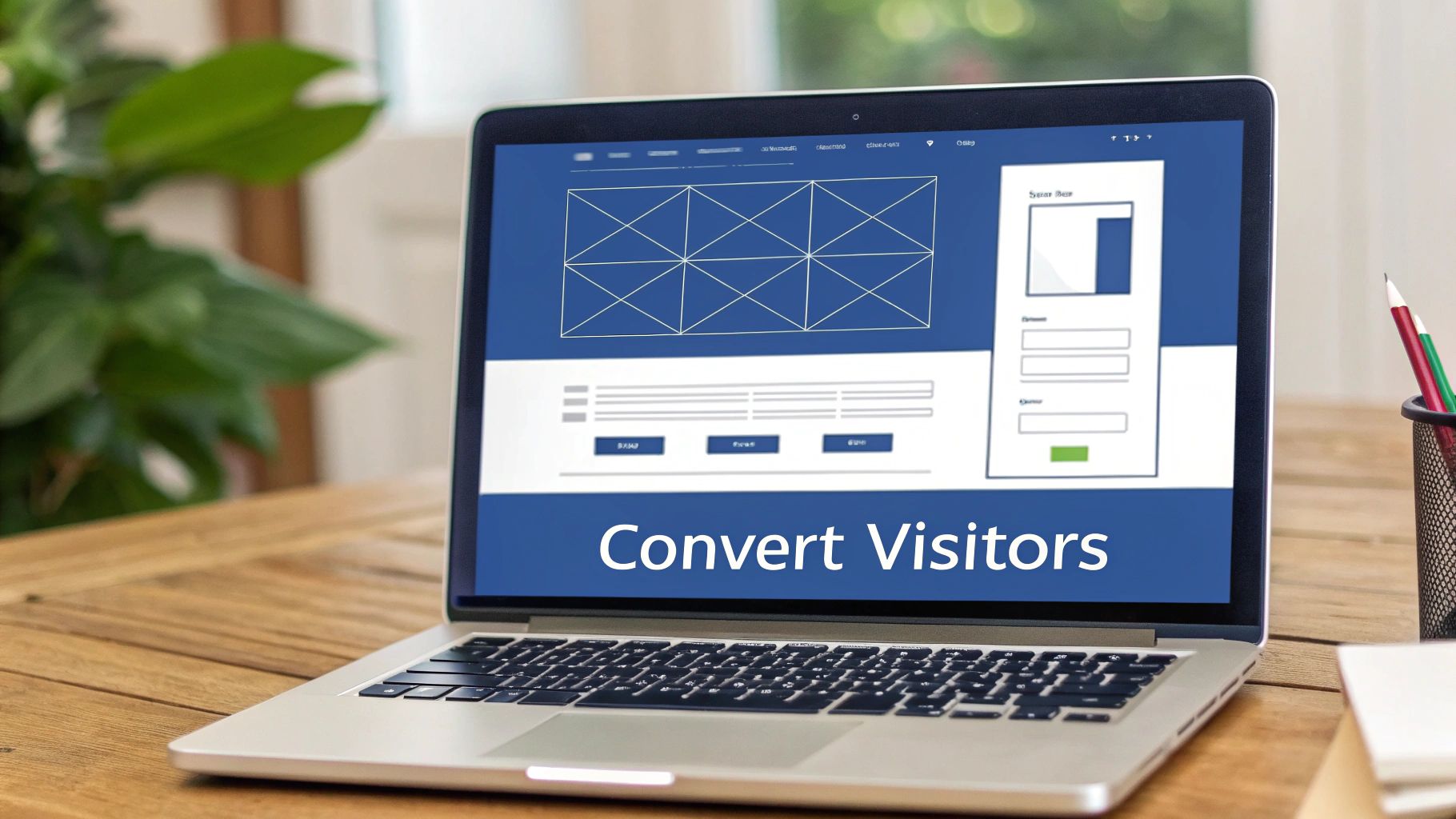
Your website should be your hardest-working sales tool, operating 24/7 to engage prospects and turn interest into business opportunities. It’s not a digital brochure.
This requires an engineering mindset. We aren’t just building a site to look good; we’re building it to perform a specific job—converting visitors into qualified leads. Every element, from the navigation to the button text, must be intentionally designed to guide your ideal customer toward taking a next step.
Your website is the central hub for your entire inbound b2b marketing strategy. Get it right, and every other marketing activity becomes more effective.
Core Components of a Conversion-Focused Website
A website built to convert is clean, intuitive, and laser-focused on the user. Forget flashy animations and dense jargon. Your prospects are busy people looking for clear answers to their problems. Your goal is to remove all friction between their challenge and your solution.
Here are the non-negotiable elements your site must have:
- Crystal-Clear Calls-to-Action (CTAs): Don't make visitors guess. Every page needs a clear, compelling CTA like "Request a Quote," "Schedule a Consultation," or "Download the Spec Sheet."
- Intuitive Navigation: Can a first-time visitor find what they need in two clicks or less? Your site map should be logical, with main services and contact information easily accessible.
- Mobile Responsiveness: Many B2B decision-makers research solutions on their phones. If your site is clunky on mobile, you're actively losing leads.
- Trust Signals: Prominently display case studies, testimonials, and industry certifications. This social proof makes a visitor feel comfortable enough to provide their contact information.
This deliberate approach pays off. According to industry data, inbound tactics generate 54% more leads than traditional outbound marketing at a much lower cost. But to capitalize on that, your website must be ready to capture that interest.
Setting Up the Technical Infrastructure for Success
A great user interface is only half the battle. The real power comes from the backend system that captures, tracks, and nurtures every lead automatically. This is where a robust CRM becomes the engine of your lead generation machine.
We use platforms like GoHighLevel because they centralize everything. It connects your website forms, online schedulers, and lead magnets directly into a single, unified contact record. So when a prospect fills out a "Download Our Guide" form, they don't just get an email.
Instead, a fully automated system kicks in. The contact is created, tagged based on their interest, and a nurture sequence begins—all without anyone on your team lifting a finger. This is how you build a scalable system where no opportunity slips through the cracks.
This level of automation turns a passive website visit into an active sales conversation. To dig deeper into the technical side, you can explore this guide on Mastering SEO for B2B Growth.
Implementing High-Value Conversion Points
Generic "Contact Us" forms are where leads go to die. To persuade a visitor to share their information, you have to offer something genuinely valuable in return. Implement strategic conversion points that offer immediate utility.
Here are three powerful examples we use regularly:
- Lead Magnets: Offer a high-value resource like a technical whitepaper, a detailed buyer's guide, or an ROI calculator. This immediately positions you as an expert.
- Webinar Sign-ups: Host an educational webinar that tackles a major pain point for your ideal customer. The registration is a natural way to collect contact details from engaged prospects.
- Self-Service Schedulers: Embed a calendar tool on your site that allows qualified visitors to book a consultation. This removes back-and-forth emails and dramatically shortens the sales cycle.
By building out this digital infrastructure, you create multiple pathways for a prospect to engage with your business on their own terms.
Fueling Your System with High-Value Content

If your website is the engine, high-value content is the fuel. Without it, your perfectly engineered lead machine sits idle. Many businesses build the infrastructure but fail to create the strategic assets that actually attract their ideal customers.
Content isn’t about hitting a blog post quota. It’s about methodically answering the most urgent questions your ideal customer has. Every piece of content you publish must have a specific job to do in your inbound b2b marketing system.
Adopting a Problem-Solving Content Mindset
Here’s a hard truth: your prospects aren't searching for your company by name. They’re searching for answers. They're typing "how to reduce scrap rate in CNC machining" or "best practices for industrial equipment maintenance" into Google. Your job is to show up with the best answer.
This requires a fundamental shift. Stop thinking like a salesperson pushing a product and start acting like a trusted expert providing guidance.
Your entire content strategy should be built around this diagnostic question: "What are the top 10 problems our ideal customer is trying to solve, and how can we create the single best resource on the internet for each one?"
When you focus on their challenges first, you build credibility and trust long before a sales conversation is even on the radar. This approach naturally pulls in qualified buyers who see you as a knowledgeable partner, not just another vendor.
Identifying High-Impact Topics with Keyword Research
How do you figure out what questions they're asking? You don’t have to guess. Keyword research is the tool we use to uncover the exact phrases your prospects are searching for. The key is to pinpoint specific, high-intent queries that signal a real need, not just chase generic, high-volume terms.
For example, someone searching for "manufacturing" is just browsing. But someone searching for a "preventive maintenance checklist for industrial machinery" has a specific problem they need to solve—and is a much more qualified prospect.
A Practical Approach to Keyword Research:
- Start with "Problem" Keywords: Go back to your Ideal Customer Profile. List out all the common challenges and pain points you identified.
- Use Professional Tools: Platforms like Ahrefs or Semrush are non-negotiable. They show you search volume for your brainstormed terms and uncover related queries you'd never think of.
- Analyze Competitor Content: See what your successful competitors are ranking for. This reveals content gaps and gives you opportunities to create something more comprehensive.
This data-driven process ensures you’re not creating content in a vacuum. You’re strategically building assets designed to capture existing search demand from your ideal buyers.
Turning Topics into Strategic Content Assets
Once you have a list of high-impact topics, you need to pick the right format. Different problems require different types of content. The goal is a full library of resources that help prospects at every stage of their buying journey.
- Top-of-Funnel Blog Posts: Educational articles that tackle broad industry problems, perfect for attracting new visitors who are just starting their research.
- Mid-Funnel Case Studies: Nothing builds trust like proof. A great case study tells a clear story of how you solved a specific problem for a client, complete with measurable results.
- Bottom-of-Funnel Technical Guides & Spec Sheets: For prospects close to a decision, detailed technical documents can be the final piece of the puzzle that prompts them to engage your sales team.
The data backs this up. Marketers who prioritize blogging are 13x more likely to see a positive ROI, and B2B companies with blogs generate 67% more leads than those without. Consistent, high-quality content is the engine of organic search. You can dig into even more inbound marketing statistics that drive this point home.
B2B Content Strategy ROI Potential
A comparison of key B2B content marketing tactics and their direct impact on lead generation and business growth.
| Tactic | Key Statistic | Why It Matters for Manufacturers |
|---|---|---|
| SEO-Driven Blog Posts | Companies that blog get 97% more links to their websites. | More links mean higher search rankings, making it easier for engineers and purchasing managers to find you when they have a problem. |
| Gated White Papers & Guides | 76% of B2B buyers will share information in exchange for a white paper. | This is your primary tool for converting anonymous website traffic into actual, qualified leads with names and email addresses. |
| Video Case Studies | Including video on a landing page can increase conversion rates by 80% or more. | Seeing your equipment in action or hearing from a happy customer builds trust and credibility that text simply can't match. |
| Detailed Spec Sheets | 60% of B2B tech buyers say datasheets are important content types. | For technical buyers, the details matter. Easily accessible spec sheets can shorten the sales cycle by answering critical questions upfront. |
A strong content strategy ensures every piece you create serves a purpose—attracting new eyes, converting interest into leads, or helping your sales team close deals.
Automating Lead Nurturing And Re-Engagement
Getting a lead is just the starting line. The real work—and where most of the money is made—happens in the follow-up.
A prospect downloading a guide is an invitation to a conversation. Automation is how you have that conversation at scale, without dropping the ball.
This is about building a system that methodically nurtures relationships over time, guiding prospects from initial curiosity until they're ready to talk business. Without it, you're hoping your sales team can manually chase every download, which is a recipe for missed opportunities.
Building Your Automated Follow-Up System
When a new lead enters your system—whether they filled out a form or downloaded a spec sheet—what happens next is critical.
A fast, relevant response shows you’re professional and organized. An automated welcome sequence ensures this happens every single time.
This initial sequence is your digital handshake. Its job is simple:
- Deliver the asset: Immediately send the resource they requested.
- Set expectations: Let them know what kind of helpful information you'll be sending.
- Offer more value: Keep them engaged by sharing a related blog post or case study.
For example, if a prospect downloads your guide on "Reducing CNC Machine Scrap Rates," your automated follow-up shouldn't just say "thanks." A few days later, another email could share a case study of a client who cut scrap by 15%. A week after that, you could send a video explaining a common maintenance mistake. You’re becoming a helpful expert, not just another vendor.
Re-Engaging Your Most Overlooked Asset
What about all those old leads collecting dust in your database? The prospects who went cold or past customers you haven't spoken to in years? This is one of the most underutilized assets in any business.
A simple re-engagement campaign can turn that dormant list into a powerful new source of revenue. The goal isn't to blast them with sales pitches; it's to restart the conversation by offering fresh value.
The best re-engagement campaigns don't ask for a sale; they offer help. Try a simple question like, "Are you still focused on improving X?" or share a new industry report you think they'd find valuable. It’s a low-pressure way to see who’s still listening and bring valuable contacts back into the fold.
This simple act can reactivate conversations you thought were long gone. To see how these systems can be applied specifically to your industry, our guide on marketing automation for manufacturing dives deeper into the mechanics.
Crafting Emails That B2B Buyers Actually Read
Email is still king in B2B communication. It's direct, personal, and incredibly effective when done right. In fact, for B2B marketers, email is over two times more effective than paid ads for lead generation, pulling in a 2.4% conversion rate.
The secret to unlocking this potential at scale is automation. Nearly 100% of marketers agree it's essential. You can find more stats like these in these B2B marketing trends on dbswebsite.com.
To make your emails stand out, they need to be focused and valuable. Here’s a simple framework:
- Subject Line: Make it clear and compelling. "Quick Question About Your [Industry] Goals" works far better than "Don't Miss This Amazing Offer!"
- Opening: Get straight to the point. Acknowledge why you're emailing and offer something relevant.
- Body: Keep it short and easy to scan. Use bullet points or bold text to call out key information.
- Call to Action (CTA): Have one clear next step. Don't ask them to read a blog, watch a video, and book a call. Pick one logical action.
By automating these thoughtful touchpoints, you build a system that works 24/7—warming up cold leads, nurturing new prospects, and ensuring that when a buyer is ready to talk, you're the first person they think of.
Your 90-Day Inbound B2B Marketing Roadmap
Theory doesn't mean anything without execution. To get your inbound B2B marketing system running, you need an actionable plan that builds momentum and gets wins on the board quickly.
Think of this 90-day roadmap as a proof-of-concept. It’s a series of focused, 30-day sprints designed to take you from a standstill to a functioning lead-generation system. The goal isn't perfection; it's tangible progress.
Phase 1: The Foundation (Days 1-30)
The first 30 days are about laying the groundwork. This is the essential infrastructure that all other marketing activities will depend on. Rushing this part only creates headaches later.
Your only job is to get the core technical and strategic pieces in place. Focus on the absolute must-haves.
What to tackle in Month 1:
- Finalize Your ICP and Positioning: Lock in your Ideal Customer Profile and positioning statement. This is your north star for all messaging.
- CRM and Tracking Setup: Configure your CRM, like GoHighLevel, to capture leads. Install tracking codes on your website to see what visitors are doing.
- Build Your First Lead Magnet: Create one high-value asset—a simple checklist or short guide—that solves a real problem for your ICP.
- Create a Simple Nurture Sequence: Write and automate a basic 3-email follow-up for anyone who downloads your lead magnet. The goal is to deliver the asset, offer more value, and gently introduce your solution.
The point of this phase is to build the machine. You're just making sure that when a lead comes in, your system is ready to catch it, track it, and start the conversation.
Phase 2: Activation (Days 31-60)
With the foundation in place, month two is about flipping the switch. Now that your website is prepped to convert visitors, it’s time to start actively attracting your ideal customers.
This is where your content strategy powers the engine. You’ll publish your first strategic assets and use them to attract prospects who are already searching for the solutions you provide.
What to tackle in Month 2:
- Publish Your First Pillar Content: Write and publish two in-depth, SEO-focused blog posts targeting high-intent keywords you've already researched.
- Promote Your Lead Magnet: Build a dedicated landing page for your lead magnet and start promoting it on relevant channels.
- Launch a Simple Social Media Cadence: Share your new blog posts and lead magnet on the platforms where your ICP spends time, like LinkedIn.
- Set Up Basic Reporting: Start tracking essential metrics in your CRM and analytics so you can see what’s actually happening.
By the end of this phase, you should see your first inbound leads trickle in. The system is no longer just a blueprint; it’s a living engine.
Remember, the point of this 90-day plan is to build a predictable system. It’s about leaving behind random acts of marketing and creating a consistent process that attracts, nurtures, and converts leads day in and day out.
This timeline shows how that journey works—from attracting a prospect to nurturing the relationship and re-engaging them down the road.
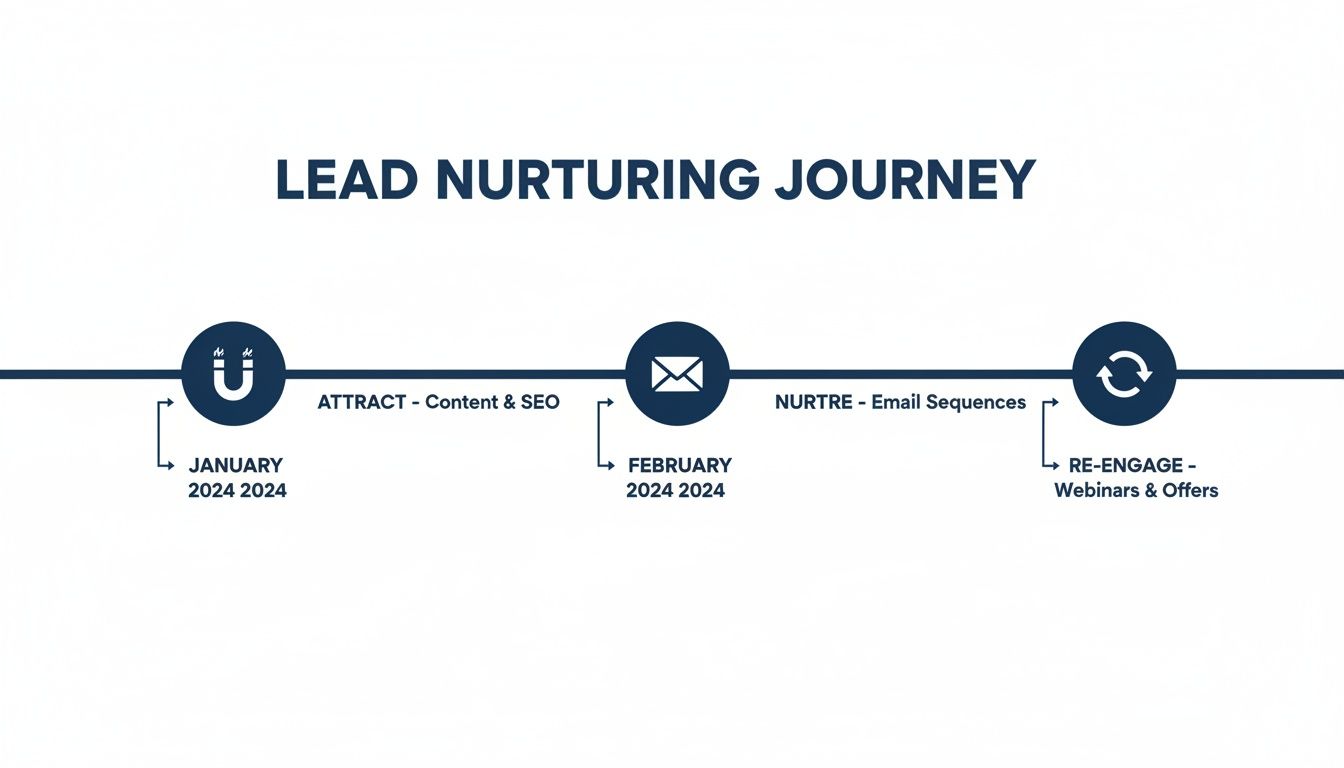
It’s a constant loop, not a one-time event. This is how you ensure no potential customer falls through the cracks.
Phase 3: Optimization (Days 61-90)
The final 30 days are for analyzing data and making smart adjustments. You now have real-world feedback on what your audience responds to and what they ignore. This is where you apply an engineering mindset: diagnose, tweak, and improve.
What to tackle in Month 3:
- Analyze Early Results: Dig into your key performance indicators (KPIs). Which blog posts are bringing in traffic? What’s the conversion rate on your lead magnet landing page?
- Refine Your Nurture Sequence: Based on open and click rates, tweak subject lines and email content to improve engagement.
- Plan Your Next Content Pieces: Use the data to decide what to write about next. Double down on what's working.
By day 90, you will have a functioning, data-producing system. You’ll have a clear baseline for key metrics, a growing list of nurtured leads, and a proven process you can finally scale. This is how you build a predictable engine for growth.
The 90-Day Proof-of-Concept Roadmap
Here’s a table that lays out the entire 90-day sprint. Think of this as your project plan to get from a standing start to a functioning inbound marketing system.
| Phase (30 Days) | Key Activities | Primary KPIs to Track |
|---|---|---|
| Phase 1: Foundation | 1. Finalize ICP & Positioning 2. Set up CRM & tracking codes 3. Create first lead magnet 4. Build 3-email nurture sequence |
1. Website traffic (baseline) 2. System functionality (test leads) |
| Phase 2: Activation | 1. Publish 2 SEO pillar posts 2. Launch lead magnet landing page 3. Start social media promotion 4. Establish basic reporting |
1. Organic traffic growth 2. Number of new leads generated 3. Landing page conversion rate |
| Phase 3: Optimization | 1. Analyze blog & landing page data 2. Tweak nurture email content 3. Plan next content based on performance |
1. Lead-to-MQL conversion rate 2. Email open & click-through rates 3. Cost per lead (if running ads) |
This roadmap isn't about achieving perfection in 90 days. It's about building a solid foundation and proving that the system works. Once you have this engine running, you can tune and scale it to drive serious, sustainable growth.
If you're ready to stop guessing and start building a predictable marketing system, let's talk. At Machine Marketing, we specialize in implementing these exact roadmaps for manufacturers and B2B businesses. Book a discovery call with us to get a tailored diagnosis and a plan for your sustainable growth.