If your B2B lead generation feels like a rollercoaster of feast and famine, you’re not wrestling with a marketing problem—it’s a system problem. Marketing automation for B2B is how you engineer a predictable, scalable lead machine. A well-designed marketing automation for B2B system consistently attracts, nurtures, and qualifies leads, turning sporadic interest into a reliable sales pipeline. It’s the difference between hoping for leads and building a system to create them.
Diagnosing Your B2B Lead Generation System with Marketing Automation for B2B
Are you struggling to draw a straight line from your marketing spend to actual sales? We see this all the time. You’re running ads and creating content, but the pipeline is still a mystery. This isn’t a sign of failure; it’s a symptom of a disconnected process. Marketing automation for B2B helps diagnose and fix these common failure points by turning scattered efforts into a connected, measurable system.
Why Manual B2B Marketing Is a Losing Game
The typical B2B sales cycle can drag on for months. Are you trying to manage that with manual follow-ups? That approach is a recipe for disaster—it’s inefficient and riddled with human error. Leads go cold. Follow-ups get missed. And those valuable prospects who aren’t ready to buy right now are completely forgotten.
This manual approach creates massive leaks in your sales funnel, and potential revenue is slipping right through the cracks. The root cause is the absence of a systematic process. Without automation, you’re leaning on memory and messy spreadsheets to manage complex, long-term customer relationships. The solution is to build a system that works for you, 24/7.
The System Solves the Goal: Your real goal isn’t just “more leads.” It’s predictable revenue. A well-engineered automation system connects every marketing action directly to that outcome, making growth a process, not a guessing game.
The Foundational Blueprint for B2B Automation
Before you even look at software, you need a blueprint. A high-performing B2B lead machine is built on a rock-solid strategy, and a deep understanding of marketing automation implementation is non-negotiable from day one.
This isn’t just some passing trend; it’s the standard operating procedure. The data backs this up: 51% of companies are now actively using marketing automation. Even more telling, 47% of small businesses use these tools to punch above their weight and compete effectively.
To build your system, you have to nail these pillars first:
- Define Your Ideal Customer Profile (ICP): Who, exactly, are you selling to? Go deeper than just job titles. What are their pain points? What is their company size, industry, and what are the specific triggers that send them looking for a solution like yours? A fuzzy ICP leads to generic marketing that connects with no one.
- Map the Buyer’s Journey: Document every step a prospect takes, from realizing they have a problem to choosing your solution. What questions are they asking at each stage? What content do they need to feel confident moving forward?
- Set Clear, Measurable Goals: What does a “win” look like? Is it generating 10 sales-qualified demos every month? Is it slashing the sales cycle by 20%? You must define the numbers upfront so you can measure whether the system is performing as designed.
With these strategic elements in place, you can begin to assemble the components of your automation engine.
Core Components of a B2B Automation System
To bring your strategy to life, you need a few key pieces working in harmony. Think of it like building a machine where each part has a specific job. Here’s a breakdown of the essential pillars and the questions you should be asking for each.
| Component | Function | Key Question to Ask Yourself |
|---|---|---|
| CRM & Data Model | Serves as the central “brain” holding all contact, company, and deal information. | Do we have a single source of truth for all customer data? |
| Lead Capture | Web forms, landing pages, and pop-ups that convert anonymous website visitors into known contacts. | Are we turning our website traffic into actionable leads? |
| Lead Nurturing | Automated email and SMS sequences that deliver relevant content to prospects over time. | How are we building trust with leads who aren’t ready to buy today? |
| Lead Scoring | Assigning points to leads based on their demographic data and on-site behavior (e.g., page views). | How do we identify our hottest, most sales-ready leads automatically? |
| Sales Handoff | Automated triggers that notify sales reps when a lead hits a certain score or takes a key action. | Is our handoff from marketing to sales instant and seamless? |
| Reporting & KPIs | Dashboards that track key metrics like conversion rates, pipeline velocity, and ROI. | Can we prove the ROI of our marketing and pinpoint bottlenecks? |
Each of these components is crucial. When they’re properly integrated and aligned with your strategy, they create a powerful, self-sustaining system for generating predictable revenue.
Setting Up Your Tech Stack for Marketing Automation for B2B
Picking the right technology for your B2B marketing automation is a critical decision. It’s easy to get lost in a sea of complicated, overpriced platforms packed with features you’ll never use.
What we’ve learned from working with countless businesses is that the trick isn’t finding the tool with the most features, but the right one that can act as the central nervous system for your entire marketing and sales operation.
For most manufacturing and professional service firms, an all-in-one platform like GoHighLevel is the solution. It rolls a CRM, email and SMS marketing, landing pages, and sales pipelines into one system. This single move helps you avoid the data silos and integration nightmares that happen when you try to tape different tools together.
Building Your B2B Operations Hub in GoHighLevel
Getting your tech right from day one is about establishing a clean, simple data model. A messy setup creates a domino effect of chaos, making any real automation impossible. A well-built system ensures every lead is tracked, every conversation is logged, and no opportunity falls through the cracks.
Think like an engineer during the initial setup:
- Create a Naming Convention: Before importing a single contact, agree on a consistent way to name everything—tags, campaigns, pipelines, and forms. This small discipline now will save you from massive headaches later.
- Import and Clean Your Data: Pull all your contacts from old spreadsheets, previous CRMs, and email lists. Before you import, scrub that data. Remove duplicates, standardize company names, and ensure key fields are formatted correctly.
- Define Your Custom Fields: The default fields are never enough. What information is critical for your sales process? Think about things like “Industry,” “Company Size,” “Product Interest,” or “Lead Source.” Creating these upfront means you’re capturing the data you need for smart segmentation from the start.
Choosing the right platform is the first step, but how you set it up matters just as much. For a deeper look into what makes a great central hub for your customer data, check out our guide on how to choose a CRM system.
Customizing Your Sales Pipeline for Marketing Automation for B2B
Your CRM’s sales pipeline should be a perfect digital reflection of your real-world sales process. Generic, out-of-the-box stages like “Lead In” or “Proposal Sent” are almost always too simple for a considered B2B sales cycle. A pipeline built for your business gives you instant clarity on where every deal is.
A customized pipeline isn’t just for organization; it’s a diagnostic tool. It shows you exactly where deals get stuck. This lets you pinpoint bottlenecks and fix your sales process based on real data, not just a gut feeling.
Let’s look at a realistic pipeline for a B2B manufacturer:
- New Inquiry: A potential customer fills out a form or calls. Automation can instantly create the deal card and assign it to the right sales rep.
- Qualification Call Booked: The prospect has scheduled an initial discovery call.
- Needs Analysis Complete: The rep has spoken with the prospect and confirmed they are a legitimate fit.
- Technical Spec & Quote Sent: A detailed proposal, with all necessary specs and pricing, has been delivered.
- Follow-Up & Negotiation: This is the active back-and-forth of answering questions and finalizing terms.
- Contract Signed / PO Received: The deal is officially won.
Each stage is a clear milestone. When you build this structure in GoHighLevel, you can set up automations that trigger as a deal moves from one stage to the next—like sending a perfectly timed follow-up email or creating a task for your sales team. Your CRM stops being a passive database and becomes an active player in closing deals.
Automating Lead Capture and Qualification with Marketing Automation for B2B
Your automation setup is only as good as the leads you feed it. A brilliant nurture sequence sent to unqualified contacts is a waste of effort. Now, we shift our focus from the internal plumbing to engineering the front end of your machine—the part that captures and qualifies new leads on autopilot.
This is about transforming a messy contact list into a clean, prioritized queue of sales-ready opportunities. Think of it as building a systematic filter that ensures your sales team only spends their valuable time on prospects with a real shot at becoming customers.
Designing Your Lead Capture Mechanisms
First, you need reliable, automated entry points into your system. This goes beyond a simple “Contact Us” form. Look at every place a potential customer might interact with your brand. Each one is an opportunity to capture their info and pull them into your ecosystem.
Here are a few essential capture points to start with:
- Smart Forms on High-Intent Pages: Don’t use the same generic form everywhere. Place specific, tailored forms on pages that signal serious interest, like your pricing, case study, or services pages. Ask a qualifying question on the form (e.g., “What is your biggest operational challenge?”) to start segmenting them from the get-go.
- Gated Content Downloads: Offer your best resources—whitepapers, buyer’s guides, or ROI calculators—in exchange for contact details. This is a classic for a reason. It perfectly captures leads who are deep in the research phase.
- Google Business Profile Inquiries: This is huge for local B2B. Automate pulling inquiries from your GBP directly into your CRM. It ensures these high-value local leads get an immediate, professional response instead of sitting in a generic inbox.
The technology that powers these capture points follows a straightforward setup process.
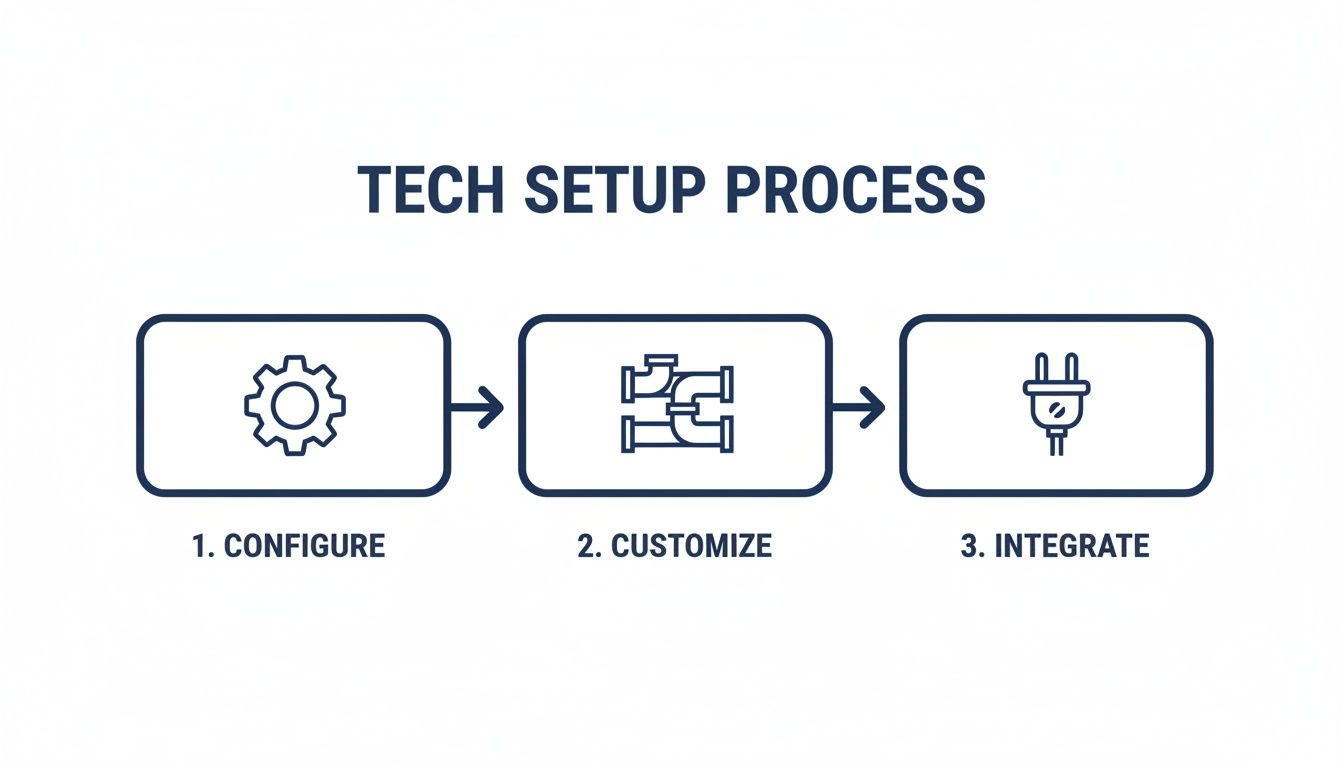
This Configure > Customize > Integrate flow is a good reminder that powerful automation starts with a solid foundation, which you then tailor to the exact needs of your business.
Implementing an Automated Lead Scoring Model
So, leads are flowing into your system. Now what? How do you tell which ones are hot and ready for a sales call versus those that need more warming up? This is the problem that automated lead scoring solves. It’s a system that assigns points to leads based on who they are (firmographics) and what they’re doing (behaviors).
The concept is built on one truth: not all leads are created equal. A CEO from a target industry who downloads a case study is infinitely more valuable than an intern who just subscribed to your blog. Lead scoring puts a number on that value, letting your system automatically spot and prioritize your best prospects. It’s a non-negotiable discipline, and we’ve put together a full guide on how to qualify sales leads if you want to go deeper.
By assigning a numerical value to a prospect’s profile and engagement, you remove the guesswork from sales prioritization. Your team stops wasting cycles chasing cold leads and gets automated alerts for contacts who are clearly signaling they’re ready to talk.
A Sample Lead Scoring Model for a B2B Manufacturer
Let’s make this real. Imagine we’re building a scoring model for a manufacturer. The goal is to set a threshold—say, 100 points—that automatically triggers a task for the sales team to follow up.
Firmographic Scoring (Who They Are)
- Job Title: C-Level/VP (+25), Director (+15), Manager (+10)
- Industry: Target Manufacturing Vertical (+20)
- Company Size: 50-500 Employees (+15), 500+ Employees (+10)
- Lead Source: “Request a Quote” Form (+30), Trade Show Scan (+15)
Behavioral Scoring (What They Do)
- Website Visit: Visited Pricing Page (+20)
- Website Visit: Viewed a Product Spec Sheet (+15)
- Content Engagement: Downloaded a Technical Whitepaper (+15)
- Email Engagement: Clicked a link in a nurture email (+5)
Using this model, a Plant Manager (+10) at a target account (+15) who visits the pricing page (+20) and downloads a spec sheet (+15) racks up 60 points. They’re warm, but probably need more nurturing.
But what about a VP of Operations (+25) from that same company (+15) who requests a quote (+30) and views a case study (+15)? They just hit 85 points. One more meaningful action, and they’ll cross that 100-point threshold and land directly on a sales rep’s dashboard. This is how you build a real lead generation machine.
start=”775″ data-end=”853″><strong data-start=”775″ data-end=”853″>Designing Multi-Channel Nurture Sequences for Marketing Automation for B2B
Let’s be direct: not every lead is ready to buy the moment they fill out a form. One of the biggest mistakes we see B2B marketers make is tossing a lead aside just because they aren’t “sales-ready” right now. This is exactly where automated nurture sequences become your secret weapon.

Think of these sequences as pre-built, multi-channel conversations that use email and SMS to educate prospects, build trust, and keep your brand top-of-mind. They turn lukewarm interest into genuine sales opportunities, all without your team having to manually chase down every contact.
The Logic Behind Multi-Channel Nurturing
Someone might download your whitepaper today but not have budget approved for another six months. Without a system in place, that lead goes cold. They forget about you, and you forget about them. A well-designed sequence ensures that when they are ready to buy, you’re the first person they think to call.
This isn’t a fringe tactic; it’s becoming the standard. In fact, nearly 80% of marketers now automate parts of their customer journey. This shift shows a clear understanding that manual follow-up just can’t scale.
The key is mixing your channels. Email is the workhorse, but a timely SMS can cut through the inbox clutter for critical reminders. In a tool like GoHighLevel, you can build a workflow that sends an email, waits a few days, checks if the lead opened it, and fires off a quick text if they didn’t. This creates a more persistent—and effective—way to stay in front of them.
Building Your Core Nurture Sequences
You don’t need a dozen complicated campaigns to get started. We recommend focusing on three foundational sequences that cover the most common B2B scenarios. This way, you can get relevant, automated messaging in front of the majority of your new leads right away.
-
The “Welcome & Educate” Series: This is for new leads who downloaded a guide or filled out a generic contact form. The goal isn’t to sell; it’s to deliver immediate value and set the stage. The concept is similar to a classic drip email campaign.
- Email 1 (Instant): Deliver what they asked for and briefly introduce your company’s mission.
- Email 2 (Day 3): Follow up with a related case study showing you get real results.
- Email 3 (Day 7): Offer another piece of high-value content, like a checklist or popular blog post, with no strings attached.
-
The “Long-Term Nurture” Track: This is your slow-burn sequence for leads who are early in their buying journey. The pace is much slower—maybe one email every two or three weeks—and the content is all about thought leadership.
- Content Focus: Industry trend reports, expert interviews, or detailed answers to common questions your sales team gets.
- Goal: To become the most helpful, trusted resource in your industry.
-
The “Re-engagement” Campaign: This one is designed to wake up inactive leads. It targets past customers or prospects who haven’t interacted with you in over 90 days.
- Trigger: A contact hasn’t opened or clicked an email in 90 days.
- Message 1: Announce a new product feature or a special “welcome back” offer.
- Message 2: Ask for feedback with a one-click survey to find out why they’ve been quiet.
Pro Tip: Keep SMS messages short and to the point. Use them for high-priority communications only—like webinar reminders or a heads-up that a quote has been emailed. Never use SMS for generic marketing blasts. It’s the fastest way to get an “unsubscribe.”
Structuring Your Campaigns in GoHighLevel
Building these sequences in a platform like GoHighLevel is intuitive because it’s based on triggers and workflows. A “trigger” is the event that kicks off an automation, like a form submission or a tag being added to a contact.
From there, the “workflow” is the series of actions you want to happen. You can visually map it out step-by-step: send this email, wait X days, add a condition (like “did they click the link?”), and split them down different paths based on what they did or didn’t do.
To nail your execution, make sure you’re following the best practices for email campaigns. When you combine a solid strategy with a powerful automation tool, you create a system that doesn’t just save you time—it actively generates qualified opportunities from leads you might have otherwise lost.
Nailing the Sales Handoff: Where Marketing Automation Pays Off
Everything you’ve done so far—capturing leads, scoring their interest, and nurturing them—all comes down to one critical moment: the handoff from marketing to sales. This is where most companies drop the ball. A clumsy, manual process lets hot leads go cold while your team fumbles with spreadsheets.</p>
When you engineer the proces
s correctly, the transition is instant and seamless. This is the real power of <strong>marketing automation for B2B. We’re not just sending emails; we’re tearing down the walls between marketing and sales to create a single, unified revenue team. The goal is simple: the second a lead is ready to talk, a sales rep is ready to listen. No delays, no excuses.
The Automated Handoff Trigger
The secret to a perfect handoff is a clear, automated trigger. Forget about manually checking lead scores and forwarding names. Your system should do the heavy lifting, creating a process that’s both instant and foolproof.
Inside a platform like GoHighLevel, you can build workflows that act as your company’s digital nervous system. Here’s how to set up the most important triggers:
- Lead Score Threshold: As soon as a contact’s score hits a specific number—say, 100 points—an automation kicks in. This single action can change the lead’s status to “Sales Qualified Lead” (SQL) and assign it to the right sales rep in an instant.
- High-Intent Actions: Some actions are so powerful they should bypass the scoring system and trigger an immediate handoff. Think about someone filling out your “Request a Demo” or “Get a Quote” form. That’s an active buyer signaling they’re ready to engage.
This isn’t just about being fast; it’s about being smart. When that notification lands in a sales rep’s inbox, it needs to come with context—all the recent activity that shows why this lead is hot right now.
Building the Handoff Workflow
Once that trigger fires, a series of automated actions should kick off to guarantee nothing gets missed. A solid workflow bridges the gap between marketing intelligence and sales action.
Here’s what a practical workflow for a new SQL looks like:
- Instant Notification: The assigned sales rep gets an immediate internal alert via email or SMS. It should include the lead’s name, company, contact info, and the specific action that triggered the handoff.
- Automated Task Creation: The system automatically creates a “Follow-Up” task in the rep’s calendar, due within 24 hours. This builds accountability directly into their daily routine.
- Pipeline Stage Update: The lead’s deal card is automatically moved to the “Sales Qualified” or “Needs Outreach” stage in your sales pipeline. This gives the entire team a clear visual of what’s happening.
This systematic approach takes lead management from a reactive, memory-based game to a proactive, system-driven process. It ensures every qualified lead gets the attention it deserves, exactly when it matters most.
Measuring What Matters
Finally, a well-engineered system has to be measurable. You can’t improve what you don’t track. Your automation platform should be the single source of truth for the KPIs that show the health of your pipeline and prove the value of your marketing efforts.
The ROI is real. Marketing automation isn’t just a buzzword; on average, it delivers $5.44 for every $1 invested. You can find more data on the impact of marketing automation ROI on Thunderbit.com.
To prove it, focus on tracking a handful of vital metrics:
- Lead Velocity Rate (LVR): Are you generating more qualified leads this month than last month? This is a leading indicator of future revenue.
- MQL to SQL Conversion Rate: Of all the leads marketing qualifies, what percentage does sales accept? This tells you if your lead scoring model is working.
- Customer Acquisition Cost (CAC): How much does it cost in total marketing and sales spend to land one new customer?
- Pipeline Velocity: How fast are deals moving from the first conversation to a closed-won deal?
By building a simple dashboard in GoHighLevel to watch these numbers, you can stop guessing and start making data-driven decisions. You’ll be able to fine-tune your process, prove your ROI, and turn your marketing into a predictable engine for growth.
Your 90-Day B2B Automation Rollout Plan
All the theory in the world doesn’t matter if you can’t execute. Trying to build everything at once is a recipe for disaster, which is why we roll out every B2B automation system in phases. This approach prevents overwhelm and makes sure each piece is working perfectly before you build on top of it.
This is the exact 90-day roadmap we use to get our clients up and running—and generating a real return—fast.
Days 1-30: The Foundation and Data Integrity
The first month is all about getting the foundation right. If you rush this part, you’re setting yourself up for data chaos and campaigns that fall flat. The goal here is simple: get your tech configured and wrangle all your existing data into a single, clean source of truth.
- Configure Your Tech: Set up your GoHighLevel account, create your naming conventions for every asset (campaigns, tags, forms), and define your custom fields and sales pipelines.
- Migrate Your Data: Pull all your contacts out of old spreadsheets, legacy CRMs, and random email lists. It’s time to get everything in one place.
- Clean Your Data: Before you import a single contact, scrub the list. De-duplicate records, standardize company names (so you don’t have “ABC Inc.” and “ABC Company” as two different accounts), and ensure critical data fields are correct.
- Set Up Initial Lead Capture: Connect your main website contact form and your Google Business Profile. This gets new inquiries flowing directly into the system from day one.
Transformation: By the end of this phase, you’ll have a clean CRM and a reliable way to capture every new lead. You’ve officially built the bedrock of your entire automation machine.
Days 31-60: Build and Launch Your First Campaigns
With the technical plumbing in place, it’s time to start building. This is where you create the automated assets that actually engage and qualify your leads. The key is to keep it simple, test everything, and get your first wins on the board.
- Launch Your Welcome Sequence: Your first priority is building an initial welcome and education campaign for all new inbound leads. This ensures every person who contacts you gets an immediate, consistent, and helpful response.
- Implement Lead Scoring: Define your initial lead scoring model. Start by assigning points based on the key firmographic data (like company size or industry) and behavioral signals (like visiting the pricing page) that matter most to your sales team.
- Create the Sales Handoff: Build the automated workflow that instantly notifies your sales team the moment a lead hits that “sales-qualified” score. This is where automation directly fuels your pipeline.
Days 61-90: Optimization and Expansion
Your core system is now live and working. The final 30 days are all about looking at the data, learning what’s working, and strategically expanding your efforts.
- Analyze Early Performance: Dive into the numbers from your welcome campaign. What are your open rates and click-through rates? Are people converting?
- Refine Your Lead Scoring: Talk to sales. Are the leads they’re getting actually good? Use their real-world feedback to adjust the point values in your scoring model. Maybe a certain job title is more valuable than you thought.
- Build a Long-Term Nurture Track: Not every lead is ready to buy today. Create a slower-paced, value-driven nurture sequence to keep your brand top-of-mind with colder, longer-term prospects.
- Develop a Reporting Dashboard: Create a simple, at-a-glance dashboard to track your core KPIs. This gives you a clear, honest view of your system’s health and its ROI.
Your B2B Marketing Automation Questions, Answered
Jumping into a new s
ystem always brings up a few questions. That’s perfectly normal. We’ve been there. Here are some straight answers to the most common concerns we hear from business owners ready to make this move.
How much does marketing automation really cost?
This is always the first question, and the honest answer is: it varies. You can find simple email tools for under a hundred dollars a month, while enterprise platforms will run you thousands. But the sticker price isn’t the real story. You need to think about the total cost of ownership.
Don’t just look at the monthly subscription fee. You have to factor in the time and money for implementation, training, and running the system. A cheap tool that collects digital dust is more expensive than a well-implemented system that brings in a clear return.
For most B2B service businesses and manufacturers we work with, an all-in-one platform like GoHighLevel hits the sweet spot. It bundles your CRM, email, SMS, and sales pipelines, so you aren’t paying for five different tools that don’t talk to each other.
Is this going to be too complicated for my team?
That’s a legitimate worry. The last thing you want is a powerful system that nobody uses. The key is to start small and focus on one battle at a time. You don’t need to build out a dozen complex workflows on day one.
Instead, pick a single, high-impact automation to start with. A great one is the “Welcome & Educate” sequence for new leads. Nail that process. Let your team get comfortable, show them a clear win, and then build on that momentum. Success makes the next step feel much easier.
How quickly will I actually see results?
Marketing automation is not a magic button; it’s an investment in building a scalable, predictable system. While you can get your first lead capture forms and welcome emails live within 30 days, the real value compounds over time.
You’ll immediately see improvements in how organized your leads are and how consistently they’re followed up with. But the tangible ROI—like a shorter sales cycle or a higher lead-to-customer conversion rate—usually becomes obvious within the first 90 to 180 days. That’s when your nurture sequences have had time to work and you’ve gathered enough data to see the patterns.
ata-start=”281″ data-end=”600″>Ready to build a predictable lead machine without the guesswork? We specialize in marketing automation for B2B, engineering scalable systems that consistently generate and qualify leads. Book a discovery call with Karl, and we’ll diagnose your current process and map out a clear, actionable plan for your business.