For manufacturers, lead generation often means relying on a patchwork of tactics—trade shows, referrals, maybe a few ads—that produce unpredictable results. One month the pipeline is full, the next it's dry. What's the root cause?
This isn't a sales problem; it's a systems problem. The feast-or-famine cycle is a direct symptom of a reactive, "hope-based" approach instead of an engineered system for growth. In this guide, we’ll show you how to diagnose the gaps in your current process and build a predictable engine that delivers a consistent, measurable flow of qualified B2B prospects.
Diagnosing Your Inconsistent Lead Flow

If your lead flow is unpredictable, the issue isn't a lack of effort—it's a gap in your system. Before throwing money at more tactics, you have to diagnose the root cause. We approach this like an engineering problem: you wouldn't try to fix a complex machine without knowing which part is broken.
Too many manufacturers skip this crucial diagnostic step. They jump straight to a solution without understanding the specific bottleneck holding them back from consistent growth.
Identifying Your Core Bottlenecks
The first step is an honest audit of your current marketing. The goal isn't to find fault; it's to find opportunities for improvement with precision. In our experience, inconsistent leads almost always trace back to one of these common disconnects.
Ask yourself these critical diagnostic questions:
- Audience Mismatch: Are you speaking the right language to the right people? Your messaging for an engineer obsessed with technical specs should be worlds apart from your pitch to a procurement manager who lives and dies by cost and lead times.
- Website Performance: Is your website just a digital brochure, or is it a lead-capture machine? A site that only lists products is a passive asset. One that offers CAD files, spec sheets, and detailed case studies becomes an active part of your sales team.
- Message Clarity: Does your core message solve a specific, painful problem? Vague statements like "quality craftsmanship" are just noise. A clear value proposition like "reducing downtime by 30% with our predictive maintenance sensors" gets an engineer's attention.
Why this matters: We find that over 70% of B2B buyers conduct extensive online research and define their needs before ever speaking to a sales rep. If your digital presence isn't answering their questions from the start, you're invisible during the most critical part of their journey.
From Reactive Tactics to a Proactive System
Once you've done a proper diagnosis, you can start shifting from disconnected actions to a cohesive strategy. An effective manufacturer lead generation system doesn’t lean on a single channel. It integrates multiple components that all work together to attract, engage, and convert your ideal customers.
Think about how your current efforts connect—or don't. Does your trade show strategy include pre-show digital outreach and a post-show automated follow-up sequence? Does your website content directly support the keywords you're targeting in paid ad campaigns? If the answer is no, you're operating with siloed tactics, not a system.
By pinpointing where your process is breaking down, you can stop wasting resources on activities that don't produce results. The real transformation begins when you move from guessing what might work to building a predictable engine for attracting qualified buyers. The following sections provide the blueprint.
Building Your Lead Generation Foundation

Your website should be your hardest-working digital asset—a true 24/7 sales engine. But for too many manufacturers, it’s just a static online catalog. It does nothing to actively bring in leads.
To get a consistent flow of qualified buyers, your site needs a foundation built on two things: razor-sharp messaging and solid technical execution. This isn't just about looking professional. It's about engineering a user experience that speaks directly to a technical audience and guides them toward taking action.
Positioning That Resonates with Engineers
Engineers, project managers, and procurement specialists don't care about vague marketing fluff. They need specs, performance data, and real solutions to tangible problems. Your website’s core message has to reflect that reality.
Can a visitor land on your homepage and know exactly what problem you solve within five seconds? If not, you've already lost them. Forget buzzwords like "innovative solutions" and "quality craftsmanship." Get specific.
- Weak Positioning: "High-Quality Custom Machining"
- Strong Positioning: "AS9100-Certified CNC Machining for Aerospace Components with ±0.0001” Tolerances"
The second one instantly tells an aerospace engineer that you understand their world, meet strict compliance needs, and deliver the required precision. That’s how you build trust.
Quick Check: Your website is often the first handshake. It must immediately answer the prospect's main question: "Do these people understand my specific, technical challenge?" If it doesn't, they'll bounce and find a competitor who does.
To build a robust lead generation foundation, it is essential to understand and apply proven lead generation best practices for attracting and converting qualified prospects. This framework helps ensure every element of your site is optimized for conversion.
Creating Calls to Action They Can't Ignore
Once you've grabbed their attention with clear positioning, you need to tell them what to do next. A generic "Contact Us" button is a massive missed opportunity. Your calls-to-action (CTAs) must be valuable, relevant, and almost impossible for a prospect in a research phase to ignore.
The best CTAs for manufacturers offer something tangible and reduce friction:
- Download CAD Files: An engineer planning a project needs models. Putting these files behind a simple form is a classic, highly effective way to capture a lead.
- Request a Quote (RFQ): Make your RFQ form obvious and easy to find. Crucially, only ask for the minimum information needed to start a conversation.
- Access Spec Sheets: Detailed technical specs are non-negotiable for buyers. Offer them as a downloadable resource in exchange for an email.
- Schedule a Technical Consultation: Frame this as a problem-solving session with one of your experts, not a sales call.
Each of these CTAs speaks to a different stage in the buyer's journey. By offering a mix, you can capture leads whether they're just starting their research or are ready to buy.
Foundational SEO for Manufacturers
Your beautifully engineered website is useless if no one can find it. Foundational search engine optimization (SEO) is what makes you show up when a prospect searches for a specific machine type, process, or solution. For manufacturers, SEO isn't about broad keywords—it's about technical precision.
You need to be targeting long-tail keywords. These are highly specific phrases that signal a buyer is much further along in the process.
| Broad Keyword | Long-Tail Keyword Example |
|---|---|
| CNC Machining | "5-axis CNC machining for medical implants" |
| Metal Fabrication | "stainless steel fabrication for food processing equipment" |
| Laser Cutting | "high-tolerance laser cutting for automotive parts" |
These specific terms attract a far more qualified audience. For a deeper dive into this topic, you can learn how to build a dominant online presence with our comprehensive guide on SEO for manufacturing companies.
Finally, don’t neglect your local presence. Optimizing your Google Business Profile with accurate info, services, and photos is critical for grabbing regional opportunities. When a local engineer searches for a nearby supplier, you need to be the first name they see.
Executing a Smart Inbound and Outbound Strategy
With a solid website foundation in place, you’ve built the engine. Now it’s time to add the fuel.
The most effective manufacturer lead generation isn't about picking one tactic; it's about combining the pull of inbound marketing with the push of targeted outbound outreach. Inbound attracts prospects who are already searching for a solution, while outbound lets you get in front of ideal customers who might not know you exist yet. When you blend them, you create a system that fills your pipeline from both directions.
Fueling the Inbound Engine with Technical Content
Your ideal customers—engineers, project managers, and operations directors—aren't impressed by flashy ads. They’re looking for answers to highly specific, technical problems. This is where your content strategy becomes your most powerful inbound tool.
By creating content that genuinely solves their problems, you naturally attract them to your website and establish your company as an expert.
Here are the content types that consistently deliver for manufacturers:
- Detailed Case Studies: Don't just say you solved a problem; prove it. A great case study defines the client's challenge, details your solution, and—most importantly—quantifies the results. "Increased production throughput by 22%" is infinitely more compelling than "improved efficiency."
- Problem-Solving Blog Posts: Think about the questions your sales team gets asked every day. Turn those into detailed blog posts. Titles like "How to Select the Right Alloy for High-Temperature Applications" will pull in exactly the right audience from search engines.
- Spec Sheet & CAD File Downloads: For engineers in the design phase, these are pure gold. Gating this high-value content behind a simple email form is one of the most effective ways to capture serious leads.
The transformation: SEO leads close at an impressive 14.6% rate, easily outpacing other channels. Businesses that adopt modern digital strategies report 451% more qualified leads through automation and nurturing. You can discover more insights about these lead generation statistics and how they apply to your business.
Precision Outbound with LinkedIn Outreach
While inbound content works 24/7 to attract prospects, targeted outbound lets you go after the high-value accounts you really want. For manufacturers, there is no better platform for this than LinkedIn. It’s the digital equivalent of walking the factory floor to find the exact decision-maker you need.
The key is to avoid generic, spammy connection requests. Your outreach must be personalized, relevant, and genuinely helpful.
Here’s a practical example of an outreach message that gets a response:
Subject: Quick question about [Company Name]'s fabrication process
"Hi [First Name],
I saw your recent post about expanding your production line for [specific product type]. We recently helped [Similar Company] reduce their cycle time on a similar component by 18% using a multi-axis machining approach.
I put together a brief case study outlining the process. Would you be open to me sending it over? No sales pitch, just a resource I thought might be relevant to your expansion goals.
Best,
[Your Name]"
This message works because it’s:
- Personalized: It references specific information about their company.
- Relevant: It connects your solution to a challenge they are actively facing.
- Value-First: It offers a helpful resource instead of immediately asking for a meeting.
By combining inbound content with precision outbound, you build a robust and predictable system for manufacturer lead generation. You’re no longer just waiting for the phone to ring; you’re proactively filling your pipeline.
Implementing Your CRM and Automation Engine
Leads are worthless if they fall through the cracks. We've all seen it happen: a promising RFQ lands in an inbox, gets forwarded to a busy rep, and vanishes. A Customer Relationship Management (CRM) system is the central nervous system that stops this, turning messy, manual tasks into a predictable, scalable process.
This isn't just a digital rolodex. It's an engine that manages your entire sales pipeline. Relying on spreadsheets and a sales rep's memory is the biggest point of failure we see. It always leads to missed follow-ups and lost revenue.
Choosing and Setting Up Your Central Hub
For most manufacturers we work with, an all-in-one platform like GoHighLevel hits the sweet spot between power and usability. It bundles a CRM with essential marketing automation tools—email, SMS, call tracking—all in one place. This integration is the secret to a smooth manufacturer lead generation process, as you aren't trying to duct-tape five different tools together.
The first move is to map out your sales process. Get a whiteboard and draw the distinct stages a lead moves through from inquiry to closed deal.
- New Lead: An RFQ hits your website form.
- Attempting Contact: Your team is actively reaching out.
- Needs Analysis: A conversation is happening to qualify project specs.
- Quote Sent: The prospect has your formal proposal.
- Negotiation: The back-and-forth on pricing or terms.
- Closed Won / Lost: The final result.
Setting this up as a visual pipeline in your CRM gives you an immediate, at-a-glance snapshot of your entire sales world, helping you track deals and forecast revenue without complex spreadsheets.
Building Workflows That Do the Heavy Lifting
This is where the magic happens. Automation isn't about replacing your sales team; it’s about freeing them from tedious tasks to focus on high-value conversations. You can create automated "workflows" that trigger based on specific lead actions. For a deep dive, our guide on how to implement a CRM system breaks down the entire process.
Here’s a real-world example of a "New Web Lead" workflow:
- Trigger: A prospect fills out the "Request a Quote" form on your site.
- Action 1 (Instant): The system creates a new contact and a deal card in the "New Lead" pipeline stage.
- Action 2 (Instant): An internal alert (email or SMS) pings the assigned sales rep with the lead's info.
- Action 3 (Instant): The prospect immediately gets a personalized confirmation email. "Thanks for your RFQ, [First Name]. We've received your details and our team will be in touch within 24 hours."
- Wait 24 Hours: The system pauses.
- "If/Then" Check: If the deal is still in "New Lead," the system sends a follow-up email to the prospect and creates a task for the sales rep to call.
Why automation is critical: Responding to a new inquiry within the first five minutes can increase your odds of converting that lead by a staggering 400%. Automation is what makes that kind of speed possible, every single time.
Lead Generation Channel Comparison for Manufacturers
This table breaks down traditional vs. modern channels, helping you see where each fits best in a comprehensive strategy. A blended approach is almost always the most effective.
| Channel | Typical Sales Cycle | Primary Benefit | Best For |
|---|---|---|---|
| Trade Shows | 6-18 months | High-quality, face-to-face interactions. | Niche industries, launching new products, relationship-building. |
| SEO / Content | 9-12 months | Attracts inbound, problem-aware leads. | Building long-term authority and a sustainable lead pipeline. |
| Paid Ads (PPC) | 1-3 months | Fast, targeted lead generation with measurable ROI. | Testing new markets, promoting specific capabilities, driving immediate RFQs. |
| Cold Outreach | 3-6 months | Proactively targets ideal customer profiles. | Breaking into new accounts or specific verticals. |
| Referrals | Varies | Highest trust and conversion rates. | Leveraging existing client relationships for warm introductions. |
Nurturing and Re-Engaging Without Manual Effort
Your CRM is a goldmine for more than just new leads. It’s the perfect tool for waking up cold prospects and nurturing long-term opportunities.
- Cold Lead Reactivation: Set up a workflow that automatically sends a "just checking in" email to any lead that has been in the "Attempting Contact" stage for over 30 days.
- Long-Term Nurturing: Got a prospect who's a good fit but the timing is wrong? Add them to a monthly email sequence that shares valuable case studies, keeping you top-of-mind.
Newer tools can even manage initial inbound calls when your team is busy. You can see how some of these advanced systems are built for manufacturing needs with this overview of AI Answering for Manufacturers.
By putting a solid CRM and automation engine in place, you’re not just buying software—you’re building a reliable system that gets maximum value from every single lead.
A 90-Day Roadmap for Predictable Leads
Theory is great, but execution is what matters. Let’s put it all together into a practical, 90-day roadmap to get your lead generation system built and running.
This is a phased, methodical approach designed to build momentum and create a foundation for predictable growth. Let's break it down month by month.
Month 1: Diagnosis and Foundation (Weeks 1-4)
The first 30 days are about building the engine before you add fuel. Rushing this stage is a common mistake—it’s like building a factory on a shaky foundation. The goal here is to establish the core infrastructure that will support everything else.
- Website Optimization: Implement foundational SEO changes. Optimize key service pages for technical, long-tail keywords. Make sure your CTAs are crystal clear and RFQ forms are impossible to miss.
- CRM Implementation: Get your CRM, like GoHighLevel, up and running. Define your sales pipeline stages—from "New Lead" to "Quote Sent"—and import existing contacts. This is your company's new central nervous system.
- Initial Automation: Build your first and most critical workflow: the "New Web Lead" automation. Every inquiry must trigger an instant confirmation email and get assigned to a sales rep immediately. This one step can plug a massive revenue leak.
The goal for Month 1: It isn't to get a flood of new leads. It's to build a reliable system that can handle a flood of leads without anything falling through the cracks. You have to get the plumbing right before turning on the water.
This timeline gives you a visual for how a proper CRM implementation should progress, moving logically from initial setup to ongoing tracking.
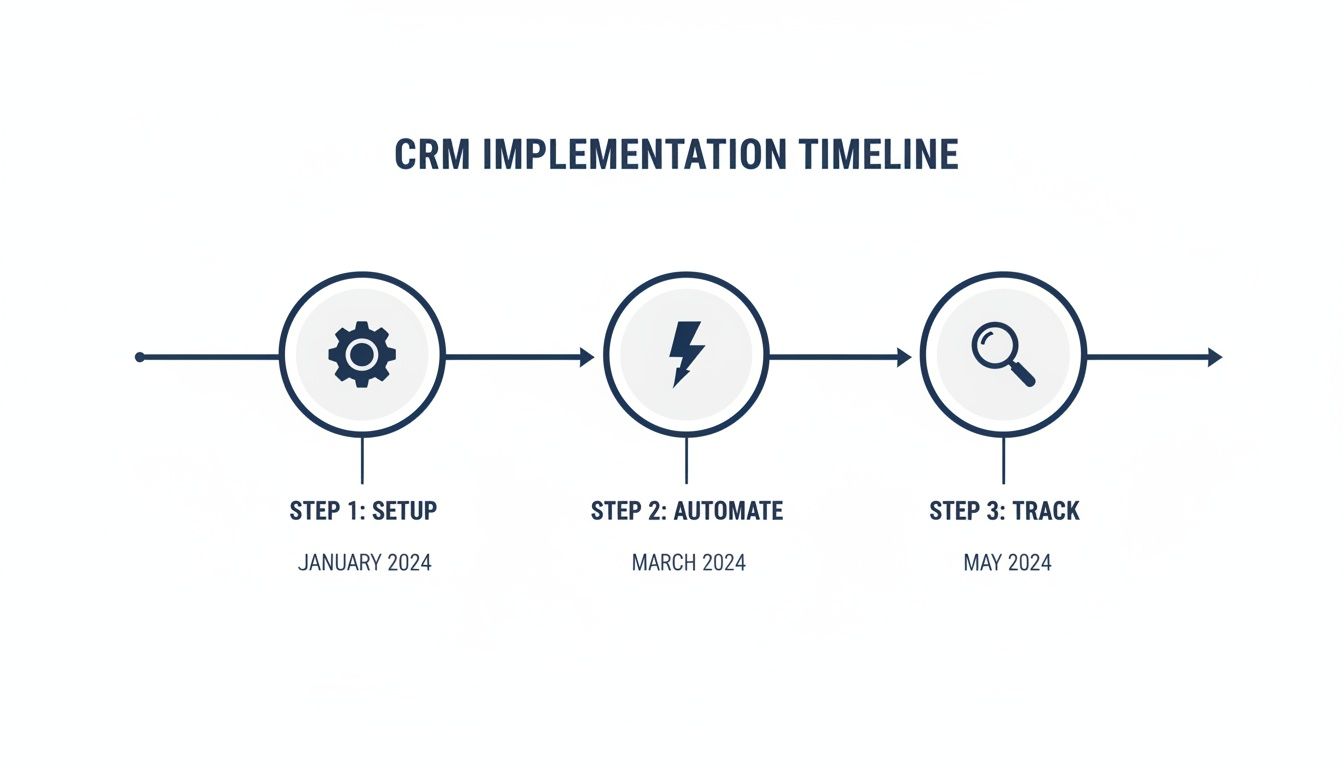
This progression from setup to automation and then tracking ensures you build a system that's both powerful and manageable.
Month 2: Campaign Launch and Execution (Weeks 5-8)
With your foundation in place, it’s time to generate traffic and start conversations. Month two is about launching your first campaigns and gathering real-world data on what resonates with your ideal buyers.
- Content Creation: Develop and publish your first two "pillar" pieces of content. These should be high-value assets, like a detailed case study proving a specific result or a technical blog post solving a common engineering headache.
- Targeted Outreach: Launch a small, focused LinkedIn outreach campaign aimed at a well-defined list of ideal prospects. Use the value-first messaging we outlined earlier, offering your new content as a helpful resource.
- Paid Campaign (Optional): For faster feedback, consider a small, targeted Google Ads campaign focused on one or two of your most profitable services. The goal isn't massive volume; it's to quickly learn which keywords and ad copy drive qualified clicks and RFQs.
Month 3: Analysis and Optimization (Weeks 9-12)
The final 30 days are all about data. You now have actual performance metrics from your content and outreach. The goal is to figure out what worked, what didn't, and double down on the winners. This is how you prove the concept and set the stage for scaling up.
This is your "review and improve" phase. You'll watch a few key performance indicators (KPIs) to measure success.
Key KPIs to Track:
- Number of Marketing Qualified Leads (MQLs): How many new leads from your ideal customer profile did the system generate?
- Cost Per Qualified Lead (CPQL): Divide your total marketing spend by the number of MQLs. This is your core efficiency metric.
- Website Conversion Rate: Of the visitors to your key landing pages, what percentage filled out a form? This tells you how effective your messaging is.
- Lead-to-Opportunity Rate: What percentage of MQLs did the sales team accept and convert into active sales opportunities? This measures the handshake between marketing and sales.
By the end of 90 days, you won’t have a perfect, fully scaled machine. But you will have a functioning prototype. You'll have moved from guesswork to a data-driven process with clear metrics that show a return on your investment. This is the proof you need to build a truly predictable engine for growth.
To help you stay on track, we’ve put together a comprehensive resource. You can find more detailed guidance in our free marketing roadmap template, which provides checklists and frameworks for each stage of this process.
Common Questions from Manufacturers
Even with a detailed playbook, there are always a few questions that pop up. Here are the answers to the ones we hear most often from manufacturers diving into modern lead generation.
How Long Does It Take to See SEO Results?
The honest answer is that SEO is a long-term play. You can expect to see positive signs like more organic traffic and better keyword rankings within 3-4 months, but the real, needle-moving impact on leads usually kicks in around the 6-12 month mark.
It takes time for search engines to recognize the authority of your technical content. That's why we pair it with faster tactics, like targeted LinkedIn outreach, to get you early momentum while your long-term organic engine warms up.
How Can a Small Sales Team Manage a CRM?
Valid concern. A properly set up CRM should give your team time back by automating repetitive, manual tasks.
The key is to start simple. Don’t try to build a dozen complex workflows on day one. A CRM should serve your team, not overwhelm them.
We recommend starting with the single biggest bottleneck. For most, that’s automating the initial follow-up for every new lead. Just that one automation ensures no inquiry falls through the cracks and frees up your reps to do what they do best: build relationships.
Are Trade Shows Still Relevant for Manufacturers?
Absolutely, but their role has evolved. It’s no longer about digital versus in-person; it’s about making them work together. Trade shows are still unmatched for hands-on demos and cementing key relationships.
But your digital presence, especially on a platform like LinkedIn, is what makes your trade show investment pay off. You can use it to:
- Connect with key people and schedule meetings before you get there.
- Share live updates and booth demos during the event.
- Nurture new contacts with automated follow-up sequences long after the show ends.
The goal is a cohesive system where your digital and in-person efforts feed each other.
How Much Should a Manufacturer Budget for Lead Generation?
This varies based on your revenue goals, sales cycle, and niche competitiveness. Instead of pulling a number out of thin air, we advise clients to work backward from their customer's lifetime value (LTV).
First, figure out what a new customer is worth to your business over several years. Once you have that number, it becomes much easier to determine what you can reasonably invest to acquire each qualified lead. The focus should always be on generating a predictable and positive return on investment (ROI).
Ready to stop guessing and start building a predictable lead generation engine? At Machine Marketing, we specialize in creating marketing systems that deliver measurable results for manufacturers.
Book a discovery call with Karl today to get a clear diagnosis and a practical roadmap for sustainable growth.