If you're a business owner struggling to generate consistent leads, you’re not alone. We see this all the time—and the root cause is often hidden in plain sight. It's not a sales problem; it's a demand problem.
So, what is demand generation marketing? It's the strategic process of creating awareness and desire for your solutions long before a prospect is ready to buy. It's about building a system that makes your business the obvious choice when the time comes.

Building a Market Instead of Just Capturing It
Are your marketing efforts focused entirely on capturing the small fraction of people actively searching for your solution right now? If so, you're competing for a very small piece of the pie.
Demand generation is the art of making the entire pie bigger. It’s a long-term strategy that builds your authority and educates your audience, making your business the only logical choice in its field.
Instead of just shouting "buy our stuff," you consistently answer questions, solve adjacent problems, and build genuine trust. This approach transforms your marketing from a short-term cost into a long-term, revenue-generating asset. When it works, customers don't just find you by chance—they seek you out because they already know, like, and trust your expertise.
The core principle is simple: show up with valuable, no-strings-attached help. You provide solutions and share educational resources until your audience comes to you when they're finally ready to make a decision.
How This System Delivers Transformation
A well-oiled demand generation engine makes your sales process smoother, more predictable, and far more efficient. Here’s the transformation you can expect:
- Educated Buyers: Prospects arrive at sales calls already understanding the problem you solve and why your approach is the best one.
- Shorter Sales Cycles: Your team can skip the basic education. With trust already established, they can focus on closing deals, not just convincing prospects.
- Higher-Quality Leads: The content you create acts as a natural filter, attracting people who are a perfect fit and repelling those who aren't.
Demand generation shifts your strategy from interrupting prospects to becoming an indispensable resource. It's the foundation that makes every other part of your marketing—lead capture, sales, customer retention—more effective. It's the difference between hunting for individual customers and building a system that brings them directly to your door.
Demand Generation vs. Lead Generation
It's a common point of confusion: people often use "demand generation" and "lead generation" interchangeably. They are not the same. They solve two different problems, and understanding the distinction is critical to building a marketing system that drives sustainable growth.
Think of it like this: demand generation is the broad strategy of creating a market for your services. It's about educating your audience, building trust, and ensuring your company is the first one they think of when they have a problem you can solve.
Lead generation, on the other hand, is a specific tactic. It’s the process of capturing the contact information of people who are already showing interest and are ready for a conversation.

Cultivating vs. Harvesting
Let's use a farming analogy. Demand generation is like tilling the soil, planting seeds, and watering your crops. It's the upfront work you do to ensure a healthy harvest later.
Lead generation is the act of harvesting the ripe produce.
If you focus only on harvesting (lead gen) without ever cultivating the field (demand gen), you create a feast-or-famine cycle. You might get a few quick wins, but you'll eventually run out of crops. A healthy system requires both. While demand generation builds awareness, a key outcome is making it easier to generate leads on social media and other channels.
Demand generation builds the audience; lead generation converts that audience into prospects. One creates the opportunity, and the other captures it. They are two separate but essential stages of the same journey.
To help you diagnose where your marketing efforts are currently focused, let's break down the practical differences.
Demand Generation vs. Lead Generation Key Differences
This side-by-side comparison will help you identify potential gaps in your current marketing system.
| Aspect | Demand Generation (Creating the Market) | Lead Generation (Capturing the Market) |
|---|---|---|
| Primary Goal | Educate, build trust, and create awareness for your solution. | Capture contact details from interested prospects. |
| Audience Focus | A broad, defined audience that may not yet know they have a problem. | A narrow audience that has already shown interest or intent. |
| Timeline | A long-term, ongoing strategic process. | A short-to-medium-term tactic with clear start and end dates. |
| Key Metrics | Website traffic, brand mentions, audience growth, content engagement. | Conversion rate, cost per lead (CPL), marketing qualified leads (MQLs). |
After reviewing that table, it should be clear this isn't an "either/or" choice. The most effective marketing systems integrate both seamlessly.
Demand generation warms up your market, creating a steady flow of educated, high-intent buyers. This makes your lead generation efforts far more efficient. To see how these concepts fit into a larger framework, check out our guide to inbound marketing and lead generation.
The Core Channels of a Demand Generation Engine
A powerful demand generation strategy isn't a single tactic. It's an engine with multiple, interconnected parts working in sync. Relying on just one channel is like trying to run a factory on a single extension cord—it’s not a sustainable system.
To build a B2B marketing machine that drives predictable results, you need a cohesive system that educates your ideal customers and cements your reputation as the go-to expert.
Let's diagnose the core components of this engine and see how each part contributes to the whole machine.
SEO-Driven Content Marketing
Your potential customers are on Google right now, typing in questions to diagnose their business problems. Your goal is to be the one providing the answers. This is where SEO-driven content marketing becomes the foundational gear in your demand generation engine.
Search engine optimization (SEO) is not just about keywords; it's about building strategic assets designed to attract organic traffic for years. Every blog post, case study, or guide should be engineered to answer a specific question your ideal buyer is asking.
By building a library of genuinely helpful resources, you can transform a static website from a digital brochure into a revenue-generating asset. We've seen it firsthand. You can learn more about our approach in our guide to content marketing best practices.
Social Media as an Authority Platform
For most B2B businesses, especially in manufacturing and professional services, LinkedIn is the town square. It’s where your buyers, partners, and competitors gather. Using it effectively isn't about spamming connections; it’s about building genuine authority.
Here are a few actionable steps:
- Share Your Expertise: Don't just post links. Add insightful commentary on industry news and trends to demonstrate your knowledge.
- Engage in Conversations: Find relevant groups and contribute to discussions where your ideal customers are already active.
- Showcase Your Human Side: Highlight your team, your process, and your values to build connection and trust.
Think of social media not as a megaphone, but as a roundtable discussion. Your goal is to become a respected voice in the conversation. This builds familiarity long before a sales call ever enters the picture.
Email Marketing for Relationship Nurturing
Once someone shows interest—perhaps by downloading a guide or subscribing to your updates—email marketing becomes your primary tool for nurturing that relationship. This isn't about blasting generic newsletters. It’s about delivering targeted value over time.
A well-designed email system segments your audience based on their interests and actions, delivering relevant content that helps them move forward. For example, a new contact might receive an introductory sequence explaining your core philosophy, while someone who downloaded a case study gets follow-up content related to that specific topic.
When you integrate these channels, you create a system where each part strengthens the others, building a predictable pipeline of educated, engaged future customers.
How to Measure Demand Generation Success
If you can't measure your marketing, you can't improve it. Too many business owners get bogged down in vanity metrics like social media likes. While those numbers feel good, they don't tell you if your demand generation engine is actually driving revenue.
To make smart, data-driven decisions, you have to focus on the metrics that draw a direct line to business growth. This isn't just about justifying a budget; it's about turning data into actionable strategy. The 2023 Demand Generation Benchmark Survey shows just how critical this alignment has become for companies chasing aggressive growth.
Core Metrics That Actually Matter
To get a clear diagnosis of your marketing performance, you need a dashboard that tracks the right things. A platform like GoHighLevel is ideal for this, allowing you to pull all these metrics into one place for a transparent view of your marketing ROI.
Here are the essential KPIs you should be watching:
- Website Traffic Growth: This is your top-of-funnel pulse check. Is your content bringing more of the right people to your site over time? An upward trend here is a great sign your awareness efforts are paying off.
- Marketing Qualified Leads (MQLs): This is the next step. An MQL tracks prospects who take a meaningful action, like downloading a spec sheet or requesting a quote. It shows your content is successfully moving people from just looking to actively engaging.
- Cost Per Acquisition (CPA): This one is simple but powerful: your total marketing cost divided by the number of new customers you landed. The goal is to drive this number down as your system gets smarter and more efficient.
- Marketing-Sourced Revenue: This is the big one. It answers the ultimate question: How much actual revenue did our marketing activities bring in? This KPI connects your demand generation engine directly to the company's bottom line.
A healthy demand generation system shows steady improvement across all these areas. You’ll see more traffic, which turns into more MQLs, which—when paired with a solid sales process—lowers your CPA and drives up your marketing-sourced revenue.
To make this even clearer, here’s a quick reference table of the KPIs that should be on your radar.
Essential Demand Generation KPIs
A quick reference guide to the key metrics for measuring the true impact of your demand generation efforts.
| Metric | What It Measures | Why It Matters for B2B |
|---|---|---|
| Website Traffic Growth | The increase in unique visitors to your website over a specific period. | Indicates if your top-of-funnel content and SEO efforts are attracting a larger audience of potential buyers. |
| Marketing Qualified Leads (MQLs) | The number of leads who have shown interest by taking a specific action. | Shows if your content is resonating enough to move prospects from awareness to active consideration. |
| Cost Per Acquisition (CPA) | The total marketing spend divided by the number of new customers acquired. | Measures the efficiency of your marketing engine. A lower CPA means you're acquiring customers more profitably. |
| Marketing-Sourced Revenue | The total revenue generated directly from marketing-led initiatives. | The ultimate proof of ROI. It directly links marketing activities to business growth and justifies your budget. |
These metrics give you a complete story, from initial interest all the way to a closed deal.
Turning Data into Decisions
Monitoring these metrics isn't a passive exercise. It's about diagnosis and action.
Is your traffic up but MQLs are flat? You may have an issue with your calls-to-action. Are MQLs high but marketing-sourced revenue isn't moving? That could signal a disconnect between marketing and sales.
Each KPI is a clue pointing to where your engine needs a tune-up. By focusing on these core numbers, you can systematically improve your process and build a predictable pipeline for growth. To get a better handle on this, check out our detailed guide on the fundamentals of marketing analytics.
Your 90-Day Demand Generation Starter Plan
Theory is great, but action drives results. We’ve covered the "what" and "why" behind demand generation. Now, it's time to build your machine.
This is a practical, step-by-step 90-day plan to get your system running. It’s the same proof-of-concept approach we use to help our clients achieve early wins.
We’ll break it down into three focused 30-day sprints. The goal isn’t perfection; it’s momentum. Follow this roadmap to start building a true marketing asset for your business.
Month 1: Foundation and Diagnosis (Days 1-30)
The first 30 days are about laying the groundwork. You can’t build a strong system on a shaky foundation. This month is dedicated to a deep diagnosis—figuring out exactly who you're trying to reach and what problems keep them up at night.
Your checklist for this month:
- Define Your Ideal Customer Profile (ICP): Go beyond basic demographics. What are their job titles? What specific pains do they face? What does a "win" look like for them?
- Map Their Problems: List the top 5-10 challenges your ICP is trying to overcome. These problems become the raw material for your future content.
- Perform Keyword Research: Identify the exact phrases your ICP uses when searching online for solutions. This bridges the gap between their problems and your content.
Don't rush this stage. Every hour you spend on deep customer diagnosis in Month 1 will save you ten hours of wasted effort on ineffective marketing in Months 2 and 3.
Month 2: Content and Awareness (Days 31-60)
With your foundation set, Month 2 is about building your first asset and creating awareness. You're going to create one significant piece of content that directly solves a major pain point you identified last month. This "pillar" piece will be the centerpiece of your initial push.
This is where you start sharing your ideas with the world. Demand generation has become a cornerstone for B2B companies. In fact, a striking 88% of marketers who use SEO are committed to increasing or maintaining their investment, according to recent essential demand generation statistics for 2023.
Your checklist for this month:
- Create One Pillar Content Piece: This could be an in-depth guide, a comprehensive blog post, or a detailed case study that solves a specific problem for your ICP.
- Start Social Promotion: Begin sharing insights from your pillar content on LinkedIn. Focus on starting conversations and providing value, not just dropping links.
- Identify Distribution Channels: Where else does your ICP hang out online? Make a list of forums, groups, or industry publications where you can share your content.
This visual timeline shows how your efforts in awareness and engagement build toward measurable revenue over time.
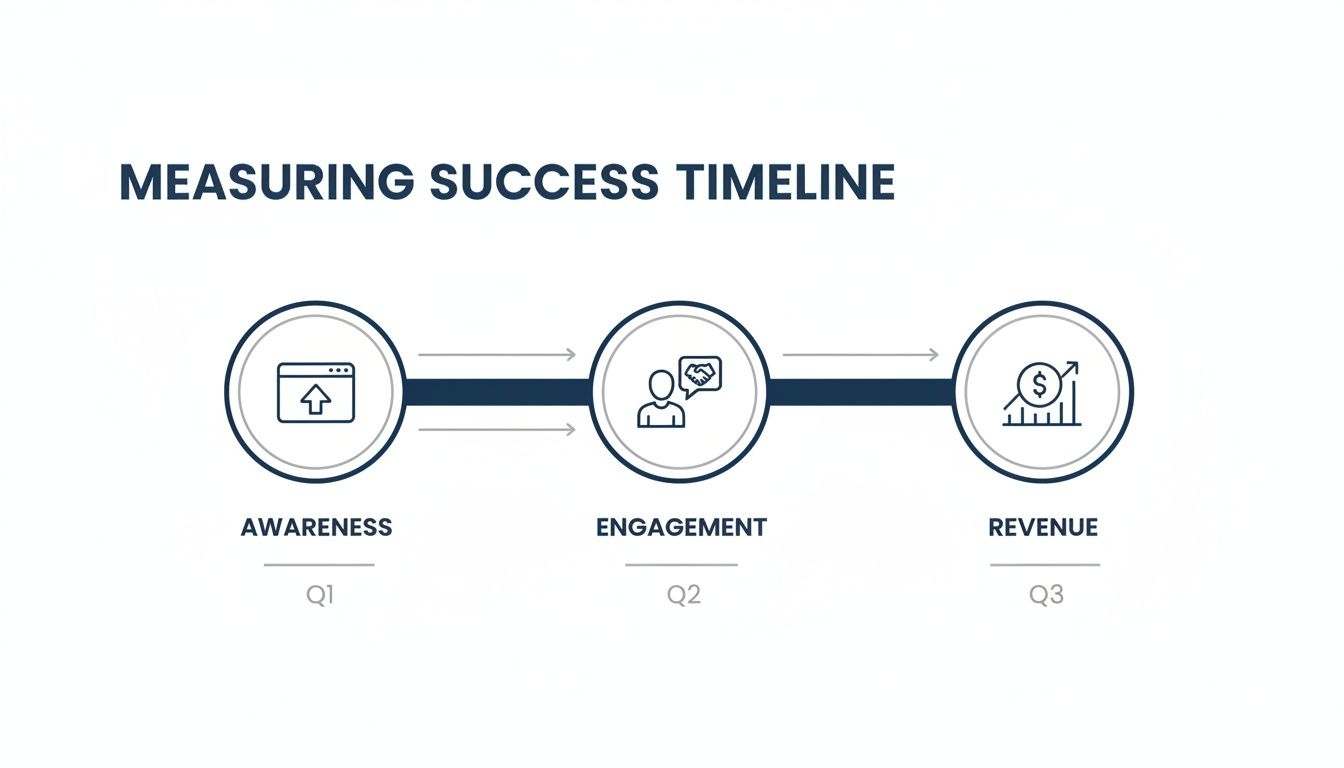
The key takeaway is that each stage builds on the last. You're turning initial visibility into tangible business growth.
Month 3: Nurturing and Optimization (Days 61-90)
In the final 30 days, your focus shifts to nurturing the interest you’ve generated and optimizing your process. You’ve attracted attention; now it's time to build a simple system to follow up and stay top-of-mind.
Your checklist for this month:
- Set Up a Simple Email Nurture Sequence: Create a 3-5 email series that new contacts receive. Each email should offer more value related to your pillar content.
- Create a Lead Magnet: Offer a downloadable checklist or template related to your pillar piece in exchange for an email address. This is how you convert anonymous traffic into known contacts.
- Review and Refine: Look at your data. Which social posts got the most engagement? What was the open rate on your emails? Use these early insights to plan your next 90-day sprint.
Answering Your Questions About Demand Generation
As you explore demand generation, a few practical questions always come up. We get these all the time from business owners trying to determine if this is the right approach for them. Let's tackle them head-on.
How Long Does It Take to See Results?
This is the big one, and we believe in being transparent: demand generation is a long-term strategy, not a quick fix. Think of it like planting an orchard instead of a vegetable garden.
You’ll likely see positive indicators within the first 90 days—more website traffic and better social media engagement. But the true, revenue-driving results typically take 6 to 12 months of consistent effort to build. You're creating a marketing asset that will feed your business for years, not just a temporary spike from a paid ad campaign.
Can a Small Business Afford Demand Generation?
Yes, absolutely. In fact, over the long term, it’s often more cost-effective than relying solely on paid ads, where costs continually rise.
The common myth is that you need a huge budget. The truth is, the biggest investment isn't cash—it's consistent effort and expertise. For a smaller business, the key is to be focused.
Questions to ask yourself:
- Which one or two channels can we realistically master right now?
- What is the single most urgent problem our audience has that we can solve better than anyone else?
- What foundational assets, like SEO-focused blog posts, will give us the best long-term return?
You build momentum by getting really good at one thing before adding another.
Your CRM isn't just a database; it's the central nervous system of your demand generation machine. It connects every touchpoint, from the first blog post they read to the final sales call, giving you a complete picture of the customer journey.
What Is the Role of a CRM?
Your CRM is the engine room for your entire demand generation strategy. It’s where you track every interaction someone has with your brand, whether they read an article, download a guide, or attend a webinar.
A tool like GoHighLevel makes this powerful by letting you automate follow-up based on that behavior. When a prospect is ready to talk, your sales team gets a seamless handoff with a full history of that person’s journey, setting them up for a much more productive conversation.
How Is ABM Different from Demand Generation?
We like to use a fishing analogy here.
Demand generation is like casting a wide net. You're creating interest and building awareness across your entire target market, hoping to attract a large number of good-fit prospects.
Account-Based Marketing (ABM) is like spear fishing. It applies the same principles but with an intense focus on a specific list of high-value accounts. It's a hyper-targeted approach, often used alongside broader demand generation efforts to go after the biggest opportunities.
Ready to build a predictable marketing system that brings customers to you? The team at Machine Marketing specializes in diagnosing growth roadblocks and implementing the right demand generation strategies for manufacturers and B2B businesses. Let's build a machine that works for you. Book a discovery call today.