If your manufacturing company is struggling to land consistent, high-quality leads, you're not alone. We see this all the time—and the root cause is often a disconnected system. A modern marketing manufacturing strategy isn't just a website or a trade show booth; it's an integrated engine built to turn your online visibility into measurable revenue.
In this guide, we'll show you how to diagnose the common gaps in industrial marketing and share the practical steps you can take to build a reliable system for growth.
Why Your Manufacturing Business Needs More Than a Website

Does this sound familiar? You have a decent website and a presence at major trade shows, but there's no real strategy connecting those dots to genuine sales opportunities. If so, your marketing isn't a system—it's a collection of disconnected parts.
This guide is designed to diagnose those gaps, from having a fuzzy picture of your ideal customer to letting powerful digital channels go unused. We'll show you how to build a marketing engine that creates a predictable system for growth.
The Game Has Changed for Industrial Buyers
The way your buyers make purchasing decisions has fundamentally changed. The old days of relying solely on a handshake and a trade show floor are gone. Today, your prospects conduct extensive online research before they even consider speaking with a sales rep.
This isn't a minor shift. We know that 57% of industrial buyers are deep into their decision-making process before they ever make direct contact with a company. For the fastest-growing manufacturers, search engines are now driving 65-75% of their traffic, far surpassing direct visits.
What does that mean for you? Your website can't be a passive online brochure. It has to be your hardest-working salesperson, operating 24/7.
The Diagnosis: If your website is just a digital version of your company brochure instead of an active lead-generating machine, you are effectively invisible to the vast majority of your potential market. Your website redesign project plan needs to treat the site as the central hub of your entire marketing system.
To build a marketing strategy that works today, you have to meet buyers where they already are: online. We'll walk you through the framework to do just that:
- Define who you are talking to and what you need to say.
- Optimize your digital presence so engineers and procurement managers can find you.
- Implement a CRM to automate follow-up and ensure no lead falls through the cracks.
Diagnosing Your Foundation for Growth
Before spending a dollar on ads, you need to run an honest diagnostic on your business. A winning marketing strategy for a manufacturer isn’t built on assumptions; it’s built on a solid foundation of data and a deep understanding of your market. This is where we apply an engineering mindset.
Think of this as a foundational check. The goal is to identify where you stand in the market, who your most profitable customers actually are, and what competitive advantages matter most to them. This is the single most important step in building a system that generates predictable revenue.
Defining Your Ideal Customer Profile
Most manufacturers can name the industries they serve. That’s the easy part. A truly effective Ideal Customer Profile (ICP) goes much deeper, moving beyond simple firmographics to focus on the specific, costly operational challenges your product solves.
An ICP isn't just a description; it’s a filter. It helps you cut through the noise and focus your resources on prospects who will see immediate, undeniable value in what you do.
The Transformation: A weak ICP forces your teams to waste time and money on prospects who were never going to buy. A sharp ICP, laser-focused on the problems you solve, is a qualification tool that ensures you only engage high-potential leads.
Questions to ask yourself to define your ICP:
- Problem-Based: What specific, expensive problem do our best customers have that we are uniquely equipped to fix?
- Trigger Events: What typically happens inside a company that forces them to search for a solution like ours? (e.g., new compliance rules, a production bottleneck, critical equipment failure).
- Role-Specific Pains: How does this problem impact the plant manager versus the procurement officer or the CEO? Each role experiences different pain, and your messaging needs to address each one.
Practical Market Research Without a Big Budget
Market research doesn't have to be expensive. You can gain incredible insights by simply analyzing what your competitors are already doing in the open. Their messaging, content, and case studies are a goldmine of information.
Start by mapping out your top 3 to 5 direct competitors. Visit their websites and analyze their language. Are they focused on technical specs, ROI, or reliability? This tells you what they believe their customers value most. Then, look for the gaps. What customer pain points are they ignoring? That gap is your opportunity.
Of course, before diving into tactics, it's crucial to understand how to approach setting the right marketing goals. Clear objectives will guide every decision from here on out.
Crafting a Core Value Proposition That Resonates
With a clear picture of your ideal customer and the competitive landscape, you can build your core value proposition. This is a concise statement explaining the tangible value you deliver. It’s not a fluffy slogan; it’s the direct answer to your customer’s biggest question: "Why should I choose you over everyone else?"
Remember, your value proposition must speak to different decision-makers in their own language.
- For the Engineer: They care about specs, integration, and reliability. Your message must center on technical superiority and performance data.
- For the Procurement Manager: Their world revolves around total cost of ownership, lead times, and supplier stability. Your message must highlight efficiency and long-term value.
- For the C-Suite: They focus on the big picture—ROI, risk reduction, and competitive advantage. Your message needs to connect your solution directly to their bottom-line business results.
Nailing this foundational diagnosis ensures that every subsequent marketing activity is built on solid ground. It transforms your marketing from a series of random acts into a cohesive system engineered for growth.
Building Your Digital Marketing Engine

Now that you've done the diagnostic work, it's time to build the machinery that will bring in prospects and turn them into customers.
This isn't about throwing random tactics at a wall. We are engineering a cohesive system where every piece works in harmony. Think of it as your digital factory, running 24/7 to generate opportunities. The core components are your website, a solid CRM, and content that proves your expertise.
Get these three components working together, and you've built a powerful engine to drive your entire marketing manufacturing strategy.
Your Website Is Your Digital Factory Floor
Your website is the heart of your entire operation. It's where potential customers inspect your capabilities, verify your expertise, and decide if they trust you enough to start a conversation. A confusing site is like a disorganized shop floor; it kills confidence and sends prospects straight to your competitors.
Your site must be built for two audiences simultaneously: the human engineers and buyers you want as customers, and the search engine bots that determine if you get found. This requires a balance between a clean user experience and solid technical SEO.
What to look for in a high-performing manufacturing website:
- Logical Service Pages: Create dedicated pages for each core service or capability. Each page must answer specific questions about applications, material compatibility, and key technical specs.
- Technical Keyword Research: Your ideal customers search for precise solutions. Think "CNC machining for aerospace components" or "ISO 13485 certified injection molding." These are the long-tail keywords to weave throughout your site.
- Clear Calls-to-Action (CTAs): Every page should guide the visitor to a logical next step. Make it obvious what you want them to do, whether it's "Request a Quote," "Download Spec Sheet," or "Speak with an Engineer."
Data shows that search engines are projected to drive 65-75% of all visitors for high-growth manufacturing firms. With U.S. manufacturing revenue on track to grow by 4.2%, being visible when your customers are searching is not optional.
Installing the Brains of the Operation: A CRM
If the website is your factory floor, the CRM is the control room. It’s the central system that captures every lead, tracks every interaction, and automates your follow-up. Without one, valuable leads are falling through the cracks—we guarantee it.
We often set our clients up with a system like GoHighLevel because it integrates marketing, sales, and communication tools into a single platform.
When your CRM is configured correctly, you can:
- Capture Every Lead: Website forms, social media inquiries, and phone calls are all logged automatically.
- Automate Follow-Up: When someone requests a quote, they get an instant confirmation. No lead feels ignored.
- Track the Entire Journey: See every page a prospect visited, every email they opened, and every conversation they’ve had with your team. This context is gold for your sales conversations.
The real transformation comes from building a powerful B2B marketing automation strategy. This is what turns a static contact list into a predictable sales pipeline. To make it work, you need a clear picture of your entire marketing technology stack.
Manufacturing Your Foundational Content Assets
Finally, you need to produce high-value assets that fuel the engine. This isn’t about writing blog posts to have something new on the site. It’s about creating strategic content that proves your expertise, builds trust, and answers your ideal customer's most critical questions.
Our Approach: Treat your content like your products. Each piece must be well-engineered, solve a specific problem for the user, and have a clear purpose in your sales process.
Before creating a full content calendar, build out your core digital assets. The table below helps you map out which pieces to create first based on their impact on your lead generation and sales cycle.
Digital Asset Priority Matrix for Manufacturers
| Asset Type | Primary Goal | Key Audience | Implementation Priority |
|---|---|---|---|
| In-Depth Case Studies | Build trust & credibility | Decision-makers, Engineers | High |
| Technical Spec Sheets | Provide critical data, capture leads | Engineers, Technical Buyers | High |
| Problem-Solving Blog Posts | Establish thought leadership, attract search traffic | Engineers, Project Managers | Medium |
| Detailed Service Pages | Educate prospects on capabilities | All relevant buyers | High |
| "About Us" / Team Page | Humanize the brand, build connection | All audiences | Medium |
| FAQ Section | Overcome common objections | All audiences | Low |
By prioritizing assets like case studies and spec sheets, you directly support buyers who are further along in their journey, while foundational blog content works to attract new prospects over time.
Activating Your Audience to Generate Leads

You’ve done the heavy lifting—you've diagnosed the issues and built the digital engine. Now it’s time to flip the switch and generate a measurable flow of leads. This is the activation phase, where we shift from building assets to proactively driving traffic and starting conversations.
A well-built system is powerful, but it needs fuel. For manufacturers, that fuel is a multi-channel approach combining quick wins with long-term tactics. The focus now is pure execution.
Re-Engaging Your Warmest Audience First
Before spending a dollar on new ads, look at the goldmine you're already sitting on: your existing list of past customers, old quotes, and leads that went quiet. They already know who you are; they just need a compelling reason to re-engage.
This is where smart email and SMS campaigns come in. We’re not talking about generic newsletters. Instead, create specific reactivation sequences designed to solve a problem or offer new value.
Actionable ideas to try:
- The "New Capability" Campaign: Did you just get a new certification or install a new CNC machine? Send a targeted email to past clients in relevant industries, explaining how this new capability can solve their production challenges.
- The "Check-In" Sequence: For leads that went cold six months ago, a simple, automated email asking if that quoted project is still a priority can restart a surprising number of conversations. Frame it as a helpful follow-up, not a sales pitch.
Our Takeaway: A thoughtful reactivation campaign will almost always produce a higher ROI in the first 30 days than any cold outreach campaign. It’s the fastest, most cost-effective way to build immediate momentum.
Executing Targeted Paid and Social Strategies
Once you’ve activated your existing list, you can turn your attention to bringing in new prospects. But this isn't about aimless brand awareness. Every dollar spent must be tied directly to a lead generation goal. For any modern marketing manufacturing strategy, that means focusing on platforms where you can target with surgical precision.
This is a known challenge; while a staggering 95% of manufacturers use social media, only 39% report getting solid results. To make matters worse, 64% admit they can't effectively prove the ROI on their marketing. The secret is picking the right tool for the job. You can dig deeper into these common manufacturing marketing challenges and solutions here.
Pinpoint Your Dream Clients with Account-Based Marketing
Forget trying to reach everyone. Instead, make a list of your top 10 "dream clients." These are the high-value accounts you know you can deliver incredible results for. This is the core of Account-Based Marketing (ABM)—a strategy built on precision, not volume.
LinkedIn Sales Navigator is your best friend here. It allows you to identify key decision-makers—engineers, procurement managers, or VPs of operations—within those target companies. Your outreach can't be a generic sales pitch. It must be a personalized message that references their company's challenges, positioning you as a problem-solver from the first touchpoint.
Capturing High-Intent Leads with Google Ads
While LinkedIn is great for proactive outreach, Google Ads is where you intercept active demand. You aren't creating interest; you're showing up the moment someone is searching for a solution. The trick is to avoid broad, expensive keywords and focus on high-intent, long-tail phrases.
Think like your ideal customer. They aren't searching for "manufacturing services." They're searching for things like "custom metal stamping for automotive prototypes" or "quick-turn PCB assembly services."
Bidding on these specific phrases ensures your ad is shown only to prospects actively looking for your exact solution. This approach keeps your cost-per-lead down and the quality of those leads high.
Measuring Performance and Optimizing for ROI
You can build the most sophisticated marketing engine, but if you aren't measuring its output, you're just burning fuel. This final phase is about creating a rhythm of review and optimization. It's where you ensure a positive return on your investment.
Forget vanity metrics like social media "likes" or website "impressions." They don't pay the bills. We need to zero in on the numbers that have a direct impact on your bottom line.
KPIs That Actually Matter for Manufacturers
To get a real grip on performance, you must track Key Performance Indicators (KPIs) that connect marketing activity to sales outcomes. This is how you transform marketing from a cost center into a predictable, revenue-generating asset.
The three KPIs that tell you almost everything you need to know:
- Cost Per Qualified Lead (CPQL): This is your truth serum. It tells you exactly how much you're spending to get a real sales opportunity into the pipeline.
- Lead-to-Customer Conversion Rate: What percentage of those qualified leads become paying customers? This metric is a gut check for both your sales process and lead quality.
- Sales Pipeline Value from Marketing: This is the big one. It measures the total dollar value of all sales opportunities in your pipeline that came directly from your marketing efforts.
You can set up simple dashboards in your CRM or Google Analytics to monitor these numbers. The goal isn't to track everything—it's to track what matters. For a deeper dive, check out our guide on how to measure marketing ROI.
The Continuous Improvement Loop
Data is useless if you don't act on it. The most successful manufacturers we work with have a non-negotiable monthly or quarterly review process. This meeting isn't just about looking at charts; it's about asking tough, diagnostic questions.
The Core Question: Which activities are producing the highest-value leads for the lowest cost, and how can we double down on what's working?
This visual sums up the powerful, yet simple, process of tracking, analyzing, and optimizing.
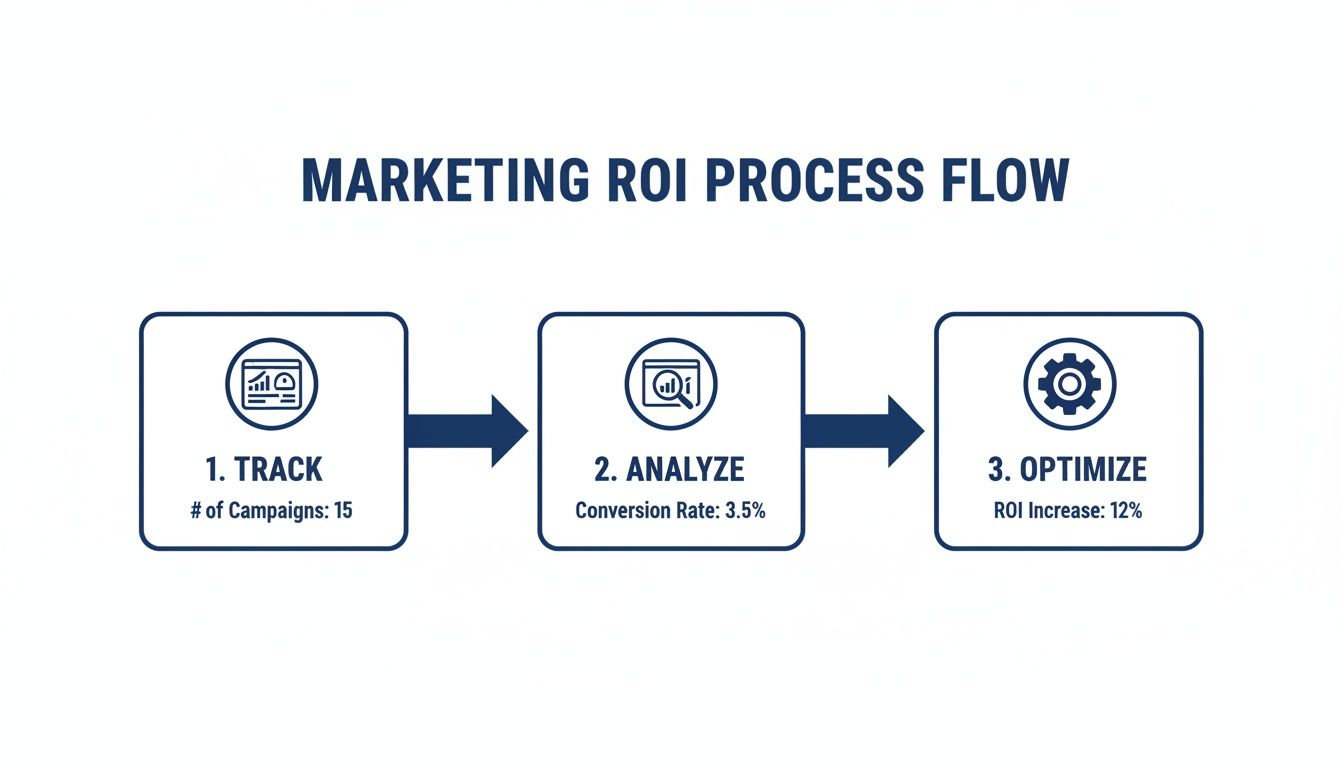
Each step feeds the next, creating a cycle of constant improvement that systematically increases your return on investment.
In your review meetings, your team should be ready to answer:
- Which marketing channels are driving our most profitable customers? Is it a niche Google Ads campaign or the technical content on our blog?
- Where are the biggest bottlenecks in our sales process? Are good leads going cold between the first call and the quote?
- Is our messaging still hitting the mark? Are leads asking the right questions, or are they confused about our core capabilities?
Answering these questions honestly allows you to make decisions based on facts, not feelings. You might find one LinkedIn campaign generates leads at one-third the cost of another, telling you exactly where to shift your budget. This is what turns marketing campaigns into a predictable system for growth.
Your 90-Day Manufacturing Marketing Action Plan
Theory is one thing; execution is everything. We’ve walked through the diagnosis, building, and activation phases. Now, let’s turn that framework into a practical, 90-day action plan designed to build real momentum.
This roadmap breaks the process into clear, weekly tasks, giving you a structured path from planning to execution. The goal is simple: start generating real opportunities, fast.
Month 1: The Diagnostic Phase (Weeks 1-4)
The first 30 days are about laying a rock-solid foundation. This month is dedicated to deep-dive discovery to ensure every dollar you spend from here on out is pointed in the right direction.
Weeks 1-2: Market & Customer Diagnosis
- Conduct a competitor analysis. Where are the messaging gaps you can exploit?
- Interview your top five customers and at least two ideal sales prospects to understand their real-world pain points.
- Finalize your Ideal Customer Profile (ICP) based on this data.
Weeks 3-4: Messaging & Value Proposition
- Draft your core value proposition. It must be a clear, powerful statement that explains the specific value you deliver.
- Develop key messaging points tailored to each person in the buying decision (engineer, procurement, CEO).
- Run this messaging by your sales team and a trusted customer for feedback.
Month 2: The Building Phase (Weeks 5-8)
With a clear strategy locked in, Month 2 is about building the essential digital assets. This is where you construct the machinery to attract, engage, and capture leads.
Think of it this way: We're setting up the shop floor. Every tool and asset needs a specific function and must be integrated correctly to ensure a smooth workflow.
Weeks 5-6: Website & CRM Foundation
- Identify and overhaul one high-impact landing page on your website (e.g., for a key service or product).
- Set up your GoHighLevel CRM. Import existing contacts and create basic lead capture forms.
Weeks 7-8: Foundational Content Creation
- Create your first pillar piece of content, like a detailed case study or a technical guide that solves a key problem for your ICP.
- Create a simple download gate for this content on your website to start turning anonymous visitors into tangible leads.
Month 3: The Activation Phase (Weeks 9-12)
The machinery is built. Now it's time to flip the switch. Month 3 is about proactive outreach and generating your first wave of marketing-driven leads.
Weeks 9-10: Launch Reactivation Campaigns
- Write and schedule a simple 3-step email reactivation campaign targeting old leads or past customers.
- Launch a targeted LinkedIn outreach sequence to decision-makers at 10 of your top "dream client" accounts. Make it personal and valuable.
Weeks 11-12: Track, Measure, & Refine
- Set up a simple KPI dashboard in your CRM. At a minimum, track Cost Per Qualified Lead and the number of sales appointments set.
- Hold your first monthly marketing review. Dig into the initial results to decide what's working and where to double down next month.
Answering Your Manufacturing Marketing Questions
We've covered a lot, from diagnosing problems to laying out an execution plan. It's natural to have questions as you build your own marketing manufacturing strategy.
Here are the straight answers to the questions we hear most often from manufacturers.
How Much Should a Manufacturing Company Budget for Marketing?
You'll hear benchmarks like 2-5% of annual revenue for established companies or 5-10% for growth-focused firms. While a decent starting point, it's not the most strategic approach.
A smarter method is to work backward from your goals. Determine your revenue target, then calculate how many qualified leads your sales team needs to hit it. This allows you to set a specific "cost per lead" budget for the channels with the best ROI. Marketing stops being a line-item expense and becomes a predictable investment in revenue.
What Is the Most Important Marketing Tactic for a Manufacturer?
Your website. Period.
It is the single most critical asset you have. A technically sound, SEO-optimized website that clearly explains what you do is your digital salesperson, working 24/7. It's the central hub where every ad, social post, and trade show follow-up points.
Our Diagnosis: If your website can't properly educate visitors and convert them into leads, any money you spend driving traffic there is wasted. Before you scale any other tactic, you must get your website and core messaging right. It’s the foundation of the entire system.
How Long Does It Take to See Results From a New Marketing Strategy?
You can absolutely see results within 90 days. Quick-win tactics like an email reactivation campaign can spark conversations and generate qualified leads in the very first month.
However, foundational strategies like SEO and content marketing are a long game. These assets build value over time. Expect it to take 6-12 months to see significant, compounding returns in organic search traffic and brand authority. An effective strategy balances both: short-term activation for immediate wins and long-term asset building for sustainable growth.
Ready to stop guessing and start building a marketing system that generates predictable revenue? At Machine Marketing, we specialize in diagnosing growth bottlenecks and engineering the right solutions for manufacturers. Book a discovery call with Karl and we'll help you build a clear, actionable roadmap for your business.