If your lead generation feels like a constant rollercoaster of feast or famine, the problem probably isn't your sales team—it's your marketing system. A solid content and inbound marketing strategy creates a predictable engine for growth. It’s a fundamental shift from interrupting prospects to genuinely earning their attention and trust.
In this guide, we'll diagnose why old-school marketing falls short and give you a practical, step-by-step blueprint to build a system that attracts a steady stream of qualified leads. You'll learn how to stop chasing business and start having ideal customers come to you.
Diagnosing The Root Cause Of Unpredictable Leads
Does your team spend most of its day making cold calls, blasting out mass emails, and just hoping for a reply? If that sounds familiar, you’re stuck in an outbound marketing model. This approach is like shouting into a crowded room and hoping the right person happens to hear you. It's expensive, inefficient, and often kills trust before a real conversation can even start.
The result is a wildly unpredictable pipeline. One month you’re a hero, and the next you’re scrambling. We see this all the time with B2B businesses and manufacturers. The root cause is simple: you're trying to force a sale instead of helping solve a problem. Today's buyers are self-sufficient; they research solutions long before they want to talk to a salesperson. Interrupting their day with an unsolicited pitch just doesn't work anymore.
The Shift From Interruption To Attraction
Content and inbound marketing flips this old model on its head. Instead of pushing your message out, you pull potential customers in by creating genuinely helpful content that answers their questions and solves their toughest challenges.
Think of it like this: an outbound marketer is a door-to-door salesperson showing up unannounced. An inbound marketer is the trusted expert who wrote the definitive industry guide that everyone is searching for. One interrupts; the other attracts. This isn't just a trend—it’s how modern business relationships are built.
To put these two approaches in perspective, let's break down the key differences.
Outbound vs Inbound Marketing: A B2B Comparison
This table highlights the fundamental shift in mindset. Outbound is about volume and interruption, while inbound is about value and connection.
| Attribute | Outbound Marketing (The Old Way) | Inbound Marketing (The New Engine) |
|---|---|---|
| Approach | "Push" – Interrupting the audience with ads, calls, and emails they didn't ask for. | "Pull" – Attracting the audience with helpful content that solves their problems. |
| Focus | Company-centric. The message is all about "us," our products, and our features. | Customer-centric. The content is all about "them," their challenges, and their goals. |
| Communication | One-way. The company talks at the prospect. | Two-way. A conversation is started through blogs, social media, and valuable resources. |
| Asset Value | Short-term. An ad campaign or email blast is over once it runs. | Long-term. A great article or guide can generate leads for years. |
| Cost | High and ongoing. You're constantly "renting" attention through advertising. | Lower over time. You're "owning" assets that build equity. |
| Buyer's State | Unaware or uninterested. They weren't actively looking for a solution. | Problem-aware and actively seeking solutions. They find you. |
| Primary Goal | Generate immediate, often unqualified, leads through sheer volume. | Build trust and authority to generate qualified, educated leads. |
Ultimately, one method feels like a constant uphill battle, while the other builds a system that works for you, attracting the right people at the right time.
What Does This Transformation Look Like?
When you commit to a content and inbound marketing system, your website transforms from a simple digital brochure into a lead-generation machine that works for you 24/7. This system is built to:
- Attract the Right Audience: Your ideal customers will start finding you through search engines and professional networks because your content directly answers their questions.
- Build Trust and Authority: By consistently sharing your expertise, you position your company as the go-to resource in your niche. People buy from experts they trust.
- Generate Qualified Leads: Prospects will gladly give you their contact information in exchange for high-value resources like technical guides, checklists, or webinar access.
- Nurture Relationships at Scale: Automated workflows deliver the right information at the right time, guiding leads toward a purchase decision without any aggressive or pushy sales tactics.
The core principle is simple: be the most helpful and trusted resource in your industry. When you consistently solve your audience's problems, they will naturally want to do business with you when the time is right.
For a closer look at the mechanics of turning website visitors into real prospects, this Lead Capture Automation Essential Guide offers practical steps for building a more reliable growth engine.
Designing Your Inbound Marketing Blueprint
Predictable results don’t happen by accident; they're the product of a well-engineered system. Before you create a single piece of content, you need a blueprint. Businesses often jump straight to creating content, which is like building a house without a foundation. Sooner or later, it all comes crashing down.
A solid blueprint ensures every marketing action you take is aligned and effective.
Question to Ask: Who Are You Really Trying to Reach?
First, you need to get laser-focused on your Ideal Customer Profile (ICP). "Everyone" is not a business strategy. Your ICP is a crystal-clear picture of the exact company that is a perfect fit for your solution.
To define your ICP, ask yourself these questions:
- Industry: What specific industry are they in? (e.g., aerospace manufacturing, medical device production)
- Company Size: What is their typical employee count or annual revenue? (e.g., 50-200 employees, over $10M ARR)
- Pain Points: What keeps them up at night? (e.g., struggling with supply chain visibility, needing to reduce scrap rates)
- Technology: What tools are they already using? (e.g., specific ERP systems, CNC machinery)
Once you know the company, you can pinpoint the people inside it. Are you talking to the lead engineer wrestling with a technical problem, or the purchasing manager focused on cost and reliability? They each care about different things and need a different conversation.
This is the core difference between inbound and outbound marketing. Inbound is a magnet, pulling the right people in. Outbound is a megaphone, shouting at everyone and hoping someone listens.
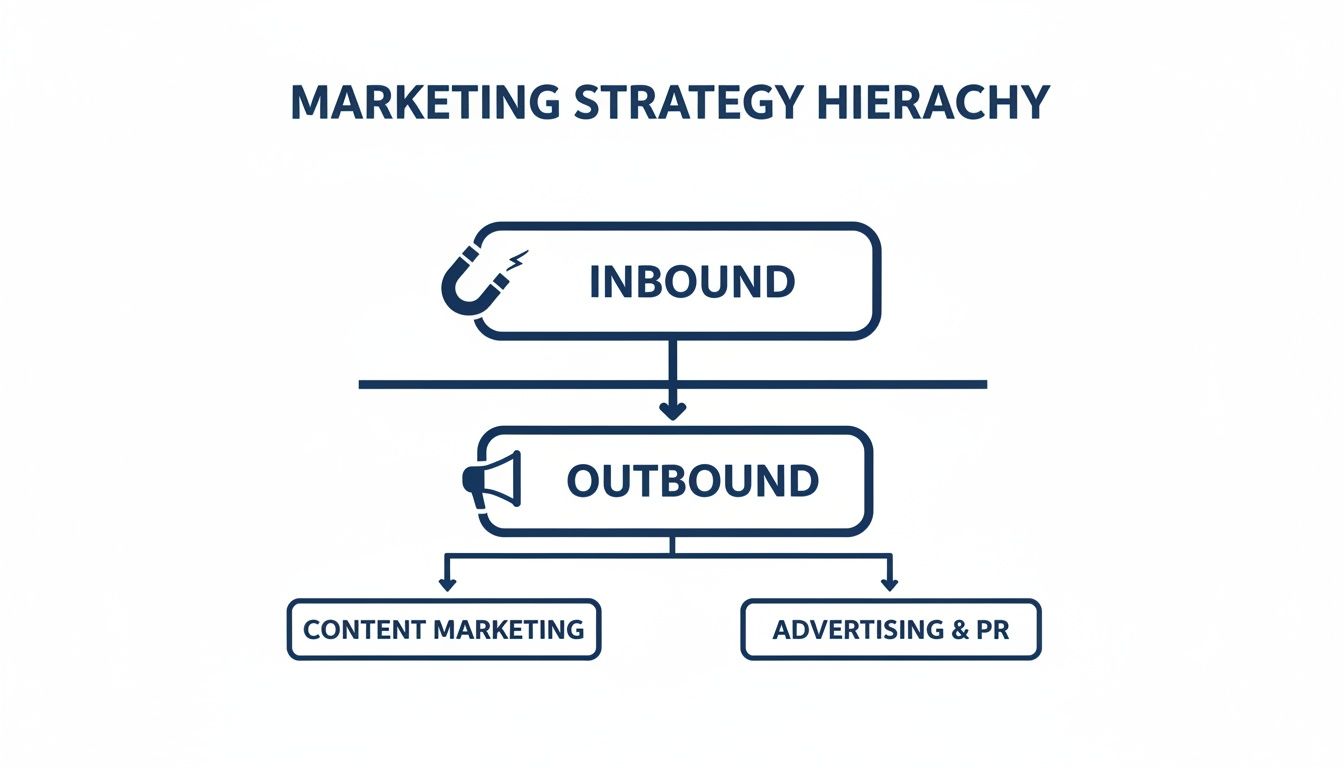
Your blueprint is all about building that magnet—a system that attracts the right prospects so you don't have to chase them.
Craft Your Core Messaging
Once you know exactly who you're talking to, you can craft a message that hits home. Your core message needs to immediately answer three critical questions from your customer's point of view:
- What specific problem do you solve for me?
- How will this make my job easier or my business better?
- What’s the clear next step I should take?
This isn’t the place to list product specs or your company history. It’s about communicating the transformation you deliver. Keep it simple, clear, and focused entirely on their success.
Develop Your Content Pillars and Lead Magnets
Now, let's organize your expertise into content pillars. These are the 3-5 core topics your business will be known for. For a custom machine shop, these might be "CNC Machining Efficiency," "Quality Control Systems," and "Supply Chain Optimization."
Every piece of content you create—blog posts, videos, guides—should fall under one of these pillars. This builds your authority on the subjects that matter most to your ideal customer.
Finally, you need to turn that expertise into a high-value lead magnet. This is a practical resource your ideal customer would gladly trade their email address for.
A lead magnet isn’t a sales brochure. It’s a tool that helps your prospect solve a small piece of their problem for free, demonstrating your value and earning their trust.
For a B2B audience, effective lead magnets could be:
- A detailed technical guide on a complex process.
- A downloadable checklist for equipment maintenance.
- An ROI calculator to help estimate project costs.
This framework—from ICP to lead magnet—is your blueprint for turning anonymous web traffic into a pipeline of qualified leads. As you put your plan together, using an essential content marketing strategy guide can help ensure all your efforts are aligned for growth.
Building Your Content and SEO Engine
Once you have a solid blueprint, it’s time to build the engine that powers your lead generation. This isn’t about just creating content for the sake of it. We’re talking about systematically producing pieces that attract your ideal customers and drive measurable results.
Think of this as the manufacturing floor for your marketing—it's where raw expertise is transformed into valuable, lead-generating assets.
To start, brainstorm topics by answering your customers’ most pressing questions. Don't guess what they care about. Listen to your sales team, dig through customer service logs, and pay attention to the questions that come up in consultations. Every question is an opportunity for an authoritative piece of content.

From Ideas to Authoritative Content
The main goal is to turn your deep industry knowledge into content that genuinely solves problems. This is where your content and inbound marketing strategy becomes a tangible asset. You're not just a writer; you're an expert sharing valuable insights.
Your go-to content formats will likely include:
- Authoritative Blog Posts: These are your workhorses. Use them to tackle specific questions, break down complex processes, and share industry news. Aim for depth and clarity.
- Detailed Case Studies: Nothing builds trust faster than proof. Show exactly how you solved a real problem for a real customer, detailing the challenge, your solution, and the bottom-line results.
- Practical How-To Guides: Create step-by-step guides or checklists your audience can put to use immediately. This positions you as a helpful partner, not just another vendor.
Maintaining Momentum with a Content Calendar
Consistency is the fuel for your content engine. Sporadic posts won't build the momentum needed to see real results. This is why a content calendar is absolutely essential. It’s your production plan, ensuring a steady stream of high-quality content flows out the door.
Your calendar should map out topics, formats, authors, and publish dates for at least a month ahead. This simple system kills the last-minute scramble for ideas and keeps everyone aligned. For a deeper look, check out our guide on how to create a content calendar that you’ll actually stick to.
Ensuring Your Content Gets Discovered
Creating great content is only half the battle. If your ideal customers can't find it, it might as well not exist. This is where foundational on-page SEO comes into play. You don’t need to be a technical wizard, but you do need to get the basics right.
SEO isn’t about tricking search engines. It’s about structuring your content in a way that makes it easy for Google to understand what it's about and who it’s for.
For every piece of content you publish, focus on these key on-page elements:
- Keyword Integration: Weave your target keyword—the phrase your customer is actually searching for—naturally into your title, headings, and opening paragraph.
- Descriptive Titles and Headings: Make your titles and subheadings clear and compelling. They need to accurately reflect the content and make someone want to keep reading.
- Readable Formatting: Use short paragraphs, bullet points, and bold text to make your content easy to scan. Google loves content that provides a good user experience.
- Internal Linking: Link to other relevant articles on your own website. This helps search engines discover more of your content and keeps visitors on your site longer.
Distributing and Repurposing Your Content
Once an article is published and optimized, it’s time to get it out there. Proactively share your hard work where your audience actually spends their time. For most B2B businesses, this means platforms like LinkedIn. Share your articles, pull out key quotes, or create short video summaries to drive traffic back to your site.
Finally, squeeze every drop of value from each piece by repurposing it. A single, in-depth guide can be transformed into multiple pieces of content without reinventing the wheel.
- A detailed blog post can become a short video script.
- A case study can be turned into an infographic.
- Key statistics from a whitepaper can become a series of social media posts.
This system of creation, optimization, distribution, and repurposing is how you build a powerful content engine that works for you around the clock, attracting and nurturing leads for years to come.
Connecting Your Systems with CRM and Automation
Great content gets you leads, but a smart system is what turns them into customers. If your content engine is pulling in prospects but you have no organized way to handle them, you're watching money walk out the door. This is where a Customer Relationship Management (CRM) platform and automation become the central nervous system for your growth.
Think of it this way: your content is the magnet, but your CRM is the organized warehouse that receives, sorts, and tracks every lead that magnet pulls in. Without it, you just have a messy pile. This setup lets your content and inbound marketing scale without burying your team in manual work.

Making Your CRM a Single Source of Truth
A well-configured CRM, like GoHighLevel, does more than just hold a list of contacts. It becomes the undisputed record—the single source of truth—for every interaction a lead has with your company. It tracks their entire journey, from the first blog post they read to the moment they ask for a quote.
This unified view is absolutely critical. It gets rid of guesswork and empowers your sales team to have smarter, more relevant conversations. They can see exactly what a prospect cares about, which guides they’ve downloaded, and how engaged they've been.
A well-implemented CRM turns anonymous website traffic into detailed lead profiles. It’s the difference between flying blind and having a full dashboard of actionable intelligence at your fingertips.
Building Simple, Effective Automation Workflows
Automation isn't about replacing people. It's about taking over repetitive tasks so your team can focus on valuable, human conversations. It works for you 24/7, ensuring no lead gets ignored and every new contact gets a timely, relevant response.
Here's how you can put simple automation to work right away:
- Instant Lead Magnet Delivery: Someone fills out a form for your technical guide? An automation instantly sends them an email with the download link. This delivers immediate value and confirms you got their request.
- Welcome and Nurture Sequences: A new contact can be automatically dropped into a short email sequence. The first email delivers the resource, the second shares a related case study a few days later, and a third might invite them to a webinar. You're building the relationship without lifting a finger.
- Lead Segmentation: You can automatically "tag" leads based on their actions. For example, if someone downloads a guide on CNC machining, tag them "Interested in CNC." This allows you to send them hyper-relevant content later.
How to Get Started with Automation
You don't need a complex workflow to get results. Start with simple processes that make a big impact. If you want a deeper dive into the different systems involved, you can learn more about building a modern marketing technology stack here.
Here’s a practical starting point for your very first workflow:
- Create Your Assets: Build a simple landing page with a clear headline and a form to capture name and email for your lead magnet.
- Set the Trigger: The "trigger" is the action that kicks the whole thing off. In this case, it’s “Form Submitted” on your landing page.
- Define the Actions: Once triggered, the system runs through a series of steps. A basic flow would look like this:
- Action 1: Add a tag to the contact (e.g., "Downloaded CNC Guide").
- Action 2: Send an email immediately with a link to the guide.
- Action 3: Wait 3 days.
- Action 4: Send a follow-up email with a link to a relevant case study.
- Action 5: Notify a salesperson that a new lead is engaged.
This simple, five-step system ensures every new lead is captured, nurtured, and handed off to your team at the right time. It’s the operational backbone that turns your content and inbound marketing from a hopeful strategy into a predictable, scalable engine for business growth.
Measuring the Metrics That Actually Matter
You can't improve what you don't measure. A solid content and inbound marketing system isn’t built on guesswork; it’s engineered with data.
But it’s dangerously easy to get lost in "vanity metrics"—numbers like likes, shares, and follower counts that look impressive but don’t tell you if you're actually growing the business. They don’t pay the bills.
To get a true diagnosis of your marketing health, focus on the Key Performance Indicators (KPIs) that signal tangible progress and connect your content efforts directly to your bottom line.
Moving Beyond Vanity Metrics
The goal is to build a straightforward dashboard that gives you an honest, at-a-glance view of what's working and what isn't. Instead of drowning in data, we focus on a handful of critical metrics that tell a clear story about your return on investment.
Here are the four essential KPIs you should be watching:
- Organic Website Traffic: This is your pulse check. It shows how many people are finding you through search engines like Google. A steady climb here is a strong sign your SEO and content are hitting the mark.
- Lead Conversion Rate: This is where traffic turns into opportunity. It's the percentage of visitors who take a specific action, like downloading a spec sheet or requesting a quote. This number tells you how effective your website is at turning anonymous visitors into actual leads.
- Marketing-Qualified Leads (MQLs): Not all leads are created equal. This metric tracks the number of leads who fit your Ideal Customer Profile and have shown real buying intent. These are the high-potential prospects your sales team actually wants to talk to.
- Customer Acquisition Cost (CAC): This is the ultimate bottom-line metric. It calculates the total cost of your marketing and sales efforts to land one new customer. The entire purpose of your inbound system is to consistently drive this number down over time.
By tracking these four KPIs, you replace ambiguity with clarity. You can pinpoint which content pillars are generating the best leads and know exactly where to adjust your strategy for better results.
Proving Tangible ROI
When you track the right data, you can prove the undeniable value of your inbound system. The numbers speak for themselves. Well-executed content marketing costs 62% less than traditional outbound methods while generating three times as many leads. For B2B companies, SEO-driven content can produce a powerful return on investment.
A great marketing dashboard doesn't just show you data; it shows you the story of your business growth. It answers the most important question any business owner has: "Is this investment actually working?"
This focus on measurement is what allows for continuous improvement. You can double down on what’s working, fix what’s broken, and confidently report on the tangible value your content and inbound marketing strategy is delivering. It's the engineering mindset applied to business growth.
If you want to dive deeper into the tools and methods behind this, our guide on what is marketing analytics provides a great next step.
Your First 90 Days: An Actionable Launch Plan
Strategy is useless without action. To get your content and inbound marketing system off the ground and generating leads, you need a clear, step-by-step roadmap.
This 90-day plan is designed to build momentum fast. It's about getting early wins on the board to prove the value of your investment and give you data to build on. Think of it as a phased rollout, where each 30-day block sets the stage for the next.
Month 1: Diagnosis And Setup
The first 30 days are all about laying a solid foundation. You can't build a high-performance engine on a shaky frame, so we start with the essentials: getting crystal clear on who you're talking to and how you'll manage the relationships you build.
- Define Your Ideal Customer Profile (ICP): Get specific. What are the real-world challenges, daily frustrations, and ultimate goals of the people you're trying to reach?
- Configure Your CRM: Your CRM is your central nervous system. We set up a platform like GoHighLevel as your command center—importing contacts, building out your sales pipeline, and creating custom fields to track what matters.
- Technical SEO Audit: We run a baseline audit on your website to find and fix any glaring technical issues that are holding back your search rankings before you start publishing new content.
Month 2: Building Foundational Assets
With your foundation in place, month two is about production. This is where you start turning your expertise into tangible assets that will attract, engage, and convert your ideal customers. The mission here is to create your first content pillar and a lead magnet that's too good to ignore.
Here are your priorities:
- Create Your First Content Pillar: Write 3-4 comprehensive articles that dive deep into one of the core topics from your strategy blueprint. This is how you signal your authority to both potential customers and search engines.
- Develop One High-Value Lead Magnet: Build that guide, checklist, or calculator you planned out. This is the critical tool for turning anonymous website visitors into known contacts.
- Build Your First Nurture Sequence: Write a simple 3-email automated sequence. The first email delivers the lead magnet, and the next two provide more value and build trust with your new contact.
Month 3: Launch And Distribution
Month three is go-time. You'll start publishing your content, actively promoting it to your target audience, and switching on the automations you’ve built. The focus shifts from building to doing—and gathering your first round of real-world data.
This is the moment you move from planning to executing. Don't aim for perfection; aim for progress. Launching now lets you start learning from your audience immediately.
Your launch plan should include:
- Publishing Your Content: Get your pillar articles live on a consistent schedule.
- Promoting on Key Channels: Start sharing your content on LinkedIn and other relevant channels, targeting the specific roles and industries defined in your ICP.
- Activating Your Nurture Flow: Flip the switch on the automation that connects your lead magnet form to your email sequence.
- Monitoring Initial KPIs: Begin tracking your core metrics: organic traffic, lead magnet downloads, and conversion rates.
To make this even clearer, here’s how the first three months break down in a simple, phased plan. We use this exact framework to get new inbound systems off the ground, ensuring every step builds logically on the last.
90-Day Inbound Marketing Launch Plan
| Phase (30 Days) | Key Objectives | Example Deliverables |
|---|---|---|
| Month 1: Foundation | Establish strategic clarity and technical readiness. | – Documented Ideal Customer Profile (ICP) – Configured CRM with sales pipeline – Completed technical SEO audit report |
| Month 2: Asset Creation | Develop core content to attract and convert the ICP. | – 3-4 pillar blog posts (1,500+ words each) – 1 high-value lead magnet (e.g., PDF guide) – 3-part email nurture sequence |
| Month 3: Activation | Launch the system, drive initial traffic, and gather data. | – Published content on blog and social media – Active lead magnet landing page – Live email automation flows – Initial KPI dashboard |
This 90-day sprint is about building a functional, lead-generating machine. It’s not about doing everything at once; it’s about doing the right things in the right order to create sustainable momentum.
Got Questions? We've Got Answers.
Jumping into a new marketing approach always brings up a few questions. That's a good thing—it means you're thinking strategically. Here are the honest, straightforward answers to the questions we hear most often from business owners just like you.
How Long Does Inbound Marketing Take to Work?
Let's be transparent: this isn't a light switch. While you'll likely see early signs of life, like more website traffic, within the first 90 days, a true inbound system takes time to mature. You should expect to see a consistent, predictable flow of good leads in about 6 to 12 months.
Think of it like planting a tree versus renting a billboard. The billboard gets attention now, but it's gone the second you stop paying. The tree takes a little while to grow, but once it does, it provides leads for years to come. Your content is a business asset, not just a marketing expense.
Is This a Good Fit for a Niche B2B Company?
Absolutely. In fact, it’s often better for niche businesses. The more specific your audience, the more powerful inbound marketing becomes.
When you're trying to reach a very specific person—say, an aerospace engineer or a plant manager in the food processing industry—you can create content that speaks directly to their unique problems. Generic marketing just can't compete with that. You may get fewer leads than a massive consumer brand, but the quality will be lightyears ahead. You become the go-to expert in your small pond, and that’s a powerful place to be.
Do I Have to Be a Professional Writer?
No. You just have to be an expert in what you do. Your biggest advantage is your deep understanding of your customers and their pain points. That's the gold. The most effective B2B content isn't about fancy words; it's about being genuinely helpful and authentic.
The goal is to provide clarity and value, not win a Pulitzer. Your expertise is the raw material; a good marketing partner helps you shape it into content that gets results.
This is where a partnership can make all the difference. You bring the industry knowledge, and an agency can help package it into well-structured, SEO-friendly articles, guides, and videos that connect with your audience. It lets you stay focused on running your business while a production system handles the rest.
At Machine Marketing, we build the systems that turn your expertise into predictable leads. If you're ready to move from unpredictable marketing to a reliable growth engine, book a discovery call with us today.