If your lead flow feels more like a trickle than a flood, you’re not just unlucky—you’re operating without a system. A proper B2B marketing plan is an engineered roadmap, designed to create predictable, measurable, and scalable results. It’s the difference between guessing and growing.
In this article, we’ll show you how to diagnose the gaps in your current marketing system and share the exact steps you can take to build a plan that actually works.
Diagnosing Your Current B2B Marketing System

Does your current marketing feel like a patchwork of random tactics? Many business owners we talk to are stuck in this rut. You might be relying on the occasional trade show, some inconsistent cold calls, and maybe an outdated brochure, all while wondering why growth is so unpredictable.
This approach is a classic symptom of a deeper problem: a disconnect between your marketing activities and how modern B2B buyers actually make decisions.
The game has changed. Today’s B2B buyers are researchers. They educate themselves online, digging through blog posts, case studies, and reviews long before they ever think about picking up the phone. In fact, many are 70% of the way through their decision-making process before they even contact a sales rep.
If your marketing isn't showing up in those early research stages, you're invisible.
Questions to Ask Yourself (The Diagnosis):
The core issue we see isn't a lack of effort. It’s the lack of a cohesive system. Without a real plan, marketing activities are just isolated shots in the dark. Ask yourself:
- Is our lead flow consistent? Are you trapped in a cycle of feast or famine, making it impossible to forecast revenue?
- Do we know our ROI? Is money going out for marketing, but you can’t confidently say which activities are working or why?
- Are sales and marketing aligned? Does the sales team complain about lead quality while the marketing team feels undervalued?
The Diagnosis: An inconsistent marketing approach produces inconsistent results. A systematic, engineered plan isn't a "nice to have"; it's the only way to build a machine that generates predictable leads and sustainable growth.
This guide provides the framework to build that machine. We'll give you actionable steps to construct a B2B marketing plan that delivers the measurable results your business needs. It’s time to stop patching leaks and start engineering a system for success.
Defining Your Ideal Customer Profile
You can't build a powerful marketing system if you don't know exactly who it's for. This is where many businesses stumble, creating generic "personas" that are too vague to be useful. An effective B2B marketing plan demands a sharper tool: a data-driven Ideal Customer Profile (ICP).
Think of an ICP as an engineering spec sheet for your best-fit client. It goes beyond surface-level details like job titles to focus on the firmographic, behavioral, and environmental triggers that signal a "perfect match." Getting this right is the critical first step to ensuring your marketing attracts high-value partners, not just random leads.

From Vague Persona To Precise Profile
Where do you find the data to build this profile? Start with the customers who already love what you do. These clients are the blueprint for your future growth.
Your CRM is a goldmine. Dig into your top 5-10 clients and look for common threads.
- What industry are they in?
- What's their company size or annual revenue?
- What specific, nagging problem did they hire you to solve?
- What was the "trigger event" that finally pushed them to look for a solution?
This diagnosis replaces guesswork with hard evidence. It helps you focus your time and money on prospects who share the same DNA as your most profitable customers. A great next step is to learn how to create buyer personas that are genuinely actionable.
Uncovering The Why Behind The Buy
Once you’ve nailed down the quantitative data, it’s time to dig into the qualitative—the human element. This is about understanding the motivations, pressures, and realities of the people inside your ideal customer's organization.
It's also crucial to know who your buyer is today. The B2B buyer landscape has shifted. By 2025, Millennials will make up a staggering 59% of buyers, with 30% already acting as lead decision-makers. The old playbook is officially obsolete.
To get this right, you have to ask better questions. Here are a few from our own client discovery process to get you started.
Use these prompts to build a comprehensive picture of your ideal customer, moving beyond surface-level data to understand their real-world context.
Key Questions for Your B2B Buyer Persona
| Category | Guiding Question |
|---|---|
| Professional Goals | What does a "win" look like for them professionally? (e.g., hitting a quota, getting promoted) |
| Daily Frustrations | What internal processes or bureaucratic hurdles slow them down? (e.g., outdated tech, red tape) |
| Information Sources | Where do they go for information to solve work problems? (e.g., LinkedIn, industry publications, webinars) |
| Purchase Objections | What are their biggest hesitations about a solution like yours? (e.g., cost, implementation time, fear of change) |
Answering these questions transforms your ICP from a static document into a dynamic tool. For instance, knowing your buyer is a purchasing manager obsessed with long-term ROI allows you to create content that speaks directly to that priority.
This level of precision is the bedrock of an effective marketing machine. Every piece of content and every campaign you launch will be guided by this deep understanding of who you serve. Without it, you’re just making noise.
Nail Your Core Message And Channel Strategy
With a clear picture of your Ideal Customer Profile, you can stop shouting into the void and start having meaningful conversations. The next step is to build a core message so sharp that your ideal buyer sees you as the only logical choice. This isn't about a clever slogan; it’s about articulating undeniable value.
A powerful message answers one simple question from your customer's perspective: “Why should I choose you?” If your answer is generic—like “we have great quality”—you’ve already lost. You must connect what makes you unique directly to their biggest headaches.
For example, a custom machine shop shouldn't just say, "We build precision parts." A stronger message is, "We deliver custom-fabricated parts with 99.8% tolerance accuracy, eliminating costly assembly line rework for production managers." The first is what you do. The second is the transformation you provide.
Building Your Value Proposition
Your value proposition is the bedrock of all your marketing. It’s a clear statement explaining the tangible results a customer gets from working with you. To build it, find where these three elements overlap:
- Your Customer’s Deepest Need: What’s the critical business problem they're trying to solve? (e.g., reduce unplanned downtime).
- Your Unique Solution: What specific process or feature of yours solves that problem better than anyone else? (e.g., proprietary predictive maintenance software).
- Provable Quantification: How can you measure the outcome? (e.g., reduces downtime by up to 25% in the first six months).
The Takeaway: Your core message isn’t for everyone. It’s a finely-tuned signal designed to resonate with a specific audience. If it doesn’t actively repel the wrong-fit customers, it’s probably not strong enough.
A robust go-to-market (GTM) strategy is essential to make sure your message aligns with your bigger business goals. You can also dive deeper into building a full communications plan by exploring our guide on the marketing messaging framework.
Choosing Your Channels With An Engineer's Precision
Once your message is locked in, where do you deliver it? The biggest mistake B2B companies make is trying to be everywhere at once. This "spray and pray" approach just burns through your budget. The goal here is strategic focus, not exhaustive coverage.
Don't ask, “What channels could we use?” Instead, ask, “Where are our ideal buyers already looking for solutions?” Your ICP research provides the answer.
For most B2B businesses, a handful of high-impact channels consistently deliver the best ROI.
- Search Engine Optimization (SEO): Your buyers are on Google researching solutions. SEO is how you show up when they do. This isn't a quick trick; it's a long-term asset that builds authority and generates a steady flow of qualified, inbound leads.
- LinkedIn: This is the B2B social network. It's incredibly valuable for targeted outreach, sharing industry expertise, and running ad campaigns aimed at specific job titles, companies, and industries.
- Strategic Email Nurturing: Once you've captured a lead, email is the engine that builds the relationship. By delivering valuable content over time, you stay top-of-mind and guide prospects through their (often long) buying cycle.
When you pick your channels based on data, not trends, you put your money and effort where they’ll make the biggest difference.
Designing Your Content And Campaign Calendar

Strategy without execution is just a wish. We need to translate your messaging and channel strategy into a tangible content and campaign calendar. This is the moment your B2B marketing plan becomes a living system for generating real momentum.
The goal is to eliminate reactive, last-minute marketing. No more scrambling for a social media post. Instead, you'll build a predictable rhythm that consistently attracts, engages, and converts leads. We're building an engine, not just running sporadic campaigns.
Mapping Content To The Buyer's Journey
You wouldn't show an architectural blueprint to someone asking where the front door is. It’s the same with your content. It must meet your audience where they are. Every single piece of content needs to have a specific job.
Think of it as a logical path:
- Awareness Stage: The buyer has a pain point but might not know how to name it. Your content should focus on their problems and questions. This is perfect for SEO-driven blog posts, checklists, and short videos.
- Consideration Stage: The buyer has defined their problem and is researching solutions. This is your chance to provide deeper value with webinars, in-depth guides, and case studies.
- Decision Stage: The buyer is evaluating vendors. Your content should make it easy for them to choose you. This is where you offer free consultations, demos, or powerful client testimonials.
The Transformation: Moving from random acts of content to a journey-based model turns your marketing from a cost center into a strategic asset. It guides prospects through your sales process, often before they ever speak to a salesperson.
This approach is critical. Content marketing is a dominant force in B2B, with 74% of marketers reporting higher-quality leads. More importantly, baking SEO into your content calendar can boost close rates to nearly 15%—a massive leap from the average 2% from outbound tactics.
Structuring Your Calendar With Quarterly Themes
To keep your content focused and tied to business goals, organize your calendar around quarterly themes. This prevents your content from becoming a scattered mess of topics. Instead, you build a deep library of resources around a core subject, establishing true authority.
A manufacturing client, for instance, might use themes like these:
- Q1 Theme: "Reducing Unplanned Downtime"
- Q2 Theme: "Improving Production Line Efficiency"
- Q3 Theme: "Integrating Automation for Quality Control"
- Q4 Theme: "Planning Your 2026 CapEx Budget"
This thematic approach lets you create one "cornerstone" piece of content each quarter (like a webinar), then slice it into smaller pieces—blog posts, LinkedIn articles, and email tips—all reinforcing the same core message. It maximizes your resources and hammers home your expertise.
To get started, check out our practical guide on how to create a content calendar.
Implementing Your GoHighLevel Tech Stack
A B2B marketing plan is an engine. But that engine needs a chassis, a transmission, and a dashboard to get you somewhere. For a modern B2B company, that operational framework is your tech stack.
Without a unified system, even the best strategy will stall out, buried under manual work and disconnected data. This is where we stop talking theory and start building the machine, using an all-in-one platform like GoHighLevel.
Trying to piece together separate tools for email, CRM, and landing pages creates chaos. A single, integrated platform ends that, giving you a clear view of every lead’s journey.
Configuring Your CRM For Total Clarity
The first step is setting up your CRM. And we don't mean using it as a digital Rolodex—it needs to be your dynamic command center.
Your CRM should track every touchpoint: every email opened, every page visited, every form submitted. This isn't about spying; it’s about having the intelligence to engage prospects with the right message at the right time.
For our manufacturing clients, we build a pipeline that mirrors their actual sales process. It’s simple but brutally effective:
- New Lead: A contact enters from a website form or LinkedIn.
- Contacted: The system sends an initial automated email or SMS.
- Nurturing: The lead receives a sequence of educational content.
- Meeting Booked: The prospect books a call via a calendar link.
- Proposal Sent: The opportunity is now officially in the works.
This organization gives you instant clarity. You can see exactly where every prospect is in your pipeline, which means no more guesswork and no more opportunities falling through the cracks.
Building Automated Nurture Sequences
Let’s be honest: B2B sales cycles are long. Trying to manually follow up with every lead for months is impossible.
This is where automation becomes your most valuable employee. It never forgets to follow up. It works 24/7.
Our Engineering Mindset: We treat automation like a Standard Operating Procedure (SOP) for relationship building. It guarantees every lead gets a consistent, valuable experience that guides them along the buyer's journey without you lifting a finger.
Inside GoHighLevel, we build smart "if/then" workflows that respond to user behavior. For instance, a lead downloads a guide on "Reducing Machine Downtime." That action automatically tags them and drops them into a specific email sequence.
- Email 1 (Day 1): Delivers the guide and introduces a related case study.
- Email 2 (Day 4): Shares a short video testimonial from a client who solved that exact problem.
- Email 3 (Day 9): Invites them to a webinar on predictive maintenance.
This systematic approach ensures relentless, relevant nurturing that builds trust over time. You can learn more about how we assemble these systems in our overview of modern marketing tech stacks.
Creating High-Converting Landing Pages
Finally, your campaigns need a destination. The landing pages and forms you build are the front doors for new leads.
When you use an integrated platform, everything is connected. Someone fills out a form, and they're instantly added to your CRM, triggering the right automation. You don’t need to mess with clunky integrations between different software tools.
For any serious B2B marketing plan, this integration is non-negotiable. It gives you the seamless data flow you need for true ROI tracking. This isn’t just a tech tutorial; it’s the blueprint for building a marketing machine that runs with engineered efficiency.
Your First 90 Days: A Practical Roadmap
A plan is just a document until you put it into motion. The shift from a strategy deck to actual execution is a huge hurdle for most businesses.
To clear it, you need to think in terms of focused, achievable sprints. This isn't about doing everything at once. It’s about building momentum through deliberate action.
Here’s a practical roadmap to bring your marketing plan to life over the next 90 days. This framework provides structure, forces accountability, and is built to get you tangible results—fast.
Month 1: The Foundational Setup (Days 1-30)
The first 30 days are about pouring the concrete. Rushing this stage creates expensive problems later. The goal is to get your core systems online, lock in your targeting, and launch a quick-win campaign to start getting immediate feedback.
Your primary objectives this month should be:
- Finalize Your ICP and Messaging: Lock in your Ideal Customer Profile and core value proposition. Every person on your sales and marketing team must be able to recite who you serve and why you're the only choice.
- Configure Your GoHighLevel Engine: Set up your CRM pipeline, create initial lead-capture forms, and build the first version of your email nurture sequence. Get the plumbing right from day one.
- Launch a "Quick Win" Campaign: Don't wait months for SEO to kick in. You need data now. Run a focused campaign for immediate impact, like reactivating an old email list or running a hyper-targeted LinkedIn ad campaign.
Month 2: Building Momentum (Days 31-60)
With your foundation solid, month two is about scaling up your content engine and refining your automated processes. It's time to start feeding your system with high-value content that attracts, engages, and builds trust.
Our Approach: We see month two as the phase where you build your core assets. These are the big-ticket content pieces and smart automated workflows that will keep generating leads for months—or even years—to come.
During this phase, your focus shifts to expansion and optimization:
- Publish Cornerstone Content: Create and publish your first major piece of content—an in-depth guide, a comprehensive webinar, or a detailed whitepaper that solves a major pain point for your ICP.
- Refine Lead Nurture Sequences: Look at the engagement from month one. Which emails had the best open rates? Use that data to refine and expand your automated follow-up sequences in GoHighLevel.
- Begin Consistent Channel Activity: Start a consistent publishing cadence on your primary channels, like LinkedIn and your company blog. The goal is to establish a predictable presence and build an audience that sees you as an authority.
Month 3: Optimization And Scaling (Days 61-90)
By now, you should have a steady stream of data flowing into your system. Month three is about analyzing that data and making smart decisions about where to double down. This is the "measure and adjust" phase.
Look at your key performance indicators (KPIs). Which channels are driving the most qualified traffic? Which content topics are resonating with your ideal buyers? The answers are in the data.
Your key actions for this month are:
- Conduct a Full KPI Review: Dive deep into your analytics. Look at the metrics that matter, like conversion rates from lead to opportunity, not just vanity metrics like traffic.
- Double Down on What Works: Reallocate your time and budget toward the strategies delivering the best results. If one blog topic drove a dozen qualified leads, create a whole content series around that theme.
- Plan the Next 90 Days: Use the insights you've gained to map out your plan for the next quarter. This iterative cycle of executing, measuring, and refining is the key to building a marketing system that truly scales.
A Few Common Questions About B2B Marketing Plans
When we sit down with business owners to build their marketing plans, a few questions always come up. Here are the straight answers to the most common ones.
How Often Should I Update My Plan?
Think of your marketing plan as a living document, not a stone tablet. You should do a full strategic review annually to ensure it's still aligned with your big-picture business goals.
However, we recommend quarterly check-ins to track against your KPIs and make tactical shifts. And if something big happens—a new product launch or a major move by a competitor—that's your cue to open the plan back up immediately.
What Is a Realistic Budget for a Small B2B Company?
The standard advice is 5-10% of total revenue, but for a smaller B2B company, it's less about the percentage and more about efficiency. Your first dollars should go into foundational assets that deliver long-term value.
What does that look like in practice?
- A high-converting website that’s more than a digital brochure.
- Strong, SEO-driven content that pulls in qualified leads.
- An automation tool like GoHighLevel to nurture relationships without manual effort.
Start small. Pick one or two channels, prove they can generate a positive ROI, and then you'll have the data—and the confidence—to scale your investment.
This 90-day roadmap is a great way to visualize how to break down that initial execution into manageable phases.
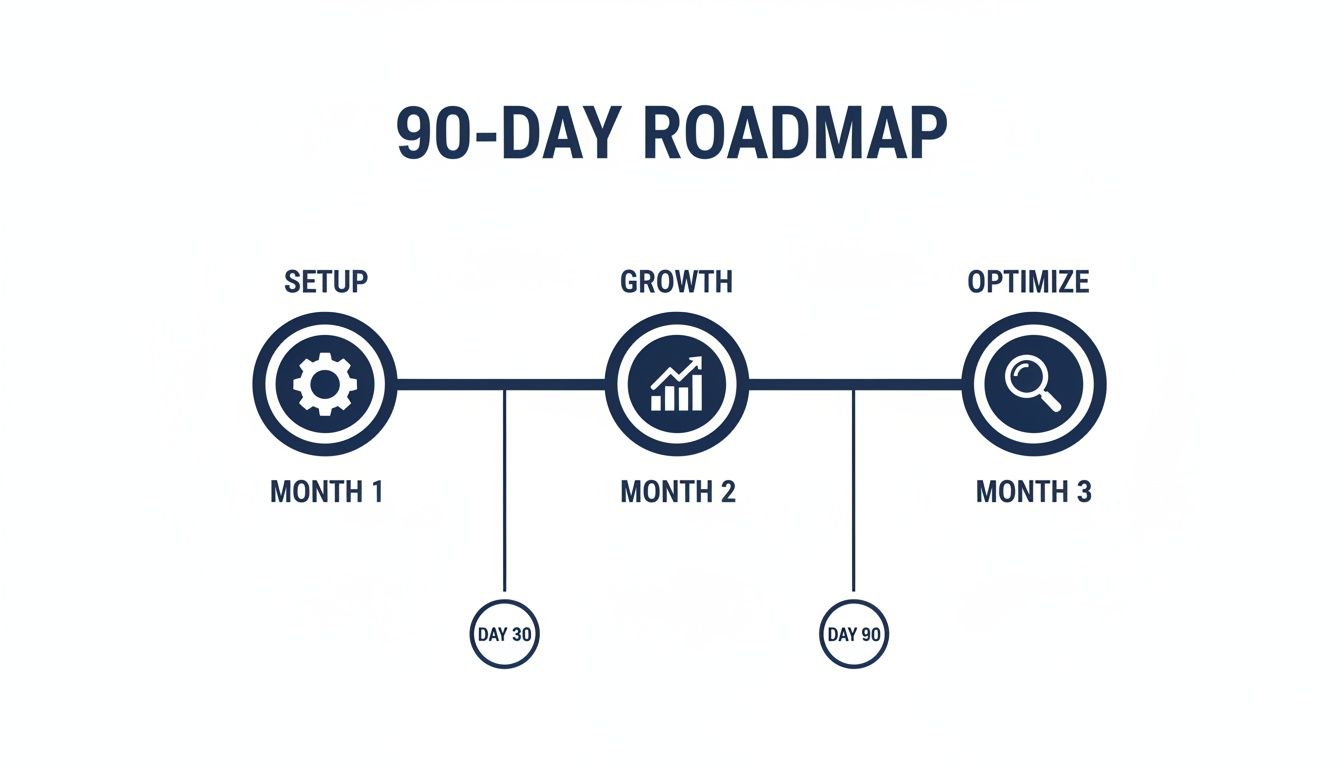
This approach ensures you're building on solid ground before trying to scale up and optimize.
How Long Until I See Real Results?
Patience is a virtue in B2B marketing, as sales cycles are longer. For foundational plays like SEO and content marketing, expect to see a significant, predictable flow of leads in 6-12 months. It's an investment that builds an asset that keeps paying you back for years.
That doesn't mean you have to wait a year to see traction. A well-designed plan should generate "quick wins" inside the first 90 days from a targeted PPC campaign or an email sequence to re-engage old leads. The best plans create immediate opportunities while building the foundation for long-term growth.
Ready to stop guessing and start engineering a predictable lead generation system? The team at Machine Marketing can build a B2B marketing plan that delivers measurable results. Book your discovery call today and get a clear roadmap for growth.