If your marketing feels like a random collection of tasks that aren't producing consistent leads, you’re not alone. We see this all the time—and the root cause is often a lack of a clear system. The problem isn’t how hard you're working; it's the absence of a blueprint for turning strangers into customers.
A marketing funnel is that blueprint. It’s an engineered system that maps a customer's journey with your business, from their first interaction to the final sale. In this guide, we’ll show you how to diagnose the gaps in your current approach and share the practical steps to build a predictable engine for growth.
Why Your Marketing Feels Random and How to Fix It
Does your marketing feel like a constant grind? Are you struggling to generate a steady flow of qualified leads? When we ask business owners this, the answer is almost always "yes."
Too many businesses treat marketing like a checklist of disconnected activities—a social media post here, an ad campaign there. This scattershot approach is impossible to measure, predict, or fix when it’s not working. The solution isn’t more activity; it’s a better system. That’s the entire idea behind a marketing funnel: transforming random actions into a predictable process.
A marketing funnel gives you a clear, structured path. It helps you understand exactly how customers find you, what they need from you at each step, and what it finally takes to earn their business. It turns guesswork into a repeatable science.
From Disconnected Actions to a Cohesive System
Imagine trying to build a car by just throwing parts into a pile. You might have the right components—engine, wheels, chassis—but without a blueprint telling you how they connect, you’ll never get a vehicle that runs. Your marketing funnel is that blueprint.
It gives you a framework to diagnose the real gaps in your process by forcing you to ask the right questions:
- Awareness: How do potential customers even discover we exist in the first place?
- Consideration: What information do they need to see us as a credible, trustworthy solution to their problem?
- Decision: When it comes down to it, what makes them choose us over a competitor?
Instead of just hoping for the best, you can build a system. For instance, a smart approach to Search Engine Optimization can consistently bring qualified people to the top of your funnel, creating a steady stream of prospects for you to nurture.
The Marketing Funnel at a Glance
This table breaks down the core stages and what you're trying to accomplish at each one. Think of it as your cheat sheet for understanding the customer's mindset.
| Funnel Stage | Primary Goal | Questions Your Audience Is Asking |
|---|---|---|
| Top of Funnel (TOFU) | Generate Awareness | "I have a problem, but I don't know the solution yet." |
| Middle of Funnel (MOFU) | Build Trust & Educate | "I'm researching options and comparing solutions." |
| Bottom of Funnel (BOFU) | Drive a Decision | "I'm ready to choose a provider and make a purchase." |
Seeing it laid out this way makes it clear: you can't talk to someone who's just discovering their problem the same way you'd talk to someone ready to sign a contract. Each stage requires a different conversation.
The Transformation You Can Expect
Adopting a funnel-based approach is about building a reliable, predictable system for generating revenue. You stop being reactive and start being proactive. For a manufacturer or a service business, this means you’re no longer at the mercy of word-of-mouth or an inconsistent lead flow that dries up without warning.
This guide will break down what a marketing funnel is from a practical, boots-on-the-ground perspective. We'll show you exactly how the system works, how to spot where your prospects are getting stuck, and the specific steps to plug the leaks. By implementing a clear funnel, you ensure every dollar and every hour you spend on marketing contributes directly to your bottom line.
If you're ready to build a more comprehensive strategy around this, our guide on how to build a marketing plan is a great place to start.
Diagnosing the Three Core Funnel Stages
A marketing funnel isn't just a concept; it's a journey you guide your customers through, stage by stage. To build one that actually works, you have to get inside the head of your customer at each phase. Treating it like a random series of activities is a surefire way to burn through your budget. But when you see it as a system, you create a predictable path to growth.
This visual captures the shift from a tangled, random approach to the clear, systematic one a funnel provides.
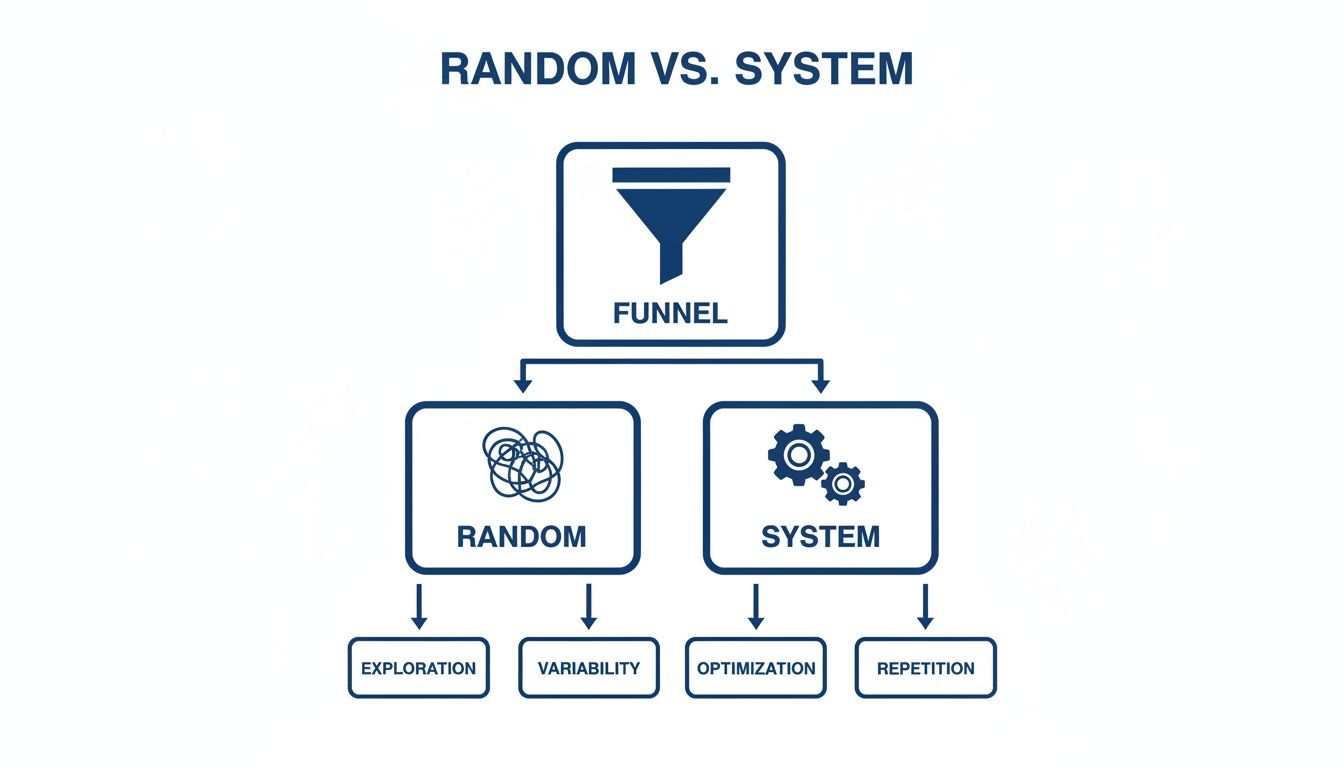
This mental shift is everything. It forces you to build a process with distinct steps, turning marketing chaos into a repeatable system. The three non-negotiable stages you need to master are the Top of Funnel (TOFU), Middle of Funnel (MOFU), and Bottom of Funnel (BOFU).
Top of Funnel (TOFU): Capturing Attention
Think of the Top of the Funnel as your first handshake. It's all about awareness. Your only job here is to grab the attention of your ideal audience—the people who have a problem you can solve but might not even know your company exists yet.
They’re asking broad, problem-focused questions. For a manufacturer, an engineer isn't searching for your specific product; they're Googling things like "ways to reduce CNC machine downtime." Your mission is to show up with genuinely helpful, educational content that answers that exact question, with no sales pitch in sight.
Actionable TOFU Tactics:
- Educational Blog Posts: Write articles that solve real industry problems.
- SEO-Optimized Content: Ensure your content ranks for the questions your audience is asking.
- Helpful Social Media Updates: Share useful tips on the platforms where your prospects actually spend their time.
The key metric here is relevant website traffic. Are more of the right people finding you? If not, your TOFU strategy needs a diagnosis.
Middle of Funnel (MOFU): Building Trust
Once you have their attention, people slide into the Middle of the Funnel. The goal now is to nurture their interest and build real trust. These people are solution-aware; they know options exist, and they're actively weighing them.
This is your chance to pivot from general education to demonstrating your specific expertise. You need to provide tangible value that shows how your solution works, turning casual browsers into serious prospects who view you as a credible authority.
The MOFU stage is where most leads go cold. Businesses either push for the sale too early or fail to provide the detailed proof prospects need to feel confident moving forward.
Actionable MOFU Tactics:
- Detailed Case Studies: Show, don't just tell. Prove the real-world results you've delivered for others.
- Webinars or Demos: Give them an in-depth, behind-the-scenes look at your product or service.
- Technical Whitepapers: Offer a deep dive for the technical buyers who need to see the specs and data.
Your primary KPI here is qualified lead generation. How many visitors are willing to trade their contact information for your high-value content? To really figure out what's working, you need a solid grip on what marketing analytics are and how to track engagement.
Bottom of Funnel (BOFU): Driving Action
Finally, at the Bottom of the Funnel, you’re dealing with qualified leads on the brink of a decision. The objective is simple: convert these leads into paying customers. Your messaging becomes direct, focusing on why your solution is the smartest choice they can make.
You have to make it incredibly easy for them to take that final step. We’re talking about crystal-clear pricing, one-click consultation booking, or a checkout process so simple it's effortless. This stage demands a sharp, compelling call to action.
The ultimate KPI here is your sales conversion rate. Of all the qualified leads you generated, how many actually became customers? This is the final scorecard for your entire funnel.
Putting the Marketing Funnel into Action
Theory is useful, but application is what drives results. Knowing the concepts is one thing, but the real transformation happens when you apply them to your business. Let’s build out two marketing funnels you can use as a blueprint—one for a B2B manufacturer and another for a local service business.

These examples will show you how to pick the right tactics for each stage—TOFU, MOFU, and BOFU—to walk a potential customer from "who are you?" to "here's my money."
Example Funnel For a B2B Machine Manufacturer
Let’s say you manufacture high-end CNC machines. Your customers are engineers and procurement managers making big, long-term decisions. Your funnel needs to build trust and deliver serious technical value.
Top of Funnel (TOFU) Goal: Attract Engineers
Your ideal customers aren't searching for your brand; they’re searching for answers to complex problems.- Tactics: You create a deep-dive technical whitepaper like "5 Ways to Improve CNC Machining Efficiency" and optimize it to rank for the exact terms those engineers are typing into Google.
- Transformation: An engineer hunting for a solution finds your genuinely helpful content. You’re now on their radar as a knowledgeable authority.
Middle of Funnel (MOFU) Goal: Nurture and Educate
They know you exist. Now you have to prove your machines are the right solution.- Tactics: Host a live webinar that shows your machine's unique features in action. Back it up with case studies proving how similar companies achieved a 20% reduction in production time.
- Transformation: Your prospect sees tangible proof. Their passive interest morphs into active consideration.
Bottom of Funnel (BOFU) Goal: Convert the Lead
The prospect is ready to make a move. Your job is to make it incredibly easy for them to say yes.- Tactics: Create a simple "Request a Customized Quote" landing page. When they fill it out, you follow up with a one-on-one consultation.
- Transformation: You’ve created a clear, low-friction path to purchase. That qualified lead becomes a new customer.
Example Funnel For a Local HVAC Contractor
Now, let's switch gears to a local HVAC contractor. The audience is homeowners in a specific area, and the game is all about being visible, trustworthy, and easy to book when disaster strikes.
- Top of Funnel (TOFU) Goal: Be Found Locally
When an AC unit dies in July, homeowners need help now. They grab their phone and search. You have to be right there.- Tactics: Optimize your Google Business Profile. Load it with services, real photos, and tons of positive reviews to dominate the local map pack.
- Transformation: A frantic homeowner with a broken AC finds your business first on Google Maps. You win the moment of need.
For a local service business, the TOFU stage is often won or lost on Google. Dominating local search is the single most effective way to fill the top of your funnel with immediate, high-intent leads.
Middle of Funnel (MOFU) Goal: Build Trust and Stay Top-of-Mind
Not everyone who finds you needs service today. Maybe their unit is just old. You need a way to stay relevant.- Tactics: Put a simple email newsletter sign-up on your website offering seasonal maintenance tips. No hard sell, just helpful advice.
- Transformation: You build a real relationship with homeowners, becoming their go-to expert before they even have a problem.
Bottom of Funnel (BOFU) Goal: Secure the Appointment
The customer is ready for service. Make booking so easy they can do it in 30 seconds.- Tactics: Send an automated SMS to your email list reminding them about a seasonal tune-up. Include a direct "Book Now" link that takes them straight to an online scheduling tool.
- Transformation: You just converted a nurtured lead into a scheduled, revenue-generating job.
How to Build and Automate Your Funnel
Building a funnel is the first critical step. Automating it is how you achieve real scale and consistency. A manual funnel is better than nothing, but an automated system is an asset that works for you 24/7. This is our engineering-minded guide to getting it done, so you can stop chasing leads and start building a system that nurtures them for you.
The marketing funnel isn't a new fad. The core concept has been around for over a century, originating with Elias St. Elmo Lewis's AIDA model (Attention, Interest, Desire, Action) in 1898. This framework is still incredibly vital today. You can find more insights on the marketing funnel's enduring relevance on V12Marketing.com.
Step 1: Map the Customer Journey
Before you automate anything, you have to define the path your ideal customer takes. What specific questions are they asking at each stage? What piece of content would give them the confidence to take the next step?
This isn't an abstract exercise. It's about mapping specific assets to each stage of your funnel:
- TOFU: What blog post, checklist, or social media update will first grab their attention?
- MOFU: What case study, webinar, or whitepaper will prove your expertise and build trust?
- BOFU: What consultation offer, demo page, or quote form will make it simple for them to buy?
Only when this journey is crystal clear on paper can you begin building it digitally.
Step 2: Implement with a CRM like GoHighLevel
A Customer Relationship Management (CRM) platform is the engine that brings your funnel to life. We use and recommend GoHighLevel because it rolls all the necessary tools into one system, but these principles apply to any solid CRM. Your goal is to translate your journey map into a series of automated actions.
An automated funnel doesn't just save you time—it ensures every single lead gets a consistent, high-quality experience. No one falls through the cracks, and every interaction is tracked and measured.
This is where you'll build out the core components of your system. For a deeper dive, you can explore more advanced concepts in our guide on effective marketing automation strategies.
Step 3: Build and Monitor the System
With your journey mapped and your CRM ready, it’s time to build the assets that will power your automated marketing funnel.
Here’s a practical checklist to guide your implementation:
- Build High-Converting Landing Pages: Create dedicated pages for your MOFU and BOFU offers. Keep them simple, focused on one clear call to action.
- Set Up Email and SMS Sequences: Write the messages that will fire automatically when leads take specific actions, like downloading a whitepaper. These sequences nurture them from the middle to the bottom of the funnel.
- Track Lead Sources: Use tracking parameters (like UTM codes) to know exactly where your leads are coming from. This is crucial for figuring out which TOFU channels are worth your time and money.
- Create a Performance Dashboard: Your CRM should give you a real-time view of your funnel's health. Keep a close eye on key metrics like traffic, lead conversion rates, and sales to spot bottlenecks.
Common Funnel Failures and How to Avoid Them
Building a marketing funnel is a huge step forward, but it’s not a "set it and forget it" solution. We’ve seen countless businesses build something that looks great on a whiteboard but fails to deliver results. The problem almost always boils down to a few common, avoidable mistakes. If you can spot these potential issues from the start, you can build a system that’s resilient and works from day one.
The hard truth is that most funnels have leaks. Data shows a typical sales funnel converts somewhere between 3% and 10% of its leads, a number that can highlight massive opportunities for improvement if you know where to look. Getting ahead of the most common funnel failures is key.
Misalignment Between Marketing and Sales
This is the big one. Marketing does its job, generates a promising lead, and passes it over… only for it to die on the vine. Either sales doesn't follow up quickly enough, or they enter the call blind, lacking the context to have a meaningful conversation. This disconnect creates a massive leak right when you're closest to the finish line.
Questions to Ask Yourself:
- Do our sales and marketing teams operate from the same playbook?
- Does our sales team know exactly what journey a lead took before the handoff?
- How quickly are we following up with qualified leads?
Failing to Nurture Your MOFU Leads
Another classic mistake is pushing for the sale too soon. A prospect who downloads a whitepaper (a classic MOFU action) is showing interest, not whipping out their credit card. Bombarding them with "buy now" messages at this stage is a guaranteed way to scare them off. Nurturing isn't about rushing the sale; it's about patiently building trust and proving your value over time.
Solutions to Common Pitfalls
Let's get practical. Here’s how you plug those leaks.
Problem: Dropped Leads at Handoff
- Solution: Put a Service Level Agreement (SLA) in place. This document defines exactly when and how marketing hands off leads to sales. Better yet, use your CRM to automate a notification the second a lead is qualified so sales can follow up in minutes, not days.
Problem: Ignoring the Middle Funnel
- Solution: Build an automated email or SMS nurture sequence that delivers value without asking for anything in return. Send them case studies, useful tips, or an invite to a webinar. Earn their trust before you ever ask for the sale.
Problem: Not Tracking the Right Metrics
- Solution: Stop obsessing over vanity metrics like website traffic. The only numbers that really matter are the conversion rates between each stage of your funnel. This data will shine a spotlight on exactly where your process is breaking down.
Your 90-Day Plan to a High-Performing Funnel
Theory is great, but execution is what gets results. Let's move from understanding the funnel to building one. This is your roadmap—a clear, actionable 90-day plan to get a working funnel up and running. The goal here is momentum, not perfection.
We’re going to tackle this in three 30-day sprints. Follow this plan, and by the end of this quarter, you’ll have a system in place that’s generating and converting leads.
Month 1: Diagnosis and Foundation (Days 1-30)
The first month is about laying a solid foundation. You can’t build a high-performing system on shaky ground, so we start by getting clear on who you're selling to and what tools you'll use.
- Audit Your Current Marketing: Where are leads coming from right now? What's actually working, and what's a waste of time? Be brutally honest.
- Define Your Ideal Customer: Get specific. What are their biggest headaches? What exact questions are they typing into Google at each stage of their buying journey?
- Set Up Your CRM: This is non-negotiable. Choose your tool—something like GoHighLevel is perfect for this—and get it configured. This is the engine that will power your entire funnel.
This initial diagnosis ensures the system you build is designed from day one to attract the right people and solve the right problems.
Month 2: Build Your Funnel Assets (Days 31-60)
With the foundation poured, it’s time to build the structure. This is where you create the content and web pages that will guide prospects from stranger to customer.
A funnel without content is just an empty diagram. The assets you build in this phase are what will actually do the work of educating, nurturing, and converting your leads.
- Create Your TOFU Content: Write the first few blog posts, film a short video, or create the social media content that will grab your ideal customer's attention.
- Develop a MOFU Nurture Sequence: Draft the email or SMS messages that will follow up, demonstrate your expertise, and show you understand their problem.
- Build Your BOFU Landing Pages: Keep it simple. Design clear, focused pages for your bottom-of-funnel offers, like a "Request a Quote" or "Book a Demo" page. No fluff, just a clear call to action.
Month 3: Launch and Iterate (Days 61-90)
The system is built. Now it's time to flip the switch and start collecting data. This final month is all about driving initial traffic and making smart adjustments based on what the numbers tell you. Your job isn't to get it perfect immediately; it's to launch a working version you can improve over time.
- Drive Initial Traffic: Start promoting your TOFU content. Push it out on social media or run a small ad campaign to start filling the top of your funnel.
- Monitor Your KPIs: Pay close attention to your conversion rates between each stage. Where are people dropping off? Is the lead magnet working? Are they opening the emails?
- Make Data-Driven Adjustments: Use what you learn to tweak your content, landing pages, and offers. The data will tell you exactly what needs to be fixed.
At Machine Marketing, we specialize in engineering predictable marketing systems for businesses ready to scale. If you're ready to move from random actions to a reliable growth engine, let's talk.
Book a discovery call with us. Let's diagnose your current system and build a better one together.