If your social media efforts feel like shouting into a void, you’re not alone. We see this all the time—the root cause is often hidden in plain sight. Activity doesn't equal achievement, especially when it comes to social media and lead generation. A system that actually works isn't about posting more; it’s about building a direct, measurable path from a prospect’s fleeting attention to their contact info landing squarely in your CRM.
In this guide, we’ll show you how to diagnose the gaps in your marketing system and share practical steps you can take today to start seeing real results.
Diagnosis: Why Is Your Lead Generation System Broken?
We see this problem constantly—B2B firms, particularly in manufacturing, are active on social media but have zero measurable leads to show for it. The root cause is almost always a broken system, not a lack of effort. Random posting without a clear conversion path is like building a machine with missing parts. It looks busy, but it simply won’t run.

To fix this, you must treat your marketing like an engineering problem. You need to identify the faulty components before you can build a solution that works. A great first step is understanding how to generate leads on social media that actually convert.
Where Most B2B Social Funnels Fail
The disconnect usually happens in one of three areas.
First, your content isn’t solving a real problem. Many businesses post company news or generic updates that don’t address a customer's specific pain point. That kind of content gets ignored because it offers no immediate value. It's just noise.
The second common failure is targeting the wrong audience. You might be creating brilliant content, but if it’s shown to people who can't buy from you, your resources are completely wasted.
Finally, and this is the most critical mistake, there’s no clear offer. A post that ends with "visit our website" is a dead end. You have to give prospects a compelling reason to take the next step and exchange their information for something valuable.
The Litmus Test: If a potential customer sees one of your social media posts, what is the single, specific action you want them to take next? What tangible value do they get for doing it? If you can't answer that instantly, your system is broken.
Start asking these questions to pinpoint the weaknesses in your own process:
- Who is my exact customer? Be specific. Not "manufacturing companies," but "Procurement managers in the aerospace industry."
- What problem does my content solve for them? Does it help them reduce downtime, improve quality control, or cut operational costs?
- What is my lead magnet? Do you have a downloadable guide, a spec sheet checklist, or a compelling case study ready to go right now?
- Is there a clear path from the post to the offer? Can someone get from your LinkedIn post to your lead magnet in two clicks or less?
Answering these honestly will shine a bright light on the gaps in your current approach.
Choosing The Right Platform For B2B Manufacturing
Trying to be everywhere at once is a classic recipe for burning through your marketing budget with nothing to show for it. For B2B manufacturers and technical firms, your resources are far too valuable for that kind of scattergun approach. The key to effective social media and lead generation is surgical focus.
For your industry, one platform consistently stands head and shoulders above the rest.
When we diagnose a client's marketing system, one of the first questions we ask is simple: "Where are your ideal buyers spending their time professionally?" Nine times out of ten, the answer is the same.
Why LinkedIn Dominates The B2B Space
Let's cut through the noise. When you need to reach engineers, procurement managers, and C-suite executives, LinkedIn is the undisputed powerhouse.
The data is overwhelming. Recent benchmarks show 89% of B2B marketers rely on it for lead generation. It’s the engine driving a staggering 80% of all social media leads in the B2B space.
One study found LinkedIn is 277% more effective for generating leads than Facebook or X (formerly Twitter). Think about that. For manufacturers who dedicate just six hours a week to the platform, 66% see new leads. You can find even more B2B lead generation statistics that reinforce just how critical this focus is.
This isn't about popularity; it's about business intent. People on LinkedIn are in a professional mindset. They are actively looking for solutions, networking with peers, and researching suppliers. That’s a fundamentally different environment than a platform built for sharing vacation photos.
To put it into perspective, here's how the major platforms stack up for a typical industrial company.
B2B Social Platform Effectiveness Comparison
For manufacturers, the choice of platform directly impacts lead quality. The table below breaks down the primary strengths and weaknesses of each major network in a B2B context.
| Platform | Primary B2B Audience | Key Strength for Lead Gen | Best Use Case for Manufacturers |
|---|---|---|---|
| C-Suite, Engineers, Procurement, Technical Buyers | Hyper-specific targeting by job title, industry, and company size. Professional user intent. | Building targeted lead lists, account-based marketing (ABM), sharing technical case studies, and establishing industry authority. | |
| Varies widely, less professional focus | Large user base, good for community building and brand awareness. | Showcasing company culture to attract talent, running brand awareness campaigns in specific geographic areas. Generally low ROI for direct lead gen. | |
| X (Twitter) | Tech, Media, and Niche Industry Professionals | Real-time industry news, event promotion, and quick engagement. | Monitoring industry trends, engaging with trade media, and sharing company news. Not ideal for deep, technical lead nurturing. |
| Younger demographic, visually-driven | Strong for visual branding and behind-the-scenes content. | Highlighting impressive machinery, showcasing company culture and employee spotlights, or demonstrating product aesthetics. Very limited for B2B lead gen. |
While other platforms have uses for brand awareness or recruitment, none come close to LinkedIn's power for directly engaging the decision-makers you need to reach.
A Real-World Scenario
Imagine a custom machine shop that needs to connect with project engineers at medical device companies. They could waste ad spend on Instagram or Facebook, targeting broad "manufacturing" interests, but that's a gamble. The audience is wrong, the context is unprofessional, and the leads will be low-quality, if any.
Now, let's apply an engineering mindset to this problem.
Using LinkedIn Sales Navigator, that same machine shop can build an incredibly precise list of ideal prospects. They can dial in their search by:
- Industry: Medical Device Manufacturing
- Job Title: Project Engineer, Mechanical Engineer, R&D Manager
- Company Size: 100-500 employees
- Geography: Within a 200-mile radius
This level of granular targeting is impossible on other platforms. The shop can now create content that speaks directly to the challenges these engineers face—like material selection for prototypes or achieving tight tolerances. They can share relevant case studies, join industry groups, and build genuine connections that lead to real conversations.
The Transformation: By choosing the right platform, the machine shop moves from hopeful, broad-based advertising to a targeted, predictable system for finding and engaging ideal buyers. This aligns their limited resources directly with the platform where their customers are actively looking for solutions. It’s the difference between shouting into a crowd and having a direct conversation with the right person.
Creating Offers Your Prospects Actually Want
Getting the right audience on the right platform is just the start. Your content needs to do more than inform—it has to compel your ideal B2B buyers to take a specific, measurable action. This is where we shift from broad strategy to tactical execution.
The goal is to build valuable, problem-solving assets that do the heavy lifting for your sales team, turning passive social media scrollers into qualified leads inside your CRM.
Match Your Offer to the Buyer’s Journey
Let's be transparent: not all your prospects are in the same headspace. Some are just realizing they have a problem, while others are deep in the weeds comparing solutions. A smart social media and lead generation system meets them exactly where they are.
Think of it in three simple stages:
- Problem-Aware Content: This is for the folks who feel the pain but can't quite name the problem. Your job is to diagnose it for them and prove you understand their world.
- Solution-Focused Content: Now you're talking to people actively hunting for a fix. This is where you provide the practical, technical details they need to weigh their options.
- Decision-Stage Content: These are the prospects on the verge of a purchase. Your content needs to make it incredibly easy for them to raise their hand and talk to your sales team.
By creating distinct offers for each stage, you build a funnel that works for everyone, no matter how far along they are in their buying process.
High-Value Lead Magnets For a Technical Audience
Forget the fluffy ebooks. When you're talking to engineers, plant managers, or technical buyers, they crave utility and specifics. Your lead magnets have to deliver real, tangible value that helps them do their job better. Period.
Here are a few concrete examples of offers that work for each stage:
1. For the Problem-Aware Prospect
At this point, your goal is to build trust and show you understand their challenges.
- Example Offer: A detailed case study titled, "How a Midwest Aerospace Manufacturer Reduced CNC Downtime by 18%."
- Why It Works: It hits on a common, expensive problem and immediately shows a real-world solution. This isn't theory; it's proof that you get results, which builds instant credibility.
2. For the Solution-Focused Prospect
Here, you want to become their go-to resource.
- Example Offer: A downloadable library of CAD files for standard components or a comprehensive "Guide to Selecting the Right Industrial Lubricant."
- Why It Works: This is pure utility. You’re giving them a practical tool or critical information that saves them time and makes their job easier. Spec sheets and detailed comparison charts are gold here.
3. For the Decision-Stage Prospect
The goal now is simple: remove all friction and start a conversation.
- Example Offer: A "Free 30-Minute Project Consultation" or a personalized demo video of your equipment running a part similar to theirs.
- Why It Works: It's a direct, low-risk way for them to get specific questions answered by an expert. You're moving them from passively considering to actively engaging.
The Key Insight: The best lead magnets feel less like marketing and more like a genuine service. You're solving a small problem for free to earn the trust to solve their much bigger problems down the road. These assets are the real engine of your social media lead generation system.
Building Your Social Media to CRM Funnel
You've crafted high-value offers. Now it's time to connect the dots and turn your social media activity into a predictable sales pipeline. This is where we move beyond just posting content and start building a real system.
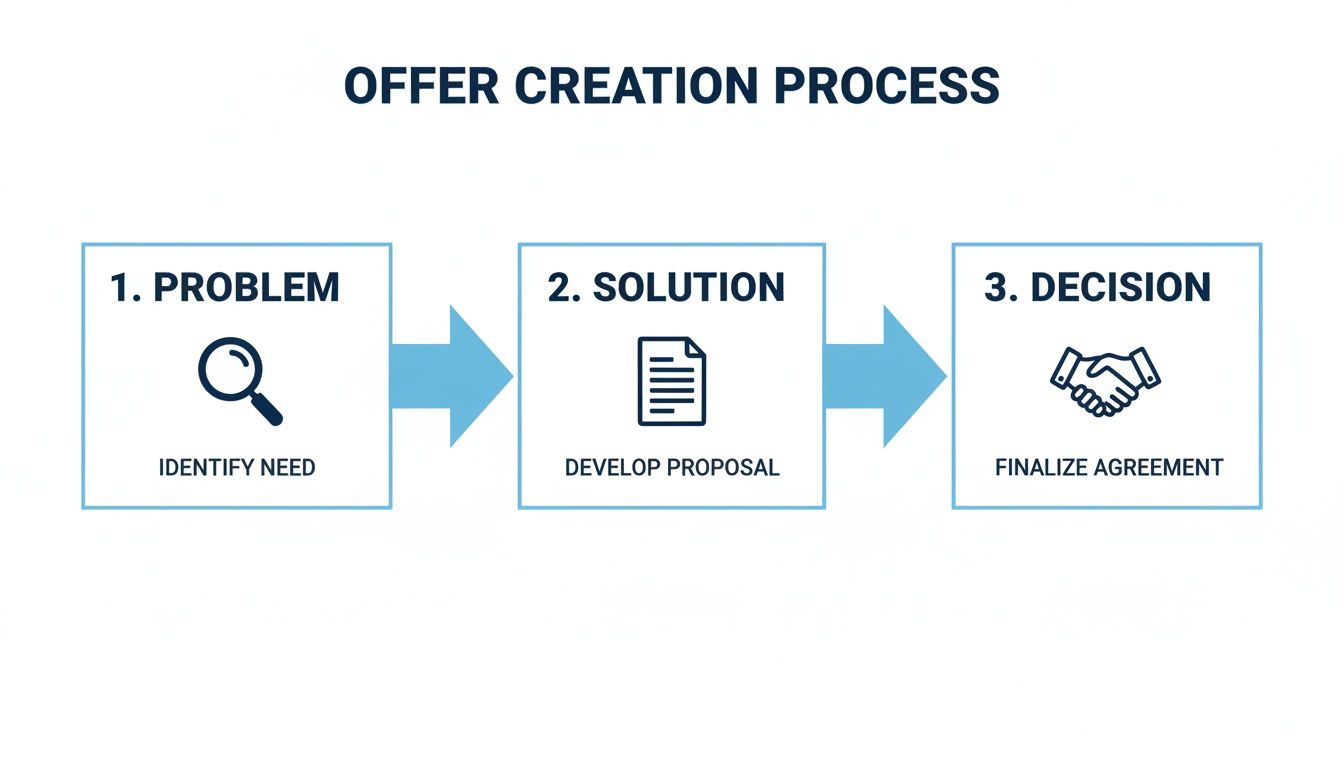
The flow is simple but powerful. A social media post promotes your lead magnet, a user clicks through to a dedicated landing page, and they fill out a form to get it. You've just created a smooth, direct path from a LinkedIn post to a new, qualified contact sitting in your CRM.
This process hinges on a core principle: every great offer starts by identifying a prospect's problem, presenting your solution, and making their decision to engage with you feel like the most logical next step.
Designing The Capture Mechanism
Your landing page and form are the most critical pieces in this system. We’ve seen amazing offers fall flat because of a confusing landing page or a form that asks for too much information. Your goal here is a seamless, intuitive experience.
We build all of these assets for our clients inside GoHighLevel because it keeps everything under one roof—the landing pages, forms, email automations, and the CRM itself. This saves the technical headaches of trying to stitch together different tools. You can get a deeper look into our methods by checking out our complete guide to social media for lead generation.
Optimizing Your Landing Page and Form
To get the most out of your traffic, your landing page needs to do one job perfectly: sell the value of your lead magnet.
Here are a few tips we’ve learned after building hundreds of these pages:
- Mirror Your Ad Copy: The headline on your landing page must match the language in the social post that got them there. Consistency tells the visitor they're in the right place.
- Focus on Benefits, Not Features: Don't just tell them what the guide is. Tell them what it will help them achieve. Instead of "A 10-page guide," try "Learn how to slash operational costs by 15%."
- Keep It Simple: Use a clean layout with a single, clear call to action (CTA). Remove everything else—website navigation, links to other pages, any distraction that could pull them away.
Your form is just as important. The golden rule is to ask for the absolute minimum information you need. For a top-of-funnel offer like a guide, a name and an email address are usually enough.
Our Test-and-Learn Approach: We once tested a form for a manufacturing client that asked for a name, email, company, and phone number. The conversion rate was around 12%. We removed just one field—the phone number—and the conversion rate shot up to 28%. That simple change more than doubled their lead flow.
Always ask yourself if every single field on your form is essential. Each one adds friction and gives a potential lead another reason to walk away. Keep it lean, and you'll turn your social media presence into a machine for generating new business.
Automating Your Lead Nurturing In GoHighLevel
Getting a new lead is the starting point, not the finish line. We’ve seen it happen time and again: a perfectly good lead from social media goes cold because no one followed up quickly enough. That initial spark of interest has a short shelf life.
This is where automation becomes your most valuable player. By setting up automated nurturing sequences in a platform like GoHighLevel, you can engage new leads the moment they show interest. This system ensures every prospect gets a consistent, high-quality experience, freeing up your team from manual, repetitive follow-ups.
Building Your First Automated Workflow
The goal here isn't just to send emails. It's to guide a prospect from a simple download to a real, sales-ready conversation. You're delivering a carefully planned sequence of value that educates them and builds trust in your expertise. To dial this in, it helps to master some advanced automated social media posting strategies so your top-of-funnel is always full.
Here is a practical workflow you can build today inside GoHighLevel:
- The Trigger: It all starts when a prospect fills out the form on your landing page to download your "Guide to Reducing CNC Downtime." That single action kicks off the entire sequence.
- Instant Delivery (Email #1): Within seconds, an automated email hits their inbox. It should be simple: thank them for their interest and provide a direct link to the guide. This immediate delivery is crucial for building trust.
- The Value-Add (Email #2): Three days later, another email goes out. This one doesn't sell anything. Instead, it offers a quick, related tip, like "3 Common Mistakes in CNC Maintenance." You're reinforcing your expertise.
- The Proof (Email #3): A week after the initial download, you send a short email sharing a relevant case study. Something like, "See how [Client Name] cut their downtime by 18%." This provides social proof and shows you get real-world results.
- The Ask (Email #4): Finally, about 10-14 days after the download, you send an email inviting them to a low-commitment next step. Think a "15-minute diagnostic call" to discuss their specific operational challenges, not a hard sales pitch.
This simple four-email sequence transforms a cold contact into an educated, warmed-up prospect who understands the value you provide.
The System’s Impact: An automated sequence ensures no lead is ever forgotten. Your sales team stops wasting time chasing cold contacts and starts engaging only with prospects who have been educated on your value and have shown sustained interest.
Adding SMS For Timely Follow-Ups
Email is powerful, but for certain actions, an SMS can cut right through the noise.
Imagine a prospect books that 15-minute diagnostic call. Inside GoHighLevel, you can automate an SMS reminder 24 hours before the call and another one hour before. This simple touchpoint dramatically reduces no-show rates and keeps your conversation top of mind.
By implementing these automated systems, you connect your social media efforts directly to your sales pipeline. You'll not only see a jump in social media and lead generation but also a significant improvement in your sales team's efficiency and close rates. For a deeper dive, explore our insights on marketing automation for manufacturing.
How To Measure And Optimize Your Campaigns
You can't improve what you don't measure. Launching a social media lead generation system is just the beginning; the real growth comes from tracking performance and making data-driven adjustments. This is how you turn a good system into a highly profitable one.
The key is to stop chasing vanity metrics. Likes, shares, and follower counts feel good, but they don't pay the bills. Instead, we need to diagnose your campaign's health using metrics that tie directly back to business growth.
The KPIs That Actually Matter
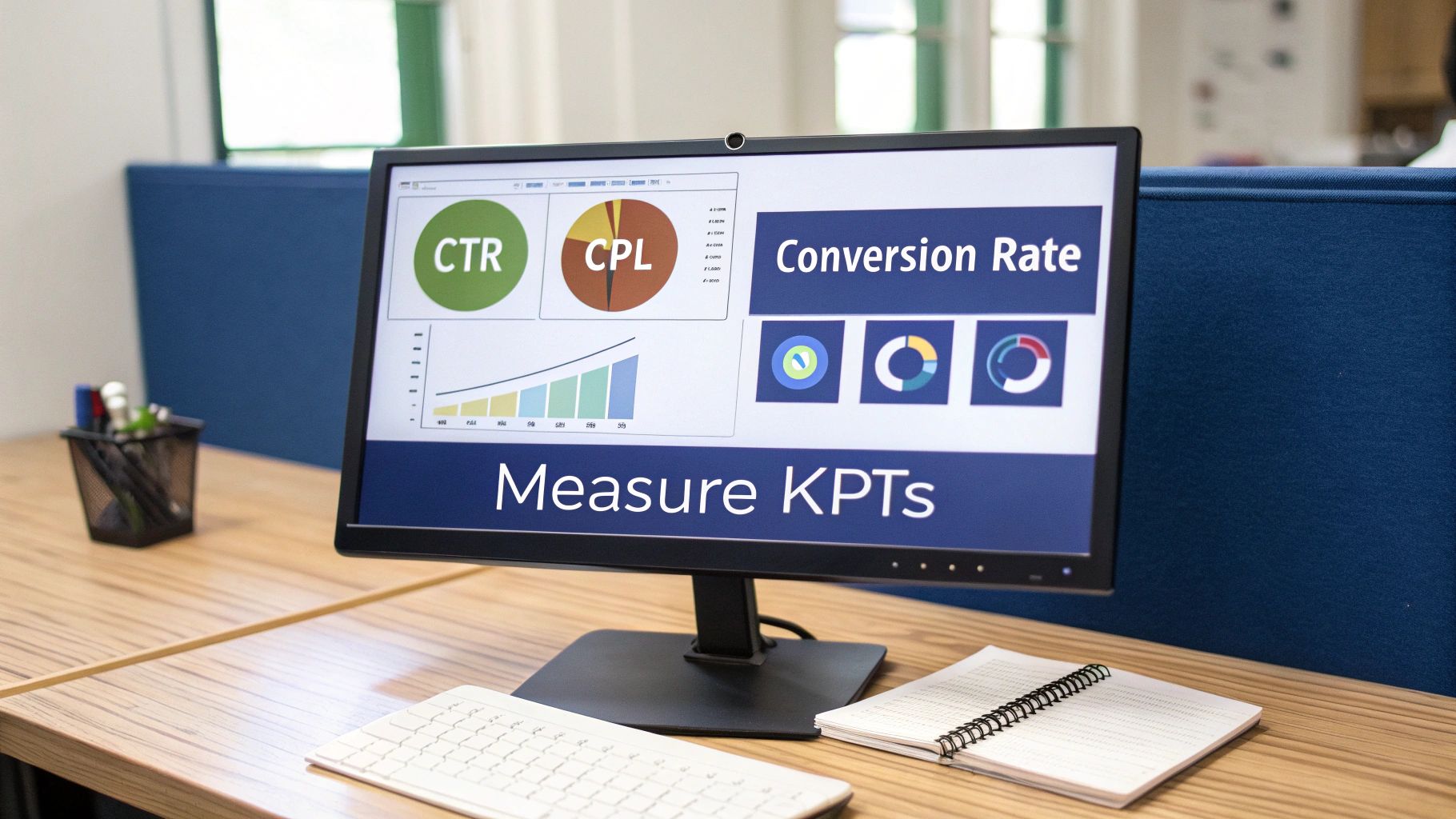
Inside a tool like GoHighLevel, you can build dashboards to monitor the vital signs of your campaigns. We recommend focusing on a handful of key performance indicators (KPIs) that tell a clear story about your return on investment.
These core metrics provide a complete picture of your funnel's efficiency from the initial click to the final sale.
- Lead Conversion Rate: This is the big one. It's the percentage of people who click your link and then actually fill out the form. A low rate here is the first red flag that there's a disconnect between your ad and your offer.
- Cost Per Lead (CPL): Simple but crucial. How much are you spending to acquire one new lead? Calculated by dividing your total ad spend by the number of leads, your CPL tells you if your efforts are financially sustainable.
- Customer Acquisition Cost (CAC): This takes it a step further. CAC measures the total cost to acquire a paying customer, not just a lead. This is the ultimate metric for proving the profitability of your social media and lead generation system.
Diagnosing and Solving Campaign Problems
Data is only useful when you use it to ask the right questions. When you see a problem in your metrics, it's time to put on your engineering hat and diagnose the root cause.
Let’s walk through a common scenario. Imagine your new LinkedIn campaign for a downloadable CAD library has a fantastic click-through rate (CTR), but the Lead Conversion Rate is shockingly low. People are interested enough to click, but they aren't converting.
The Diagnostic Question: Where is the friction point between the click and the form submission?
This single question lets you systematically investigate potential failures:
- Is it the landing page? Does the headline mirror the social post's promise? Is the copy focused on benefits, not just features? Is there a single, clear call to action, or are you confusing people with multiple options?
- Is it the offer itself? The moment the page loads, is the value proposition crystal clear? Have you built enough trust to convince someone to hand over their contact information?
- Is it the form? This is a notorious conversion killer. Are you asking for too much information upfront? Try removing non-essential fields like a phone number and watch your conversion rate climb.
By isolating each variable and testing changes one at a time, you can methodically improve performance. This iterative process of measuring, diagnosing, and optimizing is what ensures your system becomes more efficient and profitable over time.
Answering Your Questions
When we talk about building a full-blown lead generation system, a few questions always come up. Here are the honest, direct answers we give business owners who are wondering if this is the right move for them.
How Long Until I See Real Results?
This is the big one, and the honest answer is: it depends, but there's a pattern. For clients who commit to the system—creating the right offers, publishing consistently, and letting automations work—they usually start seeing qualified, sales-ready leads within 60 to 90 days.
Real momentum comes from methodical, day-in-day-out execution. You're building an asset, and like any valuable asset, it takes a little time to construct before it starts paying dividends. This isn't about one viral post.
Do I Need a Massive Budget for This?
Absolutely not. That’s the whole point. This system is built around the power of smart organic content and efficient automation, which makes it incredibly cost-effective.
You can always accelerate results with paid ads on a platform like LinkedIn, but the core engine works just fine with a minimal budget. Your biggest investments will be your time and an all-in-one platform like GoHighLevel to run the machine smoothly.
A well-engineered system beats a big budget every single time. It's about precision and consistency, not just raw spending power. The goal here is to create a predictable lead source, freeing you from being totally reliant on expensive, temporary ad campaigns.
Will This System Actually Work for Niche Manufacturing?
Yes. In fact, it often works better in highly specialized industries like manufacturing.
Niche manufacturers serve very specific audiences who have very specific problems. That clarity is a huge advantage. It makes creating hyper-targeted lead magnets that resonate much easier. When you know exactly who your ideal customer is—down to their job title and daily challenges—finding them on a platform like LinkedIn becomes a straightforward task.
This approach flips the script, turning your niche from what feels like a limitation into your greatest strength for effective social media and lead generation.
Ready to stop chasing leads and start building a predictable system that brings them to you? At Machine Marketing, we specialize in diagnosing broken marketing funnels and engineering powerful, automated systems for manufacturers.
Book a discovery call with Karl, and let's diagnose your current system and map out a clear path to sustainable growth.