If you're a business owner, you track revenue and material costs down to the penny. But could you, right now, state exactly what each new lead costs your business?
For many, the answer is "no," and that's a massive blind spot in your marketing system. The first step to fixing a problem is diagnosing it correctly, and understanding your Cost of a Lead (CPL) is the most powerful diagnostic tool you have.
The cost of a lead (CPL) is simply the total amount you spend on a marketing campaign divided by the number of new potential customers it brings in. If you spend $1,000 on a Google Ads campaign that generates 50 leads, your CPL is $20.
Knowing this number isn't just an academic exercise—it's the first step in transforming your marketing from an unpredictable expense into a reliable growth engine.

What Is Cost Of A Lead And Why Does It Matter?
Without knowing your CPL, you're guessing where your marketing dollars should go. It turns your marketing spend from a mysterious expense into a predictable, manageable investment. Once you know your CPL, you can start answering the questions that actually drive growth.
Let's break down the essential concepts.
Quick Guide To Cost Per Lead Essentials
This table summarizes the core ideas behind calculating and using your CPL. Think of it as your cheat sheet for turning marketing data into actionable business intelligence.
| Concept | Quick Explanation | Why It Matters For You |
|---|---|---|
| CPL Definition | The total cost of a marketing campaign divided by the number of leads generated. | It's the most direct measure of how efficiently your marketing dollars are attracting potential customers. |
| Cost Components | Includes ad spend, agency fees, software costs, and even the time your team invests. | A comprehensive view prevents you from underestimating your true costs and making bad budget decisions. |
| Lead Definition | A potential customer who has shown interest (e.g., filled out a form, made a phone call). | You must have a clear, consistent definition of a "lead" to calculate CPL accurately across all channels. |
| Channel Benchmarking | Comparing the CPL of different marketing channels (e.g., SEO vs. Paid Ads vs. Trade Shows). | This tells you where your money is working hardest, so you can double down on what's effective and cut what's not. |
Understanding these basics is what allows you to move from simply spending money on marketing to strategically investing it for a predictable return.
The Diagnostic Power Of CPL
Calculating your CPL gives you immediate, unfiltered clarity on your marketing performance. It's the key that unlocks your ability to:
- Benchmark Your Channels: Is LinkedIn giving you leads for $50 while trade shows are costing you $500 per lead? CPL cuts through the noise and reveals the true efficiency of each channel.
- Forecast Your Budget: If you know you need 50 new leads next quarter and your average CPL is $100, you can confidently budget exactly $5,000 to hit your goal. No more guesswork.
- Optimize Your Spending: A rising CPL is an early warning sign. It tells you an ad campaign might be losing steam or that your messaging is off-target, giving you a chance to make adjustments before you waste more money.
- Justify Marketing Investment: CPL provides the hard data you need to show the direct link between marketing spend and lead generation. This is crucial when you need to measure your marketing ROI.
In short, CPL is the foundational metric for building a marketing system that is accountable, scalable, and built for profitable growth. It moves you from "we think this is working" to "we know this is working."
Ultimately, the goal isn't just to calculate this number but to understand it. To truly grasp what you're investing, you need to explore what is a good cost of a lead for your specific industry and how different factors can push it up or down. This knowledge is what empowers you to stop funding ineffective tactics and start doubling down on what truly delivers results.
How To Accurately Calculate Your Cost Per Lead
Figuring out your Cost Per Lead (CPL) is the first real step toward controlling it. This isn’t some abstract number; it's a critical health check for your entire marketing system. When you get a real number—not just a gut feeling—you can start diagnosing what’s working, what isn't, and build a predictable engine for growth.
The universal CPL formula is refreshingly simple:
CPL = Total Marketing Spend / Total New Leads
But don't let that simplicity fool you. The accuracy of your final number hinges entirely on how you define those two variables. Let's break down each component so you can calculate a CPL that actually reflects reality.
Defining Your Total Marketing Spend
What really goes into your "Total Marketing Spend"? For a true diagnosis, you have to account for every single dollar it took to generate those leads. A common mistake is only counting direct ad spend, which gives you a dangerously incomplete picture.
To do this right, you need to be comprehensive. Pick a time frame—like a month or a quarter—and start gathering the numbers for everything involved:
- Direct Ad Spend: This one’s the most obvious. It’s the cash you pay directly to platforms like Google, LinkedIn, or Facebook for your campaigns.
- Agency or Freelancer Fees: If you’re working with a marketing partner (like us), their retainer or project fees are a direct cost of your lead generation efforts.
- Marketing Software Subscriptions: Don't forget the tools that make it all happen. This includes your CRM, email platforms like Mailchimp, and SEO tools like Ahrefs.
- Content Creation Costs: Did you pay a writer for those blog posts or a designer for that new ebook? Those expenses are part of the system that attracts leads. They count.
- Team Salaries: This is the one most people miss, but it's critical. You need to factor in the portion of your marketing team’s salaries dedicated to the specific campaign or channel you're measuring.
Defining a True "New Lead"
Just as important as adding up your costs is deciding what you actually count as a lead. If your definition is fuzzy or inconsistent, your data will be contaminated, and your CPL calculation will be meaningless. You and your sales team need to be on the exact same page here.
A new lead is someone who has shown genuine interest in your company by taking a specific action. This could be:
- Submitting a "Contact Us" or "Request a Quote" form.
- Downloading a gated resource like a whitepaper or case study.
- Making a direct phone call to your sales line that you can track.
- Signing up for a product demo or a webinar.
The key here is to only count new, unique contacts. Don't pad your numbers with existing customers, obvious spam submissions, or duplicates. Clean data is the bedrock of an accurate CPL.
A Practical CPL Calculation Example
Let's walk through a real-world scenario. Imagine a B2B manufacturer running a Google Ads campaign for one month.
Here are their costs (Total Marketing Spend):
- Google Ads Spend: $3,000
- Agency Management Fee: $1,500
- Landing Page Software (Unbounce): $100
- Total Spend = $4,600
During that month, their campaign generated 46 form submissions for a technical spec sheet. Each of these is a unique, new contact, so Total New Leads = 46.
Now, we just plug those numbers into the formula:
$4,600 (Total Spend) / 46 (New Leads) = $100 CPL
Just like that, the business owner has a clear, actionable benchmark. They now know it costs them exactly $100 to get one potential customer through this channel. While focusing on your Cost Per Lead (CPL), it's also beneficial to understand the broader metric of Customer Acquisition Cost (CAC). You can explore a comprehensive guide and Customer Acquisition Cost Calculator to see how these metrics work together. This clarity is the starting point for every strategic decision that follows.
Benchmarking Your CPL In B2B And Manufacturing
So you've calculated your Cost Per Lead (CPL). The first question that always pops up is, "Is this number any good?" The honest answer? A CPL without context is just a number. A $50 CPL might be a massive win for a company selling complex industrial machinery, but a complete disaster for another selling commodity components.
This is where benchmarking comes in. It’s not about judging your business against others; it’s a diagnostic tool you use to get a realistic read on your own performance. Generic, all-industry averages can be dangerously misleading for B2B and manufacturing companies, which have different sales cycles and customer values.
The simple flow below shows how your marketing spend and the number of leads you get directly determine your CPL—the very metric we need to benchmark.
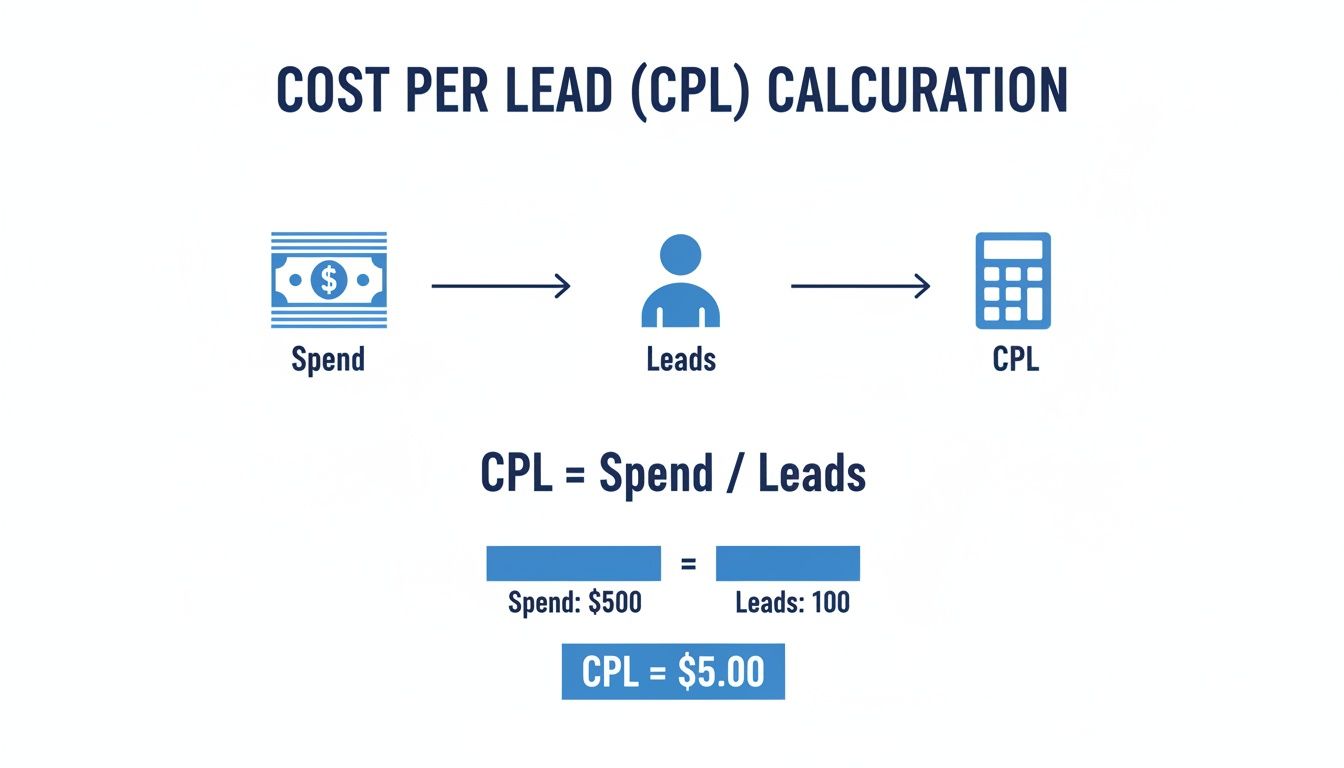
This process makes it clear: your CPL is a direct result of your investment and how efficiently you're using it. That makes it the perfect place to start analyzing performance.
Why Industry Averages Are A Starting Point, Not An Answer
So, what are other businesses paying? The cost per lead in B2B markets can vary wildly. Recent data shows an all-industry average hitting $391.80 across both paid and organic channels. Zeroing in on B2B SaaS—a key segment for many tech-focused businesses—the average CPL is around $237. That breaks down to about $310 for paid channels and $164 for organic.
For manufacturers and B2B service providers, it's not unusual to pay $200–$700 for a single, qualified sales-ready lead (SQL). Marketing-qualified leads (MQLs) can range from $150–$400.
These numbers give you a rough map, but you need to find your exact location on it. A custom machine builder with a six-month sales cycle and a $500,000 average deal isn't just expecting a higher CPL—they should embrace it. A high CPL in that context isn't a red flag; it’s a sign of a healthy, targeted strategy.
Factors That Influence B2B And Manufacturing CPL
Your CPL isn't a static number. It's a dynamic metric influenced by several key factors. To really understand your performance, you have to consider these variables.
Here are the critical elements that directly impact what you should expect to pay for a lead:
- Sales Cycle Length: The longer it takes to close a deal, the more marketing touchpoints are needed. That naturally drives up the investment required to nurture a prospect into a qualified lead, pushing your CPL higher.
- Customer Lifetime Value (LTV): If a single customer is worth tens or even hundreds of thousands of dollars, it only makes sense to invest more to acquire them. A $1,000 CPL might seem outrageous until you realize it’s for a customer with an LTV of $250,000.
- Market Competition: Are you one of three companies in your niche, or one of three hundred? Intense competition on platforms like Google Ads means more bidders fighting for the same keywords, which directly drives up your CPL.
- Target Audience Specificity: Reaching a very specific role—like a procurement manager at a Tier 1 automotive supplier—requires precise (and often more expensive) targeting than broadcasting to a general audience. The more niche your ideal customer is, the higher your CPL will likely be.
Think of your CPL not as a pass/fail grade but as a vital sign. It tells a story about your market position, the value of your customers, and the intensity of your competition. Your goal isn't just to lower it—it's to understand it.
When you look at your CPL through this lens, you shift from simple comparison to a confident diagnosis of your marketing system's health. For those focused specifically on industrial sectors, it’s also helpful to dig into proven strategies for lead generation for manufacturers to see how these benchmarks apply in the real world.
Why Lead Quality Matters More Than Lead Cost
Chasing the lowest possible cost of a lead is one of the most common—and costly—traps in marketing. It feels good to watch that CPL number drop, but a cheap lead that never converts isn't a bargain. It's a resource drain that burns your marketing budget and, even worse, your sales team's valuable time.
The whole conversation needs to shift from cost to value. We have to think like engineers and diagnose the entire system, not just obsess over one isolated metric.
Think of your CPL as the price of a raw ingredient. Your Cost Per Acquisition (CPA)—the real cost to land a paying customer—is the price of the finished product. You wouldn't buy low-grade materials just because they're cheap if it ruins the final product, right? The exact same logic applies to your leads.
Differentiating MQLs From SQLs
To get this right, you absolutely have to distinguish between two critical types of leads. This distinction is the bedrock of a healthy sales pipeline and a predictable growth engine.
- Marketing Qualified Lead (MQL): This is someone who has shown initial interest but isn't necessarily ready to buy. Maybe they downloaded a whitepaper or subscribed to your newsletter. They're curious, but they're still in the research phase.
- Sales Qualified Lead (SQL): This is someone who's been properly vetted and is showing clear signs of buyer intent. They've requested a quote, asked for a demo, or have a specific project they need to solve now. They are ready for a real conversation with your sales team.
MQLs are an important part of the funnel, but SQLs are what drive immediate revenue. Confusing the two is a recipe for an inefficient sales process and a deeply frustrated team. You can learn more about how to systematically separate these prospects by reading our guide on how to qualify sales leads.
The Real-World Impact on Your Bottom Line
Let's break this down with a clear, side-by-side comparison. Imagine you run two different campaigns, each with a $1,000 budget.
Campaign A: The "Low CPL" Approach
- Goal: Generate as many leads as possible for the lowest cost.
- Result: You get 100 MQLs.
- CPL: $1,000 / 100 leads = $10 per lead.
- Sales Process: Your team spends hours calling all 100 leads. Most aren't ready to buy, and only 2% eventually become customers.
- Final Outcome: 2 new customers.
Campaign B: The "High-Quality" Approach
- Goal: Generate leads who have demonstrated clear buying intent.
- Result: You get 20 SQLs.
- CPL: $1,000 / 20 leads = $50 per lead.
- Sales Process: Your team follows up with 20 highly interested prospects. The conversations are productive, and 25% become customers.
- Final Outcome: 5 new customers.
Now, let's look at the number that really matters—the Cost Per Acquisition (CPA).
Campaign A CPA: $1,000 / 2 Customers = $500 per customer.
Campaign B CPA: $1,000 / 5 Customers = $200 per customer.
This is the whole game. Campaign B, with a CPL that was five times higher, delivered more than double the customers at less than half the final acquisition cost. This isn't just a better result; it's a fundamentally more efficient and scalable system for growth. It proves that focusing on the quality of your leads is what actually builds a profitable business.
Actionable Strategies To Lower Your CPL
Alright, you've diagnosed the problem by understanding and benchmarking your CPL. Now, let's talk about the solution.
Bringing down your cost of a lead isn't about some secret marketing hack. It’s about methodically tuning up your marketing engine. A small improvement in a few key areas can lead to a big drop in your final CPL—all without sacrificing the quality of the leads you're bringing in.
This section provides a step-by-step framework you can start using today.
Optimize Your Landing Pages for Conversion
Think of your landing page as the final handshake. It's the moment a visitor decides whether to become a lead. Even the world's greatest ad campaign will fall flat if the destination page is slow, confusing, or unconvincing. Improving your conversion rate here is the fastest way to slash your CPL because you get more leads from the exact same ad spend.
Start by running a quick diagnostic on your landing pages:
- Is the headline crystal clear? Does it perfectly match the ad they just clicked? The visitor needs instant confirmation they're in the right place.
- Is the form too long? Every single field you add creates friction. Only ask for the absolute bare minimum you need to qualify someone.
- Is the Call-to-Action (CTA) obvious? Use a button with a contrasting color and punchy, action-oriented text like "Get My Quote" instead of a passive "Submit."
A simple A/B test—pitting one version of a page against another with a single change—can show you exactly which headline or form length gets you more leads. It gives you a data-driven path to a lower CPL.
Refine Your Ad Targeting and Audience
Paying to show your ads to people who will never buy from you is like setting up a booth at the wrong trade show. It’s a guaranteed way to inflate your cost of a lead. The more precisely you can define and reach your Ideal Customer Profile (ICP), the more efficient every dollar you spend becomes.
If you’re running paid ads on platforms like LinkedIn or Google, you need to go deep into the targeting options. Don't just target an entire industry; get granular.
For instance, instead of just targeting "Manufacturing," drill down to an audience like this:
- Job Titles: "Plant Manager," "Operations Director," "Procurement Specialist."
- Company Size: "50-200 employees."
- Geographic Location: Zero in on specific industrial parks or service regions.
This level of precision ensures your budget is spent reaching actual decision-makers, which immediately improves the quality of your clicks and the return on your investment.
A well-targeted campaign brings in fewer, better leads. This might slightly increase your cost-per-click, but it drastically reduces your cost per qualified lead, which is the metric that truly matters.
Nurture Leads With Simple Automation
Not every lead is ready to buy the second they fill out a form. A prospect who downloads a whitepaper is clearly interested, but they probably need a little more info before they're ready for a sales call. This is where lead nurturing is a game-changer.
Instead of throwing every new MQL straight to your sales team, set up a simple automated email sequence. This system works for you 24/7, warming up prospects and gauging their actual interest.
A basic nurturing sequence could look like this:
- Email 1 (Immediate): Delivers the whitepaper or guide they requested.
- Email 2 (2 Days Later): Shares a relevant case study showing how a similar company solved a problem.
- Email 3 (4 Days Later): Invites them to a short webinar or offers a "10-Point Checklist" for their next project.
If a lead engages with these follow-ups—by clicking the case study or signing up for the webinar—that's a huge buying signal. At that point, they become a much warmer, more qualified SQL for your sales team. This process filters out the tire-kickers and frees up your sales reps to focus on deals that can actually close.
Build a Long-Term CPL Advantage With SEO
Paid advertising gets you leads now, but you have to pay for every single one. Search Engine Optimization (SEO) and content marketing work differently. They're about building an asset.
When you create genuinely helpful content that answers your customers' biggest questions—through blog posts, guides, or technical articles—you start attracting organic traffic from search engines.
Sure, there’s an upfront investment to create the content. But a single great article can generate high-quality leads for months, or even years, to come. Over time, the CPL for these organic leads trends toward zero. It’s a strategy that builds a sustainable, low-cost system for attracting leads who come to you with a problem they already know you can solve.
Choosing The Right Partner For Your Lead Generation
Let's be transparent: managing all the moving parts of lead generation is a full-time job. For many business owners, trying to do it all themselves means something eventually gives. This is where bringing in a specialized agency can be a game-changer, giving you the expertise and horsepower to actually scale your efforts.
But picking the right partner is a make-or-break decision. Not all agencies are the same, and their approach will directly impact your cost of a lead and, ultimately, your ROI.
An agency's price tag isn't just a fee—it’s a window into their process. B2B lead generation pricing has moved on from old-school, volume-based models. Today, it’s all about outcomes, with monthly retainers spanning anywhere from $2,500 to $19,000 and beyond.
Mid-tier partners, often in the $6,000–$10,000 monthly range, typically blend technology with intent data to sharpen their targeting. At the top end ($11,000+), you'll find agencies using advanced systems to pinpoint prospects in their exact buying window. They’re focused on genuine pipeline impact, not just vanity metrics. As you look at options, don't get fixated on the monthly fee. Focus on the capability it buys you. You can get a deeper dive into B2B agency pricing models here.
Diagnosing Your Potential Partner
Before you even think about signing a contract, it’s on you to diagnose any potential agency partner. How they answer your questions will tell you everything you need to know about whether they're just another vendor or a true strategic partner.
A great partner will start by asking you questions. They should be far more interested in understanding your current system, defining your ideal customer, and nailing down what a "qualified lead" actually means to your sales team than they are in pitching their services.
If an agency immediately starts talking about their "secret sauce" before they understand your unique business challenges, that's a massive red flag. A true partner diagnoses before they prescribe.
Questions To Ask A Potential Agency
When it's time for that first call, come prepared with a checklist. These questions are designed to cut through the marketing fluff and get to the heart of how they work, how they measure success, and if they're actually the right fit for your company.
Use these questions to steer the conversation:
- Process & Diagnosis: "What’s your process for diagnosing a new client’s needs? What specific information do you need from us to get started?"
- Lead Quality: "How do you define and measure lead quality? How do you differentiate between an MQL and an SQL for your clients?"
- Measurement & Reporting: "What KPIs do you track to measure success beyond just CPL? Can we see an example of a monthly performance report?"
- B2B & Manufacturing Experience: "Can you share a case study or a specific example of how you've helped another B2B or manufacturing company like ours succeed?"
- Technology & Systems: "What CRM or marketing automation platforms do you work with? How do you make sure leads are handed off smoothly to our sales team?"
- Pricing & Value: "How is your pricing structured? What specific deliverables or outcomes are tied to that investment?"
Their answers should paint a crystal-clear picture of their expertise, their transparency, and whether their goals align with yours. Choosing an agency is a major investment. Doing your homework now ensures you're putting your money into a system built for real, sustainable growth.
CPL FAQs: Your Questions Answered
We get a lot of questions about Cost Per Lead. It's a critical metric, but it can be tricky. Here are some quick, straight-to-the-point answers to the most common ones we hear.
What Is The Difference Between Cost Per Lead And Cost Per Acquisition?
Think of it like this: Cost Per Lead (CPL) is the price of getting someone to raise their hand and say, "I'm interested." Cost Per Acquisition (CPA) is the price of getting them to actually sign a check and become a customer.
CPL measures interest; CPA measures closed business. You could have a fantastic CPL of $50, but if it takes 10 of those leads to land one new customer, your CPA is actually $500. A low CPL is good, but a low CPA is what pays the bills. The real goal is to find the sweet spot—leads that are high-quality enough to convert without breaking the bank.
How Often Should I Calculate My CPL?
It depends on what you're measuring. For active paid campaigns on platforms like Google or LinkedIn, you should be checking in weekly. This lets you react quickly, shift budget away from what isn't working, and double down on your winners before you waste too much money.
For the business as a whole, a monthly and quarterly check-up on your blended CPL gives you that high-level, strategic view. It helps you see the bigger picture, track trends over time, and diagnose the overall health of your marketing system.
What Is The Fastest Way To Reduce My CPL Today?
Hands down, the single best place to start for a quick win is your landing page conversion rate. You're already paying for the traffic, so getting more leads from the same visitors is pure profit. It instantly drops your CPL.
Ask yourself these questions, right now:
- Is my contact form asking for too much information?
- Is the value I'm offering crystal clear and compelling?
- Is the call-to-action button big, obvious, and easy to click?
Fixing these small friction points can have a massive impact. Even a tiny bump in your conversion rate means more leads for the exact same ad spend.
Do Organic Leads From SEO Have A CPL?
Yes, they do, but you calculate it a bit differently. You aren't paying for clicks, but you are investing time and money into content creation, technical website work, and maybe even salaries or agency fees.
To figure out your organic CPL, just add up your total investment in SEO and content for a given period (say, a quarter). Then, divide that total cost by the number of new leads you generated from organic search during that same time.
While it takes time to get going, the CPL for SEO is often dramatically lower in the long run compared to paid channels. It's the engine for sustainable, predictable growth.
Ready to stop guessing and start building a marketing system that delivers predictable, high-quality leads? At Machine Marketing, we specialize in diagnosing and solving growth challenges for B2B and manufacturing companies. Let's build a clear roadmap to lower your CPL and increase your ROI.