If you’re struggling with customer engagement, you’re not alone. We see this all the time—and the root cause is often a disconnected customer experience. The solution is to stop guessing what your customers want and start diagnosing where the real friction points are.
In this guide, we'll walk you through a proven system to diagnose the gaps in your customer journey and share the practical steps you can take today to build a loyal, profitable customer base.
Step 1: Diagnose Your Current Engagement System
Before you can improve customer engagement, you need an honest, data-driven picture of where you stand today. Jumping into new tactics without understanding what’s broken is a waste of time and money.
We approach this like an engineering problem. The goal is to conduct a practical audit of your entire customer journey, similar to the 40-Question Marketing Review we use with our clients. This isn’t about blame; it’s about gathering facts to make smarter decisions.

Questions to Ask Yourself During the Audit
Your customers interact with you across multiple channels, and each one tells part of the story. You need to look at all these touchpoints to see what’s really happening.
Ask these questions for each channel:
- Website: Can people easily find what they need? Where are they abandoning forms or carts? Can they find your contact information in under 10 seconds?
- Email Marketing: What are your actual open and click-through rates? Are you sending the same generic message to everyone? Which email caused the last spike in unsubscribes?
- Social Media: Which platforms are starting conversations versus just collecting passive likes? How quickly are you responding to comments and direct messages?
- Google Business Profile (GMB): Are you responding to all reviews—good and bad? Is your Q&A section providing real value, or is it empty?
This diagnostic process illuminates the small frustrations that drive customers away and, more importantly, the hidden opportunities you’ve been missing.
Establish Your Baseline Metrics
Once you’ve gathered your insights, you must turn them into hard numbers. Without a baseline, you have no way to prove that any changes you make are actually improving customer engagement.
Your baseline should include metrics that tie directly to both engagement and your bottom line. We recommend starting with these:
- Repeat Purchase Rate: The percentage of customers who buy from you more than once. This is the clearest sign of loyalty.
- Customer Lifetime Value (CLV): The total revenue you can expect from a single customer relationship. Engaged customers are more valuable over time.
- Email Open & Click-Through Rates: These fundamental metrics tell you if your message is relevant enough to capture attention.
- Website Session Duration: How long are people sticking around? Longer sessions suggest you're holding their interest.
- Review Response Rate & Time: How many reviews are you getting, and how quickly are you responding on platforms like GMB?
This work is your foundation. It transforms a vague goal like "improve engagement" into a specific, measurable mission.
Step 2: Build Your Engagement Engine with a Modern CRM
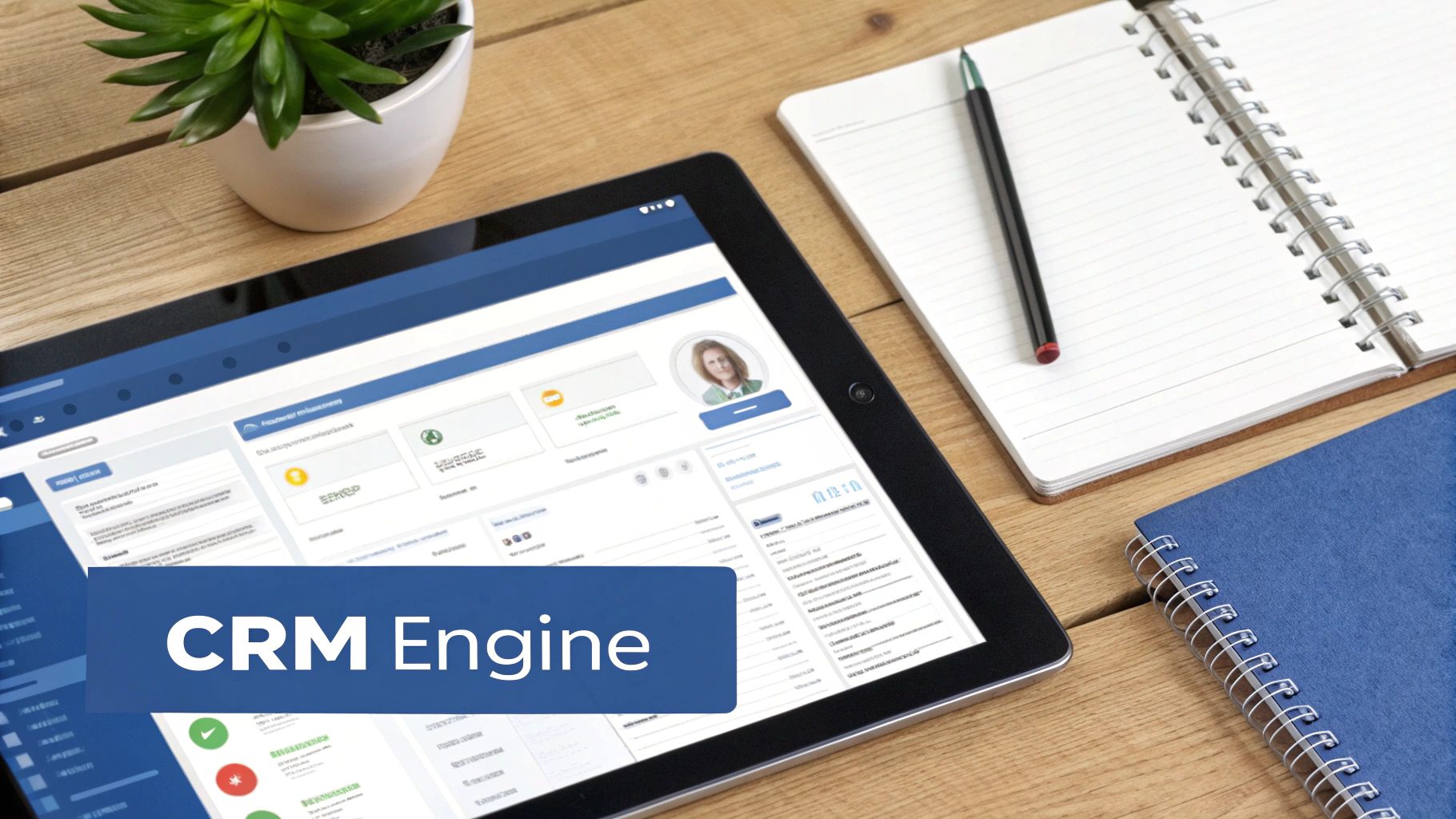
Are you still managing customer relationships from a spreadsheet? If so, you’re not just making your life harder—you’re actively losing money. A modern Customer Relationship Management (CRM) system is the engine for your entire engagement strategy.
A CRM unifies every interaction—every email opened, every service call, every purchase—into a single customer view. This context is what allows you to move from generic blasts to personalized conversations that build real relationships.
Activate Your Data with Segmentation
The real power of a tool like GoHighLevel is its ability to turn a static contact list into a dynamic system that reacts to your customers. This transformation begins with segmentation.
Segmentation means grouping your audience based on shared characteristics or behaviors. Instead of sending one message to everyone, you can deliver the right message to the right person. This is the single most important step you can take to make your communications relevant.
Here are a few ways you can segment your audience:
- Lead Source: How did they find you? (e.g., Trade Show, Google Search, Referral)
- Purchase History: What did they buy, and when? (e.g., First-time Buyer, Repeat Customer)
- Behavioral Triggers: What actions have they taken? (e.g., Visited Pricing Page, Abandoned Cart)
- Demographics: Who are they? (e.g., Industry, Job Title)
This isn’t just about organization; it’s about setting the stage for smarter, more effective conversations at scale.
Put Your CRM to Work with Automation
With your audience segmented, it’s time to use automation to do the heavy lifting. Automation ensures no lead is forgotten and no customer feels ignored by triggering specific actions based on their behavior.
Think of it as setting up a series of "if this, then that" rules for your marketing. For example, if a prospect downloads a whitepaper, the system can automatically send them a follow-up email sequence related to that topic. If a customer hasn't made a purchase in 90 days, it can trigger a re-engagement text with a special offer.
If you're unsure which platform is right for your business, we created a guide on how to choose a CRM system. It breaks down the key questions to ask before you commit.
A Real-World Example: B2B Manufacturer
Let's make this tangible. Imagine you’re a B2B manufacturer returning from a trade show with 50 new leads. The old method involves a stack of business cards and a week of manual, generic follow-ups.
Here’s the transformation with a CRM system:
- Immediate Tagging: The moment you’re back, you import the leads and tag them "Trade Show Lead – Q4 2024".
- Automated Workflow Trigger: This tag instantly kicks off a pre-built automation. Within hours, each lead receives a personalized email: "Great to meet you at the show, [First Name]!"
- Intelligent Follow-Up: The system waits three days. If a lead hasn’t replied, it can send a second, different follow-up or create a task for a sales rep to make a personal call.
- Long-Term Nurturing: Leads that don't convert immediately are automatically added to your monthly newsletter, keeping your brand top-of-mind without any manual effort.
This systematic approach transforms a cold list into a warm pipeline, turning your database into an active, revenue-generating asset.
Step 3: Weave Your Channels Into a Cohesive Campaign
Your customers don’t live in one place. They see your ads on social media, find your site on Google, and receive your emails. An effective customer engagement strategy connects these touchpoints into a single, seamless conversation.
A multi-channel approach is about meeting your audience where they already are. It means orchestrating your messages across email, SMS, your website, and social media so the experience feels cohesive and logical. When you get this right, each channel reinforces the others.
Match the Message to the Medium
The key to multi-channel success is understanding that each platform has its own rules. Blasting the same message everywhere is a fast way to get ignored. You must tailor your communication to fit the context of the channel.
- SMS for Urgency: Texting is direct and immediate. Use it for appointment reminders, shipping alerts, or flash sales. Its high open rates are powerful, but use it sparingly to avoid being intrusive.
- Email for Depth: Email is your workhorse for building relationships. Use it for detailed newsletters, product guides, or educational content that tells a complete story.
- Social Media for Community: Platforms like LinkedIn are your digital town squares. Use them to build community with behind-the-scenes content, polls, and two-way conversations.
- Website & GMB for Action: Your website is your digital headquarters, and your Google Business Profile is the front door for local customers. Both must provide clear information and make it simple for users to take the next step.
To learn more about the nuances of texting, check out our guide on SMS marketing best practices.
Orchestrating a Real-World Campaign
Let's walk through another example. You run an HVAC company and want to reactivate customers who haven't booked service in over a year for a pre-winter tune-up. A single email gets lost. A single text feels random.
A coordinated workflow built in a platform like GoHighLevel changes the game. Here’s how that system can work:
- Trigger: An automation starts the moment a contact in your CRM hits the 12-month mark since their last service.
- Email (Day 1): The system sends an educational email: "Is your furnace ready for winter, [First Name]?" It outlines the benefits of a tune-up and includes a clear call-to-action to book online.
- Pause (Days 1-3): The system waits and watches to see if the customer clicks the booking link.
- SMS Nudge (Day 4): If there’s no click, a simple text follows up: "Hi [First Name], just a friendly reminder from [Your Company] to schedule your furnace tune-up before the cold hits. Book here: [link]."
This isn’t about spamming people. It’s a smart system that delivers a timely, relevant reminder in the right place at the right time, turning dormant contacts into paying customers. This focus on a personalized customer experience shows customers you understand their needs and makes them feel valued.
The Transformation: Connecting Engagement to Your Bottom Line
So, what's the ultimate impact of all this work? Why does improving customer engagement actually matter? Because it's a direct investment in your company's bottom line. A superior customer experience (CX) leads to tangible financial growth.
Customers don't just buy products; they buy the experience you provide. When you deliver a great experience, you shift the conversation from price to value. That’s how you earn loyalty and the right to command a premium.
From Price-Based Decisions to Value-Based Partnerships
When a customer feels understood and valued, their loyalty deepens. The personalized interactions you build through your CRM and automation forge this connection, turning one-off buyers into repeat customers and brand advocates.
For B2B companies, this is everything. A great customer experience transforms a simple transaction into a long-term, profitable partnership, creating a predictable revenue stream built on trust.
The data is clear: an astounding 86% of customers are willing to pay more for a better customer experience. This is a massive market signal that exceptional service is one of the most powerful revenue drivers you have.
The ROI of Customer Engagement
A strong customer engagement strategy pays real dividends that directly impact financial performance. Here’s a look at the hard data that proves why this investment is critical.
| Statistic | Impact on Business | Key Takeaway for You |
|---|---|---|
| 86% of buyers will pay more for a great customer experience. | Directly increases profit margins and revenue per customer. | You can compete on value, not price, protecting your margins. |
| Companies that lead in CX outperform laggards by nearly 80%. | Superior experience is a massive competitive differentiator. | Being the easiest company to work with is a powerful advantage. |
| Engaged customers purchase 90% more frequently and spend 60% more per transaction. | Boosts Customer Lifetime Value (CLV) and sales velocity. | Loyal customers are your most reliable source of recurring revenue. |
| Increasing customer retention by 5% can increase profits by 25-95%. | Reduces churn and lowers the cost of acquiring new business. | It is far more profitable to keep a customer than to find a new one. |
These statistics show that focusing on the customer experience isn't a "nice-to-have"—it's a core driver of your company's financial health.
The Financial Impact of a Great Experience
So, how does this translate into numbers on your balance sheet? Engaged customers don't just buy more often; they are also less sensitive to price and more forgiving of minor issues.
Consider these direct financial benefits:
- Increased Customer Lifetime Value (CLV): Loyal customers spend more with you over their lifetime. Every step you take to improve engagement increases the total value of each customer.
- Higher Profit Margins: The freedom to compete on value means you aren't forced into a race to the bottom on price.
- Reduced Customer Acquisition Costs (CAC): Your happiest customers become your best marketing channel through word-of-mouth referrals.
Improving the experience is a direct path to boosting your company's financial resilience. For more on this, check out our guide on how to increase customer lifetime value.
Fostering Advocacy Through Engagement
The ultimate goal of customer engagement is advocacy—the point where your customers actively promote your business to their networks. This doesn't happen by accident. It's the result of a systematic approach that makes customers feel heard and valued at every touchpoint.
To move beyond generic outreach and dive deeper into modern B2B strategies, explore this guide on how to enhance customer engagement.
Your 90-Day Implementation Plan
Strategy is useless without a clear execution plan. We’re going to break this down into a manageable 90-day roadmap, moving from foundation to optimization in three phases.
This is the exact proof-of-concept approach we use to deliver measurable results. The goal isn't to build a perfect system in three months; it's to build a functional, repeatable system that proves its value quickly.
Days 1-30: Foundation and Quick Wins
Your first month is for diagnosis and setup. You can't build on a shaky foundation, and the same is true for your engagement system. This phase is about understanding what you have and getting the core tools in place.
Your priorities for this 30-day sprint are:
- Complete Your Engagement Audit: Use the framework from Step 1 to conduct a thorough review of your website, email, social media, and Google Business Profile.
- Define Key Metrics: Based on your audit, establish the baseline numbers you'll track, such as repeat purchase rate and customer lifetime value (CLV).
- CRM Setup and Data Import: Select and configure your CRM, like GoHighLevel. The most critical task is importing and cleaning your existing customer data. Ensure every contact is tagged correctly from the start.
Days 31-60: Automation and Campaign Launch
With your foundation in place, month two is about bringing your system to life. You'll start building the automated workflows that do the heavy lifting. The focus shifts from setup to activation.
Here’s your action plan for days 31-60:
- Build Your First Automation: Start with something simple but high-impact, like a "welcome sequence" for new leads or a "re-engagement campaign" for inactive customers.
- Launch a Multi-Channel Test: Design a simple campaign using two channels. For example, send an email, wait three days, and if there's no response, follow up with an SMS.
- Monitor Early Results: Keep a close eye on your initial campaign metrics. Are people opening the emails? Are they clicking the links? This early feedback is invaluable.
This diagram shows the direct path from engaging customers to building loyalty and driving revenue.
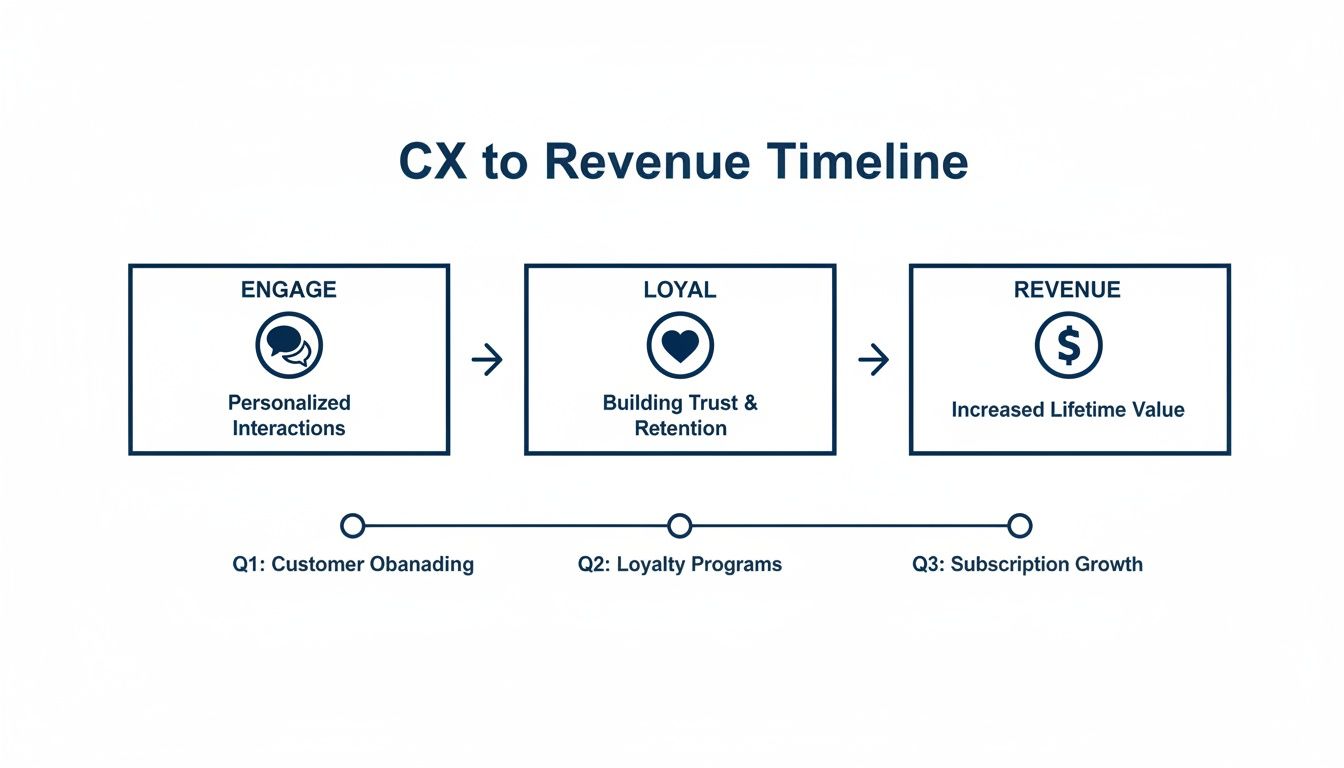
Each step builds on the last, turning initial interactions into reliable business growth.
Days 61-90: Measurement and Optimization
The final month is about turning data into decisions. You've built the foundation and launched your campaigns; now it’s time to analyze what happened and make the system smarter. This continuous improvement loop is what separates a great engagement strategy from a mediocre one.
The numbers tell a compelling story. Research shows that fully engaged hotel guests spend 46% more per year than disengaged ones—a principle that applies directly to B2B and service businesses. This is a critical lever for growth, especially since customer acquisition costs have surged nearly 60% in the last five years, as detailed in this ProProfs Chat article.
Your focus for this final phase is refinement:
- Analyze Campaign Performance: Dive into the data from month two. Which subject lines got the most opens? Which channel drove the most conversions?
- Gather Customer Feedback: Send a simple survey to customers who experienced your new sequences. Ask them directly: "Was this helpful?"
- Iterate and Expand: Based on your data and feedback, start tweaking your automations. You might adjust the timing of your messages, change the call-to-action, or build out a second workflow.
By the end of 90 days, you won't have a perfect system. What you will have is a working, data-producing engine that is already improving customer engagement and delivering a tangible return.
Answering Your Top Customer Engagement Questions
We've covered the diagnosis, the system, and the strategy. Now let's tackle the practical questions business owners always ask when it's time to turn this plan into action.
How much time will this realistically take?
The honest answer: you'll invest more time upfront to save a massive amount of time later. The first 30-60 days are the most intensive as you conduct the audit, clean your data, and build your initial automations.
But once those systems are live, they handle the repetitive follow-ups and nurturing that used to consume hours each week. The goal of the system is to free up you and your team to focus on high-value conversations.
What’s the biggest mistake to avoid?
Trying to do everything at once. We’ve seen many business owners get excited by the possibilities and immediately try to build a dozen complex workflows. This almost always leads to burnout and a system that's too convoluted to manage.
Start small, then iterate. Pick one specific problem—like re-engaging inactive customers—and build a simple, effective automation for it. Prove it works, learn from the data, and then build on that success.
How do I know if this is actually working?
You’ll know it’s working when the baseline numbers from your initial audit start to improve. Gut feelings don't pay the bills; you need to track hard data that connects engagement to your bottom line.
Keep a close eye on these KPIs:
- Repeat Purchase Rate: Are customers buying from you more often?
- Customer Lifetime Value (CLV): Is the average customer spending more with you over time?
- Campaign Conversion Rates: Are your emails and texts driving clicks and purchases?
- Positive Reviews & Referrals: Are you seeing an increase in unsolicited praise and word-of-mouth business?
Is this only for big companies with huge budgets?
Absolutely not. In fact, smaller, more agile businesses often have an advantage. You're closer to your customers and can implement changes much faster than a large corporation.
Modern platforms like GoHighLevel have made powerful CRM and automation tools accessible to businesses of any size. You don't need a massive marketing department to build meaningful relationships at scale—you just need a solid process and the right system.
Ready to stop guessing and start building a customer engagement system that grows your business? At Machine Marketing, we implement the tools and strategies that turn one-time buyers into lifelong partners. Book a discovery call with us today and we'll help you diagnose the gaps in your current system.