If you’re a business owner struggling to keep up with leads, follow-ups, and customer communication, you're not alone. The root cause is often a lack of systems, not a lack of effort. Without the right automation, you’re forced to perform repetitive tasks manually, which costs you time and lets potential customers slip through the cracks. Is this operational bottleneck leading to inconsistent marketing and missed revenue?
This guide provides a clear, engineering-minded breakdown of the top marketing automation platforms available. We'll diagnose the common challenges these tools solve and help you find the solution that fits your specific business. Before we dive in, if you need a refresher on the basics, you can explore the core definition of a marketing automation platform to understand its fundamental components.
In this resource, you will find:
- A clear diagnosis of 12 leading platforms, including HubSpot, GoHighLevel, and Marketo.
- Practical use cases for manufacturers, SMBs, and local service businesses.
- Transparent pros and cons to help you identify the right fit.
- Pricing and integration details, with direct links for each tool.
Our goal is to help you move from manual effort to a streamlined, automated system. We’ll show you how to select the right tool to build a marketing engine that generates results consistently, so you can focus on growth instead of routine tasks. Let's find the platform that puts your marketing on autopilot.
1. HubSpot Marketing Hub
HubSpot positions itself as an all-in-one CRM and marketing automation platform, making it a strong contender among the top marketing automation platforms for businesses wanting a single source of truth. Its core strength lies in its tight integration between marketing, sales, and service tools, all built on a robust, user-friendly CRM. This unified system provides a complete view of the customer journey, which means less time stitching data together and more time acting on insights.
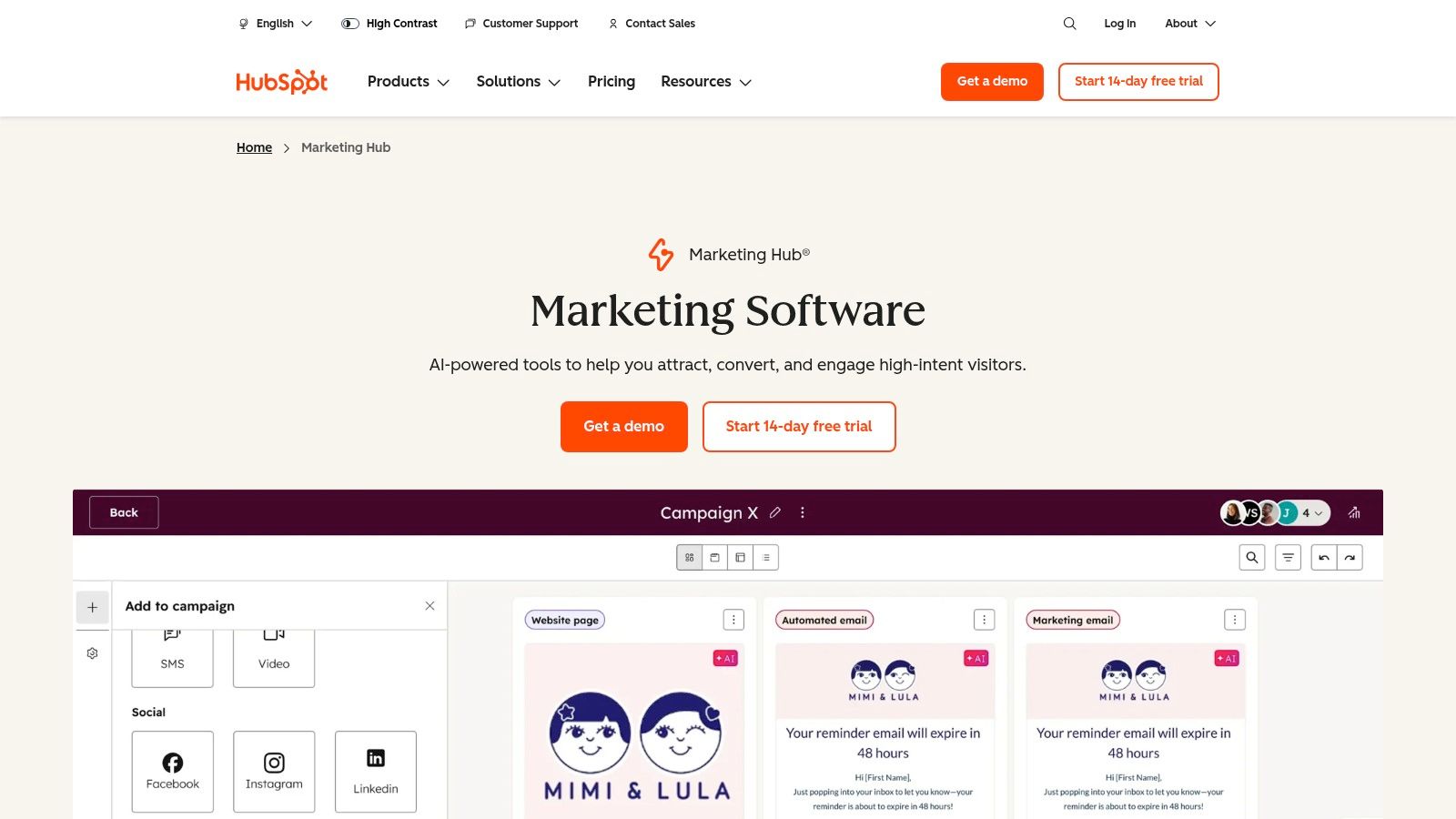
The platform’s visual workflow builder is a standout feature, allowing you to design complex automation sequences without writing code. You can trigger workflows based on almost any contact property, page view, or form submission, giving you granular control. HubSpot’s extensive educational resources also significantly reduce the learning curve, helping you understand the true benefits of marketing automation by connecting activities directly to revenue.
Key Details & Implementation
- Best For: SMBs and manufacturers seeking a unified CRM and marketing platform with extensive support and a large integration ecosystem.
- Pricing: Scales from a limited free plan to enterprise tiers. Pro and Enterprise plans require mandatory, paid onboarding. Be transparent about costs: pricing is based on "marketing contacts," which can increase quickly as your lists grow.
- Pros: Excellent user interface, comprehensive reporting, and a massive ecosystem of integrations.
- Cons: The contact-based pricing model can become expensive. The mandatory onboarding fees for higher tiers are a significant upfront investment. It might be overkill if you only need basic email automation.
Website: https://www.hubspot.com/products/marketing
2. Salesforce Marketing Cloud Account Engagement (formerly Pardot)
Salesforce Marketing Cloud Account Engagement (formerly Pardot) is Salesforce's B2B-focused solution, making it one of the top marketing automation platforms for organizations already embedded in the Salesforce ecosystem. Its primary strength is its native sync with Salesforce CRM, creating an integrated system for managing long sales cycles. For manufacturers and B2B service companies, this means marketing and sales teams operate from a single dataset, ensuring seamless alignment.
The platform excels at sophisticated lead management, with robust lead scoring and grading to help sales prioritize qualified opportunities. Its Engagement Studio allows you to build intricate lead nurturing journeys that adapt to prospect behavior. While its interface can feel less modern, its power lies in its B2B Marketing Analytics, which provide deep ROI reporting that connects marketing efforts directly to closed-won deals in Salesforce.
Key Details & Implementation
- Best For: Mid-market to enterprise B2B companies that use Salesforce CRM as their central source of truth and require strong governance.
- Pricing: Offered in tiered plans billed annually. The entry-level cost is significantly higher than many SMB-focused platforms, reflecting its enterprise focus.
- Pros: Unmatched native integration with Salesforce CRM. Powerful analytics and ROI reporting that tie directly to sales outcomes.
- Cons: The high price point and complexity make it a poor fit for most small businesses. The platform delivers the best results when paired with Salesforce CRM, creating a trade-off of vendor lock-in.
Website: https://www.salesforce.com/marketing/b2b-automation/pricing/
3. Adobe Marketo Engage
Adobe Marketo Engage is an enterprise-grade powerhouse among the top marketing automation platforms, built for organizations with complex B2B and B2C marketing needs. Its strength is in its capacity for sophisticated, multi-touch journey design, advanced account-based marketing (ABM) orchestration, and deep analytics. Marketo excels where businesses need granular segmentation and the ability to track revenue from initial engagement to final sale, making it a go-to for established companies with dedicated marketing operations teams.
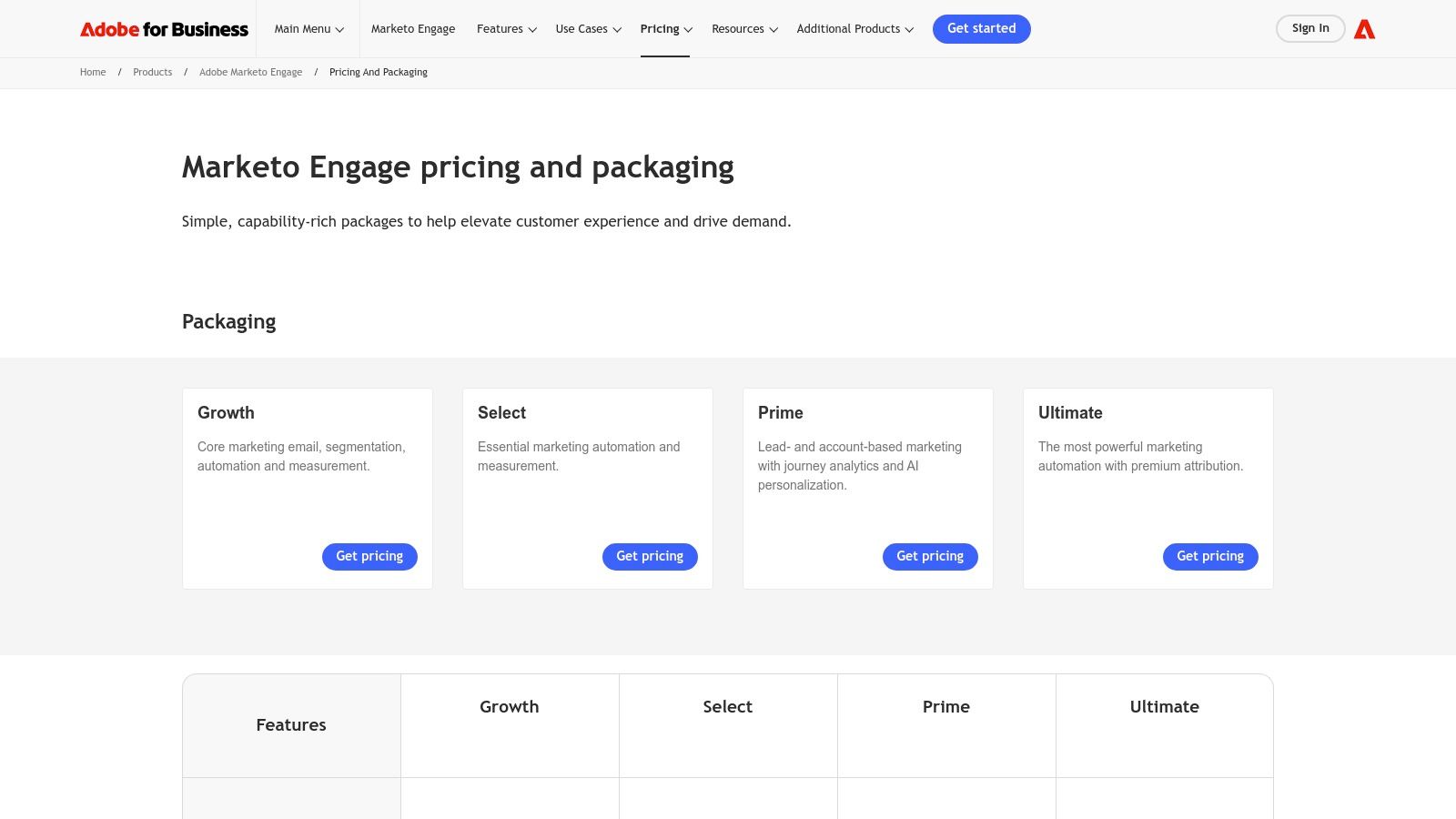
The platform’s Revenue Cycle Modeler allows for unparalleled flexibility in designing and measuring complex nurture campaigns. You can orchestrate data-intensive programs that align marketing activities directly with sales outcomes, a critical function for a solid marketing automation strategy. While powerful, its depth means it comes with a significantly steeper learning curve than SMB-focused tools.
Key Details & Implementation
- Best For: Enterprise-level organizations and large mid-market companies needing advanced B2B features and highly customizable journey orchestration.
- Pricing: Entirely quote-based and customized to your database size and feature needs. Expect a significant investment, as implementation often requires a certified partner.
- Pros: Extremely flexible for building complex nurture and ABM campaigns. Supported by a large, knowledgeable community and partner ecosystem.
- Cons: The quote-based pricing and partner-led implementation create high barriers to entry. The platform's complexity results in a steep learning curve not suitable for small teams.
Website: https://business.adobe.com/products/marketo/pricing.html
4. Oracle Eloqua (Oracle Marketing Automation)
Oracle Eloqua serves the enterprise segment, positioning itself as a top marketing automation platform for global B2B organizations managing massive data volumes. Its strength is rooted in its capacity for complex campaign orchestration, advanced data governance, and deep integration within the Oracle CX suite. For large-scale manufacturers or multinational corporations, this means unparalleled control over intricate lead routing and personalization at scale.
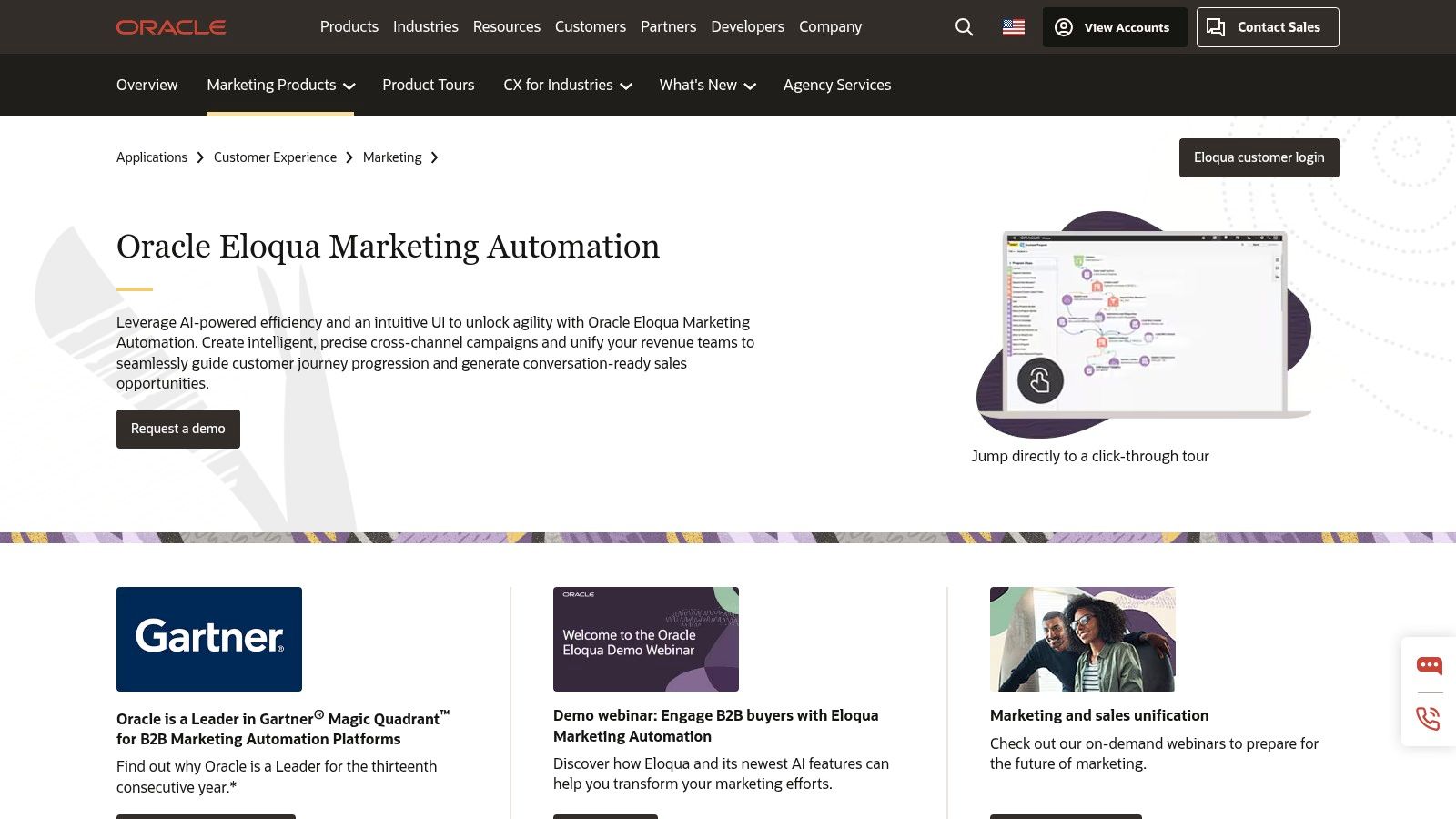
The platform's Program Canvas is a powerful tool for designing sophisticated, multi-step marketing and sales enablement workflows. It allows for advanced lead scoring models and seamless handoffs to sales teams, which is critical for organizations with long sales cycles. With over 500 prebuilt integrations, Eloqua can connect to a wide array of enterprise systems, making it a powerhouse for teams with the technical resources to leverage its full capabilities.
Key Details & Implementation
- Best For: Large, global B2B enterprises that require robust data handling, enterprise-level security, and complex campaign routing.
- Pricing: Quote-based only. The platform represents a significant financial and resource investment, with implementation and ongoing management requiring dedicated, skilled personnel.
- Pros: Exceptional capability for handling large data volumes and building complex segmentation. Enterprise-grade security and compliance features are a core strength.
- Cons: The heavy implementation requirements and quote-based pricing make it inaccessible for most SMBs. Its user interface is less intuitive than more modern platforms.
Website: https://www.oracle.com/cx/marketing/automation/
5. Microsoft Dynamics 365 Customer Insights – Journeys
Microsoft Dynamics 365 Customer Insights – Journeys is Microsoft’s answer to enterprise-grade marketing automation, firmly planted within its expansive business application ecosystem. Its greatest advantage is the native integration with Dataverse and Microsoft 365. This isn't just a marketing tool; it's a component of a larger operational system. For businesses heavily invested in Dynamics 365 for sales or finance, this platform provides a seamless extension for marketing.
The platform excels at creating real-time, event-based customer journeys, allowing you to react instantly to customer actions across multiple touchpoints. It offers robust segmentation and built-in consent management tools to help navigate compliance requirements like GDPR. While it presents a steeper learning curve, its power lies in leveraging the entire Microsoft stack. This makes it one of the top marketing automation platforms for companies looking to unify their sales, service, and marketing data within a single environment.
Key Details & Implementation
- Best For: Organizations deeply integrated with the Microsoft ecosystem (Dynamics 365, Azure) that need a powerful, data-driven automation engine.
- Pricing: Follows a tenant-based model rather than per-user. Pricing is often based on the number of "Interacted People" per month.
- Pros: Unmatched native integration with other Dynamics 365 and Microsoft apps. Transparent tenant-level pricing and strong data governance.
- Cons: The licensing concepts can be complex to forecast. It delivers its best value when used with other Dynamics 365 applications, making it less ideal as a standalone solution.
Website: https://www.microsoft.com/en-us/dynamics-365/products/customer-insights/pricing
6. ActiveCampaign
ActiveCampaign has earned its place among the top marketing automation platforms by offering advanced automation, CRM, and email marketing at a competitive price. It’s well-suited for SMBs that need sophisticated workflow capabilities without the enterprise cost. Its core strength is its flexible and visual automation builder, which allows for intricate "if/then" logic, enabling highly personalized customer journeys based on user behavior or CRM data.
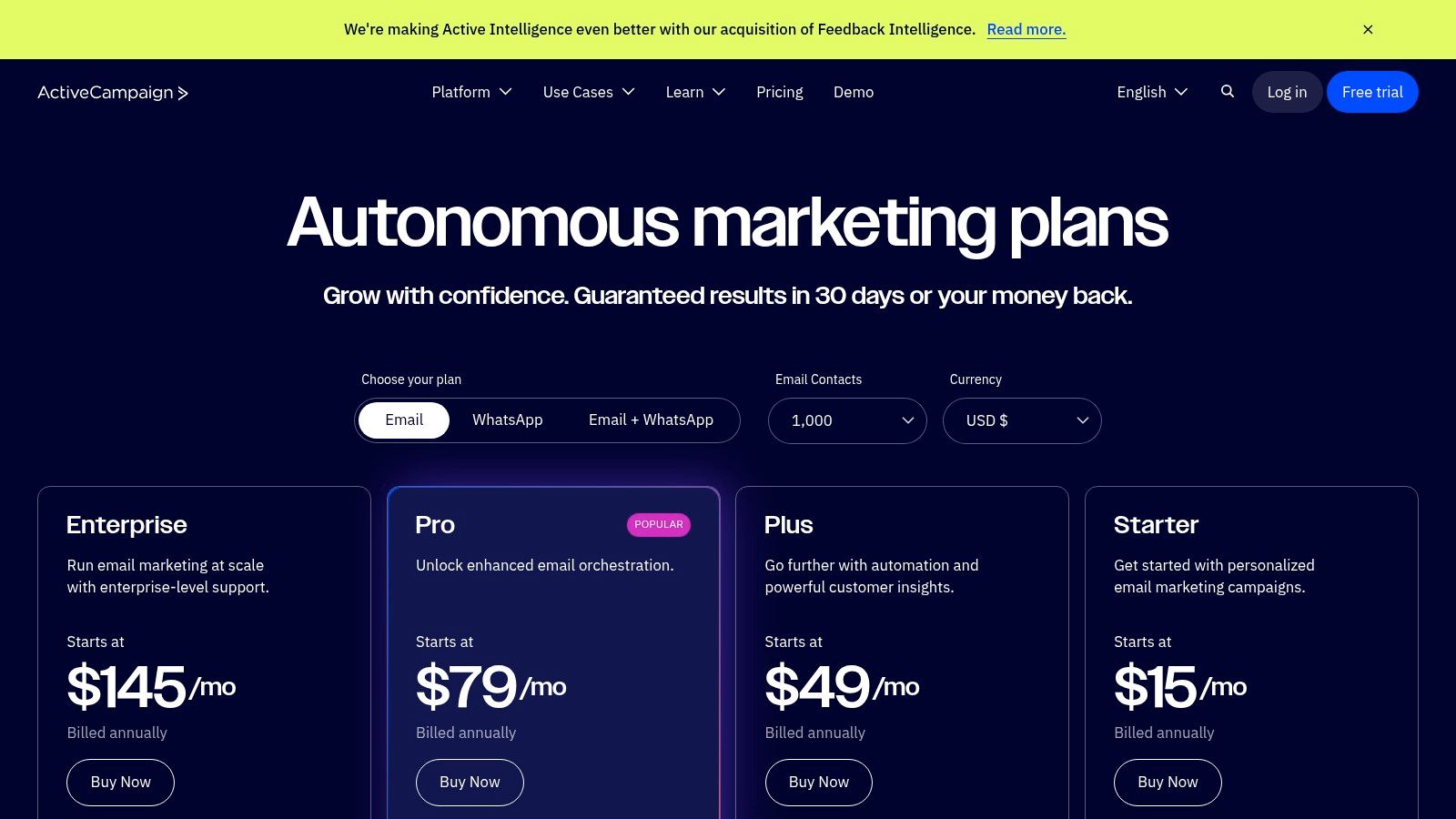
The platform is more than just email; its integrated sales CRM helps businesses manage deals, track tasks, and automate sales processes. With over 1,000 integrations, ActiveCampaign provides a comprehensive hub for multichannel communication. For businesses that have outgrown simpler email tools, it offers a free trial and migration support, reducing the friction of adoption.
Key Details & Implementation
- Best For: SMBs and mid-market companies that prioritize powerful, flexible automation and integrated CRM at a competitive entry price.
- Pricing: Based on contact tiers and feature levels. Costs can escalate as your contact list and feature needs grow, so it's wise to check your specific account details.
- Pros: Highly flexible and visual automations at a competitive cost. Excellent onboarding resources, free migration support, and an active user community.
- Cons: Advanced reporting and features are often locked behind higher-priced tiers. The pricing model requires close monitoring as you scale.
Website: https://www.activecampaign.com/pricing
7. Mailchimp (Intuit Mailchimp)
Mailchimp is a recognized name in email marketing that has evolved to include foundational marketing automation features. Its strength lies in its simplicity and accessibility, making it an excellent starting point for small businesses, especially in e-commerce, who are just beginning to explore automation. The platform excels at guiding users through creating email campaigns and basic automated "journeys" for welcome series or abandoned carts.
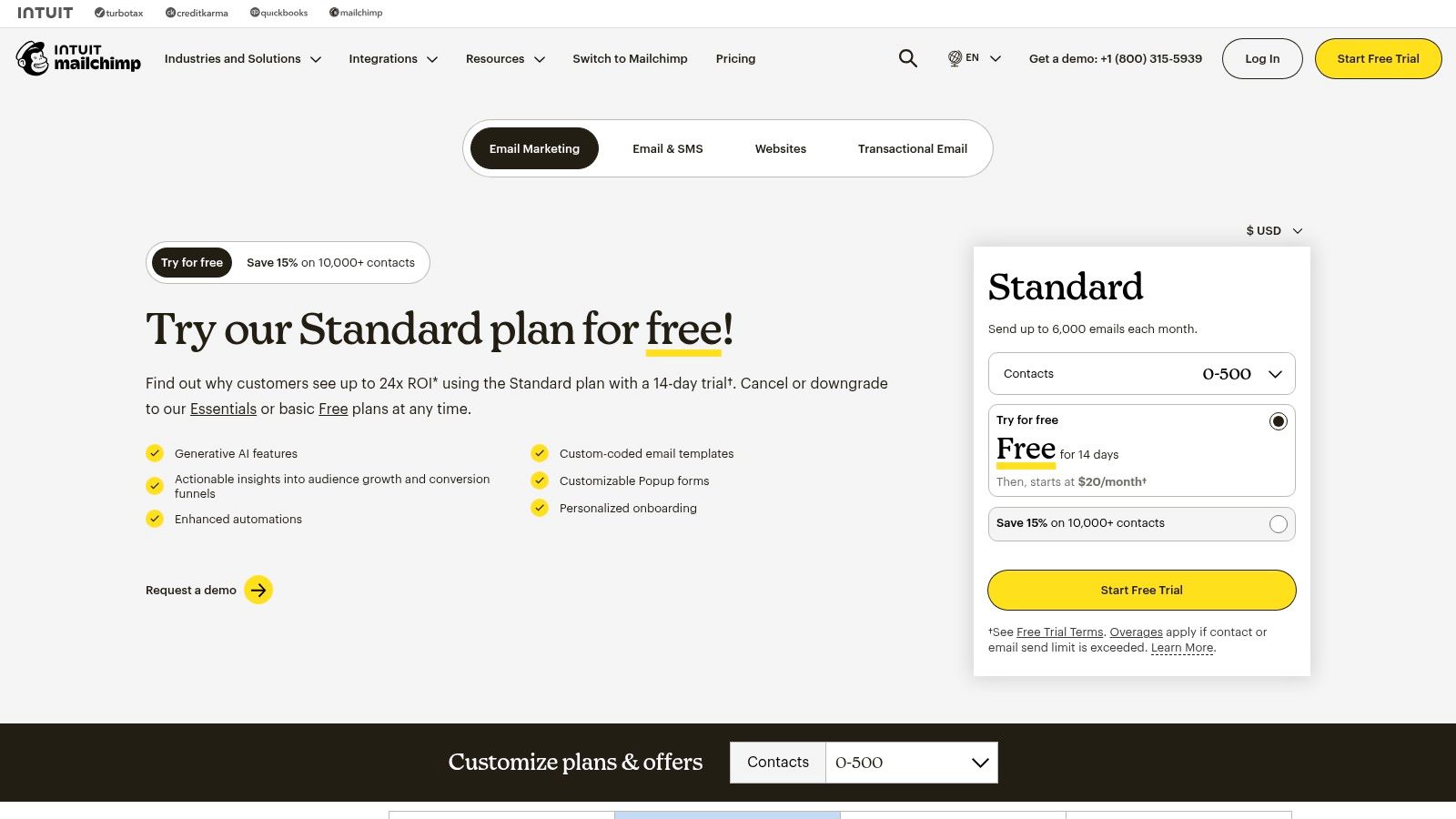
While not as complex as other top marketing automation platforms, Mailchmp offers a clean interface, robust templates, and straightforward audience management tools. This focus on the essentials allows businesses to get up and running quickly. As you explore options, it's helpful to see how it stacks up against others; our email marketing platforms comparison provides additional context. For businesses needing reliable email delivery and simple sequences, Mailchimp is a solid choice.
Key Details & Implementation
- Best For: Small businesses, e-commerce stores, and startups needing a user-friendly email platform with basic, easy-to-implement automation.
- Pricing: Offers a very limited free plan. Paid plans scale with contact and send volume, with more advanced features reserved for Standard and Premium tiers.
- Pros: Extremely intuitive interface with excellent templates and learning resources. Fast setup and a large marketplace of integrations.
- Cons: The free plan is highly restrictive. True multi-step automation requires more expensive plans, and its capabilities are limited compared to dedicated, all-in-one automation platforms.
Website: https://mailchimp.com/pricing/
8. Klaviyo
Klaviyo is a dominant force among top marketing automation platforms built specifically for ecommerce. Its value lies in deep, real-time data integrations with platforms like Shopify, allowing it to pull in customer behavior data that generic platforms miss. For businesses with a direct-to-consumer (D2C) arm, this means you can build highly personalized email and SMS campaigns based on actual purchase history, abandoned carts, and browsing activity.
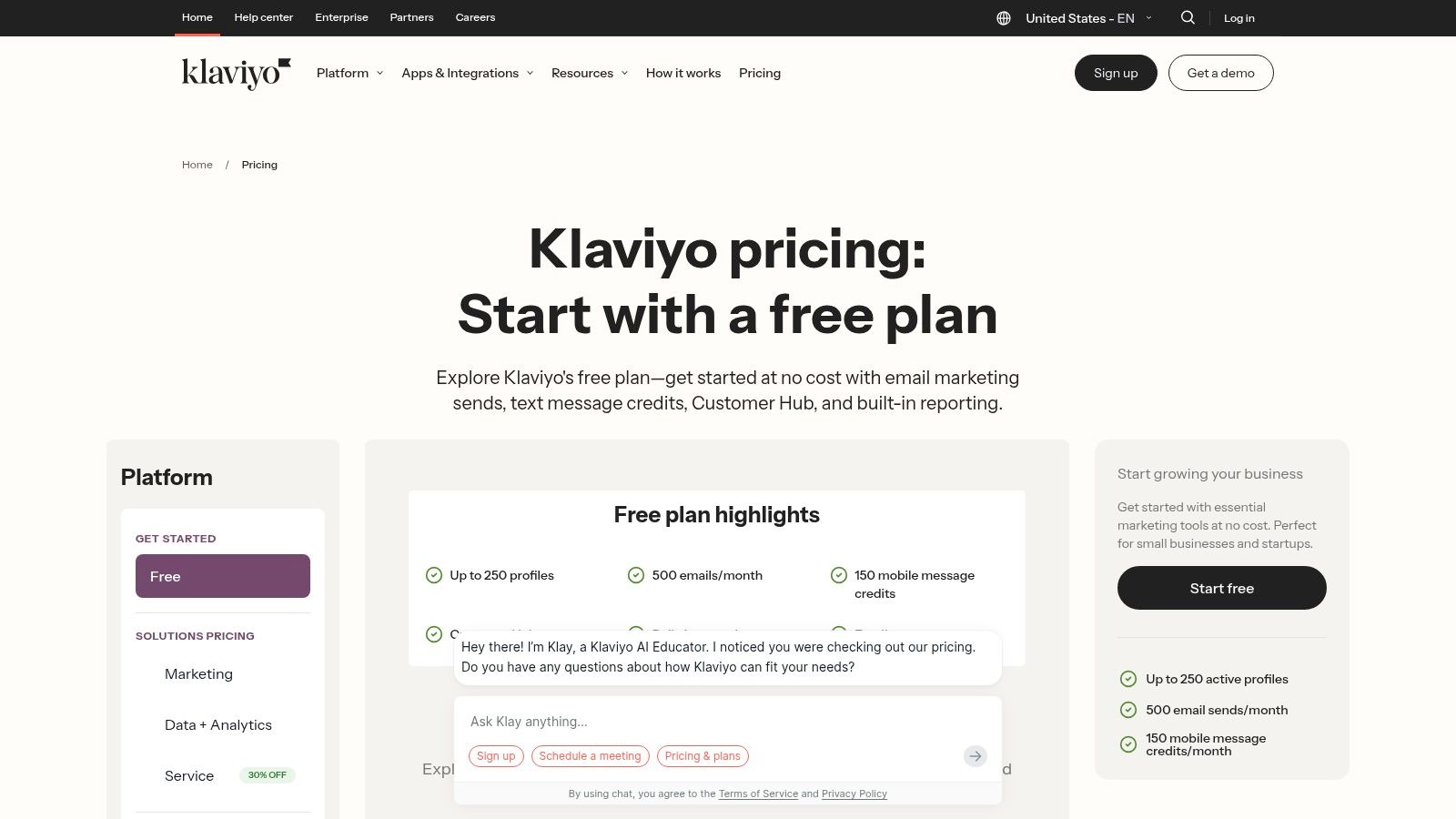
The platform stands out with its pre-built ecommerce segments and automation templates designed to drive sales. You can quickly launch campaigns for welcome series, abandoned cart reminders, and post-purchase follow-ups without starting from scratch. Klaviyo’s AI tools for generating subject lines further streamline the process. While not a traditional all-in-one CRM, its laser focus on the ecommerce data model makes it an indispensable tool for product-based businesses.
Key Details & Implementation
- Best For: Ecommerce businesses and D2C brands that need powerful, data-driven email and SMS automation tied directly to revenue.
- Pricing: A free plan is available for very small lists. Paid plans scale based on the number of contact profiles and SMS credits, which can add up quickly.
- Pros: Exceptional ecommerce data model with precise revenue attribution reporting. Fast, native integrations and a huge library of ecommerce-specific templates.
- Cons: Can become expensive as your contact list and SMS usage increase. The platform is not a good fit for non-ecommerce B2B or service businesses.
Website: https://www.klaviyo.com/pricing/
9. GoHighLevel (HighLevel)
GoHighLevel has carved out a unique space among the top marketing automation platforms by focusing on marketing agencies and the SMBs they serve. It acts as an operating system for marketing, consolidating tools like CRM, funnel builders, email/SMS marketing, and calendars into one platform. Its core value is the ability for agencies to white-label the entire system and resell it as their own software, creating a new revenue stream.
The platform's strength is its breadth of features and multi-client sub-account architecture. An agency can manage hundreds of clients from one dashboard. The visual workflow builder is powerful, enabling complex sequences that integrate two-way SMS, email, and social media DMs. For a local service business, this means having an agency-level toolset to manage leads from every channel, all automated within one system.
Key Details & Implementation
- Best For: Marketing agencies and consultants who want to offer a white-labeled, all-in-one platform to their clients, as well as SMBs wanting to consolidate their marketing tech stack.
- Pricing: Features a flat pricing model, with the Agency Unlimited plan allowing for unlimited contacts and sub-accounts for a single monthly fee. Note that telephony and email usage are billed separately.
- Pros: Incredible value by consolidating many point solutions into one flat-fee platform. The agency-focused features and unlimited contacts on higher plans are major cost advantages.
- Cons: The learning curve can be steep due to the sheer number of features. It's best for teams willing to standardize on its stack, as it can feel less polished than specialized tools.
Website: https://www.gohighlevel.com/
10. SharpSpring by Constant Contact
SharpSpring, now part of the Constant Contact suite, carves out its space among the top marketing automation platforms by focusing on SMBs and marketing agencies. It delivers a comprehensive solution that bundles a built-in CRM with extensive automation tools. This integration allows you to manage the entire customer lifecycle, from lead capture to long-term nurturing, within a single system without the complexity of enterprise solutions.
The platform’s standout feature is its pricing model, which includes unlimited users on all plans, making it cost-effective for growing teams and agencies. Its visual workflow builder is intuitive, enabling users to map out customer journeys and automate email sequences and lead scoring. With included onboarding specialists, SharpSpring aims to reduce the implementation friction often associated with adopting a new automation tool.
Key Details & Implementation
- Best For: SMBs and marketing agencies needing a full-featured platform with predictable costs and strong support without per-user fees.
- Pricing: Tiered pricing based on the number of contacts. An onboarding fee is typically required, but this includes dedicated support to get your system configured.
- Pros: The unlimited user model provides excellent value. Its broad feature set covers most SMB needs, and the included onboarding is a significant benefit.
- Cons: Pricing transparency can be less straightforward, often requiring a conversation with sales. The interface, while functional, can feel less modern than other leading platforms.
Website: https://sharpspring.com/pricing/
11. Braze
Braze positions itself as a customer engagement platform built for real-time, cross-channel communication at an enterprise scale. It excels where many top marketing automation platforms fall short: connecting with mobile-first audiences through channels like push notifications, in-app messages, and SMS, alongside email. For app-driven companies, this means you can create a cohesive customer experience that responds instantly to user behavior, whether on your website or in your mobile app.
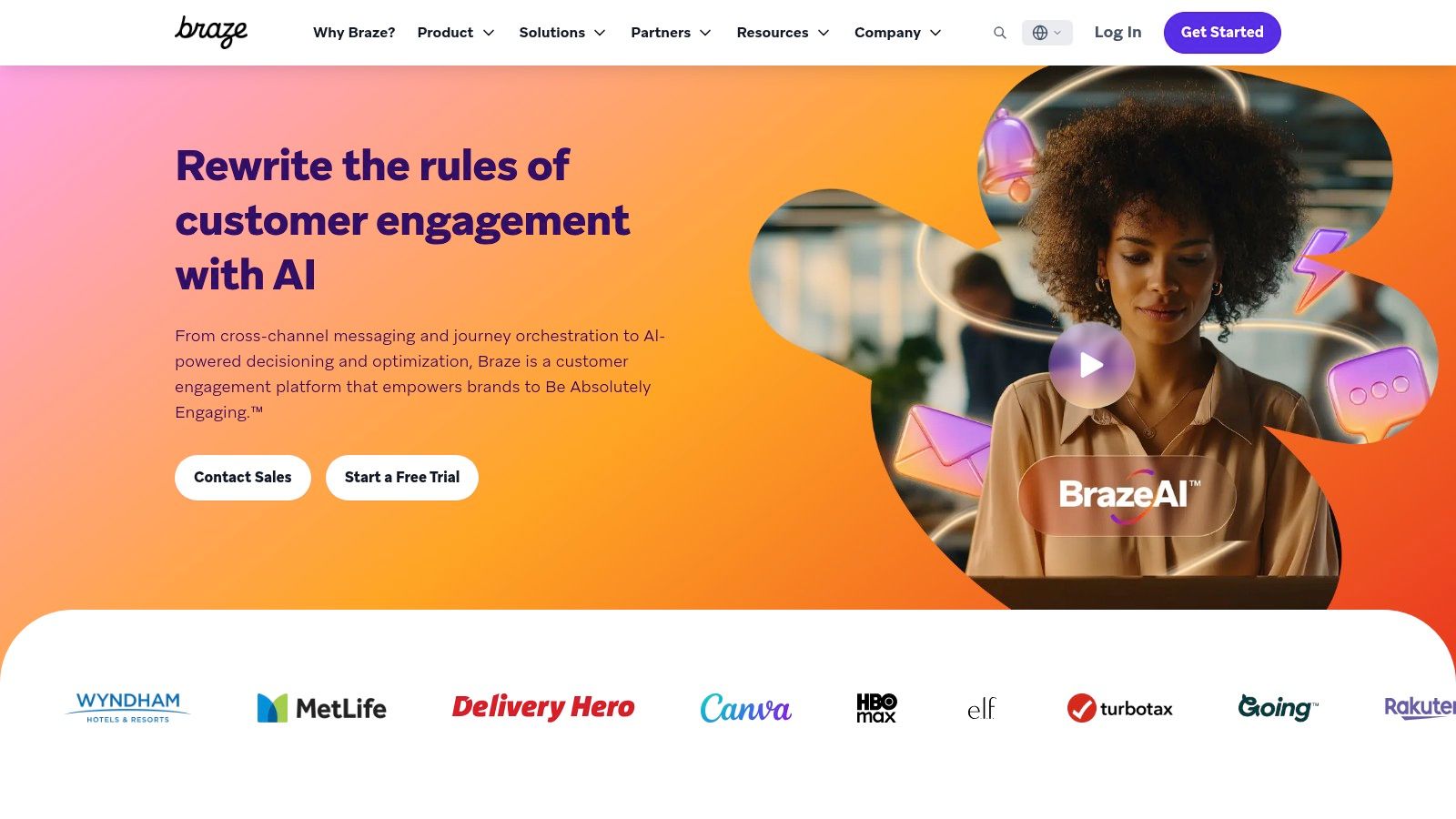
The platform’s standout feature is its "Canvas" journey orchestration tool, which allows you to build sophisticated, multi-step customer journeys with built-in A/B testing. You can trigger messages based on real-time events and use BrazeAI for predictive decisioning. This level of real-time responsiveness and built-in optimization is what sets Braze apart for companies needing to manage communications with millions of users.
Key Details & Implementation
- Best For: Enterprise B2C companies and mobile-first businesses that need to deliver personalized, cross-channel messages at a very large scale.
- Pricing: Quote-based and tailored to enterprise budgets. It's not suited for small businesses.
- Pros: Market-leading capabilities for real-time, cross-channel delivery (push, in-app, SMS, email). Powerful analytics and experimentation tools are integrated into the journey builder.
- Cons: The platform comes with a high price tag. Implementation is complex and almost always requires significant developer resources to integrate data sources correctly.
Website: https://www.braze.com/
12. Iterable
Iterable positions itself as an AI-powered, cross-channel communication platform built for the modern tech stack. It's designed for teams that require flexible, real-time personalization. Its core strength lies in its "composable" nature, allowing you to integrate it seamlessly with existing data warehouses. This makes it one of the top marketing automation platforms for companies with rich customer data who want to avoid the constraints of a closed, all-in-one system.
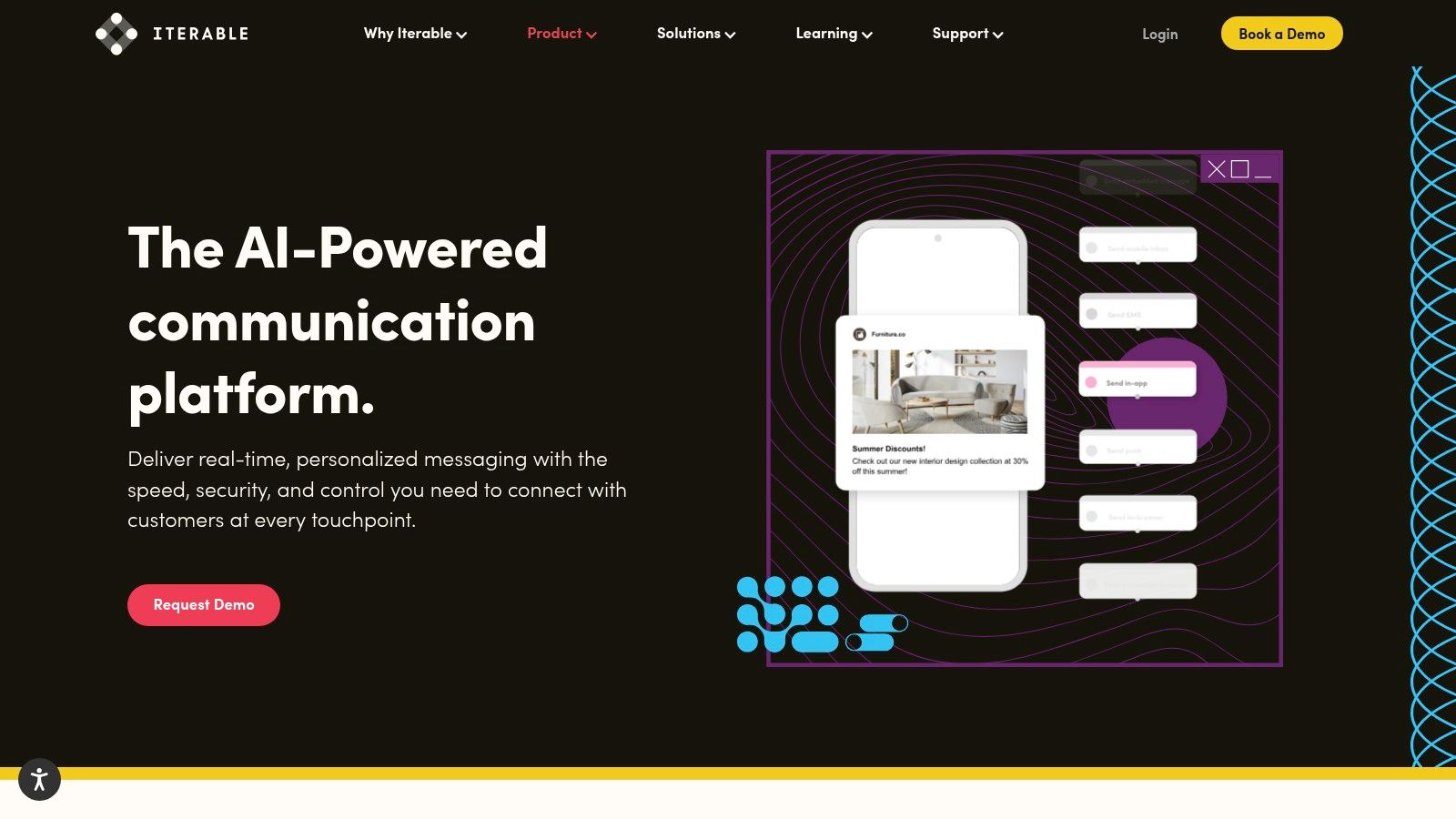
The platform’s standout feature is its Explainable AI, which moves beyond "black box" algorithms to provide clear reasons behind its personalization decisions. This transparency helps you understand why certain users are targeted, enabling smarter strategy adjustments. Iterable orchestrates campaigns across email, SMS, and push notifications, triggered by real-time user events. For businesses with complex journeys and a need for enterprise-grade security, Iterable provides a powerful, data-first alternative.
Key Details & Implementation
- Best For: Mid-market and enterprise companies with sophisticated data infrastructure seeking a flexible, AI-driven platform for cross-channel communication.
- Pricing: Custom pricing is provided through the sales team, tailored to specific data and volume requirements. It is positioned for enterprise-level budgets.
- Pros: Excellent for composable tech stacks and data-rich use cases. Offers flexible migration support, open integrations, and advanced, transparent AI capabilities.
- Cons: The custom pricing model is not transparent for smaller businesses. A significant implementation effort is required to properly connect data sources.
Website: https://iterable.com/product/
Top 12 Marketing Automation Platforms: Feature Comparison
| Platform | Core features ✨ | Target audience 👥 | Pricing/value 💰 | Strengths / Quality ★🏆 |
|---|---|---|---|---|
| HubSpot Marketing Hub | Visual workflows, email/SMS, landing pages, native CRM ✨ | Sales‑aligned teams; SMB → Enterprise 👥 | Scales free→Enterprise; contact‑based billing; onboarding fees 💰 | Fast time‑to‑value, large ecosystem ★★★★ 🏆 |
| Salesforce Marketing Cloud Account Engagement (Pardot) | Lead scoring, nurturing, ROI reporting, Salesforce sync ✨ | B2B manufacturing & complex orgs; Salesforce users 👥 | Annual contracts; higher TCO for mid→enterprise 💰 | Deep Salesforce alignment, strong analytics ★★★★ 🏆 |
| Adobe Marketo Engage | Multi‑touch journeys, ABM, advanced API capacity ✨ | Enterprise ABM / complex nurture use cases 👥 | Quote‑based pricing; partner implementations common 💰 | Very flexible for complex programs ★★★★ 🏆 |
| Oracle Eloqua | Campaign Canvas, advanced scoring, 500+ integrations, enterprise security ✨ | Global B2B, large data volumes, Oracle CX customers 👥 | Quote‑based; heavier implementation & governance costs 💰 | Scales for large data & security needs ★★★★ 🏆 |
| Microsoft Dynamics 365 Customer Insights – Journeys | Real‑time journeys, consent mgmt, Dataverse + Power Platform ✨ | Organizations standardized on Microsoft stack 👥 | Tenant/licensing concepts; best paired with Dynamics 💰 | Native MS integration; transparent tenant options ★★★★ |
| ActiveCampaign | Visual automation, built‑in CRM, landing pages, SMS options ✨ | SMBs & mid‑market seeking quick wins 👥 | Competitive entry pricing; contact tiers apply 💰 | Flexible automations, strong onboarding ★★★★ |
| Mailchimp (Intuit) | Email campaigns, templates, basic automation, audience tools ✨ | Small teams & ecommerce starters 👥 | Free tier limits; clear plan tiers for scaling 💰 | Fast setup, excellent templates & learning ★★★ |
| Klaviyo | Ecommerce email & SMS, real‑time sync, revenue attribution ✨ | D2C brands and ecommerce arms of manufacturers 👥 | Free for tiny lists; pricing scales with profiles & SMS 💰 | Best‑in‑class ecommerce attribution ★★★★ 🏆 |
| GoHighLevel (HighLevel) | CRM, funnels/sites, calendars, multi‑client subaccounts, white‑label ✨ | Agencies & local‑service SMBs (white‑label) 👥 | Flat/unlimited plan options; telephony billed separately 💰 | Consolidates many tools; agency‑friendly ★★★★ |
| SharpSpring by Constant Contact | Visual workflows, built‑in CRM, unlimited users, onboarding ✨ | SMB / mid‑market and agencies 👥 | Agency‑oriented pricing; onboarding fee typical 💰 | No per‑user fees, strong onboarding ★★★ |
| Braze | Cross‑channel (email/push/in‑app/SMS), Canvas, BrazeAI, experimentation ✨ | Consumer brands, apps; enterprise scale 👥 | Quote‑based; enterprise budgets required 💰 | Market‑leading real‑time cross‑channel delivery ★★★★ 🏆 |
| Iterable | Cross‑channel orchestration, explainable AI, warehouse‑friendly data ✨ | Mid‑market → Enterprise; data‑rich teams 👥 | Customized pricing; enterprise focus 💰 | Strong personalization & composable integrations ★★★★ |
From Diagnosis to Transformation: Choosing Your Growth Engine
Navigating the landscape of the top marketing automation platforms can feel like an exhaustive diagnostic process. We've explored a dozen systems, from enterprise titans like Salesforce and Marketo to SMB champions like ActiveCampaign and all-in-one solutions like GoHighLevel. The core takeaway isn't that one platform is definitively "the best." The right platform is the one that best fits your specific operational blueprint and growth ambitions.
For a machine manufacturer, the ideal tool might offer deep CRM integration for managing long B2B sales cycles. In contrast, a local service business will find more value in a platform that excels at reputation management and local lead generation. Your choice is a critical component, but it's not the entire machine.
Your Next Steps: Questions to Ask Yourself
The real transformation begins when you move from selection to strategic implementation. A powerful platform sitting unused is just expensive code. To turn your investment into a reliable growth engine, you need to treat it as a central part of your business system.
Here are the critical questions to ask as you move forward:
- Diagnosis Before Prescription: What specific bottleneck are you trying to solve? Is it lead qualification, nurturing cold leads, or reducing sales team admin work? Choose a tool that solves your most pressing problem.
- Integration and Workflow: How will this platform connect with your existing systems, especially your CRM? The goal is a seamless flow of data, not another silo.
- Team Adoption and Training: Who on your team will own this platform? A simpler platform your team uses consistently will always outperform a complex one that gathers dust.
From Platform to Performance: A Clear Call to Action
The most common point of failure we see isn't choosing the wrong platform; it's the lack of a clear implementation plan. Simply "turning on" automation isn't a strategy. Success requires a deliberate, step-by-step approach.
Start small. Instead of trying to automate everything at once, pick one high-impact workflow, such as a lead nurturing sequence for webinar registrants. Build it, test it, measure the results, and then expand. This methodical, engineering-minded approach ensures you get early wins.
For many of the SMBs we partner with, the complexity of multiple tools is the primary obstacle. This is why an integrated platform like GoHighLevel often becomes the most practical solution. It consolidates your CRM, sales pipeline, email, and SMS into a single system, making it easier to build and scale your automated marketing efforts without the technical overhead. The transformation lies not in the list of top marketing automation platforms, but in how you integrate your choice into a system that consistently delivers results.
Feeling overwhelmed by the options and unsure how to build a system that connects marketing to real sales growth? At Machine Marketing, we specialize in diagnosing these exact challenges and implementing scalable marketing automation systems. We can help you choose the right platform and build the workflows that turn leads into loyal customers. Book a discovery call with us today, and let's create a clear roadmap for your business.