If your sales process feels unpredictable and you're struggling to forecast revenue, the problem isn't your team or your product. The root cause is often hidden in plain sight: the lack of a clearly defined sales cycle.
So, what is a sales cycle? Think of it as the step-by-step roadmap your team follows to turn a potential customer into a paying one. In this article, we’ll show you how to diagnose the gaps in your current process and share a practical framework to build a system that generates predictable growth.
Your Sales Cycle Is Your Blueprint for Predictable Revenue
Are you frustrated by deals that stall for no reason? Is your revenue inconsistent from one month to the next? The real issue is almost always a chaotic, undocumented sales process. Without a clear map, your team is navigating in the dark, unsure of where a prospect is in their journey or what the next best move should be.
A well-defined sales cycle changes that. It transforms chaos into a repeatable system. It provides a structured path that guides prospects through their buying decision and helps your team manage sales pipeline effectively.
By breaking the process into distinct, measurable stages, you can finally diagnose problems, measure what works, and apply the right actions at the right time to keep deals moving forward.
Diagnosis: A sales cycle is the tactical, repeatable process your team follows to turn a lead into a customer. Without one, you can't measure performance or fix what's broken. With a structured cycle, you always know where each lead is and what your next move should be. It’s your framework for engineering success.
Here is a quick summary of the typical stages in a B2B sales cycle, defining the primary goal of each phase.
The B2B Sales Cycle At A Glance
| Stage | Primary Goal |
|---|---|
| Prospecting/Lead Generation | Identify and attract potential customers who fit your ideal customer profile (ICP). |
| Qualification | Determine if a lead is a good fit based on their need, budget, authority, and timing (BANT). |
| Nurturing | Build trust and provide value to qualified leads who aren't ready to buy yet. |
| Proposal/Presentation | Present a tailored solution that directly addresses the prospect's specific problems. |
| Closing | Handle objections, negotiate terms, and secure a signed contract. |
| Post-Sale & Retention | Onboard the new customer successfully and foster a long-term relationship for repeat business. |
Having this framework is the foundation. The next step is adapting it to your specific business.
Why a Defined Sales Cycle Matters More Than Ever
The modern B2B buying journey has stretched out, with some reports showing it takes 22% longer to close a deal than it did in 2022. According to sales statistics from SPOTIO, a huge portion of a buyer’s research now happens independently, long before they ever talk to a sales rep.
This makes having a clear, documented process non-negotiable. It's the first step toward building a sales engine that generates predictable revenue.
A documented sales cycle helps you:
- Identify Bottlenecks: Pinpoint exactly where deals are stalling. Is it during qualification? Or after the proposal? A defined cycle gives you the data to know for sure.
- Improve Forecasting: Get a clearer picture of future revenue based on how many deals are in each stage of your pipeline.
- Increase Efficiency: Ensure your team spends their valuable time on the right activities with the right prospects.
- Onboard Reps Faster: Give new hires a clear playbook for success from day one, rather than forcing them to figure it out on their own.
The 6 Core Stages of a High-Performing Sales Cycle
If you want to control your sales outcomes, you must first map the journey. Every deal moves through a predictable series of stages. Approaching this process like an engineer—with clear inputs, actions, and outputs for each stage—is how you build a high-performance system.
This approach lets you diagnose weak spots in your process and keeps your team laser-focused on the right activities at the right time.
Here’s the blueprint. These are the six core stages that form the backbone of nearly every successful B2B or manufacturing sales cycle.
1. Prospecting and Lead Generation
This is the top of your funnel, where you actively identify potential customers who match your ideal customer profile (ICP). The goal isn't just to find any company, but to find the right ones—those with the exact problems your products or services solve.
- Input: A clearly defined ideal customer profile.
- Action: Running outreach campaigns, creating valuable content, SEO, and networking.
- Output: A fresh list of potential leads ready for initial contact.
2. Initial Contact and Qualification
Once you have a list, it's time to reach out and quickly determine who is a genuine fit. This qualification step is critical. It prevents your team from wasting valuable time and resources on leads who were never going to buy.
Question to Ask: Does this lead have a real problem we can solve, the budget for our solution, and the authority to approve a purchase? A "yes" to these questions turns a generic lead into a qualified prospect worth pursuing.
3. Needs Assessment and Nurturing
Here's a reality check: even a qualified prospect isn't always ready to buy today. This stage is about building trust and demonstrating your value. Instead of a hard sales pitch, you are diagnosing their specific pain points on discovery calls and sharing helpful resources.
The modern buyer's journey starts long before they talk to a salesperson. They do a tremendous amount of independent research first.
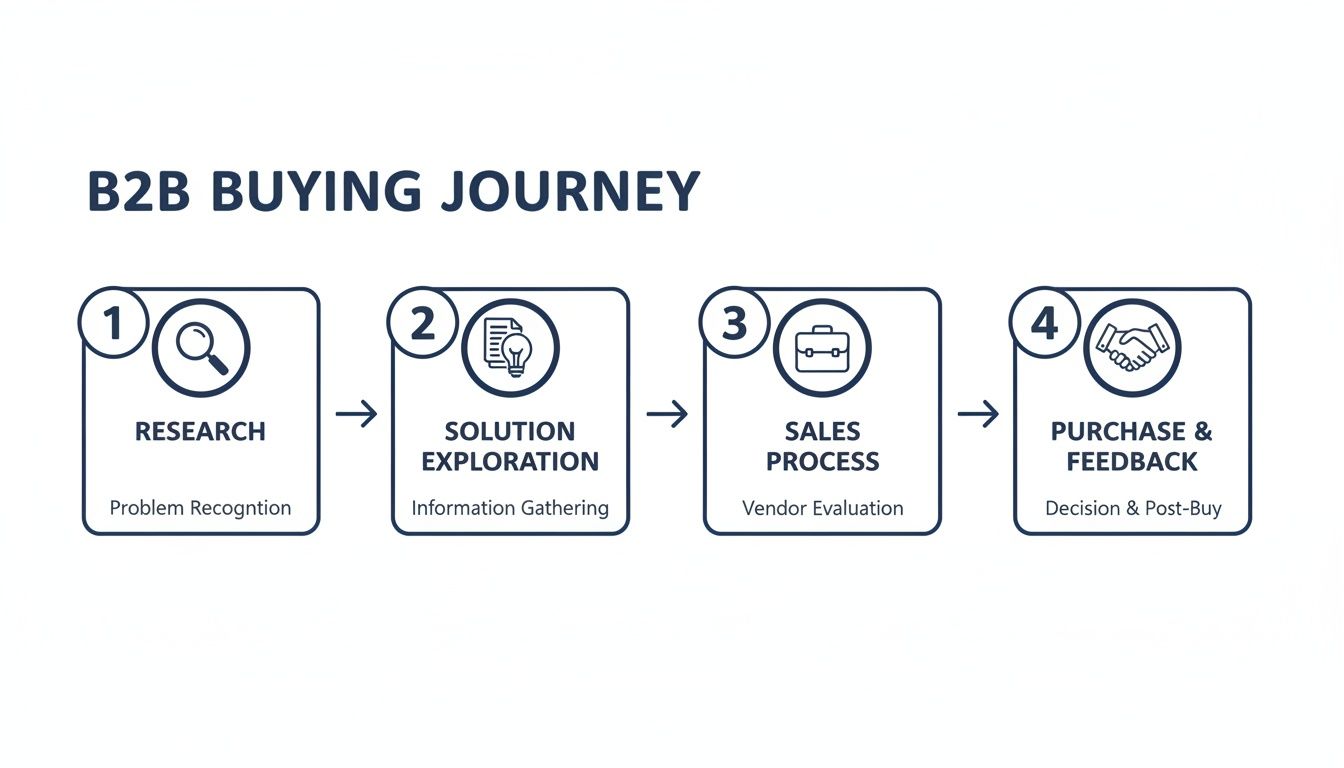
As you can see, a large part of their decision is made while they're still in the research phase, well before they enter your active sales process. Your job is to be a helpful resource during this phase.
4. Proposal and Presentation
Now that you have a deep understanding of the prospect's needs, you can present a solution tailored specifically for them. This is where you draw a straight line from their problem to your product, showing a clear and compelling return on investment (ROI).
A strong proposal isn't a generic brochure. It’s a custom plan of action that speaks directly to the challenges you uncovered during your discovery calls.
5. Overcoming Objections and Closing
Prospects almost always have questions or concerns—it’s a natural part of the buying process. This stage is about confidently addressing those objections, negotiating terms, and guiding the prospect to a final decision.
When you handle this stage well, you solidify trust right before the final agreement. The goal is simple: a signed contract and a new customer.
6. Post-Sale and Retention
The cycle doesn't end when the contract is signed. The final stage is about delivering a smooth onboarding experience, ensuring the customer gets the value you promised, and building a foundation for a long-term relationship.
Happy customers are your best asset. They lead to repeat business, powerful referrals, and invaluable case studies.
Mapping these stages is your first step. The next is to turn them into a functional system. For a deeper dive, check out our guide on how to build a sales pipeline that drives consistent growth.
Diagnosing Common Bottlenecks in Your Sales Process
Even with a perfectly mapped-out sales cycle, things can go wrong. If your pipeline is full of deals that never seem to move, it’s time to find out why. You need to diagnose where momentum is dying—the bottlenecks choking your revenue.
For most B2B and manufacturing companies, these problems are painfully familiar. Maybe you have a flood of unqualified leads. Or perhaps your proposals are met with radio silence. Each symptom points to a specific breakdown in your system. It's time to stop guessing and start diagnosing.
The True Cost of Stalled Deals
When a deal stalls, you’re not just losing time; you’re losing money. Time kills all deals. The longer a prospect lingers in your pipeline, the higher the chance they lose interest, face a budget cut, or get snapped up by a faster-moving competitor.
Sales velocity is everything. Data shows deals that close in under 50 days have a win rate of 47%. For deals that drag on longer, that rate plummets to just 20%. That gap can be the difference between hitting your quota and missing it completely.
With 57% of sales professionals reporting that sales cycles are getting longer—and many B2B manufacturing deals now stretching past a year—fixing these bottlenecks is not a luxury. It’s a matter of survival.
Finding the Problem to Build the Solution
To get your pipeline flowing again, you need a diagnostic mindset. Think of yourself as an engineer for your sales system—you must identify the symptom, diagnose the cause, and then apply the right fix.
Here’s a look at the most common bottlenecks we see, along with a straightforward framework for solving them.
Common Sales Cycle Bottlenecks and Their Solutions
This table breaks down typical problems, their likely causes, and what you can do about it right now.
| Symptom (The Bottleneck) | Likely Cause (The Diagnosis) | Actionable Solution |
|---|---|---|
| High lead volume, low qualification rate | Your marketing message is too broad, attracting unqualified leads, or your lead filtering is weak. | Sharpen your Ideal Customer Profile (ICP). Refine ad targeting and content to speak only to their specific pain points. Build a stronger filter using our guide on how to qualify sales leads. |
| Prospects go silent after the proposal | The proposal was sent too early before enough value was established. Or, it's a generic document that doesn't connect your solution to their exact problems. | Never send a proposal cold. It should be a written confirmation of a conversation you’ve already had. Get verbal agreement on the solution and price before you put it in writing. |
| Deals get stuck in negotiation for weeks | Key decision-makers weren't involved early enough. Your initial discovery missed crucial internal politics or buying processes. | Map out the entire buying committee during the discovery stage. Ask upfront: "Besides yourself, who else is involved in this decision?" Ensure you have buy-in from all stakeholders. |
| Long gap between a verbal "yes" and a signed contract | The final steps are unclear. Your contracting process is complicated, involving legal or procurement hurdles you didn't anticipate. | At the proposal stage, clearly outline the next steps: "Once you approve this, our next step is X, then Y." Use e-signature tools and have standardized, pre-approved contracts ready to go. |
By treating these symptoms methodically, you can stop plugging leaks and start building a pipeline that reliably closes deals.
How to Optimize and Shorten Your Sales Cycle
A stalled deal costs you more than time—it bleeds momentum and money from your business. Once you’ve diagnosed the bottlenecks in your sales process, it’s time to build a smarter, more efficient system that closes deals faster without sacrificing the quality of your client relationships.
This isn’t about moving faster; it's about moving with purpose. That means using the right tools and messaging to make every interaction count, eliminating administrative drag, and letting your sales team do what they do best: sell.
Automate Repetitive Tasks to Focus on Relationships
One of the quickest ways to shorten your sales cycle is to automate the manual, repetitive tasks that consume your team's day. Following up, sending reminders, and logging activities are necessary, but they shouldn't be where your team spends most of its time.
This is where a solid CRM with automation features, like GoHighLevel, pays for itself. You can build automated sequences that keep leads warm and engaged without anyone on your team having to lift a finger.
Our Approach: Automation isn't about replacing personal connection; it's about creating more time for it. By automating low-value tasks, your sales reps can pour their energy into high-value conversations, such as discovery calls and proposal walkthroughs.
For example, when a new lead fills out a form on your website, a good automation can instantly trigger:
- A personalized welcome email and SMS message.
- A follow-up email two days later with a useful resource, like a case study or a technical spec sheet.
- A task automatically created for a sales rep to make a personal call on day four if the lead hasn't responded.
This simple system ensures no lead goes cold because someone forgot to follow up. To see how to apply this, check out our detailed guide on how to automate sales process.
Sharpen Your Messaging and Calls to Action
Your website and marketing materials can do much of the heavy lifting, pre-qualifying prospects before they ever speak with your team. The secret is hyper-targeted messaging and crystal-clear calls to action (CTAs).
Stop trying to speak to everyone. Your website content, ads, and emails should speak directly to your ideal customer about their specific problems.
- For a manufacturer, your messaging should focus on production efficiency, reducing material costs, and improving supply chain reliability.
- For a B2B service provider, you should talk about ROI, time savings, and eliminating operational headaches.
When your message resonates, the right people will self-select and raise their hands.
Next, make it incredibly easy for them to take the next step. Vague CTAs like "Learn More" create confusion. Instead, use direct, action-oriented language that sets a clear expectation:
- "Get a Custom Quote in 24 Hours"
- "Schedule a 15-Minute System Diagnosis"
- "Download Your Free CNC Machine Checklist"
A well-optimized website with sharp messaging acts as a 24/7 qualification filter, ensuring that the leads who reach your sales team are already primed for a serious conversation. This simple shift can dramatically shorten your entire sales cycle.
Measuring What Matters: Key Sales Cycle KPIs

You can’t fix what you can’t measure. Optimizing your sales cycle without the right data is just guesswork—an expensive habit in B2B. The good news is you don’t need a mountain of metrics. A handful of core Key Performance Indicators (KPIs) will tell you nearly everything you need to know about the health of your sales process.
Think of these KPIs as the vital signs for your sales engine. They tell you what’s working, what’s broken, and where to focus your energy. When you track them consistently, you stop relying on gut feelings and start making decisions based on data.
The Takeaway: If a deal is a car, your sales cycle KPIs are the dashboard gauges. They’re your speedometer, fuel level, and engine temperature—all critical for making smart adjustments before you end up stranded.
Core KPIs for Every B2B Sales Cycle
To get a clear picture of your performance, start with these four fundamental metrics. Most modern CRMs can pull these numbers for you automatically, but understanding the "why" behind them is what turns data into insight.
Sales Cycle Length: The average number of days it takes to move from initial contact to a signed contract. A cycle that keeps getting longer is a huge red flag—a classic symptom of a new bottleneck. For many B2B firms, a healthy cycle is 60-90 days, though complex manufacturing deals can understandably stretch to 6-12 months.
Lead-to-Opportunity Conversion Rate: Of all the leads you generate, what percentage are qualified enough to become real, workable opportunities? This KPI is a direct report card on your lead generation quality. If your rate is low (e.g., under 10%), it’s a strong signal your marketing is attracting the wrong audience.
Deal Win Rate: Once you have a qualified opportunity, what are your chances of closing it? This is a direct measure of your team's effectiveness. A consistently low win rate might mean your proposals aren't compelling or your team needs better objection-handling training.
Customer Lifetime Value (CLV): This metric looks beyond the first deal, calculating the total revenue you can expect from a single customer over the entire relationship. A high CLV proves you’re building profitable, long-term partnerships, not just making one-off sales.
Putting Your KPIs Into Action
Once you begin tracking these numbers, patterns will emerge. For example, a low win rate paired with a long sales cycle is a classic indicator that deals are stalling and dying after the proposal stage. That’s a bottleneck you can immediately isolate and address.
For a holistic view, calculate your overall sales velocity. This formula combines your win rate, average deal size, and sales cycle length into a single number that shows how much revenue you’re generating per day. It’s the ultimate at-a-glance measurement of your sales engine’s output.
Your 90-Day Plan to a More Efficient Sales System
Understanding your sales cycle is one thing; fixing it is another. Knowledge without action is just trivia—it won't improve your bottom line.
This is where we get to work. Here is a practical, 90-day roadmap designed to overhaul your sales system. This isn't just a thought exercise; it’s the proof-of-concept framework we use to help our clients build real momentum and see results, fast.
We structure the work into three focused 30-day sprints. This makes progress manageable and creates a repeatable system you can use for sustainable growth.
Month 1: The Diagnosis and Mapping Sprint
The first 30 days are about getting an honest look at what’s really happening in your sales process. You can't fix a problem you don’t truly understand. The goal here is to establish a solid baseline so you can measure your progress and prove your efforts are working.
Your Month 1 Action Items:
- Map Your Current Sales Cycle: Get your team in a room with a whiteboard. Visually map every step a lead takes, from first contact to a signed deal. Define the exit criteria for each of the six core stages we covered.
- Gather Your Baseline KPIs: Pull the numbers. What is your current Sales Cycle Length, Lead-to-Opportunity Conversion Rate, and Deal Win Rate? You need these benchmarks.
- Interview Your Sales Team: This is crucial. Ask your reps where deals get stuck. What are their biggest frustrations? Where do they waste time on administrative tasks? Their frontline perspective is invaluable.
- Identify Your Top 3 Bottlenecks: Using the data and team feedback, pinpoint the three most significant chokepoints in your process. Is it slow lead follow-up? A messy proposal stage? Be specific.
Month 2: The Foundational Tools Sprint
With your diagnosis complete, Month 2 is about implementing the right tools to give you control and visibility. This is where you lay the foundation for the automation and efficiency that will transform your process.
Your Month 2 Action Items:
- Implement a CRM: If you don't have one, this is non-negotiable. We recommend GoHighLevel for its powerful, built-in automation. If you have a CRM, do a deep clean. Ensure the sales stages in the software perfectly match the map you created in Month 1.
- Build One Simple Automation: Create your first automated workflow. A great place to start is a "New Lead" sequence that sends a confirmation email to the lead and simultaneously creates a follow-up task for the assigned rep.
- Refine Your Lead Qualification Checklist: Turn your ICP into a concrete checklist inside your CRM. This enforces consistency and ensures every rep qualifies leads the same way.
Month 3: The Optimization and Measurement Sprint
With your foundation in place, Month 3 is dedicated to optimization and tracking progress. This is where you use data from your new CRM to make intelligent adjustments and double down on what’s working.
Your Month 3 Action Items:
- Review Your KPIs: Check the scoreboard. Compare your new Sales Cycle Length and conversion rates to your Month 1 baseline. Are deals closing faster? Is your win rate improving?
- Refine Your Automation: Analyze the performance of your first sequence. Check open rates and responses. Tweak email copy and adjust timing based on real data.
- Hold a Pipeline Review Meeting: With clean CRM data, you can finally have a meaningful pipeline review. Discuss stalled deals and strategize as a team on how to get them moving again.
- Plan Your Next 90-Day Sprint: Growth is a continuous process. Based on your results, identify the next set of bottlenecks and build a new plan to tackle them next quarter.
Your Top Sales Cycle Questions, Answered
Even with a perfect plan, real-world questions always come up. Here are the most common ones we hear from business owners trying to get a handle on their sales cycle, along with our direct answers.
What's the Difference Between a Sales Cycle and a Sales Funnel?
This trips many people up, but the distinction is simple.
Your sales cycle is your team's playbook—it’s the “how.” It describes the sequence of steps you take to move a deal from lead to close (e.g., Prospecting, Qualification, Proposal). It's your internal process.
A sales funnel is about the customer's journey—it’s the “how many.” It's a visual representation of how many prospects exist at each stage and, more importantly, where they drop off. The funnel shows the health of your pipeline and helps diagnose leaks.
How Often Should I Review My Sales Cycle?
We recommend a formal review every quarter. This is enough time to collect meaningful data on your KPIs and see if your efforts are paying off, but not so long that a small problem becomes a major one. It’s the perfect cadence to align strategy with what's happening on the ground.
That said, if you’ve just implemented a major change—like a new CRM or marketing campaign—you should check in monthly for the first 90 days. This allows you to fix issues and make quick adjustments before bad habits form.
A key clarification: Automation can hurt customer relationships, but only when it’s done poorly. The goal isn’t to replace human interaction; it’s to create more time for it.
Will Automating My Sales Process Hurt Customer Relationships?
This is a valid fear, but the answer is no—if you do it right. The key is to automate the repetitive, low-value tasks so your sales team has more time for the high-value, personal conversations that build relationships.
Use automation to send the first follow-up email, schedule reminders, or log activities. Let the system handle the administrative work so a good lead never falls through the cracks. This frees up your team to do what they do best: listen to customers, diagnose their problems, and build genuine trust. Automation should support your relationships, not become a cheap substitute for them.
Ready to stop guessing and start building a predictable sales system? At Machine Marketing, we help businesses diagnose their sales process, implement the right tools, and create a roadmap for growth. Book a discovery call today to get a clear, actionable plan for your business.