Are your marketing efforts feeling scattered and failing to bring in the leads you need? We see this constantly. The root cause is often hidden in plain sight: relying on one or two channels while your customers are active across many. To fix this, you need a system that meets buyers where they are.
This guide is your blueprint for building that system. We’ll diagnose the problem with single-channel dependency, give you a step-by-step framework for building a multi-channel marketing machine, and show you how to measure what truly matters. Let’s get started.
Your Guide to Multi Channel Marketing

So, what is multi-channel marketing, really? It's the practice of using several independent platforms to engage with your customers. Think of it like fishing: you cast one line in the lake (your website), another in the river (email), and a third in the ocean (social media). Each line works on its own, but together, they give you a far better chance of getting a bite.
Your customers aren't in just one place. They're researching on Google, connecting with colleagues on LinkedIn, and checking industry news in their inbox. A multi-channel system is built to meet them on those platforms, strategically placing your brand where your ideal buyers spend their time.
To see the transformation this offers, let's diagnose the differences between a multi-channel and single-channel approach.
Diagnosis: Multi-Channel vs. Single-Channel Marketing
The table below breaks down the fundamental differences in approach, risk, and outcomes. Ask yourself which column more accurately describes your current marketing operation.
| Aspect | Single-Channel Marketing (The Problem) | Multi-Channel Marketing (The Solution) |
|---|---|---|
| Approach | Focuses on perfecting one platform (e.g., only email or only social media). | Uses multiple, separate platforms to engage with customers where they are. |
| Customer Reach | Limited to the audience on that single platform. | Broader reach, meeting customers on various platforms they frequent. |
| Brand Exposure | Repetitive exposure on one channel; risk of audience fatigue or being ignored. | Multiple touchpoints build familiarity and trust across different contexts. |
| Risk Factor | High risk; if the channel's algorithm changes or costs rise, leads can dry up. | Diversified risk; underperformance on one channel is offset by others. |
| Customer Journey | Linear and restrictive; forces the customer down one path. | Offers multiple, independent paths for customers to discover and engage. |
As you can see, a multi-channel framework isn't just about adding more platforms; it's a strategic pivot to build a more resilient and effective marketing system.
Why This Approach Is No Longer Optional
Relying on a single channel is like building your entire business on rented land. If the rules change or costs spike, your lead flow can vanish overnight. A multi-channel system diversifies your efforts and creates multiple touchpoints, which is essential for building the trust needed in complex B2B and manufacturing sales cycles.
The data confirms this. B2B buyers now use 10 or more channels to inform their decisions—a massive jump from just five a few years ago.
This shift isn't just a trend; it's a massive economic force. The multi-channel marketing market is projected to hit $14.66 billion by 2026, growing at a 25.8% CAGR. You can explore more findings on multi-channel market growth to see the full scope. The message is clear: companies that master this will grow, while those in single-channel silos risk being left behind.
This isn't about being on every platform imaginable. It's about being on the right platforms to make it easy for ideal customers to find you, learn from you, and choose to do business with you.
The Critical Difference: Multi-Channel vs. Omnichannel
It’s easy to use “multi-channel” and “omnichannel” interchangeably. Many business owners do. But this common mix-up leads to broken strategies and wasted money, because the difference defines the entire goal of your marketing system.
To put it simply:
- Multi-channel marketing is about being present on multiple platforms. The channels operate independently.
- Omnichannel marketing is about creating one unified, seamless customer experience across all those platforms. The channels work together.
Think of multi-channel as your "what" (the channels), while omnichannel is your "how" (the way they connect).
A Question of Experience vs. Channels
Let’s use a department store analogy to diagnose the difference.
A multi-channel approach is like having separate, walled-off departments. Shoes are over here, clothing is over there, and accessories are on another floor. Each department runs its own show. A customer can visit them all, but the experience is disconnected.
An omnichannel approach is like giving that customer a personal shopper. The shopper knows the customer’s tastes, remembers they just looked at a specific pair of shoes, and can now recommend the perfect outfit to match. The journey is connected, intelligent, and built around the customer.
The numbers don’t lie: companies with strong omnichannel strategies retain 89% of their customers, a stark contrast to the 33% retention for businesses with weak execution. What’s more, customers engaged through an omnichannel experience have a 30% higher lifetime value. You can learn more about these omnichannel engagement statistics and see for yourself why integration is such a powerful business driver.
The Right Foundation: Start with Multi-Channel First
So, should you aim for a perfect, all-knowing omnichannel system from day one? For most businesses, the answer is a hard no. Trying to build a fully integrated "personal shopper" experience before you’ve even set up your individual "departments" is a recipe for failure.
The most practical path is to build it piece by piece.
- Start with Multi-Channel: First, focus on mastering a few key channels independently. Get your email marketing dialed in. Build a real presence on LinkedIn. This is the foundational work you can't skip.
- Evolve to Omnichannel: Once individual channels are pulling their weight, you can start wiring them together. This is where you use a CRM to track interactions across platforms, letting your email campaigns reflect what a lead just did on your website.
This phased approach sets realistic goals and builds your marketing system on solid ground. You first master multi-channel marketing in practice, then start weaving the channels together into a stronger, more intelligent system.
Choosing Your Core Channels for B2B and Manufacturing
Trying to be everywhere at once is a fast track to burning out your team and your budget. The goal isn’t to cast the widest net; it’s to choose the right channels where your buyers—engineers, procurement managers, and C-suite decision-makers—actually spend their time.
A smart multi-channel system isn't about using every tool. It’s about picking the right tool for the job. Let's break down the platforms that truly matter for industrial companies and define the specific role each one plays.
Digital Headquarters: Your Website + SEO
Your website is your company's digital headquarters. It’s the only channel you fully control, and it should be the central hub where all other marketing activities point back to. When a prospect finds you on LinkedIn or gets an email, their next move is almost always a visit to your site.
The primary job of your website is to establish credibility and provide deep, valuable information. This is where you house case studies, detailed product specs, and technical white papers. But an incredible website is worthless if no one can find it.
This is where Search Engine Optimization (SEO) comes in. SEO is the engine that makes your website visible to people actively searching on Google for the solutions you provide. For a manufacturer, that means ranking for specific, high-intent phrases like “CNC machining for aerospace parts.” A well-optimized site acts as your best salesperson, working 24/7 to bring qualified leads to your door.
Professional Networking & Prospecting: LinkedIn
For any B2B company in the manufacturing or industrial space, LinkedIn is non-negotiable. It’s far more than "social media"—it's a massive digital trade show floor combined with a powerful prospecting database.
Here’s how to use it in your system:
- Targeted Prospecting: Use LinkedIn to pinpoint and connect directly with key decision-makers at your ideal target companies. You can filter by job title, industry, and company size.
- Building Authority: When you share content that solves real problems for your audience—like an article on boosting production efficiency or a guide to selecting the right material—you position your company as an expert.
- Driving Website Traffic: Every post and profile link should be a signpost guiding interested prospects back to your digital headquarters—your website. Our guide on using social media for lead generation offers practical steps you can use today.
Relationship Nurturing: Targeted Email Marketing
Once you've captured a lead’s attention through your site or LinkedIn, email marketing becomes your workhorse for building that relationship. Email is your direct, personal line of communication for staying top-of-mind during long B2B sales cycles.
The real power of email isn't in blasting promotions to a giant, faceless list. Its value comes from segmentation and relevance. By sending the right information to the right people at the right time, you build trust and gently guide them toward a sale.
For instance, a new lead who downloads your white paper on a specific polymer shouldn't get a generic company newsletter. They should get a follow-up sequence with more information related to that material. This targeted approach shows you were listening and understand their specific challenges.
Local Visibility & Trust: Google Business Profile
Never underestimate the power of your Google Business Profile (GBP). For manufacturers serving a regional customer base or offering local services like equipment repair, your GBP is a mission-critical channel. It's often the very first impression a potential local buyer has of your business.
An optimized GBP—with your correct address, hours, services, high-quality photos, and positive reviews—is a massive trust signal to Google. It proves you're a legitimate, active local operator, which dramatically boosts your visibility in local search results and on Google Maps, helping nearby customers find you the moment they need you.
How to Build Your Multi-Channel Marketing System
A powerful multi-channel marketing strategy doesn’t just happen. It’s built, piece by piece, on an intentional foundation. Let's break down how to turn this idea into a manageable project that gets results.
Step 1: Establish Your Single Source of Truth (CRM)
Before you write a single post or email, you must get your data house in order. This is where a Customer Relationship Management (CRM) platform becomes the brain of your marketing operation.
A good CRM connects all the dots—tracking a lead’s activity on your website, their engagement on LinkedIn, and their response to your emails. It turns isolated actions into a coherent customer story. Platforms like GoHighLevel are built for this, combining a powerful CRM with marketing automation tools.
This unified dashboard is the foundational layer that makes a true multi-channel system possible. Without it, you're just running disconnected campaigns.
Step 2: Define Your Ideal Customer and Audit Your Channels
You can't sell to someone you don't understand. The next step is to build a detailed Ideal Customer Profile (ICP). Go deeper than job titles and company size to diagnose their real-world problems.
Ask yourself these questions:
- What are their biggest professional challenges? What operational headaches or business roadblocks are they dealing with daily?
- Where do they look for information? Are they in specific LinkedIn groups, reading certain industry journals, or attending webinars?
- What triggers their search for a new vendor? Pinpoint the exact pain points that push them to start looking for a solution like yours.
Once you know who you’re talking to, do an honest audit of your current channels. What's working? What's a waste of time? This is about diagnosis, not judgment. If you’re spending hours on a platform bringing zero leads, you need to know that so you can reallocate those resources.
Step 3: Select and Integrate Your Core Platforms
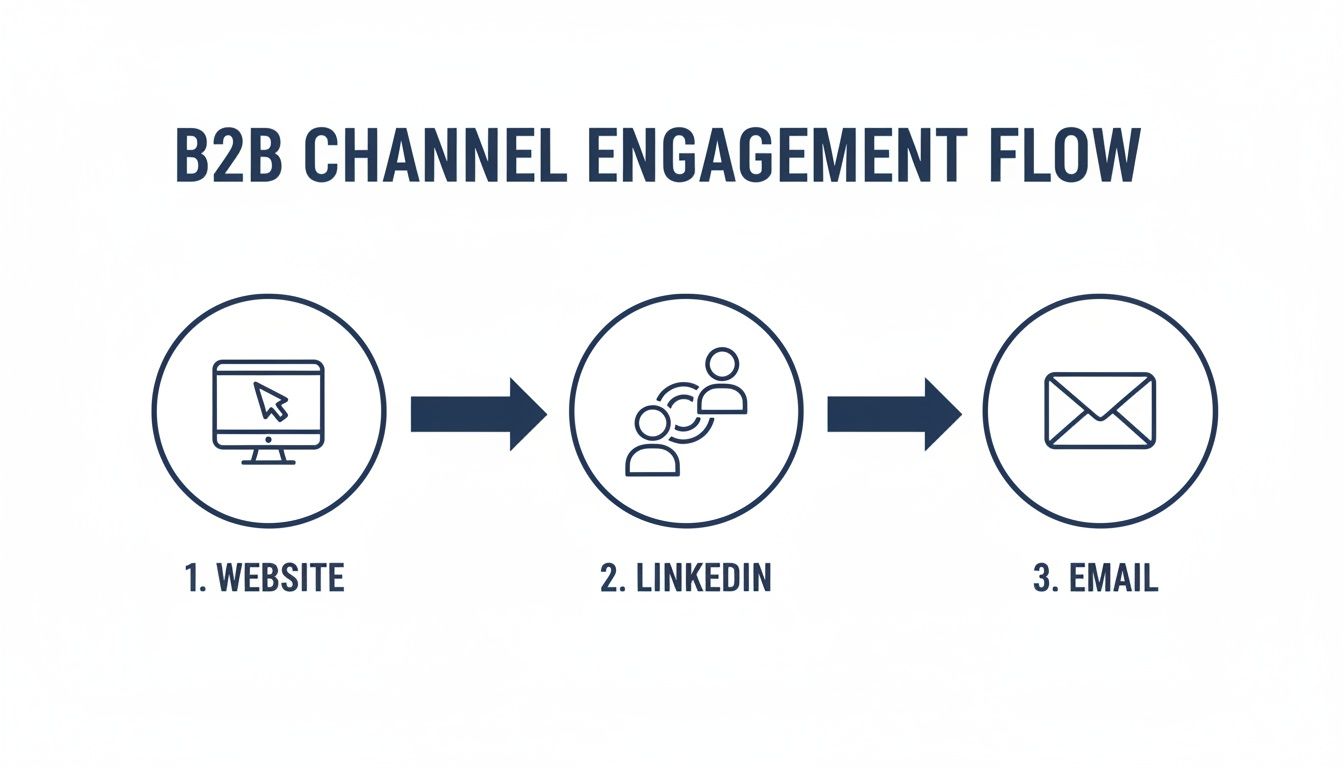
Now, based on your ICP research, pick 2-3 core channels to focus on. Don't try to be everywhere. For most B2B and manufacturing companies, a powerful starting combination is your website (fueled by SEO), LinkedIn, and email marketing.
These three channels work together to create a simple but effective engagement flow.
A prospect might discover you on LinkedIn, head to your website to learn more, and then receive targeted follow-up emails—all tracked seamlessly by your CRM. A well-constructed marketing technology stack is what unifies your data and streamlines campaigns. If you need help choosing the right tools, our guide to building a marketing technology stack is a great place to start.
This integration is where the transformation begins. When a form fill on your website automatically triggers a nurture sequence in your CRM, you’ve officially built a marketing system, not just a collection of tactics.
Step 4: Create a Simple, Problem-Solving Content Plan
Finally, map out a content plan that serves your audience on your chosen channels. Don’t overcomplicate this. Your goal is to create valuable, problem-solving content that builds trust and pulls prospects back to your website.
Your content plan should be built around answering the questions your ideal customers are already asking. Start with a few core topics and create different formats for each channel—a detailed article for your blog, a summary post for LinkedIn, and a quick tip for your email newsletter.
By following these steps, you’re not just doing marketing. You’re building a resilient, predictable, lead-generating machine.
Measuring the Metrics That Actually Matter
You can't improve what you don't measure. But in multi-channel marketing, it’s dangerously easy to get lost in a sea of "vanity metrics"—like social media likes or impressions—that feel good but don't tell you if your system is actually making you money.
To truly diagnose performance, you have to track the Key Performance Indicators (KPIs) that connect directly to business growth. Your goal is to see exactly how marketing efforts translate into real leads and sales.
Core Business Metrics for Your Marketing System
These are the numbers that justify your marketing spend and prove your strategy is working. We recommend tracking these inside a central hub like GoHighLevel, which pulls all your data into one clear view.
- Customer Acquisition Cost (CAC): Your bottom-line number. It’s the total cost of your marketing and sales efforts to land one new customer. If your CAC is climbing, it’s a red flag that a channel is underperforming.
- Customer Lifetime Value (LTV): This forecasts the total revenue you can expect from a single customer over your relationship. A healthy business has an LTV that is significantly higher than its CAC—ideally by a ratio of 3:1 or more.
- Lead-to-Customer Conversion Rate: What percentage of your qualified leads actually become customers? This KPI is a direct reflection of how well your marketing and sales teams are working together.
These big-picture metrics provide a high-level diagnosis of your entire multi-channel engine. They help you answer the most important question: "Is our marketing investment generating a positive return?" To really dig in, it’s critical to understand what is marketing attribution and how different models can shape your insights.
Channel-Specific KPIs to Watch
Once your core business metrics are in place, you can drill down to diagnose how each channel is performing. Focus on the 2-3 metrics that matter most for each platform.
Website & SEO (via Google Analytics)
- Conversion Rate: The percentage of visitors who complete a goal, like filling out a quote request or downloading a spec sheet. This is the ultimate measure of your website's effectiveness.
- Cost Per Lead (CPL): If you're running paid ads, CPL tells you exactly how much you're spending to generate each new lead.
- Organic Traffic from High-Intent Keywords: Are you attracting visitors who are actively searching for what you sell? Tracking your rank for "buying" keywords shows if your SEO is connecting with qualified prospects.
Email Marketing (via GoHighLevel)
- Click-Through Rate (CTR): This shows how many people clicked a link in your email. It’s a far better indicator of engagement than open rates.
- Conversion Rate from Email: How many people who clicked a link went on to become a lead or a customer? This ties your email activity directly to revenue.
Social Media (e.g., LinkedIn)
- Website Clicks: How many people are leaving the social platform to visit your website? This measures whether your content is driving prospects toward your digital headquarters.
- Engagement Rate on Problem-Solving Content: Are your ideal customers commenting on or sharing your educational posts? This tells you you're building authority and trust.
By focusing on this curated set of metrics, you cut through the noise. You can confidently diagnose what’s working and make smart, data-driven decisions to keep your multi-channel marketing system firing on all cylinders. Learn more in our guide on what is marketing analytics.
Your First 90 Days: A Multi-Channel Action Plan

Theory is one thing, but results come from action. It's time to put this framework to work with a tangible, 90-day roadmap. We've broken the process into three 30-day sprints to help you build momentum and score early wins without getting overwhelmed.
The goal isn't perfection; it's progress. Follow these steps to lay the foundation for a predictable, lead-generating machine.
Month 1: Foundation and Diagnosis
Your first 30 days are about building your infrastructure and getting a crystal-clear picture of your starting point. You can't build a strong system on a shaky foundation.
Your Month 1 Action Checklist:
- Set Up Your CRM: This is non-negotiable. Implement a CRM like GoHighLevel to serve as your single source of truth for every customer interaction. All roads lead back here.
- Define Your Ideal Customer Profile (ICP): Document their biggest pain points, day-to-day challenges, and the specific triggers that make them search for a solution like yours.
- Conduct a Channel Audit: Take an honest inventory of your current marketing channels. What’s working? What’s a ghost town? Identify where your ICP truly spends their time online.
Month 2: Activation and Content
With your foundation in place, it’s time to activate. In month two, you'll launch your presence on one or two core channels and start creating content that actually helps people. The key is to start small and focus on quality.
Your objective here is not to be everywhere, but to be excellent where it counts. Starting with a focused effort on LinkedIn and email, for instance, allows you to master a simple system before adding complexity.
Your Month 2 Action Checklist:
- Launch on 1-2 Core Channels: Based on your ICP research, focus your energy where it matters most. For many B2B businesses, this means optimizing your LinkedIn company page and the profiles of your key team members.
- Create Your First Content Pillars: Develop 2-3 cornerstone pieces of content that solve a major problem for your ICP. This could be a detailed blog post, an in-depth "how-to" guide, or a powerful case study.
- Build Your Initial Email Nurture Sequence: Write a simple 3-5 part email series to automatically follow up with new leads. The goal is to build trust and educate, not to hard-sell.
Month 3: Optimization and Measurement
In the final phase of your first 90 days, your focus shifts from building to optimizing. You now have initial data flowing into your CRM, which means you can start making informed decisions instead of guessing. This is where you begin the cycle of reviewing, tweaking, and improving.
Your Month 3 Action Checklist:
- Review Initial KPIs: Dive into your first month of real data in your CRM. What was the click-through rate on your emails? How much engagement did your LinkedIn posts get? Look at the real numbers.
- Tweak and Adjust: Use that data to make small, smart adjustments. If one type of content massively outperformed another, double down on it. Was an email subject line a dud? A/B test a new one.
- Establish a Reporting Rhythm: Block out a recurring time each week or month to review your dashboard. Make this a non-negotiable part of your routine to ensure continuous improvement.
By the end of this 90-day plan, you won't just have a strategy—you'll have a functioning multi-channel marketing system, primed for sustainable growth.
Common Questions About Multi-Channel Marketing
We work with business owners every day, and we hear the same practical questions time and again. Here are the direct, no-fluff answers to help you move forward with clarity.
How many channels are enough for a small business?
You don't need to be everywhere. You just need to be where your customers are.
For most small B2B or manufacturing companies, starting with two or three core channels isn't just enough—it’s the smart move. A powerful starting point includes:
- Your Website (SEO-optimized): Your central hub. Non-negotiable.
- Email Marketing: Your workhorse for turning leads into customers.
- LinkedIn: The premier platform for B2B prospecting and authority-building.
Master these three first. Once you have a smooth system that is generating provable results, you can use data to decide if and where to expand. The key is always quality over quantity.
Is multi-channel marketing too expensive for a small budget?
That's a fair question, but this approach is often far more cost-effective than dumping your entire budget into a single channel like paid ads. When you diversify, you build a more resilient business. If one channel's costs skyrocket, the others are there to keep leads flowing.
The secret is to start small and focus on activities with a high ROI. Things like SEO and content marketing build long-term, compounding value without the massive recurring ad spend.
Modern platforms also consolidate costs. A system like GoHighLevel can combine the functions of a CRM, email marketing tool, and more into one subscription, drastically cutting your software bill. The return from better customer retention and higher conversion rates almost always outweighs the initial cost.
How do I keep my branding consistent across channels?
Consistency is the foundation of trust. If a prospect sees one version of your brand on LinkedIn and a different one on your website, it creates confusion. Luckily, maintaining a cohesive presence is straightforward.
Start by creating a simple Brand Style Guide. This doesn't need to be a hundred-page book. Just document the basics:
- Logo Usage: Clear rules on how and where your logo appears.
- Brand Colors: Your primary and secondary color hex codes.
- Brand Fonts: The specific fonts for headings and body text.
- Brand Voice: A few keywords to describe your tone (e.g., direct, helpful, expert).
Keep this in a shared document your whole team can access. Use a central content calendar to plan your core messages. This ensures the main story stays the same, even as you tweak the format for each channel.
What is the first step I should take today?
The single most important action you can take is to establish a "single source of truth" for all your customer data. In plain English, that means setting up your CRM.
Before you launch another channel or write a single email, you need one system to capture, organize, and track every lead and interaction. Without a CRM, your efforts will become a mess of disconnected spreadsheets and lost information. You won’t know if the person who filled out your website form is the same one you connected with on LinkedIn.
Starting with this foundation ensures every action you take from here on out is measurable, scalable, and contributes to a unified view of your customer. It’s the real first step in building a marketing machine that works.
Ready to stop guessing and start building a predictable marketing system? At Machine Marketing, we specialize in diagnosing growth gaps and implementing practical, results-driven strategies for B2B and manufacturing companies. Book a discovery call with us today to get a clear roadmap for your business.