So, what exactly is a Sales Qualified Lead (SQL)? It’s a potential customer who has been researched and vetted—first by your marketing, then by your sales team—and confirmed to be ready for a direct sales conversation. This isn't just a contact showing casual interest; it's a prospect with clear, legitimate intent to buy.
The Real Cost of a Pipeline Full of Bad Leads
Is your sales team always busy but revenue is flat? Their effort probably isn't the problem. The real issue? The quality of the leads filling their pipeline. We see this all the time: B2B and industrial companies with pipelines clogged with prospects who aren’t ready to make a move. This misalignment causes friction, wastes resources, and slowly strangles your growth.

Let’s diagnose this from an engineering perspective. Your sales process is a high-precision machine. You start with raw materials (leads) that must go through several stages of refinement. A Sales Qualified Lead is the perfectly milled, finished part—inspected for quality and ready for the customer. Anything less is just raw material.
Sending an unqualified lead to your sales team is like handing a rough block of steel to your finishing department. You're forcing your most valuable and expensive resource—your sales experts—to do the basic shaping and cutting that should have happened much earlier in the process.
Diagnosing the Problem in Your System
The cost of poor lead qualification for B2B companies is staggering. Research shows that a whopping 67% of lost sales happen because sales reps don't qualify their prospects properly from the start. You can explore the full findings on lead qualification to see the full impact. This is why a solid qualification framework is an investment, not an expense.
If you don't have a clear definition for a Sales Qualified Lead, you're probably seeing these symptoms:
- Wasted Sales Hours: Your team burns time educating contacts who have no budget, authority, or immediate need.
- Inaccurate Forecasting: Your pipeline looks full, but it's bloated with low-quality opportunities, causing you to miss revenue targets again and again.
- Friction Between Teams: Marketing celebrates hitting lead volume goals while sales complains about the terrible quality, creating a frustrating cycle of blame.
- Longer Sales Cycles: Deals drag on forever because the initial qualification was skipped, forcing your reps to start from square one.
A rigorous qualification system isn't a bottleneck; it's the most critical filter in your growth machine. It ensures that your sales team's valuable time is spent only on opportunities with a high probability of closing.
When you look at it this way, the problem isn't a lack of leads. It's the lack of a system to find the right leads. The solution is to build a clear, shared definition of a Sales Qualified Lead and lock in a process to identify them. Once you do that, you transform your sales pipeline from a cluttered workshop into a streamlined assembly line for revenue.
The Critical Difference Between MQLs and SQLs
Confusing a Marketing Qualified Lead (MQL) with a Sales Qualified Lead (SQL) is one of the most common—and expensive—mistakes a business can make. It’s like confusing a person browsing your online catalog with someone who’s standing at the checkout counter, credit card in hand.
Both individuals are valuable, but you need to treat them in completely different ways.
The difference boils down to one simple concept. An MQL signals interest. This is someone who has engaged with your marketing content, showing they’re curious about the problems you solve. They’re essentially asking, "What is this?"
An SQL, on the other hand, signals intent. This person has taken specific, high-value actions that tell you they’re actively considering a purchase. They’re ready for a sales conversation and are now asking, "How can I buy this?"
When you get this wrong, it creates massive inefficiency. Your expert sales team wastes time trying to nurture lukewarm leads, while your marketing team gets frustrated that their hard-won prospects aren't turning into revenue. Drawing a clear line between these two stages is the secret to building a scalable growth engine where each team does what it does best.
From Interest to Intent: The Lead Journey
So, how does a prospect make that leap from casual interest to serious buying intent? It happens by tracking their “digital body language”—the trail of actions they take as they interact with your brand online.
Initially, a lead might become an MQL by taking actions like:
- Downloading a whitepaper or guide: They are in the research phase, exploring a problem your business solves.
- Subscribing to your newsletter: They want to stay informed about your industry and what you have to offer.
- Attending an educational webinar: They’re gathering information and looking at potential solutions.
These actions show engagement, but not necessarily a desire to buy right now. This is where your marketing team should shine, nurturing this interest with helpful content until the lead becomes a sales qualified lead.
A Sales Qualified Lead (SQL) is an MQL who has been vetted and confirmed by your team to have a specific need, the budget to solve it, and the authority to make a purchasing decision within a reasonable timeframe.
This transition from MQL to SQL is where many sales pipelines break down. While the lead-to-MQL conversion rate can average a healthy 31%, the real challenge is that only 5-15% of those MQLs typically convert into an SQL. You can discover more insights about generating sales-qualified leads and see just how critical it is to get this stage right.
MQL vs SQL: A Practical Comparison
To make this distinction crystal clear for your teams, you need a shared reference point. This table breaks down the core differences in mindset, actions, and how your team should respond.
| Characteristic | Marketing Qualified Lead (MQL) | Sales Qualified Lead (SQL) |
|---|---|---|
| Primary Signal | Interest: "I'm learning." | Intent: "I need to solve a problem." |
| Common Actions | Downloads a guide, attends a webinar, subscribes to a blog. | Requests a demo, asks for a quote, visits the pricing page multiple times. |
| Typical Mindset | Problem-aware, exploring solutions. | Solution-aware, evaluating specific vendors. |
| Who Owns It? | The marketing team is responsible for nurturing. | The sales team is responsible for direct engagement and closing. |
| Next Step | Nurture with educational content (emails, case studies). | A sales rep should follow up within hours for a discovery call. |
When your marketing team focuses on building interest and your sales team focuses solely on closing deals with high-intent prospects, you create a powerful system. This separation of duties prevents pipeline friction and ensures every lead gets the right attention at the right time.
Defining a Sales Qualified Lead for Your Business
Let's get practical. What does a “sales qualified” lead actually look like for your business? At its core, an SQL is a prospect your team has researched and confirmed is ready for a direct sales conversation.
This isn’t just someone who downloaded a whitepaper. An SQL is a contact who has been actively confirmed to meet a specific, pre-agreed set of criteria. This step acts as the critical bridge between marketing's wide-net casting and sales' high-precision spear fishing.
Building Your Qualification Framework
To stop guessing and start standardizing, you need a framework. One of the most durable and straightforward models is BANT, which stands for Budget, Authority, Need, and Timeline. It fits perfectly in the B2B world, especially for manufacturing and industrial services.
Think of BANT as the foundation for your qualification checklist. Here’s how you can translate it into real-world questions:
- Budget: Does this prospect have the financial means to buy your solution? You're not looking for an exact dollar amount on the first call, but you need to know if they're in the right ballpark.
- Authority: Are you speaking with the final decision-maker? Or are they an influencer who needs to get buy-in from someone else?
- Need: What specific, urgent pain point are they trying to fix? A clearly defined need is the engine of any sale.
- Timeline: When are they planning to implement a solution? Understanding their urgency helps you prioritize your hottest opportunities.
The goal is to create a standardized checklist based on these pillars. This gives everyone, from marketing to sales, a single source of truth for what a high-value opportunity is.
An SQL isn't just a contact; it's a diagnosed opportunity. The BANT framework acts as your diagnostic tool, confirming the health and viability of a lead before it consumes your sales team's valuable time.
From Framework to Actionable Questions
Turning the BANT framework into a real tool means giving your team the right questions to ask. These aren't just for a discovery call; they can be integrated right into your "Request a Quote" form to help pre-qualify leads automatically.
The screenshot below shows a great visual of this concept, where a lead must clear certain hurdles to be considered sales-ready.
This image drives home a core idea: an SQL must hit a minimum set of conditions tied to their company profile and their recent actions. To dial this in, you need to master the practical steps of lead qualification. There are many great guides on how to qualify sales leads that can help you refine your process even further.
Here are a few sample questions you can adapt for your own BANT-based checklist:
Questions to Ask Yourself to Determine SQL Readiness
- Need:
- "What's the specific challenge they're hoping to solve right now?"
- "What are the consequences if they don't find a solution in the next quarter?"
- Budget:
- "Have they allocated a budget for this initiative?"
- "So we can recommend the right solution, what budget range are they working with?"
- Authority:
- "Who else on their team will be involved in evaluating this?"
- "What does their company's typical purchasing process look like?"
- Timeline:
- "What's their ideal timeline for getting a solution up and running?"
- "Are there any upcoming projects or deadlines driving this need?"
By arming your team with these questions, you build a repeatable system. It takes the guesswork out of lead qualification and makes it a measurable, predictable part of your sales engine.
How to Build Your Lead Scoring System
How do you find SQLs at scale without manually reviewing every single contact? You build an automated system to do the heavy lifting.
A lead scoring system is the machine that separates the merely curious from the genuinely interested. It works in the background, assigning points to leads based on who they are and what they do. Once a lead’s score hits a certain number, they’re automatically flagged as an SQL, and your sales team gets an alert to engage.
The Two Pillars of Lead Scoring
Your scoring model will stand on two critical pillars: demographic data (how well they fit your ideal customer) and behavioral data (the actions they take). A great lead scores high in both categories. A bad-fit lead, even if highly engaged, probably isn't worth a sales call.
Here’s how to build out each side of your system.
1. Demographic and Firmographic Scoring (Who They Are)
This is all about fit. You give points based on how closely a lead matches your ideal customer profile.
- Job Title: A VP of Operations or Plant Manager is a great sign. Give them +15 points. An Intern? -10 points.
- Company Size: If your sweet spot is companies with 50-200 employees, assign +10 points to leads in that range.
- Industry: A lead from a target industry like "Metal Fabrication" could be worth +20 points. A contact from an unrelated field gets 0 points.
- Location: If you only serve a specific region, assign points to leads inside your territory and zero to those outside.
2. Behavioral Scoring (What They Do)
This part is all about intent. You assign points for actions that show a lead is moving from passive interest to active consideration.
- Requesting a Quote or Demo: This is the clearest buying signal. Assign +30 points.
- Visiting Your Pricing Page: They're evaluating the investment. That’s a strong signal worth +15 points.
- Downloading a Bottom-of-Funnel Case Study: They're looking for proof that you can deliver. Add +10 points.
- Opening a Sales Email: A simple but important sign of engagement. Give them +3 points.
- Unsubscribing from Your Newsletter: This is a negative signal. Subtract -5 points.
When you combine these two scores, you get the full picture. A Plant Manager (high demographic score) who requests a quote (high behavioral score) is an immediate, red-hot SQL ready for a call.
Setting the SQL Threshold
Once you have your point values, you need to decide on the magic number—the total score that officially turns a lead into an SQL. This isn't a random guess; it should be based on your data.
Look back at your last 10-20 closed-won deals. Score them manually using your new system. What was their average score? Now, do the same for 10-20 deals you lost. The goal is to find a number that consistently separates your best customers from the rest.
Rule of Thumb: A good starting point is to set your SQL threshold at a score that 80% of your past customers would have met. If most of your best customers would have scored 75 or higher, then 75 is your threshold.
You can then set up an automation in your CRM, like GoHighLevel, to:
- When a lead’s score surpasses 75 points, change their status to “Sales Qualified Lead.”
- Automatically create a task for the assigned sales rep to follow up.
- Send an instant notification to your sales team via email or Slack.
The infographic below shows how the core components of a qualification framework like BANT often drive these scoring rules.
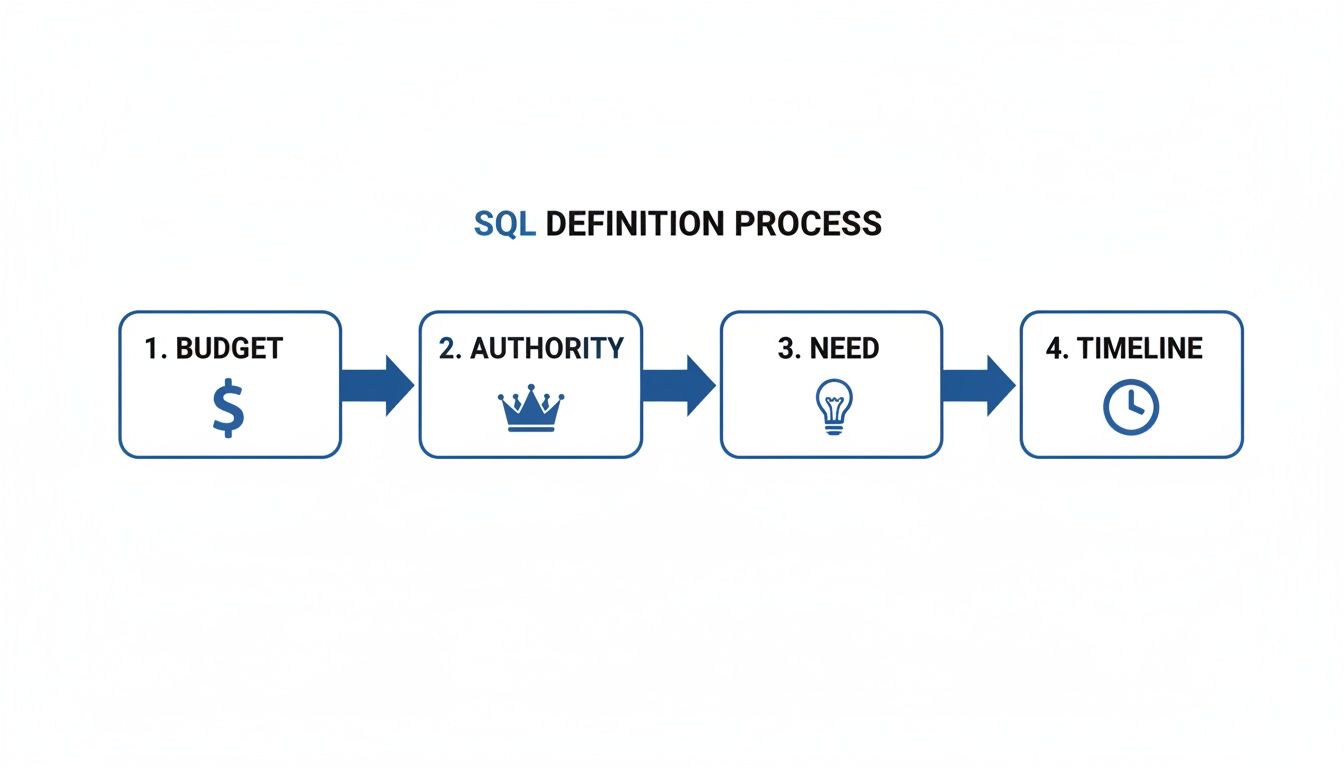
This flow shows the hurdles a lead needs to clear to be truly sales-ready, a process your scoring system helps automate. For more practical tips, our team has put together a great resource on how to qualify sales leads.
An automated system doesn't just make your team more efficient; it makes them smarter. It ensures every minute a salesperson spends is with someone vetted for both fit and intent.
Creating a Seamless Handoff from Marketing to Sales
Pinpointing an SQL is a major milestone, but it’s only half the job. All that hard work can evaporate if the handoff from marketing to sales is clumsy. A deal's momentum is fragile, and a poor transition can kill it before your sales team even makes the first call.
You need a clear, repeatable Standard Operating Procedure (SOP) to pass an SQL from one team to the other without losing critical context or speed.
Think of it like a relay race. Your marketing team just ran a brilliant leg, building up speed. The handoff to the sales team has to be perfect to keep that momentum. If the baton gets dropped—meaning information is lost or the transfer is delayed—that warm lead can go cold in just a few hours.
Building Your Handoff SOP
For a clean transfer to happen, your sales team needs the full story behind the lead. You need to arm your sales reps with the intelligence required to have a relevant conversation from the very first minute. This is where your CRM becomes the central nervous system of your operation.
When a lead hits the SQL threshold, your CRM should automatically package up a detailed brief and deliver it to the right sales rep. That handoff absolutely must include:
- Complete Lead Score Breakdown: Don't just show the final number. Show how they got that score, detailing both the demographic and behavioral points they earned.
- Full Engagement History: Which emails did they open? What product pages did they spend time on? This context is pure gold for a salesperson.
- Original Lead Source: Knowing if they came from a trade show, a Google search, or a referral completely changes the opening line of the conversation.
- Qualification Notes: Any specific details gathered from forms or initial chats—like a budget range or project timeline—are essential.
The Power of a Service Level Agreement
To keep everyone on the same page and make sure no lead falls through the cracks, you need to formalize the rules of engagement between marketing and sales. The tool for this is a Service Level Agreement (SLA). An SLA is a straightforward document that clearly defines the expectations for both teams.
While you can read up on the full structure of Service Level Agreements, your version should at a minimum outline:
- Lead Acceptance Criteria: The exact, agreed-upon definition of an SQL. No ambiguity.
- Response Time: How quickly must sales follow up with a new SQL? (Best practice is under one hour).
- Follow-Up Cadence: The specific number and frequency of contact attempts sales will make before a lead is marked as unresponsive.
- Lead Rejection Process: A clear protocol for sales to "return" a lead to marketing with direct, actionable feedback if it's not a good fit.
An SLA isn't about creating corporate red tape. It's an engineering document for your revenue engine, designed to eliminate friction and ensure every component works together perfectly.
This structured approach is why building a solid qualification system is so crucial. The performance justifies the effort—SQLs consistently convert to customers at an impressive 20-30% rate. In manufacturing and B2B, that kind of efficiency is non-negotiable.
How to Measure and Optimize Your SQL Pipeline
A system is only as good as the results it produces. Now that you've built your qualification, scoring, and handoff process, the real work begins: measuring what’s working and what isn’t.
Tracking the health of your Sales Qualified Lead pipeline is how you stop guessing and start making data-driven improvements. This is where you diagnose problems early and find opportunities to get better every single week.
Key Metrics for Your SQL Dashboard
It’s time to move beyond just counting leads. To get a real picture of performance, you have to focus on the metrics that actually drive revenue: quality, speed, and efficiency—not just volume.
Your CRM is the perfect place to build a dashboard for these numbers. This creates a single source of truth for both sales and marketing, making it easy to spot bottlenecks before they derail your quarter.
Here are the critical KPIs you need to track:
- MQL-to-SQL Conversion Rate: This is the ultimate test of your lead scoring accuracy. If this rate is low (below 5%), it’s a red flag that your definition of an MQL is too broad or your scoring model is off.
- SQL-to-Customer Conversion Rate: This metric tells you how effective your sales team is at closing opportunities. A low number here could mean the SQLs aren't as "qualified" as you thought, or the sales follow-up needs work.
- Sales Cycle Length: How long does it take for an SQL to become a paying customer? Tracking this helps you forecast revenue with greater accuracy. If this number starts to creep up, it's a sign of friction in your process.
- Lead Velocity Rate (LVR): This measures your month-over-month growth in qualified leads. If you generated 100 SQLs last month and 115 this month, your LVR is 15%. It's a powerful leading indicator of future sales growth.
Creating a Powerful Feedback Loop
Data on a dashboard is useless until you act on it. The secret to a high-performing SQL pipeline is a consistent, open feedback loop between your sales and marketing teams.
We strongly recommend a weekly or bi-weekly "Pipeline Health" meeting. This is dedicated time for sales and marketing leaders to sit down together and review the SQL dashboard.
A pipeline meeting isn't for pointing fingers; it's a diagnostic session. The goal is to analyze data, identify system weaknesses, and collaborate on solutions that improve lead quality and close rates.
During this meeting, your teams need to be asking tough questions:
- Which marketing campaigns produced the best and worst SQLs this week? This tells you where to double down on your budget and what to cut immediately.
- Why did sales reject certain SQLs? Was the budget too small? Was the timeline too far out? This direct feedback is gold for refining your lead scoring rules.
- Where are the bottlenecks in our follow-up process? If the gap between SQL handoff and first contact from sales is too wide, you're losing deals to inertia.
This collaborative review turns your SQL framework from a static document into a living, intelligent system. By continuously analyzing feedback, you ensure marketing and sales are always pulling in the same direction. To connect this data to your bottom line, it's also crucial to know how to measure marketing ROI across all your efforts.
Frequently Asked Questions About Sales Qualified Leads
Building a solid lead qualification system is one of the most powerful things a B2B business can do, but it's rarely a straight line. Here are the most common questions we hear, along with our straight-shooting answers.
How Long Does It Take for a Lead to Become an SQL?
There’s no magic number. The timeline depends entirely on your sales cycle's complexity. For a manufacturer selling custom equipment, the journey could span months. For a company offering a standardized service, it might be just a few days.
The key is to let a lead’s behavior, not the calendar, tell you when they’re ready. Stop guessing and start tracking your average MQL-to-SQL conversion time. This gives you a concrete benchmark you can actively work to improve.
What if Sales Rejects a Lead That Marketing Qualified?
This isn't a bug in your system; it's a feature. When a sales rep sends a lead back to marketing, it creates a crucial feedback loop. This is how the entire engine gets smarter.
For this to work, sales can't just say "no." They must provide a specific reason inside your CRM, like "budget confirmed under $5,000" or "project timeline is 18+ months out." This is gold for the marketing team, who can then use that intel to fine-tune their scoring rules.
An effective Sales Qualified Lead process is a living system. It requires constant, honest communication between your sales and marketing teams to improve over time.
Can a Small Business Use the SQL Framework?
Absolutely. In fact, for a small business, defining an SQL is even more critical. Your time is the single most valuable—and limited—asset you have.
By setting up a simple, automated scoring system in a tool like GoHighLevel, you're building a filter. It ensures you only invest your precious sales hours in conversations with prospects who have already shown high intent and a strong fit. It’s the ultimate efficiency play for any lean team.
What Is the First Step to Creating an SQL Definition?
Don't try to invent it in a conference room. Your first step is to talk to the people who know the truth: your best customers and your top-performing salesperson.
Sit down with them and ask two simple but powerful questions:
- "What specific problem were you trying to solve right before you first reached out to us?"
- "What was the final trigger that made you decide you had to buy a solution now?"
The answers will reveal the common threads of need, timing, and authority that connect your ideal buyers. Those real-world stories contain the DNA of your perfect Sales Qualified Lead.
Ready to stop wasting time on unqualified leads and build a predictable engine for growth? The team at Machine Marketing specializes in designing and implementing sales and marketing systems that deliver results. Book a discovery call with us today to get a clear, actionable plan for your business.