Is your sales team busy but not consistently closing deals? You’re likely looking at a systems problem, not a people problem. We see this often: reps spend hours searching for content, marketing delivers leads that go nowhere, and new hires take months to become productive. The result is inconsistent performance and missed revenue targets.
The solution isn't another software tool or a motivational speech; it's a strategic, engineering-minded approach to building a support system for your sales force. This is the core of sales enablement. It equips your team with the specific processes, content, and training they need to engage buyers effectively at every stage of their journey. It bridges the critical gap between marketing and sales, ensuring every resource is aligned toward one goal: closing more business, more efficiently.
In this article, we’ll show you how to diagnose the gaps in your current process and build a system that delivers results. We provide a direct blueprint of 10 actionable sales enablement best practices, covering everything from CRM setup and content creation to data-driven coaching. You will learn precisely how to build a reliable system that empowers your team, shortens sales cycles, and drives predictable growth.
1. Implement a Comprehensive CRM as Your Central Hub
What happens when your sales and marketing data live in separate spreadsheets, email inboxes, and notepads? You operate with a critical blind spot. A Customer Relationship Management (CRM) system solves this by acting as the single source of truth for all customer interactions, sales activities, and pipeline data. It provides the operational backbone for every other strategy.

For a B2B manufacturer, this means tracking a complex, multi-stage sales cycle with custom pipeline stages that reflect quoting and procurement. For a service business, a CRM like GoHighLevel can automate appointment reminders and re-engage past customers with targeted campaigns.
How to Apply This:
Implementing a CRM isn't just about choosing software; it's about building a system.
- Diagnosis Question: Have you mapped your exact sales process on paper? Before you touch any software, define the specific stages a lead goes through to become a customer. These will become your pipeline stages.
- Prioritize Clean Data: The rule is simple: garbage in, garbage out. A CRM is useless if you import messy, unverified contact lists. Start with clean data.
- Automate Repetitive Tasks: Identify low-value, manual tasks that consume your sales team's time. Use your CRM to automate follow-up email sequences, create tasks for the next action, and log calls.
- Train Your Team Thoroughly: Your team must understand why the CRM is important and how to use it consistently. Provide hands-on training before and after the system goes live.
Key Insight: A CRM is more than a database; it’s a diagnostic tool. Use its analytics to spot where deals stall, identify your most effective sales activities, and forecast revenue with greater accuracy.
For a deeper dive into the specific steps involved, from data migration to team training, you can find a detailed guide on how to implement a CRM system that walks you through the entire process.
2. Develop Sales Collateral and Battlecards Aligned to Buyer Personas
Are you expecting your sales reps to create their own materials? That’s a recipe for inconsistent messaging and wasted time. Sales collateral and battlecards solve this by arming your team with official, on-brand assets designed to support every stage of the sales process. This practice ensures reps can confidently handle objections, differentiate your offerings, and speak directly to a buyer's specific needs.
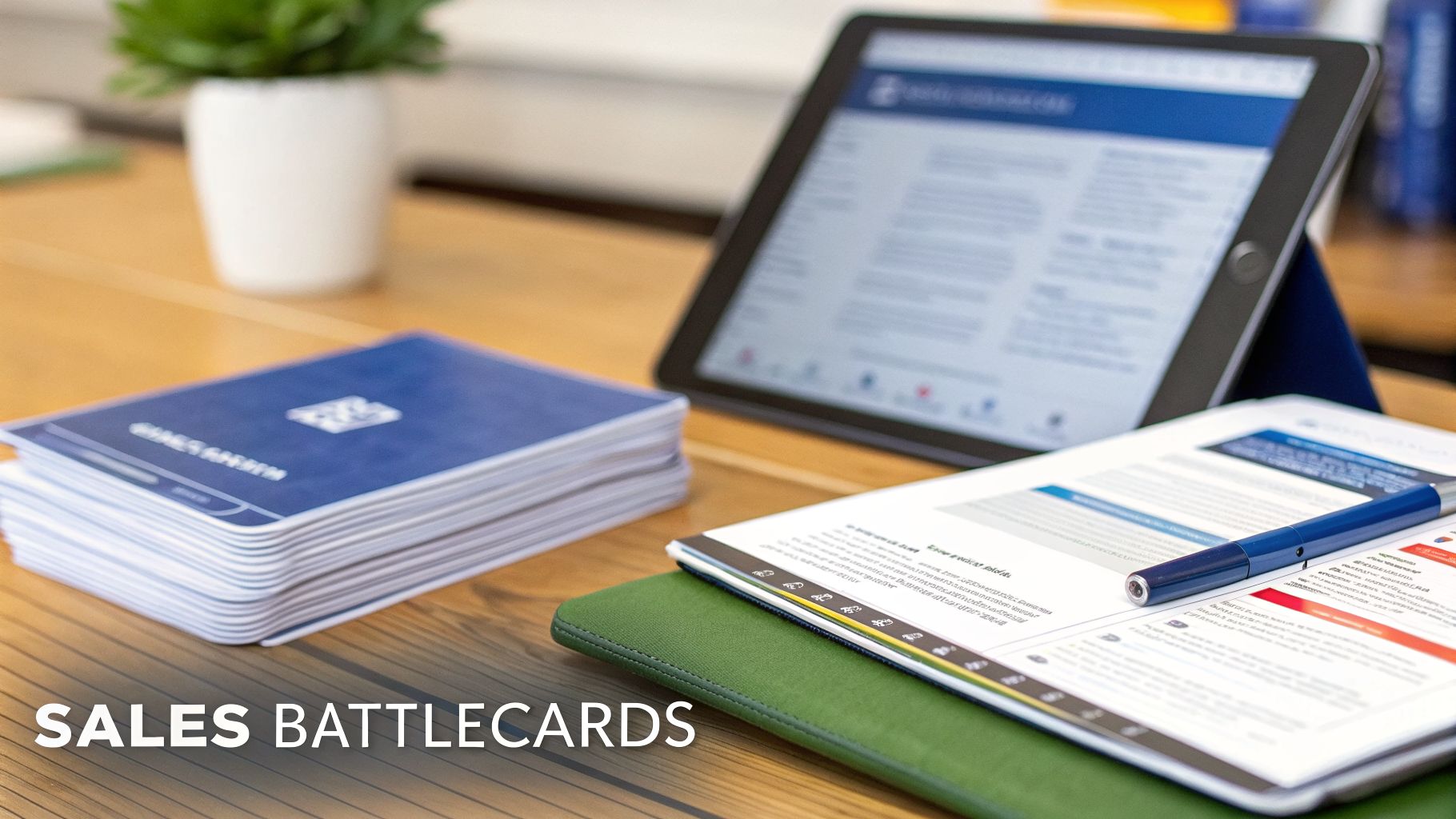
For a manufacturer of industrial equipment, this could be a one-page summary showing ROI calculations for a specific industry. For a service business, a battlecard might compare your approach against a key competitor on price, guarantees, and reliability. This ensures every conversation is sharp, accurate, and persuasive.
How to Apply This:
Creating useful sales assets starts with deep customer knowledge, not just product features.
- Diagnosis Question: Do you know your buyer’s biggest pain points, what metrics they care about, and what questions they are asking? Your collateral must answer their questions, not just talk about you.
- Keep Battlecards Scannable: A battlecard should be a one-page cheat sheet, not a novel. Use bullets, bold text, and clear sections so a rep can find the exact information they need in seconds during a live call.
- Use Concrete Numbers: Replace vague claims like "improves efficiency" with specific, quantifiable results like "reduces production downtime by 18%." Case studies with real data are far more convincing.
- Ensure Easy Access: Store all collateral in a centralized, mobile-friendly location, ideally integrated with your CRM. If a rep can't find it in under 30 seconds, it might as well not exist.
Key Insight: The best sales collateral isn’t created in a marketing silo. It's built with direct feedback from the sales team. Regularly ask your reps: what objections do you face most often, and what materials would actually help you close deals?
To further empower your sales team with effective tools, you can explore actionable B2B SaaS sales battlecard examples that show how to structure these critical assets.
3. Establish a Sales Enablement Program with Regular Training and Coaching
One-time training events create a temporary spike in knowledge but rarely lead to lasting behavioral change. A structured sales enablement program fixes this by treating training and coaching as an ongoing process, not a singular event. This practice is crucial because it ensures your sales team can adapt to new products, shifting markets, and evolving customer needs.
For a B2B manufacturer, this means quarterly product update sessions paired with competitive positioning training. In a service business, this could involve a peer-mentoring system where top performers share successful call scripts with newer team members. The goal is continuous improvement, not just initial onboarding.
How to Apply This:
Building a successful training and coaching program requires a commitment to relevance and consistency.
- Diagnosis Question: Is your training based on generic "best practices" or on the actual challenges your reps face today? Use tools like Gong to analyze real customer calls and build coaching moments around what you hear.
- Use Engaging Formats: Long, text-heavy presentations are ineffective. Use a mix of interactive workshops, short video tutorials, and role-playing exercises to help the information stick.
- Schedule Strategically: Don't schedule mandatory training during the last week of the quarter. Plan sessions during slower times to ensure your team is present and receptive.
- Empower Managers as Coaches: Your sales managers are the most critical part of this system. Provide them with a clear framework for one-on-one coaching and train them on how to give constructive, actionable feedback.
Key Insight: The most effective sales enablement is built around reinforcement. Tie training completion and skill improvements to recognition programs or performance metrics. This transforms training from a requirement into a pathway for career growth.
4. Create a Documented Sales Process with Clear Pipeline Stages
If your sales reps operate on gut feel, your revenue will be unpredictable. A documented sales process is the standard operating procedure (SOP) for your revenue engine. It defines the exact steps a prospect moves through from initial contact to a closed deal, with objective criteria for moving from one stage to the next. This brings consistency and predictability to your sales function.
Without a defined process, forecasting is a guessing game, and coaching reps is nearly impossible. A B2B manufacturer might define stages like Lead → Technical Qualification → RFQ Submitted → Proposal Approved → Won. A service business might use Lead → Discovery Call → Quote Provided → Closed.
How to Apply This:
Building a documented sales process turns your sales operation from an art into a science.
- Diagnosis Question: Are your pipeline stages based on your internal actions or the actual steps your customer takes when buying? Base your process on the customer's journey.
- Define Objective Entry/Exit Criteria: Advancement to the next stage must be based on verifiable actions, not a rep's optimism. For example, a deal can't move to "Proposal Sent" until the proposal is attached in the CRM.
- Enforce the Process with Your CRM: Use your CRM to guide reps. Make certain fields mandatory for stage advancement and use workflows to automate tasks when a deal enters a new stage.
- Analyze Stage Duration: Monitor how long deals sit in each stage. If deals consistently get stuck in the "Negotiation" phase, it’s a signal that your team may need better negotiation training.
Key Insight: A documented sales process isn’t a rigid set of rules; it’s a diagnostic framework. It shows you exactly where your sales motion is breaking down so you can fix it with targeted training, better content, or process adjustments.
5. Implement Account-Based Marketing (ABM) for High-Value Prospects
Instead of casting a wide net for generic leads, Account-Based Marketing (ABM) flips the funnel. It's a strategic approach where your sales and marketing teams focus their combined energy on a select group of high-value accounts. This practice is a cornerstone of advanced sales enablement, especially for businesses with long, complex sales cycles.
ABM treats individual accounts as unique markets. For a B2B manufacturer, this means creating custom case studies and executive outreach for a handpicked list of 20-30 tier-one prospects. The goal shifts from lead volume to account quality and deep engagement.
How to Apply This:
Implementing ABM requires a shift in mindset from "more leads" to "the right accounts."
- Diagnosis Question: Do you know what your best customers look like? Before targeting new accounts, analyze your existing high-value clients to identify common attributes like industry, revenue, and employee size. This is your Ideal Customer Profile (ICP).
- Build a Target Account List: Start small and focused. Identify a list of 15-25 high-value accounts that match your ICP. Trying to scale ABM too broadly from the start will dilute your efforts.
- Map Key Stakeholders: Don't rely on a single point of contact. Research the account to identify all key stakeholders—from technical evaluators to executive decision-makers—and create a plan to engage each one.
- Align Sales and Marketing: Both teams must be in lockstep. Agree on the account strategy, coordinate the timing of outreach, and share insights. Marketing creates the personalized content, and sales delivers it with context.
Key Insight: ABM isn't just a marketing campaign; it's an operational strategy. Its success depends on deep research and creating a genuinely personalized buying experience for every key stakeholder within a target account.
For a more detailed breakdown of building a strategy from the ground up, you can find helpful guidance on account-based marketing for B2B businesses that covers each step of the process.
6. Use Sales Analytics and Data to Optimize Performance
Gut feelings have no place in modern sales management. The best sales enablement practices are built on a foundation of data. Sales analytics is the process of tracking, measuring, and analyzing sales metrics to find trends, remove bottlenecks, and uncover opportunities. This evidence-based approach turns your sales operation into a predictable system.

For a B2B manufacturer, data might reveal that deals consistently stall after the proposal is sent, pointing to a need for a structured follow-up process. A service business could use conversation intelligence tools like Gong.io to find that reps who use a specific discovery call checklist see a 25% higher conversion rate. These are actionable insights that directly improve performance.
How to Apply This:
Begin by identifying the numbers that truly matter and building a routine around reviewing them.
- Diagnosis Question: Are you tracking vanity metrics or metrics that connect directly to revenue? Focus on win rates by stage, sales cycle length, average deal size, and forecast accuracy.
- Establish Clear Definitions: Ensure everyone agrees on what each metric means. What officially qualifies a lead? When is a deal considered "won"? Consistency is essential for accurate analysis.
- Conduct Win/Loss Analysis: Regularly analyze why you win and, more importantly, why you lose. This process provides invaluable feedback on your pricing, product, and competitive positioning.
- Use Data to Coach, Not Punish: The goal is improvement. Use metrics to identify reps who are excelling (and learn from them) and to spot those who need targeted coaching to succeed.
Key Insight: Data tells a story. Your job is to listen to that story and act on it. Instead of asking reps "How are things going?", you can ask "I see your win rate on proposals over $50k has dropped; let's review your last few calls to see what's changed."
7. Align Marketing and Sales Through a Shared Agreement
Sales and marketing misalignment is a classic, costly problem. Marketing generates leads, but sales complains they're unqualified. Sales fails to follow up, and marketing laments the wasted effort. The solution is a formal agreement that defines accountability and shared success.
A Service Level Agreement (SLA) bridges the gap by creating a single, agreed-upon definition of a "good lead" and outlining the responsibilities each team has for nurturing it. This forces both teams to stop pointing fingers and start working from the same playbook.
How to Apply This:
Building alignment is a process of negotiation and documentation, not a one-time meeting.
- Diagnosis Question: Do marketing and sales agree on the exact criteria for a "sales-ready" lead? Sit both teams down to define a Marketing Qualified Lead (MQL) and a Sales Qualified Lead (SQL) together.
- Establish Clear Handoff Protocols: Document the process. When a lead becomes an MQL, what happens next? The SLA should specify that it’s assigned to a sales rep who must make initial contact within a set timeframe, like 24 hours.
- Create a Feedback Loop: Sales must have a simple way to report back on lead quality. This isn't for complaining; it's for data collection. If leads from a certain campaign are consistently poor, marketing needs that data to refine its targeting.
- Align Incentives: If marketing is rewarded for lead volume and sales for closed deals, they will always be at odds. Tie a portion of each team's compensation to shared goals, such as MQL-to-SQL conversion rate.
Key Insight: A strong SLA is a living document, not a stone tablet. Review its performance monthly or quarterly. Use data to identify what’s working and what isn’t, and be prepared to adjust lead criteria and shared goals as your market evolves.
8. Leverage Sales Conversation Intelligence to See What Works
What if you could pinpoint the exact moment a deal goes right or wrong just by listening? That’s the power of sales conversation intelligence. These platforms record, transcribe, and analyze sales calls to uncover what your best reps are saying and doing differently. This practice moves coaching from theory to reality, providing a data-backed blueprint for what works in live conversations.
For a B2B manufacturer, this could reveal that top performers structure follow-ups around a specific timeline question. For a service business using a tool like CallRail, it might show that reps who discuss the business impact of a problem see a 40% higher close rate. This moves sales enablement from guesswork to a science.
How to Apply This:
Implementing conversation intelligence is about creating a culture of continuous improvement, not surveillance.
- Diagnosis Question: How are you coaching your sales team today? Is it based on anecdotal feedback or on objective data from actual customer interactions?
- Be Transparent with Your Team: Explain that recordings are for coaching and celebrating wins, not for punishment. Frame it as a tool to help everyone improve by learning from the best.
- Focus on Patterns, Not Single Calls: Look for trends across dozens of interactions. Identify common language used in won deals versus lost ones, or how top reps handle specific objections.
- Create a "Greatest Hits" Library: With permission, build a library of best-practice calls. This is an invaluable asset for onboarding new hires, showing them exactly what "good" sounds like.
Key Insight: Conversation intelligence is your team's game tape. It allows you to analyze performance, identify winning plays, and train your entire team on the specific behaviors that correlate directly with closed deals.
9. Build a Knowledge Management System Your Reps Will Actually Use
Your reps shouldn't waste valuable selling time digging through shared folders or old emails for the latest pricing sheet. A centralized knowledge management system is the answer. It acts as an organized, single source of truth for all sales collateral, product specs, and case studies. This directly boosts rep productivity and ensures every customer receives consistent, accurate information.
For a manufacturer, this means a searchable library of technical spec sheets and competitor guides. For a service business, it could be a mobile-friendly hub with pricing options and answers to FAQs. A well-organized system reduces ramp-up time for new hires and keeps your entire team on the same page.
How to Apply This:
Creating a content library is about building a reliable resource, not just collecting files.
- Diagnosis Question: How much time do your reps spend searching for information versus selling? A disorganized system is a hidden productivity killer.
- Organize Content Logically: Don't just dump files into a folder. Structure your content in a way that mirrors your sales process. Organize by sales stage, product line, or common objections.
- Prioritize Search and Accessibility: Your reps need to find information in seconds. Use a system with robust search functionality, like Notion or Guru, and ensure it’s mobile-friendly for field reps.
- Establish Clear Ownership and Version Control: Assign people to own different content categories and keep them current. All documents should have version numbers and "last updated" dates so reps trust they are using the correct information.
Key Insight: A knowledge base is a living system, not a static archive. Continuously gather feedback from your sales team to identify content gaps, learn what assets are most effective, and discover what new materials they need to close deals.
10. Implement a Lead Scoring and Nurturing Program
Not all leads are created equal. A prospect who downloads a checklist is in a different buying stage than one who requests a demo. Lead scoring and nurturing creates a system to automatically prioritize hot leads for sales and educate cooler leads until they are ready. This practice is vital for long-cycle sales, ensuring no opportunity is forgotten.
Lead scoring assigns points to prospects based on their profile (job title, industry) and behaviors (website visits, content downloads). Nurturing uses automated workflows to deliver relevant content, building trust and keeping your brand top-of-mind. This ensures sales reps focus only on the most qualified, sales-ready opportunities.
How to Apply This:
Building a scoring and nurturing program creates a powerful bridge between marketing and sales.
- Diagnosis Question: Does your sales team complain about lead quality? If so, you need an objective system to define what a "good lead" looks like.
- Involve Sales in Scoring: Sit down with your sales team and ask: "What are the clear signs of a sales-ready lead?" Use their answers to build your initial scoring model. Agreement is non-negotiable.
- Start with Simple Rules: Don't overcomplicate it. Begin with basic scoring: +10 for a target industry, +5 for visiting the pricing page, +15 for a demo request. You can add complexity later based on data.
- Map Nurture Content to Needs: Your nurture emails should solve problems, not just promote products. Send content that addresses pain points at different stages of their journey, like case studies or ROI calculators.
Key Insight: A lead scoring system acts as an objective gatekeeper. It prevents sales from chasing low-interest leads too early and stops marketing from handing off prospects who aren't ready, improving conversion rates and inter-departmental trust.
For a complete breakdown of how to build an effective follow-up system, our guide on what is lead nurturing offers actionable steps for creating campaigns that convert.
10-Point Sales Enablement Best Practices Comparison
| Initiative | 🔄 Implementation Complexity | ⚡ Resource Requirements | 📊 Expected Outcomes | 💡 Ideal Use Cases | ⭐ Key Advantages |
|---|---|---|---|---|---|
| Implement a Comprehensive CRM System as the Central Hub | High — customization, integrations, data migration required | High — licensing, admin, integrations, user training | ⭐⭐⭐⭐⭐ — centralized data, faster cycles, improved forecasting | B2B manufacturers and service orgs with multi-stage pipelines and field teams | Single source of truth; automation of follow-ups; real-time pipeline visibility |
| Develop Sales Collateral and Battlecards Aligned to Buyer Personas | Medium — research, design, persona alignment | Medium — content creators, designers, research time | ⭐⭐⭐⭐ — consistent messaging, higher win rates, faster rep responses | Complex technical products needing differentiation vs competitors | Clear objection handling; quick-reference selling tools; accelerated ramp |
| Establish a Sales Enablement Program with Regular Training and Coaching | Medium–High — program design, schedule, ongoing coaching | High — trainers/coaches, manager time, learning tools | ⭐⭐⭐⭐ — faster ramp, better deal quality, improved rep confidence | Teams with frequent hires or consultative selling requirements | Consistent skills application; measurable rep development; culture of improvement |
| Create a Documented Sales Process with Clear Pipeline Stages and Criteria | Medium — mapping, criteria definition, CRM enforcement | Low–Medium — process owners, CRM configuration | ⭐⭐⭐⭐⭐ — predictable forecasting, reduced variability, easier coaching | Complex, multi-stage B2B sales (manufacturing, engineering) | Consistent execution; objective stage criteria; improved pipeline hygiene |
| Implement Account-Based Marketing (ABM) and Account Planning for High-Value Prospects | High — deep account research, coordinated cross-functional plans | High — marketing & sales alignment, custom content, executive involvement | ⭐⭐⭐⭐ — larger deal sizes, higher win rates for targeted accounts | High-value, strategic accounts and complex solution sales | Focused ROI, tighter sales-marketing alignment, multi-stakeholder engagement |
| Use Sales Analytics and Data-Driven Insights to Optimize Performance | Medium — dashboarding, data consolidation, metric definition | Medium–High — BI tools, data hygiene, analyst/ops support | ⭐⭐⭐⭐⭐ — objective insights, bottleneck ID, improved forecast accuracy | Organizations seeking measurable performance improvements and scale | Evidence-based coaching; early warning signals; replication of best practices |
| Align Marketing and Sales Through Shared Goals and Lead Quality Agreements | Medium — negotiation of SLAs, governance, ongoing review | Low–Medium — regular meetings, lead routing tooling, monitoring | ⭐⭐⭐⭐ — fewer disputes, improved lead quality and conversion | Organizations experiencing lead quality/hand-off friction | Shared accountability; clearer lead definitions; faster response times |
| Leverage Sales Conversation Intelligence and Call Recording Analysis | Medium — recording setup, transcription, compliance handling | Medium — subscription tools, storage, review/coaching time | ⭐⭐⭐⭐ — improved coaching, replication of winning behaviors, better objection handling | Teams that rely heavily on calls/meetings for qualification and closing | Concrete call-based insights; rapid coaching; searchable call library |
| Build a Knowledge Management System and Content Library for Sales Reps | Medium — taxonomy, content migration, search setup | Medium — KM platform, content owners, curation resources | ⭐⭐⭐⭐ — reduced search time, consistent messaging, faster onboarding | Distributed teams or complex product portfolios needing centralized content | Single source of truth; version control; mobile access for field reps |
| Implement a Lead Scoring and Nurturing Program | Medium — scoring model, workflows, ongoing tuning | Medium — marketing automation, content creation, analytics | ⭐⭐⭐⭐ — prioritized pipeline, higher conversion, sustained engagement | Long sales cycles where multiple touches are required (manufacturing) | Automated prioritization; timely nurturing; improved marketing ROI |
From Best Practices to Business Transformation: Your Next Step
We've walked through a blueprint for building a high-performance sales engine. Each practice—from establishing a CRM as your single source of truth to aligning marketing and sales—represents a critical gear in your revenue-generating machine. This isn't about checking a box; it's a fundamental shift from reactive sales efforts to a proactive, data-driven system built for predictable growth.
The transformation is stark: instead of relying on a few star performers, you build a system that elevates the entire team. New hires become productive faster, sales cycles shorten, and win rates increase because your reps are consistently equipped with the right content, training, and processes at the right time.
Key Takeaways for Immediate Application
Thinking about this from an engineering perspective, each best practice solves a specific point of failure in the typical sales process.
- Process & Alignment First: The most impactful starting points are often the least technical. Documenting your sales process and forging an SLA between sales and marketing create the foundation. Without this, even the best tools will fail to deliver results.
- Content is a Sales Multiplier: Your battlecards and case studies are not just marketing assets; they are critical tools. When aligned with buyer personas, they empower reps to have more value-driven conversations.
- Data Turns Insight into Action: Implementing sales analytics and conversation intelligence moves you from guesswork to guided strategy. You can diagnose the exact point of friction and apply a targeted fix.
Your 90-Day Action Plan
Don't try to boil the ocean. Pick one area to diagnose and improve.
- Choose Your Focus: Select one practice from this article that addresses your biggest current bottleneck. Is it lead quality? A messy pipeline? Inconsistent messaging?
- Define Success: What does "done" look like? For example, a finalized sales process document with defined stages and sign-off from sales leadership.
- Assign Ownership & Timeline: Put one person in charge and set a realistic 90-day deadline. This creates accountability and a sense of urgency.
Mastering these concepts separates the businesses that struggle to scale from those that achieve predictable revenue. The goal is a business that runs on systems, freeing you to focus on growth instead of constantly fighting fires. To deepen your understanding, explore these additional 10 Sales Enablement Best Practices for another layer of insight.
Ready to move from diagnosis to a real solution? If you need a partner with an engineering mindset to help build and implement a sales and marketing system, Machine Marketing can help. We specialize in implementing these frameworks, often using GoHighLevel to create a central hub for your business growth. Book a free discovery call with us today to start building your roadmap.