If your manufacturing company is struggling to win deals without slashing prices, your brand might be the root cause. A powerful brand strategy b2b isn’t about a flashy logo; it's a core business system designed to make you the obvious choice for your ideal customers.
In this guide, we'll walk you through how to diagnose the gaps in your current brand, build a rock-solid foundation, and activate it to attract high-value clients consistently.
Diagnosing Your Current Brand Strategy: What's the Real Problem?
If you're a manufacturer, your focus is on product quality, operational efficiency, and hitting sales quotas. But have you ever asked if the biggest obstacle to your growth is a weak or inconsistent brand? This is a problem we see constantly with B2B companies that have gotten by on reputation and relationships alone.
An undefined brand strategy almost always forces you to compete on price. When customers can't easily tell the difference between you and your competitors, they’ll just go with the lowest bid. It’s a race to the bottom that kills your margins and makes growth feel impossible.
Are You Trapped by Short-Term Thinking?
Many B2B companies get stuck in a cycle of prioritizing immediate leads from trade shows, cold calls, and PPC ads. These tactics might deliver a quick bump in inquiries, but you’re not building any lasting value or market position.
This approach is fragile. Your pipeline becomes completely dependent on how much you’re willing to spend and how hard your team is willing to grind.
A strong brand does the opposite. It acts like a magnet, pulling in better-quality prospects who already understand your value before they even speak to a sales rep.
A powerful B2B brand isn't a 'nice-to-have'—it's a critical system for generating consistent, high-quality leads and building a defensible market position that protects you from commoditization.
We take an engineering-minded approach to this challenge. The flowchart below breaks down how we diagnose and fix these brand-related issues through a clear, repeatable process.
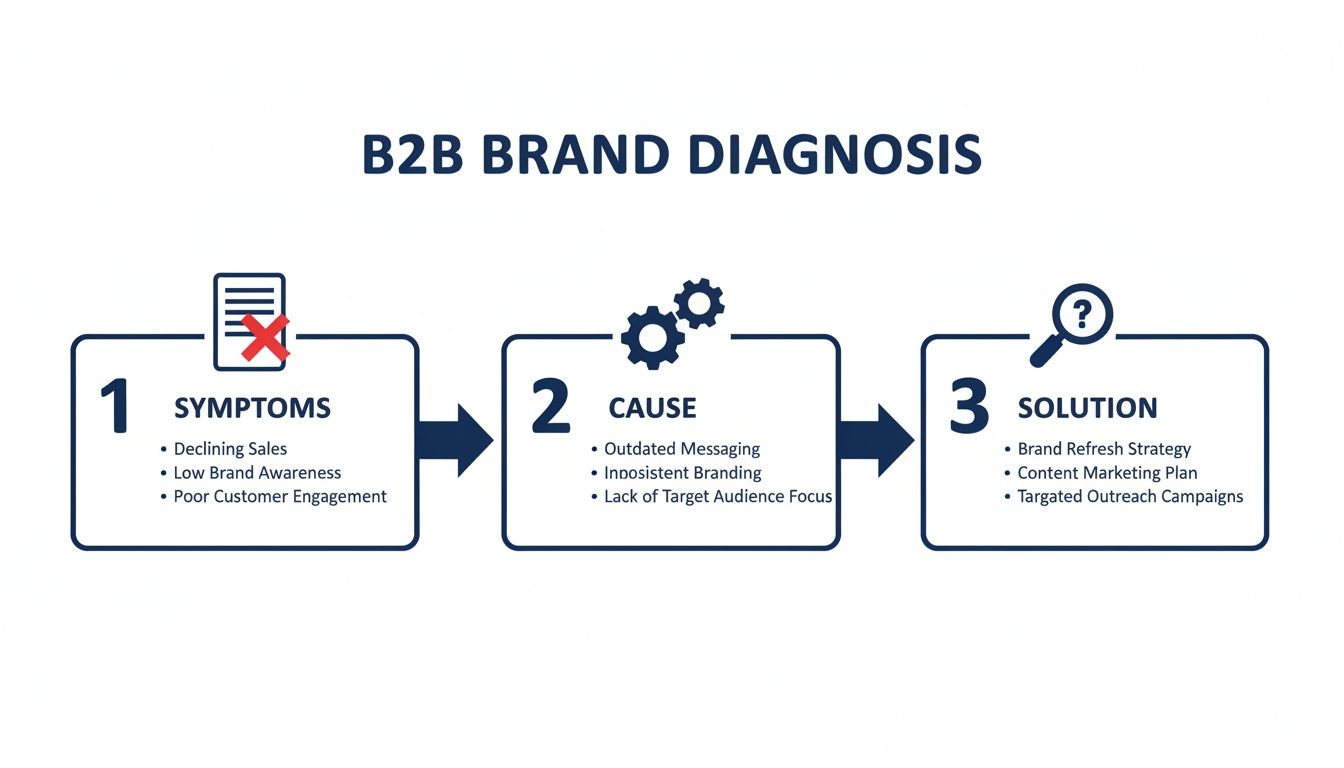
It’s all about a clear process: identify the symptoms, find the root cause, and then engineer the solution.
Questions to Ask: Symptoms of a Failing B2B Brand
So, how can you tell if your brand is the problem? The symptoms are usually hiding in plain sight. Answering these questions honestly is the first step toward a real diagnosis.
- Can your team explain what makes you different in one sentence? If your own people struggle to articulate your unique value simply, you can bet your customers can't either.
- Is your messaging inconsistent? Does your website say one thing while your sales deck says another? Inconsistency erodes trust before you even get a chance to build it.
- Are you attracting the wrong customers? If you’re constantly fielding calls from prospects who haggle on price or don't fit your ideal profile, your brand is failing to pre-qualify them.
- Is customer loyalty low? A strong brand creates a connection that turns one-time buyers into long-term partners. If your customers jump ship for a slightly better price, you have transactions, not relationships.
These symptoms point to a deeper problem. A full diagnosis, much like the process we outline in our guide on what is a marketing audit, is the only way to pinpoint the exact gaps. This moves you from guessing to knowing, providing a clear roadmap to build a brand that drives growth.
Building Your Brand Foundation: The Blueprint for Success
You’ve identified the warning signs of a weak brand. Now it’s time to build a solid foundation. A powerful B2B brand strategy isn’t built on vague mission statements; it’s forged from the tangible DNA of your company.
This process is about documenting who you are so that everyone, from the shop floor to the sales team, operates from the same playbook. The goal is simple: create a foundation that makes you the only logical choice for your ideal customers.
Find Your Unoccupied Space in the Market
Before you can stand out, you have to know what you’re standing against. This means putting your competitors under a microscope—not to copy them, but to find the market position they aren’t occupying. We see too many manufacturers fall into the "sameness" trap, all making identical claims.
Your job is to find a position you can own. Start by asking these critical questions about your top 3-5 competitors:
- What’s their core promise? Are they the fastest? The cheapest? The most durable?
- Who are they talking to? Check their case studies. Are they chasing massive enterprises or focusing on small job shops?
- What’s their tone of voice? Is it overly technical and academic, or direct and practical?
- Where are they silent? What customer needs are they completely ignoring? This is often where your biggest opportunity is hiding.
By mapping out their positions, you'll start to see the gaps. Maybe everyone is focused on technical specs, but no one is talking about post-sale support and operator training. That’s your opening. You can build a brand around being a true operational partner, not just another vendor.
Define Your Ideal Customer with Razor-Sharp Precision
Once you know where you can win, you need to know exactly who you’re winning for. Many businesses define their Ideal Customer Profile (ICP) too broadly, like "manufacturing companies with 50+ employees." That’s not specific enough to be useful.
A strong ICP is less about demographics and more about their problems, motivations, and buying triggers. Think of your ICP as a filter for your entire marketing and sales system, ensuring you only spend time on prospects you can truly help.
Your Ideal Customer Profile isn't just about who you can sell to. It's about who you should sell to—the customers who see the most value in your unique strengths and become your most profitable long-term partners.
To build this profile, ask yourself:
- What specific, costly problem is making their life difficult?
- What failed solutions have they already tried before looking for you?
- What does a “win” look like for them, both professionally and personally?
- What are their biggest fears or objections about purchasing in your category?
For instance, instead of targeting "facility managers," you might focus on "facility managers at food processing plants who are failing audits due to outdated equipment and need a solution with guaranteed compliance." That specificity gives your brand strategy its real power.
Articulate Your Core Brand Pillars
With a clear picture of the market and your customer, you can define your brand’s core pillars. These are the tangible, provable truths about your business that guide every decision. They represent your unique value, your core values in action, and the promise you make to every customer.
A structured approach helps get these ideas onto paper. To make this easier, you can use a comprehensive brand strategy template to organize your findings.
Here’s a diagnostic checklist we use to help clients codify their brand foundation.
Brand Foundation Diagnostic Checklist
This simple checklist will guide you in defining the core components that make your brand unique and valuable.
| Component | Key Question to Answer | Example (Machine Manufacturer) |
|---|---|---|
| Unique Value Proposition | What is the single most compelling benefit we offer that no one else can? | We deliver custom CNC machines with a guaranteed <24-hour service response, minimizing costly downtime. |
| Core Values (In Action) | What are our non-negotiable principles, translated into customer benefits? | "Extreme Ownership" means our engineers are on-site for installation and training until your team is 100% self-sufficient. |
| Brand Personality | If our brand were a person, what three words would describe it? | Knowledgeable, direct, reliable. |
| Proof Points | What tangible evidence proves our claims? | Case studies showing 30% reduction in production errors; 98% customer satisfaction rating on post-install support. |
Documenting these pillars creates an unbreakable foundation. It becomes the source code for your messaging, your sales process, and your customer service. When your entire team is aligned on this foundation, your brand transforms from a logo into a powerful, lead-generating machine.
Developing Your Core Messaging Playbook
You’ve done the hard work of laying your brand foundation. Now it's time to turn that strategy into a Core Messaging Playbook. This isn't just a document; it's the operational system that ensures your marketing and sales teams communicate with one voice.
Think of it as your single source of truth for every piece of content you create. It’s what prevents your website from promising one thing while your sales reps say something completely different. Without this playbook, even the best brand strategy gets lost in execution.
From Brand Story to Message Pillars
Every strong brand is built on a story—a genuine narrative that connects your solution to your customer’s reality. It needs to answer one question for them: "Why should I care?"
A great brand story weaves together your customer's biggest pain point, your unique ability to solve it, and the transformation you provide. For a custom machine builder, the story isn't "we build high-quality machines." It’s "we help plant managers escape the nightmare of production bottlenecks by engineering custom solutions that make them look like a hero to their bosses."
Once you have that core story, distill it into 3-5 distinct message pillars. These are the central themes you want to be known for.
- Pillar 1 Example: Unmatched Reliability & Uptime
- Pillar 2 Example: True Engineering Partnership
- Pillar 3 Example: Future-Proof Technology
Each pillar then acts as a content category. You can write a blog post focused on reliability, film a case study about partnership, and create a white paper on your technology. This ensures consistency while giving you plenty of creative room.
Building Your Messaging Hierarchy
A messaging hierarchy is an operational tool that makes it simple for anyone to talk about what you do. It provides the right words for any situation, from a 30-second elevator pitch to a deep-dive technical demo.
The structure moves from broad to specific:
- Key Message Pillars: Your high-level themes (e.g., "Unmatched Reliability").
- Supporting Points: The "how" behind your claims. For "Unmatched Reliability," this could be, "We use premium-grade components and put every machine through a 200-point inspection."
- Proof Points: The tangible evidence that makes your claims undeniable.
Your messaging is only as strong as its proof. Without data, case studies, or testimonials, your claims are just empty promises. Proof points are what turn skepticism into trust.
Effective proof points are tangible and specific:
- Quantitative Data: "Our machines maintain a 99.8% uptime rate over a 5-year operational period."
- Case Studies: "How Company X slashed production defects by 40% in six months using our system."
- Testimonials: "Their technician was on-site within 12 hours and had us back online, saving us from a costly shutdown."
Once your brand foundation is solid, building your playbook requires a proven B2B content marketing strategy to ensure your value is articulated perfectly for your target audience.
Tailoring Messages for Different Audiences
Your core brand message must be consistent, but its delivery needs to adapt. An engineer, a procurement manager, and a CEO all view the same purchase through different lenses. A smart messaging playbook anticipates this.
Let's stick with the new machine example:
- The Engineer: Needs technical specs, integration capabilities, and maintenance details.
- The Procurement Manager: Focuses on total cost of ownership, warranty details, and service level agreements (SLAs).
- The CEO: Cares about ROI, impact on market share, and long-term competitive advantage.
Your playbook should map out message variations for each key persona. This arms your sales team to have the right conversation with the right person at the right time. For a deeper system, check out our guide on the marketing messaging framework. This differentiation is critical, as 43% of B2B companies are still stuck chasing short-term leads. A playbook helps you build a system to win.
Activating Your Brand With Your Tech Stack

A brilliant brand strategy is worthless if it collects dust in a Google Doc. Its power comes to life when you execute it consistently across every customer touchpoint. This is where your technology stack becomes a brand activation engine.
For most manufacturers, this means wiring your brand directly into your CRM. It’s about creating a cohesive system where technology amplifies your strategy, ensuring every interaction builds trust.
Embedding Your Brand into Your CRM
Think of your CRM—we use and recommend GoHighLevel—as the central nervous system for your brand's execution. Here, you can put your messaging playbook into action, turning abstract concepts into automated, personalized communication at scale.
This process moves your brand strategy b2b from a static document to a daily operational standard. Here’s how you can make it happen:
- Build Email & SMS Templates: Create pre-built sequences in the CRM using the exact phrasing from your messaging playbook for lead nurture, post-purchase follow-ups, and more.
- Segment Audiences by Persona: Use CRM tags to align contacts with your buyer personas. This lets you automatically send messages that speak directly to an engineer’s technical pain points or a procurement manager’s ROI focus.
- Standardize Sales Communication: Arm your sales team with CRM-based email templates for proposals and follow-ups, all pre-loaded with your core value propositions and proof points.
This systematic approach eliminates brand inconsistency. For a deeper dive, check our guide on building an effective marketing technology stack.
Personalization at Scale is Non-Negotiable
A one-size-fits-all approach is a fast track to being ignored. Personalization is no longer optional in B2B. The numbers show 75% of customers are more likely to buy when content feels personal. This is especially true as younger buyers, now 71% of the B2B market, expect it. You can discover more insights about these B2B marketing statistics to see how they're shaping today’s strategies.
How do you pull this off without spending all day writing individual emails?
The goal is to use automation to deliver a message that feels personal and relevant, not robotic. Your CRM should enable you to speak to a segment of one, at scale.
This is where your tech stack proves its worth. Using a platform like GoHighLevel, you can use triggers and custom fields to create incredibly relevant, timely interactions.
- Example 1: The Abandoned Quote Follow-Up: A prospect views a quote but doesn't buy. Your system can automatically send a 3-day follow-up from their sales rep, mentioning the exact machine and linking to a relevant case study.
- Example 2: The Post-Trade Show Nurture: You tag a lead as "Interested in CNC Mills." They are automatically placed into a 3-part email sequence with tailored content, from a simple "thank you" to a guide on "Choosing the Right CNC Mill."
These are targeted, context-aware communications that deliver on your brand’s promise to be helpful and knowledgeable. Systematizing this process turns your brand strategy b2b into a predictable, pipeline-building machine.
Taking Your New Brand to Market—and Proving It Works
You’ve laid the foundation and built the system. Now it's time to go live. A brand launch isn’t a one-day event; it's the beginning of a new way of operating. A successful launch is a deliberate, phased process that turns your strategy into a living part of your business.
The biggest mistake we see is focusing on the external reveal while forgetting your most important audience: your own team. If your people don't believe in the brand, it will fail before a single customer sees it.
Start Inside Your Own Four Walls
Before you touch your website, you must turn every employee into a brand champion. Everyone, from engineers to sales reps, has to see, understand, and adopt the new brand first. A half-day workshop or a dedicated all-hands meeting is a non-negotiable investment.
Here’s how to structure an internal rollout:
- Show Them the "Why": Walk them through the entire journey—the diagnosis, the market analysis, and the customer interviews. Show them why this change had to happen.
- Roll Out the Messaging Playbook: Give every person access to the playbook. Go over the brand story, message pillars, and new brand voice. Role-play common customer questions to help them get comfortable.
- Arm the Sales Team: Your sales reps need the new, branded collateral immediately—updated pitch decks, sell sheets, and proposal templates. Their confidence is everything.
When your team understands the thinking behind the brand, they become its most passionate advocates.
A brand isn't what you say it is. It's what your team does, what your sales reps promise, and what your service department delivers every day. An internal launch ensures everyone is delivering on the same promise.
Execute a Phased External Rollout
With your team on board, you can turn your attention outward. A phased rollout gives you control over the narrative and ensures every touchpoint is high-quality.
We recommend this order:
- Digital Foundation First: Your website is your brand’s home base. Update every core page with the new messaging and visuals.
- Announce to Your Core Audience: Email your customer list and warm leads explaining the brand's evolution and what it means for them.
- Update Social & Sales Channels: Update your social media profiles (especially LinkedIn for B2B) and confirm the sales team is using the new collateral.
- Launch Supporting Content: Start publishing blog posts, case studies, and articles that prove your new brand pillars. This is the long game that embeds your new position in the market.
Measure What Actually Matters
You must measure the impact of your brand strategy b2b to justify the effort. Forget vanity metrics; focus on KPIs tied directly to business growth. Track these metrics before the launch to get a baseline, then measure them quarterly.
- Lead Quality: Are you getting more calls from your Ideal Customer Profile? Use your CRM to track the percentage of qualified inbound leads. If this number goes up, your brand is hitting the mark.
- Sales Cycle Length: A clear brand builds trust faster, which should shorten deal times. Measure the average days from first contact to signed contract. A 10-15% reduction is a huge win.
- Average Deal Size: As your brand becomes associated with higher value, you should be able to command better pricing. Track the average revenue per new customer to see if it’s increasing.
- Customer Lifetime Value (CLV): A powerful brand creates loyalty. Are customers staying longer and buying more? This is the ultimate test of brand equity.
By focusing on these metrics, you transform your brand from a marketing expense into a core business asset that generates a measurable return.
Frequently Asked Questions About B2B Branding
Even with a solid playbook, developing a brand strategy b2b can feel like a massive undertaking. Here are the answers to the questions we hear most often from business owners.
How is B2B Branding Different from Marketing?
This is the most important distinction. Your brand is the “why”—your core identity, your promise to the market, and the reason customers choose you. It’s a long-term asset.
Marketing is the “how”—the activities you use to communicate that promise, like your website, trade shows, and email campaigns.
When you do marketing without a clear brand, you're just making noise. Your message is inconsistent, and you’re left competing on price because nobody understands your real value.
How Long Does a B2B Brand Strategy Take to Develop?
The timeline depends on your starting point. For a company with some pieces in place, we can typically move through a focused project in 8-12 weeks. A business starting from scratch will naturally take longer.
The goal isn't speed; it's precision. Rushing foundational work like customer research is a recipe for a weak strategy you'll just have to redo later. It’s always better to invest the time to get it right the first time.
The work generally breaks down into these phases:
- Diagnosis & Research (3-4 weeks): Stakeholder interviews, customer surveys, and competitor analysis.
- Strategy & Messaging Development (3-5 weeks): Building your core foundation and messaging playbook.
- Activation & Internal Rollout Planning (2-3 weeks): Creating initial assets and preparing your team.
How Do I Get My Team to Adopt the New Brand Strategy?
This is where many branding projects fail. You can't just send an email with a new logo. True adoption comes from a deliberate internal launch where your team understands the why behind the changes.
Here’s our simple, three-part approach:
- Run an Internal Launch Workshop: Make it interactive. Walk everyone through the research and how you arrived at the strategy.
- Give Them Practical Tools: Everyone gets a copy of the messaging playbook. Role-play common customer conversations to build confidence.
- Lead From the Top: The leadership team must live and breathe the new brand. If you don’t use the new language, no one else will.
Getting your team on board isn’t a one-time event. It requires consistent reinforcement and celebrating the wins that come from having a clearer, more powerful brand.
Building and implementing a robust brand strategy b2b is a system, not a one-off project. It requires a clear diagnosis, a solid foundation, and consistent execution. If you're ready to stop competing on price and start building a brand that attracts your ideal customers, we can help build the systems that turn your brand into a predictable lead-generation machine.
Ready to start the diagnosis? Book a discovery call with Karl to get started.