If you feel like you're throwing money at marketing without seeing a real return, the problem is often a lack of a coherent system, not a lack of effort. In this guide, we'll diagnose the common gaps in a small business marketing system and give you a proven, step-by-step framework to build a strategy that generates predictable leads, not just random clicks.
We’ll show you how to diagnose what’s not working and, more importantly, how to choose the right channels to finally reach your ideal customers.
Diagnosing Your Current Marketing System
When your marketing feels chaotic, it's easy to get frustrated. Too many business owners chase the latest trend or a shiny new platform, which almost always leads to wasted time and money. The first step toward predictable growth is a frank, honest diagnosis of what you're doing right now.
This means looking at your marketing not as a random list of tasks, but as a system with interconnected parts.

This diagnostic process helps you stop guessing and start making decisions based on actual data. Before you spend another dollar, you need to understand what’s working, what’s broken, and where the biggest opportunities are hiding in plain sight.
Questions To Ask Yourself
A thorough self-assessment is the foundation for any strategy that gets results. To kick off your diagnosis, ask yourself these critical questions about your business:
- Who is our ideal customer? Be specific. "Everyone" is never the right answer. What’s their job title? What problems keep them up at night?
- What channels are actually driving leads? Dig into your data. Where do your best customers really come from—Google, social media, referrals, or somewhere else?
- What is our core message? Can you state, simply and clearly, what makes you different and why customers should choose you?
- What assets do we already have? Think about your website, your email list (no matter how small), social media profiles, and—most importantly—your existing customer relationships.
Key Takeaway: An honest marketing diagnosis isn't about finding fault; it's about finding clarity. It reveals the gaps in your system so you can fix them methodically, ensuring every marketing dollar works harder for you.
As you refine your message, it’s also a smart move to review some essential Small Business Branding Tips to make sure your identity in the market is clear and compelling.
For a more structured, in-depth process, you might want to learn how to conduct a formal marketing audit. This gives you a complete picture of your marketing health, allowing you to build a strategy that delivers real, measurable results. You can find out more in our guide: What is a Marketing Audit?
Building Your Foundation With a High-Performing Website and SEO
Let's be direct: your website should be your hardest-working salesperson. It works 24/7, never calls in sick, and has the power to be your number one source of qualified leads. But for too many small businesses, their website is just a digital brochure—a relic that looks nice but does nothing to actually grow the business.
A high-performing website isn't just a nice-to-have; it's the bedrock of your digital marketing. All roads lead back to your site, whether they start from a social media post, a paid ad, or an email. If that foundation is cracked, everything you build on top of it will be shaky.

From Digital Brochure to Lead Generation Machine
The biggest mistake we see is websites that talk endlessly about the company ("we've been in business since…", "we are the best at…"). Your prospects don't care about that. They land on your site with one question: "Can you solve my problem?" Your website’s only job is to answer that question, loud and clear, and show them the next step.
To make that happen, every page needs a purpose. Your homepage must instantly tell visitors what you do and who you do it for. Your service pages need to dig into the specific problems you solve and the results you deliver. Your contact page? It should make it dead simple for a motivated prospect to get in touch.
A website that converts visitors into leads has a few non-negotiable elements:
- Clear, Above-the-Fold Messaging: The second someone lands on your site, they should know exactly what problem you solve. No industry jargon, no corporate fluff.
- Prominent Calls-to-Action (CTAs): Buttons like "Request a Quote," "Schedule a Call," or "Download Our Guide" must be impossible to miss on every single page.
- A Mobile-First Design: The majority of your traffic will come from a smartphone. If your site is a mess to navigate on mobile, you’re throwing leads away.
- Fast Loading Speed: In the game of web traffic, patience is not a virtue. If your site takes more than a few seconds to load, visitors are gone. It's a conversion killer.
Why SEO Is Your Most Powerful Long-Term Investment
Once your website is tuned for conversions, you need a system to bring the right people to it. That system is Search Engine Optimization (SEO). While paid ads can get you traffic today, SEO builds a sustainable, long-term asset that generates "free" organic traffic for years to come.
SEO is the undisputed powerhouse for small businesses, consistently delivering the highest ROI of any marketing tactic. A staggering 92% of marketers are optimizing for both traditional and AI-driven search, because that's where the customers are. In fact, 32.9% of all internet users discover new brands through search engines. If you're not on Google, you're practically invisible. For a deeper dive into the numbers, you can review the latest industry statistics on HubSpot.com.
For a business owner, SEO means showing up the exact moment a customer is actively searching for the solution you sell. It’s the difference between interrupting prospects and being the answer they were looking for.
A Practical SEO Checklist for Small Businesses
Getting started with SEO doesn't require a Ph.D. in Google algorithms. Focusing on a few core fundamentals can move the needle in a big way. Here's a practical checklist to get you started.
- Optimize your Google Business Profile: If you serve a local area, this is non-negotiable. Fill out every single section—services, hours, photos, and accurate contact info. Then, actively encourage and respond to customer reviews.
- Target the right keywords: Put yourself in your customer's shoes and identify the exact phrases they're typing into Google. Your goal is to find "intent-based" keywords that signal someone is ready to buy or solve a problem, not just browse.
- Create genuinely helpful content: Write blog posts, guides, or FAQ pages that answer the most common questions your sales team gets. This not only positions you as the expert but also gives Google more high-quality content to rank.
- Optimize on-page elements: Make sure every page has a unique Title and Meta Description. These are the snippets of text that show up in Google's search results. Write them to be compelling, include your target keyword, and give people a reason to click on your link instead of a competitor's.
By pairing a conversion-focused website with a consistent SEO effort, you build a reliable engine for growth. If you want to get a jump start, check out our guide on how to increase organic traffic for more practical steps.
Driving Engagement With Smart Social Media and Video
For a B2B business, social media isn't about chasing viral trends. It’s about building trust and proving your expertise where your customers are already looking for answers. A focused social media and video strategy is a core part of a modern digital marketing strategy for a small business, turning passive profiles into active lead-generation tools.
The key is to stop thinking of platforms like LinkedIn and YouTube as just "social" channels. Start treating them like search engines. Your ideal clients are on there right now, searching for solutions to specific problems. Your job is to create the content that provides those solutions.

From Vanity Metrics to Valuable Conversations
Forget about follower counts and likes. For a small business, the only metrics that matter are the ones that lead to conversations and, ultimately, revenue. Your social media presence should be a direct support system for your sales team, demonstrating your company's value and expertise before they even get on a call.
Here’s how to shift your focus from broadcasting to connecting:
- Solve, Don't Sell: Your content should be the answer to your audience's most pressing questions. Think practical "how-to" guides, quick tips that save them time, and clear explanations of complex industry topics.
- Show, Don't Just Tell: Use visuals—especially video—to demonstrate your products or processes. A short walkthrough of a machine in action or a behind-the-scenes glimpse of your process is far more compelling than paragraphs of text.
- Engage with Intent: When someone comments on your post, they are raising their hand. Respond thoughtfully. The goal is to move the conversation offline to a call or email when it makes sense.
Key Insight: Your LinkedIn and YouTube profiles are not just company pages; they are extensions of your sales team. Every single post is an opportunity to prove your value and start a real conversation with a potential client.
If you’re serious about transforming your social media into a reliable lead engine, we’ve put together a guide you'll find helpful. You can see our detailed approach to social media for lead generation to learn more.
The Power of Low-Budget, High-Impact Video
Video marketing is no longer optional. It's projected that by 2026, 91% of businesses will use it, with 93% seeing it as a critical part of their strategy. For our clients—engineers, machine makers, and B2B operators—short, problem-solving videos on YouTube and LinkedIn provide the walkthroughs and proof that convert prospects.
The good news is you don't need a Hollywood budget. Your smartphone is more than capable of creating high-impact video content that gets results.
Practical Video Ideas You Can Film Today
The best videos are often the simplest. They feel authentic, are genuinely helpful, and directly address a customer’s need or question.
Here are a few ideas you can start with right now:
- Product or Service Walkthroughs: Record a simple screen-share or point-of-view video showing exactly how your product works. Focus on the benefits and the problems you're solving for the customer.
- Quick-Tip Tutorials: Take a common question you get from customers and answer it in a 60-second video. These are perfect for sharing on LinkedIn or as YouTube Shorts.
- "Meet the Expert" Features: Have one of your engineers or technicians briefly explain a key process. This builds incredible trust and showcases the deep expertise within your team.
- Before-and-After Case Studies: Show the problem a client was facing and then demonstrate the solution you provided. Visual proof is incredibly powerful.
Your video content also plays a massive role in your website's visibility. To make sure your site is easily discoverable when customers are searching, you need a solid SEO foundation. This practical Small Business SEO Guide can help you tie all your digital efforts together. When you pair helpful video with smart SEO, you create a powerful system for attracting and converting your ideal customers.
Mastering Customer Relationships With Email and a CRM
Let’s talk about your most valuable marketing asset. It’s not your follower count or your ad budget. It’s the list of people—prospects, leads, and past customers—who’ve already raised their hands and said they’re interested. A proper digital marketing strategy for a small business has to create real, long-term value with this audience.
Pairing targeted email marketing with a Customer Relationship Management (CRM) system isn't just a good idea—it's essential for growth.
Why Email and a CRM Are Non-Negotiable
If social media is like renting an apartment, building your email list is like owning the building. You are no longer at the mercy of a shifting algorithm or a platform that could disappear tomorrow. You have a direct line to people who have given you permission to be there.
A CRM is the engine that makes it all run. We use platforms like GoHighLevel for our clients because it’s much more than a digital address book. It’s a central command center that tracks every touchpoint: every form filled out, every email opened, and every link clicked. This data allows you to ditch one-size-fits-all marketing.
The real goal isn't just to collect emails; it's to collect context. A CRM tells you who your leads are, what they care about, and where they are in their buying journey. That’s the gold you need to send the right message at the right time.
The financial proof is hard to ignore. Email marketing delivers an incredible $42 return for every $1 invested. A huge reason for this is segmentation—dividing your audience into smaller, relevant groups. In fact, 78% of marketers say subscriber segmentation is their most powerful email tactic. You can find more crucial data for your 2026 digital marketing strategy to see how important this is becoming.
Moving From Blasts to Automated Sequences
The true power of a CRM and email combo comes alive with automation. Instead of manually sending every message, you can build "sequences" or "workflows" that trigger automatically based on what a person does. This lets you systematically nurture leads without lifting a finger for each one.
Here’s a simple but effective system you can put in place:
- Lead Capture: A form on your website offers something valuable—like a "Buyer's Guide" or a "Project Checklist"—in exchange for an email.
- Tagging and Segmentation: As soon as someone submits that form, your CRM automatically tags them as a "new lead" interested in that specific topic.
- The Welcome Sequence: The system instantly sends the first email, delivering the promised resource and welcoming them.
- The Nurture Campaign: Over the next few days or weeks, a pre-written series of emails is sent automatically, designed to build trust, educate, and guide them toward a conversation.
This isn't about being pushy. It’s about being helpful. You're giving value first and establishing yourself as the expert, so when that lead is ready to make a decision, you’re the first one they call.
A Proven Framework for Your First Nurture Campaign
Building your first automated campaign might sound complicated, but a simple three-to-five-part sequence can work wonders.
- Email 1: Deliver the Goods & Welcome. Get straight to the point. Deliver the lead magnet they asked for, thank them, and briefly tell them what to expect from you next.
- Email 2: Address the Problem. A couple of days later, send an email that explores the core problem your lead is trying to solve. Share a quick insight or a common mistake you see people make.
- Email 3: Introduce the Solution. Now you can connect their problem to your solution. Share a quick case study or a customer success story that shows how you solve that exact problem.
- Email 4: Overcome an Objection. What’s a common hesitation or question you get from prospects? Tackle it head-on in an email. This shows you understand their concerns and builds trust.
- Email 5: The Soft Call-to-Action. End the sequence with a low-pressure invitation to take the next step, like scheduling a short discovery call.
By putting this system in place, you turn your website from a passive brochure into an active lead-nurturing machine. You build a pipeline of educated, engaged prospects who are far more likely to become your best customers.
Your 90-Day Digital Marketing Launch Plan
A great strategy is worthless without execution. Turning a plan on paper into real-world results is what separates businesses that grow from those that just spin their wheels.
This is where the rubber meets the road. We've broken down everything we've covered into a clear, actionable 90-day launch plan. The goal is to build momentum and get results without getting overwhelmed.
Instead of trying to do everything at once, you'll focus on foundational work in month one, create core content in month two, and then amplify your efforts in month three. It's a systematic approach to turning your digital marketing into a reliable engine for growth.
This timeline gives you a bird's-eye view of the plan, broken into three distinct phases.
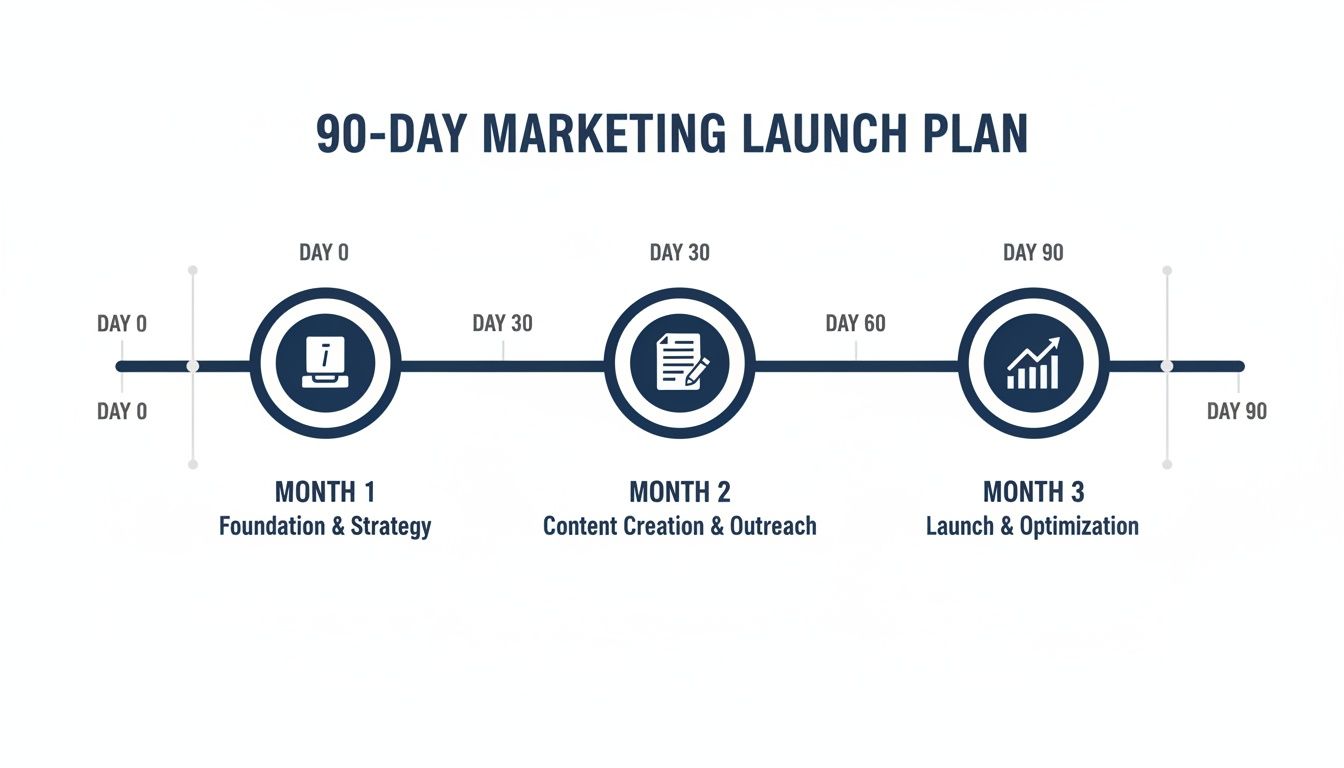
The secret is how each month builds on the last, creating a powerful compounding effect over time.
Month 1: The Foundation
Your first 30 days are all about getting your house in order. Think of this as building the essential infrastructure that will support every other marketing move you make. If you skip this, any ads you run or content you create will fall flat.
This is the behind-the-scenes work that makes all the difference.
Here’s your action plan for Month 1:
- Conduct Your Marketing Review: Use the diagnostic questions from the first part of this guide to do an honest internal audit. Get crystal clear on your ideal customer, nail down your core message, and take stock of your current marketing assets.
- Set Up Your GoHighLevel CRM: This is non-negotiable. Get your CRM implemented so you have one central place for all leads and customer data. Even a basic setup where you manually add contacts is a massive step up.
- Optimize Your Digital Storefront: Focus on two things. First, do a quick review of your website. Is your messaging clear? Are there obvious calls-to-action on your most important pages? Second, completely fill out and optimize your Google Business Profile.
Why This Matters: Month 1 is about building the machine. By the end of these 30 days, you’ll have a clear picture of where you stand and a system ready to capture and organize the leads you’re about to generate.
Month 2: Content Creation
With your foundation solidly in place, Month 2 is all about creating your first round of valuable marketing assets. This is where you start proving your expertise and giving potential customers a reason to engage with your brand.
The mission isn't to create a huge library of content. It’s about producing a few high-quality pieces that speak directly to your ideal customer’s biggest problems.
Here are your priorities for Month 2:
- Launch Your First Pillar Blog Post: Write and publish one in-depth, genuinely helpful blog post of 1,500+ words. It should answer a major question your customers are asking. This will become a powerful, long-term SEO asset.
- Create a Simple Lead Magnet: Don't overthink it. This could be a one-page PDF checklist, a short buyer’s guide, or a template that ties into your pillar post. The goal is to offer something valuable enough to trade for an email address.
- Build Your Initial Email Nurture Sequence: Write the three-to-five emails we mapped out earlier. Set them up in your GoHighLevel CRM to send automatically whenever someone downloads your new lead magnet.
This simple workflow creates a self-contained content engine. The blog post attracts traffic, the lead magnet converts that traffic into leads, and your email sequence warms those leads up for a sale.
Month 3: Amplification and Analysis
Now that you have your systems and content in place, Month 3 is about getting it all in front of the right people. This is where you start closing the loop and learning from your initial data.
Your focus shifts from building to promoting and measuring. You're lighting the fuse and seeing what happens.
Here’s what you need to do in Month 3:
- Promote Your Content: Start sharing your new blog post on your key social media channels (like LinkedIn). Pull out key quotes, create simple graphics from the post, or even record a short video discussing the main points.
- Analyze Your First 30 Days of Data: Log into your GoHighLevel dashboard and Google Analytics. Look at the basic numbers: How many people visited the blog post? How many downloaded the lead magnet? What were the open rates on your emails?
- Plan Your Next Cycle: Based on what you learned, decide what to do next. If the blog post topic resonated, plan another one. If email open rates were low, test a new subject line. This is the beginning of iterative improvement.
This 90-day plan is the first turn of the flywheel. By following this focused roadmap, you’ll build a powerful marketing system that generates predictable results, establishing a digital marketing strategy for your small business that truly works.
Your Top Questions, Answered
Even with the best roadmap, practical questions always come up during execution. That's perfectly normal. We hear these from business owners all the time, so let's address the most common ones.
How Much Should a Small Business Budget for Digital Marketing?
Everyone wants a magic number, but the honest answer is: it depends. A good starting point for established businesses is to earmark 7-10% of total revenue for marketing. However, if you're in a growth phase or just starting out, you’ll want to be more aggressive—think closer to 12-20% to build initial momentum.
The real focus shouldn't just be on the spend, but on the return on investment (ROI). We guide clients to start with foundational, high-ROI channels like SEO and email marketing because they build long-term assets that you own.
As you see returns from that initial investment, you can strategically reinvest those profits into other channels. The 90-day plan we outlined is the perfect way to establish a baseline ROI that will inform your budget decisions for years to come.
Which Digital Marketing Channel Should I Focus On First?
For most B2B and service-based businesses, the priority is always the same: build your owned assets. These are the marketing channels you have complete control over, independent of changing social media algorithms or ad prices.
Start by cementing these two cornerstones:
- A professional, SEO-optimized website built from the ground up to convert visitors into leads.
- A solid email marketing and CRM system, like GoHighLevel, to capture and nurture every single one of those leads.
Think of it this way: your website is your best salesperson, working 24/7. SEO is the engine that brings qualified buyers to its door. Your email list is your direct line of communication to your audience. Once that foundation is unshakable, you can expand to social media to amplify your message and distribute your content.
Ready to stop guessing and start building a marketing system that delivers predictable results? At Machine Marketing, we specialize in diagnosing marketing challenges and engineering solutions for sustainable growth.
Book a discovery call with Karl today to get a clear roadmap for your business.