If your lead flow feels like a lottery—some months you hit the jackpot, most months you don’t—the problem isn't your effort. It’s the lack of a system. For a tech company, this is an engineering problem in disguise.
Effective digital marketing for tech isn't about just doing more. It’s about building a predictable machine where every part works together to produce the one thing that matters: qualified leads. This guide lays out our engineer's approach to diagnosing your marketing gaps and building that machine.
Why Your Tech Company Needs a Marketing System, Not Just Tactics
As a leader in a tech or manufacturing company, you build superior products. But what happens when that incredible product sits on the shelf because the right people don’t know it exists? What if your sales team is starved for good prospects?
The typical reaction is to throw tactics at the wall—a blog post here, a random social media campaign there—and hope something sticks. We call this "random acts of marketing," and it’s a recipe for inconsistent results and wasted budgets.
The real solution is to think like an engineer. You need a system-based approach to your marketing, moving from disconnected actions to an integrated framework designed for one purpose: scalable growth.
Diagnosis: Identifying the Core Problem
For most tech and industrial companies we work with, the issue is rarely the product. It’s a fundamental disconnect between that great product and the market that needs it. Your marketing feels like shouting into the void because it isn't part of a cohesive plan.
Here are the questions to ask yourself. Does any of this sound familiar?
- Inconsistent Lead Flow: Are some months a flood and others a desert? Do you have any ability to reliably forecast your sales pipeline?
- Low Visibility: Do competitors, even those with weaker products, seem to be everywhere online while you struggle to get noticed?
- Wasted Resources: Does money go into marketing, but you can't connect a single dollar of it directly to a sale?
- Sales and Marketing Misalignment: Does your sales team complain the leads are poor quality, while your marketing team feels undervalued?
A marketing system turns your business from one that’s constantly hunting for leads into one that predictably generates them. It aligns every single activity—from a blog post to a CRM entry—toward the singular goal of attracting, nurturing, and closing your ideal customers.
The Shift from Tactics to a System
Adopting a system means every marketing move is intentional. You stop asking, "What should we do next?" and start asking, "How does this piece fit into our lead-generation engine?"
Think of it as the difference between throwing a pile of parts at a problem versus meticulously building an engine. Each component—your website, your SEO, your paid ads, your CRM—is a gear that must mesh perfectly with the others to drive the whole machine forward.
To illustrate this shift, let's compare the two mindsets.
Moving from Random Tactics to a Reliable Marketing System
Most tech companies are stuck in a tactical loop, which feels chaotic and produces unreliable outcomes. Shifting to a system creates the structure and predictability that engineers and business leaders crave.
| Characteristic | Tactical Approach (The Common Problem) | System Approach (The Effective Solution) |
|---|---|---|
| Focus | Short-term activities (e.g., "We need a blog post.") | Long-term outcomes (e.g., "We need to increase qualified leads by 20%.") |
| Process | Reactive and fragmented; "random acts of marketing." | Proactive and integrated; every action serves a strategic purpose. |
| Measurement | Vanity metrics (likes, clicks, traffic) with no clear tie to revenue. | Business-critical KPIs (cost per lead, conversion rates, customer lifetime value). |
| Results | Unpredictable, inconsistent, and difficult to scale. | Predictable, measurable, and scalable growth. |
| Team Alignment | Sales and marketing operate in silos, often with conflicting goals. | Sales and marketing are fully aligned on lead quality and the customer journey. |
This isn't just a different way of thinking; it's a fundamentally different way of operating. A system provides the framework you need to finally get off the marketing hamster wheel and start seeing predictable, measurable, and scalable results.
Laying Your Foundation With Audience and Messaging
You wouldn't start building a complex machine without a detailed blueprint. So why would you start marketing one that way? Before you spend a single dollar on ads or an hour writing content, you have to nail down two fundamental questions: Who are we really talking to? And what, exactly, do we need to say to them?
This is the diagnostic work. Get this right, and your marketing becomes a precision instrument. Get it wrong, and you're just making noise. All the budget in the world can't save a campaign that’s aimed at the wrong people with the wrong message.
Pinpointing Your Ideal Customer Profile
Too many B2B tech companies fall into the trap of trying to be everything to everyone. The result? A bland message that connects with no one. The first move is to get razor-sharp about your Ideal Customer Profile (ICP). This isn't just a loose idea; it's a tight definition of the perfect-fit company for your solution.
Get your team in a room and ask these questions:
- Which companies see the biggest, most tangible wins from our product?
- Where are our most profitable customers? What industry? What size?
- What specific technical or operational headaches do they have that we are uniquely equipped to solve?
- Are there common threads among our best clients? (e.g., revenue, employee count, or even the tech stack they already use).
Answering these questions gives you clarity. Suddenly, "everyone" becomes someone specific. For instance, your ICP might be: “North American machine shops with 50-200 employees that are struggling with production bottlenecks due to outdated CNC programming.” That’s your North Star.
From Profiles to People With Buyer Personas
Once you know the right companies, you need to understand the people inside them who influence the purchase. This is where buyer personas come in. A persona is a character sketch of your ideal customer, built from market research and real data on the people you already serve.
For a complex B2B tech sale, you'll likely have a few key players:
- The End User: The engineer or machine operator who’s hands-on with your product every day. They care about features, usability, and making their job less frustrating.
- The Decision-Maker: The Plant Manager or VP of Operations. They’re thinking about ROI, seamless integration, and the long-term strategic fit.
- The Financial Approver: The CFO or purchasing lead. Their world revolves around budget, payment terms, and the total cost of ownership.
A common mistake is marketing only to the C-suite. The engineer on the floor who becomes an internal champion for your product is often your most valuable asset. Your messaging has to speak to each of these people, addressing their unique priorities.
Crafting a Message That Cuts Through the Noise
Now that you have a clear ICP and detailed personas, you can finally build your core message. This isn't just a catchy slogan. It’s the central pillar that communicates your value so clearly that, for your ideal buyer, choosing you becomes the only logical option.
A powerful message always has three parts:
- Acknowledge the Pain: Show them you get it. Start by articulating their problem better than they can (e.g., "Manual quality control is slow, inconsistent, and lets costly defects slip through.").
- Present Your Solution: Connect their pain directly to your product (e.g., "Our automated vision system inspects 100 parts per minute with 99.9% accuracy.").
- Show the Transformation: Paint a vivid picture of the "after" state (e.g., "This crushes bottlenecks, slashes waste, and can boost your production throughput by 30%.").
This foundational work is the single most important investment you can make in your marketing. To see how these principles apply in even more complex sales cycles, our guide on B2B tech marketing goes even deeper. With this blueprint in hand, every piece of content you create and every campaign you launch will be perfectly calibrated to attract and win your ideal customers.
Choosing the Right Channels for the Tech Industry
You've nailed down your message and you know exactly who you're talking to. What now? It’s time to decide where you’re going to deliver that message, and for a tech or manufacturing company, this isn't about guesswork.
Effective digital marketing requires a focused, multi-channel strategy where every piece works together to guide a prospect from a curious click to a signed contract. Your time and budget are finite, so you need to invest where it actually counts. Instead of casting a wide net and hoping for the best, we focus on a handful of high-impact channels that consistently deliver results for technical buyers.
This isn’t about picking channels out of a hat. The whole process is sequential. Your research informs your audience, your audience defines your message, and that message dictates the channels you use.
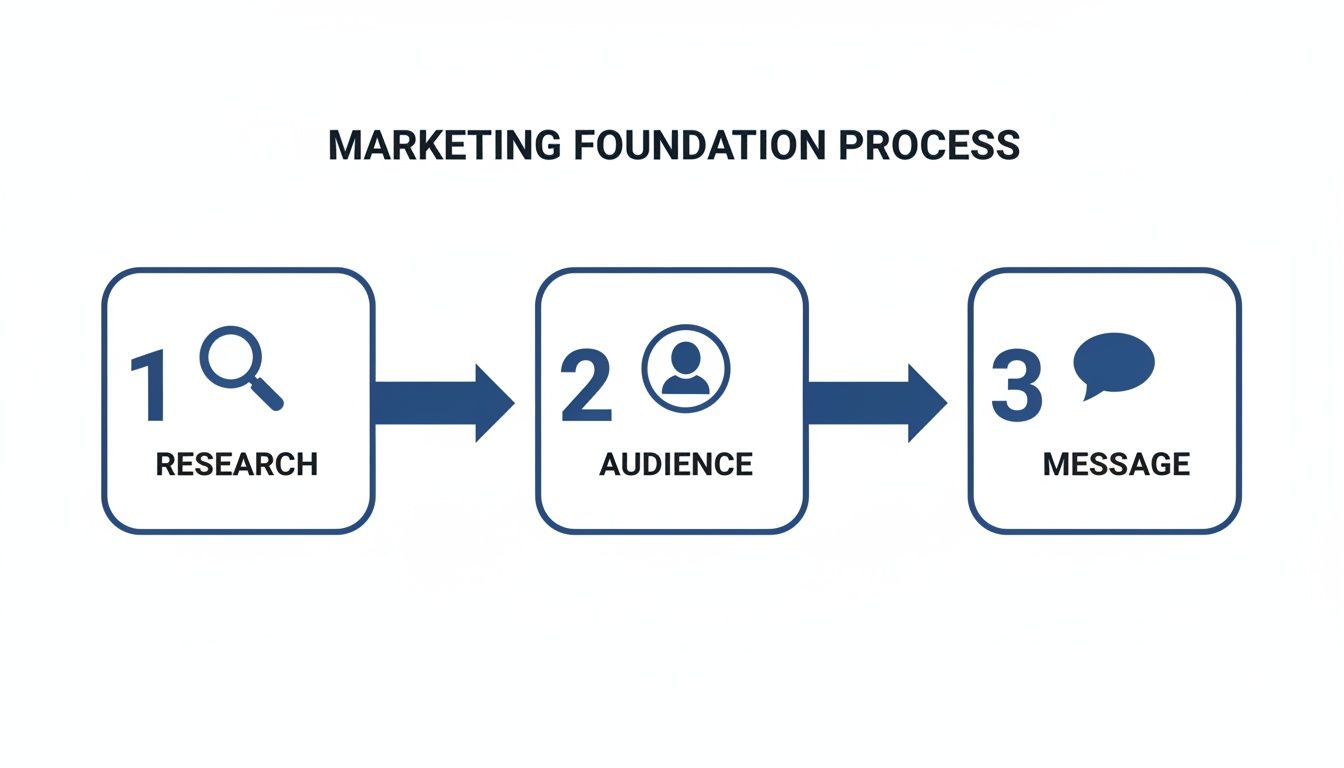
Think of it like building a house. You don't start by putting up the walls (your channels). You start with a solid foundation of research, audience definition, and clear messaging. Each step builds on the last.
Your Website and SEO: The Digital Hub
Your website is not a digital brochure—it’s the central hub of your entire marketing system. For B2B tech companies, it's where engineers, project managers, and purchasing agents go to see if you’re credible. It has to be professional, fast, and built to answer their most pressing technical questions.
This is where Search Engine Optimization (SEO) becomes absolutely critical. When your ideal customer searches for a solution like "automated quality control systems for CNC," you need your website to show up. A solid SEO strategy covers a few key areas:
- Technical SEO: This ensures Google can easily crawl and index your site. Fast load times and a mobile-friendly design are non-negotiable. A slow or broken site screams technical incompetence.
- On-Page SEO: This means optimizing every page with the right keywords, clear headings, and content that directly answers what the searcher is looking for.
- Local SEO: If you serve specific geographic areas, optimizing your Google Business Profile (GBP) is a must. It’s a powerful—and free—tool for showing up in local searches and on the map.
Your website is your digital storefront and primary sales tool. It must function as an asset that works for you 24/7, attracting visitors and converting them into qualified leads even when your sales team is offline.
With search engines increasingly relying on AI, optimizing for these new systems is key. To get a handle on it, you can Master LLM SEO and AI Search Ranking with this practical guide.
Content Marketing: The Authority Builder
In a complex B2B sale, trust is everything. Content marketing is your number one tool for building that trust and proving you know your stuff. Generic, fluffy blog posts won’t get you anywhere. Your audience of engineers and decision-makers wants real substance.
Your content needs to meet prospects at every stage of their journey:
- Top-of-Funnel (Awareness): Think blog posts and articles that tackle high-level problems and answer common industry questions. This is how you get on their radar in the first place.
- Mid-Funnel (Consideration): This is where you go deep with guides, whitepapers, and case studies that put your solution under a microscope. A detailed case study showing how you fixed a production bottleneck for a company just like theirs is infinitely more powerful than a product page.
- Bottom-of-Funnel (Decision): Give them the tools they need to make a purchase decision. We're talking product spec sheets, ROI calculators, and demo videos that help a serious prospect justify the investment to the rest of their team.
Paid Ads and LinkedIn: Precision Targeting
While SEO and content are building your long-term authority, sometimes you need to get leads in the door right now. That's where paid advertising comes in, but it demands a surgeon's precision, not a sledgehammer approach.
For most B2B tech companies, LinkedIn Ads are the most powerful paid channel. Why? No other platform lets you target users based on their exact job title, company, industry, and seniority. You can put your message directly in front of the "VP of Engineering" or "Purchasing Manager" you defined in your buyer personas.
The smartest strategy is to combine channels. For example, you can run Google Ads to capture people who are actively searching for a solution, while simultaneously using LinkedIn Ads to proactively reach the decision-makers who fit your Ideal Customer Profile but might not be searching yet. This integrated system lets you capture both active and passive buyers.
Building Your Engine With a CRM and GoHighLevel
Your marketing channels are finally bringing in leads. Great. But what happens next? If those hard-won contacts are just landing in a messy spreadsheet or a forgotten inbox, you're not just disorganized—you're actively leaking revenue. Every effective marketing system needs a powerful, central engine. For today's tech and manufacturing businesses, that engine is a Customer Relationship Management (CRM) platform.
Think of it as the command center for your entire marketing and sales operation. This isn't just a digital address book. A properly implemented CRM is the single source of truth that tracks every single interaction, from a prospect's first click on your website to the final signed contract. It’s where your strategy finally meets execution, turning scattered data points into real, actionable intelligence.
Why GoHighLevel Is Our Go-To Platform
While there are plenty of CRMs out there, we build our clients’ marketing engines on GoHighLevel. Why? Because it’s an all-in-one platform that consolidates the tools you’re probably already paying for separately—email marketing, SMS, call tracking, online scheduling, and more—into one unified system.
This integrated approach is a game-changer. Instead of fumbling with multiple subscriptions and trying to patch data together from different sources, everything just works in concert. This directly tackles a major headache for B2B tech companies. Even though 63% of businesses are increasing their digital marketing budgets, efficiency is the name of the game. With only 24% of CMOs feeling they have enough funds, they have to make every dollar count. Integrating tools with a platform like GoHighLevel is the most direct path to that efficiency.
Turning Your CRM Into a Lead-Generation Machine
Just signing up for a CRM and importing a list of contacts is a waste of time. The real power comes from building automated workflows that run 24/7 to save time, nurture leads, and empower your sales team. This is where we apply an engineering mindset to build a system that works for you.
Here’s a quick look at how we configure GoHighLevel to create a predictable sales pipeline:
- Automated Lead Capture: A prospect fills out a form on your website to download a spec sheet. They are instantly and automatically added to the CRM. No manual data entry, no delays.
- Instant Nurturing: The system immediately sends them the spec sheet via email and tags them based on their interest (e.g., "Interest-CNC-Machining").
- Targeted Follow-Up: A few days later, an automated email can follow up with a relevant case study or an invitation to a product demo webinar.
- Sales Team Alerts: If that same lead later visits your "Request a Quote" page, the system sends an instant notification to the sales team, flagging them as a "hot" prospect who is ready for a real conversation.
Your CRM should be more than a database; it must be an active participant in your sales process. By automating routine communication and tracking engagement, it frees your team to focus on high-value conversations with qualified buyers.
To make this even more efficient, you can integrate tools for CRM lead capture through AI actions, which can help qualify and route new leads without any human intervention. This is the kind of automation that transforms marketing from a cost center into a predictable revenue driver.
Ultimately, this system breaks down the walls between your teams. Sales can see every marketing email a prospect has opened and every page they’ve visited on your site. That context is pure gold, leading to smarter, more relevant sales calls. You can learn more about how to fully integrate your CRM and digital marketing efforts in our detailed guide. When you build this engine, you create a closed-loop system where you can finally track a customer from their first click all the way to a closed deal.
Measuring What Matters to Prove Your Marketing ROI

If you come from an engineering or manufacturing background, you live and breathe data. You know that if you can't measure something, you can't manage it. The same exact principle applies to marketing.
This is where so many B2B and tech companies get it wrong. They get distracted by metrics that look good on paper but have zero connection to revenue. To prove your marketing is actually working, you have to look past the vanity metrics and focus on what’s impacting the bottom line.
Forget about likes, shares, or even raw website traffic. Those are just indicators, not results. They don't pay the bills.
The core question is simple: For every dollar you put into marketing, how many dollars are you getting back in sales? If you can’t answer that, you don't have a marketing system—you have a marketing expense.
KPIs That Actually Drive Growth
To get a true picture of your marketing’s health, you need to track Key Performance Indicators (KPIs) that connect directly to your sales pipeline. These are the numbers that let you diagnose what’s working, what isn’t, and where to invest your next dollar.
Your dashboard should revolve around three critical metrics:
Cost Per Lead (CPL): This is your total spend on a channel divided by the number of leads it generated. It tells you exactly what you’re paying to get a potential customer to show interest. Are you paying $50 for a lead from Google or $500 for one from a trade publication ad? You need to know.
Customer Acquisition Cost (CAC): This takes it one giant step further. It’s your total sales and marketing cost divided by the number of new customers you landed in a specific period. This is the real-world cost of winning a new client.
Pipeline Velocity: How fast are leads moving from that first click to a signed contract? A slow pipeline can mean your follow-up is weak, your messaging is off, or the leads themselves aren't qualified. Speed is a critical indicator of health.
When you track these KPIs, you can confidently answer questions like, "Are the leads from LinkedIn Ads converting faster and at a lower cost than leads from our blog?" That’s the kind of data that empowers smart business decisions.
To dive deeper into the formulas and setup, check out our complete guide on how to measure marketing ROI.
Building Your Real-Time Dashboard
The goal is to have this data available at a glance, not buried in a spreadsheet you update once a month. This is another area where a unified platform like GoHighLevel is invaluable. It pulls data from tools like Google Analytics and your ad platforms into a single, real-time dashboard.
In one view, you can see which channels are producing the lowest CPL, how your CAC is trending over time, and where bottlenecks are slowing down your sales process. This immediate feedback loop is what allows you to optimize on the fly.
This data-driven approach is becoming non-negotiable. In digital marketing for tech, 73% of marketers are already using AI tools for content and analysis. And with 64% of businesses believing AI is critical for creating personalized customer experiences, you can't afford to guess. You can see more on these digital marketing statistics and trends on Marketing Dive.
This is how you turn marketing from a mysterious "art" into a measurable science, giving you the confidence to report back to leadership and double down on what truly works.
Your 90-Day Proof-of-Concept Plan
Theory is good, but results pay the bills. After we’ve diagnosed your specific needs and designed the system, it's time to prove it works. This is where we stop planning and start executing with a clear, 90-day roadmap.
Think of it as three focused 30-day sprints, not one giant project. Each month has a specific goal designed to build momentum and show you real, measurable progress. The point is to build a working marketing engine and get your first batch of data-backed insights, proving that results are possible in just one quarter.
Month 1: Foundation and Setup
The first 30 days are all about building the essential infrastructure. You simply can't run successful campaigns on a shaky foundation. This sprint makes sure every piece of your system is configured correctly and ready for launch.
Our focus is on two key outcomes:
- Finalize Messaging and Core Content: We take the audience and messaging work we've already done and make it concrete. This means developing your first foundational content pillar—like a comprehensive guide or a detailed whitepaper—that will act as a magnet for your ideal customers.
- Configure Your GoHighLevel Engine: We set up and customize your GoHighLevel instance. This isn't just turning on software; it’s building the automated workflows, lead capture forms, email sequences, and reporting dashboards that will run your entire marketing operation. By the end of this month, your central hub is fully operational.
Month 2: Activation and Launch
With the foundation solidly in place, month two is when we flip the switch. This sprint is all about activating your channels and driving your first streams of targeted traffic. The goal here is to start generating initial leads and collecting performance data.
This is where we put your system to the test in the real world. We move on three fronts at once to create a coordinated push.
- Content Deployment: We publish the cornerstone content piece we built in month one and start the initial promotion across your own channels.
- SEO Kickstart: We begin implementing the on-page and technical SEO fixes identified in our audit. This kicks off the long-term process of building your organic search visibility so prospects can actually find you.
- Targeted Ad Campaign: We launch your first paid ad campaign, usually on LinkedIn or Google Ads, aimed directly at the buyer personas we defined. The objective is to drive immediate, high-intent traffic to your new content or a dedicated landing page.
A common mistake is launching channels one by one. It creates a slow, disconnected effort. By activating content, SEO, and paid ads together, you create a flywheel effect where each channel strengthens the others, speeding up your initial results.
Month 3: Optimization and Reporting
In the final 30 days, we shift from activation to analysis. The campaigns we launched in month two are now feeding us valuable data, telling us exactly what's resonating with your audience and what's falling flat. This sprint is all about making data-driven adjustments to improve performance and prove the ROI on your initial investment.
The key activities for this month are:
- Data Analysis: We dive deep into the numbers from your ad campaigns, website traffic, and lead forms. We're looking at metrics like Cost Per Lead (CPL), click-through rates, and conversion rates to pinpoint top-performing assets and find areas for improvement.
- Campaign Optimization: Based on what the data tells us, we make targeted tweaks. This might mean rewriting ad copy, refining your audience targeting on LinkedIn, or optimizing a landing page to get more conversions.
- Performance Reporting: At the end of the 90 days, we deliver your first comprehensive performance report. This isn't just a data dump. It's a clear analysis of what we accomplished, what we learned, and our strategic recommendations for the next quarter.
This structured 90-day plan moves you from abstract theory to tangible proof. It shows how a systematic approach to digital marketing for tech can quickly build momentum and lay the foundation for long-term, scalable growth.
Frequently Asked Questions
When we sit down with leaders in tech and manufacturing, the same smart questions always surface. Everyone wants to know what it really takes to get results.
Here are the straight-up answers to the questions we hear most—and the ones you should be asking, too.
How Long Until We See Results?
This is always the first question, and it’s the right one to ask. While every business is unique, you should expect to see meaningful data and an initial flow of leads within the first 90 days.
The first 30 days are all about building your foundation—nailing the messaging and getting the systems set up. By month two, campaigns are live and running. Month three is when we have enough real-world data to begin optimizing and reporting on initial performance.
This isn't about finding a magic button. It's about building a predictable engine for growth, step by step.
What Is the Most Important First Step?
The single most critical first step is defining your Ideal Customer Profile (ICP) and core messaging. Everything else—your ads, your content, your SEO—is built on this foundation.
Without a crystal-clear picture of who you're talking to and what they actually care about, your campaigns will miss the mark and fail to connect.
You can have the best product and the biggest ad budget, but if you're talking to the wrong people with the wrong message, you're just making expensive noise. Get the foundation right first, and every other tactic becomes exponentially more effective.
Is GoHighLevel the Only CRM That Works?
No. We build our systems on GoHighLevel because its all-in-one platform is incredibly powerful and efficient, but the principles we've covered apply to any solid CRM. Whether you're using HubSpot, Salesforce, or another platform, the strategy doesn't change.
The specific tool is less important than how you use it. The real key is having one central system and using it methodically to track leads, automate communications, and arm your sales team with the intel they need to close deals.
The breakthrough comes from the system, not just the software.
Ready to diagnose your marketing gaps and build a system that delivers predictable leads? Our process provides a clear roadmap for B2B tech and manufacturing businesses.