If you're a business owner, you care about one thing: results. You need your investment in marketing to turn into tangible business growth, not just a list of completed tasks on a monthly report. This is why SEO pay for performance catches your eye.
The premise is simple and powerful: you only pay an agency when they deliver specific, measurable outcomes. But does this model align with your real goal of sustainable, profitable growth? We see business owners grapple with this question all the time. In this guide, we'll diagnose the pay-for-performance model, show you how it really works, and give you a clear framework to decide if it's the right solution for you.
What Is Pay-For-Performance SEO?

Think of it like hiring a new sales rep. A traditional SEO retainer is like paying a salary for their time and effort. A pay-for-performance model is like paying a commission on the deals they actually close.
You and an agency agree on concrete milestones upfront. When they hit a target—like getting a key product page to the top 3 on Google—you pay them. If they miss, you don't. It’s this direct link between payment and results that makes the model so tempting.
The Promise vs. The Reality
On paper, performance-based SEO sounds like the perfect solution. It promises total accountability and almost zero financial risk. You aren't paying for someone's time; you're buying a specific result. The key is knowing which results actually drive your business forward, which requires a sharp eye for measuring content marketing ROI.
But here’s the problem we often have to diagnose: the "results" you pay for might not translate into customers or revenue. An agency could get you to #1 for a specific keyword, but if that keyword doesn't bring in qualified buyers, you've just paid for a vanity metric that doesn't impact your bottom line.
The Diagnosis: The biggest risk in a pure performance model is a fundamental misalignment of goals. Your ultimate objective is sustainable, profitable growth. An agency’s goal, driven by the payment structure, can easily become hitting the narrowest, fastest billable target—even if it does little to help your business long-term.
Before you commit, it's critical to understand the trade-offs.
Pay-For-Performance SEO At a Glance
| Aspect | The Promise (Potential Advantage) | The Reality (Potential Disadvantage) |
|---|---|---|
| Payment Structure | You only pay for tangible results like rankings or leads, not for hours worked. | Metrics can be easily gamed (e.g., low-value traffic) if not defined precisely. |
| Risk Profile | The agency carries the upfront financial risk, making it feel "safer" for you. | You risk paying for results that don't generate revenue or are achieved with risky, short-term tactics. |
| Strategic Focus | The model is highly focused on achieving specific, pre-defined goals. | It encourages short-term wins over building a durable, long-term SEO foundation and brand authority. |
| Transparency | The outcome is clear: the goal was met or it wasn't. | The methods used can be a black box, potentially involving tactics that could harm your site later. |
How Performance-Based SEO Models Actually Work
Let's pull back the curtain and look past the sales pitch. How are these agreements structured, and what exactly triggers a payment? Understanding the mechanics is the first step in protecting your business.
At its heart, a performance-based SEO model ties your payments directly to predefined results. You and your agency agree on specific, measurable targets. When a target is hit, you get an invoice. This is a world away from a standard monthly retainer, where you’re paying for a team's time and expertise.
Common Payment Triggers You Will Encounter
The "performance" in SEO pay for performance isn't a vague promise for "more visibility." It's a concrete number tied to a Key Performance Indicator (KPI). The entire payment structure is built around hitting these milestones.
Here are the most common triggers you'll see:
- Keyword Rankings: The classic model. You agree on a list of high-value keywords and pay a set fee when a keyword hits a specific spot on Google (e.g., top 10, top 5, or top 3).
- Organic Traffic Milestones: Payment is triggered when your website’s organic traffic hits a certain level. For example, a bonus might kick in when traffic grows by 20% over the last quarter.
- Lead Generation: This model aligns much better with business goals. Payment is triggered only when a certain number of qualified leads—like form fills or phone calls from organic search—are generated. This demands extremely precise tracking.
Understanding the nuance here is critical. Focusing only on traffic can be a trap if those visitors aren't qualified buyers. You can learn more about attracting the right kind of visitors in our guide on how to increase organic traffic with the right strategies.
What to Look For: A transparent agency will help you define KPIs that actually tie back to your business goals, not just vanity metrics that are easy to hit. They should show you exactly how they track results in tools like Google Analytics 4 and Google Search Console and give you direct access to the data.
Sample Pricing Structures
Not all performance deals look the same. The two arrangements you’ll most likely see are the "Hybrid" model and the "Pure Performance" model. Knowing which one an agency prefers tells you a lot about their business philosophy.
1. The Hybrid Model (Base Fee + Performance Bonus)
- How it Works: You pay a smaller, fixed monthly fee that covers foundational work like technical audits, strategy, and content creation. On top of that, you pay bonuses when specific performance targets are met.
- Example: A B2B manufacturer might pay a $1,500/month base fee. If the agency gets their top 5 product category keywords into the top 3 on Google, an additional $500 bonus is paid for each keyword that month.
- Why It's Used: This is a healthier, more collaborative model. The base fee ensures the agency has resources to do the essential, unglamorous work that underpins sustainable growth, while the bonus keeps them focused on results.
2. The Pure Performance Model (Pay-for-Results Only)
- How it Works: There are no monthly fees. You only pay when an agreed-upon result is delivered.
- Example: A local service business agrees to pay $100 for every qualified lead generated through organic search. If they get 15 leads in a month, the invoice is $1,500. If they get zero, you pay nothing.
- Why It's Used: This is the ultimate "put your money where your mouth is" model. It's high-risk for the agency, so they often use it as a sales tool. Be aware, however, that it can incentivize an agency to chase the fastest (and sometimes riskiest) path to getting paid.
Comparing SEO Pricing Models
Choosing an SEO partner is about picking a business model that aligns with your goals. To make the right call, you need to see how SEO pay for performance stacks up against the industry workhorses: the monthly retainer and the project-based fee.
Each model forges a different kind of working relationship. There’s no single “best” option—only the right fit for your business today. Understanding the various SEO pricing models is a crucial step before signing any contract.
SEO Pricing Model Comparison: Retainer vs. Project vs. Performance
| Pricing Model | Best For | Risk Profile | Agency-Client Relationship |
|---|---|---|---|
| Monthly Retainer | Comprehensive, long-term growth and building a digital asset. | Low Risk. Agency has consistent resources to execute a holistic strategy. Client risk is tied to agency performance over time. | Partnership. The agency acts as an extension of your marketing team, deeply invested in broad business success. |
| Project-Based | Specific, one-off tasks with a clear scope and deadline (e.g., website audit, keyword research). | Low-to-Medium Risk. Costs are fixed and deliverables are clear. The risk is that the one-off project may not address the larger SEO picture. | Contractor. The agency is a specialized vendor hired to complete a defined job. It's transactional and efficient. |
| Pay-for-Performance | Businesses seeking specific, measurable results like rankings or leads, often with high risk tolerance. | High Risk. Can incentivize black-hat tactics. Agency risk is high (no results, no pay), which can lead to corner-cutting. Client risks include low-quality work and potential penalties. | Vendor (High Pressure). Relationship is purely transactional, focused on hitting a narrow, billable KPI, which can create friction. |
As you can see, the right choice hinges on whether you're looking for a long-term partner, a short-term specialist, or a results-driven vendor.
The Monthly Retainer Model
The monthly retainer remains the most common SEO model for a reason. Think of it less as a service and more like hiring an expert partner. You pay a fixed fee each month, and in return, you get a team invested in building your digital presence from the ground up.
This model is a perfect fit for businesses that want sustainable, compounding growth. It gives an agency the runway to learn your business and execute a complete strategy—from technical SEO and content creation to building your site's authority. If you want to build a growth engine, a retainer is almost always the right move.
Some models try to blend this stability with results-based incentives.
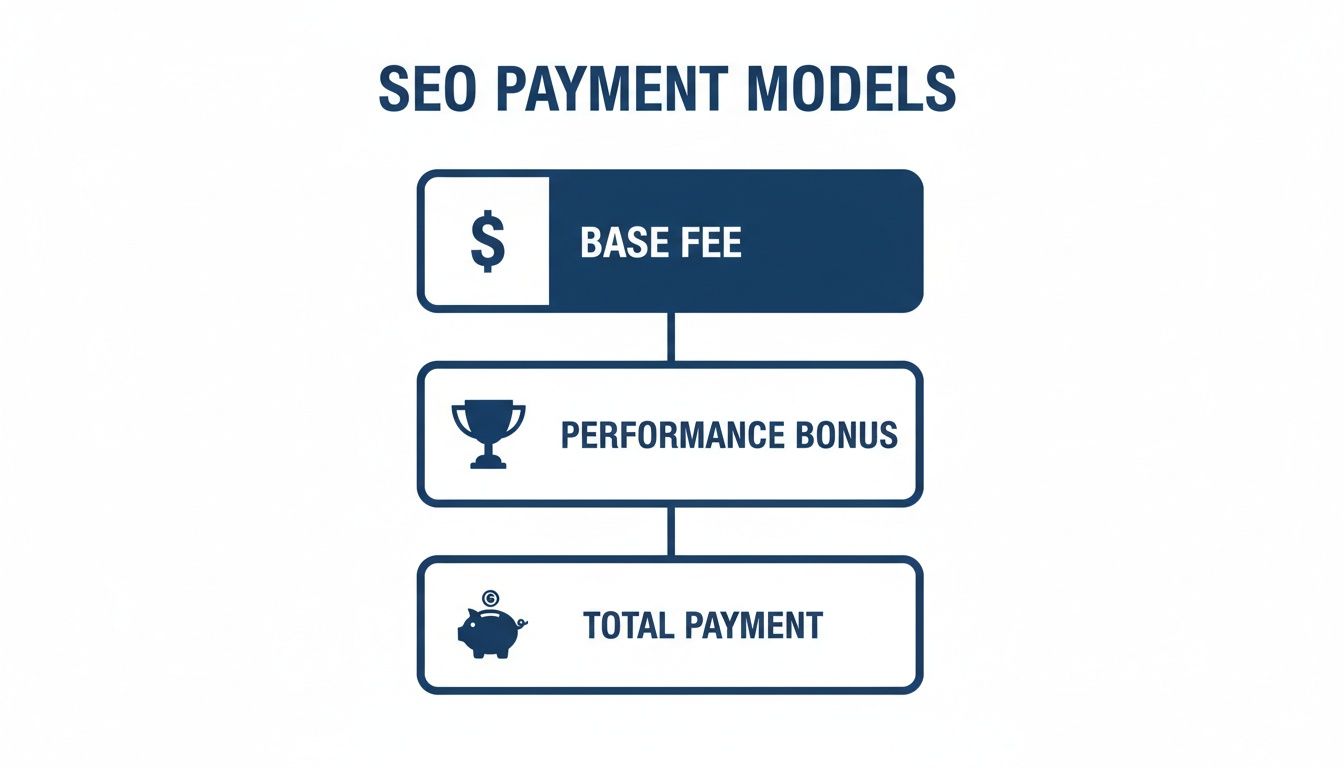
This hybrid approach tries to offer the best of both worlds, ensuring the agency has a budget for essential work (the Base Fee) while also rewarding them for hitting specific targets (the Performance Bonus).
The Project-Based Fee Model
Need a specific job done? That’s where project-based fees come in. This model is for a one-time, clearly defined task with a firm start and finish. It could be a full technical website audit, a deep dive into keyword research, or setting up your local SEO.
The biggest benefit is clarity. You know exactly what you’re getting and what it will cost. This setup positions the agency as a specialized contractor. It’s a great way to fix a critical problem without a long-term commitment. For instance, manufacturers can get huge value from a project focused on conversion-centric technical content SEO.
How The Model Shapes The Relationship
The payment structure you choose directly dictates the dynamic between you and your agency. A retainer builds a deep partnership. A project fee creates a clean, transactional relationship.
The Question to Ask Yourself: "Am I looking for a short-term vendor to complete a task, or a long-term partner to drive sustainable growth?" Your answer will point you straight to the right model.
A pure pay-for-performance model aligns an agency with hitting a very specific, billable metric. That’s a critical distinction every business owner needs to understand before they sign a contract.
The Hidden Risks Of Performance-Based SEO

The promise of only paying for results feels safe, but before you sign, you need to understand the hidden risks. An agreement that looks like a low-risk win can quickly turn into a massive headache.
The fundamental issue is a clash of goals. Your goal is sustainable, profitable growth. An agency on a pure performance model has a simpler one: hit the billable target, fast. This pressure often pushes them toward short-term tactics that can poison your website’s long-term health.
The Lure of Vanity Metrics
The most common trap in SEO pay for performance is paying for rankings that generate zero revenue. An agency might get you to the top of Google for a keyword, triggering their payment. But if that keyword has no commercial intent, you’ve just paid for a flood of traffic that will never convert.
Imagine you're a manufacturer of industrial CNC machines. The agency gets you to #1 for "what is CNC machining?"
- The Result: A surge in traffic from students and hobbyists.
- The Problem: None of these visitors are qualified buyers for a $150,000 machine.
- The Transformation: You write a check for hitting a "ranking" goal, but your sales team gets no new leads. You’ve paid for a metric, not a business outcome.
The Danger of Black-Hat SEO Tactics
When an agency's paycheck depends on hitting a number by month-end, the temptation to cut corners becomes enormous. This is where "black-hat" SEO tactics that violate Google's guidelines come into play. These shortcuts can produce fast results, but the fallout can be catastrophic.
Common black-hat methods include:
- Link Farming: Buying thousands of low-quality links from irrelevant websites (PBNs).
- Keyword Stuffing: Jamming pages with so many keywords that they become unreadable to humans.
- Cloaking: Showing one version of a page to Google and a different one to visitors.
The Diagnosis: When Google's algorithm catches on—and it almost always does—the penalties are brutal. We’ve seen businesses lose over 80% of their traffic overnight. It’s like being erased from the internet, and recovery can take months or even years. The agency gets paid, and you’re left with the mess.
Contractual Pitfalls and Lack of Foundational Work
Performance contracts are often written to protect the agency, not you. Without careful review, you can get locked into an agreement that bleeds your budget without building any lasting value. Agencies face intense financial pressure, especially with rising specialist salaries. This can push them to prioritize quick, billable wins over long-term success. You can see how salary trends can impact agency behavior to understand these dynamics.
Worse, these models discourage foundational SEO. Building a powerful online presence means investing in high-quality content, improving site speed, and earning genuine authority. Since these crucial tasks don't always produce an immediate, billable "result," they are often skipped.
An agency has no incentive to build you a strong house if they only get paid for planting a flag on the roof. You end up renting temporary results instead of building a valuable, long-term asset for your business.
When Does SEO Pay For Performance Make Sense?
So, is pay-for-performance SEO always a bad deal? Not necessarily. While it's often a poor fit for long-term growth, we've seen specific situations where it can be a smart, calculated move.
Think of it as a specialist's tool, not a complete strategy. It’s not for building a brand; it’s for hitting a very specific target with surgical precision. The key is knowing if your business situation fits the narrow profile where this model works.
The Ideal Use Case: A Laser-Focused Goal
The single most important factor for a successful performance deal is having an extremely clear, easily measurable, and high-value conversion goal. The more direct the line between the SEO activity and a tangible business result, the better this model performs. Vague goals like "more brand awareness" are a recipe for disaster.
So, when might it be a good fit?
- Single-Service Local Businesses: A local plumber wants more calls for "emergency drain cleaning." A performance deal based purely on qualified phone calls or form fills from that service page can work because the goal is crystal clear.
- Targeted E-commerce Products: You're launching a new product with obvious commercial keywords. A model where you pay for top 3 rankings on "buy [product name]" can be effective, as the searcher's intent is purely transactional.
- Low-Competition Niches: If you operate in a specialized B2B space with little online competition, an agency can often deliver quick wins without resorting to risky tactics.
The Litmus Test: Can you define the desired outcome in a single sentence with one key metric? If your answer is, "We need more qualified lead forms for our 'CNC machine repair' service," you might have a candidate for performance SEO. If the answer is, "We need to improve our overall digital presence," this is the wrong model for you.
When To Consider It As A Trial Run
Another practical way to use a performance agreement is as a short-term trial. If you’re new to SEO or have been burned by retainers that didn't deliver, a 3-to-6-month performance deal can feel like a safer way to test the waters with an agency.
This lets you see if an agency can move the needle without a long-term financial commitment. However, it's crucial to treat this as a temporary diagnostic phase, not a permanent strategy. Once the trial is over, the goal should be to shift to a more sustainable partnership that builds lasting digital assets for your brand.
Your Contract Checklist: Questions to Ask Before Signing

In a pay-for-performance model, the contract is your only protection. A poorly written agreement can have you paying for vanity metrics while your business gets zero real value.
Think of the contract as an engineering schematic. Every part needs to be defined, every risk managed, and every outcome clearly specified. Use this checklist to ask the right questions and ensure your contract protects you.
Questions About Performance & KPIs
This is the heart of the agreement. If the definition of "performance" is fuzzy, you're walking into a future argument.
Ask these questions:
- What are the exact KPIs? Are we paying for specific keyword rankings, a percentage lift in organic traffic, or qualified leads? Get granular.
- What tools will be the source of truth? Will we use Google Analytics 4 for traffic and Google Search Console for clicks?
- What counts as a "qualified" lead? A valid phone number? A company of a certain size? A specific project budget?
- "If we looked at this metric in three months, is there any way we could interpret it differently?" If the answer is yes, the definition isn't tight enough.
Questions About Payments & Exit Clauses
A performance deal can create unpredictable costs without airtight terms. The contract must protect your budget and provide a clear exit ramp.
Ask these questions:
- What is the exact payment schedule? Is it a one-time bonus for hitting a target or a recurring fee for maintaining it?
- What is the cancellation policy? A 30-day notice is standard. Be wary of long lock-in periods or massive penalties for early termination.
- Does the contract explicitly forbid black-hat SEO? It must prohibit link farms, cloaking, and keyword stuffing. This is your legal recourse if an agency gets your site penalized.
Questions About Ownership & Red Flags
A great agency builds assets for you. A predatory one rents them to you. The difference is in the contract. We explore this concept in our guide on how to measure marketing ROI.
Ask these questions:
- Who owns the content and links? The contract must state that you retain 100% ownership of all digital assets (content, backlinks, technical fixes).
- Will I have full admin access to my analytics? If an agency hesitates to give you access to your own Google Analytics and Search Console, it is a giant red flag. Full transparency is a requirement, not a bonus.
Common Questions About Pay For Performance SEO
As a business owner, you need straight answers. When a model as tempting—and potentially risky—as pay-for-performance SEO comes up, it’s only natural to have questions. Let's tackle the ones we hear most often.
What Kind of Results Can I Realistically Expect?
You can expect results that are laser-focused on the exact metric you agreed to pay for, and almost nothing else. If the contract is about ranking for one specific keyword, that’s where the agency will pour its energy.
This model is built around a single, billable outcome, often at the expense of a holistic strategy. Don't expect a boost in your overall brand authority or a rich library of evergreen content. The results are transactional. You'll get the result you paid for, which may or may not be the one your business truly needs.
Are There Upfront Costs With This SEO Model?
It depends, and this is a critical question to ask. Some "pure" pay-for-performance models advertise zero upfront costs. In reality, many reputable agencies offering this will still require a setup fee or a small base retainer.
That initial fee isn't a random charge; it covers essential diagnostic work like technical audits, competitor research, and initial strategy development.
Be cautious of any deal that sounds too good to be true. An agency that asks for no upfront investment might be signaling they won't be doing any deep, foundational work. Real SEO takes resources, and a small initial investment often ensures the agency is building your growth on solid ground.
How Long Does It Take to See Results?
Because the model incentivizes quick wins, agencies will use tactics that show movement faster. For less competitive keywords, you could see results within 3-4 months.
But for competitive terms that drive significant business value, sustainable SEO still takes 6-12 months or more.
Any agency promising #1 rankings in weeks is a massive red flag. They're likely using risky, short-term tactics that could get your site penalized. Your contract should define a realistic timeline for hitting performance milestones.
At Machine Marketing, we believe in building sustainable growth engines, not just chasing temporary wins. We help you create a marketing system that aligns every action with your long-term business goals. If you're ready for a clear roadmap to predictable results, book a discovery call with us today.