If your lead flow keeps swinging between busy months and worrying silence, your marketing probably does not have a nurturing system. Many manufacturers and B2B service firms still depend on trade shows, referrals, and a handful of outbound efforts. Those channels matter, but they are not reliable enough on their own.
A strong newsletter changes that. Done right, b2b newsletter marketing gives you a repeatable way to stay visible, educate buyers, and keep conversations warm while deals move slowly through internal reviews, budget checks, and technical evaluation.
Email still holds a unique position in B2B. 81% of B2B marketers use email newsletters as their primary form of content marketing, and 79% of B2B marketing companies report that email is their most successful channel for distributing content according to the data summarized by DBS Website (B2B marketing statistics and trends).
The practical shift is this. Stop thinking about a newsletter as “something to send once in a while.” Start treating it as an asset that compounds. Every issue can answer objections, reinforce expertise, surface demand, and help sales start warmer conversations.
Why Your B2B Marketing Feels Stuck (And How a Newsletter Fixes It)
A lot of B2B marketing feels stuck for one reason. The business communicates in bursts.
You go hard before an event. You post when a new machine ships. You follow up after a quote request. Then things go quiet. From the buyer’s side, that feels inconsistent. From your side, it feels like marketing is always starting over.
That pattern hurts most in manufacturing because buying cycles are long and rarely linear. A prospect might care today, disappear for months, then resurface when a project gets approved. If you are invisible during that gap, someone else gets remembered first.
The problem is not lead generation alone
Most owners diagnose this as a traffic problem or a sales problem. Often it is a continuity problem.
If a contact meets you at a trade show, downloads a spec sheet, or asks for a quote, what happens next? In many firms, the answer is “someone follows up when they can.” That is not a system. That is a dependency on memory.
A newsletter solves that by putting regular, useful communication in place. Not random promotions. Not product blasts. A structured cadence of relevant updates that keeps your company present while trust builds.
What a newsletter does
A good B2B newsletter helps you do four things at once:
- Stay visible: Buyers remember the companies they keep seeing in a useful context.
- Educate the market: You can explain process, quality, timelines, material choices, and common mistakes before sales gets on the phone.
- Nurture multiple stakeholders: Engineers, operations leaders, procurement, and ownership do not all care about the same details.
- Create hand-raisers: Some readers will reply, click, or forward your email when a project becomes active.
Key takeaway: The job of a B2B newsletter is not to close every sale directly. Its job is to make your company the familiar, trusted option when a buying moment arrives.
What does not work
Three patterns fail repeatedly:
- Sending only promotions: Buyers tune out if every email asks for a meeting.
- Writing for everyone: A plant manager and a sourcing lead do not need the same message.
- Treating the list like a dump bin: Old contacts, bounced addresses, and vague imports drag down results and create operational mess.
A newsletter works when it becomes part of your sales system. That starts with a blueprint.
Laying the Foundation for a High-Impact Newsletter
Most weak newsletters fail before the first draft. The business has not decided who the newsletter is for, what it should accomplish, or why anyone should keep reading it.
That is a strategy problem, not a writing problem.

Start with one business objective
Your newsletter can support several outcomes, but it should have one primary job. If you skip this, your content gets scattered fast.
Use this simple decision table:
| Primary business need | Newsletter job | Example focus |
|---|---|---|
| New pipeline | Generate qualified conversations | Educational issues tied to common buying triggers |
| Long sales cycle | Nurture existing prospects | Technical explainers, project insights, objection handling |
| Repeat business | Reactivate customers | Product updates, maintenance guidance, cross-sell relevance |
| Channel support | Help reps and distributors stay aligned | Market updates, application examples, launch notes |
For many manufacturers, the primary objective is not instant lead capture. It is staying top of mind while projects move slowly.
Define your reader
A common mistake in b2b newsletter marketing is describing the audience as “industrial buyers” or “decision-makers.” That is too broad to be useful.
You need to know who opens the email and what they are trying to avoid. In B2B, people read with a job to protect.
Ask yourself:
- Does this reader care most about uptime, cost control, lead time, compliance, or technical fit?
- Are they the person who identifies the problem, approves the purchase, or shortlists vendors?
- What would make them forward your email to someone else internally?
- What language do they use in calls and quote requests?
A procurement contact may care about supplier stability, responsiveness, and pricing clarity. An engineer may care about tolerances, materials, and process capability. A plant manager may care about downtime, labor efficiency, and implementation friction.
Those are different newsletters, even if they come from the same company.
Write a sharp value promise
People do not subscribe because you “send updates.” They subscribe because they expect ongoing value.
Your promise should answer this question. Why should a busy buyer keep you in the inbox?
Good value promises sound like this:
- Practical production insights for operations teams evaluating automation
- Monthly technical guidance for engineers sourcing precision components
- Short field-tested advice for B2B owners improving quoting, fulfillment, and customer retention
Bad value promises sound like this:
- News from our company
- Product announcements and updates
- Monthly email blast
The stronger your promise, the easier content planning becomes.
Questions to ask before you send anything
Use this as a working checklist.
- What action matters most: Reply, quote request, demo request, site visit, or simple familiarity?
- What stage are we targeting: Early research, active evaluation, or existing customer expansion?
- What topics can we cover repeatedly: Quality control, material selection, lead times, project planning, machine maintenance, process improvement?
- What can only we say credibly: Shop-floor lessons, project lessons, niche application knowledge, implementation mistakes we see often?
Tip: If your newsletter strategy cannot fit on one page, it is probably too vague to execute consistently.
Build around relevance, not volume
A smaller list with clearer intent usually beats a larger list with weak fit. That becomes even more important once you segment and personalize.
CXL’s guidance on B2B email performance points to four pillars behind strong newsletters: permission, deliverability, content, and design. It also notes practical execution details such as removing hard bounces after every send, analyzing soft bounce patterns, and using A/B testing. In that framework, disciplined testing can yield 28% higher returns (CXL on B2B email marketing).
That should influence your planning from day one. If your list strategy is loose and your promise is generic, no amount of clever copy will save the system later.
A simple strategy document
Keep this lightweight. One page is enough.
Include:
- Primary audience
- Primary objective
- Core value promise
- Three recurring content themes
- Preferred next action
- CRM tags or segments required
- Owner of content, review, and sending
That document becomes your operating blueprint. It keeps the newsletter aligned with the business instead of turning into another marketing chore.
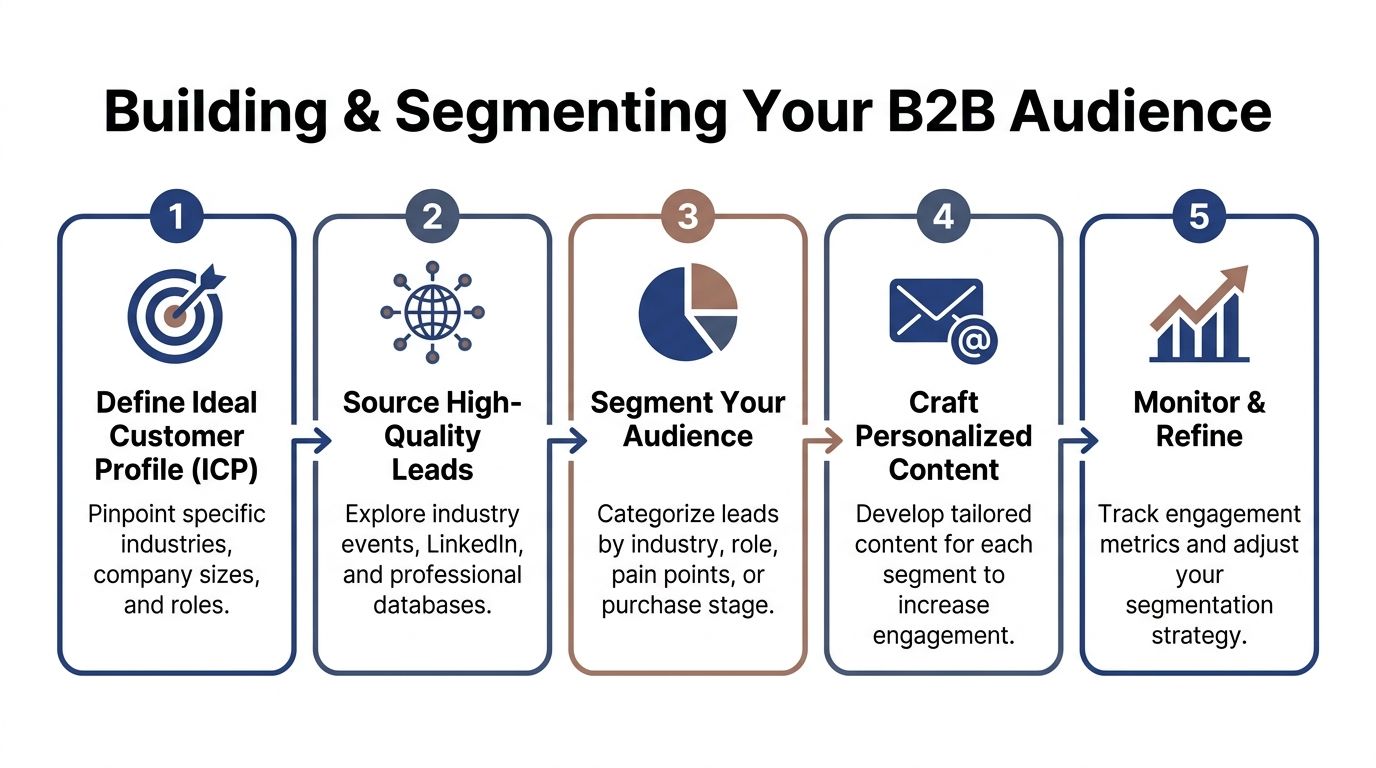
Building and Segmenting Your B2B Audience
List size gets too much attention. List quality matters more.
A small, well-segmented audience of relevant contacts can outperform a large, mixed list that includes old trade show scans, generic inquiries, and people who never asked to hear from you. In B2B, irrelevance is expensive. It lowers engagement, confuses reporting, and gives sales weak signals.
Where strong B2B lists come from
For manufacturers and technical service firms, the best contacts usually come from places where buyers already show intent.
- Website conversions: Quote forms, contact forms, downloadable spec sheets, capability guides, and technical resources.
- Trade shows and industry events: Collected business cards, scanned badges, booth conversations, and follow-up requests.
- Sales conversations: Prospects who are not ready now but fit your market well.
- Customer service interactions: Existing customers asking repeat questions that suggest future demand.
- LinkedIn networking: Connections with specific roles inside target accounts.
- Webinars and demos: Especially useful when tied to a technical topic or process problem.
The key is consent and context. If someone gave you a card at an expo, do not dump them straight into a generic monthly blast. Add them to a follow-up path that reminds them where they met you and gives them a reason to stay subscribed.
What to offer instead of “join our newsletter”
Most B2B buyers will not subscribe for vague updates. They will exchange their email for something useful.
In manufacturing, that might be:
- A technical guide: Material selection, tolerance considerations, machine maintenance, process planning
- A buyer checklist: Questions to ask before choosing a supplier
- An application sheet: Common use cases for a component or machine type
- An ROI worksheet: A simple tool that helps justify a process change internally
- An event follow-up pack: Slides, notes, or a summary after a presentation
These assets attract better contacts because they reveal what the prospect cares about.
Segment by buying context, not just job title
Demographics help. Journey stage helps more.
A contact can be an engineer in one situation and an internal champion in another. A purchasing lead can be comparing suppliers actively or just gathering names for later. If both receive the same newsletter, one of them gets the wrong message.
Useful segmentation layers include:
| Segment type | Example | Why it matters |
|---|---|---|
| Industry | Food processing, aerospace, packaging | Buyers care about different constraints |
| Role | Engineer, procurement, plant manager, owner | Each role reads for different reasons |
| Interest | Automation, maintenance, custom fabrication | Reveals topic preference |
| Buying stage | Awareness, consideration, decision | Determines call to action |
| Relationship | Prospect, active opportunity, customer | Prevents tone mismatch |
If you need a practical walkthrough on list structure, this guide on how to segment email lists is a useful reference point.
A clean segmentation model for manufacturers
For many B2B firms, this is enough to start:
Cold but relevant
These are contacts from events, downloads, or networking who fit your audience but have not shown immediate buying intent.Active evaluators
These contacts requested a quote, booked a call, viewed specific service pages, or replied with project details.Customers
Existing buyers should not receive the same nurture stream as new prospects.Dormant opportunities
Deals that stalled still need structured follow-up, but the content should focus on reactivation, not general education.
What good segmentation changes
When you segment properly, your newsletter becomes more useful and easier to act on.
You can send:
- An engineer a technical article
- A buyer a checklist for vendor evaluation
- A former customer a maintenance update or product expansion note
- A stalled prospect a practical project-planning email with a low-friction reply prompt
Performance starts to improve when you send: According to Stripo’s roundup of B2B email benchmarks, personalized and segmented B2B emails achieve 30% higher open rates and 50% higher click-through rates than generic campaigns (B2B email marketing statistics and insights for 2025).
Practical rule: If everyone on your list gets the same issue, you do not have a newsletter strategy yet. You have a mailing habit.
A short audience-building checklist
- Capture source data: Always record where the contact came from.
- Tag first interest: Product line, service type, topic, or event.
- Assign relationship status: Prospect, opportunity, customer, reactivation.
- Use preference signals: Clicks, replies, form submissions, and page views.
- Review imports manually: Especially after trade shows and older CRM migrations.
This is slower than blasting one list. It is also how you build a newsletter that buyers keep reading.
Developing Newsletter Content That B2B Buyers Read
Most B2B newsletters fail because they read like company announcements. Buyers do not need another email saying you attended an event, hired a manager, or have a new brochure. They care about problems, risk, decisions, and outcomes.
That is why content for b2b newsletter marketing needs to feel more like field guidance than promotion.

Take a fictional machine tool manufacturer. They sell CNC equipment and retrofit services to mid-sized industrial shops. Their buyers include owners, production managers, and engineers. If that company sends a monthly “news update,” it gets ignored. If it sends useful decision support, it earns attention.
The project showcase email
One of the best recurring formats is the project showcase. Not a glossy brag piece. A practical breakdown.
A strong issue might look like this:
- The customer had a recurring bottleneck on a machining line.
- The issue caused delays, excess handling, or tolerance inconsistency.
- The manufacturer recommended a machine configuration or retrofit path.
- The email explains what changed operationally and what the buyer should learn from it.
This works because readers can map that story onto their own situation. It also gives sales something concrete to reference in follow-ups.
The engineer’s corner
This format is for your technical audience. It should answer one narrow question well.
Examples:
- How to think about tolerances when a component moves from prototype to production
- Material trade-offs that affect wear, heat, or maintenance
- What buyers should review before approving a machine retrofit
- Common causes of avoidable downtime in a specific process
These emails do not need to be long. They need to be clear. Good technical newsletter content respects the reader’s time and intelligence.
The FAQ issue that sales wishes existed
A lot of newsletter content is already hiding inside your sales inbox.
Ask your team:
- What objection comes up repeatedly?
- What misunderstanding slows deals down?
- What question tells you a buyer is serious?
- What do customers ask after they already purchased?
Turn each answer into one email. Over time, this creates a searchable body of helpful content that supports both marketing and sales.
Tip: If a salesperson has answered the same question three times, it should probably become a newsletter issue.
A sample monthly rhythm
For that same machine tool company, a simple monthly pattern could be:
| Week | Email type | Purpose |
|---|---|---|
| Week 1 | Technical insight | Build authority with engineers and operations |
| Week 2 | Project showcase | Make outcomes tangible |
| Week 3 | FAQ or objection answer | Support active buyers |
| Week 4 | Light promotional send | Invite replies, demos, or consultations |
This balance keeps the list warm without turning every touch into a pitch.
Later in your process, video can become a content multiplier. If your team records demos, walkthroughs, or short shop-floor explainers, this guide on how to create email newsletters from video content is a practical way to repurpose what you already have instead of creating every newsletter from scratch.
What personalization should look like
Personalization is not just putting a first name in the greeting. In B2B, it means matching the topic, framing, and next step to the reader’s situation.
That matters because Stripo reports that personalized and segmented B2B emails achieve 30% higher open rates and 50% higher click-through rates than generic campaigns. The same source also reports that marketers using email automation see an 8x increase in open rates (B2B email marketing statistics and insights for 2025).
Practical examples:
- An engineer gets a deep technical note and a link to specs.
- A plant manager gets a short email about process reliability and a consultation prompt.
- A buyer gets a checklist and a clear path to request pricing or lead time guidance.
Here is a useful reference if your team wants to think visually about email structure and flow:
What buyers read and what they ignore
Buyers tend to read:
- Clear subject lines tied to a real problem
- Short introductions with immediate relevance
- Specific examples from actual work
- Technical or operational insight they can use internally
- Emails that make forwarding easy
They ignore:
- Corporate chest-beating
- Long intros with no point
- Product catalogs pasted into the inbox
- Generic “just checking in” messages
- Overdesigned layouts that hide the idea
A practical content engine
If content creation feels heavy, use one source and split it into several formats.
One customer project can become:
- A short newsletter story
- A linked case summary on your site
- A sales follow-up asset
- A LinkedIn post
- A technical FAQ derived from implementation lessons
That is how you keep the newsletter consistent without asking your team to invent new ideas every week.
Systematizing Your Sends for Deliverability and Efficiency
A newsletter can have strong content and still underperform because the operation behind it is messy. Bad list hygiene, inconsistent sending, and manual handoffs create problems that are avoidable.
Most B2B firms do not need a more creative email program first. They need a more disciplined one.

Deliverability is an operating issue
When owners hear “deliverability,” they often think it is a technical detail for IT. It is not. It is a business issue.
If your emails land in spam, go to inactive addresses, or trigger complaints, sales loses visibility and your reporting gets distorted. That is why strong B2B email teams treat permission, list hygiene, and send quality as part of the system, not as cleanup work.
CXL’s B2B email guidance is useful here because it keeps the focus practical. Top performers build around permission, deliverability, content, and design. On the deliverability side, that means removing hard bounces right after each send and analyzing soft bounce patterns instead of ignoring them. CXL also notes that disciplined testing paired with this approach can yield 28% higher returns (B2B email marketing at CXL).
What a disciplined send process looks like
A professional process is usually simple.
- Use permission-based contacts: Do not add people casually because you met them once.
- Clean the list often: Remove hard bounces promptly. Review soft bounces for patterns.
- Set a predictable cadence: Buyers should recognize your presence, not be surprised by it.
- Test before sending: Subject lines, body structure, and rendering should all be reviewed.
- Watch engagement by segment: A drop in one segment means something changed.
If your team wants a practical supporting resource, this guide on how to validate emails can help you think through the hygiene side before addresses ever enter your active sends.
Why ad hoc sending wastes time
Ad hoc sending sounds flexible. In practice, it creates five recurring problems:
- People forget to follow up.
- New leads sit untouched.
- Sales has no clear signal for who engaged with what.
- Old contacts stay in the database too long.
- Reporting turns into guesswork.
Automation earns its keep here. It does not replace judgment. It removes avoidable delay.
A practical GoHighLevel workflow
For manufacturers and B2B service firms, a GoHighLevel setup does not need to be complicated to be useful.
A workable starting system looks like this:
| Trigger | Automation action | Sales value |
|---|---|---|
| Website form submission | Add contact to CRM, assign source tag, send welcome email | Immediate acknowledgment |
| Download of a technical asset | Apply topic tag, enter nurture sequence related to that topic | Relevance improves |
| Click on a product or service link | Add interest tag and notify salesperson | Better follow-up timing |
| Reply to newsletter | Move into active conversation queue | Strong intent signal |
| Inactivity over time | Move to re-engagement sequence | Preserves list quality |
A welcome sequence can be short. One email confirms the request. Another shares a useful piece of technical or operational content. A later email invites a low-pressure conversation. If the contact clicks on a specific product family or service line, GoHighLevel can tag that interest and prompt a salesperson with context.
That is the difference between a newsletter and a marketing machine. The send itself is only one event. The automation around it creates continuity.
Key takeaway: Automation is not about sending more email. It is about making sure the right contact gets the right next step without someone needing to remember every detail manually.
Cadence matters more than intensity
Many firms send too much when they feel ambitious, then disappear for weeks. That pattern weakens trust.
A steady cadence is better. If you can maintain one useful issue per month and a few automated sequences tied to key actions, that is enough to build a durable system. Consistency beats bursts.
Keep the system visible
Your CRM should make it easy to answer basic questions:
- Who subscribed recently?
- Which segment engaged?
- Which topic generated replies?
- Which contacts clicked and should hear from sales?
- Which contacts should stop receiving active campaigns?
If you need a broader operational framework, these email deliverability best practices are worth reviewing as part of your SOP.
Once this layer is stable, the newsletter stops depending on heroic effort. It becomes repeatable, and repeatability is what produces usable data.
Measuring True ROI Beyond Open and Click Rates
A lot of newsletter reporting is too shallow for B2B. It overvalues easy metrics and misses the job the newsletter is doing.
Open rates and clicks can be useful diagnostics. They are not the full business case.
In manufacturing and other long-cycle B2B markets, buyers often read without overt interaction. They do not click every email. They do not always fill out a form. They may forward a message internally, mention your name on a call months later, or reply only when a project finally becomes real.
Why vanity metrics mislead owners
If you judge the newsletter only by direct clicks, you will undervalue it. Some of the highest-value influence happens off-email.
A sales rep hears, “I’ve been seeing your updates.”
A prospect replies after months of silence.
An old contact comes back warmer than expected.
A customer asks about a service they have seen referenced over time.
Those are not accidental. They are signs that the newsletter is doing its job.
Recognition metrics matter in long sales cycles
One of the biggest gaps in B2B newsletter analytics is measuring indirect impact. Neal Ungerleider highlights this problem directly in the context of long sales cycles and notes that, while segmentation can increase revenue up to 760%, true success in sectors like manufacturing often shows up through recognition metrics such as replies and sales warmth rather than direct clicks (making your B2B marketing newsletters work).
That distinction matters. If your deals take months and involve multiple stakeholders, you need evidence of influence, not just evidence of immediate conversion.
What to track instead
Build your measurement around stages of commercial intent.
Early recognition
These signals suggest growing familiarity:
- Direct replies to newsletter emails
- Forwarded messages mentioned by prospects
- Contacts who engage repeatedly over time
- Event registrations or follow-up requests from subscribers
- Sales comments noting that a lead “already knew who we were”
Mid-funnel movement
These signals show active evaluation:
- Revisits to product or service pages after email sends
- Download of technical or buyer-facing resources
- Multi-touch engagement from the same account
- Requests for lead times, specs, capabilities, or consultation
Revenue influence
These signals tie the newsletter to pipeline and closed business:
- Opportunities where the contact was an active subscriber before deal creation
- Closed deals where newsletter engagement occurred during the sales cycle
- Reactivated opportunities linked to past email engagement
- Existing customers who expanded after repeated newsletter exposure
A simple CRM-based attribution model
You do not need perfect attribution to get useful visibility.
A practical model inside your CRM or GoHighLevel can include:
| Layer | What you record | Example |
|---|---|---|
| Contact source | Where the person entered the system | Trade show, website guide, LinkedIn |
| Engagement history | Opens, clicks, replies, page visits, downloads | Repeated interaction with maintenance content |
| Opportunity influence | Whether the contact engaged before or during an open deal | Subscriber clicked service page before quote request |
| Qualitative sales notes | What the rep heard directly | “They mentioned reading our emails” |
The missing ingredient in many teams is discipline. Sales needs a field for “how did they know us?” Marketing needs tags that persist. Both teams need to agree that influence matters even when last-touch credit goes elsewhere.
Practical rule: If your newsletter helps create familiarity, shortens explanation time, or warms cold outreach, it is affecting revenue even if the final conversion happened through a call or meeting.
What not to do
Avoid these traps:
- Treating opens as proof of ROI
- Ignoring replies because they do not fit a dashboard neatly
- Letting sales notes live only in inboxes
- Measuring only last-touch conversions
- Declaring the newsletter ineffective after a short window
A B2B newsletter earns trust slowly. Your reporting should reflect that reality.
Your Next Step From Planning to Action
If your current marketing feels reactive, a newsletter can become the steady part of the system. It gives you a way to stay present, educate buyers, support sales, and create momentum between major buying events.
Do not try to build the whole machine in one week. Start with the blueprint.
Define:
- Who the newsletter is for
- What business outcome it should support
- Why that reader should keep opening it
- What segments you need in your CRM
- What one recurring content format you can sustain
Then set up the simplest possible version and run it consistently. A small, focused newsletter with good segmentation and a clean follow-up process will outperform a bloated program that never settles into routine.
If you want one practical next read, this overview of database email marketing is a good place to sharpen the list and CRM side before you scale.
The businesses that get the most from b2b newsletter marketing are not the ones sending the fanciest emails. They are the ones building a system that buyers recognize, trust, and act on over time.
If you want help diagnosing your current marketing system and building a newsletter engine inside GoHighLevel, Machine Marketing can help you turn scattered follow-up into a practical, measurable growth process.