If you're getting traffic but sales aren't moving, your problem usually isn't reach. It's conversion.
We see this with B2B firms, manufacturers, and local service companies all the time. The website gets visits. Ads bring clicks. Sales gets a few inquiries. Then momentum dies somewhere between first interest and signed deal.
That usually means the system is leaking.
Learning how to improve sales conversion rate starts with a mindset shift. Stop treating conversion as a copy tweak or a button-color debate. Treat it like a system diagnosis. Traffic source, page experience, forms, follow-up, qualification, proposals, and reactivation all influence whether a lead moves forward or disappears.
The businesses that improve fastest stop asking, "How do we get more leads?" and start asking, "Where do good leads stall, and why?"
Stop Chasing Traffic and Start Fixing Your Funnel
More traffic can hide a broken process for a while. It rarely fixes one.
A company can spend more on SEO, paid ads, or outbound and still stay stuck because the handoff points are weak. The landing page doesn't match intent. The form asks for too much. The CRM doesn't route the lead properly. Sales follows up late. The proposal looks generic. The pipeline fills, but revenue doesn't.
That creates a bad loop. Marketing blames lead quality. Sales blames marketing. Leadership assumes volume is the issue. Meanwhile, the core problem sits in the middle of the funnel.
Practical rule: If leads are arriving but too few become qualified conversations or closed deals, fix conversion before you buy more attention.
We approach this like engineers working on a machine with too many failure points. You don't replace the whole system on day one. You identify the constraints, confirm where friction shows up, and make the most impactful fix first.
Here’s what usually works:
- Measure the complete funnel: Not just total leads or total revenue.
- Inspect every handoff: Traffic to page, page to form, form to meeting, meeting to proposal, proposal to close.
- Prioritize by business impact: Fix the stage that affects the most downstream value.
- Automate repeatable follow-up: So good leads don't die from inconsistency.
- Test one meaningful change at a time: So you know what improved performance.
What doesn't work is random activity. New landing pages without tracking. More content without clear offers. More software without process discipline. More leads without qualification.
Conversion improves when the system gets clearer, faster, and easier to trust.
Establish Your Baseline Conversion Metrics
You can't fix what you can't see. Most companies know how many leads came in last month. Far fewer know where those leads slowed down.
That gap matters because a single top-line conversion rate hides too much. A funnel has stages. If you only measure the final sale, you miss the exact point where money starts leaking.

Measure macro and micro conversions
Your macro conversion is the main business outcome. For many B2B and service firms, that's a closed deal, paid project, signed proposal, or booked job.
Your micro conversions are the smaller actions that show buying intent. Think form submissions, quote requests, booked calls, pricing-page visits, reply-to-email, or proposal acceptance. These are the checkpoints that tell you whether a prospect is moving.
Creating and tracking micro conversion rates across the sales funnel, instead of relying on one end-to-end number, helps you identify bottlenecks with precision. Teams that measure these granular metrics make smarter pipeline decisions, and Forecastio notes that global B2B funnels often see 20-30% drop-offs at consideration stages without intervention (Forecastio).
Start with the systems you already have
Most businesses don't need a giant reporting stack to begin. You can establish a baseline with:
- GA4: Track page views, form submissions, thank-you pages, and conversion events.
- Your CRM: Track lead status changes, follow-up activity, meetings booked, proposals sent, and closed-won outcomes.
- Call tracking or inbox data: Review whether leads got a response and whether that response was timely.
- Form data: Check what fields are being completed and where people abandon.
If your reporting is messy, that's still useful. It tells you the first problem is instrumentation, not optimization. For a plain-English walkthrough of what to measure and why, this overview of marketing analytics is a practical starting point.
Use a simple baseline model
For B2B and local service funnels, we usually map these stages:
| Funnel stage | What to count | Why it matters |
|---|---|---|
| Visitor to lead | Form fills, calls, booked appointments | Shows whether the site and offer create action |
| Lead to qualified lead | Valid contacts, right-fit inquiries | Shows lead quality and qualification friction |
| Qualified lead to proposal | Discovery calls, site visits, scoped opportunities | Shows sales process effectiveness |
| Proposal to closed-won | Signed deals | Shows trust, pricing, and closing strength |
This doesn't need to be perfect on day one. It does need to be consistent.
Questions to ask yourself
- Can you name your primary conversion event? If not, the team is probably optimizing for mixed outcomes.
- Do you know your stage-by-stage counts? Not estimates. Actual counts.
- Are marketing and sales using the same definitions? If one team's "lead" is another team's "junk form," reporting won't help.
- Can you trace a closed deal back to source and path? If not, attribution is too weak for reliable decisions.
- Do you track reactivation separately from new lead flow? Returning prospects behave differently and deserve their own view.
The fastest baseline is often manual. Pull the last full period of data, map the stages in a spreadsheet, and find the first obvious break in the chain.
Once you have that baseline, you stop guessing. You can see whether your biggest issue is poor lead capture, weak qualification, broken follow-up, or low close performance.
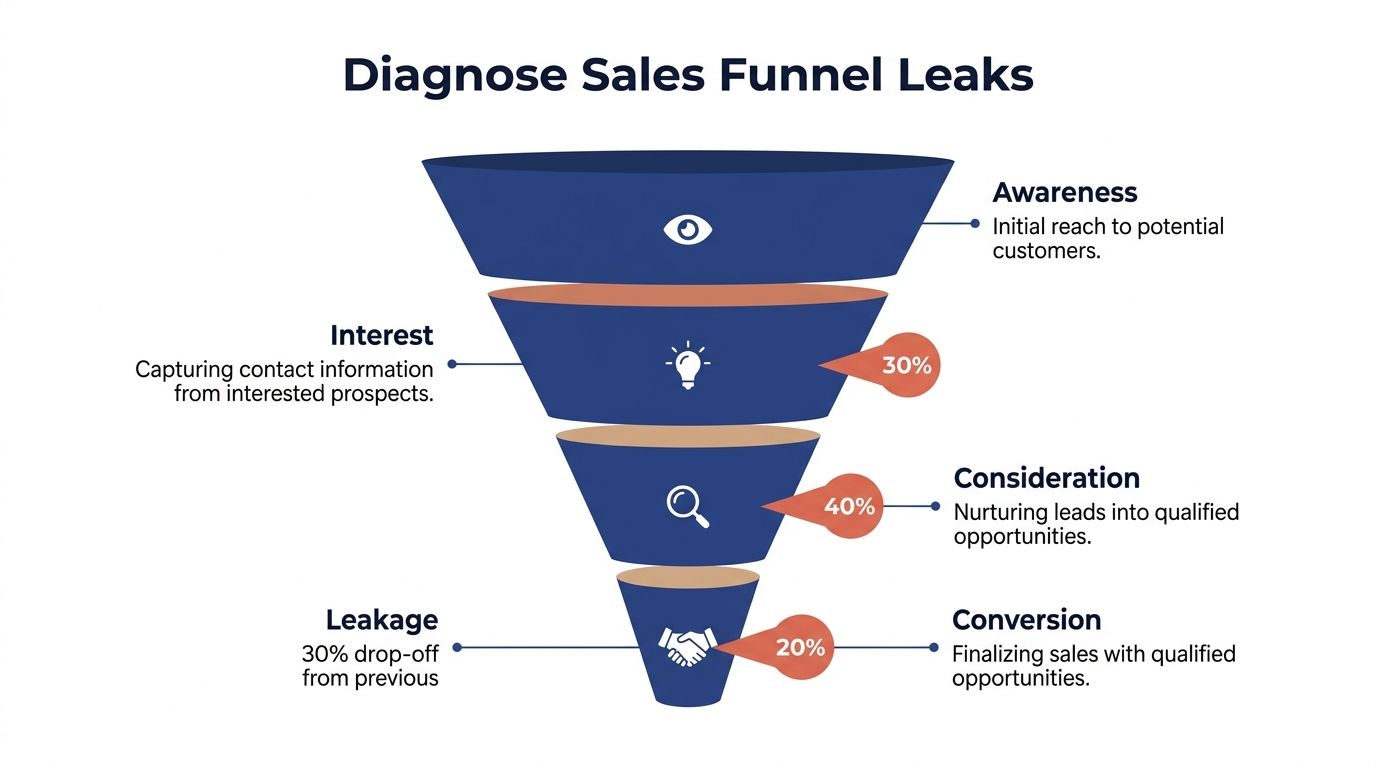
Diagnose the Leaks in Your Sales Funnel
A funnel rarely fails in one dramatic place. It usually fails in several ordinary places that compound.
A paid campaign attracts the wrong searcher. The landing page makes a vague promise. The form asks for information sales doesn't even use. The CRM sends no confirmation. A rep follows up with a generic email. The proposal arrives late and without proof.
Each step feels minor. Together, they kill conversion.
Traffic source problems
Bad traffic doesn't always mean low traffic quality. Sometimes it means misaligned intent.
A searcher looking for a comparison, a repair answer, or pricing context lands on a page pushing a consultation too early. The visitor may be relevant, but the ask is wrong for that stage.
Check these first:
- Keyword and ad match: Does the visitor land on a page that continues the same promise?
- Offer fit: Are you asking for a quote when the visitor really wants proof, specs, or examples?
- Audience segmentation: Are manufacturers, local service buyers, and general researchers all hitting the same page?
- Source behavior: Do organic, paid, referral, and email visitors behave differently after the click?
If one source sends volume but almost no progression to qualified conversation, don't scale it yet. Diagnose intent mismatch first.
Landing page friction
A weak landing page usually fails in the first few seconds. The buyer can't tell what you do, who it's for, or what to do next.
We look for clarity before persuasion.
Quick audit for the page itself
- Headline clarity: Does the page say what problem you solve in plain language?
- Relevance: Does the copy reflect the buyer's actual use case, industry, or urgency?
- Visual hierarchy: Is the main action obvious without hunting for it?
- Trust markers: Are there reviews, logos, testimonials, certifications, or process cues?
- Mobile experience: Can someone read, scroll, and act easily on a phone?
If a buyer needs to interpret your headline, you've already added friction.
One overlooked issue in B2B is proof placement. Teams often bury trust signals near the bottom or only include them on the About page. That's backward. Buyers need reassurance at the moment they hesitate.
Forms and calls to action
Forms often collect too much because teams want more data up front. That instinct makes internal reporting cleaner and front-end conversion worse.
The form should gather what you need for the next step, not every detail for the full engagement.
What to inspect in forms
| Area | Weak pattern | Better pattern |
|---|---|---|
| Field count | Asking for every project detail immediately | Collect essentials, gather depth later |
| CTA wording | Generic submit language | Clear next-step language |
| Error handling | Confusing validation or failed submissions | Clean confirmation and guidance |
| Routing | Form sits in inbox with no workflow | CRM assignment and instant acknowledgement |
Lead qualification still matters. It just needs to happen intelligently. If your team needs a stronger framework for evaluating fit without overloading the front end, this guide on how to qualify sales leads is useful.
Sales process leaks after the form
Many businesses lose deals here while assuming the website is the problem.
A lead converts on the page and then gets dropped into a loose process. No immediate confirmation. No scheduling link. No role-specific outreach. No useful follow-up if they go cold.
Review these sales-side failure points:
- Response speed: Does the lead hear from you quickly and clearly?
- Message quality: Does the first outreach reflect their context?
- Qualification discipline: Does sales know what makes a lead worth advancing?
- Meeting structure: Are discovery calls uncovering real buying criteria?
- Proposal follow-up: Is there a sequence after the proposal, or just hope?
Reactivation is usually underused
Many firms ignore the leads and customers already in the database. That's expensive.
A strong underserved tactic in B2B is using user-generated content inside CRM-driven reactivation. Calendly notes that B2B sees 161% higher conversions from UGC across the journey, yet many teams still don't integrate that proof into proposals or automated SMS and email sequences for past customers (Calendly).com/blog/sales-conversion-rate-strategy)).
That can mean:
- Review snippets in reactivation emails
- Customer photos or install examples in proposals
- Testimonial blocks in SMS follow-up pages
- Past-customer campaigns tied to service intervals or reorder timing
If you're only diagnosing net-new traffic and ignoring dormant contacts, you're leaving a major leak untouched.
Implement Prioritized Fixes for High-Impact Results
Once you've found the leaks, don't open ten projects. Pick the fix that changes the most downstream behavior.
That usually means one of two things. Remove friction at a high-volume point, or increase trust at a high-stakes decision point.
Fix what blocks action first
When we're prioritizing, we sort issues into this simple matrix:
| Priority type | What it looks like | Why it matters |
|---|---|---|
| High impact, low effort | Rewrite headline, reduce form fields, improve CTA copy | Fast gain with minimal build time |
| High impact, higher effort | Rebuild core landing page, rework qualification flow | Worth doing if it affects major pipeline stages |
| Low impact, low effort | Minor styling cleanups | Fine later, not first |
| Low impact, high effort | Full redesign without diagnosis | Usually a distraction |
A lot of companies jump to redesign because it's visible work. But a redesign can preserve the same broken message, weak offer, and messy routing. Better design doesn't automatically mean better conversion.
Start with page and message alignment
Most conversion fixes on the site itself are not glamorous. They are practical.
Try this order:
- Rewrite the main headline so a buyer can understand the offer immediately.
- Tighten the subhead so it speaks to a real use case, industry problem, or outcome.
- Reduce navigation choices on campaign pages when the goal is lead capture.
- Simplify the CTA so it describes the next step clearly.
- Trim the form to the minimum needed for action.
- Review mobile layout because many service buyers act from a phone even if the final purchase is offline.
For teams building a more structured experimentation habit, Aakash Gupta's overview of proven product growth strategies is worth reading because it reinforces the same principle. Focus on the few changes that remove friction or improve value communication before layering on complexity.
Add trust where decisions happen
The biggest mistake with social proof is placement. Teams collect testimonials and then hide them in a carousel no one reads.
What works better is specific trust proof close to commitment points.
Highlighting customer reviews and testimonials can increase sales conversion rates by up to 270%, based on Northwestern University research cited by Unbounce (Unbounce). In B2B, that matters because buyers aren't just purchasing a service. They're taking career risk.
Use proof in these spots:
- Near the primary CTA: Short testimonial, client logo row, or review excerpt.
- Beside forms: Reassure buyers before they submit.
- Inside proposals: Add relevant examples, not generic praise.
- In follow-up emails: Reinforce claims with customer language.
- On service pages: Match proof to the offer, not the company in general.
Buyers trust peers who sound like them more than polished claims from vendors.
A local service company might place review snippets next to a booking form. A manufacturer might place testimonial proof beside a quote request and repeat it in the proposal deck. Same principle. Different implementation.
Here’s a short walkthrough that aligns with this mindset:
What usually doesn't work
Some fixes look active but don't solve the underlying issue.
- Adding more traffic before fixing handoffs
- Rewriting everything at once
- Using vague testimonials with no context
- Launching popups, chat widgets, and forms all at the same time
- Testing cosmetic changes before fixing message clarity
One practical option for firms that want both diagnostic support and implementation is Machine Marketing, which handles website improvements, CRM setup, and GoHighLevel workflow configuration as part of a larger sales and marketing system. The useful point isn't the vendor. It's the operating model. Messaging, forms, CRM automation, and follow-up need to be treated as one conversion system.
Automate and Nurture with GoHighLevel
A lead shouldn't depend on whether someone remembered to follow up.
That's where automation changes the economics of conversion. Not because it replaces sales, but because it protects the lead between first action and human contact. For B2B and local service teams, that gap is where interest cools off fast.
Build the immediate-response layer
When a lead submits a form, books a call, or replies to an offer, your system should respond instantly with something useful and clear.
In GoHighLevel, that usually means:
- Confirmation email: Acknowledge the inquiry and set expectations.
- SMS follow-up: Short confirmation for speed and visibility.
- Internal notification: Route the lead to the right rep or manager.
- Task creation: Make the next human action visible inside the CRM.
- Pipeline movement: Push the contact into the correct stage automatically.
This doesn't need to feel robotic. It needs to feel reliable.
A good first sequence answers three questions fast. Did you get my request? What happens next? How do I continue if I'm ready now?
Use buyer signals, not rigid sequences
Not every lead should get the same script.
Highspot reports that sales teams using buyer-aligned plays, meaning outreach and content matched to specific buyer signals, achieve 2.5 times higher conversion rates than teams following rigid internal processes (Highspot). A CRM becomes useful when it tracks those signals and triggers the right next action.
That can include signals like:
| Buyer signal | Suggested automation |
|---|---|
| Filled out quote form | Immediate confirmation, sales notification, booking prompt |
| Clicked proposal link | Rep follow-up task, trust-proof email, reminder SMS |
| Stopped responding after discovery | Nurture sequence with objection-handling content |
| Past customer inactive for a while | Reactivation campaign with review-backed reminder |
If your current workflow treats all leads the same, automation will only scale the wrong behavior. Build plays around intent.
For teams evaluating workflow design in more detail, this guide on how to automate sales process covers the operational side well.
Reactivate cold leads and past customers
Most CRMs are full of ignored value.
Cold leads often aren't dead. Past customers often need a reason to return. What they don't need is a generic "just checking in" email sent months too late.
A stronger reactivation system usually includes:
- Segmented lists: Separate old leads, closed-lost contacts, and past customers.
- Reason-based messaging: New service, seasonal timing, maintenance reminder, updated offer, or new proof.
- Credibility assets: Reviews, testimonial snippets, short examples of solved problems.
- Clear next step: Reply, book, call, or request updated pricing.
Score leads so sales spends time where it matters
Lead scoring doesn't have to be complicated. It just needs to help sales answer one question. Which contacts deserve attention now?
Useful scoring inputs include:
- Engagement behavior: Replies, page visits, proposal opens, booking actions.
- Fit signals: Industry, service area, company type, project relevance.
- Urgency clues: Timeline, stated problem, repeat visits, inbound questions.
Automation should narrow human focus, not create more noise.
When this is set up well, your team stops manually sorting through every inquiry the same way. Sales spends more time with engaged, relevant prospects. Marketing gets cleaner feedback. Management sees where nurture is working and where messaging still needs work.
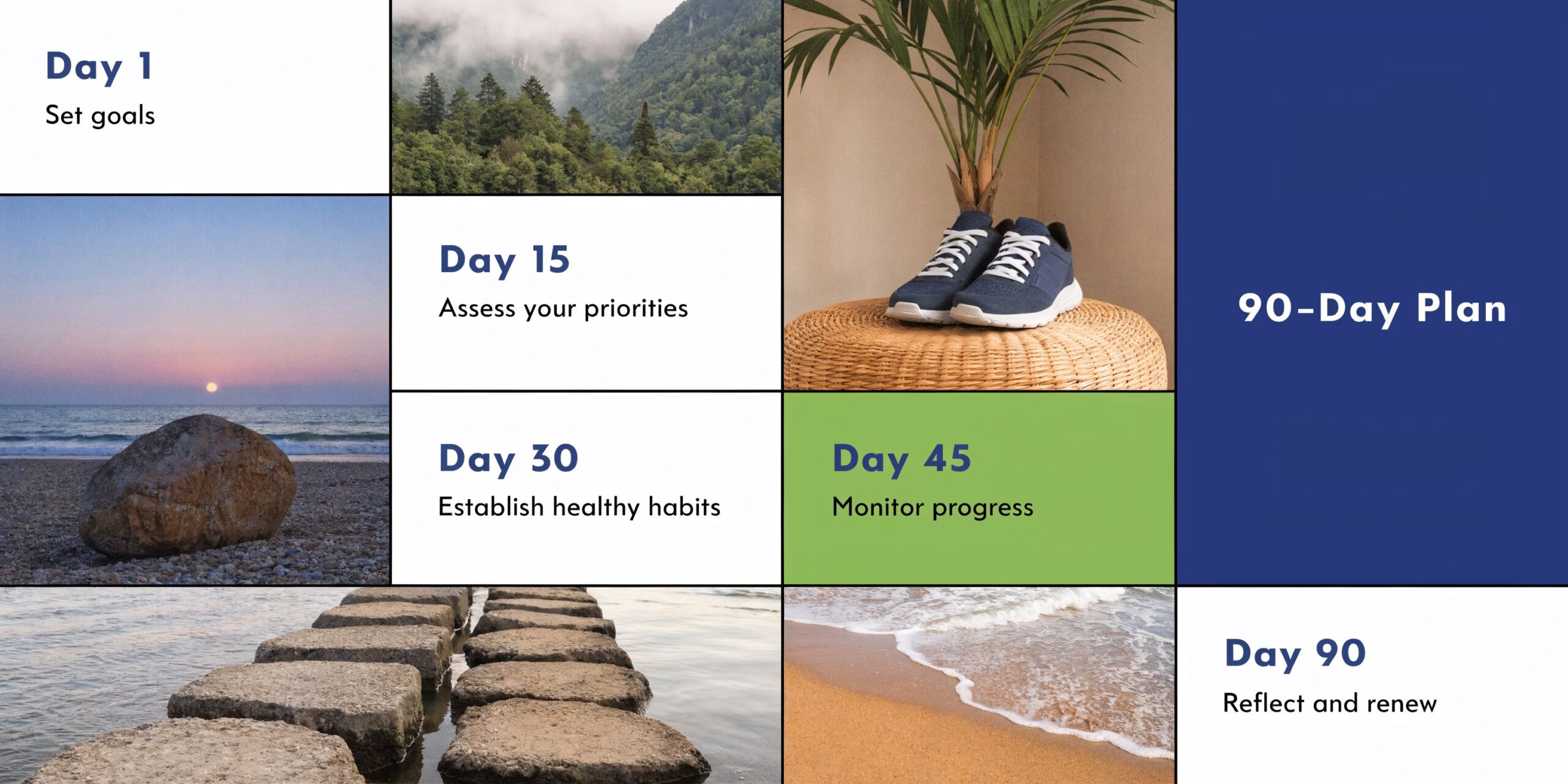
Your 90-Day Conversion Rate Action Plan
Most companies don't need a year-long optimization program to start improving conversion. They need a disciplined first quarter.
A 90-day plan works because it forces sequencing. You diagnose first, fix the clearest bottlenecks next, then build automation and testing on top of a cleaner system.
Days 1 to 30
Your first month is about seeing reality clearly.
Winning by Design recommends tracking micro-conversion rates across key funnel stages such as MQL to SQL and Proposal to Closed-Won, and reports that improving the highest-impact micro-rate can produce a 2-3x lift in overall sales conversion rate (Winning by Design).
Use that logic immediately.
First sprint checklist
- Map your funnel stages: Use the stages your team works with.
- Pull baseline counts: Visitors, leads, qualified leads, proposals, closed deals.
- Audit tracking quality: Confirm GA4 events, CRM stages, and handoff visibility.
- Review top pages: Look at service pages, landing pages, and forms with the most commercial intent.
- Pick one primary bottleneck: Don't name three. Name one.
At the end of this sprint, you should be able to say where conversion is failing with confidence.
Days 31 to 60
Now you make the first substantial fixes.
This is the build-and-test phase. Not broad redesign. Focused intervention.
Priorities for the second sprint
- Rewrite critical page messaging: Headline, subhead, CTA, trust positioning.
- Simplify forms and routing: Remove friction and ensure immediate acknowledgment.
- Set up core GoHighLevel workflows: Confirmation, follow-up, reminders, pipeline movement.
- Create one nurture path: For leads not ready to buy immediately.
- Launch one controlled test: A meaningful change tied to the main bottleneck.
A useful rule here is to test changes close to the leak. If proposal-to-close is weak, don't spend the month tweaking blog CTAs.
Days 61 to 90
The last sprint is where the system starts acting like a system.
By this point, you should have cleaner data, at least one implemented fix, and basic automation running. Now review what happened and tighten the weak spots.
Third sprint review points
| Area | What to examine | Likely next move |
|---|---|---|
| Funnel progression | Which stage improved, stalled, or got worse | Re-prioritize the next bottleneck |
| Follow-up quality | Which sequences got replies or bookings | Refine timing and message relevance |
| Sales behavior | Whether reps used the system consistently | Add SOPs and alerts |
| Trust assets | Which testimonials or proof points helped conversations | Reuse them in more places |
The first 90 days should produce better visibility and at least one repeatable conversion improvement. If all you produced was more activity, the plan drifted.
What to avoid during the 90 days
- Changing your whole website at once
- Adding tools before fixing process
- Running multiple unrelated tests
- Ignoring sales feedback on lead quality
- Declaring success from lead volume alone
A strong quarter doesn't look flashy. It looks tighter. Cleaner tracking. Better handoffs. Faster follow-up. More relevant proof. Fewer stalled deals.
That's the foundation you can scale.
Frequently Asked Questions
What is a good sales conversion rate
There isn't one universal answer because conversion depends on industry, offer, traffic source, sales cycle, and what you're asking the buyer to do. The more useful benchmark is your current stage-by-stage performance and whether it improves over time.
How long does it take to improve conversion rate
Some fixes show movement quickly, especially clearer messaging, better forms, and faster follow-up. Bigger process changes take longer because sales, CRM, and automation all need to work together consistently.
Can you improve conversion without buying new software
Yes. Many businesses can improve with better tracking, cleaner offers, shorter forms, stronger follow-up discipline, and smarter CRM usage. New software helps when process maturity is already there.
Where should a small team start
Start with measurement and one bottleneck. If you need a plain-language primer before doing the deeper work, Aureate Labs has a useful overview of What is Conversion Rate Optimization. Then come back to your own funnel and identify the first place leads are getting stuck.
Should marketing or sales own conversion rate
Both. Marketing influences lead quality and page performance. Sales influences qualification, response, and close rate. If one team owns the metric alone, the other team usually becomes the excuse.
If you want help diagnosing where your funnel is leaking and turning that diagnosis into a practical CRM, website, and follow-up system, talk with Machine Marketing. We help B2B and service businesses turn scattered marketing and sales activity into a structured conversion system.