If your manufacturing business has good products, experienced people, and a solid reputation, but growth still feels uneven, the problem usually isn’t effort. It’s design.
We see this when lead flow swings month to month, sales depends too heavily on a few relationships, margins get tighter, and competitors start winning without having a better machine, better plant, or better technical team. They win because their business model fits the market better.
Business model innovation sounds abstract until you treat the business like an engineered system. Inputs come in. Value gets created. Value gets delivered. Cash gets captured. If any part of that system is outdated, the whole machine underperforms.
For manufacturers, that often shows up in one painful place first. Inconsistent lead generation. Not because demand disappeared, but because the way the company reaches buyers, packages value, and follows up hasn’t kept pace with how buyers evaluate suppliers now.
Is Your Business Built for Yesterday's Market
A manufacturer can stay busy and still be stuck.
The plant runs. Orders go out. Existing customers still buy. But new opportunities come in sporadically, sales cycles feel harder to control, and price pressure shows up more often than it used to. That’s usually a sign that the operating business is healthy enough to survive, but the business model behind it is losing fit with the market.
BCG notes that over the past 50 years, the average lifespan of a business model has fallen from approximately 15 years to less than 5 years, and 84% of executives view business model innovation as critical for growth in its analysis of changing market conditions and competitive pressure in BCG’s work on business model innovation. For manufacturers, that matters because strong products alone no longer protect the company the way they once did.
The symptoms usually look operational
Most leadership teams first describe the problem in operational language:
- Margins are tighter: Quotes face more scrutiny, and buyers compare options faster.
- Lead flow is uneven: One quarter feels strong, then the pipeline goes quiet.
- Sales depends on individuals: A veteran rep knows the accounts, but the company doesn’t own a repeatable growth system.
- Marketing feels disconnected: The website exists, brochures exist, trade show spend exists, but they don’t work as one system.
- Competitors are changing the rules: They may bundle service, simplify buying, sell direct, or position around outcomes instead of specs.
None of these symptoms means the company is broken. They mean the company may still be running a model built for a market that has already changed.
Business model innovation is not a buzzword
A lot of firms hear “innovation” and think new product development. That’s only one path. Business model innovation asks a harder and more useful question. How does the company create, deliver, and capture value now, and what part of that system needs to be redesigned?
That could mean changing:
- who you target
- what you sell
- how you price
- how customers buy
- how service gets delivered
- how sales and marketing work together
- how recurring demand gets created instead of chased
Business model innovation works best when you stop treating growth as a sales problem and start treating it as a system problem.
For manufacturers, this is often the missing lever. The company keeps trying to get better output from the same old commercial machine. More outreach, more trade shows, more proposals, more pressure on sales. But if the system itself is outdated, extra effort just creates more friction.
What this means in practical terms
If your business was designed for relationship selling, distributor dependence, and long buying cycles with little digital visibility, you may now need a model that includes:
- a sharper value proposition for a narrower audience
- clearer packaging of services, support, or outcomes
- a modern CRM workflow for follow-up and reactivation
- better direct channels for attracting and qualifying buyers
- a repeatable process for turning demand into pipeline
That’s not reinvention for its own sake. It’s re-engineering for fit.
Diagnosing Your Current Business Model
Before you change anything, map the machine as it exists. Most companies skip this step because they think they already know how the business works. They know the products, the customers, and the numbers. But they often haven’t documented how those pieces interact as one system.
A business model diagnosis should feel closer to a technical review than a brainstorming session. You’re identifying dependencies, bottlenecks, failure points, and wasted motion. If you need a broader lens on how companies redesign entire operating systems, this overview of What is Business Transformation is a useful companion to the exercise.
Map the system before you judge it
Start with five core components.
Customer
Who buys, influences, approves, and uses what you sell? In manufacturing, those are often different people. If your messaging speaks only to engineers but procurement controls the shortlist, the model has a mismatch.Value proposition
What problem do you solve that the buyer cares enough to act on? “High quality” is rarely enough. Buyers usually respond to reduced downtime, faster delivery, less risk, easier compliance, or fewer handoffs.Delivery model
How does value get delivered from first touch to repeat business? This includes quoting, onboarding, account management, service, and follow-up. Many firms have good production systems and weak commercial delivery systems.Revenue logic
How do you get paid, and what behavior does that pricing encourage? A one-time sale model creates different incentives than a service agreement, retainer, replenishment program, or recurring support package.Cost structure
Where does complexity create drag? That could be in custom quoting, sales travel, low-quality leads, manual admin, channel conflict, or reactive service work.
Ask better diagnostic questions
A useful diagnosis doesn’t start with “How do we get more leads?” It starts with sharper questions.
- Who is your real best-fit customer? Not everyone you can sell to. Who buys fastest, stays longest, and creates the fewest operational headaches?
- What do buyers compare you on? Specs, price, speed, support, availability, confidence, or ease of doing business?
- Where do leads stall? At awareness, inquiry, quoting, follow-up, approval, or close?
- What part of the process relies on memory instead of system?
- Which offers create revenue but not profit?
- Where does handoff failure occur between marketing, sales, and operations?
- What does your website help a buyer do, and what does it fail to do?
If your lead generation engine is underperforming, an operational review like this usually pairs well with a structured marketing audit for manufacturers and growing firms.
Diagnostic rule: If growth depends on a few people remembering to do the right next step, you don’t have a scalable model. You have tribal knowledge.
What to look for during the audit
Watch for these common design flaws:
- Broad targeting: The company markets to “anyone who needs machining” or “all industrial sectors.”
- Weak commercial packaging: Buyers can’t tell the difference between your standard offer and your premium capability.
- Channel confusion: Reps, distributors, website inquiries, and direct outreach all operate separately.
- Follow-up gaps: Good inquiries come in, but no one runs a consistent nurture or reactivation sequence.
- Service invisibility: Support capability exists, but it isn’t positioned as part of the value.
A clear diagnosis often reveals an uncomfortable truth. The business isn’t short on effort. It’s short on system design.
The Four Levers of Business Model Innovation
You don’t need to redesign the entire company at once. Most successful business model innovation comes from changing a few connected parts on purpose.
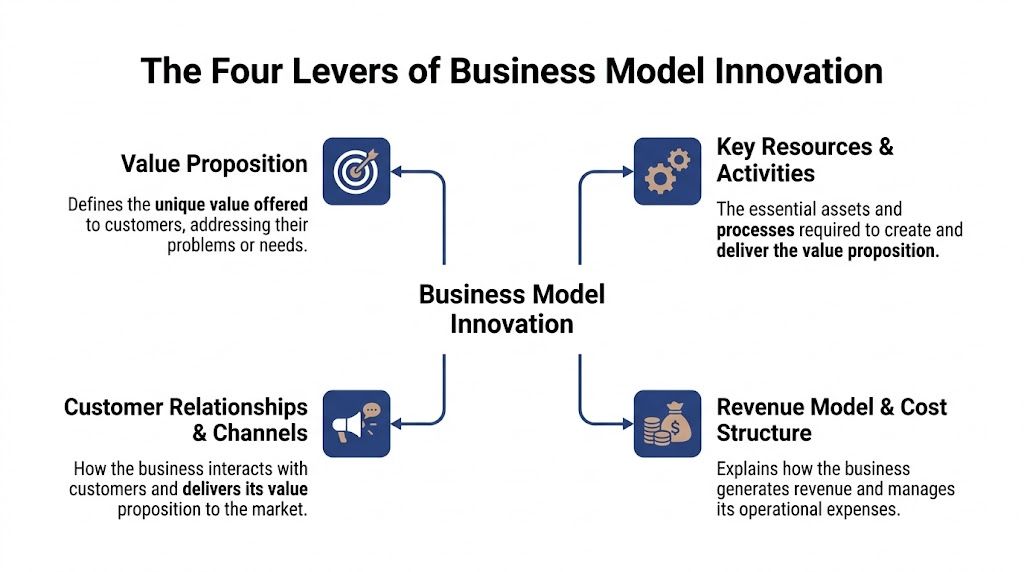
For manufacturers, four levers matter most. Pull one in isolation and you may get a short-term improvement. Pull the right combination and you can change how growth works.
Value proposition
A lot of manufacturers still sell products when buyers really want outcomes.
That doesn’t mean the product stops mattering. It means the product alone isn’t the commercial story. A machine, component, or fabricated part becomes more valuable when it’s positioned around uptime, throughput, reliability, compliance, or reduced procurement risk.
A practical example: a company making industrial equipment can stop leading with technical features and instead package the offer around operational continuity. Preventive maintenance, remote support, training, faster replacement processes, and service responsiveness become part of the sale, not an afterthought.
What works
- Defining the core operational problem your buyer needs solved
- Packaging service and support into the offer
- Translating technical capability into business impact
What doesn’t
- Assuming buyers will connect specs to outcomes on their own
- Leading with “quality” and “experience” because everyone says it
- Treating service as invisible overhead instead of market value
Key resources and activities
This lever focuses on what the company must be able to do consistently to deliver the promise.
In many manufacturing firms, the technical side is strong and the commercial system is improvised. Quoting sits in one inbox. Follow-up lives in a rep’s memory. Customer data is fragmented. Marketing creates materials that sales rarely uses. Business model innovation often requires building new resources and activities that support growth, not just production.
That may include:
- a cleaner CRM structure
- standard operating procedures for lead handling
- content that helps buyers evaluate and self-qualify
- clearer account ownership
- better visibility into inquiry sources and sales stages
A company that wants to sell more direct, for example, may need different activities than one built around distributors. The shift isn’t only strategic. It’s operational.
Customer relationships and channels
This lever is where many manufacturers have the biggest gap.
Relationships still matter. They matter a lot. But if the company relies only on trade shows, rep networks, and referrals, the lead engine stays fragile. Buyers now expect easier research, faster responses, useful content, and a smoother path from initial interest to real conversation.
A stronger model often combines relationship selling with systemized channels such as:
- a website built around buying questions
- search visibility for specific problems and industries
- email reactivation of dormant accounts
- CRM workflows that route and follow up on inquiries
- direct outreach to strategic account lists
- distributor support content that improves channel performance
When a buyer is ready to talk, speed and clarity usually beat volume. The vendor that responds with relevance often gets the next meeting.
The point isn’t to replace human selling. It’s to make the relationship engine less dependent on chance.
Revenue model and cost structure
The last lever asks whether the company gets paid in a way that matches the value it creates and whether costs support that model.
Manufacturers often default to one-time sales plus occasional service. That can work, but it can also create feast-or-famine revenue and constant pressure to refill the pipeline. In some cases, the stronger model is to create ongoing revenue through service agreements, monitoring, replenishment, support retainers, training, managed inventory, or other recurring elements tied to the customer’s operating reality.
Cost structure matters just as much. If custom work, manual quoting, low-fit leads, or fragmented tools create unnecessary drag, the model is harder to scale.
Here’s a simple way to evaluate this lever:
| Question | Healthy signal | Warning sign |
|---|---|---|
| How do we get paid? | Pricing reflects business value delivered | Pricing reflects only internal effort |
| What costs rise as we grow? | Costs scale in a controlled way | Complexity scales faster than revenue |
| Where do we lose margin? | Margin erosion is visible and manageable | Margin disappears in exceptions and rework |
| Does revenue repeat? | Existing customers create ongoing demand | Every quarter starts from scratch |
The best business model innovation efforts usually touch at least two of these levers. A new value proposition without new channels stalls. A new revenue model without better delivery creates frustration. The system has to fit together.
A 5-Step Process to Re-Engineer Your Model
A manufacturer can have a good product, a capable sales team, and still miss growth targets quarter after quarter. The usual cause is not effort. It is system design. Leads arrive inconsistently, follow-up depends on individual reps, old accounts sit untouched, and marketing activity never turns into a repeatable pipeline.
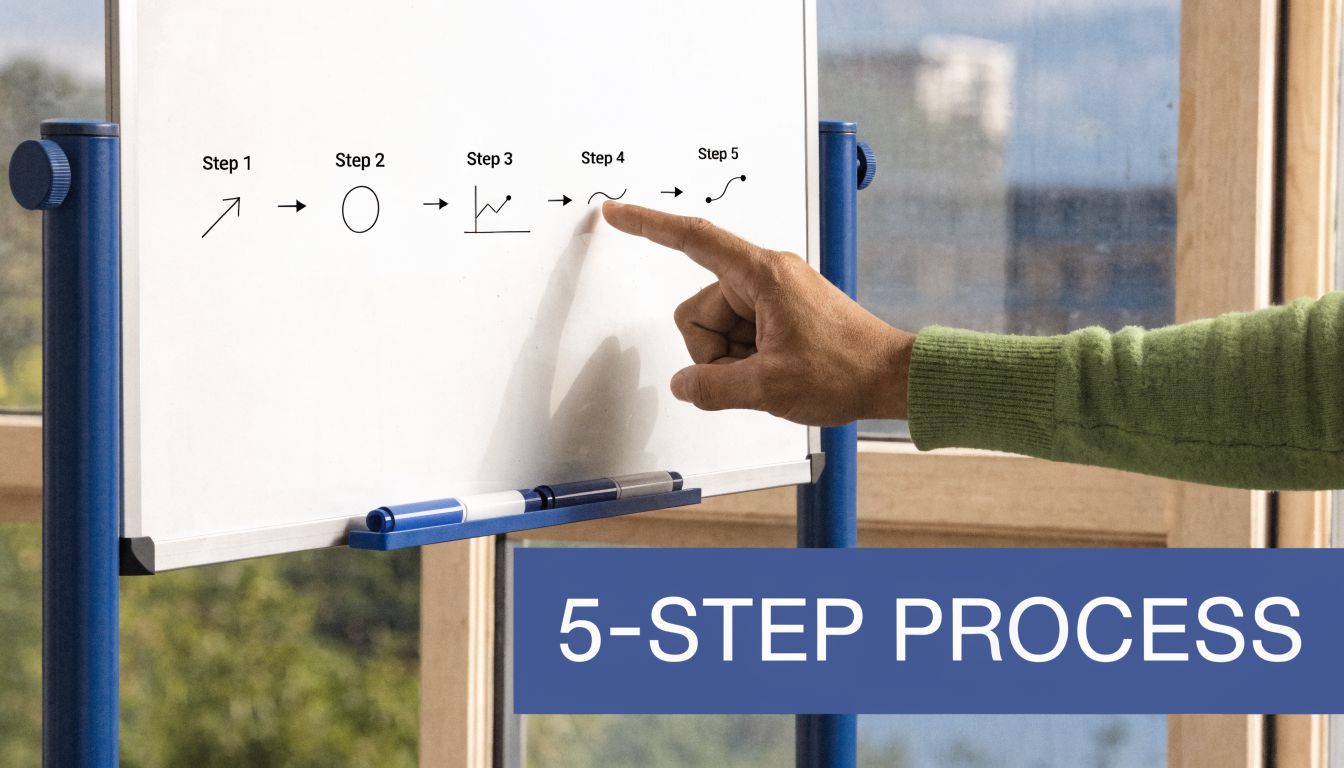
Re-engineering the model works best when leadership treats it like an operational redesign. Define the failure points. Test a controlled change. Measure what improves. Then build process around what works. Manufacturers already know this discipline on the plant floor. The same logic applies to commercial systems.
Step 1 assess the current system
Map the business as it actually runs, not as leadership believes it runs.
Document the offer, buyer type, channel mix, pricing logic, sales cycle, and post-inquiry follow-up. Then trace the commercial flow from first touch to closed business. Where do leads stall? Which quotes die without follow-up? How long does it take to respond to a form fill? Which accounts have bought before but have not heard from anyone in months? If you use a CRM, check whether the stages reflect the actual buying process or just provide a place to store contact records.
This exercise usually exposes a hard truth. Many manufacturers do not have a lead generation problem alone. They have a system problem that creates lead waste.
A practical way to keep this work grounded is to set decision criteria before ideas start flying. This strategic objective template helps leadership define what the redesign must improve, such as qualified inquiries, quote-to-close rate, service attach rate, or account reactivation.
Step 2 generate model options
Once the current model is visible, build several alternatives that could solve the specific growth constraint.
For manufacturers, that constraint is often inconsistent lead generation tied to an outdated go-to-market design. So generate options that change the commercial engine, not just the campaign calendar. Could the company package service as part of the initial offer? Could it build a vertical-specific offer for food processing, medical devices, or automotive suppliers instead of promoting general capabilities? Could it create a direct digital inquiry path that routes leads into a CRM with automated follow-up instead of waiting on inbox monitoring? Could dormant customers be reactivated with a structured sequence and a reason to re-engage?
Good model options change how demand is created, captured, or converted.
Outside perspective helps here. Internal teams usually defend the current design because they know how to operate inside it. Conversations like these insights from Poornima Ramaswamy, Founder & CEO of PivotX Advisors are useful because they show how leaders reframe growth constraints before they change execution.
Step 3 prototype a narrow version
Choose one model and reduce the test scope until it is manageable.
If the goal is steadier inbound demand, test one market segment, one offer, and one follow-up sequence. If the goal is recurring revenue, attach a service agreement to one product family instead of changing the full catalog. If the goal is better conversion, build one landing page, one offer, and one CRM pipeline before redesigning the entire website and sales process.
A useful prototype for a manufacturer often includes:
- one clearly defined offer
- one target segment
- one acquisition channel
- one sales workflow
- one CRM automation sequence
Platforms like GoHighLevel provide practical applications rather than remaining theoretical. A manufacturer can route form submissions, trigger follow-up emails and texts, assign leads to reps, track stage movement, and see where response time or handoff discipline is breaking down. That turns business model testing into something measurable.
Step 4 test with real buyers
Run the prototype in the market and watch behavior closely.
Start with buyer response. Do prospects understand the offer quickly? Do they ask questions that show interest in outcomes instead of only price? Do sales conversations get shorter because the offer is clearer? Does the team know which prospects fit and which should be disqualified early?
Then examine system performance. Track source, response speed, meeting set rate, quote volume, progression by stage, and reactivation results from existing accounts. If the new model depends on stronger lead handling, the CRM has to show whether follow-up occurred. Without that visibility, teams tend to blame traffic quality when the underlying issue is process failure.
A short explainer can help teams think through implementation rhythm before they commit further:
Step 5 scale what proves itself
Scale only after the pilot produces evidence that the model improves pipeline quality, conversion, revenue mix, or retention.
At this point, standardization matters. Document the offer. Define fit criteria. Build scripts and objection handling for the sales team. Update CRM stages, automations, reminders, and reporting so the system supports the new motion every day. If the model depends on faster follow-up, set response-time rules. If it depends on recurring service, define onboarding, support scope, and renewal ownership before volume increases.
Many companies lose momentum when they test something promising but then fail to operationalize it. The result is a good pilot with no lasting commercial change.
Use a simple checklist:
- Document the offer: scope, exclusions, pricing logic, and target account profile
- Train the team: qualification rules, messaging, and next-step discipline
- Configure the CRM: stages, automations, alerts, and reports that match the new model
- Protect delivery: operations, service, and sales must make the same promise
- Review monthly: fix breakdowns early before they become the new normal
Business model innovation works when the new design reaches the day-to-day system. For manufacturers, that usually means changing more than the offer. It means rebuilding how demand is generated, how leads are handled, and how the CRM enforces commercial discipline.
How Real Manufacturers Innovated for Growth
The easiest way to understand business model innovation is to compare an old commercial design with a better one. Below are two realistic manufacturer scenarios based on patterns we see often. The details differ by company, but the logic is consistent.
Equipment company moved from product sale to ongoing service
A mid-sized equipment manufacturer had a familiar problem. The product was respected, but growth was uneven because revenue relied on large one-time purchases. When the sales team closed a good quarter, leadership felt relief, not control. The company was always waiting for the next machine order.
The change started when the firm looked at how customers used the equipment. Buyers cared about uptime, service response, and predictable support almost as much as the hardware itself. So the company redesigned the offer around a service-backed relationship instead of a one-time transaction.
That shift changed the sales conversation. Instead of competing mostly on purchase price, the company could talk about continuity, support, and reduced operational disruption.
Case Study: Equipment Co. – From Product Sale to Service Subscription
| Component | Old Model (One-Time Sale) | New Model (Subscription Service) |
|---|---|---|
| Value proposition | Buy a machine with standard warranty | Get machine access, service, support, and uptime-focused care |
| Customer segment | Buyers replacing equipment periodically | Buyers who need predictable performance and less service risk |
| Revenue stream | Large one-time capital sale | Ongoing contract tied to service and support |
| Sales process | Project-based, quote-heavy, irregular | Relationship-based, ongoing account management |
| Customer relationship | Strong at purchase, weaker after install | Continuous contact through support and scheduled reviews |
| Cost structure | Revenue volatility, reactive service load | More service planning, more stable resource allocation |
Component supplier built a direct digital channel
A parts supplier had strong manufacturing capability and good distributor relationships, but the company lacked direct visibility into buyer demand. It depended heavily on channel partners to carry the story, gather market feedback, and surface opportunity. That made the pipeline harder to predict.
The company didn’t abandon distributors. That would have created conflict and likely damaged existing revenue. Instead, it created a parallel direct digital channel for specific product categories and customer types. The website became more useful. Product pages answered buying questions. Inquiry forms improved. Follow-up became more structured. Past customers were re-engaged with targeted email outreach tied to actual reorder logic and application needs.
The result wasn’t magic. It was clarity. The company learned which messages pulled interest, which segments responded fastest, and where direct demand justified more investment.
Why these examples matter
Neither company “innovated” by chasing novelty.
They reconfigured how value was packaged, delivered, and monetized. One shifted from transaction to ongoing relationship. The other improved market access and customer visibility without destroying what already worked.
That’s the practical test for manufacturers. A better model shouldn’t just sound modern. It should make growth more controllable.
Ask these questions against your own business:
- Where does revenue reset too often?
- Which customer need are you serving informally but not selling explicitly?
- Where are you relying on partners when you need better direct signal from the market?
- What part of the customer relationship ends too early?
A strong business model gives sales more than a product to sell. It gives buyers a better way to buy.
Common Pitfalls and How to Avoid Them
A manufacturer can redesign the offer, approve the pricing, and brief the sales team, then still see no growth. The usual failure point is not the concept. It is the operating system around the concept. Leads still arrive inconsistently. Follow-up still depends on rep memory. CRM stages still reflect the old sales motion. The new model enters the business, but the business never really changes to support it.
That is why business model work often stalls. Teams treat the new model as a project while the rest of the company keeps running on old assumptions about who buys, how demand gets captured, and what happens after an inquiry.
Pitfall one. Chasing novelty instead of demand
Manufacturing leadership teams often get attracted to the format of a new model. A portal, subscription, service contract, digital configurator, or self-serve quote tool can all be useful. None of them matters if they do not solve a buying problem better than the current setup.
Start with the customer constraint. Is the buyer trying to reduce downtime, shorten procurement cycles, simplify reordering, get faster technical support, or lower implementation risk? If the answer is unclear, the model is still a concept, not a commercial system.
A good test is simple. Ask, what buying friction disappears under the new model, and how will we see that in lead volume, conversion rate, or deal speed?
If you cannot tie the model to those signals, stop refining the packaging and fix the offer logic first.
Pitfall two. Protecting the current revenue stream so hard that nothing gets tested
This shows up in firms with healthy legacy business. Channel conflict is a real risk. So is confusing the sales force. So is shifting attention away from high-margin accounts. Those trade-offs need to be managed, not used as a reason to avoid market contact.
Use a constrained pilot.
- Limit the scope: one segment, one offer, one territory, or one product family
- Set operating boundaries: define which accounts stay on the old motion and which enter the test
- Measure commercial behavior: track inquiry rate, response time, meeting conversion, quote activity, and close reasons
- Protect the learning loop: review what the test taught you each week, not just whether it produced immediate revenue
Manufacturers often overlook a critical aspect. A pilot is not only about validating the offer. It is also about proving whether your demand capture and follow-up system can support the new model. If inbound inquiries sit in an inbox or reps follow up unevenly, the test gives you bad data. A structured marketing automation system for manufacturers helps turn pilot traffic into usable signal instead of lost opportunities.
Pitfall three. Analysis paralysis disguised as discipline
Manufacturers are usually strong at diligence. That strength becomes expensive when teams keep debating assumptions that only buyers can confirm.
Separate planning questions from market questions. Finance, operations, and service leaders should review delivery feasibility before launch. Buyers should determine whether the message is clear, the offer is credible, and the commercial terms make sense.
| Decision type | Best method |
|---|---|
| Internal feasibility | Review with operations, sales, and finance |
| Customer appeal | Test messaging and offer directly with buyers |
| Delivery complexity | Run a limited pilot and document friction |
| Scaling readiness | Standardize after repeatable proof |
A model does not become safer because a team discussed it for six more weeks. It becomes safer when the company gets live feedback and adjusts quickly.
Pitfall four. Weak ownership across sales, marketing, and operations
Committee ownership kills momentum. One group owns the offer, another owns the website, sales owns the pipeline, and nobody owns the whole commercial experiment.
Assign one leader with authority to run the test end to end. That person should own the timeline, the CRM workflow, the feedback process, and the next recommendation. Expand, revise, or shut it down. Those are the only three outcomes that matter.
For manufacturers dealing with inconsistent lead generation, this point is bigger than governance. If nobody owns the handoff from market interest to qualified opportunity, the new model will look weaker than it is. Good ideas fail every week because the surrounding system never got rebuilt to support them.
Activating Your New Model with a Marketing System
A redesigned business model still needs a route to market. Many manufacturers, however, stall at this stage. They improve the offer on paper, but they launch it through the same outdated website, the same inconsistent follow-up, and the same rep-dependent process that caused the original growth problem.

That gap is bigger than many teams realize. BCG notes that 80% of business model innovation leaders partner to fill capability gaps, especially when they need help making a new model commercially viable, in BCG’s discussion of strategies for sustainable business model innovation. For B2B manufacturers, one of the most common gaps is linking strategy to practical, CRM-driven lead generation.
Your go-to-market system has to change too
If you’ve changed the model, revisit the commercial system around it.
A new service offer may require different messaging than a traditional equipment sale. A direct-to-buyer channel needs different landing pages than a distributor-first model. A recurring revenue offer needs account workflows, reminders, and follow-up logic that a one-time sale didn’t require.
The practical stack often includes:
- Positioning and messaging: Translate technical capability into buyer language.
- Website structure: Create pages built around applications, industries, and buying questions.
- CRM workflows: Route inquiries, assign ownership, trigger follow-up, and prevent lead decay.
- Reactivation campaigns: Bring dormant customers back into active conversations.
- Sales enablement: Give reps usable sequences, qualification criteria, and offer language.
If your team is building a more automated commercial engine, this guide to marketing automation for manufacturing companies is a useful starting point.
What works in practice
The firms that activate new models well usually do a few things consistently.
- They validate before they scale: Messaging gets tested with real buyers before a full launch.
- They tighten response systems: Inquiry handling becomes faster and more structured.
- They connect marketing to sales: Website forms, email sequences, and CRM stages all feed the same process.
- They re-engage existing demand: Old quotes, inactive customers, and dormant accounts often become early wins for a new offer.
What doesn’t work is treating marketing as decoration. If the new model depends on a better customer journey, then your website, CRM, emails, and follow-up process are part of the business model itself.
The offer may be innovative. If the lead handling is slow, unclear, or manual, buyers still experience an old company.
A practical activation checklist
Before launch, check these five items:
- Can a buyer understand the new offer quickly on your website?
- Does your CRM reflect the new sales motion?
- Do sales and service teams use the same language to describe the offer?
- Have you created a follow-up sequence for leads that don’t buy immediately?
- Are you learning from inquiry patterns and adjusting the message?
Business model innovation becomes real when buyers can see it, understand it, and move through it without friction.
If your company has a solid product but an inconsistent pipeline, that’s usually a system issue, not a hustle issue. Machine Marketing helps manufacturers diagnose growth bottlenecks, sharpen positioning, and build the CRM, website, content, and automation systems needed to turn a better business model into qualified leads. If you’re ready to re-engineer how your business attracts and converts demand, book a discovery conversation.