If you're a manufacturer with a strong product and weak lead flow, the problem often isn't the product. It's the gap between what your company means to buyers and how your company shows up in the market.
We see this constantly in B2B. Engineering teams build a better process, tighter tolerance, faster turnaround, or more reliable machine. Then marketing says one thing, sales says another, the website says almost nothing, and the CRM is full of leads with no clear follow-up path. Buyers don't see one system. They see fragments.
That gap is where communications and branding either create momentum or kill it.
Your Brand Is More Than a Logo It Is Your Lead Engine
A lot of industrial companies treat branding like surface finish. Nice to have, not mission-critical. That's a mistake.
In practice, branding is what helps a buyer understand why your company is credible, relevant, and worth contacting before they ever talk to sales. Communications is how that message gets repeated through your site, email, CRM, proposals, LinkedIn posts, and follow-up sequences until the market remembers you.
When those two pieces line up, results stop being random. According to Dash branding statistics on consistency and revenue, 68% of companies report 10–20% revenue increases from consistent branding, and brands that maintain visual identity across platforms achieve about 33% higher recall and up to 23% revenue uplift.
For a manufacturer, that matters because buyers rarely purchase on one touchpoint. They compare vendors, revisit your website, forward your brochure internally, and judge your professionalism from every signal you send. If your message changes from channel to channel, they assume your execution does too.
What this usually looks like on the ground
Most companies don't have a branding problem in the abstract. They have one of these operational problems:
- The website is generic: It says "quality" and "innovation" but doesn't explain who you serve or why your process is different.
- Sales decks drift: Every rep explains the company differently.
- Follow-up is inconsistent: Leads get a quote, then silence.
- Marketing isn't connected to sales tools: Campaigns generate activity, but not a usable pipeline.
- Positioning is fuzzy: Buyers can't tell whether you're the specialist, the fast option, the premium option, or the safe option.
If that sounds familiar, start with sharper positioning. A useful reference is this breakdown of proven brand positioning methods, especially if your team knows you're good but struggles to explain why in buyer language.
Practical rule: If your sales team, website, and email follow-up don't sound like they came from the same company, your brand isn't helping lead generation. It's slowing it down.
Branding Is Your Why and Communications Is Your How
Engineers don't confuse design intent with operating procedure. Marketing teams often do.
Your brand is the design spec. It defines purpose, constraints, expected performance, and the value delivered to the end user. Your communications are the SOPs that make that spec real in the field.

What branding actually means in a B2B manufacturing context
Branding isn't just your logo, typeface, or booth backdrop. It's the clear promise behind them.
For a manufacturer, that promise may sound like this in plain English:
- We reduce downtime for food-processing plants that can't afford line stoppages
- We help OEM buyers get custom parts faster without sacrificing tolerance
- We give plant managers a safer retrofit path than replacing the full system
That promise answers three hard questions. Who are you for. What problem do you solve. Why should a buyer trust you.
Branding has deep roots for a reason. As explained in Greenville University's history of branding, branding began in the Bronze Age as symbols burned into livestock to indicate ownership. The Industrial Revolution turned branding into a trust mechanism for mass-produced goods, and that history still matters because consistent visual branding today can produce up to 80% higher recognition via signature colors.
For modern B2B firms, that isn't just a design lesson. It's a trust lesson.
What communications means when you're trying to generate leads
Communications is execution. It's what buyers experience.
That includes:
- Website copy: Does the homepage state your value clearly?
- Sales outreach: Are reps sending the same core message?
- Email nurture: Do buyers get relevant follow-up after inquiry?
- LinkedIn content: Does your expertise show up publicly?
- Proposal language: Does your estimate reinforce your position?
- CRM automation: Does the next step happen without someone remembering it manually?
A strong brand with weak communications is like a well-designed machine with no maintenance procedure. The concept may be sound, but output becomes unreliable.
Why one without the other fails
Companies often overcorrect in one of two directions.
| Situation | What happens |
|---|---|
| Strong visuals, weak message | The company looks polished, but buyers still don't understand why they should choose you. |
| Lots of activity, no brand core | Emails, posts, and campaigns go out, but they create noise instead of market memory. |
| Sales-led messaging only | Individual reps may perform well, but the company can't scale consistency. |
| Marketing-led messaging only | The message sounds good on paper but falls apart in real buyer conversations. |
The fix is alignment. Your message architecture has to sit above every channel and every sales touchpoint. If you need a deeper look at that foundation, this guide to branding and positioning strategies is a useful next read.
Buyers don't experience your brand as a strategy document. They experience it as a sequence of messages.
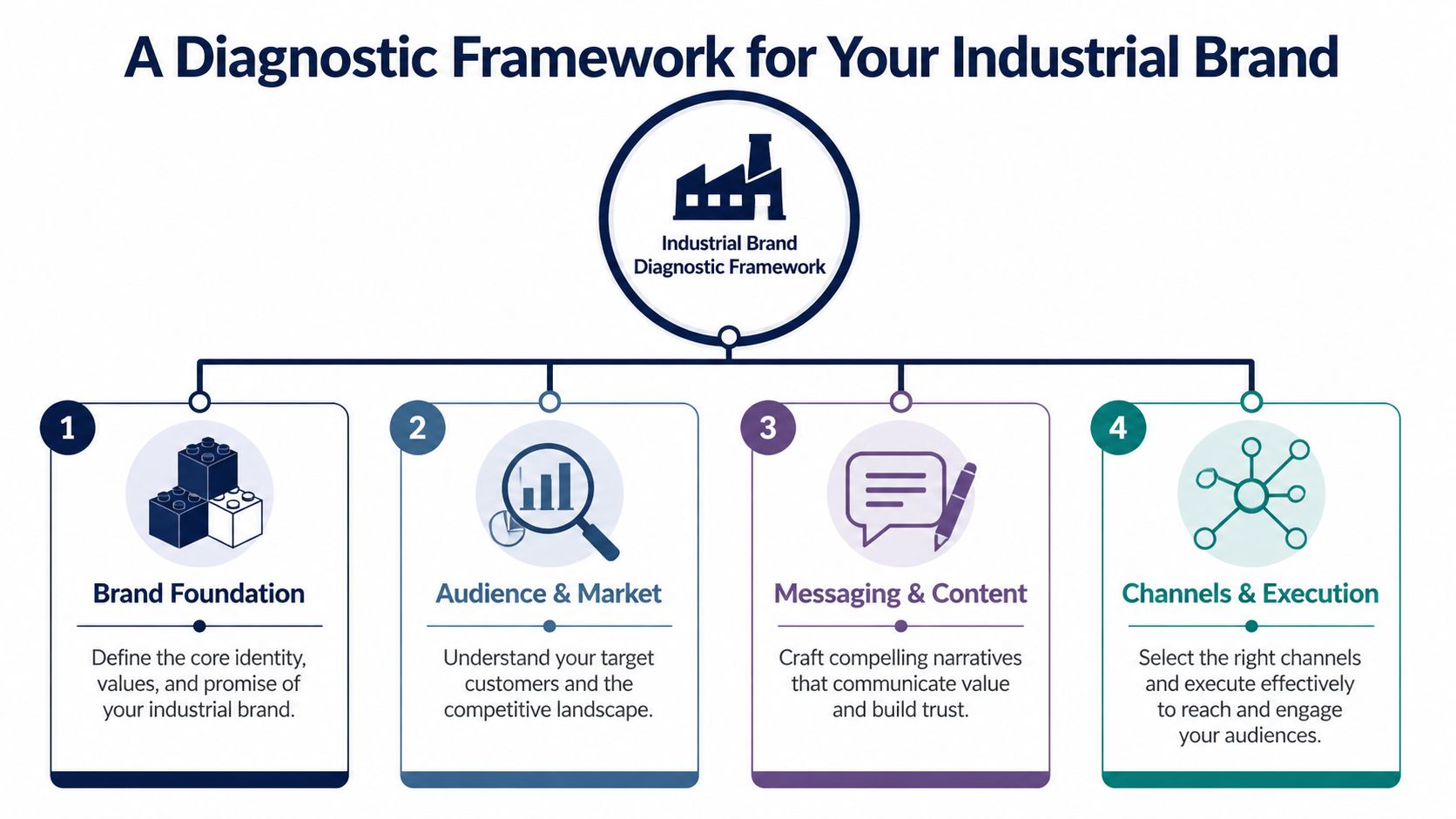
A Diagnostic Framework for Your Industrial Brand
Most branding discussions get too abstract too fast. Manufacturers don't need abstraction. They need a diagnostic model that behaves like a system check.
The cleanest way to assess communications and branding is to inspect four connected parts: audience clarity, core message, channel strategy, and performance measurement. If one part is weak, the whole system underperforms.
Pillar one is audience clarity
If you can't define the buyer precisely, every downstream communication gets softer.
A manufacturer usually serves more than one stakeholder. The plant manager cares about uptime. Procurement cares about risk and pricing structure. Engineering cares about fit, tolerances, and implementation detail. Sales reps may influence shortlist decisions long before the final buyer signs.
That means "we serve manufacturers" isn't a target market. It's a category. You need the sharper version.
Ask:
- Which verticals produce the best-fit opportunities
- Which job titles initiate contact
- Which stakeholder blocks the sale most often
- Which pain point creates urgency
- Which type of customer becomes profitable and repeatable
The moment you narrow audience definition, your content improves. So do your forms, case examples, and outbound sequences.
Pillar two is the core message
Once audience is clear, the next failure point is language.
Many industrial firms describe themselves from the inside out. They lead with process certifications, equipment lists, years in business, or generic claims like "high quality solutions." Buyers don't care until those details connect to a business problem.
A usable core message has three parts:
- The buyer problem
- Your differentiated approach
- The outcome the buyer can expect
Here is the difference:
- Weak message: "We are a full-service precision manufacturing partner."
- Better message: "We help OEM teams source precision components with tighter communication, fewer production surprises, and a clearer path from quote to delivery."
The second version gives sales something to repeat. It gives the website a headline. It gives your CRM templates a center of gravity.
If your message only makes sense to your internal team, it isn't market-ready.
Pillar three is channel strategy
Many teams waste time asking, "Which channels should we post on?" The better question is, "Where do serious buyers look for confidence?"
For some manufacturers, that means search. For others, it means email reactivation, LinkedIn, rep enablement, trade-show follow-up, or stronger quote support. You don't need to be everywhere. You need the right sequence.
A practical channel plan usually includes a mix of these roles:
| Channel role | Job in the system |
|---|---|
| Website | Converts interest into inquiry |
| SEO content | Captures buyers researching problems and vendors |
| Nurtures open opportunities and dormant leads | |
| Builds credibility and keeps expertise visible | |
| Sales collateral | Helps reps communicate consistently |
| CRM workflows | Ensures follow-up happens on time |
Most disconnected programs fail. Teams publish content, but it doesn't feed sales. Reps collect contacts, but they don't enter structured follow-up. Marketing runs campaigns, but the CRM doesn't reflect campaign logic.
That disconnect is fixable with a real marketing messaging framework, not ad hoc content production.
Pillar four is performance measurement
If you can't connect branding and communications to lead quality, the budget discussion will always go sideways.
The right question isn't "Did people like the post?" It's "Did this message move a buyer closer to inquiry, meeting, quote request, or sale?"
According to Jacob Tyler on strategic brand communications plans, effective plans in technical B2B depend on audience research, goals, messaging, tactics, and outcome metrics, and that alignment can drive 20–40% sales uplifts.
For a manufacturer, useful measurement often includes:
- Lead source clarity
- Inquiry quality
- Sales-call relevance
- Email reply patterns
- Pipeline progression by segment
- Content influence on opportunities
Those aren't vanity metrics. They're operating signals.
Your 40-Point Brand and Communications Audit Checklist
Teams don't need more ideas first. They need a disciplined inspection.
Use this checklist the way you would use a pre-production review. Don't argue with the answers. Document them. If the answer is "we're not sure," treat that as a fault condition.

Audience checklist
Score each item yes, no, or partially.
- Ideal customer defined: Can your leadership team describe your best-fit buyer in one sentence?
- Segment clarity: Do you know which industries produce the best opportunities?
- Role clarity: Do you know who usually initiates contact?
- Pain-point language: Can your team state the buyer's problem in the buyer's own words?
- Buying trigger known: Do you know what event usually causes someone to start looking?
- Disqualifiers listed: Do you know which prospects are usually a bad fit?
- Sales feedback loop exists: Does marketing hear real objections from sales regularly?
- Customer list reviewed: Have you looked at recent wins to identify patterns?
- Stakeholder map built: Do you know the concerns of engineering, procurement, and operations separately?
- Repeatable niche identified: Can you point to a market segment where you already have proof?
Messaging checklist
Drift usually shows up here.
- Core statement written: Do you have one approved sentence that explains what you do, for whom, and why you're different?
- Homepage clarity: Is that value proposition visible high on the homepage?
- Buyer-first copy: Does your messaging lead with customer outcomes instead of internal descriptors?
- Differentiators named: Are your advantages specific, not generic?
- Proof included: Do your pages support claims with process detail, examples, or evidence?
- Sales consistency: Do all reps use the same core positioning language?
- Proposal alignment: Do proposals reinforce the same value proposition as the website?
- Technical complexity simplified: Can a non-engineer at the buying company understand your message?
- Objection handling built: Have you documented answers to common buyer concerns?
- Brand voice documented: Could a new team member write an email that sounds like your company?
Field note: If your team keeps rewriting the company description in every document, your message isn't defined yet.
Channel checklist
This section checks execution, not theory.
- Website path is clear: Can a new visitor quickly find the right service or solution page?
- Forms ask useful questions: Do inquiry forms collect information that helps qualify leads?
- CRM stages make sense: Are lead stages mapped to your actual sales process?
- Follow-up timing exists: Does every new lead trigger a next action?
- Dormant leads addressed: Do you have a process to re-engage old contacts?
- Email templates approved: Are sales and marketing emails using consistent language?
- Content supports sales: Do your articles, PDFs, or videos answer real buyer questions?
- LinkedIn presence active: Does your company page reflect current capabilities and expertise?
- Trade-show follow-up structured: Are event contacts entered into a real nurture path?
- Internal ownership clear: Does each channel have a named owner?
Measurement checklist
If this section is weak, your team will rely on opinions.
- Lead source captured: Can you identify where recent qualified leads came from?
- Attribution discipline exists: Are campaign links and forms set up consistently?
- KPIs chosen: Have you selected a short list of business-relevant metrics?
- Sales quality feedback tracked: Do you know which channels produce serious conversations?
- CRM reporting usable: Can leadership review pipeline by source without manual reconstruction?
- Messaging performance observed: Do you compare which messages generate better replies or conversions?
- Review rhythm set: Do you review performance on a regular schedule?
- Lost deals analyzed: Do you track why opportunities stall or close elsewhere?
- Content influence discussed: Does sales mention when prospects reference content, emails, or website pages?
- Decision-making tied to data: Do you change campaigns based on what the numbers and conversations show?
How to use the checklist without overcomplicating it
Don't try to fix all forty points at once.
Start by marking:
- Red: Missing or broken
- Yellow: Inconsistent
- Green: Working well
Then do one more pass and circle the five items that most directly affect lead flow. In most companies, that short list includes unclear positioning, weak homepage messaging, poor CRM stage design, inconsistent follow-up, and bad lead-source tracking.
Activating Your Strategy A 90-Day Implementation Roadmap
A strategy document doesn't generate leads. Operational change does.
The fastest way to make communications and branding useful is to run it as a 90-day implementation cycle. That gives you enough time to diagnose problems, fix the high-friction assets, and launch a measurable campaign without letting the project drift into endless internal debate.
According to research on marketing attribution challenges in manufacturing, 72% of manufacturers struggle to attribute revenue to marketing, which is exactly why a structured 90-day plan matters. It forces your team to connect actions to outcomes.
Days 1 through 30 fix alignment first
Don't start with campaign production. Start with mechanical alignment.
In the first month, gather leadership, sales, and whoever owns the website or CRM. Use your audit checklist and resolve the highest-impact inconsistencies. That usually means agreeing on target audience, rewriting the core message, and deciding which metrics matter enough to review weekly.
Your first-month priorities should look like this:
- Define the audience: Choose the best-fit segment instead of trying to speak to everyone.
- Approve one core message: One sentence. Not five versions.
- Select a small KPI set: Focus on business signals such as qualified inquiries, meetings booked, and lead-source clarity.
- Map the buyer journey: Identify the key touchpoints from first visit to quote request.
- Assign ownership: Every major asset and workflow needs a responsible person.
This stage feels slower than launching a campaign, but it prevents rework.
Days 31 through 60 build the assets that carry the message
Month two is where your strategy becomes visible.
Rewrite the pages that buyers use. For most manufacturers, that means the homepage, service pages, about page, contact forms, and the first few automated emails. If your CRM or GoHighLevel setup is messy, this is the point to clean your pipeline stages, tags, forms, and notification rules.
A useful build sequence looks like this:
| Asset | What to change |
|---|---|
| Homepage | Lead with a clear value proposition and next step |
| Service pages | Tie capabilities to buyer problems and outcomes |
| Inquiry forms | Ask questions that help sales qualify faster |
| Email templates | Standardize tone, offer, and call to action |
| CRM stages | Reflect the real sales path, not vague labels |
| Lead capture paths | Route contacts by segment, need, or source |
At this point, your brand isn't a concept anymore. It's embedded in the tools your team uses every day.
A short explainer can help your team align on the planning cadence before launch:
Days 61 through 90 launch and learn
The third month is for deployment, not perfection.
Run one focused campaign tied to your best-fit audience and strongest offer. That might be a reactivation email sequence to dormant contacts, a follow-up workflow for quote requests, or a content-driven outreach sequence built around a specific capability.
Keep the first campaign narrow enough to evaluate clearly.
Operational advice: Don't measure success by how much you launched. Measure success by whether the team can now explain, track, and repeat what worked.
During this month:
- Launch one targeted campaign
- Watch lead quality, not just volume
- Listen to sales-call feedback
- Check CRM attribution weekly
- Refine message based on actual responses
- Document what to keep, cut, or improve for the next 90 days
That final point matters. The goal isn't one campaign. The goal is a repeatable system.
Tying It All Together with CRM and GoHighLevel
A branding strategy becomes real when your CRM enforces it.
Without a central system, teams improvise. One rep follows up quickly. Another waits. One email reflects your positioning. Another sounds like it was copied from a different company. That's how branding erodes in day-to-day operations.
Use the CRM to enforce audience clarity
Start with segmentation.
If your contact database lumps plant managers, engineers, distributors, and past customers into one undifferentiated list, your communication will stay generic. In GoHighLevel, that usually means setting up tags, smart lists, and pipeline views that separate contacts by industry, role, product interest, inquiry type, or sales stage.
That gives you practical control over questions like:
- Which contacts should receive technical content
- Which leads need fast sales follow-up
- Which dormant accounts should enter a reactivation sequence
- Which audience should get a quote reminder versus an educational email
The system should reflect the buyer reality you defined earlier.
Use templates and workflows to protect message consistency
Once your audience is segmented, build approved communication assets inside the CRM.
Create email templates for first response, quote follow-up, no-response follow-up, meeting confirmation, and re-engagement. Build SMS carefully and only where it's appropriate for your buyer. Add internal notes and task prompts so sales reps know what message to reinforce, not just when to click send.
The value of structure becomes evident to many companies. Your message stops depending on memory.
According to SSRN research on AI-driven personalization in B2B manufacturing communication, hyper-personalized AI emails produce 32% higher open rates in manufacturing than broad campaigns, yet only 15% of midsize firms implement them, often because setup feels complex. That's exactly where CRM design matters. Personalization isn't magic. It's organized data, sound message rules, and usable workflows.
Build nurture paths instead of isolated follow-ups
A lot of manufacturers still treat email as a one-off reply tool. That's too limited.
Better use of GoHighLevel looks like this:
| CRM function | Branding and communications use |
|---|---|
| Tags and custom fields | Segment by market, role, and need |
| Pipeline stages | Match the actual sales process |
| Automated workflows | Trigger follow-up without relying on memory |
| Email templates | Keep message and tone consistent |
| Reporting dashboards | Show which campaigns and sources create real opportunities |
If you want a broader view of how those pieces fit together, this guide to CRM and digital marketing systems is a practical companion.
A CRM shouldn't just store contacts. It should preserve your message, sequence your follow-up, and reveal which communications actually create qualified conversations.
Your Next Step From Branding to Business Growth
Communications and branding aren't soft side projects. For a B2B manufacturer, they're part of the production system for demand.
When the market can't quickly understand who you help, why you're different, and what happens next, lead flow becomes inconsistent. Sales works harder than it should. Marketing gets judged on activity instead of contribution. Good opportunities leak out of the system.
The fix isn't more random promotion. It's a tighter operating model. Define the buyer. Clarify the message. Build the channel path. Measure what creates movement. Then put it inside the tools your team uses every day.
Start with one action this week. Run the audit checklist and find the single biggest failure point. If your homepage is unclear, rewrite it. If your CRM follow-up is broken, fix that. If sales can't repeat one positioning statement consistently, lock that down first.
That's how brand strategy turns into business growth. One repaired constraint at a time.
Your Communications and Branding FAQs
We're a small team with no dedicated marketer. Where do we start
Start with the narrowest useful fix.
For most small B2B teams, the first job isn't content volume or paid media. It's message clarity. Pull leadership and sales into one meeting and force agreement on one sentence that answers three things: what you do, who you do it for, and why that buyer should care. If you can't agree on that sentence, every downstream activity will stay inconsistent.
Then pick one core asset to update. Usually that's your homepage or your inquiry follow-up email. Don't try to rebuild the whole system in a week.
How long until we see ROI from communications and branding work
You should expect different timing for different signals.
Leading indicators often show up first. Sales may report better conversations. Email responses may improve. Website inquiries may become more relevant. Internal alignment may also improve quickly, which matters more than many teams realize because clearer messaging reduces waste.
Revenue usually takes longer in B2B manufacturing because the buying cycle is slower and often includes multiple stakeholders. The key is to watch whether your system is producing better-fit opportunities and more consistent follow-up before you expect full downstream financial impact.
Is GoHighLevel or another CRM absolutely necessary
Necessary is too strong. But operating without a CRM usually means your team is relying on memory, spreadsheets, inboxes, and inconsistent habits.
That works up to a point. Then lead volume increases, follow-up becomes uneven, and no one can clearly explain which messages or channels are producing qualified opportunities. A CRM gives you structure. A platform like GoHighLevel adds automation, which matters when a small team needs to scale communication without adding headcount.
If your volume is very low, you can start manually. But if you want repeatability, visibility, and better execution across communications and branding, a central system becomes hard to avoid.
What if our sales team says branding doesn't matter
That usually means they've seen branding treated as decoration instead of sales support.
When branding is done properly, it helps sales by making the company's value easier to explain, making proposals more credible, improving first impressions, and keeping follow-up consistent. Good salespeople often do this naturally on their own. The problem is that companies can't scale "natural talent" as a process. A brand and communications system turns good instincts into repeatable execution.
How do we know if our message is actually working
Listen for clarity in buyer behavior.
When the message is working, prospects ask more specific questions. Sales conversations start in a better place. Inquiries are less vague. Existing contacts re-engage with more intent. Internally, your team also stops rewriting the company description every time it needs a new email, deck, or page.
If the same confusion keeps showing up in calls, proposals, and website behavior, the message still needs work.
If your marketing feels disconnected from your sales process, Machine Marketing can help you diagnose the failure points, tighten your messaging, and build a practical system around CRM, GoHighLevel, website content, and follow-up automation. If you're ready to turn communications and branding into a more reliable lead engine, book a conversation and start with a structured diagnosis.