If you're pricing by gut, copying a competitor, or adding a margin to cost and calling it done, you're probably dealing with one of two problems right now. You're either winning work that should be more profitable, or you're losing quotes and blaming price without proof.
For most B2B companies, especially manufacturers, that isn't a talent problem. It's a system problem. The business has quoting data, sales call notes, lead history, and customer feedback sitting in the CRM, inboxes, and proposal files, but nobody has turned it into a pricing diagnosis.
What the market will bear isn't a slogan. It's a practical question. How much can you charge before buyer resistance rises faster than the value you deliver? And just as important, how do you find that point without damaging trust, margin, or deal flow?
Is Your Pricing Leaving Money on the Table
A lot of pricing mistakes look reasonable from the inside.
You may be using a cost-plus model because it feels disciplined. You may be matching a competitor because sales says the market is tight. You may be discounting late in the deal because the quarter needs to close. Each of those moves can work in a narrow situation. None of them gives you a reliable answer to what the market will bear.
The usual symptom is confusion. One buyer signs quickly at your quoted price. Another stalls, asks for revisions, and pushes hard on cost. A third says you're too expensive, then buys a weaker solution from someone else. That pattern tells us your price is not being managed as a system.
What a broken pricing system looks like
Most B2B teams show the same warning signs:
- Quotes vary too much: Different reps charge differently for similar work.
- Discounts appear late: Price drops happen after weak value conversations, not because scope changed.
- Loss reasons stay vague: "Lost to price" gets logged, but nobody asks what the buyer compared you against.
- Margins drift downward: Revenue may hold up while profit gets squeezed.
- Premium features get away for free: Faster lead times, engineering help, reporting, and support are included without a pricing decision.
Practical rule: If you can't explain why one customer pays more than another for the same outcome, your pricing is still being improvised.
That matters even more in volatile conditions. Market cycles are real, but they aren't permanent. Since 1928, the S&P 500 has gone through 27 bear markets, averaging about 9.6 months, while accompanying bull markets have lasted longer and delivered much larger gains over time, according to historical bear and bull market data from Keen Wealth Advisors. For operators, the lesson isn't about stock picking. It's that short-term pressure can push teams into reactive pricing when they should be building a repeatable discipline.
The better question
Don't ask, "What can we get away with?"
Ask, "Where does our price align with the value this buyer clearly understands?"
That's the difference between random quoting and strategic pricing.
What 'The Market Will Bear' Really Means
"The market will bear" gets misused. Some people hear it and think it means charging as much as possible until customers complain. That approach burns trust fast.
In practice, what the market will bear is the highest price a specific buyer segment will accept when the value is clear, credible, and relevant to their situation. It is not a universal number. It changes by segment, urgency, risk tolerance, support needs, and the cost of failure.

Think of pricing like tuning a dial
If your price is too low, buyers may say yes, but you train the market to undervalue your work. Your margins shrink, your team gets overloaded, and premium service becomes impossible to sustain.
If your price is too high for the way value is being presented, buyers hesitate. They don't always reject the solution itself. They reject the mismatch between the number and the story attached to it.
The right point sits in the middle. Buyers understand what they get, what problem it solves, what risk it removes, and why the price makes sense.
What it is not
It isn't:
- Price gouging: Short-term extraction with no long-term logic.
- Commodity matching: Letting another vendor define your value.
- Pure cost recovery: Covering your costs says nothing about customer value.
- One-price-fits-all quoting: Different buyers care about different things.
A manufacturer selling precision components to an OEM with tight downtime costs should not price the same way as a supplier serving a buyer who only cares about unit cost. Same category. Different value equation.
Buyers don't pay top price because your spreadsheet says they should. They pay it because the decision feels safe, justified, and worth it.
Positioning decides pricing power
If your positioning is vague, your price ceiling drops. Buyers compare you on line items. If your positioning is sharp, your price ceiling rises because buyers compare you on outcomes, responsiveness, engineering input, documentation quality, lead time reliability, or lower operational risk.
That is why target pricing work has to connect to segmentation and positioning. If you want a useful primer, Market Edge insights on strategic pricing are a good reference for how pricing decisions tie back to market expectations and product strategy.
The practical takeaway is simple. The market doesn't bear a price in the abstract. A defined buyer segment bears a price when your value is specific enough to defend it.
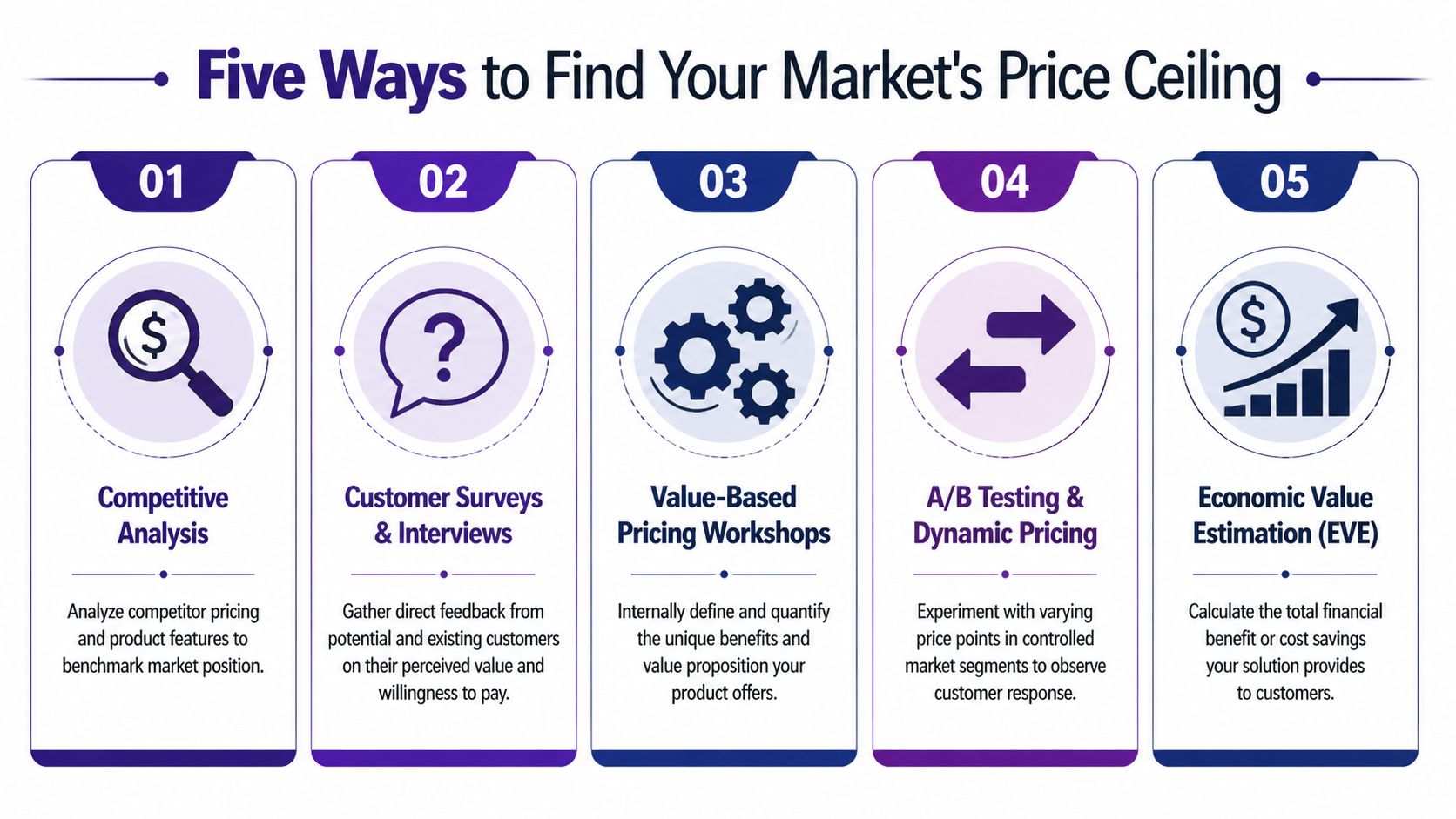
Five Ways to Find Your Market's Price Ceiling
Guessing isn't a pricing method. You need signals from buyers, sales conversations, win-loss patterns, and actual buying behavior.
Start with value before price
The first job is to define what the customer is really buying. In manufacturing and B2B, it usually isn't the part, machine, or service by itself. It's some mix of uptime, reduced scrap, faster implementation, lower labor burden, easier compliance, fewer surprises, or less back-and-forth between teams.
Ask your team:
- What expensive problem do we reduce?
- What risk do we remove for the customer?
- What do customers mention after they buy that they didn't fully appreciate before?
- Which parts of our offer matter only to premium buyers?
That gives you the raw material for price defense.
Five methods that work in the field
- Value-based pricing analysis
Start with one offering, not your whole catalog. List the customer outcomes tied to that offer. Then compare your solution to the customer's next-best alternative, which may be another vendor, an in-house process, or doing nothing for another quarter.
This method works best when your product changes labor, waste, throughput, reliability, or speed. It forces your team to stop talking about features and start talking about business consequences.
- Customer interviews
Short conversations reveal more than broad surveys. Talk to recent wins, recent losses, and long-term customers. Ask what they compared, what made the price feel reasonable or unreasonable, and what they would remove if the budget tightened.
Good questions include:
- What part of our proposal felt most valuable?
- Where did the price feel high?
- What would have made the quote easier to approve?
- What did you think you were paying for?
If you need a structured way to collect that kind of input, this guide to market research and focus groups for better customer insight can help shape the conversation.
- Controlled price testing
You don't need a dramatic price overhaul. Test small changes in a narrow segment. Adjust one variable at a time, such as list price, package structure, turnaround speed, or service level. Then watch buyer response.
This only works when the test is controlled. If you change the proposal, discounting policy, and follow-up process at the same time, you won't know what caused the result.
Field note: Test prices where sales execution is consistent. A weak rep can make a good price look wrong.
- Competitive analysis
Competitor pricing matters, but not as an anchor. It is a reference point. Look at where they charge more, where they simplify the offer, and where they hide service inside the base price.
The mistake is treating competitor numbers as your answer. If you can prove better lead time, stronger support, or lower implementation friction, you may deserve a different position entirely.
- Economic value estimation
This is the most disciplined method for high-impact situations. Estimate the financial value your offer creates compared with the next-best choice. Then decide how much of that value you should capture in price.
You don't need a complicated model to start. Even a basic estimate built from labor savings, avoided downtime, fewer errors, or reduced coordination can sharpen a pricing conversation fast.
Comparison of Price Discovery Methods
| Method | Best For | Effort Level | Data Accuracy |
|---|---|---|---|
| Value-based pricing analysis | Offers with clear operational or financial impact | Medium | High when customer outcomes are well understood |
| Customer interviews | Understanding buyer language and objections | Low to medium | High for message quality, moderate for price precision |
| Controlled price testing | Narrow segments with repeatable sales motions | Medium | High when variables are tightly managed |
| Competitive analysis | Benchmarking market position | Low | Moderate because competitors' numbers lack context |
| Economic value estimation | Complex B2B offers with measurable business impact | High | High when assumptions are grounded in real customer operations |
What doesn't work
Some pricing habits feel safe but create noise:
- Asking sales for a single “market price” when different segments buy for different reasons
- Using average margin as the main pricing guide instead of customer value
- Discounting to save weak deals before diagnosing scope, timing, or trust issues
- Repricing everything at once and creating internal confusion
Use multiple signals. One method gives you a clue. Several methods give you a decision.
Finding Pricing Signals Inside Your CRM
Most companies already own the best starting tool for pricing work. They just use it as a deal tracker instead of a diagnosis system.
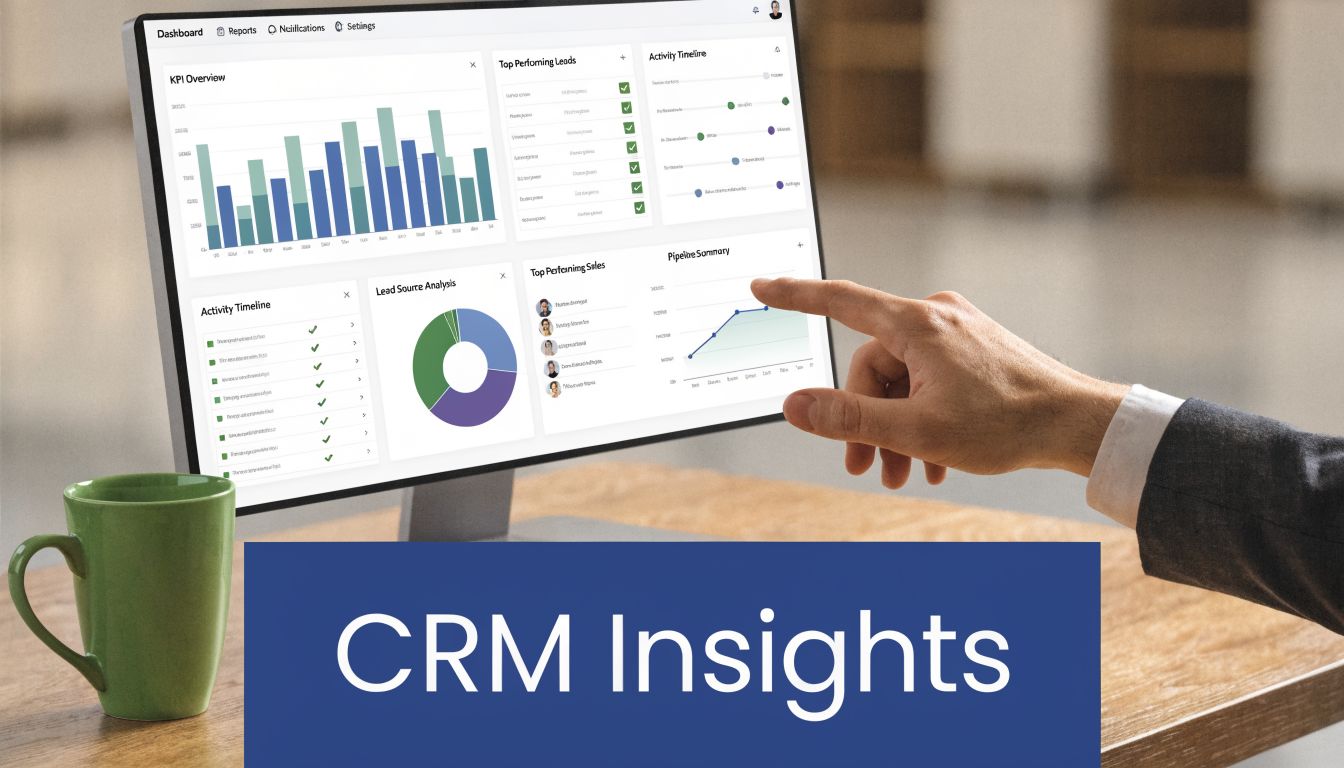
Your CRM can show where price resistance appears, which offers stall, and whether "too expensive" means the number is wrong or the value story is weak.
Four signals to pull first
Start with the fields and stages you already have. You don't need a major rebuild to find useful patterns.
- Deal velocity by quote type: Which proposals sit longest before a decision?
- Close rate by quoted value band: Are larger quotes really underperforming, or are they just sold differently?
- Discount frequency by rep or product line: Who gives price away first?
- Lost reason detail: What exactly happened before "lost to price" got entered?
A strong CRM setup should also let you segment by industry, account type, lead source, geography, and service package. That's where pricing patterns usually become visible.
"Lost to price" is often bad diagnosis
Sales teams overuse this label. Sometimes the buyer means your price was high. Sometimes they mean your proposal looked risky, hard to justify internally, or poorly matched to their use case.
Add custom fields or note tags for things like:
- Competing option named
- Urgency level
- Requested turnaround
- Support expectations
- Decision maker concern
- Whether the buyer asked to remove scope before asking for discount
That detail changes the conversation. If losses happen when buyers need fast delivery, the issue may not be base price. It may be that urgent delivery should be packaged and priced differently.
For companies building tighter reporting around pipeline and follow-up, a practical reference is this guide on running campaigns and customer journeys inside a CRM.
A simple dashboard worth building
Create one pricing dashboard with a small set of views:
| CRM View | What it tells you |
|---|---|
| Open quotes aging report | Where price friction may be slowing decisions |
| Won deals by segment and price band | Which buyers accept higher pricing more easily |
| Lost deals with objection notes | Whether "price" is really the root issue |
| Discount approvals log | Where internal discipline breaks down |
That dashboard becomes more useful when sales managers review it weekly, not quarterly.
Here is a practical walkthrough that can help your team think about CRM structure and follow-up discipline before you start changing price.
What to look for in the patterns
Look for clusters, not isolated anecdotes.
If one rep gets heavy pushback on price, check their discovery process and proposal quality before cutting list price. If one segment accepts higher quote values with less friction, protect that segment from unnecessary discounting. If a specific option causes late-stage objections, break it out, reframe it, or price it separately.
A CRM won't tell you the perfect price. It will show you where buyers stop believing the current one.
That is enough to make better decisions.
Pricing In Action for Manufacturers and B2B
The easiest way to understand what the market will bear is to look at how it shows up in ordinary selling situations.
Example one: the custom equipment quote
A custom equipment manufacturer often bundles too much into one number. Engineering review, install coordination, operator training, expedited delivery, and post-launch support all go into a proposal labeled "system price." Then the buyer says the quote is high.
That doesn't always mean the system price is wrong. It may mean the offer is packed in a way that hides value.
A better approach is to separate the base system from premium delivery conditions and support layers. When buyers can see what they are paying for, the conversation gets cleaner. Some will choose the lower package. Others will willingly pay more for faster implementation or deeper support because those items solve a real operational problem.
Example two: the component supplier with uneven margins
A component supplier serving several account types often discovers that not all customers buy the same thing, even when the part number is identical. One buyer wants stable replenishment and little contact. Another expects technical help, rush coordination, documentation support, and frequent updates.
If both accounts receive the same service and the same pricing logic, one of them is being undercharged.
Useful segmentation can be built around factors like:
- Delivery urgency
- Order complexity
- Technical support burden
- Forecast reliability
- Administrative workload
That shifts pricing away from a flat catalog mindset and toward service-adjusted value.
Example three: service businesses and scope clarity
B2B service firms run into the same issue. If you're packaging advisory, implementation, reporting, and ongoing support together, buyers compare your total fee against someone else's partial offer and call you expensive.
That is why packaging matters as much as rate setting. Teams that want a parallel example can learn about professional services billing and see how pricing structure changes the client's perception of value and scope.
A related challenge shows up in industrial marketing as well. If your positioning doesn't clearly separate strategic work from commodity execution, every proposal becomes a negotiation over line items. That's one reason many firms revisit their broader marketing strategy for manufacturers before they overhaul pricing.
What sales should say instead of discounting
Most reps haven't been trained to defend price. They've been trained to rescue deals.
Give them language that redirects the conversation:
- When buyers say you're high: "Compared with which option, and what does that option leave on your team to manage?"
- When buyers ask for a discount: "We can reduce cost by removing scope. Which part matters least to your outcome?"
- When procurement pushes broadly: "The number reflects delivery conditions, support expectations, and implementation risk. If those change, we can rework the quote."
The strongest pricing move in a negotiation is not a discount. It's a clear choice between levels of value.
That keeps the discussion on trade-offs, not panic.
Your Actionable Playbook for Pricing Iteration
Pricing gets easier when you stop treating it like a one-time decision. The right approach is iterative. Small tests. Clear baselines. Measured changes.

Step one: diagnose the current state
Pull a recent set of won and lost deals from your CRM. Review the quote values, discounting behavior, time-to-close, buyer objections, and requested scope changes.
Don't look for perfection. Look for repeated friction. Which offers trigger negotiation? Which segments buy fastest? Which reps protect price better?
Step two: write one pricing hypothesis
Keep it narrow. A weak hypothesis sounds like, "We should raise prices." A useful one sounds like, "Buyers in this segment will accept a higher price when expedited delivery and technical support are separated from the base offer."
Good hypotheses include three parts:
- The segment
- The pricing change
- The expected buyer response
Step three: run a controlled test
Choose a small sample where the sales motion is consistent. Define what changes and what stays the same. Update quoting language, package names, and approval rules before the test begins.
Avoid broad rollout. Wide changes create internal noise and make pricing look arbitrary.
Step four: measure against a baseline
Review the test with the same lens you used in diagnosis:
| Measure | What to compare |
|---|---|
| Quote acceptance | Test group versus prior similar deals |
| Sales cycle movement | Did decisions speed up, slow down, or stall? |
| Discount requests | Did buyers push back differently? |
| Margin quality | Did the business keep more value per deal? |
| Objection pattern | Did resistance shift from price to scope or timing? |
Discipline matters. If the test underperforms, don't jump to "the market won't bear it." Check whether the proposal language changed, whether reps presented it consistently, and whether the segment was right.
Step five: decide and document
Every pricing test ends in one of three outcomes:
- Roll out if the signal is strong and repeatable.
- Refine if the idea is sound but execution was inconsistent.
- Discard if buyers clearly reject the structure and the value case doesn't support it.
Then document the result. Put the rule into your quoting SOP, CRM fields, pricing sheet, and sales coaching process. If the lesson stays in one manager's head, it won't stick.
Questions to ask before the next change
Use this short checklist with your team:
- Are we changing price, packaging, or both?
- Which buyer segment is affected?
- What value are we asking the buyer to recognize?
- How will sales explain the change?
- What would count as success or failure?
One last point matters here. Operators often get reactive during downturns and cut too quickly. History argues for more discipline. Since 1929, major U.S. stock bear markets have been painful, averaging about a 36% loss across 26 instances, but bull markets that followed averaged about 114% gains, and stocks were in bull phases 78% of the time, according to historical bear market review from Arrow Investment Management. The business lesson is straightforward. Temporary pressure shouldn't force permanent pricing mistakes.
A strong pricing system helps you respond without panic. It gives you a repeatable way to test what the market will bear, protect margin, and keep trust intact.
If your pricing still depends on instinct, scattered spreadsheets, or whatever your sales team says in the moment, it's time for a real diagnosis. Machine Marketing helps manufacturers and B2B companies turn CRM data, buyer feedback, and market positioning into a practical growth system. If you want a clearer pricing process, stronger sales support, and a roadmap you can implement, book a conversation and start with the diagnosis.