You're probably seeing one of two failure modes right now. Your ads generate clicks but not qualified conversations, or they generate a few good leads and then go quiet for no obvious reason. In industrial marketing, that usually isn't a creativity problem. It's a systems problem.
Most manufacturers don't need more random campaigns. You need a machine that connects the elements of advertising in the right order, with the right tolerances, and with measurement tied back to revenue. If one component is misaligned, the rest of the system can still run, but it won't run efficiently.
That's how we approach advertising for B2B and manufacturing companies. Not as a pile of ads, headlines, and budgets, but as a working assembly. Audience. Message. Creative. Channel. Offer. CTA. Budget. Timing. Frequency. Then one control layer above all of it: measurement connected to CRM.
Table of Contents
- Your Advertising Is a System Not a Gamble
- Diagnosing the Core Components Audience Message and Creative
- Connecting the System Channel Offer and CTA
- Fueling the Machine Budget Timing and Frequency
- The Control Panel Integrating Measurement and Your CRM
- Your B2B Advertising Execution Checklist
- Build Your System Start Generating Leads
Your Advertising Is a System Not a Gamble
A lot of advertising underperforms for a simple reason. Companies treat each campaign like an isolated event. They write copy, choose a platform, set a budget, and hope demand appears. Hope is not a control method.
A working ad system behaves more like a production line. Each part has a job, and each handoff affects the next one. If the audience definition is sloppy, the message drifts. If the message is vague, the creative can't carry it. If the channel is wrong, even a solid offer won't get traction. If your CRM isn't connected, you can't tell which campaigns create pipeline.
That's why we like the engineering mindset here. It forces better questions.
- What is this component supposed to do? Audience definition narrows fit. Creative earns attention. The offer trades value for contact information or a sales conversation.
- Where does failure show up first? Often in the handoff. Ad to landing page. Form fill to CRM. MQL to sales follow-up.
- What is the tolerance limit? If a campaign only works when every condition is perfect, it isn't reliable.
One useful outside perspective on this broader operating model is strategies to scale revenue in 2025. It's helpful because it frames performance marketing as an integrated growth system, not a set of disconnected tactics.
Practical rule: If your team can't explain how an ad becomes revenue inside your CRM, you don't have an advertising system yet. You have media spend.
The nine elements matter. But the ultimate impact comes from how they connect. In B2B manufacturing, the connection points matter more than the slogans.
Diagnosing the Core Components Audience Message and Creative
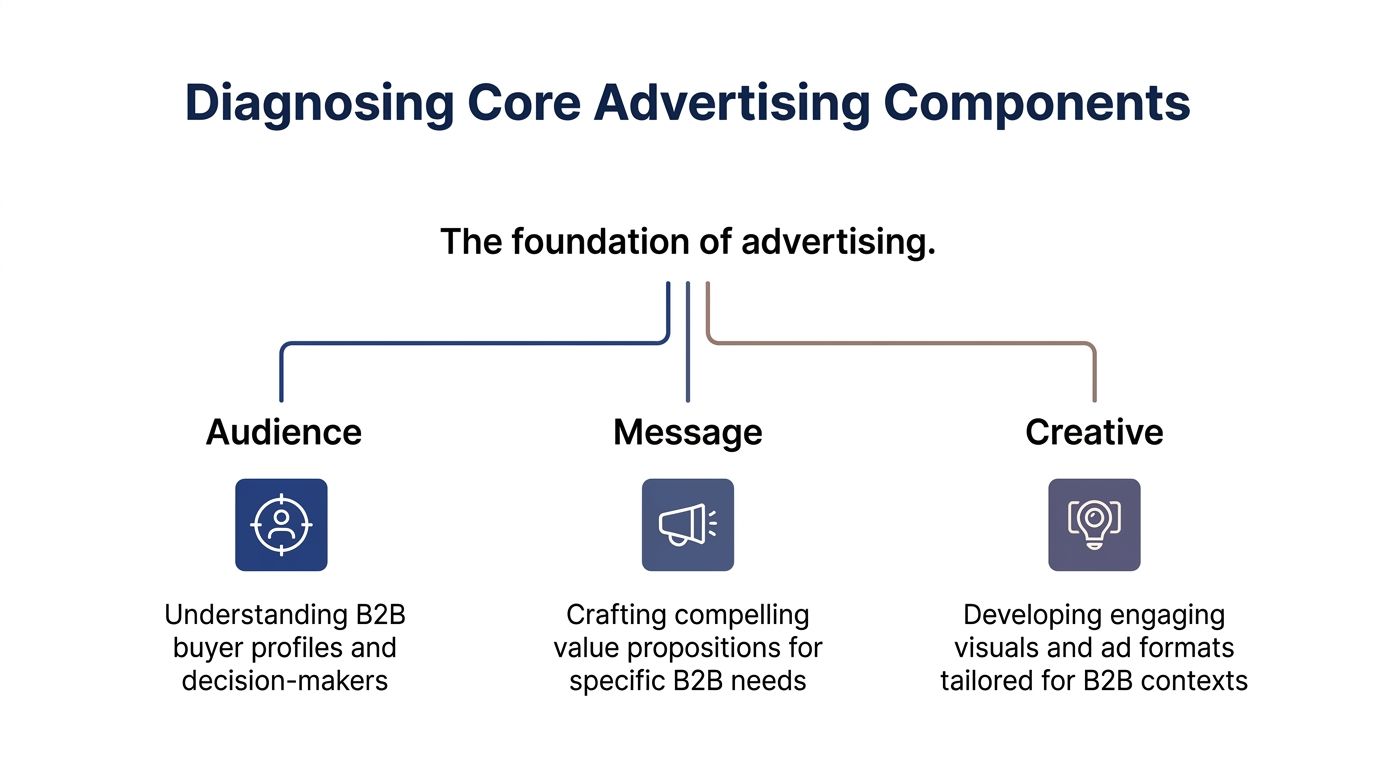
A weak campaign usually fails before the media budget ever gets spent. It fails in the first three components. The target is too broad, the value proposition is too soft, or the creative looks polished but says nothing useful to a technical buyer.
Start with the actual buying group
In manufacturing, “our audience” is almost never one person. It's usually a chain of reviewers with different concerns.
An engineer may care about tolerances, material compatibility, throughput, or integration with an existing process. Procurement may care about lead times, supplier reliability, and pricing structure. An owner or operations leader may care about downtime risk, margin protection, and ROI. If one ad tries to speak equally to all of them, it usually ends up sounding generic to each of them.
A better approach is to define the buying group by job-to-be-done.
- Engineer audience: Wants technical proof, process clarity, and confidence that your team understands constraints.
- Operations audience: Wants fewer delays, fewer quality issues, and a smoother handoff to production.
- Executive audience: Wants a supplier or partner that reduces uncertainty and supports growth.
If your team needs a structured way to sharpen that language, a good next step is a marketing messaging framework for industrial companies.
Message has to match technical scrutiny
Industrial buyers don't respond well to inflated language. “Cutting-edge solutions” and “best-in-class service” don't survive contact with a serious buyer. Your message has to translate capability into business value without skipping the proof layer.
That means your message should answer questions like these:
- What problem do you remove?
- What evidence supports the claim?
- Why should this buyer trust you with a critical process?
Nielsen's research found that creative drove 65% of a brand's sales lift in 2006, then declined to around 50 to 60% by 2017, while media rose from 15% to 36% according to Nielsen's advertising effectiveness analysis. For B2B manufacturers, that doesn't mean creative stopped mattering. It means creative still carries enormous weight, but it has to work alongside sharper delivery and targeting.
Creative is proof not decoration
In industrial advertising, creative is often misunderstood. Teams assume it means visual polish. Buyers usually care more about clarity than polish.
A strong industrial creative package often includes:
- Process visibility: Photos or video of machinery, inspection steps, shop conditions, or workflow.
- Specific outputs: The part, assembly, service result, or reporting format the buyer will receive.
- Decision support: Diagrams, spec callouts, capability snapshots, or short proof-focused copy.
Buyers don't need your ad to look expensive. They need it to reduce doubt.
What doesn't work well? Stock imagery, vague plant photos with no context, headlines that could belong to any supplier, and creative that makes a technical service sound like a lifestyle brand.
The best creative in B2B manufacturing doesn't entertain first. It clarifies first.
Connecting the System Channel Offer and CTA
Once the core components are stable, the next issue is delivery. Good advertising systems don't just say the right thing. They put the right next step in front of the right buyer in the right place.

Choose channels by buyer behavior
Manufacturers waste money when they choose channels based on popularity instead of intent. You don't need to be everywhere. You need to be visible where the buying motion begins or where evaluation happens.
For many industrial companies, that means some combination of Google Search, LinkedIn, remarketing, email nurture, and organic search support. For local or regional services, it can also include branded search and local discovery layers. If you're building that mix across touchpoints, this overview of multi-channel marketing for manufacturers is a useful reference.
The channel decision matters more now because media's contribution to sales lift rose from 15% to 36% between 2006 and 2017, as summarized in this discussion of media's growing role in advertising effectiveness. In plain terms, better delivery now has a much bigger effect on results than many industrial firms assume.
Offers should reduce buying friction
In B2B, the offer is usually not a discount. It's an exchange. You give the prospect something useful enough to justify a response.
Good offers for industrial campaigns often include:
- Technical resources: CAD files, spec sheets, capability guides, or process comparison documents.
- Evaluation tools: Application reviews, line audits, quoting consultations, or fit assessments.
- Commercial resources: ROI models, implementation checklists, or vendor transition plans.
The offer should match the buyer's stage. A cold prospect may download a whitepaper. A warmer prospect may request a quoting review. A high-intent prospect may want a direct consultation.
CTAs need to fit the stage of the sale
The CTA is where many campaigns become clumsy. Teams ask for too much too early. They push “Book a Demo” or “Request a Quote” on traffic that hasn't even seen enough proof to trust the company yet.
A better CTA sequence looks more like this:
| Buyer stage | Better CTA | Why it works |
|---|---|---|
| Early research | Download technical guide | Low-friction next step |
| Active comparison | Review capabilities | Helps the buyer evaluate fit |
| Late-stage intent | Request quote or consultation | Matches urgency and commercial readiness |
A CTA should feel like the next logical action, not a sales ambush.
What works is continuity. The channel introduces the problem. The offer helps the buyer evaluate. The CTA moves them one stage forward. When those three elements lock together, lead quality usually improves because the prospect self-qualifies before sales gets involved.
Fueling the Machine Budget Timing and Frequency
Budget, timing, and frequency look tactical on the surface. They aren't. They define how the machine runs under load.
Budget follows deal mechanics
The wrong way to budget is to ask, “What can we afford to spend this month?” The better question is, “What buying cycle are we funding, and what evidence will tell us the system is working?”
If your sales cycle is long, your budget has to support more than the initial click. It has to cover repeated exposure, retargeting, landing page testing, and follow-up paths inside email or CRM automation. A low budget can still work, but only if the scope is tight. Narrow geography, narrow service line, narrow audience.
We usually recommend treating budget allocation like shop capacity. Don't overload every line at once. Start with one product family, one vertical, or one buyer segment and get signal before expanding.
Timing should mirror the buying cycle
Industrial buying doesn't happen on consumer timelines. Some buyers need a solution now because a supplier failed or a line has a problem. Others spend months researching before they ever fill out a form.
That changes the timing model. Search campaigns can capture active demand. LinkedIn and display often support longer consideration. Email nurture keeps your message present while the prospect gets internal approval.
A simple timing map looks like this:
- Immediate demand capture: Branded search, service-specific search, urgent pain-point keywords.
- Mid-cycle education: Whitepapers, comparison pages, process videos, case-use content.
- Late-stage reinforcement: Quote follow-up ads, email reminders, sales enablement content.
Here's a useful walkthrough on the mechanics behind pacing and setup:
Frequency can help until it starts hurting
Frequency is one of the most overlooked elements of advertising. Teams either underdeliver and disappear, or they hammer the same audience until the ad becomes wallpaper.
The operational signal matters here. In B2B industrial campaigns, a CTR of 2 to 5% on LinkedIn can be a strong benchmark, while rising impressions with flat engagement often signals creative fatigue after 5 to 7 exposures per user weekly based on Improvado's advertising analytics benchmarks. The same source notes that campaigns with uncapped frequency can see engagement drop 25 to 40% after 10 exposures.
That means frequency isn't just media math. It's a maintenance issue.
- If response drops while impressions rise: Refresh the creative first.
- If the audience is tiny: Tighten frequency caps and rotate variants.
- If the offer is complex: Use sequencing instead of repetition. Show different proof points over time.
More exposure is not always more persuasion. In industrial marketing, repetition without new information usually creates fatigue, not trust.
The Control Panel Integrating Measurement and Your CRM
If there's one component we'd call essential, it's measurement tied to CRM. Without it, every other element of advertising is partially blind.
Clicks are not business outcomes
Most reporting failures happen because teams stop at platform metrics. Impressions. Clicks. Form fills. Those are useful diagnostics, but they are not proof of business value.
The question that matters is simple. Did this campaign create qualified opportunities and closed revenue?
That only becomes answerable when ad data, landing pages, forms, CRM stages, and sales outcomes are connected. If your advertising system ends at “lead submitted,” then the system is incomplete.
This is why CRM integration matters so much in industrial lead generation. The handoff from ad to automation to sales has to be visible. If a buyer downloaded a guide, requested a quote two weeks later, and became a qualified opportunity after a sales call, your system should show that chain.
A practical primer on that connection is CRM and digital marketing integration for B2B companies.
What the control panel should track
Your dashboard should mirror your sales process, not just your ad platform.
A strong control panel usually includes:
- Lead source clarity: Which campaign, ad group, or channel created the inquiry
- Lifecycle visibility: Inquiry, MQL, SQL, opportunity, closed-won or closed-lost
- Sales quality signals: Notes, disposition reasons, common objections, speed to contact
- Revenue attribution: Which campaigns influence actual pipeline, not just top-of-funnel volume
According to MarketingProfs on foundational marketing analytics success, aligning advertising analytics with business processes can drive up to 4x ROI uplift in B2B manufacturing campaigns. The same source notes that 88% of analytics tools fail to deliver insights when the process layer is missing, and successful implementations can produce 15 to 20% quarterly pipeline growth when executive sponsorship and conversion-stage alignment are in place.
How the feedback loop improves campaigns
Once the CRM is connected, the advertising machine gets smarter.
Field note: The ad with the highest click volume often isn't the ad creating the best opportunities. Sales-stage data exposes that quickly.
Here, tools like HubSpot, GoHighLevel, and reporting connectors become useful. Machine Marketing also works in this layer by connecting campaigns, CRM stages, and automation workflows so industrial teams can see where leads stall and where they convert. That's not a creative exercise. It's instrumentation.
When the loop is closed, you can answer the questions that actually matter:
- Which message creates SQLs, not just leads?
- Which channel shortens the path to a qualified conversation?
- Where are buyers dropping out between first touch and sales acceptance?
That's the difference between reporting activity and diagnosing a system.
Your B2B Advertising Execution Checklist
Execution is where many solid strategies break down. The campaign looks fine in a planning meeting, then launches with a weak offer, a generic landing page, no CRM tagging, and no agreed definition of a qualified lead.
Use this as a pre-flight check before launch.
B2B Campaign Pre-Launch Checklist
| Element | Check Point | Status (Pass/Fail) |
|---|---|---|
| Audience | Buyer roles are defined separately for engineering, operations, procurement, and executive stakeholders | |
| Audience | Geographic, industry, and service-line scope is narrow enough to produce clear signal | |
| Message | Primary value proposition states the business problem solved, not just capabilities listed | |
| Message | Proof points are present and relevant to the buyer's evaluation criteria | |
| Creative | Visuals show process, product, or outcome clearly and avoid generic stock imagery | |
| Creative | At least one alternate variation is ready for testing if response weakens | |
| Channel | Platform choice matches buyer intent and stage in the sales cycle | |
| Offer | Offer gives the prospect a useful next step such as a guide, audit, or consultation | |
| CTA | CTA matches buyer readiness and does not ask for too much too early | |
| Budget | Spend level is realistic for the audience size and campaign objective | |
| Timing | Campaign schedule aligns with sales coverage, follow-up capacity, and buying cycle length | |
| Frequency | Caps and rotation plan are set to avoid oversaturation | |
| Measurement | UTM naming, form tracking, and source attribution are in place | |
| CRM | Fields, tags, pipeline stages, and sales notifications are tested before launch | |
| Sales handoff | Team knows who follows up, how fast, and what qualifies a lead |
What to watch after launch
The first job after launch is not to panic. It's to read the right signals.
A useful pattern to watch is the relationship between CTR and engagement. In industrial campaigns, CTR and engagement rate are critical diagnostics, and 2 to 5% CTR on LinkedIn B2B industrial ads is a strong benchmark according to Improvado's benchmark discussion. If impressions rise but engagement stays flat, that often points to fatigue, weak offer fit, or an audience that's too broad. The same source warns that fatigue often shows up after 5 to 7 exposures per user weekly.
Use this quick diagnostic sequence:
- High impressions, weak CTR: Rework headline, visual proof, or targeting.
- Strong CTR, weak conversion: Fix the landing page, offer clarity, or form friction.
- Leads come in, SQLs don't: Audit qualification rules and CRM routing.
- Response fades over time: Rotate creative before frequency turns into waste.
The best checklist is the one your team actually uses before money leaves the account.
Build Your System Start Generating Leads
The nine elements of advertising matter because each one controls a different part of performance. But no single element fixes the whole machine. Strong creative won't rescue a weak offer. A smart channel plan won't compensate for broken CRM routing. More budget won't solve bad timing or audience fatigue.
The bigger issue for many manufacturers is alignment. A 2025 HubSpot report found that 68% of B2B manufacturers cite poor CRM-ad alignment as their top lead generation failure, with 23% potential revenue lost, and data from 50+ industrial clients showed campaigns integrated with GoHighLevel automation saw 3.4x higher conversion rates according to this write-up on advertising angles and CRM alignment. That's the cost of treating ads and backend systems as separate projects.
If you're reviewing your current setup, start with one campaign. Check the audience definition, the offer, the CTA, and the CRM path from first click to sales follow-up. Fix the handoffs before you add more spend.
If search is part of your mix, this outside guide to B2B Google Ads strategy is a useful complement to the system approach here because it helps you think through intent capture inside a larger lead generation process.
You don't need a more complicated advertising plan. You need a cleaner one. One where every component has a job, every handoff is tracked, and every campaign can be diagnosed like a production system.
If you want a second set of eyes on that system, Machine Marketing can diagnose the gaps between your ads, your CRM, and your sales process, then help you build a lead generation machine that's measurable, maintainable, and built for industrial growth.