If you're a manufacturer staring at a website, a CRM, a few sporadic LinkedIn posts, and a sales team asking for better leads, you're not dealing with a lack of effort. You're dealing with a disconnected system. That's why done for you marketing manufacturing works only when it's built as an operating system for lead quality, sales alignment, and revenue visibility, not as a bundle of random deliverables.
Many industrial companies already have pieces in place. They have HubSpot or GoHighLevel. They have someone writing blog posts. They run trade shows, send emails, and occasionally try paid ads. Yet the pipeline still feels inconsistent, and leadership still can't answer a basic question: which marketing activity is producing profitable business?
Table of Contents
- The Problem Your Manufacturing Business Is Facing
- What Is Done-For-You Marketing for Manufacturers
- The Components of a DFY Manufacturing Marketing System
- The Onboarding and Execution Workflow
- How to Evaluate a DFY Marketing Partner
- Key Metrics and Measuring True ROI
- Common Pitfalls and How to Avoid Them
- Your 90-Day Done-For-You Starter Plan
The Problem Your Manufacturing Business Is Facing
The usual pattern looks like this. You invested in a new site. You bought software. Someone on your team is posting content. Sales says the leads are weak. Marketing says they need more time. Leadership sees activity everywhere and accountability nowhere.
That isn't a people problem first. It's a design problem.

Manufacturing teams are spending more, but spending alone isn't fixing the issue. Manufacturing marketing budgets increased from 6.7% of revenue in 2024 to 9.5% in 2025, a 42% increase, while average website conversion remains 2.1% according to manufacturing marketing statistics. That gap is the clearest sign that disconnected tactics don't produce reliable growth.
Activity is not the same as a system
A manufacturer can have all of these at once and still underperform:
- A modern website: It looks fine, but it doesn't guide buyers to the next step.
- A CRM: Sales logs contacts, but source data is messy or missing.
- SEO efforts: Content gets published, but nobody ties it to qualified opportunities.
- Social posting: The company stays visible, but visibility doesn't equal pipeline.
Most companies don't need more motion. They need orchestration. Your website, CRM, content, email, paid traffic, and sales follow-up have to support the same commercial goal.
When marketing and sales use different definitions of a qualified lead, the whole system starts producing noise.
The root cause is usually hidden in plain sight
In practice, the actual problem is usually one of these three:
- No shared lead definition. Marketing celebrates form fills. Sales rejects them.
- No funnel design. Traffic arrives, but there's no structured path from interest to conversation.
- No revenue feedback loop. Campaigns launch, but nobody traces outcomes back to closed business.
That's where a done-for-you system becomes useful. Not because outsourcing is magical, but because an outside partner can diagnose the whole machine and rebuild the weak links. If you want a broader look at that foundation, this guide to digital marketing for manufacturers is a useful companion.
What Is Done-For-You Marketing for Manufacturers
Hearing “done for you” often leads to thoughts of outsourced tasks. A few blog posts. Some ad management. Maybe email campaigns. In manufacturing, that interpretation is too shallow to be useful.
Done for you marketing manufacturing should mean a partner designs, builds, runs, and improves the full marketing system around your sales process. That includes strategy, messaging, technology, execution, reporting, and lead handling rules.
What it is and what it isn't
A real DFY model is not the same as hiring a freelancer to write content. It's not the same as adding one in-house coordinator and hoping they can manage strategy, content, automation, reporting, and sales alignment. It's also not the same as handing work to three separate vendors who never talk to each other.
Here's the practical distinction:
- DIY marketing: Low direct cost, high management burden, slow learning curve.
- One in-house hire: Better internal context, but limited range unless you hire a full team.
- Freelancer stack: Flexible, but often fragmented and hard to manage.
- DFY system partner: Higher coordination from the outside, but stronger integration if the partner is disciplined.
The trade-off most owners miss
The trade-off isn't cost versus convenience. It's control versus cohesion.
If you build internally, you keep more day-to-day control. But you also inherit the burden of process design, vendor management, tool integration, reporting architecture, and content governance. Many manufacturers don't have time for that. They need the system to run without adding another layer of internal chaos.
A good DFY partner also adapts to how buyers search now. That includes technical search, long-form educational content, and increasingly direct-answer visibility. For teams updating their search strategy, these Answer Engine Optimization tactics are worth reviewing because they affect how engineers and buyers discover expertise before they ever submit an RFQ.
Practical rule: If a provider can't explain how strategy connects to CRM stages, sales follow-up, and reporting, they're selling activity, not a system.
What you should expect from the engagement
You should expect a DFY partner to own more than production. They should help define:
- Your ideal lead profile
- Your profitable lead criteria
- The offers and content that attract the right buyers
- The workflow that turns inquiry into opportunity
- The reporting cadence that ties effort to revenue
That's the difference between “marketing getting done” and a growth system operating.
The Components of a DFY Manufacturing Marketing System
A solid DFY program isn't a menu of disconnected services. It's a working machine with clear inputs, logic, handoffs, and outputs. If one part fails, the rest underperform.
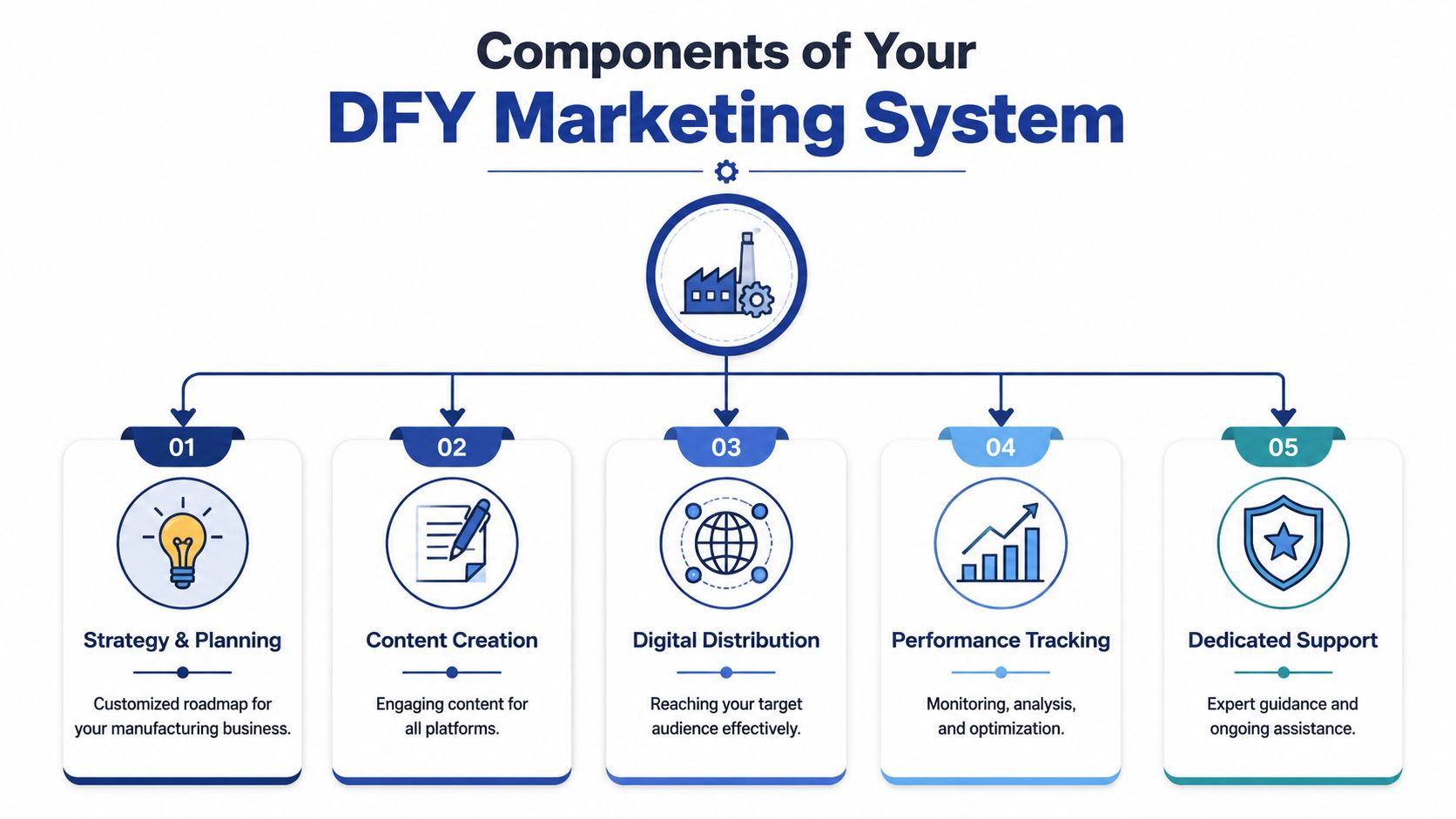
The system needs a control center
The first component is the operational core. That's usually a CRM and automation layer such as HubSpot or GoHighLevel. Within this layer, forms route, lead sources get tagged, follow-ups trigger, and pipeline stages get tracked. Without this layer, marketing can generate interest but can't manage it cleanly.
Your provider should configure:
- Lifecycle stages: Inquiry, marketing-qualified, sales-qualified, opportunity, customer.
- Routing logic: Which leads go to inside sales, outside reps, distributors, or nurture.
- Automation: Follow-up emails, reminders, task creation, and reactivation sequences.
- Data hygiene rules: Source tracking, duplicate control, and required fields.
A lot of manufacturers also try to patch capacity gaps with support staff before they fix process design. Sometimes that's smart, sometimes it just hides the underlying issue. If you're comparing staffing support against system support, this guide on finding a remote marketing assistant helps clarify what an assistant can own versus what still requires strategic architecture.
Traffic, conversion, and nurture have to work together
The public-facing layer comes next. That includes the website, SEO structure, conversion paths, and content library. The point isn't to publish more pages. The point is to publish the right assets for the right buyer at the right stage.
A complete system usually includes:
- Website conversion paths: Capability pages, quote forms, technical resource pages, and proof points.
- Search visibility: Organic content built around industrial problems, buyer questions, and technical intent.
- Educational assets: Blogs, case studies, application pages, comparison content, webinar promotion.
- Lead nurturing: Email sequences and segmented campaigns that keep prospects moving.
- Selective paid promotion: Search or paid social used to capture or shape demand where it makes commercial sense.
For manufacturers with long buying cycles, this matters even more. Manufacturing sales cycles average 6 to 18 months, and advanced DFY services use predictive analytics to identify high-probability leads early, helping data-driven firms achieve up to 32% more annual revenue according to manufacturing marketing strategy guidance.
That kind of system only works when the data loops back into operations. One option manufacturers use for that layer is marketing automation for manufacturing, especially when the current CRM exists but nobody has translated it into a usable sales and nurture process.
The question isn't whether you have enough channels. The question is whether your channels are feeding one another or competing with one another.
The Onboarding and Execution Workflow
The quality of a DFY engagement shows up fast in onboarding. If the first month feels like a scramble for passwords and vague brainstorming, the rest of the engagement usually follows the same pattern. A disciplined partner runs onboarding like a plant startup, with diagnosis first, build second, and optimization after data starts coming in.

Phase one is diagnosis
The first phase should focus on understanding the business before producing assets. That means interviews with leadership, sales, and anyone who knows what a good customer looks like. It also means reviewing the current website, CRM, analytics, email setup, forms, content library, and follow-up process.
Expect questions like:
- Which jobs are most profitable
- Which industries fit your production strengths
- Which RFQs waste estimating time
- Where do deals stall
- What information buyers ask for before they convert
A good partner will also audit the handoff between marketing and sales. That's where many engagements break down. Leads come in, but response times are inconsistent, qualification criteria are soft, and nobody documents why opportunities advance or die.
Phase two is build and launch
Once the diagnosis is complete, the partner should move into build mode. This usually includes CRM cleanup, dashboard setup, form redesign, landing page improvements, content planning, and initial campaigns.
The sequence matters. Build the measurement layer before scaling promotion. Fix conversion paths before paying for traffic. Tighten messaging before launching nurture.
A practical build sequence often looks like this:
- Clarify positioning: What you make, who it's for, and why buyers should care.
- Define lead criteria: Separate desirable RFQs from expensive distractions.
- Repair the funnel: Forms, thank-you pages, routing, email response, and rep alerts.
- Launch core content: Capability pages, proof content, and key follow-up assets.
Phase three is execution and refinement
After launch, the work shifts from setup to operation. Content gets published, ads get reviewed, emails get tested, and sales feedback gets folded into the next cycle.
What matters here is cadence. The partner should run recurring reviews around pipeline health, lead quality, campaign efficiency, and follow-up compliance. Not every month will produce dramatic gains. That's normal. Manufacturing marketing improves through iterative correction.
If your provider never asks sales which leads turned into real opportunities, they're flying blind.
The best relationships feel collaborative without becoming burdensome. You shouldn't need to manage every task, but you should always understand what's being changed, why it's being changed, and how success will be judged.
How to Evaluate a DFY Marketing Partner
Most manufacturers buy marketing the same way they buy a brochure. They compare scope lists, ask about turnaround times, and look at polished presentations. That approach misses the one thing that matters most: can this partner build a system that produces profitable pipeline?
The easiest way to test that is to interview the partner like you'd interview a process engineer. Ask about methods, controls, failure points, and reporting discipline.
Vendor Evaluation Checklist
| Question to Ask Potential Partner | What a Good Answer Sounds Like | Red Flag |
|---|---|---|
| How do you define a qualified lead for a manufacturer like us? | They ask about margins, machine fit, sales cycle, geography, buyer role, and production constraints before answering. | They say they'll optimize for more leads and figure out quality later. |
| What happens before campaigns launch? | They describe diagnosis, CRM audit, messaging review, sales interviews, and conversion path fixes. | They jump straight to ads, SEO, or content output. |
| How do you connect marketing work to revenue? | They explain source tracking, CRM stages, pipeline reporting, and opportunity feedback from sales. | They focus on clicks, impressions, ranking screenshots, or traffic only. |
| How do you handle unqualified RFQs? | They discuss disqualification rules, retargeting, form changes, audience refinement, and nurture segmentation. | They treat all inquiries as wins. |
| What role does our sales team play? | They want regular feedback on lead quality, close reasons, and handoff speed. | They say they can run everything without sales involvement. |
| What do you need from us internally? | They name a decision-maker, access to systems, subject-matter input, and timely review cycles. | They promise to do everything with almost no client input. |
| How do you change strategy when the market shifts? | They describe review cadence, testing, content updates, and budget reallocation based on results. | They sell a fixed package with little adjustment. |
| Who owns the systems and data? | They confirm your company owns accounts, CRM data, content assets, and reporting access. | They keep control inside proprietary accounts you can't easily access. |
What strong partners do differently
Good partners sound operational. They talk about workflow, attribution, routing, and handoffs. They're comfortable saying that some channels aren't a fit yet.
Weak partners sound theatrical. They lead with creativity, speed, and lead volume, but get vague when you ask how they'll filter poor-fit demand or how they'll report on pipeline contribution.
Use this short filter during calls:
- Ask for process, not promises
- Ask how they define failure
- Ask what they need fixed before scaling
- Ask how they'll challenge your assumptions
The right DFY partner won't just say yes. They'll point out where your current commercial system is leaking value.
Key Metrics and Measuring True ROI
Manufacturing leaders don't need prettier dashboards. They need evidence that marketing is contributing to revenue. That means reports have to move beyond traffic charts and engagement summaries.

The five metrics leadership should see
The strongest manufacturing programs are focusing on a tighter measurement set. As of 2026, the most effective manufacturing marketers are tracking five critical metrics: pipeline contribution by source, lead-to-opportunity conversion, buying group engagement, long-cycle revenue attribution, and marketing-sourced revenue. The same source notes that 73% of B2B marketers identify webinars and other high-value content as the best source for high-quality leads in this manufacturing marketing metrics article.
Those five metrics matter because they force marketing to answer business questions, not channel questions.
Here's what each one tells you:
- Pipeline contribution by source: Which channels are creating real opportunities, not just names in a database.
- Lead-to-opportunity conversion: Whether lead quality is improving or sales is wasting time.
- Buying group engagement: Whether multiple stakeholders are interacting, which matters in industrial deals.
- Long-cycle revenue attribution: Which efforts influence deals that close much later.
- Marketing-sourced revenue: How much business began through marketing-owned channels.
A campaign can look busy for months and still fail commercially if it doesn't create opportunities that sales can close.
What a useful report actually shows
A useful monthly report usually answers four questions:
- Where did qualified demand come from
- What turned into opportunities
- What stalled and why
- What is changing next month because of the data
For teams trying to build better reporting discipline, this resource on how to measure marketing ROI is a practical starting point.
The reporting conversation should also include sales behavior. If high-intent leads are sitting untouched, that's not a marketing failure alone. If a content campaign brings in engineering managers but nobody on the commercial side follows up with technical relevance, performance will look worse than it should.
This short walkthrough is useful if your team needs a visual explanation of attribution and performance review in practice.
What to stop rewarding
If you want better ROI, stop rewarding metrics that don't survive contact with sales. That includes reports built around vanity indicators alone.
Watch for these signs:
- Traffic without intent: Visitors arrive, but the sales team never sees meaningful opportunities.
- Form fills without fit: Marketing celebrates volume while quoting resources get drained.
- Content without progression: Downloads happen, but no next step is built into the journey.
Real ROI in manufacturing is rarely immediate. But it should be traceable.
Common Pitfalls and How to Avoid Them
The biggest failure in done for you marketing manufacturing isn't poor execution. It's solving for the wrong outcome. Many providers still optimize for lead volume because volume is easy to show, easy to sell, and easy to report.
That's also how manufacturers end up buried in RFQs they should never have received.
The lead volume trap
The hard truth is simple. Most manufacturers don't need more RFQs. They need better ones. And the primary failure of many DFY services is focusing on lead volume while ignoring that up to 73% of those leads can be unprofitable, actively harming the business by wasting sales and quoting resources according to this guide to marketing for manufacturing companies.
That failure shows up in familiar ways:
- The wrong equipment fit: Buyers ask for work your shop shouldn't take.
- The wrong margin profile: The deal is technically possible but commercially poor.
- The wrong geography or volume: Sales spends time on accounts that don't support growth.
- The wrong urgency level: Leads request quotes with no realistic buying intent.
How to prevent waste before campaigns launch
Strategy earns its keep. Before launch, define what a profitable lead is. Not vaguely. Operationally.
Create a lead filter with sales and operations that covers:
- Target job types
- Preferred industries
- Minimum commercial fit
- Capacity alignment
- Disqualifiers that should route out or into nurture
Then build those filters into the program itself.
A few examples:
- Forms: Ask better qualifying questions instead of accepting every inquiry equally.
- Ad targeting: Exclude low-fit audiences instead of broadening reach.
- Content offers: Publish resources for the buyers you want, not everyone with casual interest.
- Follow-up logic: Route weak-fit leads to nurture instead of immediate sales action.
The cheapest bad lead is still expensive once your estimators, sales reps, and engineers spend time on it.
Another common pitfall is over-automation. Automation helps with speed and consistency, but it can't replace judgment. If a system sends the same follow-up to every contact regardless of role, application, or buying stage, it creates friction instead of momentum.
The fix is simple in principle and hard in execution. Build the system around lead profitability, not just lead generation.
Your 90-Day Done-For-You Starter Plan
You don't need to rebuild everything at once. You do need to stop treating marketing as a pile of isolated tasks. A strong first quarter should produce clarity, cleaner operations, and a short list of actions you can measure.
Days 1 through 30
Start with diagnosis and control.
- Audit the funnel: Review website paths, forms, CRM stages, lead routing, and current reporting.
- Define profitable leads: Get sales, operations, and leadership aligned on fit criteria.
- Map your offers: Identify which pages, assets, and calls to action match real buyer intent.
- Clean the data: Fix source tracking, duplicates, missing fields, and lifecycle stage confusion.
This phase often reveals that the issue isn't lack of demand. It's poor capture, weak qualification, or sloppy follow-up.
Days 31 through 60
Build the core system.
At this stage, tighten the website's conversion paths, implement automation, and launch the first round of focused content. Prioritize capability pages, proof content, and follow-up sequences connected to specific buyer interests.
A practical mid-phase checklist looks like this:
- CRM and automation setup
- Revised quote or contact forms
- Email nurture for early-stage inquiries
- Sales alerts and task creation
- A content plan tied to target industries and services
If you need outside execution, a partner becomes useful. Machine Marketing provides strategy, CRM setup, content, SEO, and campaign implementation for manufacturers that already have tools and internal effort in place but need the system connected.
Days 61 through 90
Operate, review, and refine.
Don't judge the program by raw activity. Judge it by whether the right prospects are entering the system and moving through it more cleanly than before.
Use the first review cycle to answer:
- Which channels are producing qualified conversations
- Which content is attracting the right audience
- Where are leads stalling
- What should be tightened, paused, or expanded
Keep the review grounded in commercial reality. Ask sales which inquiries were strong. Ask estimating which requests wasted time. Ask leadership whether the reporting now answers better business questions than it did three months ago.
A good 90-day start won't solve every downstream issue. It will give you something better. A working system, cleaner signals, and a path to improvement based on evidence instead of guesswork.
If your team has marketing tools, some internal activity, and uneven results, Machine Marketing can help diagnose the gaps and build a connected system around lead quality, automation, content, and revenue measurement. The first step is a clear diagnosis of what's working, what isn't, and where your current marketing process is leaking value.