If your website looks polished but your inbox stays quiet, you probably don't have a traffic problem. You have a systems problem.
Most manufacturers still treat the website like a brochure. Buyers don't. They use it to screen suppliers, compare capabilities, judge credibility, and decide whether your team is worth contacting. A manufacturing website that generates leads has to do more than describe what you make. It has to guide the right visitor into a measurable next step, then hand that lead to sales without friction.
That's where most industrial websites fail. The design might be fine. The logo might be fine. The copy may even be technically correct. But if the site isn't connected to SEO, conversion architecture, CRM routing, and follow-up automation, it can't function as a real lead generation asset.
Table of Contents
- Why Your Manufacturing Website Isn't Generating Leads
- The Foundation – Audience, Messaging, and Architecture
- Engineering the Conversion Funnel
- Fueling the Engine with Targeted SEO and Content
- Connecting the System – CRM Integration and Automation
- Launch and Optimization – A 90-Day Action Plan
- Common Questions About Manufacturing Websites
Why Your Manufacturing Website Isn't Generating Leads
A website that “looks professional” isn't the same thing as a website that performs. Across industries, 90.7% of marketers rely on websites as their top lead generation tool, and for B2B companies, SEO-optimized websites convert at 2.6%, ahead of PPC at 1.5% and trade shows at 0.7%, according to lead generation statistics compiled here. If your site isn't producing inquiries, the issue usually isn't whether websites work. It's whether yours is built to work.
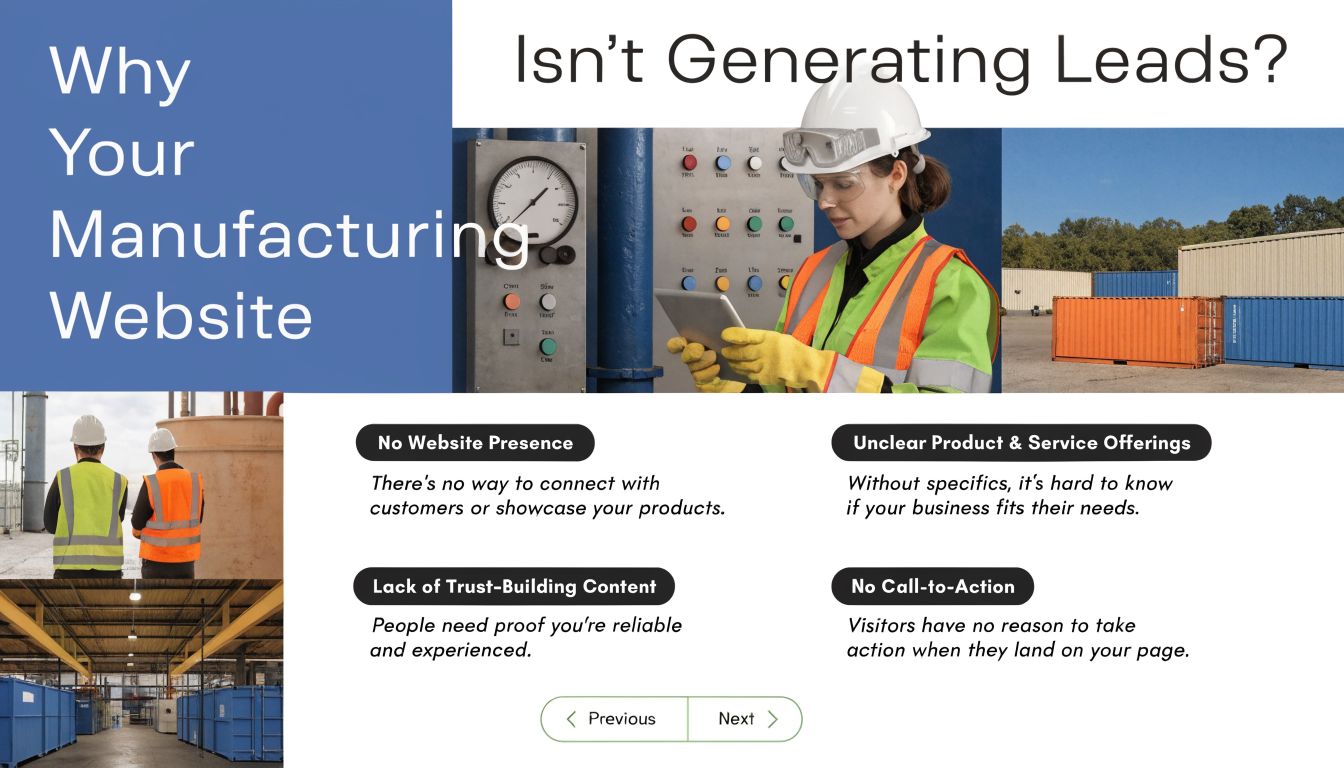
The brochure problem
Most underperforming industrial sites share the same pattern:
- They describe the company, not the buyer's problem. Visitors see equipment lists, certifications, and generic claims, but not a clear statement of what you solve.
- They hide the next step. A buyer lands on a service page and finds no meaningful call to action beyond a general contact page.
- They sit outside the sales process. Form fills go to a shared inbox, nobody owns follow-up, and marketing can't tell what happened after the inquiry.
That setup creates a false conclusion. Leadership says, “Our market must not buy online.” In practice, buyers are researching online, but your site isn't helping them move forward.
What buyers actually need
Engineers, procurement teams, and operations leaders don't need flashy animation. They need clarity and proof.
They want to know:
- Can you make the part or solve the problem?
- Have you done similar work before?
- What should they do next?
- Will someone respond quickly and intelligently?
A manufacturing website that generates leads acts like a pre-sales system. It qualifies interest, reduces uncertainty, and routes the right inquiry to the right person.
Treat the website the way you'd treat a production cell. Give it a job, define output, identify bottlenecks, and improve the process. Once you make that shift, redesign decisions become easier. You stop debating surface details and start asking operational questions: Which pages attract intent? Where do users stall? Which offers create qualified conversations? Which leads never make it into follow-up?
That's the difference between a website expense and a website asset.
The Foundation – Audience, Messaging, and Architecture
A strong site starts before design files, page templates, or platform decisions. It starts with requirements gathering. In manufacturing, that means understanding who is buying, what they need to verify, and what sequence of information helps them trust you.
Start with buying roles, not generic personas
“Target customer” is too broad to guide site architecture. Most manufacturing purchases involve multiple people, and each person looks for different proof.
Use role-based questions instead:
- Engineer or technical evaluator. What specs, tolerances, materials, process details, CAD support, or documentation do they need before reaching out?
- Procurement or sourcing. What lowers risk for them? Certifications, lead time communication, supplier reliability, quality systems, and RFQ clarity usually matter.
- Owner, plant leader, or executive. What business outcome matters most? Capacity, responsiveness, consistency, and fit for long-term supply often carry more weight than feature language.
If you need a reference point for structuring industrial pages around actual user paths, this guide on industrial website design is a useful companion.
Turn capabilities into trustable messaging
Many manufacturers bury their advantage under vague statements like “high-quality solutions” or “customer-focused service.” That language says nothing.
A better structure is simple:
| Element | What to say |
|---|---|
| Core problem | State the manufacturing problem you solve |
| Capability proof | Show the process, material, tolerance, or production strength |
| Fit | Clarify who you work best with |
| Next action | Give a clear path to RFQ, consultation, or resource download |
For example, instead of “We deliver precision machining services,” say what the buyer can verify. Focus on process capability, application fit, documentation, and response path.
Practical rule: If a buyer can't tell within a few seconds whether you're relevant to their application, the page is underperforming.
Build a site path that makes sense
Information architecture matters because buyers don't all enter through the homepage. Some arrive on a service page from search. Others land on a blog post, then need a fast route to commercial action.
A workable structure usually includes:
- Clear capability pages for each service or process.
- Application or industry pages that connect those capabilities to specific use cases.
- Proof pages with case studies, certifications, FAQs, and documentation.
- Conversion pages such as RFQ, consultation, or technical resource downloads.
Common failure points show up when companies collapse all of that into one “Capabilities” page and one generic contact form. That forces every buyer to do extra work.
A clean architecture reduces that work. It also helps your internal team. Sales gets better context. Marketing knows which content supports which stage. Leadership can see where the site is doing its job and where it isn't.
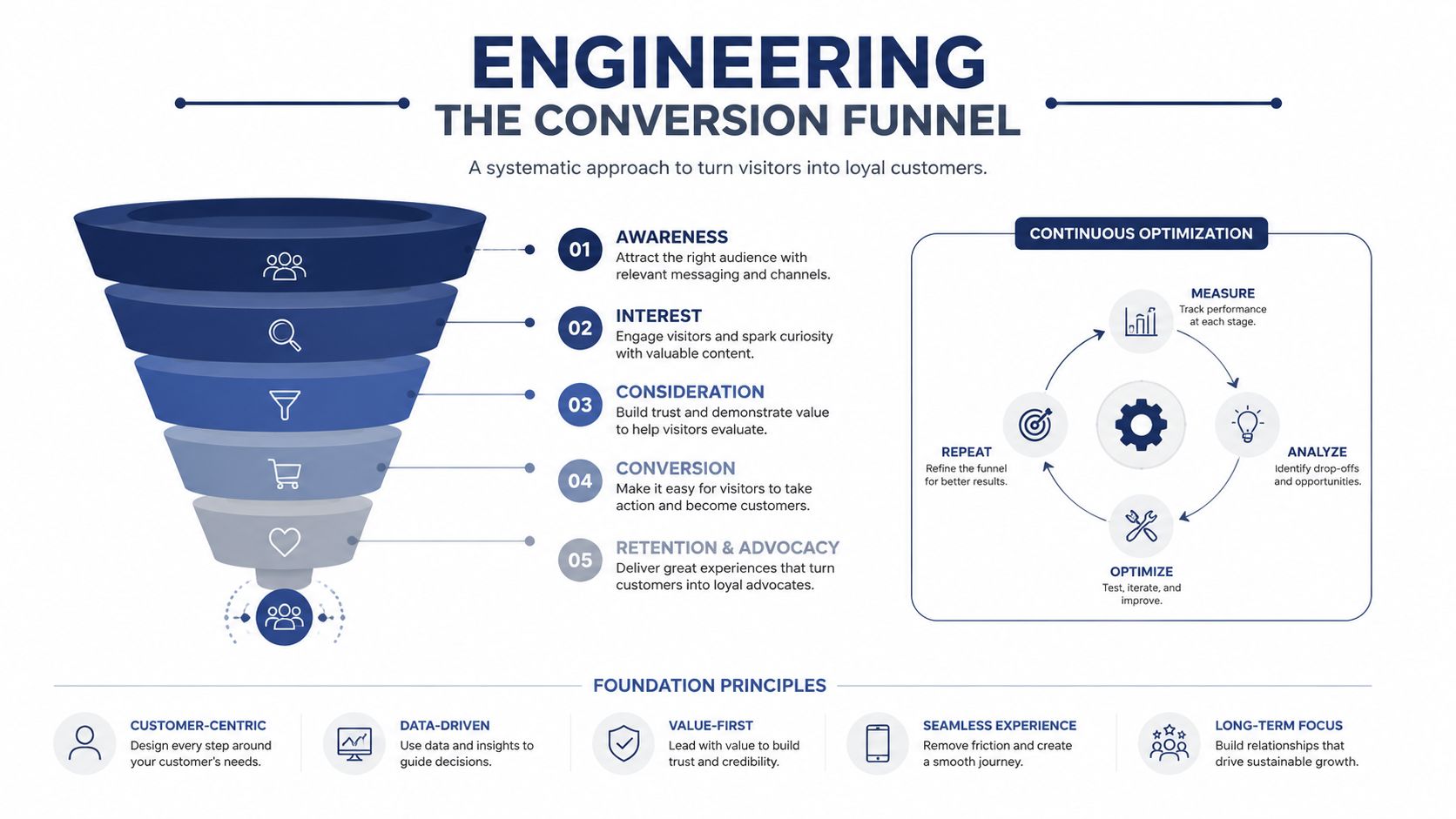
Engineering the Conversion Funnel
Traffic without conversion logic is wasted motion. Your pages need to move a visitor from interest to action in a way that feels natural, credible, and low friction.
One page, one next step
Each important page should have one primary action. Not five. Not “call, email, subscribe, follow us, request a quote, and read more.”
The action depends on page intent:
- A service page should drive RFQ or consultation.
- A technical article should drive a relevant download or deeper capability page.
- A case study should move a buyer toward a conversation once trust is established.
That focus matters because conversion elements do work when implemented correctly. This manufacturing conversion guide notes that visible, benefit-driven CTAs above the fold can increase form submissions by 15-25%, and limiting initial form fields to 3-4 can boost conversions by 20-30%. The same source says gated CAD file libraries can yield 3x higher lead quality.
Those details matter in industrial marketing because buyers respond to relevance and reduced friction, not clever wording alone.
Fix the forms before you buy more traffic
A lot of manufacturers try to solve a conversion problem by increasing traffic. That usually just sends more people into the same bottleneck.
Audit your forms with a hard eye:
- Ask only what you need first. Name, email, company, and one qualifying field is often enough to begin.
- Match the form to the offer. An RFQ form can ask more than a spec sheet download form.
- Make mobile completion easy. If the form is awkward on a phone, some buyers won't come back later.
- Set expectations. Tell the user what happens after submission.
If a prospect is ready to ask for help, don't make them complete your internal intake process before you've earned the conversation.
If you want another perspective on how design choices support lead capture, this website design lead generation guide offers a useful outside reference.
Use trust signals and gated assets together
Trust and conversion shouldn't live on separate pages. They should work together on the same path.
A practical page structure looks like this:
| Page element | Why it matters |
|---|---|
| Headline with application fit | Confirms relevance fast |
| Primary CTA | Gives the buyer a next step |
| Proof points | Reduces uncertainty |
| Technical content offer | Captures mid-funnel interest |
| Secondary CTA | Supports visitors not ready for RFQ |
Useful trust signals include certifications, process photos, real case examples, industries served, and documentation libraries. For many manufacturers, gated technical guides, CAD resources, and spec-driven downloads work better than generic “contact us” prompts because they align with how engineers research.
A conversion funnel isn't a marketing overlay. It's the page-level operating logic of a manufacturing website that generates leads.
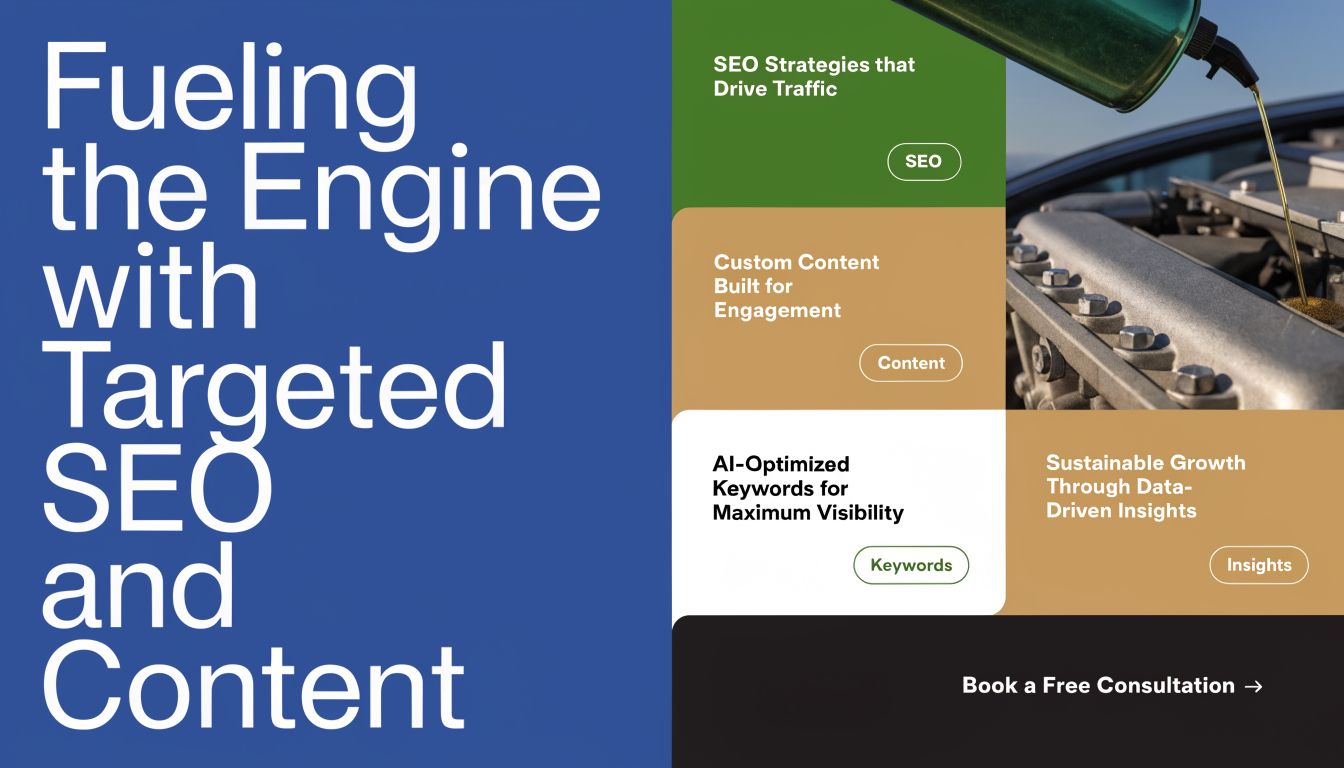
Fueling the Engine with Targeted SEO and Content
Once the conversion system is in place, you need qualified traffic. Not broad traffic. Not vanity rankings. Qualified traffic from people searching for the exact problems you solve.
A central insight from these manufacturing marketing stats is that 98% of industrial manufacturers generate leads digitally. The same source says 69% of manufacturers use organic search on their websites, and websites convert that traffic at an average rate of 2.2%. That's why search and content deserve operational attention, not occasional blog posts.
Target buyer intent, not vanity traffic
Industrial SEO often breaks because the keyword strategy is too broad. Ranking for a broad term may look good in a report, but it doesn't help if the visitors aren't potential buyers.
Start with terms tied to actual sourcing or engineering intent:
- Process-specific searches
- Material-specific searches
- Application-specific searches
- Tolerance or compliance questions
- Problem-solving searches tied to a manufacturing need
A manufacturer selling CNC services, for example, usually needs pages around capability and application combinations, not only a generic “machining services” page.
For a practical framework, see this resource on SEO for manufacturing companies.
Match content to the real buying journey
Good content strategy isn't “post twice a month.” It's building the right asset for the right stage.
Consider this perspective:
| Buying stage | Content that fits |
|---|---|
| Early research | Educational blog posts, process explainers, material comparisons |
| Mid evaluation | Capability pages, technical guides, application pages |
| Late validation | Case studies, certifications, documentation, RFQ pages |
Case studies and technical blog content tend to matter because industrial buyers need evidence, not brand storytelling. A post about material selection, process constraints, or tolerance considerations can bring in search traffic and qualify whether the visitor fits your work.
Content works when it answers a live buying question and connects to a next action. It fails when it exists only to “do SEO.”
Technical SEO still matters
Many manufacturers treat technical SEO like a separate discipline from lead generation. It isn't. If pages are difficult to crawl, slow to load, hard to use on mobile, or poorly structured, your content and offers won't do their job.
Focus on:
- Logical page hierarchy
- Clean internal linking
- Mobile-friendly layouts
- Fast-loading pages
- Metadata that reflects the search intent
- Schema markup where relevant
This isn't glamorous work, but it supports everything else. A manufacturing website that generates leads depends on visibility, usability, and relevance working together.
Connecting the System – CRM Integration and Automation
At this stage, most websites stop being useful. A lead submits a form, sales doesn't see it quickly, ownership is unclear, and follow-up depends on someone remembering to act. That isn't a growth system. It's a leak.
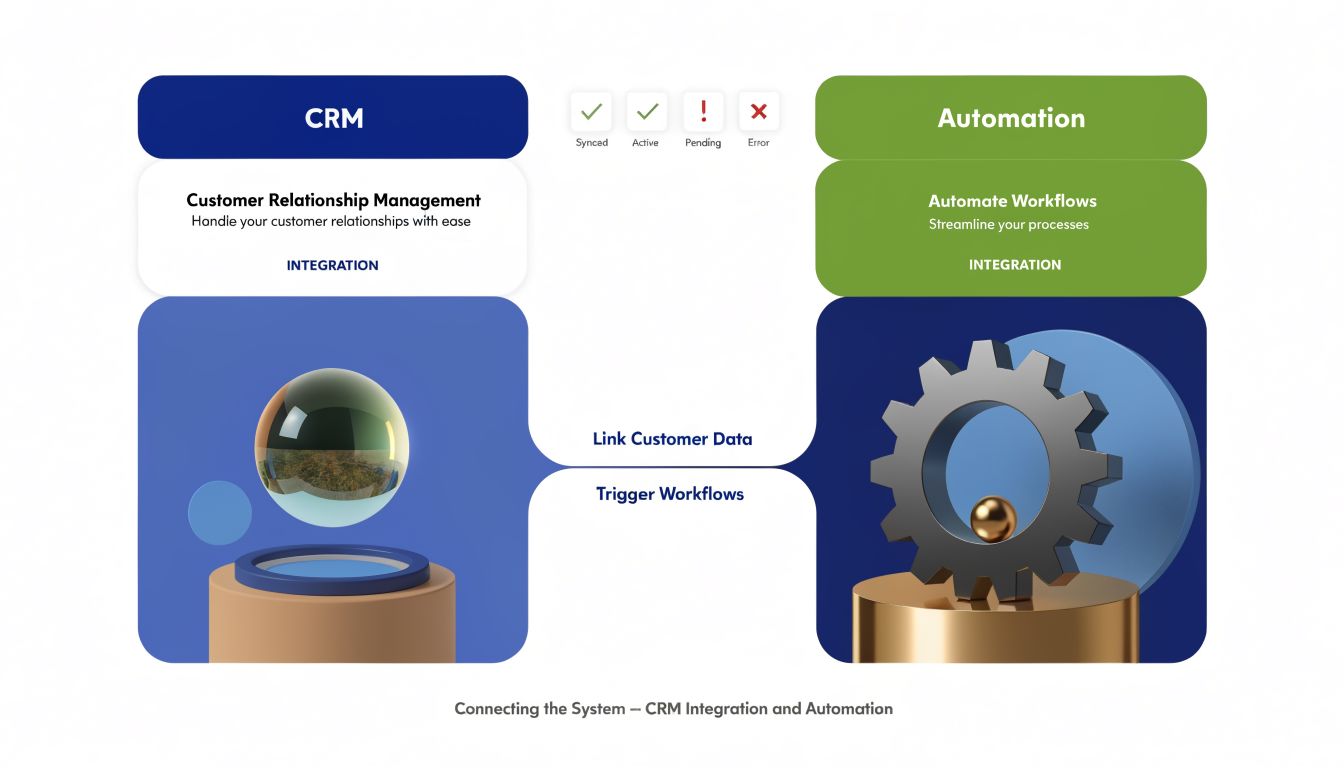
Why handoffs break
The gap between website and CRM is one of the biggest operational failures in industrial marketing. According to this analysis of manufacturing lead generation failures, 70-80% of website leads are lost due to poor handoffs between websites and CRMs. The same source notes that manufacturers who fix this with real-time lead routing and automation see 3x higher conversion rates, and that a 1-hour response window is critical.
That should change how you think about your website. If a form submission isn't routed, assigned, tracked, and followed up, the page didn't really convert. It only created a task someone may miss.
What the closed loop should look like
A proper closed-loop setup connects four things:
Capture
Forms, chat, call tracking, and content downloads feed into one record.Routing
The lead goes to the right salesperson or queue based on service, geography, or account rules.Nurture
If the lead isn't ready for sales, automated email or SMS follow-up keeps the conversation alive.Feedback
Sales outcomes flow back into reporting so you know which pages, campaigns, and offers created pipeline.
A CRM can be HubSpot, Salesforce, or GoHighLevel. The tool matters less than the process design. The system should answer basic operational questions quickly: Where did this lead come from? What did they view? Who owns follow-up? What happened next?
For manufacturers reviewing options, this overview of CRM for manufacturing companies can help frame the requirements.
Operational test: Submit a form on your own website and trace what happens in the next hour. If ownership, notification, and follow-up are unclear, the system isn't finished.
Where tools fit, and where they don't
Automation helps, but it won't rescue bad process design. Don't buy a platform before you define the workflow.
Use tools for jobs they're good at:
- CRM for record ownership, pipeline tracking, and attribution
- Marketing automation for nurture sequences and reminders
- Chat and qualification for handling simple inbound paths
- Reporting for identifying stuck stages and missed follow-up
If your team is exploring workflow orchestration and automation concepts more broadly, the Magic Genie workflow hub is one example of an external resource worth reviewing. Machine Marketing also works in this area for manufacturers that need website, CRM, and follow-up systems connected into one operating model.
The trade-off is straightforward. More automation creates more consistency, but only if your fields, ownership rules, and response standards are clear. Otherwise you just move confusion faster.
Launch and Optimization – A 90-Day Action Plan
A good plan needs deadlines, owners, and observable output. A website project drifts when it stays at the level of ideas. It moves when the work is broken into short operating cycles.
Days 1 through 30
Start with diagnosis and setup.
- Audit the current site. Review core pages, form paths, CTA placement, analytics, and mobile usability.
- Map the buyer journey. Identify the key pages and offers needed for technical evaluators, procurement, and leadership.
- Set up measurement. Make sure form submissions, calls, and key page actions are tracked.
- Review technical basics. This manufacturing lead generation resource notes that chatbots can boost lead volume by 20% and schema markup can improve click-through rates by up to 30%, so both belong in the setup conversation if they fit your sales process.
A chatbot isn't mandatory for every manufacturer. If your buying process is complex, a poorly configured chatbot can frustrate qualified buyers. The question is whether it helps triage and capture, not whether it looks modern.
Days 31 through 60
Build the core system.
| Priority | What to implement |
|---|---|
| Pages | Core capability pages, industry pages, RFQ path, trust content |
| Offers | Technical guides, spec-driven downloads, relevant gated assets |
| Conversion | Above-the-fold CTAs, shorter forms, cleaner page layouts |
| CRM | Lead routing, notifications, tags, pipeline stages, nurture workflows |
This phase usually exposes internal gaps. Sales may want different qualification fields. Operations may need RFQ routing rules. Leadership may realize the site lacks proof assets. That's normal. Better to expose those dependencies now than after launch.
Days 61 through 90
Launch, monitor, and tighten.
Focus your review around practical questions:
- Which pages create inquiries?
- Which offers attract the right type of lead?
- Where do users abandon forms?
- How fast does sales respond?
- Which leads stall after first contact?
Don't optimize the entire site at once. Improve the pages that already attract relevant traffic and support real commercial intent.
By the end of the first ninety days, you should have a functioning baseline. Not a perfect machine. A measurable one. That's enough to start improving with confidence.
Common Questions About Manufacturing Websites
Manufacturers usually don't struggle with whether they need a better website. They struggle with scope, ownership, and what “better” should mean.
The short answer is this: the website should match your sales model. If your team sells complex work with long cycles, the site needs qualification paths, technical proof, CRM visibility, and follow-up automation. If it only looks better than the old site, it's not enough.
A broader industry perspective like this piece from Come Together Media LLC can also be useful if you want to compare how other teams are approaching digital growth.
FAQ Quick Answers
| Question | Answer |
|---|---|
| How do we know if our current site is the problem? | Look at behavior, not opinion. If relevant pages get traffic but produce few inquiries, or form leads don't move into sales activity, the system likely has conversion or handoff issues. |
| Should we redesign everything at once? | Usually no. Start with the pages tied to revenue, then fix conversion paths and CRM routing before expanding. |
| Do we need gated content? | Often yes, especially for technical buyers who want documentation before talking to sales. The offer has to be relevant to the buying stage. |
| Is GoHighLevel a fit for manufacturers? | It can be, especially for firms that need structured follow-up and reactivation. The fit depends on your workflow complexity and internal ownership. |
| What should sales own in this process? | Response standards, qualification feedback, and pipeline status. Marketing can generate and route leads, but sales has to close the loop. |
| What if we don't have much content yet? | Start with what buyers ask most often. Build pages and resources from real sales conversations, RFQ questions, and recurring technical concerns. |
A manufacturing website that generates leads doesn't come from design alone. It comes from a connected system: clear messaging, logical page paths, credible content, focused conversion points, and CRM automation that prevents leads from disappearing after the form submission.
If you want help diagnosing where your current system is breaking, Machine Marketing works with manufacturers to connect website strategy, SEO, CRM setup, and automation into a more measurable lead generation process.