If you're running an Iowa manufacturing business, you probably know the pattern. A strong month brings RFQs, repeat orders, and urgent quoting. Then the pace drops, sales gets quiet, and everyone starts asking the same question: where did the pipeline go?
That cycle usually isn't a capability problem. It's a systems problem. Too many manufacturers still rely on referrals, existing relationships, and the occasional trade show bump. Those channels matter, but they don't give you control. When the market softens or buyer behavior shifts, "feast or famine" marketing leaves you reacting instead of planning.
A lot of generic advice doesn't help because it wasn't built for industrial companies in Iowa. Your buyers are technical. Your sales cycles are layered. Your market has local supplier dynamics, regional relationships, and niche national opportunities at the same time. If you want a more predictable lead flow, you need a repeatable marketing system, not a pile of disconnected tactics. If you want a broader framework for that system, Fypion Marketing's lead generation guide for manufacturing is a useful companion read.
Table of Contents
- Introduction The End of 'Feast or Famine' Marketing
- Diagnosis First Why Generic Marketing Fails Iowa Manufacturers
- Build Your Digital Foundation for Local and Niche Buyers
- Create Content That Closes Deals Not Just Clicks
- Activate Leads with Targeted Outreach and Paid Ads
- Install the 'Machine' A CRM System That Runs Itself
- Your 90-Day Starter Plan for Measurable Growth
Introduction The End of 'Feast or Famine' Marketing
A common Iowa manufacturing story goes like this. The company has solid equipment, a good reputation, and customers who stick around for years. But lead flow is uneven, sales activity depends on a few relationships, and marketing mostly means updating the website when someone has time.
That setup works until it doesn't. A customer pauses orders. A referral source retires. A competitor shows up with faster follow-up and clearer positioning. Suddenly the problem isn't awareness. It's that no one built a dependable way to attract, qualify, and convert demand.
Iowa manufacturing marketing has to do two jobs at once. It has to support near-term lead generation and long-term credibility. It also has to work in a market where buyers care less about clever branding and more about lead times, reliability, compliance, throughput, and whether you can solve a problem without creating a new one.
Practical rule: If your marketing only works when referrals are flowing, you don't have a marketing system. You have a temporary advantage.
What changes the situation is discipline. Not complexity. A stronger Google Business Profile, better capability pages, proof-based content, targeted outreach, and a CRM that follows up quickly will beat random posting and broad "brand awareness" campaigns almost every time in industrial markets.
Diagnosis First Why Generic Marketing Fails Iowa Manufacturers
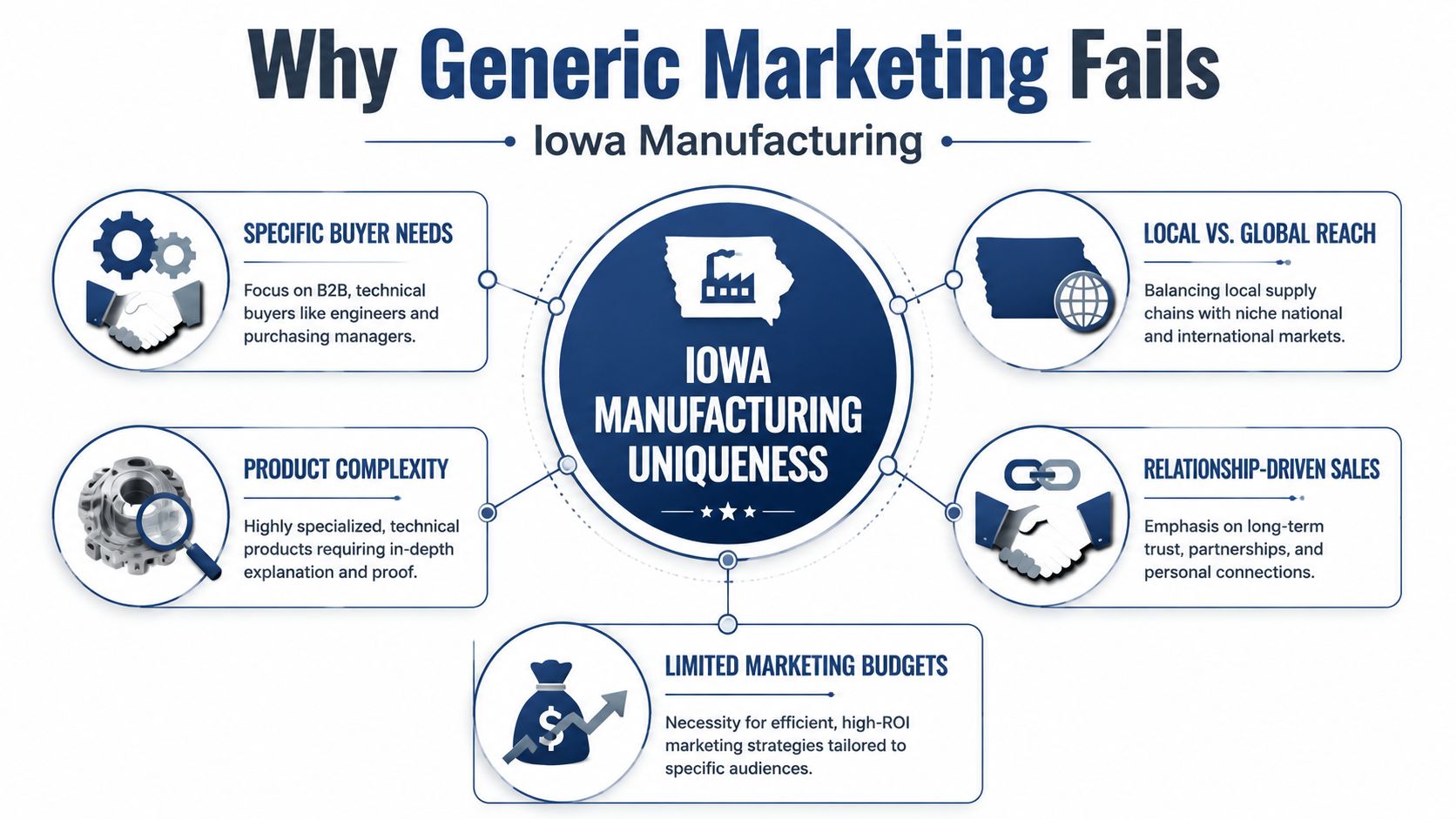
Most generic B2B marketing advice assumes a broad market, short attention spans, and buyers who convert after a few lightweight touches. That's not how many industrial purchases happen. In Iowa manufacturing, buyers often involve engineering, operations, purchasing, and leadership. They compare risk as much as price.
Iowa's industrial concentration is a big reason the messaging has to be sharper. A long-running manufacturing brief reported that manufacturing contributed $28.2 billion to Iowa's GDP in 2008, representing 20.8% of the state total, and Iowa ranked 2nd among U.S. states in share of GDP derived from manufacturing. The same brief noted that Machinery, Chemicals, and Food and Beverages accounted for 57% of Iowa's manufacturing GDP (Penn State Evidence-to-Impact Collaborative brief on Iowa manufacturing).
Why the Iowa context changes the message
That concentration matters because it tells you your audience isn't generic. If you sell into machinery, chemicals, or food processing, your prospects already think in terms of uptime, throughput, safety, quality control, and supply reliability. A homepage full of vague claims about innovation won't move them.
A better diagnostic lens looks like this:
- Buyer language: Are you using the terms your engineers, plant managers, and purchasing teams use?
- Proof depth: Does your site show tolerances, materials, processes, certifications, or application examples?
- Sales readiness: Can a high-intent buyer quickly figure out whether you're a fit?
- Risk reduction: Do you explain response times, production discipline, and what happens after first contact?
Generic marketing usually fails because it asks industrial buyers to trust the brand before the company has earned technical credibility.
What cautious buyers respond to
The other reason national advice falls flat is timing. Iowa manufacturers don't all market in boom conditions. In recent coverage, CIRAS reported Iowa manufacturing output has been relatively flat in recent years when adjusted for inflation, and Business Record noted that nearly 7,000 Iowa workers lost manufacturing jobs in the past 19 months amid closures and layoffs (Business Record coverage of Iowa manufacturing conditions).
When buyers are cautious, they don't want louder promotion. They want lower-risk choices.
A practical message stack in that environment looks different:
| Buyer concern | Weak message | Stronger message |
|---|---|---|
| Supplier risk | "We're a trusted partner" | Clear capabilities, process discipline, and response expectations |
| Margin pressure | "High-quality solutions" | Efficiency, reduced delays, and fit for specific production needs |
| Planning uncertainty | "We're ready to scale with you" | Flexible support, reliable communication, and niche expertise |
| Team scrutiny | "Contact us today" | Technical documents and proof assets buyers can share internally |
If your current marketing doesn't reflect those realities, the problem isn't traffic. The diagnosis is deeper. Your market position, message, and follow-up system aren't aligned with how Iowa industrial buyers decide.
Build Your Digital Foundation for Local and Niche Buyers
Your digital presence has to serve two very different search behaviors. One person is looking for a supplier nearby. Another is searching nationally for a very specific capability, material, or process. If your website treats those as the same intent, you blur both.
Treat search like two separate jobs
First, lock down your local visibility. Your Google Business Profile should have accurate categories, service descriptions, current photos, business hours, phone number consistency, and a short explanation of what you manufacture or machine. This is basic, but a surprising number of industrial firms leave it half-finished.
Then build your industry SEO around capability and application intent. That means pages for processes, materials, industries served, and high-value equipment or production methods. If you're not sure how to structure that research, outrank's guide to strategic keyword research is a practical reference for organizing search themes around real buyer intent.
For the local side, the operating standard is simple:
- Claim and complete your profile: Fill in every field that helps a buyer validate you quickly.
- Use industrial photos: Show equipment, facility areas, finished work, and team environments that support credibility.
- Match contact paths: Make sure your phone, website, and inquiry options route to the same follow-up process.
- Support it with on-site SEO: These local SEO best practices for manufacturers help tie your website and location signals together.
The pages your site actually needs
Many Iowa manufacturers have websites that look fine and still underperform. The issue is usually structure. Buyers land on the site and can't tell what the company does best, who it's for, or how to take the next step.
A stronger site architecture often includes:
- Capability pages for each major service or process.
- Industry pages for the verticals you serve.
- Application pages that show where your work fits in production.
- About and facility pages that build confidence without turning into company-history essays.
- Quote or contact paths that make it easy to submit the right information.
If a buyer has to call you just to figure out whether you're relevant, many won't call.
For Iowa manufacturing marketing, that dual foundation matters. Local buyers need confidence that you're close, reachable, and real. Niche buyers outside your region need confidence that you understand a specialized requirement and can deliver it without hand-holding.
Create Content That Closes Deals Not Just Clicks
Industrial content should help a buyer make a decision. Too much manufacturing content does something else. It fills a blog calendar, checks an SEO box, and generates traffic that never turns into useful conversations.

Stop publishing fluff
A purchasing manager is not looking for "five manufacturing trends to watch." An engineer isn't impressed by broad thought leadership with no technical substance. The content that helps close deals usually looks more like a sales tool than a blog post.
Useful formats include:
- Case-study pages: Show the problem, the process, and the measurable operational outcome if you have approved numbers. If you don't, stay qualitative and explain the challenge solved.
- Spec sheets and capability summaries: Make it easy for buyers to share your information internally.
- Process explainers: Clarify how a service works, where it fits, and when it's the wrong fit.
- Comparison content: Help buyers understand trade-offs between materials, methods, or sourcing options.
- Technical FAQs: Answer the questions sales hears repeatedly.
If you want a deeper framework for that kind of asset-based approach, this guide on content marketing for manufacturing companies is a practical starting point.
Content should reduce buying friction. If it only increases pageviews, it isn't doing enough.
The overlooked recruiting content play
There is also a major content gap around workforce messaging. Recent coverage noted that many manufacturers struggle to connect with Gen Z workers, who prioritize purpose and clear career paths, and that most messaging still fails to show what modern, tech-forward manufacturing work looks like and what skills and training are involved (coverage on Iowa manufacturers and Gen Z workforce messaging).
That matters because employer brand and customer brand are not separate in manufacturing. Buyers notice whether your company looks stable, modern, and well-run.
Instead of a generic hiring banner, build recruiting content around what candidates want to know:
- What the shop floor looks like now
- What equipment and technology they would work with
- How training happens
- What advancement paths exist
- Why the work matters
A good recruiting video, apprenticeship page, or day-in-the-life article can support hiring and strengthen market perception at the same time.
Activate Leads with Targeted Outreach and Paid Ads
Once the foundation is in place, the next job is activation. In this stage, many manufacturers either overspend on broad ads or do nothing at all because paid channels feel too noisy. Both are mistakes.
Use paid ads for intent not awareness
For Iowa manufacturing marketing, paid search works best when it captures existing demand. It is less useful when you ask it to create interest from scratch. If someone is actively searching for a capability, service, or production solution, paid search can put you in the conversation fast. If your offer is unclear or your landing page is weak, that traffic gets wasted.
LinkedIn serves a different role. It can help you put useful assets in front of target accounts, job titles, and decision-makers before a sales conversation starts. That usually works better with narrow audiences and specific offers than with broad company-brand campaigns.
A strong paid setup usually has these traits:
- Tight keyword or audience focus: Stay close to the problems you solve.
- A single next step: Download, quote request, consultation, or capability review. Not all four.
- Relevant landing pages: Send ad traffic to pages built for the exact offer.
- Tracked follow-up: Every lead source needs to flow into the same system.
Connect digital campaigns to offline selling
Manufacturers can gain ground quickly through a unified approach. Most industrial firms still separate digital activity from trade shows, plant visits, distributor relationships, and local events. Buyers don't experience your company that way. They experience one journey.
If you're exhibiting at a trade show, run targeted ads before the event to warm up specific accounts with a useful asset or meeting offer. After the event, don't dump business cards into a spreadsheet and hope someone follows up. Put those contacts into a sequence with a relevant follow-up email, a useful resource, and a clear next action.
A simple connection model looks like this:
| Offline trigger | Digital follow-up |
|---|---|
| Trade show booth visit | Same-day CRM entry and a short follow-up sequence |
| Sales rep meeting | Email with capability page, spec sheet, or case study |
| Chamber or local event contact | Personalized nurture path by industry or service interest |
| Plant tour request | Automated confirmation and post-visit follow-up |
When outreach and paid ads support existing sales motion, lead generation feels less random. That's the point. You're not trying to replace relationship selling. You're making it easier for those relationships to start and move.
Install the 'Machine' A CRM System That Runs Itself
Most lead generation problems don't start with traffic. They start after the lead arrives.
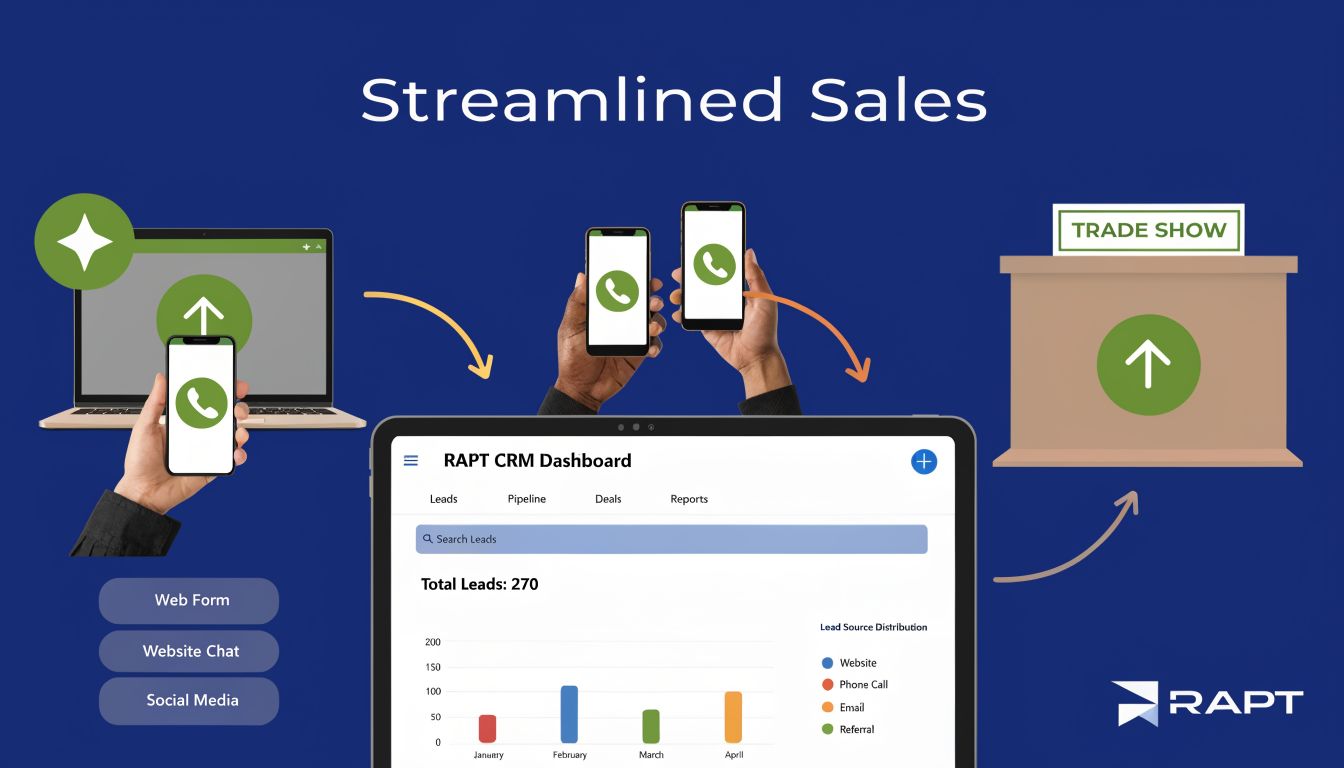
A form gets submitted on Friday afternoon. A voicemail sits in the front office inbox. A salesperson forgets to log a trade show contact. Marketing reports "interest," but sales says the leads are cold. What you really have is a handoff failure.
Fix the handoff before buying more traffic
The data provides a clear warning: Industrial and manufacturing PPC campaigns average about a 1.0% conversion rate, while SEO converts at roughly 3x the rate of PPC, and the average industrial form conversion rate is 28% (Lead Forensics manufacturing marketing benchmarks).
The practical lesson is straightforward. Before you spend more on traffic, fix the conversion stack.
That means:
- Message match: The page must reflect the exact offer or intent behind the click.
- Form friction: Ask only for the information you need at this stage.
- Routing logic: High-intent leads should go to a salesperson fast.
- CRM automation: Every lead should trigger an immediate acknowledgment and internal alert.
Better traffic won't save a weak handoff. The system after the form decides whether lead generation pays off.
A simple CRM workflow that works
You do not need a giant enterprise setup to get discipline. A well-configured system in HubSpot, GoHighLevel, or a manufacturing-focused setup from a consultancy like Machine Marketing's CRM services for manufacturers can handle the basics if the process is clear.
Here is the minimum viable workflow:
Capture every source
Website forms, phone calls, Google Business Profile inquiries, event contacts, and manual sales entries all go into one CRM.Tag the lead automatically
Source, service interest, territory, and urgency should be visible without manual cleanup later.Trigger immediate follow-up
Send a confirmation to the prospect and an internal task or alert to the right person.Stage the opportunity
New inquiry, qualified, quoting, open opportunity, closed won, closed lost. Keep it simple enough that your team will use it.Review the pipeline weekly
Not just total leads. Look at source quality, speed to response, stalled deals, and recurring objections.
If you don't have that level of control, your marketing results will always look inconsistent because your reporting is only showing the front end of the system.
Your 90-Day Starter Plan for Measurable Growth
Most Iowa manufacturers don't need a massive rebrand to improve lead flow. They need a workable sprint. Recent state materials describe advanced manufacturing as Iowa's largest industry, contributing $35 billion annually and accounting for 17% of total state GDP, with more than 5,900 manufacturers in the state. The same source noted that the Iowa Leading Indicators Index showed the manufacturing new orders index rising to 56.0 in February 2026, up from 51.4 in January 2026, while the 12-month moving average increased to 49.8 from 49.1 (Iowa Economic Development Authority advanced manufacturing overview).
That kind of purchasing signal is exactly why waiting is expensive. If demand is picking up, your system needs to be ready before the next inquiry shows up.
Days 1 through 30 build the foundation
Use the first month to clean up what buyers hit first.
- Audit your website: Check capability pages, contact paths, and technical clarity.
- Fix your Google Business Profile: Make sure business details and descriptions are complete.
- Choose one CRM workflow: Stop splitting leads across inboxes and spreadsheets.
- Define your main offers: Decide what you want inquiries for.
Ask yourself:
- Are we easy to understand in under a minute?
- Can a buyer tell what we do best?
- Does every inquiry have a clear owner?
Days 31 through 60 publish one asset
Don't try to build a giant content library. Build one useful sales asset your team will use.
That might be a case-study page, a process explainer, an industry-specific capability page, or a recruiting asset if hiring is the immediate bottleneck. The right choice depends on your sales friction.
A simple filter helps:
| If your issue is | Publish this first |
|---|---|
| Low trust with new buyers | Case study or proof page |
| Confusion about capabilities | Technical service page |
| Long quoting cycles | FAQ or process explainer |
| Hiring pressure | Career path or workplace content |
Days 61 through 90 activate and measure
In the last month, drive qualified attention to the asset and watch how the system behaves.
- Launch a narrow paid search campaign tied to one service or capability.
- Run targeted outreach to existing contacts, past prospects, or event leads.
- Measure response speed inside the CRM.
- Review lead quality weekly with sales, not just monthly with marketing.
What matters at this stage isn't volume for its own sake. It's whether your system can attract the right inquiry, route it correctly, and move it toward a real sales conversation.
If you're ready to turn Iowa manufacturing marketing into a system instead of a scramble, Machine Marketing helps manufacturers, machine shops, and industrial teams diagnose weak points, tighten lead flow, and build practical marketing systems around SEO, content, CRM, and automation.