If you run a manufacturing business, you already know the pattern. Sales can look strong for a quarter, then go quiet. A trade show produces a burst of opportunities, then the pipeline thins out. Referrals carry the load until they don't. The problem usually isn't product quality. It's that marketing for manufacturers often grows in fragments instead of as a system.
A lot of industrial companies have the right ingredients. A capable sales team. Deep technical expertise. A decent website. Maybe a CRM, a few email lists, and a couple of campaigns that worked once. What they don't have is a connected machine that turns expertise into demand, demand into qualified conversations, and conversations into measurable revenue.
That's the shift that matters. Not more random tactics. A marketing machine.
Table of Contents
- Your Manufacturing Business Needs a Marketing Machine
- Phase 1 Diagnosis and Strategy Definition
- Phase 2 Building Your Digital Foundation
- Phase 3 Fueling the Machine with Lead Generation Campaigns
- Measuring Performance and Proving ROI
- Your Actionable 90-Day Marketing Rollout Plan
Your Manufacturing Business Needs a Marketing Machine
Manufacturers don't need marketing that looks busy. They need marketing that behaves like a production system. Inputs go in, processes are controlled, output quality is measured, and weak points get fixed.
That mindset matters because industrial buying is now heavily digital before sales ever gets involved. According to a 2025 manufacturing marketing analysis, fast-growing manufacturers were estimated to get 65 to 75% of traffic from search engines, while average performers saw only 20 to 25% from search. The same source notes that industrial buyers often discover vendors through intent-based search, then return directly later once trust is built.
So if your lead flow feels inconsistent, don't assume you need more sales pressure. You may need a cleaner system for being found, educating buyers, capturing intent, and following up correctly.
What a marketing machine actually means
A real system for marketing for manufacturers usually includes four parts:
- A segmentation layer that decides which markets, order profiles, and accounts are worth pursuing
- A digital foundation built around a website, technical SEO, and CRM tracking
- Campaign engines such as content, paid search, email nurture, and reactivation
- A measurement layer that ties activity to qualified pipeline, not just clicks
Practical rule: If marketing can't tell sales which accounts engaged, what they viewed, and why they're worth calling, the system isn't finished.
What doesn't work
Most weak industrial marketing programs fail in familiar ways:
- Broad messaging: The company talks about quality, service, and innovation, but never makes a clear case for a specific buyer.
- Content without intent: Teams publish articles that attract traffic but don't help engineers, procurement, or plant leadership make a decision.
- Disconnected tools: Website forms, CRM records, ad platforms, and email systems don't share data cleanly.
- No commercial filter: Marketing chases any lead, even when the segment is low margin or operationally painful.
That last problem gets ignored too often. If you market to the wrong segments efficiently, you still lose.
Phase 1 Diagnosis and Strategy Definition
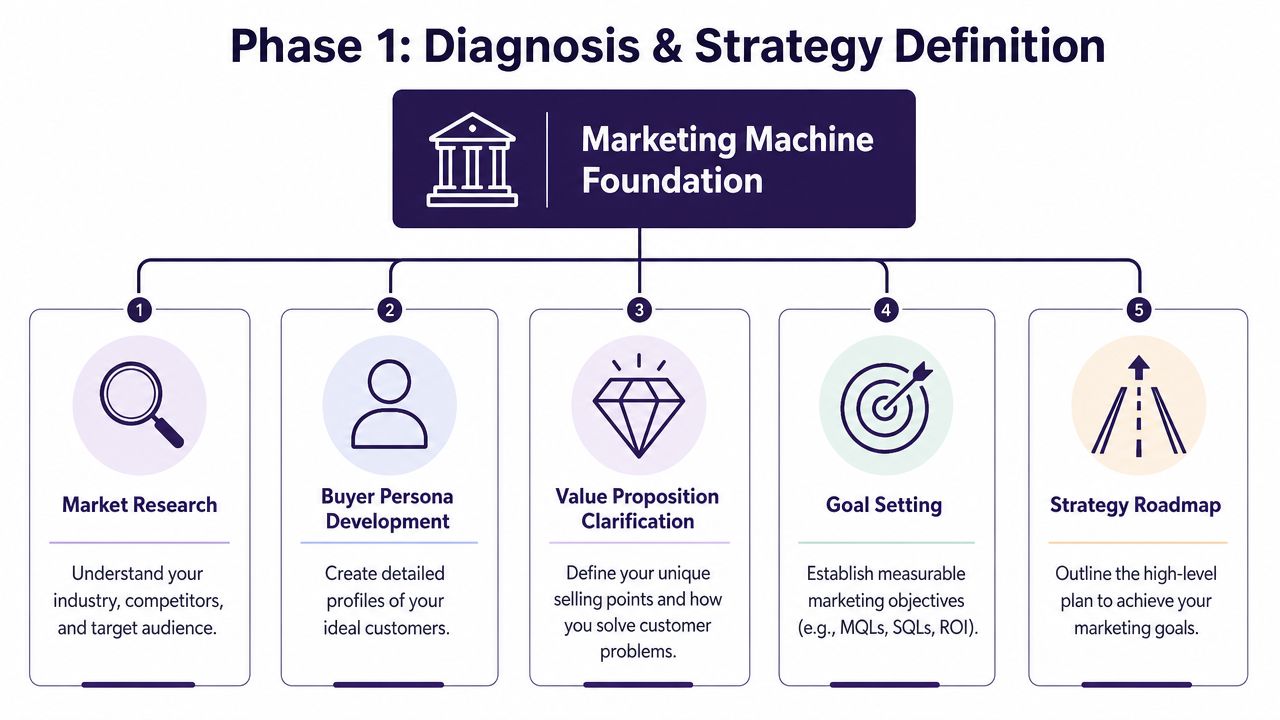
The first step isn't launching campaigns. It's reducing bad assumptions. A marketing system built on weak targeting just creates expensive noise.
Start with commercial reality
Many marketing efforts fail because the company starts with channels instead of strategy. Bain's guidance is useful here: manufacturers should define the value proposition by segment and evaluate gross margin before choosing go-to-market motions, as explained in Bain's perspective on underserved selling and segment economics.
That means your first diagnostic questions aren't "Should we run Google Ads?" or "Do we need more LinkedIn?" They are more basic.
- Which segments produce healthy business? Look at verticals, job sizes, repeat potential, geographic fit, and service burden.
- Which segments consume attention without producing margin? Some customers create quote volume and engineering effort but never become good accounts.
- Where does the sales cycle stall? Early awareness, technical evaluation, internal approval, or follow-up discipline.
- What proof does each buyer need? Performance data, implementation details, certifications, lead times, or ROI framing.
If you need a structured starting point, use a formal marketing audit framework for industrial companies. The point isn't paperwork. It's to establish a baseline before making investments.
Build buyer profile cards
Most manufacturers have a rough idea of their buyer. That's not enough. You need a working document that sales and marketing can both use.
A simple Buyer Profile Card should include:
- Role and function: Engineer, procurement manager, operations lead, plant manager, or executive sponsor
- Trigger problem: Failure rate, throughput issue, compliance need, supplier risk, cost pressure
- Questions they ask: Will this fit the application, how long is implementation, what's the lifecycle cost, what proof exists
- Assets they need: CAD files, spec sheets, comparison pages, lead-time info, FAQ pages, ROI materials
- Sales objection patterns: Price resistance, switching risk, internal approval delays, custom requirements
Most industrial marketing underperforms because it talks to "the customer" as if one person makes the decision.
A better way to define the message
Don't start with "We're a trusted leader." Start with the gap you solve for a profitable segment.
For example, a strong internal messaging prompt sounds like this:
| Segment | Operational problem | Buying concern | Proof needed |
|---|---|---|---|
| OEM engineering team | Component reliability in demanding use | Fit, tolerances, application performance | Technical data and comparison content |
| Procurement | Supplier consistency and lead-time risk | Cost, supply stability, implementation burden | Pricing logic, availability, onboarding details |
| Plant leadership | Downtime and changeover friction | Operational disruption and accountability | ROI framing and implementation plan |
That exercise sharpens everything that follows. SEO targets improve. Sales calls get cleaner. Content becomes easier to plan because it has a job.
Phase 2 Building Your Digital Foundation
A manufacturer's website shouldn't act like a brochure. It should work like a technical sales engineer that never sleeps.
The strongest demand generation setup in this market starts with self-service evaluation. According to Sales Layer's guide to digital marketing for manufacturers, 74% of B2B buyers research online before speaking with a supplier. That means your site has to do real work before a rep ever joins the conversation.
Turn the website into a self-service sales tool
When buyers land on your site, they shouldn't have to guess where the useful information lives. High-intent pages need to be easy to find information on and written for actual decision-making.
At minimum, a manufacturer site should make room for:
- Technical proof assets: Spec sheets, certifications, tolerances, materials, and application data
- Comparison support: Product comparison pages, alternative selection guidance, and FAQ content around trade-offs
- Commercial content: Lead times, implementation expectations, request-for-quote paths, and ROI framing
- Filtering and search: Buyers should be able to find the right product family, part type, or application fit quickly
A common failure pattern is hiding critical information behind generic product copy. Engineers want specifics. Procurement wants clarity. Executives want confidence that the choice won't create downstream headaches.
Build technical visibility and tracking
Once the site can support evaluation, it needs to be discoverable. In manufacturing, that usually means long-tail technical SEO rather than broad awareness terms.
Useful targets often include queries tied to:
- Part numbers
- Material types
- Application use cases
- Tolerance or failure issues
- Replacement and comparison searches
A practical SEO approach for manufacturing companies starts by mapping those searches to the actual pages buyers need. If your keyword strategy isn't connected to real buying questions, rankings won't turn into opportunities.
Your SEO strategy should mirror your quoting logic. Go after searches that reveal fit, urgency, and intent.
Tracking matters just as much. Google Analytics alone won't tell you whether a visitor reviewed a spec page, used a comparison tool, or downloaded a technical asset. That's where CRM and automation come in.
Use one central system to capture form fills, page engagement, sales notes, and follow-up status. That can be HubSpot, GoHighLevel, or a setup managed through a specialist such as Machine Marketing when a team needs CRM, website, and campaign systems tied together. The tool matters less than the discipline. Every lead interaction should be visible to both marketing and sales.
Phase 3 Fueling the Machine with Lead Generation Campaigns
Once the foundation is stable, campaigns can start doing useful work. A common misstep for many manufacturers occurs at this point. They launch activity without assigning each channel a clear job.
Give each channel a job
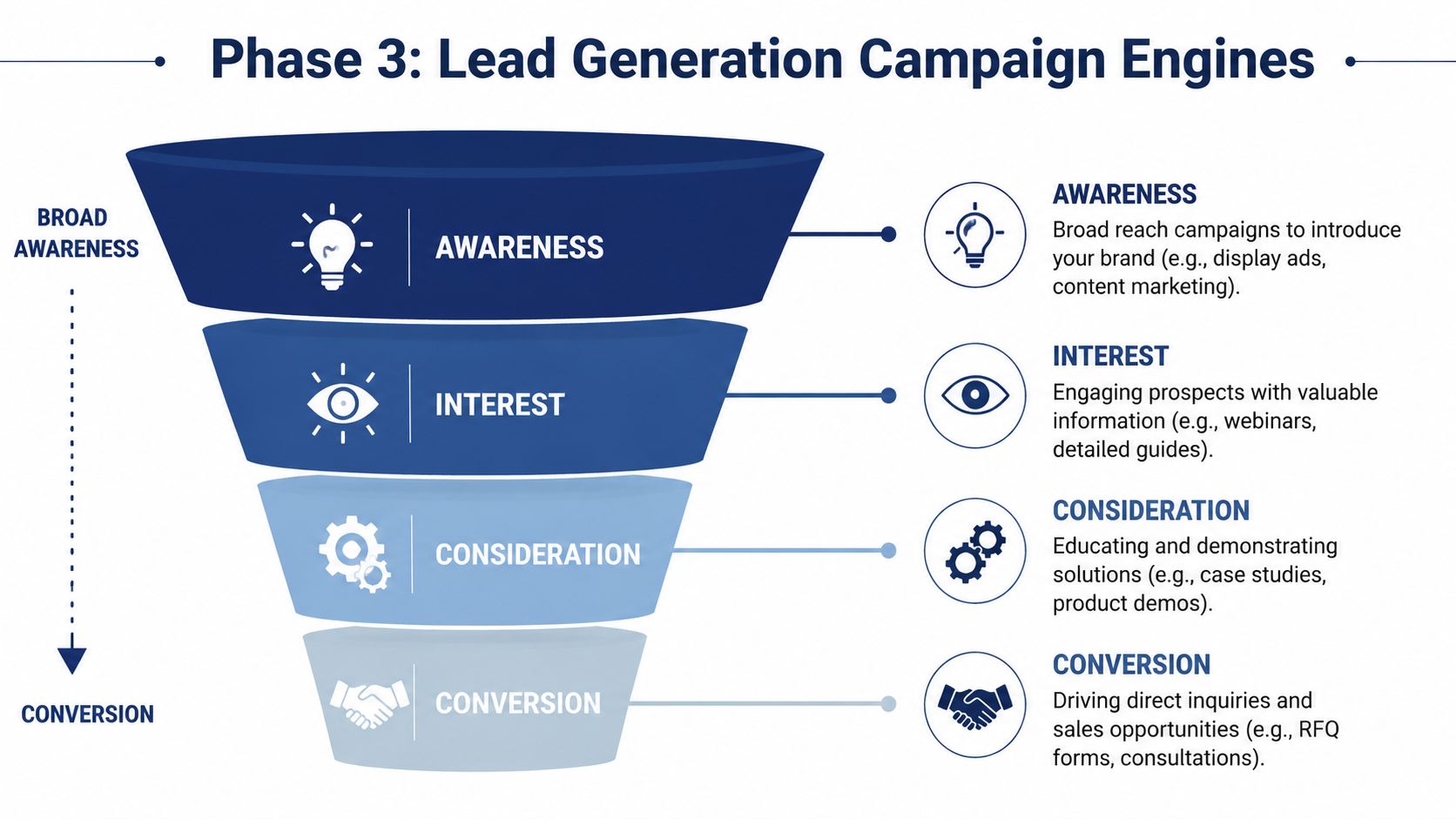
The best campaign systems in industrial markets don't ask one asset to do everything. They divide labor.
Content handles education. Paid search captures active demand. Email nurtures consideration. Sales outreach converts known engagement into meetings. Trade shows create contacts that digital follow-up can qualify and warm.
That structure matters because many manufacturing content programs still underperform. The CMI manufacturing report, summarized by Winbound, found that 67% of manufacturing marketers rated their content strategy as only "moderately effective". The same source recommends assigning each asset a single measurable goal mapped to a specific buyer stage, which you can review in Winbound's summary of the manufacturing content marketing report.
Run campaigns around buyer roles, not generic topics
A weak campaign topic says, "Why quality matters in industrial manufacturing."
A stronger campaign looks more like this:
- An engineer track with an application guide, tolerance explainer, spec download, and comparison page
- A procurement track with lead-time expectations, implementation FAQs, and total-cost framing
- A leadership track with business risk reduction, standardization benefits, and operational impact
That approach matches how industrial buying works. One company may have several stakeholders looking at the same supplier through different lenses. If your campaign only speaks to one of them, deals slow down.
A useful starting point for campaign planning is a dedicated lead generation framework for manufacturers. It helps organize offers, landing pages, and follow-up logic around actual buying stages instead of random content requests.
Before you build outbound lists or account-based campaigns, spend time evaluating top lead data providers. Data quality has a direct effect on reply rates, routing accuracy, and sales trust in the program.
If the contact data is wrong, the campaign isn't early. It's already broken.
A short explainer video can also help sales and marketing align around campaign structure and buyer flow:
Connect outbound, reactivation, and events
Here's where the machine starts to feel real. A buyer downloads a technical guide. That action triggers a segmented email sequence. Sales sees the account revisit a high-intent page. A rep follows up with context instead of a generic check-in. If the buyer later appears at a trade show booth, that interaction gets logged into the same record, not dropped into a spreadsheet graveyard.
A practical campaign mix often includes:
- Paid search for active demand: Focus on solution-specific terms and product-category terms tied to clear commercial intent
- LinkedIn for targeted visibility: Useful for reaching specific roles in named accounts, especially when paired with strong landing pages
- Email reactivation: Wake up old quote requests, dormant customers, or stalled opportunities with relevant offers
- Trade show follow-up automation: Route badge scans or booth conversations into segmented sequences by product line or buyer type
- Sales-trigger alerts: Notify reps when a lead views pricing, specs, or comparison content repeatedly
What doesn't work is sending every lead into the same nurture stream. A CAD download and a newsletter signup are not equal signals. Treating them the same wastes sales time and muddies reporting.
Measuring Performance and Proving ROI
A manufacturer can generate more traffic, more form fills, and more campaign reports, yet still miss the core question in the board meeting: did marketing create pipeline that sales could close?
Track buying signals, not vanity metrics
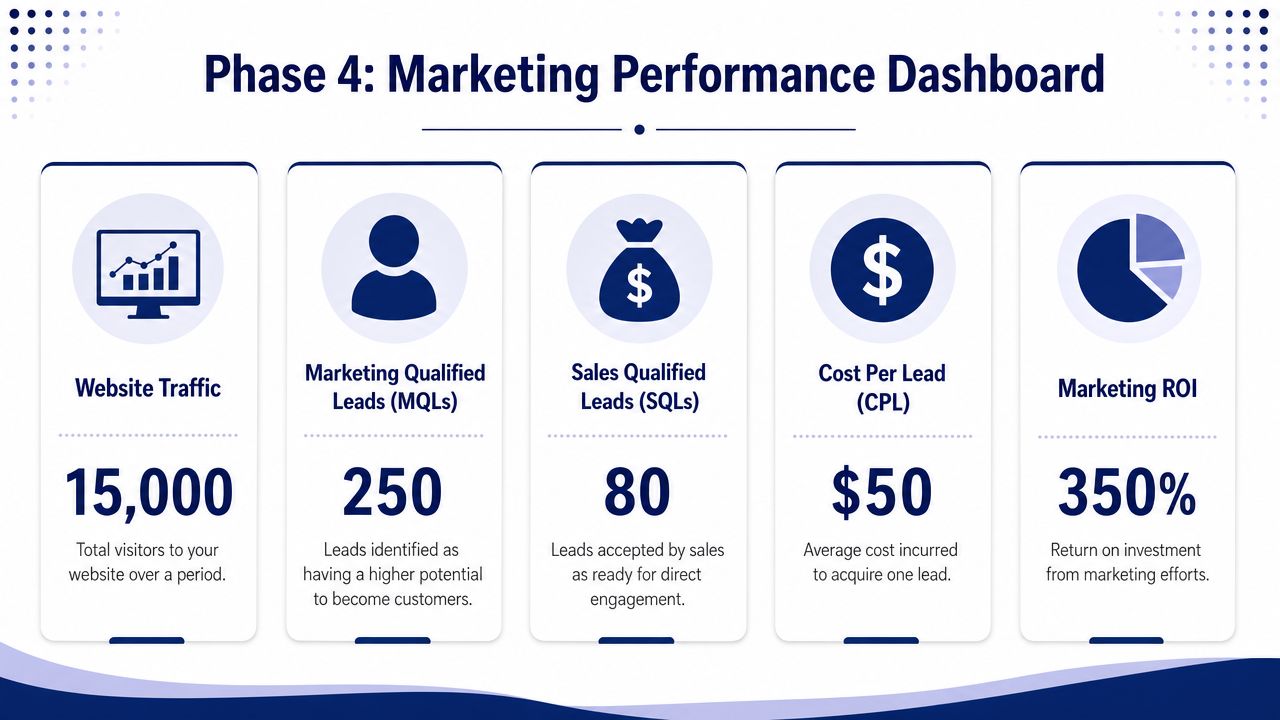
Manufacturing teams need reporting that supports decisions. The job is to show where budget is producing qualified demand, where leads are stalling, and which activity deserves a sales response.
Website traffic still matters, but only as supporting context. A spike in visits means little if those visitors never reach product pages, spec sheets, quote forms, or distributor and sales contact paths. The stronger measurement model follows buyer movement through the system and ties that movement to pipeline.
Useful metrics usually include:
- Lead conversion rate: Are technical pages, RFQ paths, and offers producing legitimate inquiries?
- Customer acquisition cost: Which channels justify continued spend?
- Content engagement: Which assets attract repeat visits, longer evaluation sessions, or deeper product exploration?
- Assisted conversions: Which pages and campaigns influence qualified opportunities before a form submission or sales conversation?
- Time to value: How long does it take a new lead to reach meaningful sales engagement?
Search visibility often serves as an early diagnostic signal. If target buyers cannot find your product categories, application pages, or technical resources during research, the rest of the machine has less to work with.
Build a dashboard sales will use
A useful dashboard should help a sales manager decide where reps spend time this week, not just help marketing report on last month.
Keep the views simple and operational:
| Dashboard view | What it should answer |
|---|---|
| Channel performance | Which channels create qualified inquiries, not just visits |
| High-intent content | Which assets correlate with sales-ready behavior |
| Lead stage flow | Where prospects stall between first conversion and pipeline |
| Account engagement | Which companies show repeat activity across multiple contacts |
Then track the behaviors that matter in a manufacturing buying cycle. Product comparison page visits. Repeated spec-sheet views. Return sessions from the same company. Form submissions tied to a specific product family or application need.
A report built around sessions, impressions, and source data alone will not help a rep decide who to call next.
In practice, this means using more than one system. CRM data shows lead status and pipeline movement. Event tracking shows what buyers did before they converted. Form attribution shows which campaign or page started the process. Heatmaps and session tools can help diagnose whether visitors reached the proof points they needed, then dropped before taking action.
The goal is not more reporting. The goal is a closed loop between marketing activity, sales behavior, and revenue outcome. Once that loop is in place, budget decisions get easier, sales trust improves, and marketing starts operating like a machine instead of a collection of disconnected tactics.
Your Actionable 90-Day Marketing Rollout Plan
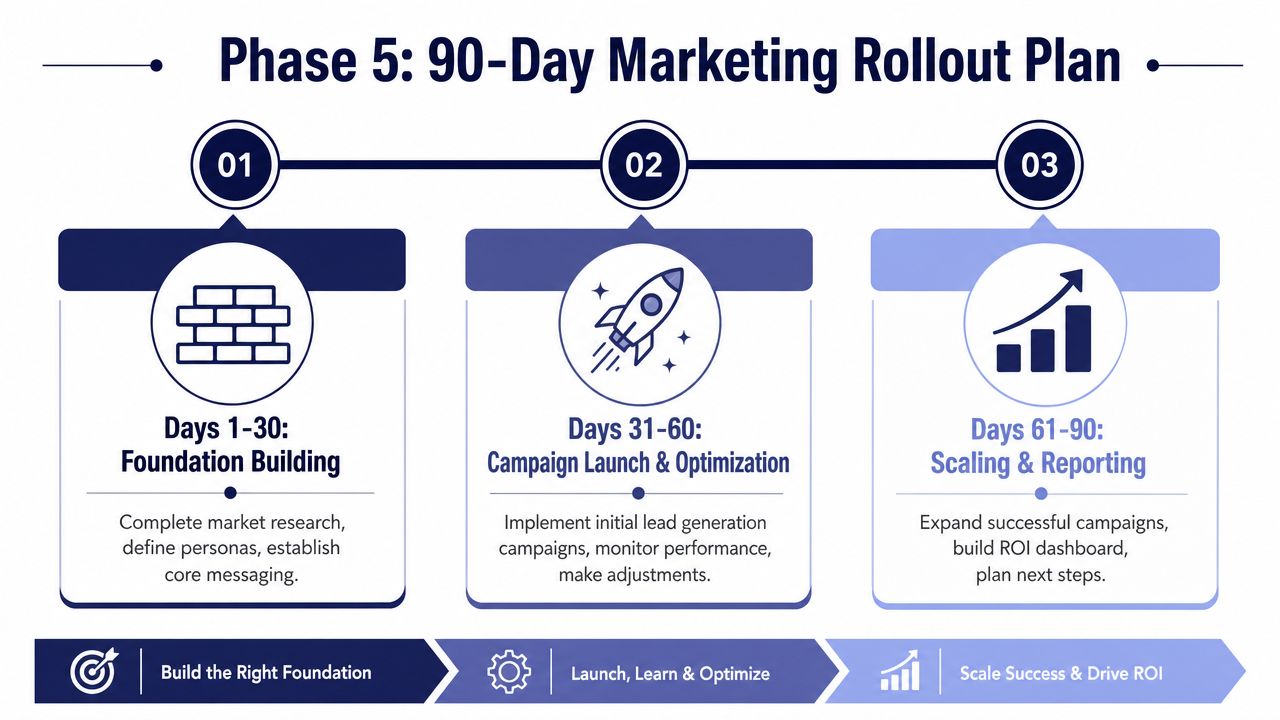
You don't need a year-long rebrand to improve lead flow. You need a controlled rollout with clear priorities. The first ninety days should produce three outcomes: sharper targeting, a stronger digital foundation, and initial campaign data you can trust.
Days 1 through 30
The first month is about diagnosis and setup. Don't rush past this part.
Start by reviewing closed-won business, stalled deals, and low-quality leads from the past year. Look for patterns in segment fit, order quality, technical complexity, and sales cycle friction. Build your shortlist of target segments and write clear buyer profile cards for engineering, procurement, and leadership stakeholders.
Then clean up the foundation:
- Audit the website: Identify missing proof assets, weak conversion paths, and pages that don't support technical evaluation.
- Define core messaging: Create segment-specific value propositions and objection handling.
- Set up CRM discipline: Standardize lead source fields, lifecycle stages, and handoff rules.
- Plan initial content: Prioritize pages and assets tied to the most common buying questions.
Days 31 through 60
The second month is launch mode, and the machine starts moving.
Publish or revise high-intent pages first. That usually means product or solution pages, comparison pages, technical FAQ content, and one or two downloadable assets. Launch one campaign per audience priority, not five at once.
Examples of good month-two moves:
- Search capture: Launch tightly focused paid search or optimize existing pages around high-intent long-tail topics.
- Email nurture: Build segmented follow-up for content downloads, quote requests, and dormant contacts.
- Sales enablement: Give reps short follow-up templates tied to specific assets and behaviors.
- Event integration: If a trade show is coming, define form capture, tagging, and post-event sequences before the event happens.
Days 61 through 90
The third month is for refinement. At this point, you should have enough data to see where attention is collecting and where friction remains.
Review channel quality, not just channel activity. Which offers produce relevant leads? Which pages attract repeat visits from target accounts? Which sequences get replies or trigger meetings? Then make a few deliberate changes instead of overhauling everything at once.
This is also when you tighten the scoring model. Raise the value of high-intent actions such as spec consumption, comparison-page visits, and repeated engagement by known accounts. Lower the value of low-commitment actions that rarely lead anywhere.
90-Day Marketing Rollout
| Phase | Key Actions | Primary KPI |
|---|---|---|
| Foundation | Audit segments, define buyer profiles, clarify messaging, clean CRM stages, identify website gaps | Qualified lead baseline |
| Activation | Publish high-intent assets, launch search and email campaigns, connect sales follow-up, tag inbound sources | Lead quality by channel |
| Optimization | Review engagement, adjust scoring, improve weak pages, refine nurture logic, build management dashboard | Sales-ready opportunities |
A few questions are worth asking before you start:
- Are we targeting the right markets, or just the easiest names to find?
- Can a buyer self-educate on our site without calling sales too early?
- Do we know which behaviors signal serious intent?
- Can sales see that intent in time to act on it?
If the answer to any of those is no, that's where the next ninety days should begin.
If you're ready to turn scattered tactics into a working growth system, Machine Marketing helps manufacturers diagnose gaps, connect CRM and campaign workflows, and build marketing programs that are easier to measure and easier for sales to use.