If you're an industrial company with a strong product line and inconsistent lead flow, the issue usually isn't effort. It's system design. We see manufacturers, OEMs, fabricators, machine shops, and technical service firms doing plenty of marketing, but the parts don't connect. The website doesn't qualify. Content doesn't support sales. CRM data doesn't trigger follow-up. Paid campaigns generate names, not opportunities.
A durable industrial marketing strategy fixes that by treating marketing like an engineered system instead of a pile of tactics. You need clear inputs, controlled processes, measurable outputs, and a feedback loop that improves performance over time.
What follows is a practical growth plan built for long sales cycles, technical buyers, and complex handoffs between marketing and sales. Use it to diagnose weak points, prioritize the right fixes, and build a machine that generates leads you can close.
Table of Contents
- Diagnosing Your Industrial Marketing System
- Why Industrial Marketing Is a Different Machine
- The 7-Point Framework for Industrial Growth
- Content and SEO The Engineer's Way
- Your Tactical 30-90-180 Day Action Plan
- Measuring What Matters Sample KPIs and Dashboards
- Industrial Marketing Strategy in Action
Diagnosing Your Industrial Marketing System
Most industrial marketing problems show up as sales complaints.
Leads are unqualified. Good opportunities go cold. The website gets traffic but doesn't produce serious inquiries. Trade shows create activity for a week, then momentum disappears. None of that is random. It usually means your system has gaps between attention, evaluation, follow-up, and handoff.
The first question isn't "Which tactic should we add?" It's "Where is the system breaking?"
A useful diagnosis checks four areas:
- Traffic quality: Are the right buyers reaching your site, or are you attracting students, competitors, and low-fit inquiries?
- Conversion architecture: Do your pages give technical buyers a next step such as quote requests, demo forms, spec sheet downloads, or application consultations?
- Lead handling: Does someone respond quickly, and does the CRM assign ownership clearly?
- Feedback loop: Are you learning which campaigns create real pipeline, not just form fills?
Practical rule: If sales says lead quality is poor and marketing says volume is fine, your tracking model is probably broken.
A marketing audit is the fastest way to surface those failures. If you need a structured starting point, use this guide to understand what a marketing audit should include. The point isn't to produce another report. It's to identify the constraints that keep revenue from moving.
Industrial companies don't need more disconnected activity. They need a system where channels, content, CRM, and sales follow-up work together.
Why Industrial Marketing Is a Different Machine
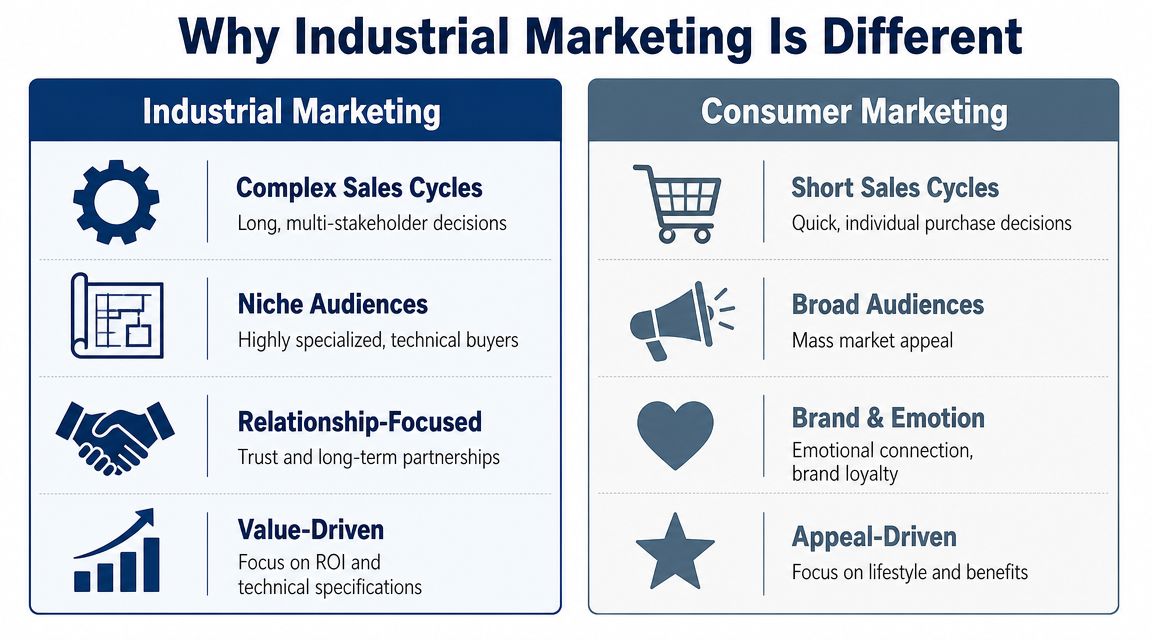
Industrial marketing fails when companies copy consumer tactics or lightweight B2B playbooks. Technical buying doesn't work that way.
The buyer is rarely one person. The process is rarely fast. And the content that persuades one stakeholder won't satisfy the rest.
Buying groups change everything
Industrial deals often involve multiple roles, including engineering, operations, procurement, finance, and sustainability. Each one evaluates different criteria such as specs, uptime, cost, ESG, and ROI, which is why buying-group intelligence matters more than single-lead tracking.
That has real consequences for campaign design.
If your ads, landing pages, and email sequences speak only to engineers, procurement can still stall the purchase. If your content focuses only on cost savings, technical evaluators may dismiss you early. If your CRM treats every inquiry as an isolated lead, you miss the account-level pattern that shows a real buying process is underway.
What generic marketing gets wrong
A generic playbook tends to assume that one person clicks, converts, and buys. Industrial marketing strategy has to assume the opposite.
Here's where standard approaches break:
| Situation | Generic approach | Industrial approach |
|---|---|---|
| Audience targeting | Target one persona | Map the full buying group |
| Messaging | Lead with broad benefits | Match proof to each stakeholder's concerns |
| Lead capture | Use one generic form | Offer role-specific conversion paths |
| Follow-up | Send one nurture sequence | Trigger follow-up by product interest, stage, and role |
| Attribution | Credit the last click | Track account engagement across touchpoints |
Technical buyers don't need more hype. They need enough evidence to reduce the risk of making a bad decision.
Trust has to be engineered
In industrial markets, trust isn't built through brand tone alone. It's built through accuracy, responsiveness, technical depth, and proof that your team can solve the application.
That means your marketing must answer questions sales hears every day:
- Application fit: Will this work in our environment?
- Performance risk: What fails, and how is that prevented?
- Commercial impact: How does this affect uptime, maintenance, and total cost?
- Implementation confidence: What does onboarding, integration, or support look like?
When companies accept that reality, their strategy improves fast. They stop chasing volume for its own sake and start building a system that supports complex decisions over time.
The 7-Point Framework for Industrial Growth
A plant manager visits your site after a line failure. An engineer reads three technical pages. Procurement checks certifications and lead times. Sales gets a form fill that says only "Need pricing."
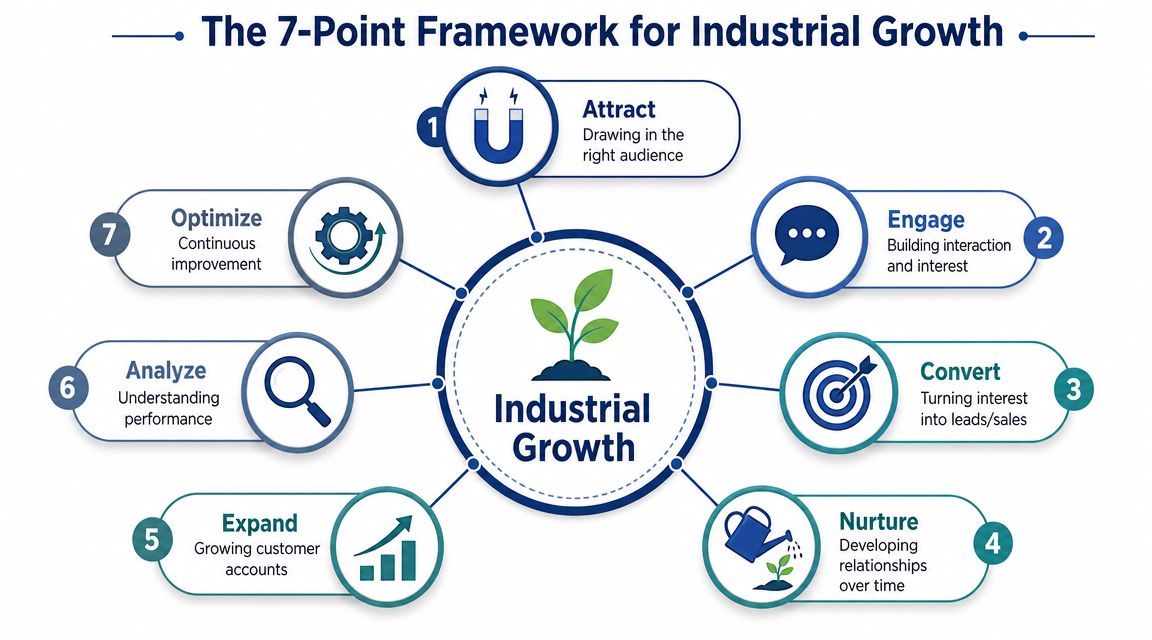
If those signals do not connect, marketing creates activity without control. Industrial growth comes from a system that identifies the right accounts, delivers the right proof, routes intent into CRM, and gives sales enough context to act fast. These seven points work together. Weakness in one usually limits the rest.
Start with fit.
1. Audience and ICP definition
Industrial teams often target too broadly, then wonder why win rates stay soft. A useful ICP is specific about plant type, application, urgency, order profile, buying group, and margin potential. "Engineers in manufacturing" is too loose to guide media, content, or qualification. "OEM product teams sourcing tight-tolerance machined plastics for repeat production runs" gives marketing and sales something operational.
The fastest way to define this is to look backward. Pull closed-won, closed-lost, and high-maintenance accounts. Compare sales cycle length, average deal value, reorder rate, support burden, and technical fit. The point is not to find the biggest market. The point is to find the segment where your commercial model and delivery model both work.
2. Messaging and positioning
Good positioning lowers perceived risk. Buyers need a clear reason to trust your process under real operating conditions, not another claim about quality or service.
A practical message structure is simple: name the operating problem, show the cost of getting it wrong, explain why your approach is more credible, then back it with proof. Proof can be lead-time history, tolerance data, certifications, retrofit experience, testing process, or application support. For technical SEO planning that aligns this proof with search behavior, use a conversion-centric approach to technical content SEO.
3. Digital channel selection
Channel choice should follow buyer behavior and sales economics. Search usually captures active demand. LinkedIn helps with account targeting and stakeholder reach. Email supports long consideration cycles. Paid search can work well for urgent replacement or high-intent product terms. Retargeting helps keep your company present while approvals move through engineering, operations, and procurement.
Analysts at WebFX found that 77% of industrial marketers who used paid content distribution relied on social media advertising and promoted posts, according to WebFX's 2026 industrial marketing benchmark summary. That does not mean every industrial firm should increase paid social spend. It means paid channels deserve a clear role, with targeting, offer, and follow-up matched to how your buyers evaluate suppliers.
The next layer is infrastructure. Campaigns underperform when handoff and follow-up are weak.
4. CRM and automation integration
A disconnected CRM creates expensive confusion. Sales cannot tell which inquiry is urgent. Marketing cannot see which campaigns produce real opportunities. Management gets reports on lead volume instead of pipeline quality.
The fix is operational discipline. Every inquiry needs source tracking. Every lead needs a defined lifecycle stage. Every handoff needs an owner and response standard. Automation should assign tasks, route by territory or product line, trigger role-specific follow-up, and record engagement such as page views, downloads, and repeat visits. GoHighLevel is often a practical choice for smaller teams that want forms, landing pages, pipelines, automation, and communication in one system. HubSpot is often better when a team needs deeper reporting and broader integrations. Machine Marketing also provides CRM and automation implementation for industrial companies that already have tools in place but need the workflows connected to sales operations.
5. High-value content strategy
Industrial content should reduce sales friction before the call. The best assets answer the same questions that stall quotes, spec reviews, and vendor approval.
Build around three classes of content. First, application pages tied to real operating environments and use cases. Second, technical articles that explain materials, tolerances, methods, maintenance, compliance, or failure points. Third, proof assets such as case studies, process documentation, certifications, photos, and videos. If your team needs outside advice on selecting an SEO partner, evaluate them on whether they can translate technical buying questions into pages that support revenue, not just rankings.
6. Sales enablement alignment
Sales enablement and measurement must be core components.
Here is a common scenario. A prospect views a product family page, returns a week later from a branded search, downloads a spec sheet, and then submits a quote request from a general form. If sales only sees the form, they miss the pattern. If sales sees the pages visited, asset downloaded, company, product interest, and response time target, the first call gets sharper.
That is the difference between lead forwarding and lead management. Marketing should give sales the full context: what the account consumed, which objection is likely in play, and which follow-up asset fits the role. Engineering may need application validation. Procurement may need lead-time, compliance, and commercial terms. Operations may care about downtime risk and implementation steps.
7. Measurement and analytics
Measurement has to connect marketing activity to qualified pipeline and revenue. Clicks and impressions are diagnostic inputs, not business outcomes.
Review performance monthly at three levels. First, channel quality: which sources create qualified opportunities and quoted work. Second, content influence: which pages and assets appear before meetings, RFQs, or demos. Third, funnel movement: where leads slow down, whether response times slip, and which stages need automation or sales process changes. A useful dashboard should let leadership compare accounts engaged, MQL to SQL conversion, quote rate, opportunity value, close rate, and sales cycle length by source and campaign.
When these seven points are connected, industrial marketing becomes a managed system. You can diagnose constraints, set a 30-, 90-, and 180-day plan, and improve output without guessing which tactic to try next.
Content and SEO The Engineer's Way
A plant engineer lands on your site after searching for a material compatibility issue. They do not want brand theater. They want a fast answer, proof that you have solved the problem before, and a clear next step if the fit looks right.
That is how industrial content should be built. Each page needs a job: answer a technical question, reduce buying risk, and move the account toward specification, shortlist, RFQ, or a sales conversation. Content that cannot support one of those outcomes is usually overhead.
The mistake I see most often is treating SEO as a publishing calendar instead of part of the lead generation system. In industrial markets, content has to connect search intent, sales objections, conversion paths, and CRM follow-up. If a page brings in the right visitor but gives sales no context, the system breaks. If the page ranks but attracts students, competitors, or low-fit buyers, the system breaks there too.
Build content around jobs, applications, and objections
The cleanest way to plan content is to map it to three operating buckets.
Application content helps buyers confirm fit in practical applications. Build pages around industries, operating environments, material conditions, equipment compatibility, compliance requirements, and use cases. Good application pages filter bad-fit inquiries while giving qualified buyers language they can use internally.
Decision content helps a buying team compare options without waiting for a sales call. Useful topics include:
- Material selection: Which material holds up under heat, corrosion, abrasion, washdown, or contamination risk?
- Process choice: Which manufacturing method fits the tolerance, volume, lead time, or cost target?
- Commercial fit: When is a custom solution justified, and when is a standard product the better choice?
Proof content lowers perceived risk. Use implementation case studies, test results, engineering FAQs, quality process explanations, and sales-call questions that come up before a quote is approved. The best proof content is specific. It names the constraint, the decision criteria, and the result the customer needed.
A strong industrial article removes one real objection.
Optimize technical assets for discovery and conversion
Industrial SEO covers more than articles. Product pages, category pages, spec sheets, CAD resource hubs, PDF libraries, and quote-request paths all influence whether a visitor becomes a lead.
Start with page intent. A buyer searching for a high-temperature gasket material should land on a page built for evaluation, not a general service page. That means clear headings, application context, technical details, related products, and a conversion step that matches buying stage. Early-stage visitors may want a guide or comparison chart. Mid-stage visitors may want a spec sheet, sample request, or application review.
Technical files need the same discipline. PDFs and downloadable assets should sit on indexable pages with descriptive copy, internal links, and a CTA. Otherwise, they get traffic without producing usable signals for the rest of the system.
For a more detailed breakdown of how technical pages can be structured to support both rankings and conversion, see this guide to conversion-centric technical content SEO.
Treat content like a tracked production line
Every meaningful asset should map to a funnel stage and a workflow inside the CRM. If someone downloads a maintenance checklist, that action should trigger tagging, source tracking, and a follow-up path in a platform such as GoHighLevel or your existing CRM. If someone visits the same application page three times and then views a case study, sales should see that sequence before outreach starts.
Industrial teams gain ground as they stop asking whether content "works" in general and start asking which pages influence qualified opportunities, which topics produce quote requests, and which assets help sales shorten evaluation cycles.
Partner choice affects execution. A general SEO vendor can publish content at volume. Industrial companies usually need a team that can work with technical SMEs, structure content around buyer intent, and connect performance back to pipeline. If you're comparing providers, this practical resource offers useful advice on selecting an SEO partner and the questions worth asking before you sign anything.
Use one final test before publishing. Would an engineer, estimator, plant manager, or procurement lead save the page because it helps them make a decision? If not, revise it until it does.
Your Tactical 30-90-180 Day Action Plan
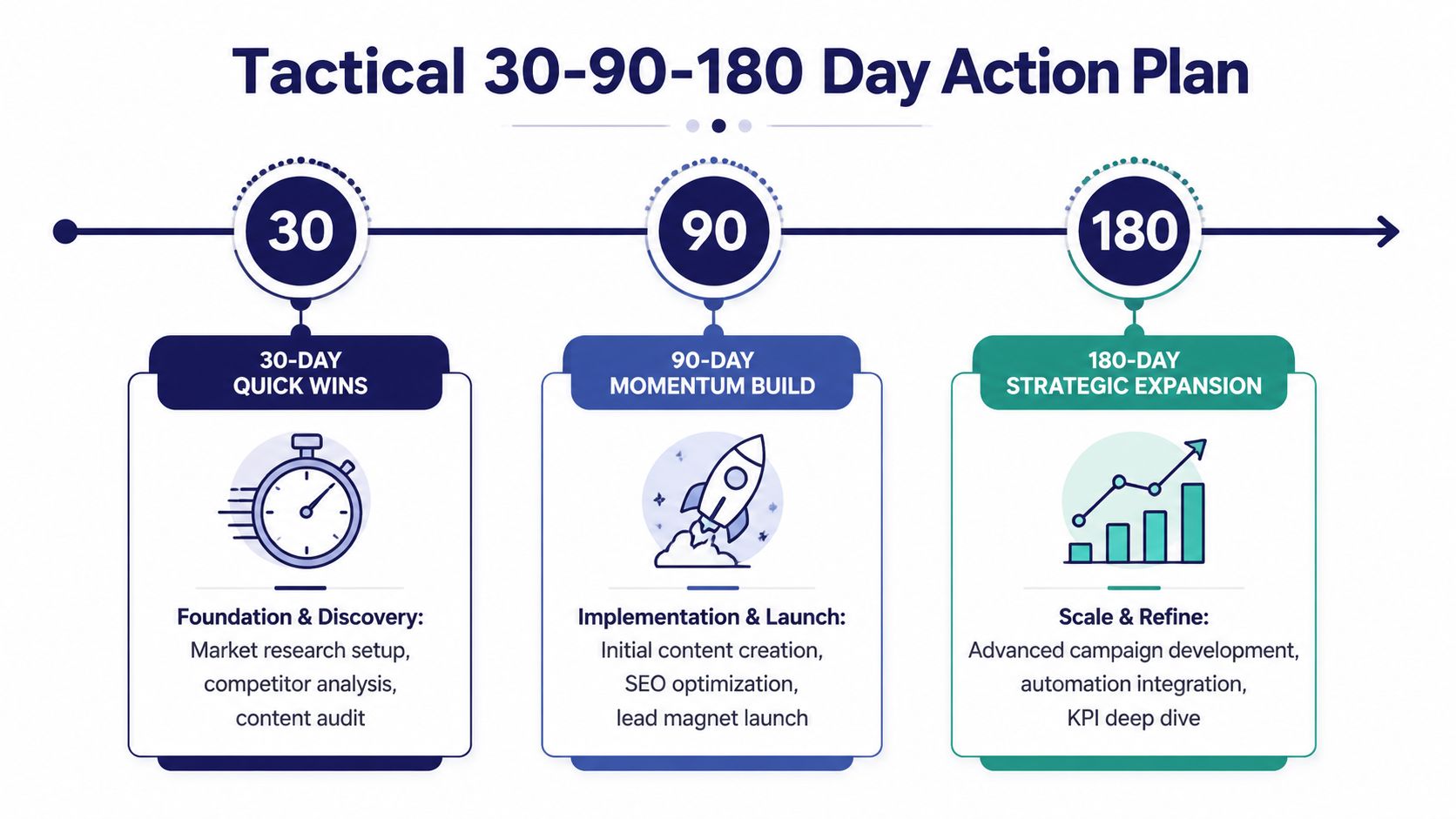
Strategy gets ignored when it doesn't translate into a build sequence. Industrial companies usually don't need a total reset. They need a phased implementation plan that fixes critical bottlenecks first.
First 30 days
The first month is for diagnosis, tracking, and basic conversion readiness.
Focus on these actions:
- Clarify the ICP: List your best-fit industries, applications, buyer roles, and sales triggers.
- Audit the website: Check page speed, mobile usability, form placement, CTA clarity, and technical page coverage.
- Clean CRM stages: Remove duplicates, define ownership, and standardize lifecycle labels.
- Install tracking: Make sure forms, calls, key pages, and campaign sources are being captured.
- Create one strong offer: Quote request, application review, demo, audit, or consultation.
Don't launch three campaigns yet. Launch one controlled path that you can monitor from click to sales response.
A good quick-win campaign could be paid search to a product or service page with a technical CTA, or LinkedIn traffic to an industry-specific landing page. If trade shows are part of your mix, make the offline and digital systems connect. For physical presence planning, teams often review examples of expo booths to think through how booth strategy, lead capture, and post-event follow-up should work together.
By 90 days
At this point, the foundation should support content and automation.
Build momentum with a tighter set of deliverables:
| Priority | What to build | Why it matters |
|---|---|---|
| Core pages | Industry, application, and product pages | Captures intent and improves qualification |
| Lead magnets | Spec sheets, buying guides, checklists, FAQs | Gives buyers a reason to convert |
| Email automation | Inquiry response, follow-up, nurture, reactivation | Prevents lead decay |
| Sales alerts | Notifications for high-intent actions | Helps sales respond with context |
Add two or three content assets that match recurring sales conversations. That might be a technical FAQ page, a use-case article, and one proof asset tied to a common objection.
Also tighten your response workflow. If a new inquiry comes in, who responds, how quickly, and with what information? Many industrial teams lose good leads because no one defined the handoff.
By 180 days
This phase is about scale and optimization, not random expansion.
Add the next layer carefully:
- Expand SEO clusters: Build supporting content around product families, applications, and common comparison searches.
- Improve segmentation: Separate automation by industry, persona, or product interest.
- Add retargeting and paid social: Use them to stay visible during long evaluation cycles.
- Refine sales enablement: Equip sales with objection-handling content and account activity context.
- Review pipeline data: Compare campaign sources against opportunity quality and deal progression.
Checkpoint: If six months of activity produced more names but not better opportunities, pause and inspect the qualification logic, message-market fit, and sales follow-up before spending more.
The 180-day mark is also the right time to review which tools still fit. Some companies outgrow spreadsheets and disconnected forms. Others discover they don't need a massive martech stack. They need a simpler system with clean data, basic automation, and discipline around follow-up.
That's the pattern worth keeping. Build only what your team can operate well.
Measuring What Matters Sample KPIs and Dashboards
A familiar failure mode looks like this. Marketing reports rising traffic, more form fills, and strong email engagement. Sales says the pipeline still feels thin, quote volume is flat, and the team is chasing buyers who were never a fit.
That gap usually comes from measuring activity instead of system output.

What to track instead of vanity metrics
In industrial marketing, reporting has one job. Help the team decide where to invest, what to fix, and what to stop. If a metric cannot support one of those decisions, it does not belong on the main dashboard.
The useful KPI set is tied to commercial performance: lead quality, conversion by stage, customer acquisition cost, sales-cycle length, pipeline contribution, and closed revenue by source. Attribution matters because industrial buyers do not convert in one visit. They move through multiple touches, often across technical pages, sales conversations, and follow-up sequences before a serious opportunity is created.
Track these five groups first:
- Lead quality: Which inquiries match your ideal customer profile, product fit, geography, and deal size?
- Stage conversion: How many raw leads become marketing-qualified leads, sales-qualified opportunities, quotes, and wins?
- Pipeline influence: Which channels, campaigns, and assets show up repeatedly in open and closed opportunities?
- Sales-cycle movement: Where do opportunities slow down, after first call, after engineering review, or after quote?
- Acquisition efficiency: What does it cost to generate a qualified opportunity and a closed customer by channel?
That last point is where weak reporting usually breaks. A campaign can produce cheap leads and still waste sales capacity. Industrial teams need to see cost per qualified opportunity, not just cost per conversion.
A simple dashboard structure
The dashboard does not need to be complicated. It needs to be consistent. A CRM report, a clean spreadsheet, or a reporting layer inside GoHighLevel can handle the job if source tracking, lifecycle stages, and ownership rules are set correctly.
A practical monthly dashboard has three layers.
Business outcomes
- New inquiries
- Qualified opportunities
- Quoted opportunities
- Closed customers
- Pipeline value created
Channel efficiency
- Organic search
- Paid search
- LinkedIn or paid social
- Referral or trade show
- Cost per qualified opportunity by channel
Content and campaign influence
- Top landing pages by qualified inquiry rate
- Resources downloaded before sales contact
- Pages viewed before inquiry
- Campaigns tied to open pipeline
- Email sequences that reactivated dormant leads
For teams building a better reporting model, this guide to what marketing analytics should tell you is a useful reference for attribution logic, definitions, and dashboard planning.
One caution from experience. Do not let the dashboard become a marketing-only artifact. Sales and marketing should review the same numbers, in the same system, with the same stage definitions. If marketing calls a contact qualified and sales treats it as noise, the KPI problem is not reporting. It is process design.
A good dashboard works like a control panel for the whole demand system. It shows whether traffic is turning into fit leads, whether automation is helping response speed, whether sales follow-up is converting interest into quotes, and whether the channels in your 30-90-180 day plan are producing pipeline worth scaling.
Industrial Marketing Strategy in Action
The framework becomes easier to apply when you look at real operating scenarios.
A CNC machine shop might struggle because the website speaks in broad manufacturing language while buyers search for specific capabilities. The fix is tighter application pages, technical articles on material and tolerance questions, and quote-request paths tied to those pages. Sales gets better-fit inquiries because marketing is attracting engineers with a real use case, not general traffic.
An OEM component manufacturer often has the opposite issue. The company already knows which accounts matter, but it isn't reaching the right people inside those organizations. Here the better strategy is account-focused LinkedIn targeting, landing pages built for procurement and engineering concerns, and CRM workflows that track engagement at the account level instead of treating each click as a separate event.
A custom automation integrator usually wins on complexity, but that value is hard to communicate quickly. Strong video walkthroughs, application pages by process type, and follow-up sequences tied to plant challenges can make the sales conversation shorter and more credible. Marketing's role isn't to oversimplify the work. It's to make the buyer confident enough to take the next step.
A regional industrial service company may rely heavily on referrals and trade events. That's workable until growth stalls. In that case, the practical move is to build local and industry-focused service pages, capture every inquiry in the CRM, automate follow-up, and use content that answers maintenance and response-time concerns before a prospect ever calls.
Different industrial businesses need different tactics. The underlying system stays the same. Define the right audience, build trust with technical content, connect your CRM and automation, and measure the parts that affect pipeline.
If you're ready to turn scattered marketing activity into a working growth system, Machine Marketing can help you diagnose the gaps, connect your tools, and build an industrial marketing strategy that supports real lead generation and sales follow-through.