You're probably in a familiar spot. The website is live. Someone is posting on LinkedIn now and then. You may have HubSpot, GoHighLevel, or another CRM in place. Sales is busy, but nobody agrees on which leads are worth pursuing, and when leadership asks what marketing is producing, the answer turns into a tour of activities instead of a view of pipeline.
That usually isn't a talent problem. It's a system problem.
For many manufacturers, the missing piece isn't another campaign or another tool. It's senior marketing leadership that can diagnose why the parts aren't working together, then build a revenue system that fits long buying cycles, technical products, distributor influence, and a sales process that doesn't move in a straight line. That's where a Fractional CMO for manufacturing becomes useful, especially if you need strategy and operating discipline without making a full executive hire.
Table of Contents
- Your Marketing Has Parts But Lacks a System
- What a Fractional CMO for Manufacturing Actually Does
- Why Machine and Component Manufacturers Hire a Fractional CMO
- Integrating a Fractional CMO with Sales CRM and GHL
- How to Hire the Right Fractional CMO
- Your First 90 Days A Sample Plan
- Proving ROI with Long Sales Cycles
Your Marketing Has Parts But Lacks a System
Many manufacturing companies already have the pieces. They have a website, trade show history, product sheets, a CRM, a sales team, and maybe an outside agency. What they don't have is a clear operating system that connects positioning, demand generation, qualification, follow-up, and reporting.
That gap shows up in predictable ways. Marketing celebrates form fills that sales ignores. Sales asks for better leads but can't define what “better” means in a way marketing can use. Product teams talk in specifications, while buyers need a mix of technical confidence, implementation clarity, and business justification.
The result is friction, not momentum.
A manufacturer can stay busy for a long time inside that kind of setup. Content gets published. Ads run. Emails go out. Trade shows get booked. But if nobody has mapped how a prospect moves from first touch to quote request to serious opportunity, activity piles up without creating a reliable pipeline.
Most manufacturing marketing underperforms because the company built functions, not a system.
That's the diagnosis. Tools are not the problem. Vendors are not always the problem either. The issue is that nobody is owning the full path from market message to sales outcome.
A Fractional CMO for manufacturing steps in at that level. The job isn't to become your newest campaign manager. The job is to decide what your market should hear, what sales needs to win, which channels deserve investment, how the CRM should reflect the buying process, and what success should look like before revenue closes.
If your current marketing feels disconnected, that's usually the signal. You don't need more motion. You need operating logic.
What a Fractional CMO for Manufacturing Actually Does
A manufacturer usually feels the need for this role at a specific moment. Trade shows still happen. Sales reps still quote. Marketing still publishes something every month. But leadership cannot answer basic operating questions with confidence: Which segments are producing real opportunities? Which messages are getting engineers to engage versus procurement to respond? Where are quote requests stalling between first inquiry and sales follow-up?
A fractional CMO answers those questions, then builds the operating system around them.
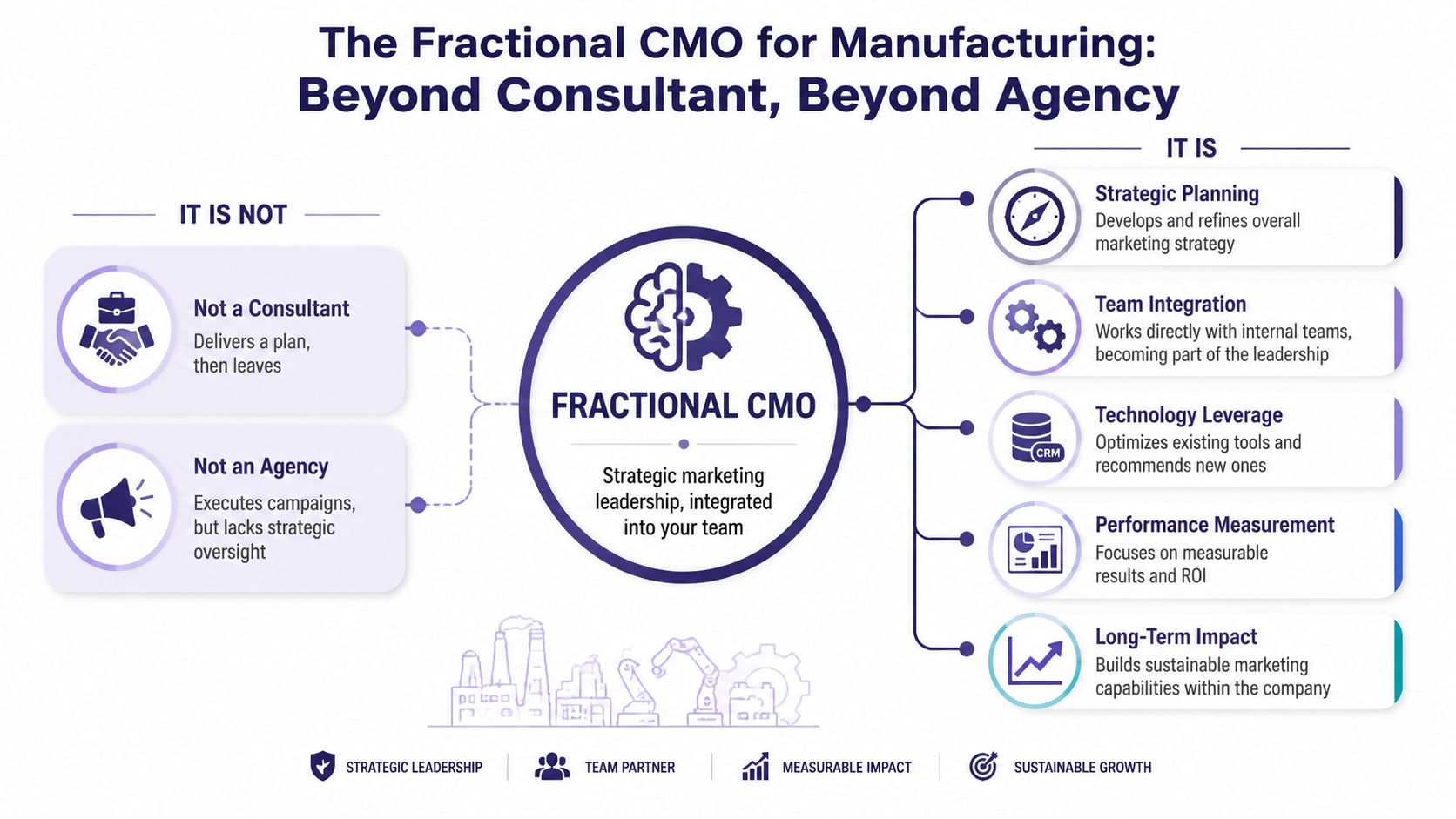
This role sits above campaign execution and inside business decisions. In manufacturing, that usually means working across sales, product, leadership, distributors, and outside vendors to make sure the company is pursuing the right buyers with the right message and a sales process that can be measured.
The practical work usually includes four responsibilities:
- Set commercial priorities: Define which verticals, applications, geographies, and buyer types deserve attention first. A precision machining shop should not market aerospace prototyping, medical production, and general industrial work with the same offer structure if margins, sales cycles, and qualification requirements are different.
- Sharpen the message for technical buying groups: Translate specs into buying language different stakeholders can use. Plant managers want uptime and implementation confidence. Engineers want tolerances, compatibility, and process fit. Procurement wants supply reliability and cost control.
- Align marketing with the sales path: Map how an inquiry becomes an MQL, how that becomes a qualified opportunity, who follows up, what content supports each stage, and where handoffs fail.
- Build measurement that fits long sales cycles: Set leading indicators that mean something before revenue closes. In manufacturing, that often includes qualified quote requests, target-account engagement, sales-accepted leads, distributor-sourced opportunities, meeting-to-opportunity rate, and pipeline by product line.
That last point is where many manufacturers get stuck.
If you sell custom equipment, components, or contract manufacturing services, revenue lags. A deal that starts with a downloaded spec sheet in Q1 may not close until Q3 or Q4. A fractional CMO puts interim scorecards in place so leadership can tell whether marketing is improving the sales pipeline before booked revenue shows up. Without that, teams either overreact to short-term lead volume or wait too long to fix a weak strategy.
In practice, I have seen this play out in predictable ways. A machine builder measures web form fills and thinks demand is healthy. Sales looks closer and finds that half the inquiries are students, low-fit distributors, or companies outside the service footprint. A fractional CMO fixes the form strategy, qualification rules, routing logic, follow-up timing, and reporting so the business tracks opportunities with purchase potential, not just names in a database.
Consultants can recommend. Agencies can execute campaigns. The fractional CMO owns prioritization, decision-making, and accountability across both. That includes deciding whether the problem is positioning, channel mix, CRM design, distributor enablement, trade show follow-up, or weak sales content for late-stage technical review.
Good fractional CMOs also reduce dependency over time. They install planning cadence, reporting standards, message architecture, and channel rules that an internal team can keep running. That may include a clearer thought-leadership plan for leadership and sales on LinkedIn. If your team needs a better publishing framework, this LinkedIn posting strategy is a useful example of how to structure it without turning subject-matter experts into full-time content creators.
The point is simple. A fractional CMO is responsible for turning scattered marketing activity into a managed commercial system, then proving progress with metrics that make sense for industrial buying cycles.
Why Machine and Component Manufacturers Hire a Fractional CMO
General B2B marketing advice breaks down fast in industrial settings. The buying path is usually technical, crowded with stakeholders, and slowed by operational risk. Engineers, plant leaders, procurement, finance, distributors, and executives often look at the same purchase through different lenses.
A Fractional CMO for manufacturing is useful because the role starts with diagnosis, not promotion. In manufacturing, early work often includes 10 to 15 customer interviews, 5 to 10 distributor interviews, sales-call observation, website and trade-show ROI audits, and a written strategy that translates technical features into channel-specific buying language, as described in OtreNix's overview of the role in manufacturing companies.
Machine builders need message control across a long decision path
Machine manufacturers usually have a message problem before they have a lead problem.
The engineering team talks about tolerances, controls, throughput, footprint, materials, or integration. Prospects may care about those details, but they also want to know what changes on the line, how risky the install will be, who else needs to approve the project, and whether the supplier will support them after purchase.
A strong fractional CMO fixes that translation layer. They help the company create different sales tools for different roles:
- For engineers: detailed spec content, integration guidance, performance claims framed carefully, and application-specific education
- For plant or operations leaders: implementation process, downtime concerns, training requirements, and operational fit
- For financial buyers: cost justification, risk reduction, replacement timing, and business impact narratives
- For sales reps: usable talk tracks, objection handling, and follow-up content tied to the actual buying sequence
That work usually improves lead quality more than a fresh ad campaign does.
Component manufacturers need channel and sales alignment
Component companies often face a different challenge. They may sell through distributors, reps, OEM relationships, or layered channels where the end user isn't always the direct buyer. In that environment, demand generation alone doesn't solve much if the channel can't carry the message forward.
A fractional CMO helps by tightening the whole revenue system:
- Clarify the ideal customer profile so sales and marketing stop chasing every inquiry that vaguely fits the product.
- Sort messaging by audience because distributors, design engineers, and procurement teams don't respond to the same proof.
- Create a nurture path for inquiries that are real but not yet ready.
- Arm the sales team with content they'll use, not generic brochures that stay in a shared drive.
What doesn't work is treating manufacturing like a short-cycle transactional business. More top-of-funnel volume can create more waste if qualification logic, channel communication, and sales follow-up aren't fixed first.
That's why these companies hire the role. Not to “do more marketing,” but to make marketing and sales behave like one commercial system.
Integrating a Fractional CMO with Sales CRM and GHL
A fractional CMO becomes valuable fast when they work inside the sales process instead of orbiting around it. In manufacturing, that means they need access to call notes, quote stages, lost-deal reasons, and the language sales uses with buyers.
Early in the engagement, the integration usually starts with the process map.
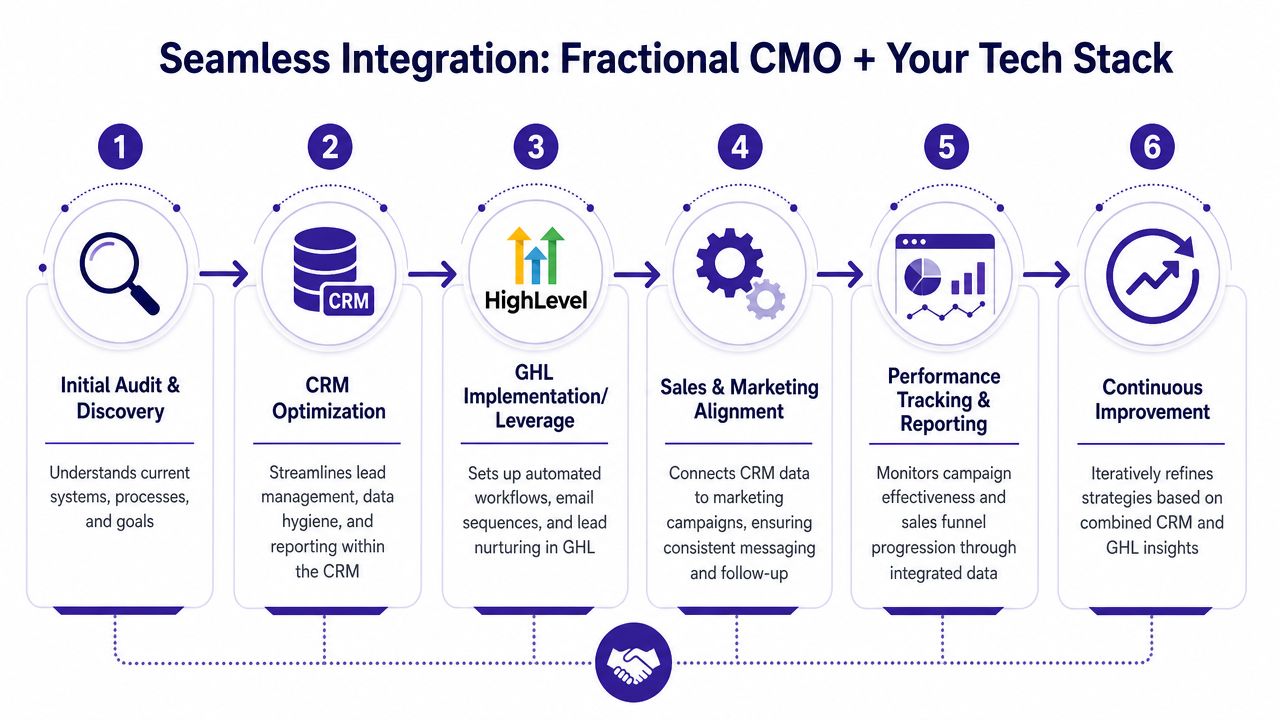
Sales alignment happens in the field and in the CRM
If marketing says a lead is qualified and sales says it isn't, the CRM should show why. A good fractional CMO doesn't solve that with opinion. They solve it by defining stages, required fields, acceptance criteria, and feedback loops.
The work often includes:
- Joining sales conversations: Sitting in on calls or reviewing recordings to hear objections, buying triggers, and the questions that repeat.
- Cleaning stage definitions: Making sure “lead,” “opportunity,” and “quote” mean the same thing to everyone.
- Improving handoff rules: Deciding when marketing owns the contact, when sales owns it, and what happens if the prospect goes quiet.
- Capturing loss reasons: If deals stall because of price, timing, missing spec alignment, or no urgency, the CRM needs to reflect that clearly.
When sales and marketing argue about lead quality, the process is usually undocumented or the CRM is too loose to reveal the truth.
A manufacturer using HubSpot or GHL should be able to answer basic questions quickly. Which inquiries fit the ideal customer profile? Which source types become real opportunities? Where do technical buyers stall? Which follow-up sequences support the sales cycle, and which ones produce noise?
GHL and HubSpot should run the process, not just store contacts
Most manufacturing companies underuse their CRM. They treat it like a database when it should act more like an operating platform.
That means the fractional CMO should be involved in workflow design, not just dashboard review. In GoHighLevel, that may include automated nurture paths, quote follow-up reminders, segmented email sequences, and internal alerts based on stage movement. In HubSpot, it may include lifecycle logic, lead routing, content engagement tracking, and reporting views by segment or rep.
This practical walkthrough of GoHighLevel for manufacturers is useful if you're evaluating how GHL fits into an industrial sales environment.
A short overview helps frame the integration work before deeper process design:
The key is behavior, not software. If reps don't trust the stages, if marketing can't segment properly, or if leadership can't see movement by account type, the platform won't help. The fractional CMO's job is to make the tech reflect the actual buying journey, then make the team use it consistently.
How to Hire the Right Fractional CMO
A manufacturing company usually decides to hire a fractional CMO after trying a little of everything. The website has been updated. A few campaigns have run. The CRM exists, but sales does not trust the stages, leadership cannot tie activity to pipeline, and marketing reports still stop at traffic, clicks, or form fills.
That is the hiring context that matters. You are not hiring for ideas alone. You are hiring for commercial control. The right fractional CMO brings structure to a long sales cycle and gives leadership a way to judge progress before closed revenue shows up six to twelve months later.
What to look for before you sign
Start by testing whether the candidate can diagnose a manufacturing growth problem in business terms.
A strong operator asks how deals move from inquiry to quote, where technical buyers stall, how reps qualify fit, and which segments deserve attention first. They want to know whether growth depends on OEM accounts, distributors, plant-level retrofits, replacement parts, or a mix of all four. That line of questioning matters because each path needs different messaging, follow-up, and measurement.
Look for these signs:
- They diagnose before recommending channels: If the conversation jumps straight to SEO, paid media, or a rebrand, you are hearing tactics without a system.
- They can turn product complexity into buyer clarity: A good fractional CMO can explain the difference between features that impress engineers and proof points that help a plant manager or procurement team approve the purchase.
- They have worked across sales, leadership, and operations: In manufacturing, marketing problems often start with messy handoffs, weak qualification, or unclear ownership. The person you hire needs to fix those issues, not work around them.
- They understand capacity constraints: There is no value in generating demand your quoting process cannot support, or in pushing a distributor strategy that conflicts with your direct sales motion.
- They talk about measurement in stages: Long-cycle manufacturing marketing needs early indicators tied to the sales process, not a vague promise of more leads.
A useful comparison is whether you need strategic leadership or a narrower advisor. If you are still sorting that out, this breakdown of small business digital marketing consultants helps clarify where consulting ends and ongoing commercial leadership begins.
Questions that reveal whether they can lead
The interview should pressure test judgment. Generic brand questions will not tell you much.
Ask questions that force the candidate to work inside your sales reality:
How would you assess our first 90 days?
Strong candidates talk about interviews, funnel review, CRM stage definitions, message gaps, and handoff problems. They do not pitch a prebuilt campaign calendar.How do you measure success before revenue closes?
Look for answers tied to leading indicators such as qualified inquiry rate, quote-to-opportunity conversion, sales acceptance, nurture engagement by segment, and stage progression over time.What would you change first if sales says our leads are weak?
Good answers usually involve lead definitions, source quality, follow-up speed, CRM evidence, and segment-level analysis. Weak answers stay at the level of “better alignment.”What should leadership expect to see in the CRM after the first month?
The right candidate should describe cleaner lifecycle stages, clearer attribution rules, agreed definitions, and reporting that shows movement, not just contact volume.Tell me about a manufacturing company that had marketing activity but no operating system. What did you fix first?
This question exposes whether they have done the work or just learned the language.
One interview cue matters more than people admit. The right person usually makes your own business easier to understand while they are still in the room.
Common Fractional CMO Pricing Models
| Model | Typical Cost | Best For |
|---|---|---|
| Monthly retainer | Often priced in the mid to upper four figures or more per month, depending on scope and involvement | Ongoing leadership, sales and marketing alignment, KPI management, and system design |
| Project-based fee | Varies by scope | A defined strategy build, messaging reset, funnel audit, or CRM redesign |
| Hybrid model | Usually combines a monthly leadership fee with a one-time implementation scope | Companies that need recurring oversight plus a major buildout |
Do not hire on price first. Hire on fit with the problem.
If your issue is weak positioning, poor funnel definitions, and no agreed way to measure progress across a nine-month sales cycle, a low-cost generalist will create expensive confusion. If your team already has a strong strategy and only needs campaign execution, a senior fractional CMO may be more firepower than you need. The right hire matches the level of commercial complexity, the pace of change your team can absorb, and the reporting discipline leadership expects.
Your First 90 Days A Sample Plan
A good start looks less like a campaign launch and more like an operational diagnosis. In manufacturing, the first phase should slow things down enough to identify where revenue leakage is happening, then speed up the right parts.
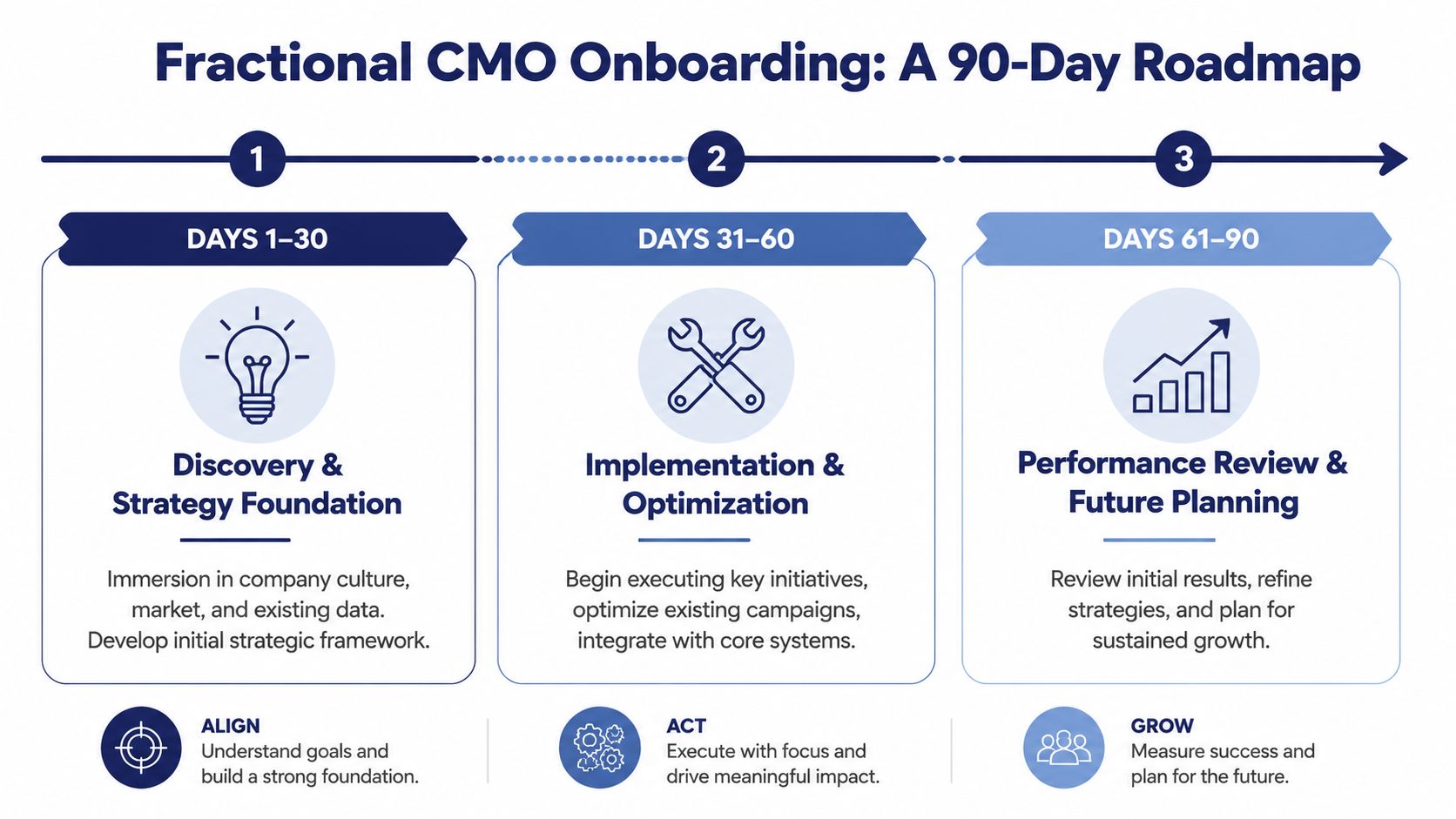
Days 1 to 30
The first month is about immersion.
A capable fractional CMO will review your current website, CRM setup, sales materials, lead sources, and reporting habits. They'll also spend time with leadership and sales to understand how the company describes its value internally versus how prospects make purchases.
Typical outputs in this phase include:
- Customer and market insight: Interviews, voice-of-customer notes, and a clearer picture of who influences the deal.
- Commercial process review: A map of the funnel from inquiry to quote to opportunity.
- Initial KPI framework: Early agreement on what should be measured before closed revenue shows up.
Days 31 to 60
The second month should produce structure.
Positioning gets sharper, CRM stages tighten, nurture logic begins to take shape, and content priorities become more practical. A machine builder may need separate sales assets for engineers, plant managers, and procurement. A component supplier may need distributor-ready messaging and cleaner follow-up paths for spec-driven inquiries.
At this point, the company should have a written strategy, not just a collection of observations.
That strategy usually includes channel priorities, audience messaging, content gaps, campaign sequencing, and ownership by function. If implementation support is needed, companies often pair the fractional CMO with internal staff, specialist freelancers, agency partners, or a manufacturing-focused consultancy such as Machine Marketing for execution in areas like CRM workflow setup, content production, or industrial SEO.
Days 61 to 90
The third month is where the system starts behaving differently.
Campaigns may launch, but the bigger sign of progress is operational. Sales should have better visibility. Marketing should know what counts as a qualified response. Leadership should see a reporting cadence that ties activity to account quality and opportunity movement.
A healthy 90-day outcome often looks like this:
- Shared definitions: Marketing and sales use the same language for stages and lead quality.
- Better enablement: Reps have materials that support real objections and buying questions.
- Cleaner reporting: Leadership can see whether the process is improving, even before deals close.
- A next-quarter plan: The company knows what to optimize next instead of guessing each month.
The first 90 days shouldn't promise miracles. They should establish control.
Proving ROI with Long Sales Cycles
This is the question that matters most. If your buyers take months to decide, how do you know the fractional CMO is working before the purchase order arrives?
The answer is to stop treating closed revenue as the only valid signal. In manufacturing, the primary challenge is the measurement gap between early progress and lagging revenue. Manufacturers need a bridge between indicators like ICP fit, sales acceptance, content engagement by role, quote requests, and pipeline velocity and the eventual business outcome, as discussed in RHBLAKE's perspective on defining success for a fractional CMO in manufacturing.
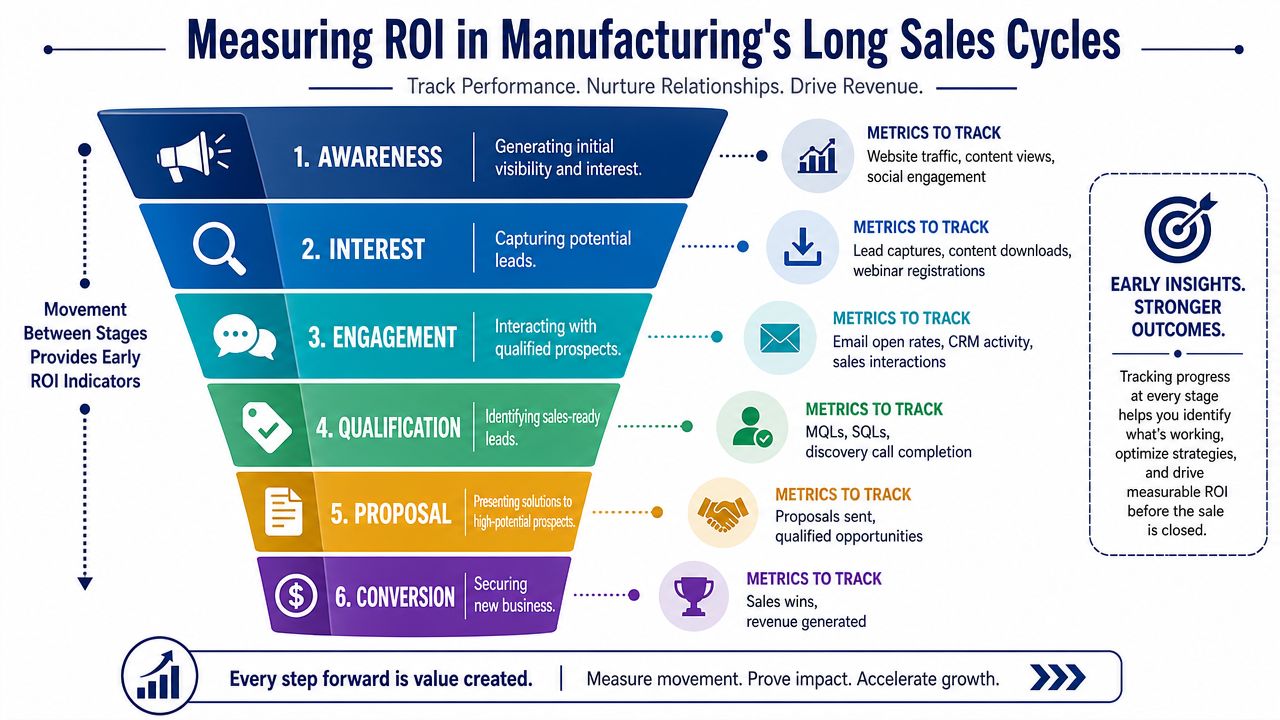
What to measure before revenue lands
If you only ask whether marketing created sales this quarter, you'll misread the role.
A better scorecard looks at whether the system is creating more qualified commercial movement. For example:
- ICP fit is improving: More inquiries match the accounts, applications, and buyer profiles you want.
- Sales acceptance is rising: Reps are engaging with inbound and campaign-generated leads instead of dismissing them.
- Role-based engagement is clearer: Engineers consume technical material, while business stakeholders engage with implementation and value content.
- Quote requests are becoming more relevant: Fewer dead-end inquiries. More requests that can move toward serious evaluation.
- Pipeline velocity is healthier: Deals are moving with less confusion and fewer preventable stalls.
A practical reporting view
A machine manufacturer may not close a complex deal for a long time, but leadership can still see whether the system is improving. If target accounts are engaging, qualified conversations are increasing, quote activity is cleaner, and opportunities are moving with more discipline, that's early evidence the commercial engine is getting stronger.
Attribution helps here, but only if you use it carefully. Manufacturing buyers rarely convert because of one touch. A practical framework like this 2026 guide to marketing attribution can help leadership think beyond first-click reporting and evaluate how different touches contribute across a longer decision cycle.
For a deeper look at industrial measurement discipline, this article on marketing ROI for manufacturers is a useful companion.
The right question isn't “Did marketing create revenue instantly?” It's “Did the system produce stronger opportunities and move them forward with less waste?”
That's how a Fractional CMO for manufacturing should be judged.
If your company has the tools, the team, and the activity but still lacks a working growth system, Machine Marketing can help you diagnose where the breakdown is and define what a practical next step looks like.