If you're a machine manufacturer, there's a good chance your digital presence looks busy on the surface but disconnected underneath. You may have a website, a LinkedIn page, a few directory listings, maybe even some paid traffic. But when you ask a simple business question like, "Which digital channels are producing qualified RFQs?" the answer gets fuzzy fast.
That's the core problem. A strong machine manufacturer digital presence isn't a collection of marketing tactics. It's an integrated system that helps engineers find technical information, helps buyers validate fit, and helps your sales team see what drives revenue. By 2025, Gartner predicts that 80% of B2B sales interactions will occur exclusively through digital channels, which means your digital presence has moved from support function to primary buying environment, as noted in Lform's summary of Gartner's projection.
Table of Contents
- Diagnose Before You Build Your Digital Presence Audit
- Build Your Digital Foundation on Solid Ground
- Install Your Lead Management System
- Fuel Your Engine with Targeted Content and Outreach
- Measure Twice Cut Once with Performance KPIs
Diagnose Before You Build Your Digital Presence Audit
Most manufacturers skip diagnosis because redesign work feels more tangible. New pages, new branding, new ad campaigns. But if the underlying system is weak, you end up polishing a workflow that still leaks leads.
Think of your audit the same way you'd inspect a production line. You don't ask whether the machine "looks modern." You ask whether it runs predictably, where it jams, and what inputs produce bad outputs. The same standard should apply to your digital presence.
Start with buyer friction
Open your site on a phone and act like a plant engineer who has two minutes between meetings. Can you find product specs quickly? Can you tell what industries you serve? Can you get from capability page to RFQ form without guessing where to click?
Then test it from the purchasing side. If someone needs a spec sheet, certification document, material detail, or CAD file, how many steps does it take? If the answer is "they need to call us," your site is creating work for the buyer instead of removing it.
Practical rule: If a qualified prospect can't confirm fit and next steps in a few clicks, your site is slowing down sales before your team ever gets involved.
Audit the system not just the homepage
A useful audit checks the full path from visibility to inquiry to follow-up. That's where many manufacturers discover the gap isn't traffic. It's missing structure.
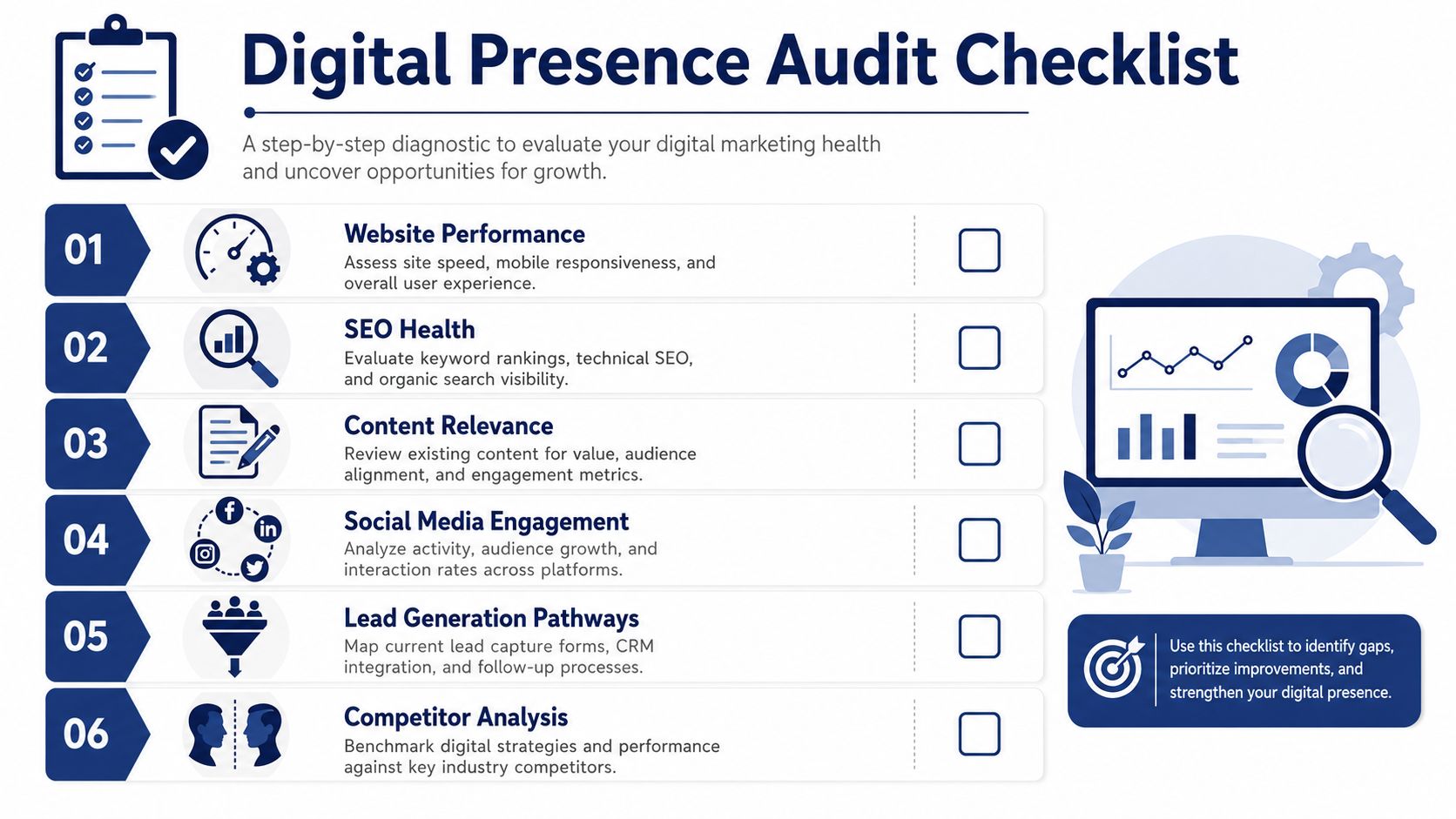
Use this checklist:
- Website performance: Review load speed, mobile usability, navigation clarity, and whether key technical pages are easy to reach.
- Search visibility: Search the capability terms, machine types, and industry phrases your buyers use. Look at what appears, what doesn't, and whether your pages match the search intent.
- Content usefulness: Check whether your content answers real technical questions or just describes the company in generic language.
- Social proof and platform presence: Review whether your LinkedIn company page, directory profiles, and other public listings reinforce the same message as the website.
- Lead capture flow: Test every form, CTA, and conversion path. Make sure submissions reach the right people and include enough detail for qualification.
- Attribution basics: Identify where current leads came from. If your team can't tell, note that as a systems issue, not just a reporting issue.
For a quick outside framework, this digital presence audit for small businesses is a useful starting point. The categories are broad, but the structure helps teams spot obvious gaps before they spend money on execution.
A machine manufacturer digital presence audit should also compare channels against buying-stage intent. A homepage visit isn't the same as a visit to a product detail page, and a specs download isn't the same as an RFQ. That's why generic traffic reports rarely help leadership make decisions.
If you need a reference point for how these pieces connect inside industrial marketing, digital marketing for manufacturers is one example of the broader system view. The key is to leave the audit with a prioritized list: what blocks buyers, what hides your expertise, and what prevents sales from trusting the data.
Build Your Digital Foundation on Solid Ground
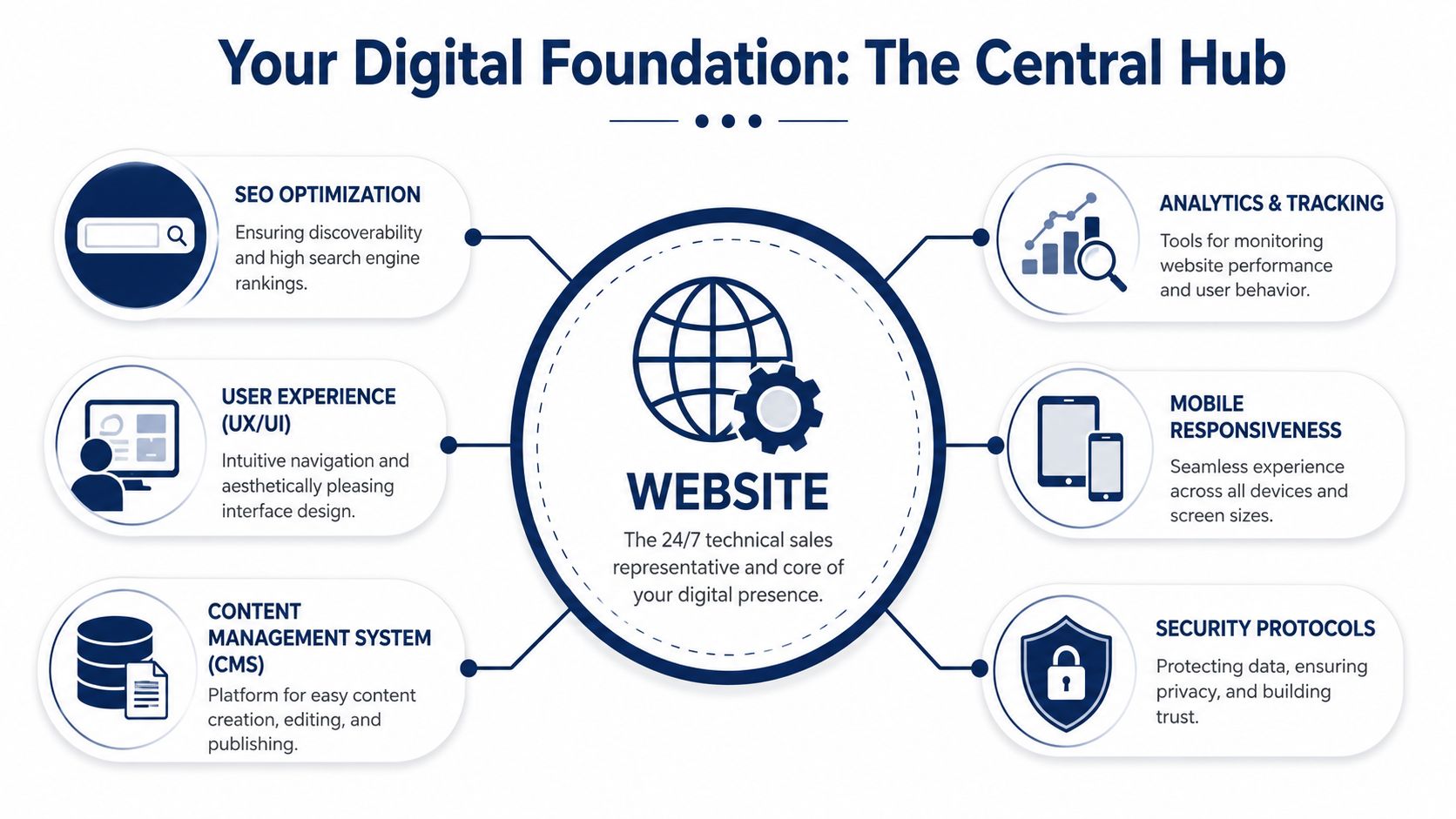
A manufacturer website shouldn't behave like a digital brochure. It should behave like a technical sales tool. That means it has to support discovery, qualification, and action without forcing every serious buyer into an early phone call.
When industrial sites underperform, the issue usually isn't visual design alone. The issue is structural. Buyers arrive with a specific question, but the site answers with vague marketing language, weak navigation, and a contact page that appears too early in the journey.
Treat the site like a technical sales environment
Engineers and procurement teams don't visit your site for inspiration. They visit to reduce uncertainty. They want to know whether you can make the part, support the tolerances, meet the application, and respond like a credible supplier.
That changes what belongs on the site:
- Capability pages: Separate pages for machining processes, equipment classes, materials, industries served, and part complexity.
- Technical detail: Specs, dimensional constraints, tolerances, certifications, file downloads, and process notes.
- Conversion paths: RFQ forms, engineering inquiry options, file upload workflows, and clear calls to action tied to buyer intent.
- Trust signals: Quality standards, facility information, application examples, and content that shows your team understands the work.
Buyers don't need more adjectives. They need enough evidence to decide whether contacting you is worth their time.
Use a layered architecture
A useful method for industrial sites is to organize them into three layers: a fast public-facing discovery layer, a reporting and analytics layer, and a contextual decision layer that maps machine-level or product-level data into business meaning, as explained in this manufacturing analytics discussion on YouTube; accurate data isn't enough. If the site and reporting environment don't translate technical detail into useful buying context, your team ends up with information that looks precise but isn't actionable.
In practice, the layers look like this:
| Layer | What it does | What usually goes wrong |
|---|---|---|
| Discovery layer | Helps buyers find you through search, directories, and capability-focused pages | Slow pages, generic copy, unclear navigation |
| Contextual decision layer | Helps engineers and buyers evaluate fit through detailed technical content | Missing specs, buried files, no application context |
| Reporting layer | Shows how visitors move, convert, and drop off | Data exists but doesn't connect to sales questions |
Architecture takes precedence over aesthetics. A polished homepage won't fix a site where visitors can't move from search intent to a useful detail page.
What solid ground looks like
The strongest manufacturer sites tend to share a few traits:
- They map pages to real buyer tasks. A visitor looking for horizontal machining capability shouldn't have to read a company history page first.
- They separate broad and deep content. Introductory capability pages attract discovery traffic. Technical subpages help serious prospects qualify themselves.
- They keep the path short. Search result to service page to technical validation to RFQ should feel direct.
- They measure behavior by page type. Teams should know which capability pages bring inquiries and which pages lose people.
Industry guidance from Thomas points out that a high-performing manufacturer website needs specs, configuration functionality where applicable, technical assets such as 3D files and whitepapers, and conversion-focused calls to action. That same guidance also warns against weak information architecture that prevents visitors from moving from search intent to specification detail to contact action in a few steps, as described in this guide to building a strong digital presence for manufacturers.
If you're planning a rebuild, resist the urge to start with menus and mockups. Start with buyer pathways, page purpose, and reporting requirements. That's the difference between a website that looks current and one that supports revenue. For a closer look at that approach in practice, manufacturing website that generates leads is a relevant reference.
Install Your Lead Management System
A prospect submits an RFQ at 4:37 p.m. for a machine your team can build. The form goes to a shared inbox. Sales is on the road. Engineering sees it the next morning, asks for missing details, and the buyer has already sent the same request to two competitors.
That is not a traffic problem. It is a system problem.
Manufacturers usually feel this gap after they have already invested in the website. Pages rank. Forms come in. Then the handoff breaks. If inquiry capture, qualification, routing, and follow-up live in separate tools or in email, website activity never turns into a reliable pipeline. You get anecdotes instead of attribution, and response time varies by whoever happened to check their inbox first.
What breaks when lead handling is manual
Manual lead handling creates two expensive failures.
First, response quality drops. Industrial inquiries often need more than a quick reply. Someone has to verify fit, review the application, confirm timing, and decide whether the request belongs with sales, estimating, or engineering. Without a defined workflow, those steps happen in a different order every time.
Second, visibility disappears. A team cannot improve lead generation if it cannot trace what produced qualified RFQs in the first place. If source, page path, campaign, and inquiry type are missing from the record, marketing reports on traffic while sales reports on quotes, and nobody can connect the two.
A CRM should close that gap. It should connect the first visit, the form submission, the qualification decision, the quote, and the sales outcome in one record. That is the difference between running campaigns and building a system that shows which digital inputs create real revenue. For manufacturers evaluating that setup, this guide to CRM for manufacturing companies is a useful reference.
What your lead system needs to do
The goal is not more software. The goal is controlled lead flow.
A workable system should include:
- Central capture: Website forms, quote requests, downloads, chat inquiries, and campaign responses should enter one database.
- Qualification fields: Ask for the details your team uses to assess fit, such as application, volume, timeline, part or machine type, and location.
- Automated routing: Send each inquiry to the right owner based on product line, territory, account type, or technical complexity.
- Task and follow-up rules: Create reminders, status changes, and reply sequences so leads do not stall after the first touch.
- Pipeline stages: Track a lead from new inquiry to qualified, quoted, active, won, or lost, with clear ownership at each stage.
- Source tracking: Preserve UTM data, landing page history, and campaign context so closed deals can be traced back to the channel that started them.
One practical rule helps here. If a salesperson has to search through email to answer where a lead came from, who owns it, or what happens next, the system is incomplete.
GoHighLevel is one option for teams that want forms, automation, CRM, and campaign tracking in one place. Other manufacturers prefer a separate CRM, form tool, and marketing platform tied together with clean field mapping. Both approaches can work. The trade-off is usually simplicity versus flexibility. An all-in-one setup is easier to manage. A modular stack can fit complex sales processes better, but only if someone owns the integration and keeps attribution intact.
Machine Marketing also offers CRM support for manufacturers as part of a broader operating model. The useful question is not which platform sounds best. The useful question is whether your process can turn website interest into qualified RFQs, then show which channels, pages, and campaigns produced customers instead of just inquiries.
Fuel Your Engine with Targeted Content and Outreach
Content works for manufacturers when it behaves like pre-sales support. It fails when it behaves like general brand filler. If your content doesn't help an engineer evaluate fit or help a buyer reduce supplier risk, it won't contribute much to pipeline.
That doesn't mean every piece has to be highly technical. It means every piece should serve a job in the buying process.

Create content that helps a technical buyer move forward
Start with the questions your sales and engineering teams hear repeatedly. Those questions are usually better content inputs than keyword tools alone.
Useful content types include:
- Application notes: Explain where a machine, process, or component performs well and where it doesn't.
- Comparison pages: Help buyers compare options, machine classes, tolerances, or production approaches.
- Project showcases: Show the problem, constraints, approach, and outcome without turning the page into a vague testimonial.
- Technical FAQs: Answer practical questions about materials, lead times, file requirements, production limits, or quality processes.
- Resource pages: Group whitepapers, drawings, spec sheets, and other assets by topic so buyers can self-serve.
One of the most common problems on industrial websites is generic content that says a company is committed to quality and service. Every competitor says that. A more useful page says what machines you run, what industries you support, what tolerances you regularly handle, and what information a buyer should include in an RFQ.
Good industrial content doesn't chase clicks first. It reduces friction first.
Use distribution channels that fit industrial buying behavior
Distribution matters because strong content hidden on your website won't do much on its own. Manufacturers need a practical mix of owned, listed, and shared channels.
Here's a simple view:
| Channel | Best use | Common mistake |
|---|---|---|
| Website blog and resource center | Depth, search visibility, technical education | Publishing broad thought pieces with no buying relevance |
| Industry listings and directories | Discovery and validation | Incomplete profiles and inconsistent capability descriptions |
| Authority, recruiting, relationship building | Posting company news only | |
| Email outreach and nurture | Follow-up, re-engagement, content distribution | Sending the same message to every contact |
As early as 2016, 97% of Fortune 500 companies were active on LinkedIn, according to Statista's business digitization coverage. For machine manufacturers, that matters less as a consumer-style social benchmark and more as proof that digital presence on professional platforms is part of mainstream B2B communication, recruiting, and authority building.
A simple LinkedIn post can work if it points to something specific. A short breakdown of a machining challenge. A photo sequence showing fixture design considerations. A note on how to prepare files for quoting. That's more useful than another culture post with no operational takeaway.
If you'd like a practical example of how others think through manufacturer visibility and online self-service, this video is worth a look:
The strongest content programs usually feel less like publishing calendars and more like knowledge systems. They package what your team already knows into formats buyers can find, understand, and act on.
Measure Twice Cut Once with Performance KPIs
Many machine manufacturer digital presence efforts encounter a common stumbling block. Traffic goes up, impressions increase, maybe form fills improve. But leadership still can't tell whether the digital program is producing qualified demand or just more activity.
The missing piece is attribution infrastructure. For machine manufacturers, the highest-ROI improvement is often better lead qualification and attribution systems, because digital technologies create value when teams integrate data across functions instead of chasing isolated top-of-funnel metrics, as discussed in this analysis of machinery manufacturing digital marketing.
Track the path from visit to qualified RFQ
If you only measure sessions, clicks, and general lead volume, you'll overvalue noisy channels and undervalue channels that bring serious buyers. Industrial sales cycles are too long and too complex for that.
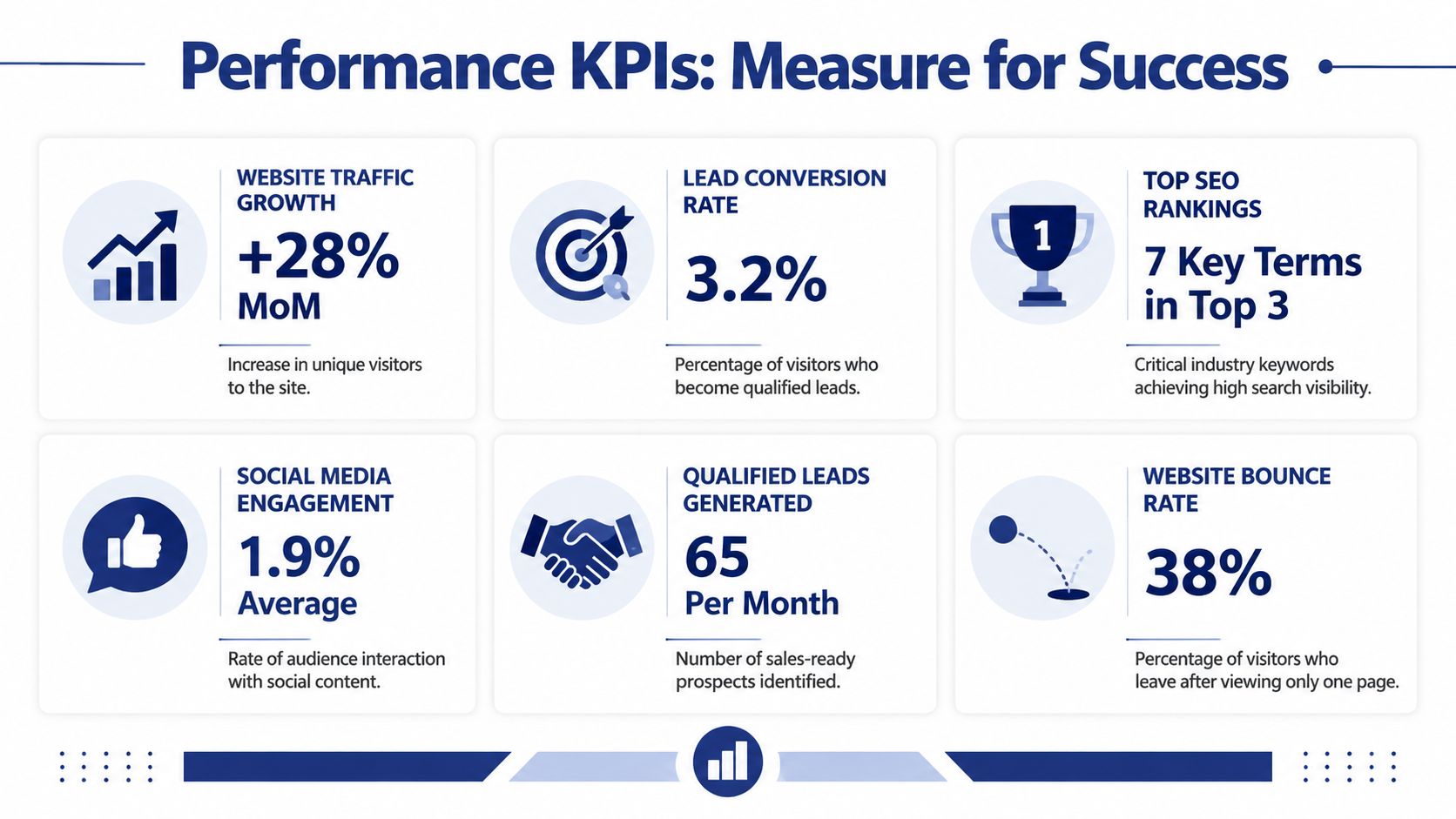
A better KPI set follows the buying path:
- Channel-to-inquiry quality: Which sources produce inquiries that fit your capabilities?
- Landing page to conversion path: Which pages start sales conversations?
- Lead qualification status: How many inquiries become real opportunities?
- Sales progression by source: Which channels create opportunities that continue moving?
- Closed-loop feedback: What patterns appear in won, stalled, and disqualified deals?
Notice what's different here. The emphasis isn't on more traffic. It's on whether traffic converts into the right type of conversation.
If your dashboard can't separate a student download, a vendor solicitation, and a serious RFQ, it isn't helping you make budget decisions.
Build a dashboard your sales team will trust
A useful dashboard isn't a marketing report dressed up with charts. It combines website analytics, CRM stages, source data, and sales feedback in one view.
That dashboard should answer practical questions:
- Which channels start qualified conversations?
- Which pages influence RFQs most often?
- Where do good leads stall?
- What content supports later-stage movement?
- Which campaigns bring visibility but no pipeline?
The review rhythm matters too. Monthly reporting helps teams catch operational issues like broken forms, weak response times, or drop-offs on high-intent pages. Quarterly review is better for bigger decisions like content priorities, campaign spend, or whether a capability area deserves its own landing-page cluster.
You don't need perfect attribution on day one. You do need consistency. Standardize source naming, define what "qualified" means, and require feedback from sales. Without those basics, even expensive tools won't produce trustworthy insight.
The goal isn't to create more reports. The goal is to make better decisions with less guessing.
If your digital presence looks active but doesn't give you a clear line from traffic to qualified RFQs, Machine Marketing can help you diagnose the gaps and build a system that connects website structure, content, CRM workflows, and attribution into something your sales team can effectively use.